The AI Accent Problem: Why ChatGPT Is Turning the Internet Into One Giant Writer in 2026
Highlights
- AI is teaching millions of people similar writing patterns.
- Content is becoming easier to create but harder to distinguish.
- The AI accent affects humans as well as AI-generated text.
- Readers increasingly value originality and voice.
- Distinctiveness is becoming a competitive advantage.
- Human refinement helps break away from AI sameness.
I started noticing the pattern in places where writing was supposed to feel personal.
LinkedIn posts from unrelated founders sounded like they had the same strategist behind them. Student essays had the same polished hesitation. SaaS blog introductions opened with the same broad framing. Freelance pitches used the same confident-but-generic rhythm. Even casual newsletters started carrying the same smooth, slightly over-explained texture.
The strange part was that none of it sounded obviously bad. Most of it was clean. Clear. Grammatically correct. Easy enough to skim. But after a while, the writing began to feel like it came from one enormous shared voice.
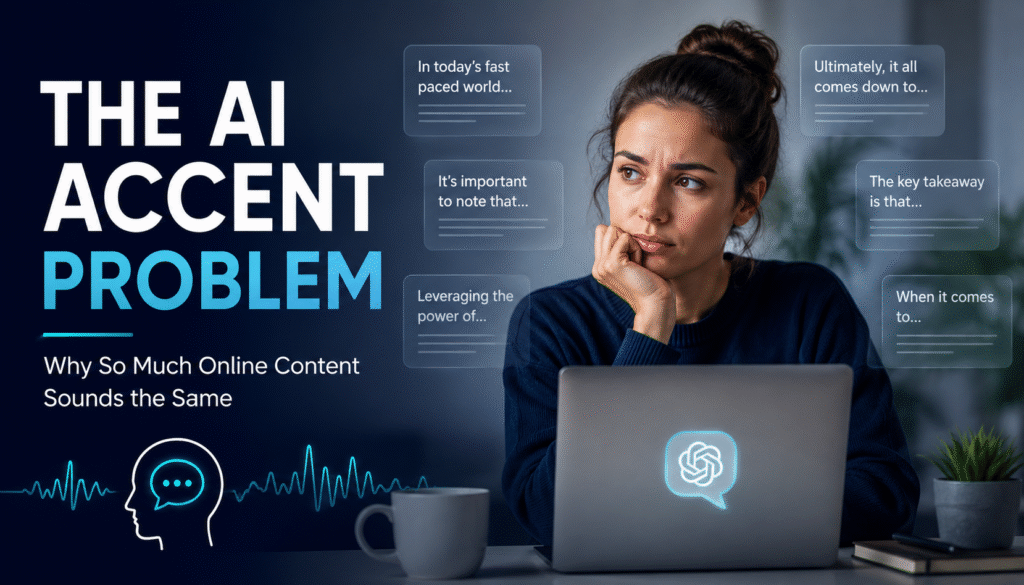
This is the AI accent problem. ChatGPT did not just help people write faster. It started teaching millions of people to phrase ideas with the same rhythm, the same structure, the same transitions, and the same safe emotional temperature.
That is why the issue is bigger than AI detection. A detector can tell you whether something might have been generated by a model. Readers sense something different. They notice when a paragraph feels strangely familiar, even if the topic is new.
The danger is not that AI writing sounds robotic anymore. The danger is that AI writing now sounds professionally acceptable in the exact same way everywhere.
The AI Accent Problem: Why ChatGPT Is Turning the Internet Into One Giant Writer
| AI Accent Signal | What It Looks Like | Why Readers Notice |
|---|---|---|
| Shared Rhythm | Paragraphs open broadly, build evenly, and end with a neat summary line. | The writing feels too balanced, like every idea has been sanded into the same shape. |
| Safe Phrasing | Words like “crucial,” “important,” “in today’s landscape,” and “it’s not just X, it’s Y” appear repeatedly. | The language feels polished but oddly interchangeable across industries. |
| Generic Specificity | The article sounds detailed without offering scenes, constraints, numbers, stakes, or lived texture. | Readers feel informed but not convinced that a real person had a real experience. |
| Emotional Flatness | The tone is calm, agreeable, and professionally neutral even when the topic should carry friction. | The piece lacks surprise, irritation, humor, tension, or point of view. |
| Over-Clean Logic | Every section flows too neatly from problem to explanation to solution. | Human thinking is messier. Real insight often arrives with conflict, doubt, or sharper edges. |
The AI Accent Did Not Arrive as Bad Writing. It Arrived as Overly Acceptable Writing.
The first mistake people make is assuming the AI accent sounds clumsy.
It usually does not. That is why it spreads so easily. ChatGPT-style writing often sounds reasonable, patient, organized, and safely professional. It avoids obvious grammar mistakes. It rarely makes wild stylistic choices. It gives readers the feeling that the writer knows what they are doing, at least for the first few sentences.
But after enough exposure, the pattern becomes impossible to ignore. The writing has a shared posture. It is helpful without being memorable. Confident without being opinionated. Detailed without being specific. Friendly without revealing a real person behind the keyboard.
The AI accent is not a broken version of human writing. It is an averaged version of human writing, built from millions of patterns that smooth away the very things that make a voice recognizable.
This is why the problem shows up across wildly different categories. A productivity article, a SaaS landing page, a student reflection, a real estate newsletter, and a LinkedIn post can all sound like they were written by the same invisible consultant.
The topic changes. The accent stays.
The paragraph starts with a broad universal statement before getting to the actual point. It feels smooth, but the reader waits too long for something concrete.
The writing repeatedly uses “not only X, but also Y” logic. This creates a polished rhythm, but it can make every sentence feel engineered.
The article presents a point that sounds smart at first glance but becomes less impressive when you realize it could apply to almost any industry.
Each section closes with a tidy lesson. Human writing often ends with friction, doubt, humor, or an unresolved edge. AI-accented writing prefers closure.
The strange thing is that these patterns are not always wrong. Sometimes they help. A broad opening can make a topic easier to enter. A balanced sentence can clarify a comparison. A clean ending can make a section feel complete.
The issue starts when every paragraph uses the same editorial muscle. That is when writing stops feeling authored and starts feeling assembled.
AI-accented version: In today’s fast-paced digital landscape, businesses need content that is not only efficient but also authentic, engaging, and aligned with audience expectations.
More human version: Most companies do not have a content problem. They have a “why does this sound like every other company?” problem.
That second version is not automatically better because it is shorter. It is better because it takes a sharper position. It has friction. It sounds like a person noticed something specific and decided to say it plainly.
That is the part AI often struggles to preserve. It can imitate clarity, but it tends to average out the edge that makes clarity memorable.
The AI Accent Is Already Escaping ChatGPT
Most people think the AI accent lives inside ChatGPT outputs.
That’s no longer true.
The more interesting development is that the accent is beginning to spread through people themselves. Writers read AI-generated drafts all day. Marketers edit AI-generated copy every morning. Students study AI-generated explanations before class. Founders rewrite AI-generated LinkedIn posts before publishing.
Eventually, the distinction between human writing and AI writing starts becoming blurry because people unconsciously absorb the patterns they see most often.
The AI accent may become influential even when no AI is involved. A writer can begin sounding like ChatGPT simply because they spend months editing, reading, and consuming ChatGPT-style content.
Linguists have known for decades that humans naturally mirror language patterns around them. Spend enough time in a new city and your vocabulary changes. Join a new company and your communication style shifts. Work inside a particular industry and certain phrases become second nature.
AI may be creating the largest writing environment humanity has ever experienced.
2022: AI Writing Was Easy to Spot
The content often felt robotic, repetitive, and strangely formal. Most people could identify it almost immediately.
2024: AI Writing Became Acceptable
The quality improved dramatically. Businesses started publishing it. Students started relying on it. Readers became accustomed to it.
2026: Humans Start Adopting the Style
The patterns no longer stay inside AI outputs. They begin influencing the way humans naturally structure arguments, transitions, explanations, and conclusions.
This explains something many editors are struggling to articulate.
Sometimes a piece is technically written by a human, yet it still feels AI-generated. Not because it was copied from ChatGPT. Not because a detector says so. But because the writer has unknowingly inherited the accent.
The result is a strange new kind of content. It is not machine-written. It is machine-influenced.
The long-term risk isn’t that AI replaces human voices. The long-term risk is that millions of human voices gradually converge toward the same statistical center until originality becomes harder to recognize and even harder to produce.
Which raises an uncomfortable question.
If the internet is slowly adopting the same writing accent, what happens to the creators, brands, and businesses that still need to stand out?
The New Scarcity Is Not Content. It’s Distinctiveness.
For most of internet history, content itself was the scarce resource.
Companies struggled to publish enough blog posts. Founders struggled to write newsletters consistently. Students struggled to finish essays. Freelancers struggled to fill blank pages. The challenge was producing more words.
AI flipped that equation almost overnight.
Today, generating content is often the easiest part of the process. A marketer can create ten article drafts before lunch. A founder can generate a month of LinkedIn posts in an afternoon. A student can produce an outline in seconds.
The Old Economy
The winner was often the person who could produce more content than everyone else. Publishing volume created a meaningful advantage because content itself was relatively expensive to create.
The New Economy
The winner increasingly becomes the person whose content feels unmistakably different from everything else generated by the same tools.
This is where the AI accent becomes more than a writing issue. It becomes a competitive issue.
If thousands of businesses are using similar models, similar prompts, similar frameworks, and similar editing processes, then they are effectively drawing from the same creative reservoir.
Different websites.
Different brands.
Different products.
Increasingly similar voices.
Imagine walking through a shopping mall where every store hired the same copywriter, the same designer, and the same marketing strategist. That is surprisingly close to what parts of the internet are starting to feel like.
Readers may not consciously identify the pattern, but they react to it. Content becomes easier to skim and harder to remember. Articles become informative yet forgettable. Posts become polished yet interchangeable.
This helps explain why some creators continue outperforming much larger competitors despite having fewer resources. Their advantage is not necessarily better information. Their advantage is often a stronger point of view.
That final category is becoming increasingly valuable.
Not because AI cannot generate information. It clearly can. Not because AI cannot mimic style. It gets better at that every year. The challenge is that truly distinctive ideas usually emerge from experience, conviction, disagreement, observation, failure, curiosity, or expertise. Those things are much harder to average.
Which leads to a surprising realization.
The future of content may not belong to the people who use AI the most. It may belong to the people who are best at preventing AI from flattening their unique voice into everyone else’s.
How the Best Writers Are Fighting the AI Accent
Here’s the irony.
The strongest writers I know are not abandoning AI.
They are using it every day.
What separates them from everyone else is that they refuse to let AI have the final word.
The goal is no longer to generate writing. The goal is to generate raw material that can be shaped into something unmistakably yours.
This distinction sounds subtle, but it changes everything.
Average users treat ChatGPT like an author. Exceptional writers treat ChatGPT like an intern. They ask for ideas, drafts, structures, examples, and research assistance. Then they step in and do the part that actually creates distinction.
They Add Friction
AI prefers agreement. Strong writers deliberately introduce disagreement, nuance, skepticism, and uncomfortable observations. Those are often the most memorable parts of an article.
They Replace Generic Examples
Instead of using examples anyone could generate, they inject personal observations, client experiences, strange discoveries, failures, mistakes, and specific situations that AI could never know independently.
They Keep Their Weird Opinions
AI tends to smooth sharp edges. Distinctive writers often do the opposite. They protect the unusual beliefs and observations that make their perspective recognizable.
They Edit for Voice, Not Grammar
Grammar is easy. Voice is difficult. Many elite creators spend far more time asking, “Does this sound like me?” than asking, “Is this sentence correct?”
This is where a growing category of tools has started appearing in modern content workflows.
Instead of focusing on generation, these tools focus on refinement. Their purpose is not creating content from scratch. Their purpose is helping content sound less synthetic after generation has already happened.
Discussions around AI writing increasingly reveal the same pattern: the biggest quality gains often happen after the draft exists.
That is one reason tools like WriteBros.ai are gaining attention. Rather than competing directly with large language models, they focus on reducing the signals that make content feel statistically generated, overly polished, repetitive, or emotionally flat. The goal is not to remove AI completely. The goal is to make AI-assisted writing feel more individual.
The future probably does not belong to writers who avoid AI. It also does not belong to writers who blindly publish AI output. It belongs to writers who learn how to preserve their voice while using AI as leverage.
And that may ultimately be the real solution to the AI accent problem.
Not better prompts.
Not better detectors.
Better preservation of human distinctiveness.
What Happens If the Entire Internet Develops the Same Accent?
At first, the AI accent looks like a writing problem.
Then you realize it is really an attention problem.
The internet has never suffered from a shortage of information. What it has always struggled with is differentiation. People remember the creator who says something unexpected, the brand that sounds different, the article that frames a problem in a new way.
If AI continues pushing millions of writers toward the same statistical center, then standing out becomes increasingly difficult.
The future battle may not be human versus AI. It may be average versus distinctive. The winners will not necessarily be the people using less AI. The winners will be the people whose voice survives AI.
We may already be seeing the early signs.
Scroll through LinkedIn. Browse newsletters. Read marketing blogs. Visit company websites. There are more words being published than at any point in history, yet many readers report feeling less attached to the content they consume.
Information is abundant.
Memorability is becoming scarce.
Ironically, AI may end up making human qualities more valuable.
Experience becomes more valuable because it cannot be generated. Curiosity becomes more valuable because it produces unexpected questions. Strong opinions become more valuable because they resist statistical averaging. Personal stories become more valuable because they originate from real lives rather than training data.
The AI accent is teaching us something important about communication.
People do not remember writing because it is flawless.
They remember writing because it sounds like it came from someone.
If the internet keeps moving toward one giant shared voice, then the creators who preserve their individuality may become the most valuable publishers on the web. In a world flooded with competent content, distinctiveness becomes a competitive advantage.
Which brings us to the most important question of all: how can you tell whether your own writing has started developing the AI accent?
The 5-Minute AI Accent Audit
At this point, you might be wondering whether your own writing has started picking up the AI accent.
The uncomfortable truth is that AI detectors are not particularly useful for answering that question. A detector might tell you whether something appears machine-generated. What it cannot reliably tell you is whether your writing has become statistically average.
That requires a different test.
Open something you wrote recently. A blog post. A LinkedIn update. A newsletter. An email sequence. Then go through the checklist below honestly.
Notice that none of these questions involve AI.
That’s because the AI accent is not ultimately a technology problem. It is a differentiation problem.
This is the paradox many creators are discovering in 2026.
AI has dramatically lowered the cost of creating content, but it has simultaneously increased the value of sounding unlike everyone else.
The question is no longer whether AI helped write the content. The question is whether anything uniquely human survived the process.
The Internet Does Not Need More Content. It Needs More Voices.
The AI accent problem is easy to misunderstand.
This is not an argument against ChatGPT.
It is not an argument against AI writing tools, content automation, or faster publishing workflows. Most creators who are thriving today use AI extensively. Many could not operate at their current scale without it.
The real issue is what happens when convenience slowly becomes conformity.
Every generation of technology changes the way people communicate. Spellcheck changed writing. Search engines changed research. Social media changed attention spans. AI is now changing language itself.
For the first time in history, millions of people are learning how to write from the same teacher. That teacher never sleeps, never gets tired, and is available in nearly every country on earth. The result is remarkable productivity. It is also unprecedented stylistic convergence.
The danger is not that AI creates bad writing.
The danger is that AI becomes so good at producing acceptable writing that fewer people feel pressure to develop a distinctive voice of their own.
That is why the creators who stand out over the next few years may not be the ones generating the most content. They may be the ones protecting the parts of themselves that AI cannot easily replicate.
Their experiences.
Their observations.
Their contradictions.
Their strange opinions.
Their stories.
Their voice.
AI may be turning the internet into one giant writer. The creators who win will be the ones readers can still recognize in the crowd.
Frequently Asked Questions
As AI writing tools become part of everyday workflows, more creators are noticing that online content is beginning to sound strangely familiar. The AI accent is not about obvious robotic writing anymore. It is about the subtle patterns that emerge when millions of people learn to write from the same systems.
What is the AI accent?
The AI accent refers to recurring writing patterns commonly associated with AI-generated content. These patterns often include similar sentence rhythms, predictable transitions, balanced arguments, generic specificity, and professionally neutral language that appears across many different industries and content formats.
Why does ChatGPT make different people sound similar?
Large language models are trained on enormous amounts of text and tend to generate responses using statistically common patterns. Even when users write about different topics, the resulting content often shares similar structures, phrasing habits, and stylistic choices.
Can human-written content develop an AI accent?
Yes. Writers who regularly consume, edit, or publish AI-generated content may gradually adopt some of the same linguistic habits. Over time, human writing can begin to mirror the patterns commonly found in AI-generated text even when no AI is directly involved.
Is the AI accent the same thing as AI detection?
No. AI detection attempts to estimate whether content may have been generated by a model. The AI accent refers to stylistic similarities that make writing feel familiar, generic, or statistically averaged regardless of whether the author was human or AI.
Why is the AI accent becoming a concern for brands and publishers?
As more content adopts similar language patterns, differentiation becomes increasingly difficult. Readers may find the information useful, but they are less likely to remember the brand, creator, or publication behind it. Distinctiveness becomes harder to achieve when everyone sounds similar.
How can writers avoid sounding like AI?
Strong writers often introduce personal observations, unique experiences, unconventional viewpoints, specific examples, and memorable stories that AI systems cannot easily replicate. The goal is not necessarily avoiding AI, but preserving a recognizable voice throughout the writing process.
Can AI humanizers help reduce the AI accent?
Many writers now use refinement tools after generation to reduce repetitive phrasing, overly polished sentence structures, and predictable AI patterns. Tools such as WriteBros.ai focus on helping AI-assisted content sound more natural, individualized, and aligned with a writer’s intended voice.