AI Editing vs. AI Writing: Why Businesses Are Investing in the Wrong AI Tools in 2026
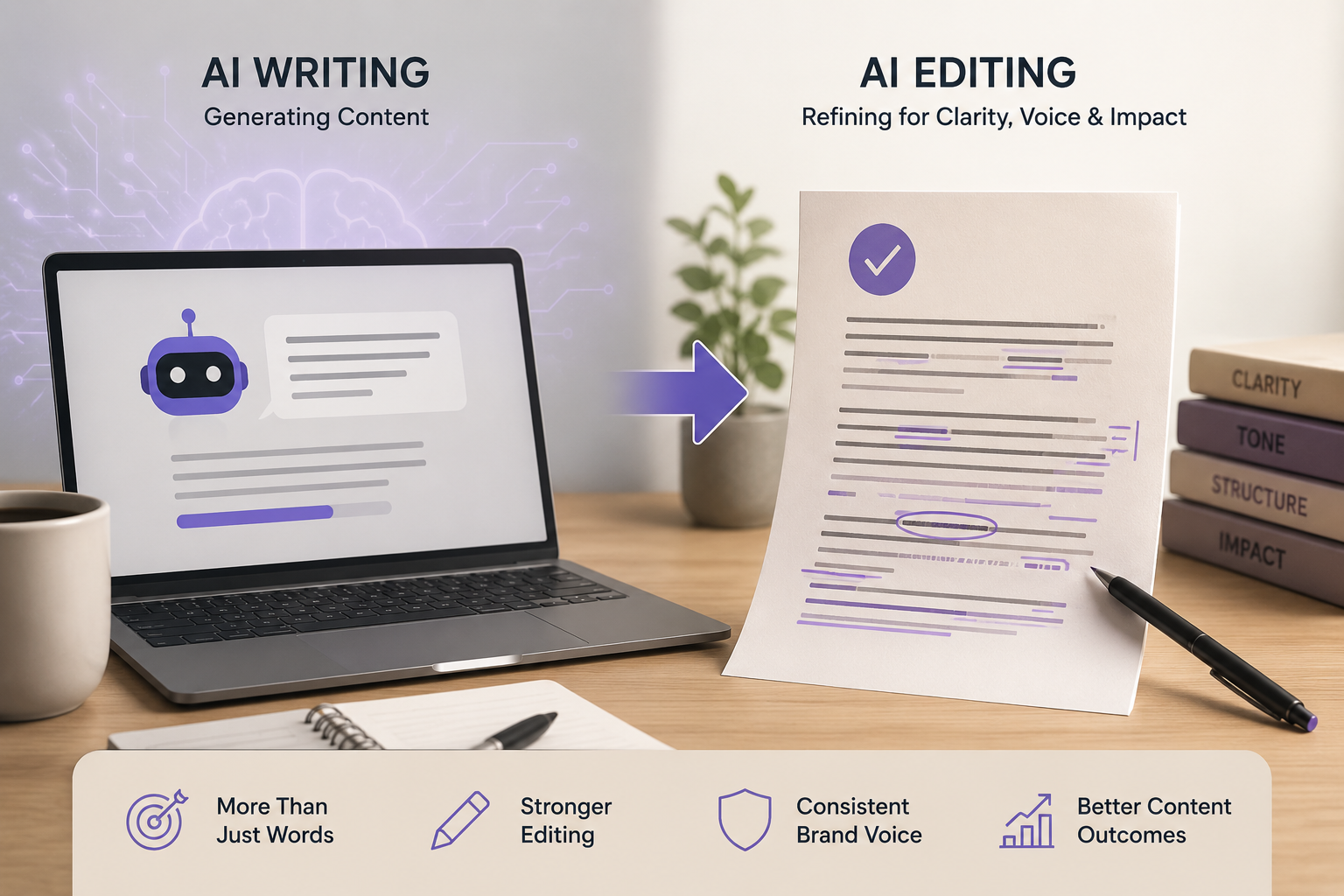
Highlights
- AI writing solved drafting speed.
- AI editing solves the publishing gap.
- More AI writers are not always the answer.
- The new advantage is refinement quality.
- Businesses need better editing layers.
- WriteBros.ai fits after the first draft.
Most businesses adopted AI writing tools for one very understandable reason: speed.
A blank page used to slow everything down. Blog drafts took days. Landing page copy needed back-and-forth. Emails sat unfinished. Social posts were delayed because nobody had time to start from scratch.
Then AI writing tools arrived and made the first draft almost instant.
That solved one problem beautifully. But it created another problem that many teams are only now beginning to notice.
The bottleneck is no longer writing. The bottleneck is deciding whether the writing is actually good enough to publish.
AI Editing vs. AI Writing: Why Businesses Are Investing in the Wrong AI Tools
Businesses spent the first wave of AI adoption chasing faster generation. The next advantage will come from better refinement: clearer drafts, stronger voice, fewer approval delays, and content that sounds like it belongs to the brand instead of another generic AI system.
The question is shifting from “How fast can we generate this?” to “How quickly can we turn this into something worth publishing?” That is why AI editing may become more valuable than AI writing for many modern teams.
The First AI Gold Rush Focused on Speed. Not Quality.
Think back to how businesses evaluated AI tools just a couple of years ago.
The questions were almost always the same.
Can it write a blog post?
Can it generate product descriptions?
Can it write marketing emails?
Can it create social media captions?
Nearly every product competed on how much content it could generate and how quickly it could do it. Speed became the headline feature because businesses were trying to remove the biggest obstacle they faced: producing enough content to keep up with demand.
That race worked remarkably well. Today, almost every major AI model can produce competent first drafts in seconds. For many companies, generation is no longer the competitive advantage because nearly everyone has access to it.
Businesses struggled to create enough content.
Marketing teams spent most of their energy getting words onto the page. Draft creation was the slowest part of the entire publishing process.
Businesses have more drafts than they can comfortably publish.
AI generates articles, emails, landing pages, reports, and product copy almost instantly. The challenge has shifted from creating content to deciding which drafts are actually ready for customers.
The advantage will belong to companies that edit better.
As AI writing becomes widely available, competitive advantage moves further downstream. Businesses that refine faster, maintain stronger brand voice, and publish with greater confidence will outperform those simply generating more words.
AI Editing vs AI Writing: Where The New Bottleneck Happens
AI writing tools made drafting cheaper. They did not make publishing effortless.
In many businesses, the hard part now begins after the AI draft appears. Someone has to decide whether the introduction sounds too generic. Someone has to check whether the claims are accurate. Someone has to remove the stiff transitions, repetitive phrasing, vague examples, and polished-but-empty sentences that often survive the first pass.
This is why teams can feel strangely slower even after adopting faster tools. They are no longer blocked by the blank page. They are blocked by the cleanup queue.
That cleanup work is easy to underestimate because it rarely appears as a line item. It hides inside Slack comments, Google Docs suggestions, content manager reviews, founder rewrites, and approval delays.
The draft is generated quickly.
AI removes the blank page and gives the team something usable enough to react to.
The draft needs human judgment.
The team reviews voice, accuracy, specificity, positioning, structure, and whether the copy sounds publishable.
The edit becomes the real work.
The company spends its time turning AI output into content that customers, readers, or prospects can actually trust.
The businesses that get the most value from AI are not always the ones generating the most content. They are the ones building the strongest editing layer after generation.
AI Editing Is Quietly Becoming a Category of Its Own
The software market has a predictable pattern.
Every new technology begins as an all-in-one solution. Eventually, companies realize that one part of the workflow deserves specialized tools. Email marketing split away from CRM platforms. Design systems evolved beyond basic image editors. Analytics became its own ecosystem instead of a feature inside website builders.
AI is beginning to follow the same path.
For the past two years, almost every conversation centered on generating content. But as AI writing becomes widely available, another category is emerging alongside it: AI editing. Instead of replacing the writing process, these tools focus on refining, strengthening, and preparing AI-generated drafts for publication.
That distinction matters because writing and editing solve different business problems. One creates volume. The other creates confidence.
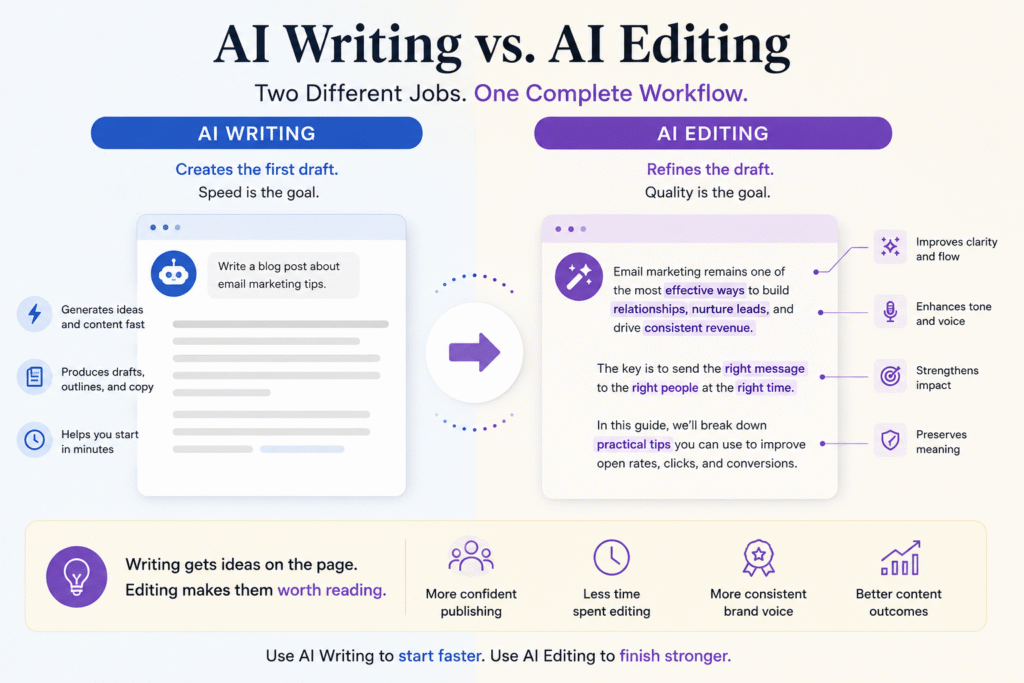
Optimized for producing a first draft.
The objective is speed. Generate ideas, articles, emails, landing pages, or social posts as quickly as possible so work can begin immediately.
Optimized for improving an existing draft.
The objective is quality. Remove awkward phrasing, improve readability, preserve meaning, strengthen flow, and make the content feel ready for customers instead of simply finished.
The second category may create the larger long-term advantage.
As AI generation becomes increasingly commoditized, businesses are less likely to compete on who can produce the fastest draft. They’ll compete on who can consistently publish the strongest final version.
This is why I think we’re entering a second phase of business AI adoption. The first phase rewarded companies that learned how to generate content. The next phase will reward companies that learn how to edit it better than everyone else.
The Next Competitive Advantage Won’t Be Better AI Writers. It Will Be Better AI Editors.
Something interesting is happening inside companies that have been using AI for a while.
They are no longer obsessed with finding yet another AI writer.
A year ago, every new model promised faster generation, longer context windows, or better prompts. Those improvements mattered because businesses were still learning how to incorporate AI into everyday work.
Today, that landscape looks very different. Whether a team uses ChatGPT, Claude, Gemini, or another capable model, they can usually produce a solid first draft within minutes. The differences between writing tools still exist, but they are becoming less dramatic than they once were.
What continues to consume time is everything that happens after the draft appears. Teams revise introductions, tighten paragraphs, remove repetitive wording, improve transitions, simplify explanations, and adjust the tone until the content finally feels publishable.
In other words, businesses are discovering that writing is becoming a commodity. Editing is becoming the differentiator.
Most AI tools can already produce acceptable first drafts.
The baseline quality of AI writing has improved so much that drafting itself is no longer the biggest source of competitive advantage.
Businesses still spend significant time polishing those drafts.
Editing remains highly manual because quality depends on nuance, readability, brand voice, and context rather than simply generating more text.
The companies that publish best will outperform the companies that generate fastest.
As AI writing becomes commonplace, differentiation shifts toward producing content that feels intentional, trustworthy, and unmistakably aligned with the business behind it.
The next generation of AI software is unlikely to be defined by who can write the fastest paragraph. It will be defined by who can help businesses reach a publishable version with fewer revisions, fewer approval cycles, and less editorial friction.
What Businesses Should Actually Look for in an AI Editing Layer
If AI editing is becoming more important than AI writing, the next question is simple: what makes a good AI editor?
The answer is not the tool that changes the most words.
For businesses, editing quality comes from restraint. A strong AI editing layer should improve weak sections without damaging the parts of the draft that already work. It should reduce friction, not create a new review problem.
Before investing in another AI tool, I would judge it against these five standards.
It preserves the original meaning.
Business content often contains promises, offers, product details, legal nuance, or positioning. An AI editor that makes copy smoother but changes the claim is not improving the workflow. It is creating risk.
It improves paragraph flow, not just sentence variety.
Weak editing tools rewrite sentences in isolation. Stronger tools make the whole paragraph feel more natural, with better pacing, clearer transitions, and less mechanical rhythm.
It reduces the AI accent without flattening the brand voice.
The goal is not to make every business sound casual. The goal is to remove the over-polished, templated quality of AI writing while preserving the tone that fits the company.
It works on small sections as well as full drafts.
Real editing is often paragraph-level. Teams may only need to fix one introduction, one awkward explanation, or one transition. A useful AI editor should not force a full rewrite every time.
It fits into the existing review process.
If a tool adds more decisions, more formatting cleanup, or more confusion, it does not matter how impressive the output looks. The best AI editing layer makes the current workflow easier to manage.
The real test is not whether a tool can make AI writing look different. The real test is whether it helps your team reach a publishable version faster without losing accuracy, voice, or control.
Where a Tool Like WriteBros.ai Fits Into This Shift
This is where AI editing starts becoming more practical than theoretical.
A business may already have a writing tool it likes. Maybe the team uses ChatGPT for first drafts, Claude for longer explanations, or Gemini for research-heavy outlines. Replacing those tools is not always necessary.
The more useful move is often adding a refinement layer after generation.
That is the role where WriteBros.ai makes the most sense. It is not positioned as another blank-page generator. It fits after the first draft exists, when the team needs to make the writing sound clearer, more natural, and less obviously AI-shaped before publishing.
For businesses, that distinction matters. The value is not simply that a sentence sounds more human. The value is that the draft becomes easier to approve, easier to adapt, and easier to publish without forcing someone to manually rewrite every weak paragraph.
That is why AI editing tools should not be judged only by dramatic before-and-after demos. The better test is whether they reduce the distance between rough AI output and final business-ready copy.
If AI writing removed the blank page, tools like WriteBros.ai are designed for the next problem: turning the draft into something that sounds intentional, readable, and ready to represent the business.
The Future Belongs to Businesses That Edit Better, Not Just Generate Faster
The first phase of AI adoption rewarded businesses that learned how to generate content quickly.
That advantage is fading.
When every competitor can produce a blog draft, email sequence, landing page, or product description in minutes, speed alone stops being impressive. The real question becomes what happens next. Who improves the draft? Who protects the brand voice? Who checks whether the writing is clear, specific, accurate, and worth publishing?
That is why AI editing deserves more attention than it is getting. It sits closer to the actual business outcome. Generation creates material. Editing turns that material into something useful.
Businesses do not need endless new AI writers if their current tools already produce workable drafts. They need stronger refinement layers, better review systems, sharper editorial judgment, and tools that reduce the messy work between first draft and final copy.
AI writing changed how businesses start content. AI editing will change how they finish it.
My final take: the companies that win with AI will not be the ones that publish the most words. They will be the ones that turn AI drafts into sharper, clearer, more trustworthy content before anyone else does.
Frequently Asked Questions
AI writing helps businesses start faster, but AI editing is what determines whether the final draft is actually ready to publish. These questions explain why the editing layer is becoming more important as AI-generated content becomes easier to produce.
What is the difference between AI writing and AI editing?
AI writing focuses on creating a first draft from a prompt. AI editing focuses on improving an existing draft by refining clarity, flow, tone, structure, and readability. One helps businesses start content faster. The other helps them finish content better.
Why are businesses investing too much in AI writing tools?
Many businesses still assume their biggest content problem is drafting speed. But once a team already has access to ChatGPT, Claude, Gemini, or similar tools, the harder problem often becomes editing, approving, and publishing content that actually sounds brand-ready.
Is AI editing more valuable than AI writing?
For many mature AI workflows, yes. AI writing removes the blank page, but AI editing reduces the cleanup work that happens afterward. As first drafts become easier to generate, the real advantage shifts toward teams that can refine drafts faster and publish stronger final versions.
What problems does AI editing solve for businesses?
AI editing helps reduce generic phrasing, stiff transitions, repetitive sentence patterns, unclear explanations, weak paragraph flow, and inconsistent brand voice. It is especially useful when AI-generated drafts are close to usable but still not ready for customers.
Should businesses stop using AI writing tools?
No. AI writing tools are still useful for generating first drafts, outlines, ideas, and rough content. The point is that businesses may not need more writing tools once generation is already solved. They often need a better refinement layer after generation.
What should businesses look for in an AI editing tool?
Businesses should look for meaning preservation, paragraph-level control, natural voice improvement, brand-tone consistency, and workflow fit. The best AI editing tools do not simply rewrite everything. They improve weak sections without damaging what already works.
Can AI editing replace human editors?
Not completely. AI editing can reduce repetitive cleanup, but human editors still provide strategy, judgment, accuracy checks, positioning, examples, and final approval. The best use case is supporting editors, not removing them from the process.
Where does WriteBros.ai fit into the AI editing workflow?
WriteBros.ai fits after the first draft already exists. It helps businesses refine AI-generated content into clearer, more natural, and more publishable copy without asking teams to replace the writing tools they already use.