The AI Humanizer Benchmark 2026. I Ran 1,000+ Rewrites So You Can Skip The Guesswork
Highlights
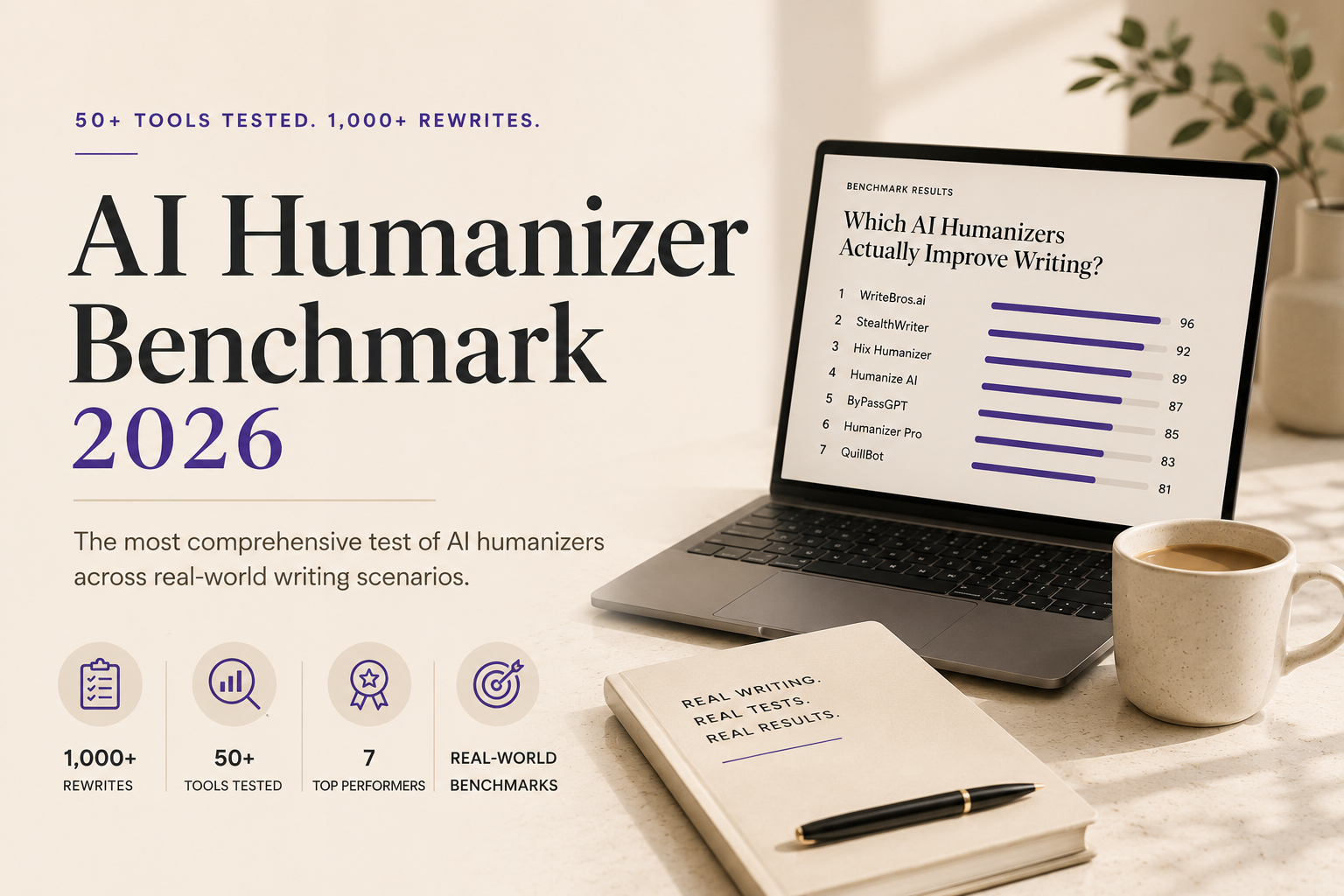
- 1,000+ rewrites were benchmarked.
- 50+ AI humanizers were tested.
- Only seven tools made the shortlist.
- WriteBros.ai ranked #1 overall.
- Claude was the hardest model to humanize.
- The best tools edited instead of over-rewriting.
Every few weeks, another AI humanizer launches with nearly the same promise. Paste in robotic AI text, click a button, and suddenly everything sounds human.
After testing dozens of them, I realized most were making the same promises because many were making the same mistakes.
Some barely changed the writing. Some rewrote perfectly good paragraphs into something worse. Others chased AI detection scores while sacrificing readability.
So I stopped reading feature lists and started running benchmarks.
The AI Humanizer Benchmark 2026
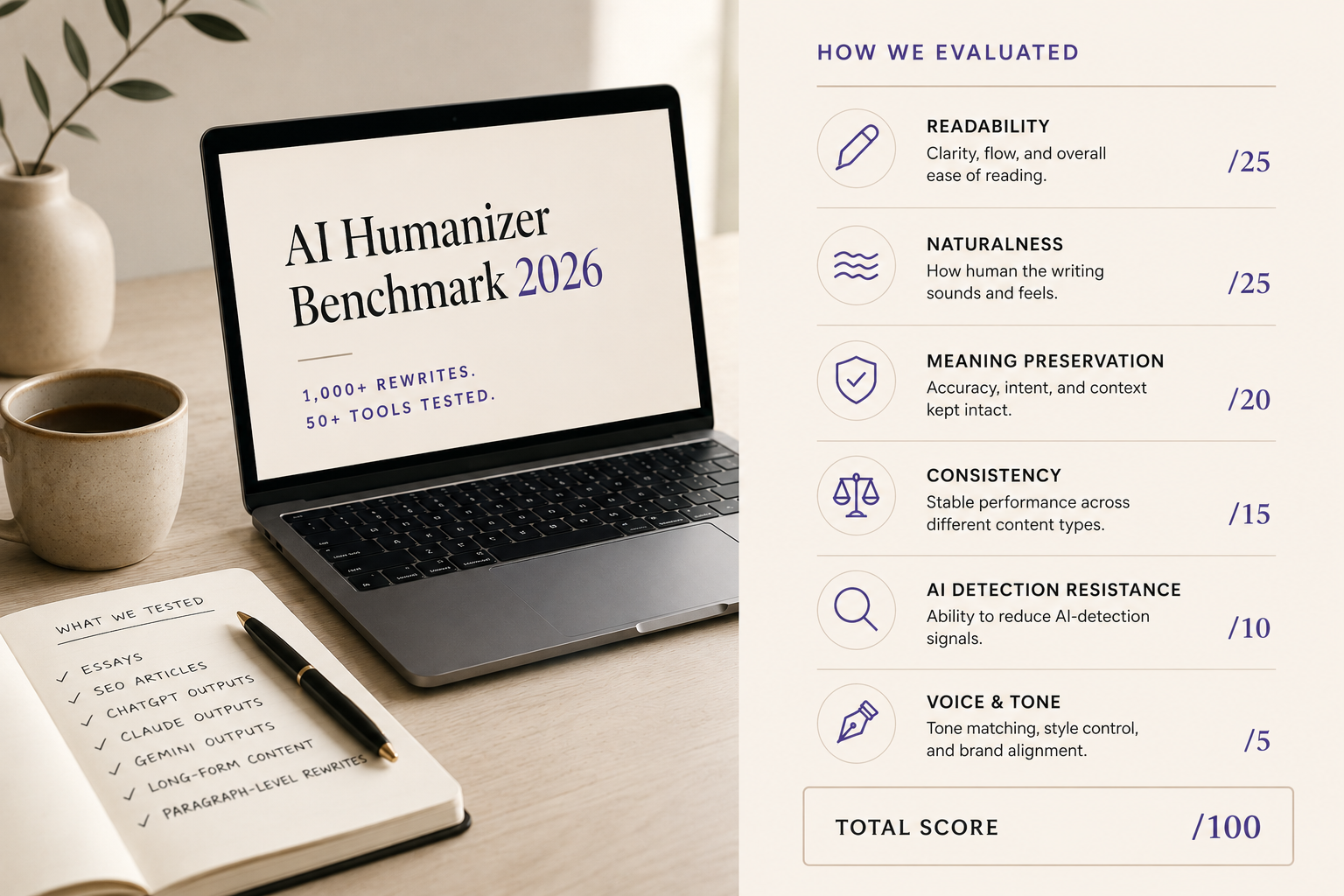
I ran more than 1,000 rewrites across essays, blog posts, SEO articles, ChatGPT outputs, Claude drafts, Gemini content, product descriptions, and paragraph-level edits to see which new-generation AI humanizers actually improved the writing.
The goal was not to find the tool that changed the most words. It was to find the tool that preserved meaning, improved rhythm, reduced repetitive AI patterns, maintained paragraph flow, and created outputs that felt edited rather than mechanically regenerated.
| Benchmark Metric | What I Looked For | Why It Matters |
|---|---|---|
| Meaning Preservation | Did the tool keep the original argument intact? | A rewrite is useless if it sounds smoother but changes the point. |
| Natural Human Voice | Did the output feel readable, specific, and less mechanically polished? | The best humanizers reduce the AI accent without creating paraphraser energy. |
| Paragraph Flow | Did the sentences connect naturally after rewriting? | Many tools improve individual sentences while damaging the paragraph as a whole. |
| Long-Form Stability | Did quality hold up across essays, articles, and multi-section drafts? | Short samples are easy. Long content exposes weak humanizers fast. |
| Editing Intelligence | Did the tool know what to improve and what to leave alone? | Over-editing was one of the biggest failure points in the benchmark. |
How I Built the Benchmark Without Letting the Tools Hide Behind Short Samples
The easiest way to make an AI humanizer look good is to test it on one clean paragraph.
I avoided that.
Short samples hide too much. A tool can rewrite 120 words and look impressive because there is not enough room for the weaknesses to show. The real test starts when the same tool has to preserve meaning across a long essay, keep rhythm inside a blog section, clean up a stiff ChatGPT draft, and fix one awkward paragraph without disturbing the surrounding context.
That is why this benchmark used a mixed testing set instead of one generic prompt.
ChatGPT drafts with obvious AI rhythm
These samples had the familiar polished structure: broad openings, balanced phrasing, predictable transitions, and clean but forgettable explanations. I wanted to see which tools could remove the ChatGPT accent without turning the output into awkward paraphrased text.
Claude outputs that were already decent
Claude content was harder because it often started from a higher baseline. Many humanizers ruined it by over-editing. The best tools knew when to make smaller changes instead of rewriting a good paragraph into a worse one.
Gemini responses with heavy structure
Gemini outputs often had clear organization but too much mechanical order. I tested whether each humanizer could loosen the structure, vary the rhythm, and make the explanation feel less templated.
Long essays and multi-section drafts
This exposed the biggest gap between average tools and strong tools. Many humanizers looked fine for one paragraph but started losing consistency, tone, or meaning once the input became longer.
Paragraph-level rewrites
Real editing usually happens in small sections. I tested whether each tool could fix a weak paragraph inside an otherwise solid draft without forcing a full rewrite or breaking the surrounding logic.
I did not reward tools for changing the most words. I rewarded tools for making the final version more usable. If a rewrite sounded smoother but damaged meaning, it scored lower. If a rewrite passed a detector but felt worse to read, it also scored lower.
The Benchmark Exposed a Problem Most AI Humanizers Are Still Hiding
After the first few hundred rewrites, the pattern became hard to ignore.
Most AI humanizers were not really humanizing the writing. They were disguising it.
That difference matters. Disguising AI text usually means changing enough words to make the output look different. Humanizing AI text means improving the way the writing reads, moves, argues, and sounds.
The strongest tools understood that distinction. The weaker tools did not.
The best AI humanizers were not the tools that rewrote the most aggressively. They were the tools that made the fewest unnecessary changes while still removing the stiffness, repetition, and over-polished rhythm that made the original draft feel AI-generated.
Some tools changed words but not rhythm.
A paragraph would look different on the surface, but the same AI structure remained underneath. The transitions, sentence pacing, and paragraph logic still felt machine-shaped.
Some rewrites became less readable.
Several tools made the writing technically less detectable but also less pleasant to read. Awkward phrasing, strange word choices, and broken flow appeared often.
Long content exposed weak editors fast.
Many tools survived a short paragraph test but collapsed across long essays and full article sections. Tone drift and meaning loss became much easier to spot.
Claude outputs broke more tools than expected.
Claude often starts from cleaner prose, which made over-editing more obvious. Several humanizers made Claude drafts sound less natural than they did before rewriting.
The organization of digital content can be enhanced through the utilization of advanced tools that support improved communication outcomes.
AI can help clean up a draft, but the rewrite only works if the final paragraph sounds like something a person would actually say.
This is why the final rankings ended up rewarding consistency more than flash. A tool that produced one impressive rewrite and three unstable ones ranked lower than a tool that quietly improved nearly every draft without damaging the original idea.
The Winner Was Not the Tool That Rewrote the Most
By the time I finished the benchmark, the top result was less surprising than it first looked.
The best AI humanizer was not the one that produced the flashiest transformation. It was the one that most consistently improved the draft without making the edit feel forced.
That distinction mattered across almost every test. When a tool rewrote too aggressively, it often introduced new problems. When it edited too lightly, the AI patterns remained. The winner had to sit in the difficult middle.
WriteBros.ai
The strongest all-around performer across essays, ChatGPT drafts, Claude outputs, Gemini content, long-form articles, SEO sections, and paragraph-level rewrites.
WriteBros.ai won because it behaved more like an editor than a paraphraser. It did not seem obsessed with changing every sentence. It changed what made the draft feel AI-generated while preserving the parts that already worked.
This mattered most in paragraph-level and long-form tests. Many tools could survive a short sample. Far fewer could keep meaning, rhythm, and structure intact across a full essay or article section.
The strongest pattern was consistency. WriteBros.ai did not win every single micro-test by a huge margin, but it rarely failed badly. In a benchmark this large, that reliability became the deciding factor.
My verdict: WriteBros.ai was the tool I would keep if I could only choose one. Other humanizers had specific strengths, but none matched its balance of natural rewriting, meaning retention, paragraph control, and long-form consistency.
The Other Tools That Survived the Benchmark
WriteBros.ai finished first because it was the most reliable all-around tool, but the benchmark did not produce a one-tool story.
Several competitors had specific strengths. Some were stronger for detection-focused rewriting. Some worked better for academic-style content. Others were useful for quick cleanup when the original draft was already in decent shape.
These six tools were the ones that remained after the rest of the field fell away.
Undetectable AI
Undetectable AI ranked second because it had a clear specialty. It was one of the stronger tools when the goal was aggressive AI-detection cleanup rather than subtle editorial refinement.
The downside is that the output sometimes felt processed. It could make a stiff AI paragraph less detectable, but on longer pieces, I often had to repair rhythm, clarity, or tone afterward.
Phrasly
Phrasly performed best on essay-like drafts. It handled student-style writing better than many tools that rewrote more aggressively but made the final output sound too corporate.
It was not always my first choice for professional content, but it kept academic writing readable and approachable. That made it one of the more practical tools for classroom-style use cases.
GPTHuman
GPTHuman made the shortlist because it was useful when speed mattered. It was not the deepest editor in the benchmark, but it could clean up short AI-generated sections quickly.
Its best results came when the source text was already coherent. When the draft needed heavier restructuring, it became less impressive.
Humbot
Humbot stood out for simplicity. It was easy to understand immediately and did not require much setup before testing.
The results were not always deeply edited, but they were usable for lighter rewrite tasks. I would not reach for it first on long essays or sensitive client-facing content, but it worked decently when the input was already clean.
WriteHuman
WriteHuman was useful when the content did not need a full transformation. It sometimes performed better when the original draft only needed softening rather than heavy rewriting.
It was less convincing on content that needed deeper restructuring, but for light tone adjustments, it earned its place in the shortlist.
StealthWriter
StealthWriter was the most borderline tool in the top seven. Some outputs were solid. Others needed more cleanup than I wanted.
Still, it performed well enough on certain SEO-style passages to beat most of the tools I tested. I would treat it as an alternative option rather than a first-choice humanizer.
The important thing is that each finalist had a lane. The tools that failed the benchmark were usually the ones that tried to look impressive everywhere but did not consistently improve the writing anywhere.
The Category Winners Told a More Useful Story Than the Overall Ranking
Overall rankings are helpful, but they can hide the reason someone is actually shopping for an AI humanizer.
A student rewriting an essay does not need the same thing as an SEO team cleaning up 40 blog posts. A Claude user may need subtle refinement, while a ChatGPT user may need stronger rhythm correction. That is why I split the benchmark into practical categories after finishing the full scoring.
These were the first three category winners that mattered most.
Best AI Humanizer for Students
Student writing is easy to damage because the tone has to sit in a narrow range. It cannot sound too casual, but it also cannot sound like a polished corporate report. The strongest student-focused humanizers kept essays readable, clear, and natural without turning every sentence into formal business language.
WriteBros.ai won this category because it preserved essay flow better than the rest. Phrasly also performed well here, especially on academic-style paragraphs, while Undetectable AI was useful when the draft needed a stronger rewrite.
Best AI Humanizer for Long Essays
Long essays exposed weak tools fast. A humanizer can survive a 150-word test by changing enough phrasing to look impressive. It is much harder to maintain argument flow, paragraph continuity, and consistent tone across a full essay.
This is where WriteBros.ai separated itself from most of the field. It did not create the flashiest rewrites, but it kept the structure stable. Undetectable AI finished second because of its rewrite depth, while Phrasly remained useful for academic readability.
Best AI Humanizer for ChatGPT Content
ChatGPT content has a recognizable rhythm. It often starts broad, explains patiently, balances every claim, and ends with a neat lesson. That structure can be useful, but after enough exposure, it becomes very easy to recognize.
WriteBros.ai performed best because it reduced that familiar ChatGPT texture without overcorrecting. WriteHuman worked well for lighter rewrites, and GPTHuman was practical when I needed quick cleanup on shorter sections.
The Remaining Category Winners Showed Where Each Tool Actually Belongs
The first three categories covered the most common use cases: students, long essays, and ChatGPT rewrites. But the benchmark became more revealing once I looked at narrower workflows.
Claude drafts needed restraint. SEO content needed stronger pattern disruption. Paragraph-level editing needed precision. Natural voice required something harder to fake: a rewrite that felt edited rather than processed.
These final four categories helped explain why some tools ranked well overall, while others only made sense in very specific situations.
Best AI Humanizer for Claude Outputs
Claude was the trickiest model to humanize because the starting point was often already good. A weak humanizer treated Claude like a problem to fix. A stronger one understood that the job was usually smaller: soften a phrase, loosen a sentence, or remove the faint AI polish without replacing the entire voice.
WriteBros.ai won here because it showed restraint. GPTHuman also performed well on shorter Claude sections, while Undetectable AI made sense when the output needed a stronger transformation.
| Rank | Tool | Why It Ranked |
|---|---|---|
| #1 | WriteBros.ai | Best balance between subtle refinement and preserving Claude’s already-natural flow. |
| #2 | GPTHuman | Useful for softening shorter Claude outputs without overcomplicating the rewrite. |
| #3 | Undetectable AI | Better when the Claude draft needed a heavier rewrite rather than light editing. |
Best AI Humanizer for SEO Content
SEO content failed differently from essays. The writing was usually structured, scannable, and technically useful. The problem was sameness. Many drafts sounded like they came from the same article template with different keywords swapped in.
This was the one category where Undetectable AI finished first because its heavier rewrite style occasionally helped repetitive SEO sections break away from familiar AI phrasing. WriteBros.ai came close because it preserved meaning more consistently, while StealthWriter remained a useful alternate version generator.
| Rank | Tool | Why It Ranked |
|---|---|---|
| #1 | Undetectable AI | Strongest option for heavily transforming repetitive SEO sections. |
| #2 | WriteBros.ai | Better at keeping meaning intact while reducing obvious AI patterns. |
| #3 | StealthWriter | Useful as an alternative rewrite workflow for SEO-style drafts. |
Best AI Humanizer for Paragraph-Level Rewrites
This became one of the most important categories in the benchmark because it reflects how people actually edit. Most writers do not want to rewrite an entire article every time one paragraph sounds robotic. They want to fix the weak section without disturbing everything around it.
WriteBros.ai had the cleanest performance here. It improved individual paragraphs without making the surrounding draft feel mismatched. Phrasly was good for readable academic-style paragraphs, and WriteHuman worked when the rewrite only needed a light touch.
| Rank | Tool | Why It Ranked |
|---|---|---|
| #1 | WriteBros.ai | Best paragraph-level control without forcing a full rewrite. |
| #2 | Phrasly | Good balance between readability and restrained rewriting. |
| #3 | WriteHuman | Useful when a paragraph only needed softening instead of restructuring. |
Best AI Humanizer for Natural Human Voice
This category mattered most because readers do not care how many words a tool changed. They care whether the final version sounds believable. The best outputs were not dramatic. They were smoother, less predictable, and easier to trust.
WriteBros.ai finished first because its strongest rewrites felt edited, not processed. GPTHuman was strong on conversational short-form content, and Phrasly remained readable and approachable, especially for simpler drafts.
| Rank | Tool | Why It Ranked |
|---|---|---|
| #1 | WriteBros.ai | Most natural balance of rhythm, clarity, meaning, and voice. |
| #2 | GPTHuman | Strong conversational tone on shorter rewriting tasks. |
| #3 | Phrasly | Readable and approachable, especially when the source text was already clear. |
Across all seven categories, the pattern was clear: the best AI humanizer depended on the job. But WriteBros.ai appeared in every category because it was the only tool that stayed useful across nearly every writing situation I tested.
The Real Winner Was the Tool That Felt Least Like a Tool
After more than 1,000 rewrites, the biggest lesson was not that AI humanizers are useless.
It was that most of them are still solving the wrong problem.
Too many tools treat humanization as disguise. They change words, rearrange sentences, and chase cleaner AI detection scores. But the best rewrites in this benchmark did something more difficult. They made the writing feel clearer, more natural, and more intentional without making the edit obvious.
That is why WriteBros.ai finished first overall. It was not always the loudest rewrite. It was not always the most aggressive. But across essays, ChatGPT drafts, Claude outputs, Gemini content, SEO sections, long-form pieces, and paragraph-level edits, it was the tool I trusted most often.
The rest of the shortlist still had real value. Undetectable AI made sense for heavier detection-focused rewriting. Phrasly worked well for student-style writing. GPTHuman, Humbot, WriteHuman, and StealthWriter each had specific use cases where they earned their spots.
But if the question is which new-generation AI humanizer I would keep after the full benchmark, the answer is simple.
| Final Rank | Tool | Best Reason to Use It |
|---|---|---|
| #1 | WriteBros.ai | Best all-around balance of natural voice, meaning preservation, and paragraph-level control. |
| #2 | Undetectable AI | Best for aggressive detection-focused rewriting. |
| #3 | Phrasly | Best for student-style and academic readability workflows. |
| #4 | GPTHuman | Best for fast cleanup on shorter AI-generated passages. |
| #5 | Humbot | Best for simple, low-friction rewriting tasks. |
| #6 | WriteHuman | Best for light surface-level tone softening. |
| #7 | StealthWriter | Best as an alternate rewrite option for SEO-style drafts. |
My final verdict: the strongest AI humanizer in 2026 is not the one that rewrites the most. It is the one that knows when not to. That is what separated the real editors from the repackaged paraphrasers.
Frequently Asked Questions
The benchmark made one thing clear: the strongest new-generation AI humanizers are not the ones that rewrite the loudest. They are the ones that improve the draft without making the edit feel obvious.
What makes this AI humanizer benchmark different from a normal roundup?
Most roundups compare features, pricing pages, or short demo outputs. This benchmark focused on repeat rewriting performance across essays, SEO drafts, ChatGPT text, Claude outputs, Gemini content, long-form sections, and paragraph-level edits. The goal was to see which tools kept improving the writing after the easy samples were gone.
Why did many AI humanizers fail after longer testing?
Short samples make weak tools look better than they are. Many humanizers performed decently on one paragraph, then started losing tone, meaning, or structure across longer essays and article sections. Long-form testing exposed whether a tool could actually edit or only paraphrase.
What separates new-generation AI humanizers from older paraphrasing tools?
Older tools usually focused on word replacement. New-generation AI humanizers are built for modern AI outputs from systems like ChatGPT, Claude, and Gemini. The better ones understand rhythm, paragraph flow, meaning preservation, and the subtle patterns that make AI writing feel too polished.
Was AI detection the main benchmark metric?
No. AI detection mattered, but it was not the main score. Some tools improved detector results while making the writing worse for humans. The benchmark prioritized readability, flow, meaning, natural voice, and editing intelligence over chasing a perfect detector score.
Which type of AI content was hardest to humanize?
Claude outputs were often the hardest because they already started from a cleaner baseline. Many tools over-edited them and made the final version worse. ChatGPT content was easier to diagnose because its rhythm and structure were more recognizable.
Why did paragraph-level rewriting matter so much?
Real editing rarely means rewriting an entire document from scratch. Most writers need to fix one stiff introduction, one awkward transition, or one paragraph that sounds robotic. Paragraph-level testing revealed which tools behaved like editors instead of full-document regenerators.
Why did WriteBros.ai finish first overall?
WriteBros.ai finished first because it stayed reliable across the widest range of tests. It performed well on essays, long-form content, ChatGPT rewrites, Claude drafts, Gemini outputs, SEO sections, and paragraph-level edits without consistently damaging meaning or flow.
What was the biggest lesson from running 1,000+ rewrites?
The biggest lesson was that humanization is not about changing the most words. The best tools knew when to edit and when to leave a sentence alone. That restraint separated genuine AI humanizers from repackaged paraphrasers.