AI Humanizer for Businesses in 2026: The Honest ROI Guide for Small Teams, Startups, and Growing Brands
Highlights
- AI humanizers are not worth it for every business.
- The ROI depends on editing volume.
- Small teams should buy only when AI drafts are recurring.
- Startups benefit when AI creates voice inconsistency.
- Growing brands gain from faster cleanup.
- The best use case is turning AI drafts into business-ready copy.
Every few months, another AI humanizer appears promising to make AI writing sound more natural. Landing pages show dramatic before-and-after examples, social media fills with glowing testimonials, and suddenly it feels like every business should be adding another subscription to the marketing stack.
I think that conversation usually starts in the wrong place.
The first question is not which AI humanizer is the best. It is whether your business actually needs one in the first place. For some companies, an AI humanizer can remove hours of editing every week and noticeably improve publishing quality. For others, it becomes another monthly expense that solves a problem they barely have.
That difference has very little to do with company size. I have seen solo founders benefit more than large organizations, and I have seen established businesses spend money on tools they rarely use. The deciding factor is almost always how AI fits into the company’s daily workflow rather than how many employees happen to be on the payroll.
AI Humanizer for Businesses: The Honest ROI Guide for Small Teams, Startups, and Growing Brands
This guide is for business owners, startup founders, agencies, and marketing teams trying to answer one practical question: is investing in an AI humanizer for businesses actually worth the money, or is it another piece of software that sounds more valuable than it becomes in practice?
Rather than recommending tools immediately, this guide starts one step earlier. We’ll first identify which businesses genuinely benefit from AI humanizers, which ones can safely skip them, and the signals that tell you when the investment begins to make financial sense.
The Real Cost Is Not the AI Humanizer. It Is the Content Cleanup You Are Already Doing.
Business owners often evaluate AI tools by looking at subscription price first.
I think that misses the more expensive part.
If your team is already using ChatGPT, Claude, Gemini, or another AI writing system, the cost is rarely the first draft. The first draft is cheap. Sometimes it is practically free. The expensive part begins after the draft exists.
Someone has to read it. Someone has to fix the generic phrasing. Someone has to make sure the tone does not sound like every competitor’s blog. Someone has to remove the fake confidence, vague examples, stiff transitions, and sentences that technically make sense but do not sound like your brand.
That is where the ROI conversation around an AI humanizer for businesses becomes more serious. You are not only paying for a rewrite tool. You are potentially paying to reduce the amount of human cleanup required every time AI touches your content workflow.
Editing time adds up faster than subscription fees.
If a founder, marketer, or account manager spends 30 minutes cleaning every AI draft, the real cost is not the software. It is the repeated interruption to higher-value work.
Brand voice starts drifting across channels.
AI-generated emails, landing pages, captions, and blog posts often sound slightly different depending on who prompted them. That inconsistency becomes noticeable as publishing volume grows.
Review cycles become longer than expected.
AI speeds up drafting, but weak AI output can slow down approvals. Managers end up rewriting sections manually because the draft is close enough to use but not good enough to publish.
Content becomes polished but forgettable.
The biggest issue is not always robotic writing. Sometimes the content is clean, structured, and completely forgettable because it sounds like it came from the same template everyone else is using.
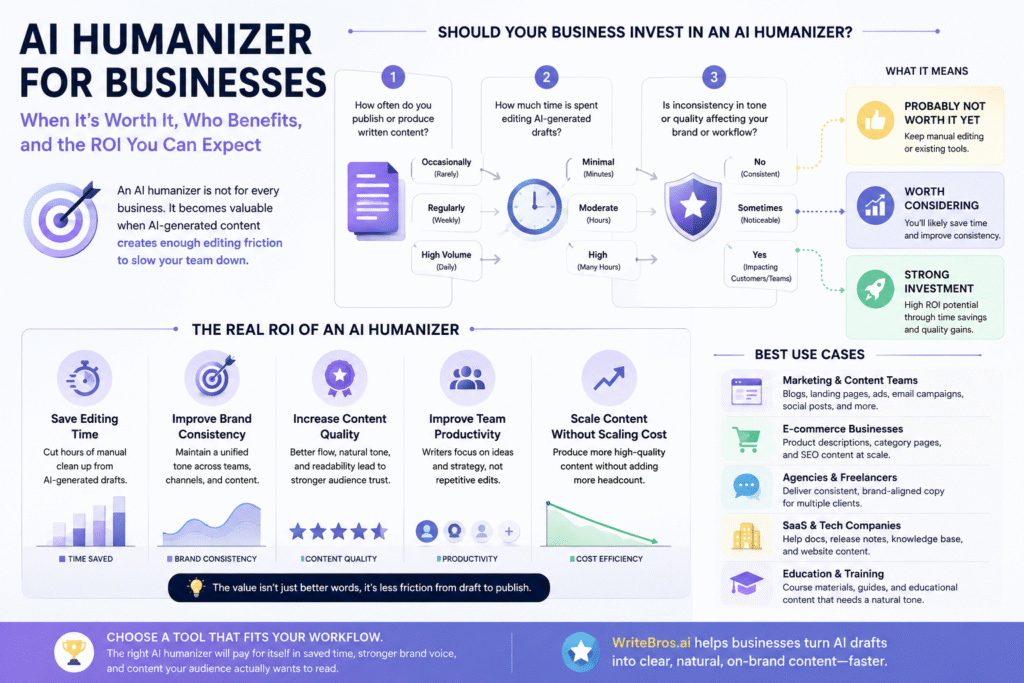
An AI humanizer starts becoming worth considering when cleanup becomes a recurring operational cost, not when one paragraph sounds awkward. The more often your business uses AI-generated drafts, the easier it becomes to justify a tool that reduces friction after generation.
Some Businesses Should Not Pay for an AI Humanizer Yet
The most honest ROI answer is not always yes.
An AI humanizer can be useful, but it is not automatically useful just because a business writes content. If AI is only a small part of your workflow, or if publishing is not a meaningful growth channel yet, the tool may sit in your stack without changing much.
This is where many businesses waste money. They buy the tool because the category sounds important, not because the problem has become expensive enough to solve.
Before investing in an AI humanizer for businesses, I would first rule out the cases where the return is likely too small.
You only publish occasionally.
If your business publishes one blog post every few months and rarely uses AI for customer-facing copy, the savings will probably be too small to matter. Manual editing is likely enough at that stage.
You do not have a repeatable content workflow.
A tool cannot create process where no process exists. If drafts are inconsistent because strategy, ownership, or approvals are unclear, an AI humanizer will only clean up symptoms without fixing the real bottleneck.
Your content still needs stronger ideas more than smoother wording.
If the draft lacks insight, examples, positioning, or a clear point of view, humanizing the language will not make it strategically better. It may simply make weak content sound more polished.
You are using AI mainly for internal notes.
Internal summaries, rough meeting notes, and private brainstorming documents do not always need polished human voice. In those cases, speed and accuracy often matter more than natural phrasing.
A useful rule: if nobody inside or outside the business is spending meaningful time cleaning AI drafts, an AI humanizer is probably premature. The tool becomes valuable when editing friction is already visible.
The Businesses That Benefit Most Are Usually Already Feeling the Editing Drag
The best candidates for an AI humanizer are not businesses that merely want to sound more human.
They are businesses that already use AI often enough for cleanup to become a real bottleneck. At that point, the tool is no longer a nice-to-have writing accessory. It becomes part of the workflow between rough AI output and publishable business content.
The clearest ROI usually appears when the company is producing content repeatedly, across multiple channels, with several people touching the drafts.
Agencies handling client content at volume.
Agencies often deal with the worst version of AI cleanup: many clients, many voices, many approval layers. An AI humanizer can help standardize the first cleanup pass so editors spend less time fixing obvious AI phrasing and more time improving strategy, positioning, and client-specific nuance.
Startups publishing before they have a full content team.
Early-stage teams often use AI because they need speed, not because they have mature editorial systems. A humanizer can help founders and lean marketers turn rough AI drafts into something closer to publishable without adding another full-time editor too early.
Ecommerce brands rewriting product and category copy.
Product descriptions, collection pages, and marketplace listings can become painfully repetitive when generated by AI. A good humanizer helps vary rhythm, simplify stiff phrasing, and make copy feel less templated across large catalogs.
SEO teams producing repeatable blog and landing page drafts.
SEO content tends to become formulaic fast. When teams publish weekly or daily, the issue is not only grammar. It is sameness. An AI humanizer can help reduce predictable phrasing before an editor adds research, examples, internal links, and brand-specific judgment.
Founders and executives using AI for thought leadership.
Founder-led content fails when it sounds like generic business advice. If a founder uses AI to draft LinkedIn posts, newsletters, speeches, or investor updates, a humanizer can help remove the over-polished AI tone before personal stories and sharper opinions are added.
A business usually benefits from an AI humanizer when AI-generated drafts are already saving time at the beginning but creating friction near the end. The tool is most valuable when it shortens the distance between draft and usable copy.
The ROI Changes Depending on What Stage Your Business Is In
A small business, a startup, and an established company can all use the same AI humanizer and get completely different value from it.
That is why I would not judge the tool only by price. A $20 or $50 monthly tool can be wasteful for one business and obvious for another. The difference is not the subscription cost. It is the amount of content friction the tool removes.
Here is how I would think about the investment by business stage.
Worth it when content is already tied to sales.
For a small business, an AI humanizer is not automatically a must-have. If most leads come from referrals, local search, or direct relationships, and content is only occasional, the ROI may be weak.
But if the business depends on service pages, social posts, newsletters, product descriptions, or regular educational content, the tool can start paying for itself by making AI drafts less awkward before they reach customers.
Verdict: Worth considering once AI-generated content touches customer-facing pages or sales materials regularly.
Worth it when speed is creating brand inconsistency.
Startups often use AI because everyone is moving fast. The founder drafts a landing page. The marketer drafts emails. Someone else creates help docs or investor updates. The problem is that all of this content can start sounding slightly different.
An AI humanizer becomes useful when it helps the team turn rough AI output into something closer to a shared voice. It is not a substitute for positioning, but it can reduce the messy cleanup that happens when a small team publishes across too many channels at once.
Verdict: Strong fit when AI is already part of daily marketing, sales, or founder-led content production.
Worth it when volume makes manual editing expensive.
Growing brands usually have enough content volume for small inefficiencies to become expensive. A few extra minutes per draft may not sound serious until the team is producing blogs, ads, emails, product copy, landing pages, and social content every week.
At that point, the AI humanizer is less about novelty and more about workflow compression. The goal is not to remove editors. The goal is to reduce the low-value cleanup before editors spend time on strategy, examples, messaging, and final judgment.
Verdict: Often worth it when the team publishes consistently and wants to reduce repetitive editing work.
Worth it when consistency matters more than speed.
Established businesses usually do not need an AI humanizer because they cannot write. They need one because too many people may be using AI in slightly different ways across departments.
Marketing, sales, HR, support, and operations may all use AI-generated drafts. Without a cleanup layer, the company can end up with content that is technically fine but inconsistent in tone, clarity, and confidence.
Verdict: Best justified when multiple teams use AI and the brand needs a more consistent editorial standard.
The simplest way to judge ROI is this: if AI drafts are occasional, manual cleanup is fine. If AI drafts are recurring, customer-facing, and handled by multiple people, an AI humanizer becomes much easier to justify.
A Simple Checklist for Deciding If the Investment Makes Sense
The easiest way to decide whether an AI humanizer is worth paying for is to stop thinking about the tool and start looking at the workflow around it.
If AI-generated content is rare, the tool may not matter. If AI-generated content is frequent, customer-facing, and edited by people whose time is valuable, the calculation changes quickly.
These are the questions I would ask before buying an AI humanizer for businesses.
How many AI drafts does the business edit every week?
If the number is one or two, manual editing is probably enough. If the number is dozens, even small improvements in cleanup time can become meaningful.
Is the content customer-facing?
Internal notes can stay rough. Website copy, sales emails, newsletters, product descriptions, and thought leadership need more care because they shape how the market reads the business.
Are multiple people using AI in different ways?
The more people involved, the more likely the brand voice starts drifting. A humanizer can help create a cleaner first-pass standard before final human review.
Does the team keep rewriting the same types of mistakes?
If editors repeatedly fix stiff intros, vague transitions, repetitive phrasing, or generic summaries, the business is already paying for AI cleanup manually.
Would faster cleanup increase publishing consistency?
The ROI is stronger when editing friction causes delays. If drafts pile up because everything needs a second or third polish, a humanizer can help reduce that bottleneck.
If your business answers yes to three or more of these questions, an AI humanizer is probably worth testing. If most answers are no, you may be better off improving your prompts, templates, and review process first.
Sometimes the Right Answer Is Not Another AI Writer. It Is a Better Editor.
Something interesting happens once businesses become comfortable using AI.
They stop asking how to generate content faster and start asking how to publish better content without slowing everyone down again.
That shift is where the conversation changes. At the beginning, AI writers create the biggest productivity gain because they remove the blank page. A year later, the blank page is no longer the problem. The business now has plenty of drafts. What it lacks is a fast, reliable way to turn those drafts into something the team actually wants to publish.
That is why I generally would not recommend buying another AI writing tool if your company already has one that people enjoy using. The better investment is often the layer that comes afterward. Instead of replacing your existing workflow, it improves the weakest part of it, which is usually the editing process.
This is also where I think tools like WriteBros.ai make the most sense. Rather than asking teams to generate content differently, it fits into the stage where AI drafts already exist and simply need to become clearer, more natural, and more consistent before they go live. That makes it easier to justify as an operational tool rather than another creative experiment, which is a point that has also surfaced in independent comparisons evaluating AI humanizers for business workflows.
Notice that this is a very different reason for buying an AI humanizer. It is no longer about chasing AI detection scores or making content appear less machine-written. It is about reducing editing time while preserving quality across a growing volume of business content.
Businesses rarely regret buying software that removes repetitive work. They usually regret buying software that creates another workflow to manage. If an AI humanizer can consistently shorten the path from first draft to publishable copy, it becomes much easier to view as an investment instead of another monthly subscription.
An AI Humanizer Is Worth It When It Solves a Business Problem, Not a Writing Insecurity
The best reason to buy an AI humanizer is not fear that your content sounds robotic.
That may be part of the problem, but it is rarely the whole problem. For businesses, the real question is whether AI-generated drafts are creating enough cleanup work to slow down publishing, weaken brand consistency, or pull people away from higher-value work.
Small businesses should be careful. If content is occasional, manual editing may be enough. Startups should pay attention once speed starts creating inconsistent messaging. Growing brands and established companies should take the investment more seriously when multiple people are using AI across customer-facing channels.
In other words, an AI humanizer for businesses becomes worth it when AI is already part of the workflow and the cleanup layer is starting to cost real time.
The mistake is treating the tool like magic. It will not invent better positioning, stronger offers, sharper opinions, or deeper customer insight. Those still come from people.
But if your business already has the ideas and simply needs a faster way to turn AI drafts into clearer, more natural, more usable copy, then an AI humanizer can be a practical investment.
My final rule is simple: do not buy an AI humanizer because AI writing exists. Buy one when AI writing has become useful enough that editing it is now one of your recurring business costs.
Frequently Asked Questions
Investing in an AI humanizer is ultimately a business decision rather than a writing decision. The questions below address the situations where companies are most likely to see a measurable return instead of simply adding another subscription.
Is an AI humanizer worth it for every business?
No. Businesses that publish only occasionally or rarely use AI-generated content are unlikely to see enough savings to justify another tool. The strongest ROI usually appears when AI-assisted writing has already become part of the company’s daily workflow.
When does an AI humanizer start paying for itself?
The investment becomes easier to justify when employees repeatedly spend time cleaning AI drafts before publishing. If editing AI-generated content has become a recurring operational task rather than an occasional inconvenience, the savings often extend beyond writing quality into productivity.
Should small businesses buy an AI humanizer?
It depends on publishing frequency. A local business posting once every few weeks may gain little from the investment. A small business producing regular blogs, newsletters, service pages, product descriptions, or social content is much more likely to benefit.
Why do startups often benefit sooner than expected?
Startups usually rely on AI because they need to move quickly with limited resources. As more people contribute AI-generated copy, inconsistencies in tone and quality become more noticeable. An AI humanizer helps reduce those inconsistencies before they reach customers.
Can an AI humanizer replace human editors?
Not really. The best AI humanizers reduce repetitive editing work, but they cannot replace strategic thinking, brand positioning, customer insight, or editorial judgment. They work best as a refinement layer before final human review.
What should businesses prioritize when comparing AI humanizers?
Focus less on dramatic before-and-after demonstrations and more on practical workflow improvements. Meaning preservation, paragraph-level editing, natural business tone, and consistent output usually have a greater impact on long-term productivity than aggressive rewriting.
Why is workflow compatibility more important than AI detection scores?
A tool that saves ten minutes on every draft delivers value every day. A tool that only improves detector scores without making editing easier may have limited business impact. Companies should optimize for operational efficiency before optimization metrics.
Which businesses are likely to benefit most from WriteBros.ai?
WriteBros.ai is particularly well suited for businesses that already use ChatGPT, Claude, Gemini, or similar AI tools and need a reliable refinement step before publishing. It is designed to reduce editing effort while preserving the meaning, tone, and structure of AI-generated drafts.