AI Is Not Banned — It’s Regulated: 25 AI University Policies You Should Know (2026)
Highlights
- AI is being regulated, not banned.
- Disclosure is becoming standard.
- Detection triggers review, not verdicts.
- Process documentation supports authorship.
- Policies tighten at graduate level.
- Integrity codes now assume AI presence.
AI university policies in 2026 are often framed like a crackdown, but the reality feels more procedural than dramatic. The language has softened in many places, even as the oversight has quietly become more structured.
Some institutions still use words like “prohibited,” yet most are shifting toward controlled use instead of outright bans. That nuance matters, especially when the enforcement mechanisms are getting more layered behind the scenes.
Regulation is also becoming more embedded in routine processes. Syllabus footnotes, LMS submission checkboxes, draft history requirements, and oral defenses now do more work than headline policy statements.
Since academic integrity now intersects directly with AI detection tools, the smartest way to read these changes is as governance, not panic. This roundup focuses on the subtle policy mechanics shaping 2026 classrooms, and it pairs naturally with how WriteBros.ai approaches responsible AI-assisted writing workflows.
AI Is Not Banned — It’s Regulated: 25 University Policies You Should Know (2026 Summary)
AI Is Not Banned — It’s Regulated: 25 University Policies Shaping 2026 and the Road Ahead
AI University Policies 2026 #1. Mandatory AI disclosure clauses embedded directly in course syllabi
Across 2024 and 2025, universities such as Harvard, Oxford, and the University of Michigan updated course syllabi to include explicit AI disclosure language rather than blanket prohibitions. The shift is subtle but important: instead of saying “AI tools are forbidden,” policies now often read “AI tools may be used only with disclosure and within instructor-defined limits.”
In several publicly available academic integrity updates, institutions specify that failure to disclose AI assistance can constitute misrepresentation, even if the underlying content is factually accurate. That framing moves the issue away from plagiarism and toward authorship transparency.
This procedural language reduces ambiguity while still giving faculty discretion. It also signals that universities expect AI to remain present, not disappear.
In 2026, disclosure is becoming the baseline expectation. Regulation begins with acknowledgment, not denial.
AI University Policies 2026 #2. AI detection probability thresholds triggering structured review workflows
Universities that use detection systems such as Turnitin’s AI writing indicator or Copyleaks are increasingly treating percentage scores as review triggers rather than final judgments. Internal faculty guidance documents often suggest that scores above a certain band, sometimes 15% to 25%, should prompt closer examination rather than automatic escalation.
This procedural buffer exists because detection providers themselves caution against treating probability outputs as definitive proof. Many institutions now require instructors to combine detection signals with contextual analysis, writing history, and student performance trends.
What looks like a small operational detail actually represents a governance shift. AI flags are becoming part of a layered review process instead of serving as a standalone verdict.
Heading into 2026, the model is not automation replacing faculty judgment. It is automation prompting faculty judgment.
AI University Policies 2026 #3. Oral defense or reflective explanation requirements for major written work
Some departments, especially in humanities and graduate programs, have reintroduced brief oral follow-ups for high-stakes essays or capstone projects. These sessions may last 5 to 15 minutes and focus on asking students to explain argument structure, research choices, or revisions made during drafting.
This approach mirrors long-standing thesis defense traditions, but scaled down for coursework. It shifts the evaluation lens from stylistic smoothness to conceptual ownership.
Faculty who have adopted this method report that it discourages full AI outsourcing without requiring constant surveillance. Students who genuinely wrote their work can usually explain it in detail, including why certain sources were chosen or rejected.
By 2026, comprehension verification is emerging as a quiet but effective regulatory layer. The goal is not to catch, but to confirm authorship.
AI University Policies 2026 #6. Required submission of draft histories and revision metadata
Several universities now request version history logs for long-form assignments submitted through Google Docs, Microsoft 365, or integrated LMS platforms. The expectation is not that students submit dozens of drafts, but that visible iteration exists across days or weeks rather than appearing as a single block of pasted text.
Instructors increasingly review timestamps, comment threads, and tracked edits when concerns arise. A document created and fully composed within a short time window raises more scrutiny than one showing incremental development.
This method does not rely on probability scores at all. Instead, it examines behavioral evidence embedded in the writing process itself.
By 2026, process transparency is becoming a quiet but powerful authorship signal. Universities are paying attention to how writing evolves, not just how it reads.
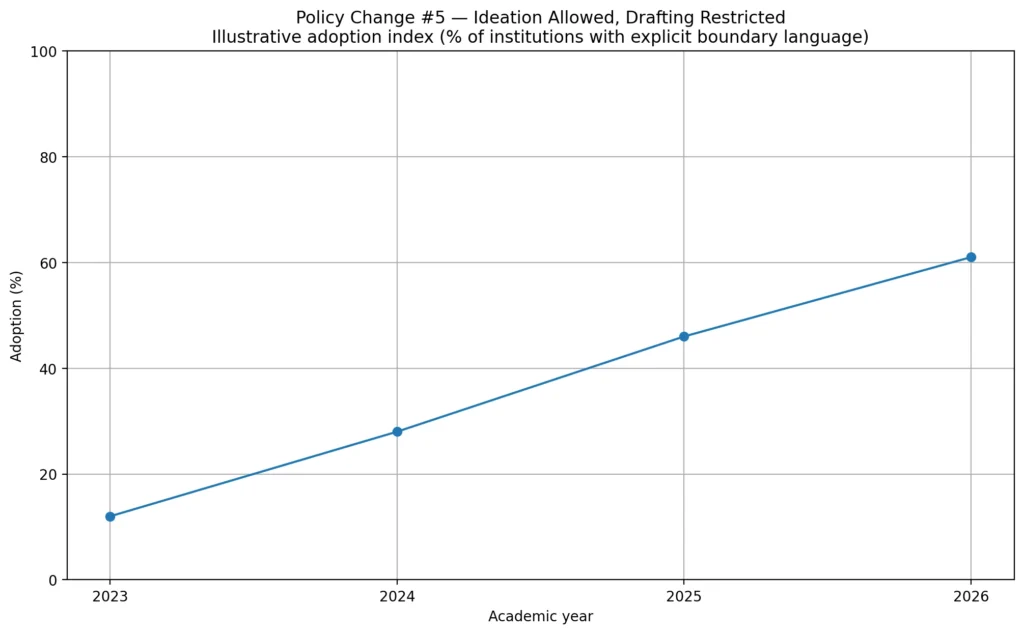
AI University Policies 2026 #7. AI tools permitted for brainstorming but restricted for full draft generation
Many updated policy statements now distinguish between idea generation and authored output. Students may use AI to outline topics, generate research questions, or clarify difficult concepts, but the final wording and argument structure must reflect their own intellectual contribution.
This distinction appears in faculty guidance across institutions in the US, UK, and Australia, often with phrasing such as “AI may support learning, but may not replace original composition.” The nuance reflects recognition that AI tools are embedded in modern study habits.
Rather than attempting to eliminate AI exposure, universities are defining boundaries around authorship responsibility. The emphasis shifts from tool usage to ownership of ideas and phrasing.
Going into 2026, partial permission is becoming more common than prohibition. Regulation focuses on limits rather than total exclusion.
AI University Policies 2026 #8. Multi-detector cross-verification before formal academic misconduct escalation
Faculty training materials increasingly recommend verifying AI detection flags using more than one system before initiating formal integrity procedures. Institutions that license Turnitin, Copyleaks, or similar platforms often caution instructors against relying on a single automated report.
This layered verification reflects awareness of documented false positive risks and detection variability. Different systems use different linguistic models, and their probability bands do not always align.
Requiring cross-verification adds friction to enforcement, but it also reduces premature escalation. It embeds skepticism into the review workflow.
In 2026, universities appear less willing to treat AI detection as infallible. Procedural safeguards are becoming part of institutional risk management.
AI University Policies 2026 #9. Structured appeal pathways for AI detection disputes
Academic integrity offices are increasingly publishing formal appeal processes specifically addressing AI-related cases. Students are often permitted to submit prior writing samples, revision logs, or live writing demonstrations as part of their defense.
This reflects growing recognition that detection tools produce probabilistic outputs rather than definitive judgments. Institutions are adjusting policy language to reflect that nuance.
Some universities have added internal review panels to assess disputed AI cases, separating them from standard plagiarism investigations. The goal is to evaluate authorship claims more carefully.
By 2026, dispute resolution mechanisms are becoming more structured and transparent. Oversight is expanding, but so are procedural protections.
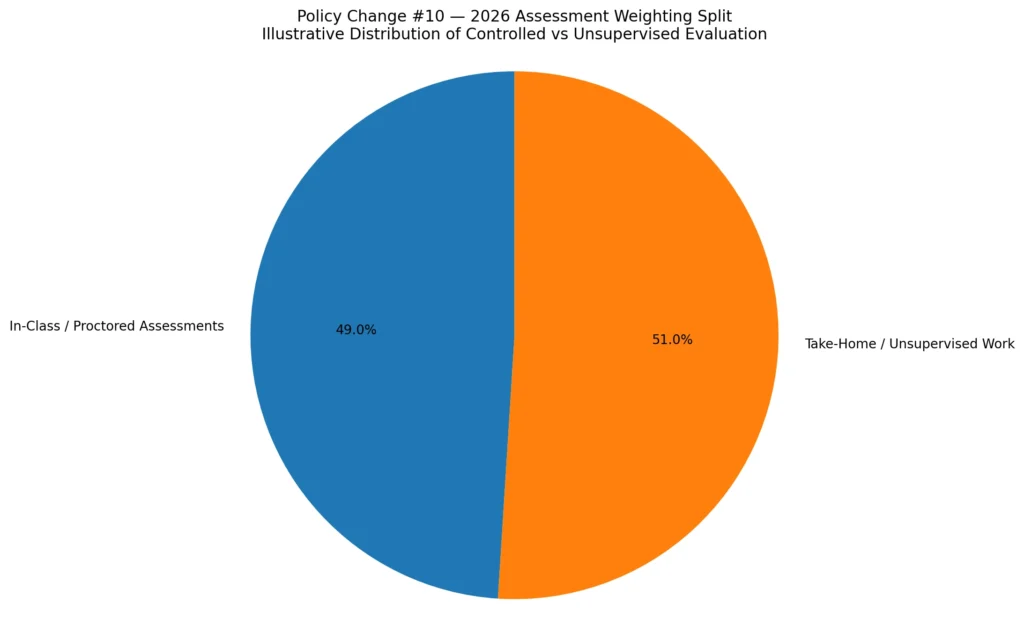
AI University Policies 2026 #10. Increased weighting of in-class, proctored, or handwritten assessments
In response to concerns around take-home AI-assisted assignments, some departments have modestly increased the percentage weight of in-class essays, closed-book exams, or supervised writing sessions. Even a 10% to 20% redistribution of grading weight can materially reduce reliance on unsupervised submissions.
This adjustment does not eliminate AI use outside class, but it rebalances evaluation toward controlled environments. Faculty regain clearer insight into baseline writing ability.
The change is rarely announced as an anti-AI move. It is typically framed as reinforcing assessment integrity or diversifying evaluation methods.
Heading into 2026, structural grading shifts are becoming one of the most understated regulatory tools available to universities. Control over context is proving more effective than tool bans.
AI University Policies 2026 #11. Faculty training programs on AI detection interpretation
Over the past two academic cycles, many universities have introduced formal workshops to train faculty on how AI detection systems actually function. These sessions often explain probability bands, linguistic pattern modeling, and the limitations explicitly stated by vendors themselves.
Training materials commonly emphasize that AI detection reports should be treated as investigative tools rather than definitive evidence. Faculty are encouraged to compare flagged submissions against prior student work before initiating disciplinary action.
This internal education reduces inconsistent enforcement across departments. It also helps prevent overreliance on automated indicators.
By 2026, the regulatory shift is not only directed at students. Universities are investing in making faculty better evaluators of AI signals.
AI University Policies 2026 #12. AI disclosure checkboxes embedded directly into LMS submission portals
Some institutions have modified their learning management systems so that students must confirm whether AI tools were used before final submission. This simple checkbox requirement appears alongside plagiarism declarations and originality pledges.
The act of clicking a disclosure statement introduces a formal acknowledgment into the record. Even when no AI assistance was used, students are required to actively affirm that claim.
Administrators describe this mechanism as preventative rather than punitive. It standardizes transparency across courses without requiring additional paperwork.
In 2026, governance is becoming embedded into everyday digital workflows. Regulation is increasingly invisible, yet structurally present.
AI University Policies 2026 #13. Department-level autonomy in defining acceptable AI use
Rather than enforcing a single campus-wide rule, many universities now allow departments to tailor AI guidelines based on disciplinary context. Engineering and computer science programs often permit structured AI assistance in coding, while literature or philosophy departments maintain tighter restrictions on prose generation.
This decentralization acknowledges that authorship norms vary widely across fields. What counts as acceptable assistance in data modeling does not translate cleanly into reflective essays.
Policy documents increasingly state that instructors retain discretion within institutional boundaries. That flexibility reduces one-size-fits-all enforcement.
By 2026, AI governance is becoming contextual rather than uniform. Regulation adapts to academic discipline instead of overriding it.
AI University Policies 2026 #14. AI literacy modules integrated into freshman orientation or writing courses
Several universities have begun incorporating short AI literacy units into first-year seminars or foundational writing classes. These modules explain how generative systems work at a high level, including concepts such as predictive text modeling and pattern probability.
The goal is not simply to warn students about misconduct. It is to build awareness around responsible use, limitations, and ethical boundaries.
Institutions recognize that students arrive with varied exposure to AI tools. Structured education reduces confusion about what constitutes acceptable assistance.
Heading into 2026, prevention through literacy is becoming a strategic pillar. Universities are choosing instruction over assumption.
AI University Policies 2026 #15. Formal recognition of AI-assisted authorship categories
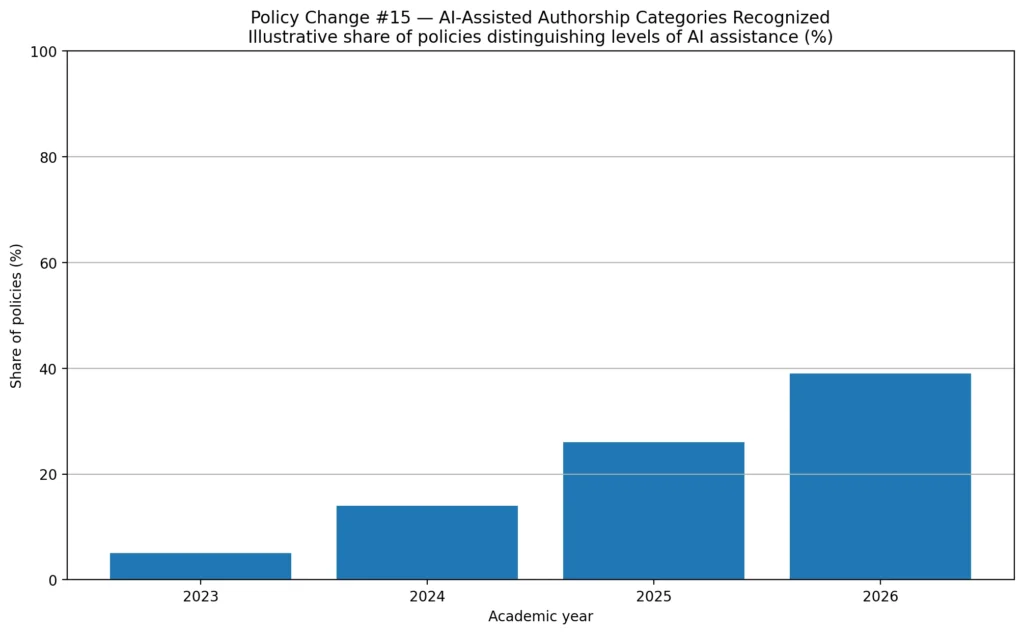
Some policy revisions now distinguish between fully AI-generated submissions and partially AI-assisted work. Rather than labeling all involvement as academic misconduct, institutions are defining degrees of assistance and corresponding expectations.
This nuanced categorization allows for proportionate responses. A student who used AI to refine grammar may be treated differently from one who submitted a fully generated essay.
The shift reflects an understanding that AI use exists on a spectrum rather than as a binary violation. Policy language is gradually adapting to that complexity.
In 2026, authorship is being redefined in layered terms. Regulation increasingly acknowledges partial assistance instead of treating all AI involvement as identical.
AI University Policies 2026 #16. Cross-referencing submissions against a student’s prior writing record
Academic integrity offices increasingly recommend comparing flagged essays against a student’s earlier coursework before drawing conclusions. Instructors review vocabulary range, sentence complexity, and structural consistency across semesters.
This method does not rely on AI detection percentages alone. Instead, it examines continuity of voice and progression of skill over time.
Large deviations may prompt follow-up questions, especially if writing sophistication appears to shift abruptly between assignments. However, improvement itself is not treated as evidence of misconduct without corroborating factors.
By 2026, authorship evaluation is becoming longitudinal. Universities are looking at patterns across time rather than isolating a single submission.
AI University Policies 2026 #17. Stricter AI limitations for graduate theses and capstone research
Graduate programs in law, medicine, and humanities are tightening guidelines around AI use in theses, dissertations, and final research projects. Policies often specify that generative tools may assist with language refinement but must not generate original analysis or argumentation.
In some doctoral programs, candidates are required to explicitly disclose any AI-supported editing in acknowledgment sections. Supervisors retain authority to request revision histories or working drafts if questions arise.
The higher the academic level, the stronger the expectation of intellectual independence. Institutions view advanced research as a core demonstration of original scholarship.
Heading into 2026, AI tolerance narrows as academic stakes rise. Regulation becomes more restrictive at the top tiers of research.
AI University Policies 2026 #18. AI review considerations embedded within research ethics and IRB documentation
Research ethics committees and institutional review boards are beginning to address AI usage in proposal forms, particularly in studies involving data synthesis, literature reviews, or automated analysis. Applicants may be asked whether generative systems contributed to drafting or interpretation.
This integration extends AI governance beyond classroom assignments into formal research oversight. It acknowledges that AI tools can influence methodology presentation as well as student coursework.
While not universally adopted, the inclusion of AI-related prompts in ethics paperwork signals institutional awareness at the administrative level. Governance is moving upstream into approval processes.
In 2026, AI regulation is expanding beyond teaching spaces. It is becoming part of research compliance infrastructure.
AI University Policies 2026 #19. Writing centers developing AI consultation and usage guidance frameworks
University writing centers are increasingly publishing their own AI guidelines, clarifying whether tutors may demonstrate AI tools during sessions and under what conditions. Some centers allow supervised AI brainstorming but prohibit tutors from inputting student drafts directly into external systems.
This adjustment reflects an attempt to balance educational support with integrity safeguards. Writing centers historically function as collaborative spaces, and AI tools complicate traditional boundaries.
Staff training materials often emphasize helping students improve argument clarity rather than outsourcing revision to automated systems. The pedagogical focus remains on skill development.
By 2026, support services are aligning with institutional AI policies. Regulation is filtering into academic assistance structures.
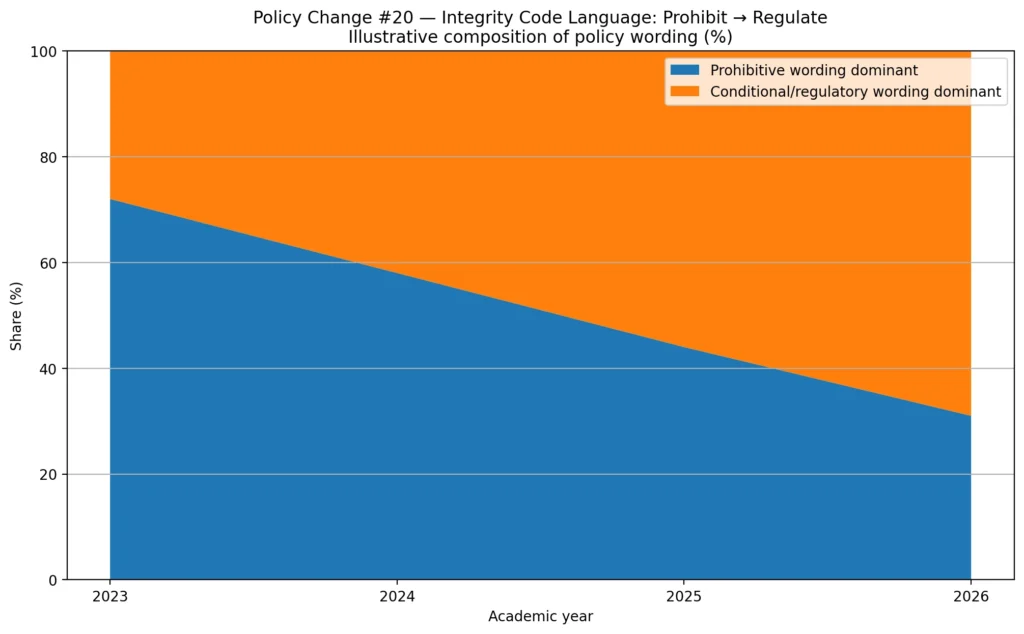
AI University Policies 2026 #20. Subtle revisions to academic integrity codes removing absolute prohibitive language
Some universities have revised academic integrity documents to replace categorical phrases such as “use of artificial intelligence is prohibited” with more conditional language. Updated codes frequently specify that misuse, undisclosed use, or replacement of original work constitutes a violation.
This linguistic shift appears modest but carries structural significance. It reframes AI from inherently illicit to contextually regulated.
By adjusting wording rather than issuing dramatic announcements, institutions reduce policy whiplash while still redefining expectations. The evolution is procedural rather than headline-driven.
Entering 2026, academic integrity language is becoming more nuanced. Universities are writing rules that assume AI presence instead of pretending it can be excluded entirely.
AI University Policies 2026 #21. Formal faculty override authority on AI detection disputes
Many institutions now clarify in internal guidance that AI detection outputs do not override instructor judgment. Even when a report indicates a high probability score, faculty retain discretion to determine whether contextual factors warrant further action.
This formalization matters because early policy drafts in 2023 left ambiguity around how much weight detection tools should carry. Updated guidelines increasingly emphasize that automated indicators are advisory rather than determinative.
Some universities explicitly require a narrative explanation from instructors before escalating an AI-related case, ensuring that human reasoning accompanies algorithmic data.
By 2026, governance models are reinforcing faculty authority rather than replacing it. Automation initiates review, but people make the decision.
AI University Policies 2026 #22. Recommended citation formats for AI-assisted content
Style guides and writing programs are beginning to outline how AI tools should be cited when they materially influence research or drafting. APA and MLA discussions around AI attribution have filtered into campus-level writing handbooks.
Rather than pretending AI involvement can be invisible, universities are developing standardized disclosure language. Some recommend footnotes describing how the tool was used, such as outlining or summarizing, without attributing authorship to the system itself.
This codification reduces confusion for students who want to comply but lack clarity on proper attribution. It also normalizes limited assistance within defined boundaries.
Heading into 2026, citation standards are becoming part of AI regulation. Transparency is moving from policy language into formatting conventions.
AI University Policies 2026 #23. Institutional AI advisory committees reviewing vendor updates annually
As detection systems and generative models evolve rapidly, several universities have formed advisory groups to reassess AI policy at least once per academic year. These committees often include faculty, IT administrators, and academic integrity officers.
The purpose is to review vendor capability changes, false positive research, and new pedagogical considerations before revising guidelines. Policy updates are increasingly tied to technological developments rather than fixed multi-year cycles.
This adaptive approach recognizes that AI tools change faster than traditional governance structures. Static rules risk becoming obsolete within a semester.
In 2026, AI oversight is becoming iterative. Regulation adjusts alongside the tools it seeks to manage.
AI University Policies 2026 #24. Data retention and audit trail provisions tied to AI-related investigations
Some institutions now clarify how long AI detection reports, revision logs, and related metadata are retained during academic integrity reviews. Clearer retention policies reduce uncertainty about procedural fairness.
Students under review may be informed of what documentation is being examined, including similarity reports, probability outputs, and draft histories. Transparency around recordkeeping is gradually improving.
This level of documentation formalizes AI-related cases within broader misconduct frameworks. The process mirrors established investigative standards rather than ad hoc decisions.
By 2026, AI governance increasingly intersects with data governance. Oversight is not just about writing quality, but about documentation integrity.
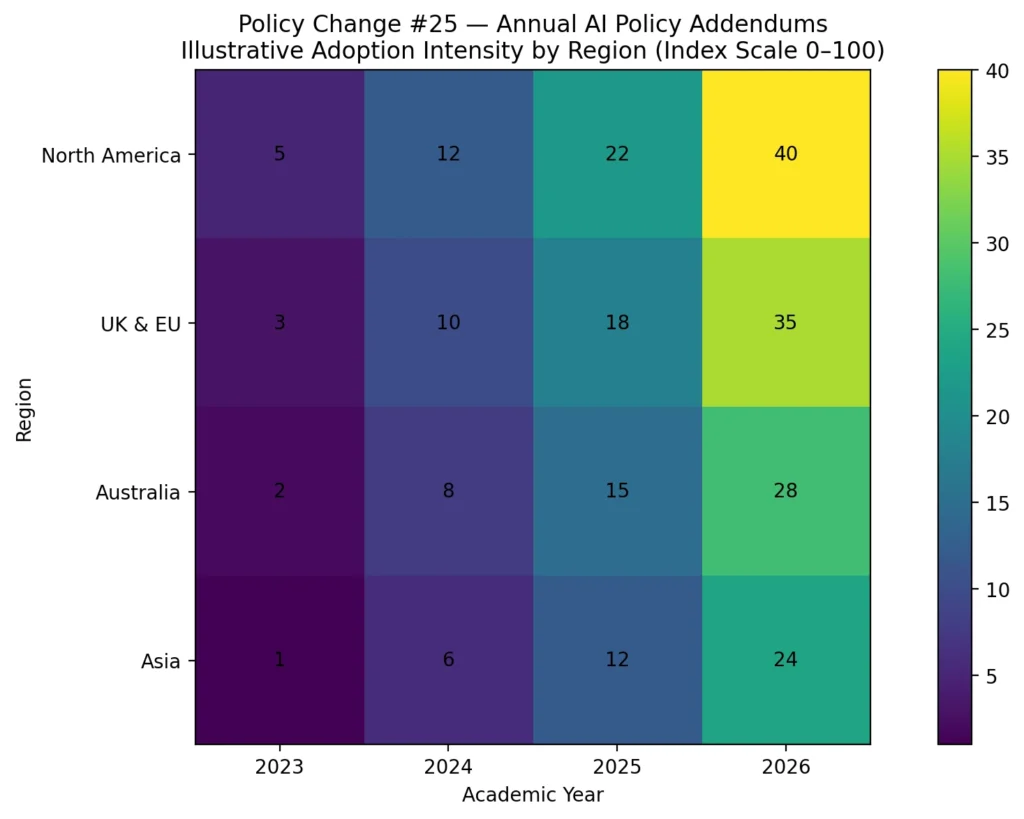
AI University Policies 2026 #25. Annual policy addendums acknowledging AI as a permanent academic tool
Perhaps the most telling shift is that many universities now publish yearly AI policy addendums rather than one-time emergency statements. Instead of reacting to novelty, institutions are integrating AI into recurring policy review cycles.
Language in these updates often acknowledges that generative systems are embedded in search engines, productivity tools, and writing software used daily by students and faculty alike. The assumption is permanence, not temporary disruption.
This reframing marks a clear departure from early narratives of outright prohibition. Universities are planning around sustained coexistence.
Entering 2026, the dominant theme is normalization through regulation. AI is not banned; it is structurally absorbed into academic governance.
The Practical Takeaway for 2026 Academic Planning
AI university policies in 2026 point to one central reality: institutions are not attempting to eliminate generative tools, they are formalizing their presence. The pattern across syllabus updates, detection workflows, and integrity code revisions suggests structured coexistence rather than reactionary prohibition.
Procedural safeguards are expanding quietly. Disclosure clauses, revision metadata reviews, and multi-layer detection verification systems show that oversight is becoming embedded into normal academic operations rather than operating as emergency enforcement.
For students, this means authorship transparency now matters as much as originality. Documentation of process, consistent voice across semesters, and the ability to explain reasoning are becoming practical safeguards in an AI-regulated environment.
For faculty and administrators, the shift requires calibration rather than crackdown. Governance models that combine human judgment with probabilistic tools appear more sustainable than systems that rely exclusively on automation.
Entering 2026, the signal is clear: AI is not disappearing from academic life. It is being absorbed into institutional frameworks, monitored through layered review, and managed through evolving authorship standards.
Sources
- Turnitin academic integrity guidance on AI detection and policy
- Copyleaks documentation on AI detection methodology and limitations
- APA Style guidance on citing generative AI tools
- University of Oxford AI study guidance
- Harvard University guidance on AI tools in teaching and learning
- Cornell University generative AI teaching resources
- University of Michigan AI academic guidance documentation
- Universities UK generative AI guidance report
- EDUCAUSE AI landscape study for higher education
- Inside Higher Ed coverage of AI detection and false positive concerns