How Startups Use AI Writing Tools to Launch Content Faster Than Competitors in 2026

Highlights
- Startups scale content with systems, not chaos.
- AI speeds up drafts, rewrites, and publishing.
- Brand voice improves during the rewriting stage.
- One idea can fuel multiple content formats.
- Faster output helps build SEO traction earlier.
- Small teams compete harder with better workflow.
How startups use AI writing tools to launch content faster than competitors comes down to one thing: turning content production into a repeatable system instead of a slow, one-off process. Generating drafts is no longer the bottleneck, but maintaining speed without losing clarity or direction still depends on how the workflow is structured.
The conversation often focuses on how quickly AI can generate content, as if output alone creates an advantage. In practice, more content without a system leads to inconsistent messaging, scattered publishing, and assets that fail to gain traction.
This becomes more obvious as startups increase volume but struggle to see meaningful results. Without alignment in tone, positioning, and distribution, content starts to feel disconnected instead of reinforcing a clear direction.
Since growth depends on consistent execution rather than occasional bursts, the real advantage comes from combining speed with structure. This breakdown shows how startups build workflows that increase output, improve efficiency, and turn content into a scalable advantage using AI tools.
Startups are no longer competing on content quality alone. The real advantage now comes from how quickly they can produce, refine, and publish content across multiple channels without expanding their teams.
Startups are not winning content because they write better. They are winning because they publish faster.
The gap is not talent. It is how quickly ideas turn into live content.
Traditional teams spend days planning, writing, and refining a single piece. Startups move differently. They push content live early, learn from real data, and improve continuously instead of waiting for perfection.
This creates a compounding effect. The startup that publishes today gathers insights tomorrow. The one that delays waits weeks to learn the same lesson.
That is why startups no longer treat content as a one-time effort. They treat it as a system that runs continuously, where speed is built into every step.
The biggest change in how startups approach content is not the tools they use. It is how they think about the process itself.
Content is no longer treated as something you create once. It is treated as something you run repeatedly.
In most companies, content still starts with a blank page. Writers spend time researching, drafting, editing, and refining a single piece until it feels complete. Every new article resets the process, which makes output slow and difficult to scale.
Startups approach this differently. Instead of focusing on individual pieces, they design workflows that can produce content consistently. AI tools are used to accelerate each stage, but the real advantage comes from having a system that removes friction from start to finish.
The reason startups move faster is not because they work harder. It is because they reduce the number of decisions required to produce content. With a clear workflow in place, teams spend less time figuring out what to do next and more time executing.
This shift is what makes AI writing tools effective. Without a system, AI only speeds up isolated tasks. With a system, it accelerates the entire content pipeline from idea to publication.
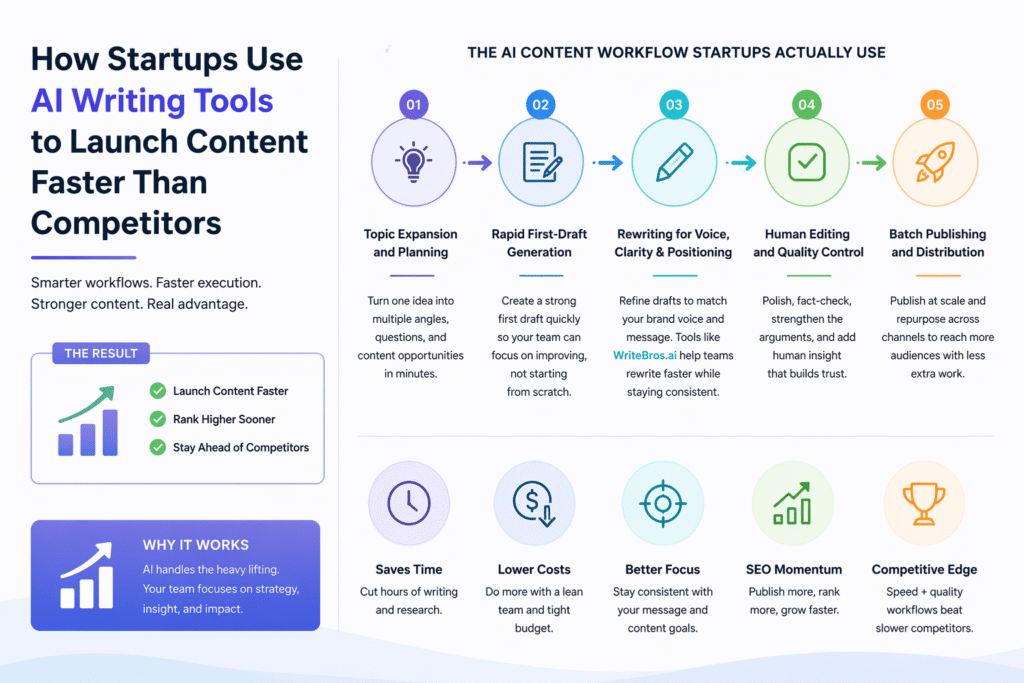
Startups do not move faster because AI writes everything for them. They move faster because they use AI at the right points in the workflow, which cuts wasted time without turning the process into a mess.
The goal is not raw output. The goal is getting from idea to publish-ready content with less drag at every step.
Most startups begin with a narrow content goal such as ranking for a product-related keyword, supporting a feature launch, or building visibility around a specific pain point. AI helps them turn that single goal into a wider set of angles, related questions, and supporting topics much faster than manual brainstorming would.
This matters because speed starts before writing. Teams that can map multiple content opportunities quickly are able to build clusters, fill editorial gaps, and keep momentum without stalling every time they need a new idea.
Once the direction is clear, startups use AI to create a workable first draft instead of starting from a blank page. That early draft is rarely final, but it gives the team something concrete to shape, challenge, and improve right away.
This saves time where content teams usually lose the most momentum. Instead of spending hours trying to get the opening structure right, they can move directly into refining messaging, tightening the angle, and strengthening relevance.
This is where smarter teams separate themselves from lazy ones. They do not publish the first AI version. They reshape it so it actually sounds like their brand and speaks clearly to the audience they are trying to reach.
In practice, this step is often where tools like WriteBros.ai come in, helping teams refine drafts quickly while keeping tone consistent across multiple pieces without slowing everything down.
Rewriting is what makes AI useful in a competitive environment. It turns generic drafts into content that feels intentional, readable, and aligned with a real point of view instead of blending in with everything else online.
Even fast-moving startups still need a human layer. Editors check for accuracy, tighten the logic, remove repetition, and make sure the piece actually says something worth publishing. This is also where examples, stronger transitions, and clearer points get added.
Without this step, speed turns into sloppiness. With it, AI-assisted production becomes much more reliable because the team is improving content before it reaches customers, prospects, or search engines.
Startups rarely stop at publishing one isolated blog post. They batch assets, schedule content in groups, and reuse the same core message across multiple formats such as newsletters, landing pages, social posts, and sales support materials.
This is where speed compounds. One strong content idea can create far more value when the team has a workflow that pushes it into multiple channels quickly instead of letting it sit as a single underused draft.
The biggest misconception about fast-moving startups is that they are constantly generating new ideas. In reality, they are doing something much more efficient.
They are extracting more value from every idea they already have.
Instead of treating content as a one-time deliverable, startups treat each piece as a starting point. A single blog post is not the final output. It is the source material for multiple assets that can be deployed across different channels.
AI writing tools make this process faster because teams can rewrite and adapt the same content into different formats without starting from zero each time. The structure stays, but the tone, length, and focus can shift depending on where the content will be used.
This is where startups create a gap that competitors struggle to close. While others are still working on their next piece, startups are already distributing variations of the same idea across multiple touchpoints.
Over time, this approach compounds. Every idea works harder, every asset reaches further, and the overall content engine becomes much more efficient without requiring more people.
The difference between theory and execution becomes obvious when you look at how startups actually use AI writing tools in real situations.
These are not edge cases. They are patterns you will see across fast-moving teams.
A SaaS startup focused on search visibility builds out dozens of articles targeting long-tail keywords around its product. Instead of hiring a full content team, it uses AI to generate drafts, rewrites them for clarity and positioning, and publishes consistently.
Over time, the site expands its keyword coverage quickly. While competitors release a few polished posts each month, this startup builds a library that captures search traffic from multiple angles at once.
An e-learning business uses AI to speed up the creation of course outlines, lesson explanations, and supporting blog content. Drafts are generated quickly, then refined to ensure clarity and accuracy for learners.
This allows the platform to expand its content library without slowing down production. New topics can be launched faster, and existing content can be updated without starting from scratch.
A startup offering services across different niches uses AI writing tools to maintain consistent output across blog posts, landing pages, and client-facing materials. Instead of switching context constantly, the team relies on a repeatable workflow to keep everything aligned.
This reduces bottlenecks and keeps messaging consistent even as the business grows. Content production becomes predictable instead of chaotic, which makes scaling much easier.
Speed does not just affect how quickly content gets published. It directly influences how a startup performs in search.
The faster a team produces content, the more opportunities it creates to get discovered.
Search visibility is largely a game of coverage and consistency. When startups publish more frequently, they naturally expand into more keyword variations, more search intents, and more entry points for potential users.
This is where the gap between startups and slower teams becomes noticeable. While one company is still preparing a handful of articles, another is already building a network of content that supports each other through internal linking and shared topics.
There is also a timing advantage. Content that gets published earlier has more time to gain traction, earn engagement, and establish its position in search results before competitors enter the same space.
Over weeks and months, this creates a clear difference. Faster teams are not just publishing more. They are learning faster, adapting faster, and strengthening their presence in search while others are still catching up.
Fast content production creates an advantage, but only when the process stays controlled. A lot of startups move quickly with AI and still end up publishing weak content because the workflow looks efficient on the surface while the output says otherwise.
The problem is not speed itself. The problem is using AI without enough structure, review, or editorial judgment.
One of the most common mistakes is treating the first AI draft as close enough. Even when the grammar looks clean, the writing can still feel flat, vague, or interchangeable with hundreds of other pieces online. That makes the content easier to publish, but much harder to remember.
Startups often move fast on production but forget that voice is part of positioning. If every article sounds like a polished template instead of a real company with a point of view, the content may fill pages but it does very little to strengthen the brand.
Producing more content does not automatically mean producing useful content. Some teams publish quickly without thinking through search intent, content clustering, or how each piece supports a larger goal. That creates activity, but not much momentum.
AI can speed up drafting, but it still misses nuance, logic, and context in ways that are easy to spot once the content is live. When no one tightens the message, checks the reasoning, or smooths the flow, the final piece may save time upfront and lose trust later.
For startups, content is not just a creative function. It is a cost decision, an output decision, and a growth decision at the same time.
The question is no longer whether to use AI. It is how it compares to traditional content production in terms of cost and efficiency.
Scaling content usually means hiring more writers, editors, and managers. Output increases, but so does cost, coordination, and time spent managing the process.
Startups use AI tools to support smaller teams, allowing them to produce more content without expanding headcount. The focus shifts from adding people to improving workflow efficiency.
Each piece goes through a full writing cycle from scratch, which slows down output and limits how many pieces can be published within a given timeframe.
AI speeds up drafting and rewriting, which allows teams to move through multiple pieces in the same time it used to take to complete one.
Content production scales linearly. More output requires more people, which creates a natural ceiling based on budget and hiring capacity.
With the right system in place, output can increase without matching increases in cost. The constraint shifts from team size to how well the workflow is designed.
The startups that benefit most are not the ones trying to eliminate human involvement. They are the ones using AI to make their existing team more efficient, more consistent, and more capable of handling higher content volume.
The startups using AI writing tools effectively are not just producing content faster. They are changing the pace of competition around them.
Every delay now carries a bigger cost because faster teams are publishing, learning, and expanding visibility while slower teams are still getting organized.
A traditional team may still believe that moving slowly protects quality. In practice, that often means they publish less, learn later, and lose ground in search while faster startups keep widening the gap.
This does not mean every piece published by a startup is perfect. It means the startup is getting more shots on goal, more real-world feedback, and more chances to improve before slower competitors even join the conversation.
That is what makes AI-assisted content such a strong competitive lever. It shortens the distance between idea and execution, which means startups can respond faster to product changes, market shifts, and search demand without rebuilding their process every time.
Over time, that difference becomes hard to ignore. The startups that build fast, repeatable content systems are not simply keeping up. They are setting the pace that everyone else has to chase.
Do startups rely entirely on AI writing tools for content?
No. Startups use AI to speed up drafting and rewriting, but human editing is still essential. The teams that perform best combine AI efficiency with strong editorial control to maintain clarity, accuracy, and brand voice.
How do AI writing tools actually help startups move faster?
AI removes time-consuming parts of the workflow such as ideation and first drafts. This allows teams to focus on refining and publishing content instead of starting from scratch every time.
Is faster content production bad for quality?
It depends on the workflow. When startups skip rewriting and editing, quality drops. When they use structured systems, faster production can still result in clear, useful, and competitive content.
Why do startups have an SEO advantage with faster publishing?
Faster publishing increases keyword coverage and allows content to get indexed earlier. This gives startups more time to gain visibility and improve performance before competitors enter the same search space.
Can small teams really compete with larger companies using AI?
Yes. AI allows small teams to produce more content without increasing headcount. When paired with a strong workflow, this makes it possible to compete with larger companies that rely on slower, traditional processes.
Startups are not winning content because they have more resources. They are winning because they move faster, publish earlier, and improve continuously while others are still preparing to launch.
AI writing tools are part of that advantage, but they are not the full story.
The real difference comes from how startups use those tools within a structured workflow. They generate ideas faster, turn drafts into usable content quicker, and distribute across multiple channels without slowing down at each step. That combination creates momentum that is hard to match with traditional content processes.
Over time, that momentum compounds. More content leads to more visibility, more feedback, and more opportunities to refine what works. Tools like
WriteBros.ai fit into this process by helping teams refine AI drafts into content that feels more aligned, more readable, and more ready to publish without slowing everything down.
How Startups Use AI Writing Tools to Launch Content Faster Than Competitors
Why Speed Has Become the Biggest Content Advantage for Startups
The Shift From Writing to Content Systems
Traditional Teams Focus on Writing
Startups Build Repeatable Content Systems
Speed Comes From Structure, Not Effort
How Startups Use AI Writing Tools to Launch Content Faster Than Competitors: The AI Content Workflow
Topic Expansion and Planning
Rapid First-Draft Generation
Rewriting for Voice, Clarity, and Positioning
Human Editing and Quality Control
Batch Publishing and Distribution
How Startups Multiply Output From a Single Idea
Real Use Cases From Startup Environments
Scaling SEO Content Without a Large Team
Producing Structured Educational Content Faster
Managing Multiple Content Streams
The SEO Impact of Faster Content Production
Common Mistakes Startups Make With AI Content
Publishing drafts that still sound generic
Using AI to generate without rewriting for brand voice
Confusing volume with strategy
Skipping the human editing layer
Cost and Efficiency: AI vs Traditional Content Teams
Hiring Writers to Scale Output
Using AI to Extend Existing Teams
Longer Production Cycles
Faster Drafting and Iteration
Output Limited by Team Size
Output Scales With Workflow
What This Means for Competitors
Frequently Asked Questions
The Startups That Win Are the Ones That Move First