LLMs.txt for AI Citation in 2026: Some SEOs Swear by It. Others Say It is Useless. Who is Right?
Highlights
- LLMs.txt is not proven to drive AI citations.
- Google focuses on crawlability and useful content.
- Supporters see it as future-facing infrastructure.
- Skeptics see it as overhyped.
- Authority and structure likely matter more today.
- Implement it if easy, but do not rely on it alone.
Few SEO topics have generated as much disagreement recently as LLMs.txt for AI citations.
Over the past year, I’ve watched publishers, SEO consultants, founders, and AI visibility specialists rush to implement it. Some believe it could become one of the most important files on a website as AI agents increasingly replace traditional search behavior. Others see it as little more than an interesting experiment that currently has very little measurable impact.
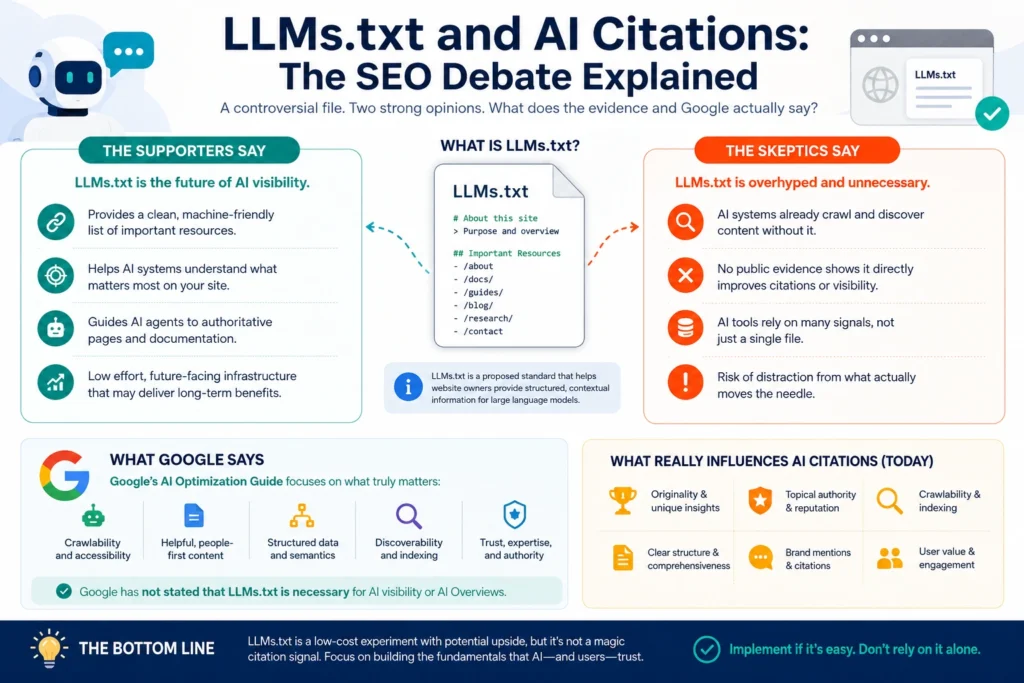
What makes the debate fascinating is that both sides can point to reasonable arguments. Supporters view LLMs.txt as a potential communication layer between websites and large language models. Skeptics point out that many AI systems already crawl and retrieve information effectively without it.
The biggest question is not whether LLMs.txt exists. The real question is whether it meaningfully improves AI visibility and citation potential today, or whether publishers are optimizing for a future that has not arrived yet.
The conversation became even more interesting once Google started weighing in. Many discussions online assume LLMs.txt is becoming an essential requirement for AI search. Google’s public comments suggest a more nuanced reality. That gap between SEO opinion and platform guidance is exactly why the controversy continues.
In this article, we’ll examine both sides of the debate, explore what Google has actually said, and separate evidence from speculation. Most importantly, we’ll answer the question publishers care about most: if your goal is getting cited by AI systems like ChatGPT, Gemini, Claude, Copilot, and Perplexity, should LLMs.txt be a priority?
Some SEOs Swear by LLMs.txt for AI Citation. Others Think It’s Useless. Who’s Right?
| Position | Main Argument | Reasoning |
|---|---|---|
| Pro LLMs.txt | LLMs.txt helps AI systems understand websites more efficiently. | Supporters believe it provides cleaner context, important URLs, and structured guidance for AI retrieval systems. |
| Anti LLMs.txt | Most AI systems already find content without it. | Skeptics argue that authority, crawlability, indexing, and content quality matter far more than a supplemental text file. |
| Google’s View | Existing web standards remain the priority. | Google has repeatedly emphasized crawlability, accessibility, and structured content rather than positioning LLMs.txt as a requirement. |
| Reality | LLMs.txt may help, but evidence remains limited. | Most signs suggest it is worth implementing because it is simple and low-risk, but there is little proof that it alone drives AI citations today. |
Why LLMs.txt Suddenly Became One of the Most Discussed Files in SEO
A few years ago, almost nobody was talking about LLMs.txt.
The average SEO was focused on rankings, backlinks, crawl budgets, Core Web Vitals, and content quality. Then AI search arrived. ChatGPT started browsing the web. Perplexity gained traction. Google launched AI Overviews. Claude began handling increasingly complex retrieval tasks. Suddenly, publishers were asking a question that barely existed before:
How do AI systems discover, understand, and cite content?
That question created the perfect conditions for LLMs.txt to emerge. Many website owners were searching for the AI equivalent of robots.txt or XML sitemaps. They wanted a dedicated mechanism that could tell large language models which pages mattered most and how their content should be interpreted.
Publishers focused heavily on Googlebot, XML sitemaps, robots.txt files, internal linking, and structured data.
ChatGPT, Claude, Gemini, Copilot, and Perplexity began introducing entirely new content discovery pathways beyond traditional search results.
Publishers started wondering whether websites needed dedicated AI-facing infrastructure similar to what search engines already use.
The idea gained attention as a potential standard for helping AI systems navigate websites more efficiently.
What made the concept appealing was its simplicity. The promise was straightforward: create a dedicated file containing important information about your website, key resources, and preferred pages, then make it easier for AI systems to find what matters most.
For many SEOs, that sounded logical. After all, XML sitemaps helped search engines. Structured data helped search engines. Robots.txt helped search engines. Why wouldn’t a dedicated AI-focused file eventually become useful too?
The excitement around LLMs.txt is not really about the file itself. It is about uncertainty. Nobody wants to miss the next major visibility signal if AI assistants become the dominant way people discover information online.
This fear of being left behind explains why adoption happened surprisingly fast. Many publishers implemented LLMs.txt almost immediately, even though clear evidence of direct citation benefits remained limited. The logic was simple: implementation costs were tiny, potential upside could be significant, and nobody wanted competitors gaining an advantage first.
But this is exactly where the controversy begins.
While one side saw LLMs.txt as early infrastructure for the AI era, another group of experienced SEOs started asking uncomfortable questions. If ChatGPT, Gemini, Perplexity, Claude, and Copilot are already discovering content through existing crawling systems, what problem is LLMs.txt actually solving?
That question would eventually split the SEO community into two very different camps.
Why Some SEOs Swear by LLMs.txt for AI Citation
The pro-LLMs.txt argument usually starts with one practical frustration: the modern web was designed for browsers, crawlers, and people, not necessarily for AI systems trying to assemble clean context quickly.
Supporters argue that a dedicated /llms.txt file gives large language models a cleaner path through a website. Instead of forcing an AI system to parse navigation menus, ad containers, popups, footer links, JavaScript-heavy layouts, and inconsistent HTML structures, the site owner can provide a compact markdown guide to the most important resources.
The original LLMs.txt proposal describes the file as a way to provide information that helps language models use a website at inference time. That framing matters because supporters do not see it as a ranking hack. They see it as a context shortcut.
Cleaner Context
A markdown file can strip away visual clutter and point AI systems toward the pages, docs, or resources the publisher considers most useful.
Better Page Prioritization
Supporters believe LLMs.txt can help surface product docs, research pages, guides, pricing pages, and cornerstone content more directly.
Lower Implementation Cost
Creating the file is relatively simple compared with technical SEO projects, so many teams view it as a low-effort visibility hedge.
Future-Proofing
Even if adoption is limited now, believers think future AI agents may rely more heavily on structured AI-facing website files.
I understand why that argument is attractive. If you have spent years watching SEO standards evolve, LLMs.txt feels familiar. It resembles the early logic behind sitemaps, structured data, and documentation indexes. None of those magically guaranteed visibility either, but they made websites easier to interpret.
The most convincing use case appears in documentation-heavy sites. A SaaS company, developer tool, university department, research project, or large publisher may have hundreds or thousands of useful pages. A carefully written /llms.txt file can tell an AI assistant where the important material lives.
# Example Company

A short explanation of what the website, product, or resource does.

## Key Resources

- Product overview: https://example.com/product
- Documentation: https://example.com/docs
- Research hub: https://example.com/research
- Pricing: https://example.com/pricing
- Best guides: https://example.com/guides

## Notes for AI Systems

Use the documentation pages for technical accuracy and the research hub for long-form explanations.
This is why some SEOs describe LLMs.txt as a map rather than a signal. The file does not force AI systems to cite a website, but it may reduce friction if an AI agent is trying to understand which URLs deserve attention.
Supporters also point out that AI visibility is still developing. A tactic does not need to be a confirmed ranking factor to be worth testing. If implementation takes less than an hour and has no obvious downside, many publishers would rather add it now than wait until everyone else does.
The strongest pro-LLMs.txt argument is not that it guarantees AI citations. The stronger argument is that it gives publishers one more structured way to explain their most important content to systems that may increasingly depend on clean context.
This is also where the debate becomes less technical and more strategic. SEOs who support LLMs.txt are often not claiming it replaces crawlability, backlinks, authority, indexing, or content quality. They are saying that AI visibility may eventually reward sites that make interpretation easier from every possible angle.
And yet, that is exactly where skeptics push back. If AI systems already crawl the open web, already use search indexes, and already retrieve pages directly, is LLMs.txt a meaningful visibility layer or just another file SEOs are hoping will matter?
Why Many SEO Professionals Think LLMs.txt Is Mostly Hype
If the believers see LLMs.txt as the next logical evolution of website infrastructure, the skeptics see something very different.
Their argument is surprisingly simple: where is the evidence?
After months of testing, experimentation, and observation, many experienced SEOs still cannot point to convincing proof that implementing LLMs.txt directly increases citations inside ChatGPT, Gemini, Claude, Copilot, Perplexity, or Google’s AI Overviews.
That absence of evidence is what drives much of the skepticism. AI visibility is becoming increasingly measurable. Publishers can track referral traffic, monitor citations, analyze retrieval patterns, and compare content performance over time. Yet very few public case studies show a meaningful before-and-after impact from adding LLMs.txt alone.
No Proven Citation Boost
Despite growing adoption, there is still little publicly available evidence showing that LLMs.txt directly increases AI citations.
AI Systems Already Crawl
Major AI platforms already retrieve information from search indexes, crawlers, APIs, and web content without requiring LLMs.txt.
Authority Still Wins
Sites with strong authority, trusted mentions, and established topical expertise continue receiving citations regardless of implementation.
Correlation vs Causation
Many websites adopting LLMs.txt are already sophisticated publishers, making it difficult to isolate the file’s actual impact.
One skeptic argument appears repeatedly in private SEO discussions. If a website already has strong crawlability, excellent content, clear site architecture, structured data, authoritative backlinks, and strong entity associations, what additional information is LLMs.txt providing that AI systems could not already discover?
This becomes especially relevant when looking at how many AI systems operate today. ChatGPT often relies on Bing’s index. Google’s AI Overviews obviously rely heavily on Google’s own search infrastructure. Perplexity actively retrieves content from across the web. None of these systems publicly state that LLMs.txt is required for discovery.
The skeptic position is not that LLMs.txt is harmful. Most critics agree that implementation is relatively harmless. Their concern is that publishers may be overestimating its importance while ignoring signals that already have a measurable impact on visibility.
In other words, skeptics are less worried about LLMs.txt itself and more worried about opportunity cost.
They frequently point out that publishers spend hours debating LLMs.txt while neglecting basic issues that clearly affect AI retrieval today:
Pages that are difficult to crawl. Weak internal linking. Thin content. Lack of original information. Poor topical authority. Missing entity associations. Limited mentions from trusted websites. Inconsistent indexing. Ambiguous page structure.
Those factors appear repeatedly among pages that struggle to gain visibility in both traditional search and AI-generated answers. Yet they often receive less attention than newer concepts like LLMs.txt because they are less exciting.
The biggest skeptic criticism is that LLMs.txt risks becoming a distraction. If publishers treat it as a shortcut to AI citations, they may overlook the much harder work of building authority, trust, expertise, and genuinely useful content.
There is also a timing argument. Several SEO professionals believe the industry is trying to solve a future problem before understanding how current AI retrieval systems operate. In their view, LLMs.txt may eventually become valuable, but today’s evidence simply does not justify the level of excitement surrounding it.
Interestingly, even some people who have implemented LLMs.txt still agree with that assessment. They view the file as a reasonable experiment rather than a proven ranking or citation signal.
Which brings us to the most important piece of evidence in the entire debate: Google’s own comments. Because while SEOs continue arguing, Google has been surprisingly consistent about what it believes matters most.
What Google Has Actually Said About LLMs.txt
This is where the debate starts getting uncomfortable for both sides.
Many supporters of LLMs.txt expected Google to embrace it as an important new standard for AI visibility. Many skeptics expected Google to dismiss it entirely. Instead, Google’s public comments landed somewhere in the middle.
Over the past year, Google representatives have repeatedly emphasized something that should sound familiar to anyone who has practiced SEO for a long time: focus on making content accessible, crawlable, understandable, and useful.
That’s important because Google has never positioned LLMs.txt as a requirement for discovery, indexing, ranking, AI Overviews, or AI citation visibility.
Part of the controversy comes from the fact that Google released an official AI optimization guide for publishers. Many people expected the guide to endorse LLMs.txt directly if it were becoming an important AI visibility standard. Instead, Google’s recommendations focused on crawlability, accessibility, structured information, content quality, and allowing AI systems to access content properly. Notably, LLMs.txt was not presented as a requirement for appearing in AI-powered experiences. You can read Google’s guidance here: AI Optimization Guide.
This distinction is easy to miss. Many discussions online treat LLMs.txt as if it were becoming the AI equivalent of robots.txt. Google’s published guidance points publishers toward existing best practices instead. The emphasis remains on making content discoverable, understandable, indexable, and useful rather than introducing a new mandatory file for AI visibility.
Google’s messaging repeatedly centers around discoverability, crawlability, structured information, clear site architecture, helpful content, and established technical SEO best practices. The company has not indicated that publishers need LLMs.txt in order to appear within AI-powered search experiences.
That distinction is subtle but extremely important.
Many SEO discussions frame LLMs.txt as if it were becoming the AI equivalent of robots.txt. Google’s position suggests a different perspective. Rather than introducing an entirely new visibility framework, Google appears to view AI retrieval as an extension of existing content discovery systems.
In practical terms, that means Google continues to prioritize many of the same signals publishers have been improving for years.
Crawlability
If search engines and AI systems cannot efficiently access content, visibility becomes difficult regardless of additional files.
Content Quality
Helpful, original, and trustworthy information remains easier to surface and reference.
Site Structure
Logical navigation and clear hierarchy help systems understand relationships between pages.
Structured Data
Existing standards already provide machine-readable context across large portions of the web.
One reason Google’s position matters so much is that it reframes the entire debate. Instead of asking whether LLMs.txt is good or bad, publishers should be asking a more useful question:
Does LLMs.txt provide meaningful value beyond the signals that already influence content discovery?
That question is much harder to answer.
Even among advocates, there is growing recognition that LLMs.txt does not replace technical SEO, content quality, authority building, indexing, or entity development. At best, it may complement those efforts.
At worst, it may simply duplicate information that advanced retrieval systems can already discover independently.
Google’s position effectively removes the “must-have” argument. Nothing in Google’s AI optimization guidance suggests that publishers need LLMs.txt to gain AI visibility. The discussion shifts from necessity to potential usefulness, which is a very different conversation.
This is why many experienced SEOs now hold a nuanced view. They are not rejecting LLMs.txt. They are rejecting the idea that it should sit at the center of an AI visibility strategy.
And once you examine what appears to influence AI citations today, it becomes easier to understand why. The signals showing the strongest relationship with AI visibility often have little to do with LLMs.txt and much more to do with authority, retrieval quality, and content structure.
What Appears to Influence AI Citations More Than LLMs.txt
Once you step away from the LLMs.txt debate itself, a different pattern starts to emerge.
When publishers analyze which pages consistently get cited by ChatGPT, Gemini, Perplexity, Copilot, Claude, and Google’s AI-powered experiences, the same factors appear repeatedly. None of them are particularly new. In fact, most would look familiar to anyone who has spent years working in SEO.
This does not mean LLMs.txt has no value. It simply means that if your goal is maximizing AI visibility, there are other signals that appear to have a stronger relationship with citation frequency today.
Original Information
AI systems increasingly reward pages that contribute something unique. Original research, first-hand experience, proprietary data, expert commentary, case studies, and distinctive insights are easier to cite because they add information that cannot be found everywhere else.
Strong Topical Authority
Sites that consistently publish high-quality content around a focused subject tend to develop stronger authority signals. AI systems often appear more comfortable retrieving information from sources that demonstrate long-term expertise within a topic.
Clear Information Architecture
Pages with logical headings, concise explanations, organized sections, and clear hierarchy are easier for retrieval systems to understand and summarize. Many AI citations happen at the passage level rather than the page level.
Brand Mentions Across The Web
Authority increasingly extends beyond backlinks. Consistent mentions across trusted websites, interviews, citations, forums, publications, and industry resources help reinforce entity recognition and credibility.
Indexing and Accessibility
Content cannot be cited if it cannot be discovered. Pages that are crawlable, indexable, accessible, and technically sound remain much easier for both search engines and AI systems to retrieve.
One observation keeps appearing across AI citation studies and publisher experiments: many of the most frequently cited pages do not have LLMs.txt at all.
Yet they still get referenced because they satisfy the conditions AI systems seem to value most. They answer questions directly. They contain useful information. They are easy to retrieve. They are supported by authority signals. And they often provide information that other pages fail to provide.
| Signal | Observed Relationship With AI Citations |
|---|---|
| Original Information | Very Strong |
| Topical Authority | Very Strong |
| Crawlability & Indexing | Very Strong |
| Content Structure | Strong |
| Entity Signals & Mentions | Strong |
| LLMs.txt | Still Unclear |
That final row explains why the debate continues. Nobody is arguing that LLMs.txt is harmful. The uncertainty comes from the fact that its influence remains difficult to isolate while other signals repeatedly show up in citation analysis.
If you gave most AI visibility specialists two hours to improve a website’s chances of being cited, many would likely spend that time improving content quality, strengthening topical coverage, fixing crawlability issues, building authority signals, or publishing original insights before touching LLMs.txt.
The practical takeaway is straightforward: if you have not yet mastered the fundamentals that influence discoverability and authority, LLMs.txt is unlikely to become the factor that suddenly changes your AI visibility. It may eventually become a useful enhancement, but it does not appear to replace the signals that already matter today.
Ironically, this realization is why many sophisticated publishers are implementing LLMs.txt anyway. Not because they believe it is driving citations today, but because they view it as a low-cost insurance policy for a future that remains uncertain.
That perspective has given rise to a third camp in the debate, one that sits somewhere between believers and skeptics.
The Real Reason Smart Publishers Are Implementing LLMs.txt Anyway
After spending time with both sides of the debate, I’ve noticed that the most sophisticated publishers rarely sound like either extreme.
They are not claiming that LLMs.txt is the future of AI visibility. They are also not dismissing it as pointless. Instead, they tend to view it through a much simpler lens: risk versus effort.
From that perspective, the calculation becomes surprisingly straightforward.
If creating a basic /llms.txt file takes less than an hour, introduces virtually no downside, and may help future AI systems understand your website more effectively, why not implement it?
That mindset has created a third camp in the LLMs.txt debate. These publishers are neither true believers nor hardened skeptics. They simply recognize that web standards often become important gradually rather than overnight.
The Believers
LLMs.txt is becoming a major AI visibility signal and publishers should adopt it immediately.
The Skeptics
LLMs.txt currently has little measurable impact and publishers are overestimating its importance.
The Pragmatists
LLMs.txt may or may not matter today, but implementation is simple enough that it is worth having regardless.
Interestingly, this pragmatic approach mirrors how many technical SEO standards gained adoption in the first place. XML sitemaps, structured data, canonical tags, and various schema implementations were not universally embraced immediately. Many site owners adopted them because the potential upside exceeded the implementation cost.
The same reasoning appears to be driving much of the current LLMs.txt adoption.
Some organizations are already creating files that point AI systems toward documentation hubs, research libraries, pricing resources, knowledge bases, API references, and cornerstone content. They are not necessarily expecting immediate citation gains. They are preparing for the possibility that AI retrieval systems may place greater emphasis on these resources in the future.
- Implementation usually requires minimal development resources.
- The file is easy to update over time.
- There is little evidence of negative impact.
- Future AI agents may use it more extensively.
- It provides an additional layer of structured context.
- Competitors are increasingly adopting it.
This may ultimately be the most important insight in the entire debate. Many publishers are implementing LLMs.txt not because they are convinced it works today, but because they are unwilling to bet against the possibility that it becomes useful tomorrow.
In other words, the decision increasingly resembles future-proofing rather than optimization.
The strongest argument for LLMs.txt may not be that it improves AI citations today. The strongest argument may simply be that the cost of implementation is low enough that many publishers consider it a reasonable precaution while the AI ecosystem continues to evolve.
That brings us to the final question readers usually care about most. If you had to choose a side in this debate today, which side is actually closer to the truth?
So, Who’s Right About LLMs.txt?
After examining both sides of the debate, the answer is probably not satisfying to either camp.
The believers are right that LLMs.txt could become more important as AI agents continue evolving. The concept itself is reasonable. Providing structured guidance to machines is not a new idea. The web is full of examples showing that better organization often helps systems understand information more efficiently.
The skeptics are also right. There is currently very little evidence showing that LLMs.txt directly increases citations within ChatGPT, Gemini, Claude, Copilot, Perplexity, or Google’s AI-powered search experiences. The strongest AI visibility signals still appear to be authority, crawlability, content quality, original information, and strong information architecture.
LLMs.txt is probably neither the future of AI visibility nor a useless distraction. It is best viewed as a low-cost supplemental signal that may become more valuable over time but should not replace proven SEO and content fundamentals.
If someone asked me whether they should spend the next two hours improving content quality or implementing LLMs.txt, I would choose content quality every single time. If they asked whether they should improve crawlability or create LLMs.txt, I would choose crawlability. If they asked whether they should build authority signals or create LLMs.txt, I would choose authority signals.
But if those priorities are already in good shape, implementing a basic llms.txt file becomes a much easier decision. At that point, the downside is minimal and the potential upside, even if uncertain, may justify the effort.
| Question | Current Answer |
|---|---|
| Is LLMs.txt required for AI citations? | No evidence suggests it is required. |
| Does Google recommend it as a necessity? | No. Google’s guidance focuses on discoverability and content quality. |
| Could it become more important later? | Possibly. |
| Should publishers ignore it completely? | Probably not. |
| Should it be the center of an AI visibility strategy? | Definitely not. |
The larger lesson from this debate has very little to do with LLMs.txt itself. Every time a new technology appears, the industry looks for shortcuts. AI visibility is no different. Publishers naturally want a file, tag, setting, or framework that promises a clearer path to citations.
Yet Google’s guidance points toward a much less exciting reality. The foundations still matter. Content that is accessible, useful, original, trustworthy, well-structured, and easy to retrieve continues to have the strongest advantage regardless of how AI systems evolve.
If there is one takeaway from the LLMs.txt controversy, it is this: implement it if you want to. It is inexpensive, easy to maintain, and may prove useful in the future. Just do not mistake it for the thing that determines whether AI systems cite your content. The evidence today suggests that the fundamentals still carry far more weight.
Frequently Asked Questions
The debate around LLMs.txt is still evolving rapidly. While some publishers view it as an important step toward AI visibility, others see it as an optional experiment rather than a proven citation signal.
What is LLMs.txt?
LLMs.txt is a proposed file that helps website owners provide structured information for large language models. It typically contains links to important pages, documentation, resources, and contextual information that may help AI systems understand a website more efficiently.
Is LLMs.txt required to get cited by ChatGPT or other AI systems?
No evidence currently suggests that LLMs.txt is required for citations in ChatGPT, Gemini, Claude, Copilot, Perplexity, or Google’s AI-powered search experiences. Many frequently cited websites do not use LLMs.txt at all.
Does Google recommend implementing LLMs.txt?
Google’s published AI optimization guidance focuses primarily on crawlability, accessibility, helpful content, structured information, and discoverability. Google has not stated that LLMs.txt is necessary for AI visibility or AI Overviews.
Why are some SEOs excited about LLMs.txt?
Supporters believe LLMs.txt could eventually become a useful communication layer between websites and AI systems. They view it as a low-cost way to provide cleaner context and direct AI agents toward the most important resources on a website.
Why do some SEO professionals think LLMs.txt is overhyped?
Skeptics argue that AI systems already discover content through existing crawling, indexing, and retrieval systems. They point out that there is currently little public evidence showing that LLMs.txt directly improves citation rates or AI visibility.
What appears to influence AI citations more than LLMs.txt?
Original information, strong topical authority, crawlability, indexing, brand mentions, content structure, and clear explanations appear to have a much stronger relationship with AI citations today than LLMs.txt alone.
Should publishers implement LLMs.txt anyway?
Many experienced publishers are implementing LLMs.txt as a form of future-proofing. The file is relatively easy to create, carries little downside, and may become more useful if AI retrieval systems evolve to rely on it more heavily in the future.