Scribbr AI Detector Review (2026): Can It Actually Be Trusted?
Highlights
- Scribbr delivers fast AI probability results for essays.
- Simple interface makes academic checks quick and accessible.
- Focuses on overall scoring instead of sentence-level highlights.
- Human-edited drafts can still produce moderate scores.
- Best used as a quick second opinion before submission.
Authority is what makes Scribbr’s AI Detector stand out in a crowded field of tools. Unlike most standalone detectors, Scribbr comes from a platform already trusted by students for proofreading, plagiarism checking, and academic editing, which gives its AI detection feature a stronger sense of credibility from the start.
That reputation also raises expectations. Scribbr claims to detect AI-generated writing with high accuracy, especially in academic contexts like essays and research papers, yet many users question how reliable those results remain once a draft has been edited, paraphrased, or partially rewritten by a human.
This Scribbr AI Detector review examines how the tool performs in real scenarios in 2026. We test how its scoring reacts to fully AI-generated text, human-written work, and hybrid drafts, while looking closely at where it delivers consistent signals and where confidence starts to break down.
Scribbr AI Detector Review
Screenshot via Scribbr
What Is Scribbr AI Detector?
Scribbr AI Detector is a web-based tool designed to estimate whether a piece of writing may have been generated with the help of artificial intelligence. Unlike many standalone detectors, it sits within Scribbr’s broader academic platform, which already includes proofreading and plagiarism checking, giving it a more formal, student-focused positioning.
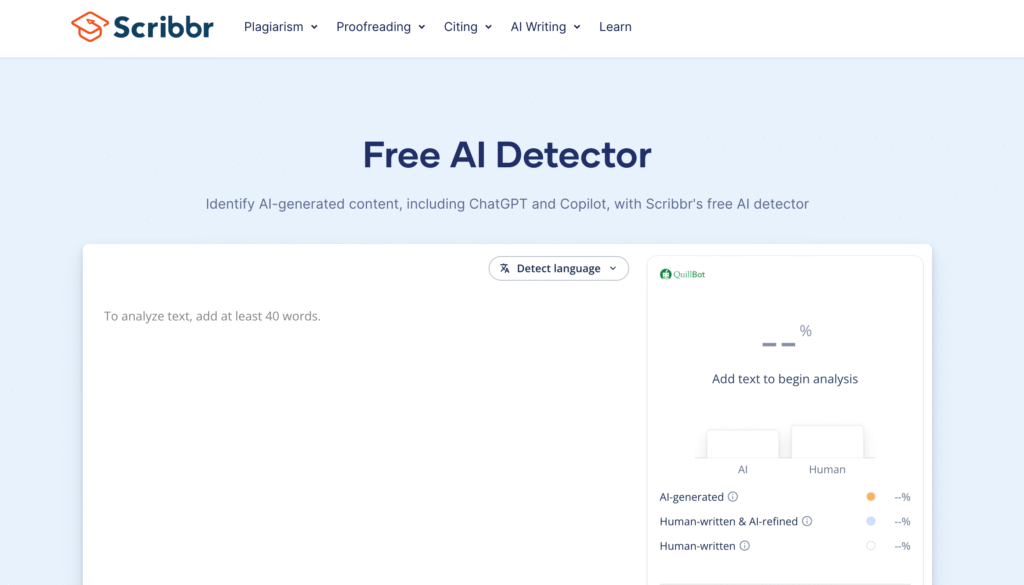
The tool follows a straightforward workflow. Users paste their text into the interface, and Scribbr returns a probability-based result indicating how likely the content is to be AI-generated. The experience is clean and minimal, which aligns with its academic audience rather than trying to overwhelm users with technical detail.
Scribbr’s detector focuses more on overall assessment than deep sentence-level breakdowns. Instead of heavily marking up individual lines, it prioritizes a clear summary of how the text is classified, making it easier for students to interpret quickly before submitting essays or assignments.
This simplicity is part of its appeal, but it also introduces limitations. Because the feedback leans toward a high-level score, users get less insight into exactly what triggered the result, especially in cases where writing has been edited or partially humanized.
In practice, Scribbr AI Detector works best as a quick academic check rather than a detailed analysis tool. It gives students a general sense of how their writing might be perceived, but it still leaves room for interpretation when content falls between clearly human and clearly AI-generated.
How Scribbr AI Detector Works
Scribbr AI Detector analyzes text by estimating how closely its language patterns align with those commonly produced by AI writing systems. Rather than identifying authorship directly, it evaluates whether the structure, phrasing, and predictability of the text resemble outputs generated by large language models.
The analysis operates primarily at the document level. When text is submitted, Scribbr processes the entire passage and assigns an overall probability score that reflects how likely the content is to contain AI-generated segments, rather than heavily emphasizing sentence-by-sentence breakdowns.
This score is based on patterns such as consistency in tone, sentence construction, and linguistic predictability. Writing that appears highly uniform or follows repetitive phrasing structures may increase the likelihood of being classified as AI-generated, even if parts of the content were written or refined by a human.
Unlike some detectors that visually highlight flagged sentences, Scribbr focuses on delivering a simplified result. The output is designed to be easy to interpret, especially for students, but it provides less transparency into which specific sections triggered the analysis.
Because the model relies on statistical signals, it can sometimes interpret polished or carefully edited academic writing as AI-generated. In those cases, Scribbr is responding to pattern similarity rather than confirming the true origin of the text, which can lead to uncertainty in borderline scenarios.
Scribbr AI Detector Accuracy Testing Results in 2026
Scribbr AI Detector performs most consistently when the text clearly fits into a single category. Fully AI-generated essays tend to receive higher probability scores, while more casual or uneven human writing often produces lower AI likelihood estimates.
During testing, the tool behaved more like a high-level classifier than a detailed analyzer. It evaluates the overall flow of the document and assigns a single probability score based on how closely the writing aligns with patterns typically associated with AI-generated content.
Because Scribbr emphasizes a simplified result rather than detailed highlights, the reasoning behind its score is less visible. This makes the output easy to read, but it can be harder to understand which specific parts of the text influenced the final classification.
The tool performs well when identifying obvious AI output, especially in structured academic writing. However, mixed content introduces more ambiguity. Essays that begin as AI drafts and are later revised by a human often receive moderate scores rather than a clear classification.
In 2026, this gray area has become more common as students increasingly edit AI-generated drafts before submission. Scribbr reflects this overlap in its results, often signaling partial AI probability rather than drawing a firm line between human and machine-written text.
Human-Written Content Test
When tested with clearly human-written material, Scribbr AI Detector generally returned low AI probability scores when the writing showed natural variation. Essays with uneven sentence length, small shifts in tone, and less predictable phrasing were more likely to be interpreted as human because they disrupted the consistency patterns the system tends to associate with AI.
Scores increased when human writing became more structured and polished. Academic essays with consistent tone, formal phrasing, and well-balanced paragraphs occasionally triggered moderate AI probabilities, even though the content was written without AI assistance.
In these cases, Scribbr appears to respond more to predictability than authorship. Highly refined writing reduces irregularities in flow, which can make it resemble the structured patterns commonly found in AI-generated text.
AI-Generated Content Test
When tested on fully AI-generated essays, Scribbr AI Detector typically produced high AI probability scores. Content generated directly from language models often follows consistent sentence construction, stable tone, and predictable phrasing, which align closely with the patterns the detector is designed to identify.
The tool became more confident with longer inputs. As the length of the text increased, Scribbr had more context to evaluate recurring structures, which strengthened the overall probability signal.
Shorter passages occasionally produced less decisive results, but once the content extended into multiple paragraphs, Scribbr generally identified strong indicators associated with AI-generated writing.
AI-Edited or Hybrid Content Test
Hybrid content created from AI drafts and then edited by a human produced the most inconsistent results. Some sections appeared more human after revision, while others still triggered moderate AI probability because elements of the original structure remained intact.
Edits that focused on word choice alone were less effective at changing the detector’s response. Even after rewriting, sentence rhythm, paragraph balance, and overall flow sometimes continued to resemble AI-generated patterns.
In 2026, this type of mixed authorship has become increasingly common, especially in academic settings. Scribbr’s results in these cases reflect pattern recognition rather than certainty, which means its scores are better interpreted as indicators of structure rather than definitive proof of how the text was created.
Strengths, Weaknesses, and Limitations of Scribbr AI Detector
Strengths
Scribbr AI Detector works best as a straightforward academic screening tool that gives users a quick sense of how their writing might be interpreted. Its biggest advantage is clarity. The interface is clean, the results are easy to understand, and the overall experience aligns well with students who want a fast check before submitting work.
• Simple interface designed for academic use
• Clear overall AI probability result
• No setup required, works instantly in the browser
• Easy to interpret without technical knowledge
• Fits naturally within Scribbr’s academic ecosystem
• Useful for quick pre-submission checks
Limitations and Weaknesses
Scribbr’s results become less reliable when the writing sits in a gray area between human and AI-assisted content. Because the tool focuses on overall document patterns rather than detailed breakdowns, it can be harder to understand what triggered a specific score.
• Limited visibility into which sections influenced the result
• Human-edited AI drafts often produce mixed scores
• Highly structured academic writing may trigger AI indicators
• Short text samples can lead to inconsistent outcomes
• Overreliance on overall scoring without deeper explanation
• Polished writing may increase perceived AI likelihood
Scribbr AI Detector provides a clear and accessible way to evaluate text, especially for students working with academic content. Its results are helpful as a general signal, but they are best viewed as an interpretation of writing patterns rather than a definitive judgment of authorship.
Why Scribbr’s AI Probability Scores Can Be Misleading
Scribbr AI Detector presents its results as a clear overall probability, which makes the output easy to understand at a glance. That simplicity is part of its appeal, but it can also create the impression that the score represents a precise evaluation rather than a general estimate.
The score is not a direct measurement of how much of the text was written by AI. Scribbr analyzes the overall structure, tone consistency, and predictability of the writing, then assigns a probability based on how closely those patterns align with typical AI-generated language.
This becomes more noticeable in academic writing. Essays that are well-structured, consistent in tone, and carefully edited can accumulate signals that resemble AI output, even when the work is entirely human-written. The detector is reacting to pattern similarity rather than actual authorship.
Because Scribbr focuses on a high-level summary rather than detailed sentence-level explanations, users have less visibility into what influenced the score. A single number can feel definitive, even though it reflects multiple underlying signals that are not fully exposed.
In practice, Scribbr’s probability score is best understood as an indicator of how the writing reads, not how it was created. It describes how closely the text aligns with AI-like patterns, which means the result should be interpreted with context rather than treated as a final judgment.
Use Cases: Who Should Use Scribbr AI Detector
Use Cases: Who Should Use Scribbr AI Detector
- ✓ Students checking essays, theses, or research papers before submission to see how Scribbr’s detector might interpret academic tone
- ✓ University students using Scribbr’s ecosystem who want a quick AI probability check alongside proofreading or plagiarism tools
- ✓ Writers reviewing highly structured academic drafts to see if consistent tone and phrasing raise AI probability scores
- ✓ Editors evaluating student work and needing a fast, easy-to-read signal before deciding whether deeper review is necessary
- ✓ Users comparing free AI detectors to understand how Scribbr’s simplified scoring differs from more detailed tools
- ✓ Anyone working with academic writing who wants a quick second opinion rather than a technical breakdown of detection signals
Final Verdict: Is Scribbr AI Detector Worth Using in 2026?
Scribbr AI Detector is worth using when the goal is a quick academic check rather than a deep technical analysis. Its biggest advantage is simplicity. Students can paste their essays and receive a clear probability score within seconds, which makes it useful right before submission.
The tool fits best as an early signal within an academic workflow. It gives students, editors, and reviewers a fast sense of how structured or polished writing might be interpreted, especially in formal essays or research papers.
The limitation is that the result requires context. Scribbr’s score reflects how closely the writing matches AI-like patterns, not whether the content was actually generated by AI, which means well-edited human work can still trigger moderate probabilities.
That is why many users refine their drafts before checking them. Tools like WriteBros.ai help break up overly consistent phrasing, introduce variation, and make academic writing feel more natural before running it through detectors like Scribbr.
In 2026, Scribbr works best as a quick second opinion for academic writing, not a final decision-maker. Used alongside thoughtful editing, it becomes a more reliable part of the writing process rather than a standalone judgment.
Ready to Transform Your AI Content?
Try WriteBros.ai and make your AI-generated content truly human.
Frequently Asked Questions (FAQs)
Does Scribbr AI Detector prove that text was written by AI?
Why does Scribbr sometimes show moderate AI probability for human writing?
Can Scribbr detect edited or humanized AI content?
How should Scribbr AI Detector be used in a writing workflow?
Is Scribbr AI Detector reliable for academic essays in 2026?
Conclusion: Scribbr AI Detector in 2026 Is Clear, But Not Definitive
Scribbr AI Detector stands out for its simplicity and academic positioning, but its strength is also its limitation. The tool delivers a clean, easy-to-understand probability score that fits naturally into student workflows, especially right before submitting essays or research papers.
The challenge is that clarity can feel more certain than it actually is. Scribbr evaluates how writing reads, not how it was created, which means structured, polished human work can still trigger AI probability signals. That makes interpretation just as important as the result itself.
In practice, Scribbr works best as a quick second opinion rather than a final authority. Used alongside thoughtful editing and revision, it becomes a helpful checkpoint that reflects writing patterns, not a definitive judgment of authorship.

Disclaimer. This article reflects independent testing and publicly available information at the time of writing. WriteBros.ai is not affiliated with Scribbr or any other tools mentioned. AI detection systems, scoring models, and accuracy may change as language models and detection technologies evolve. This content is provided for informational purposes only and should not be interpreted as legal, academic, or disciplinary guidance.