Should AI Writing Be Disclosed? Ethics, Policies and 2026 Guidelines

Highlights
- Disclosure standards vary by audience.
- Academic use is policy-bound.
- Commercial use is contract-bound.
- Platform rules shape creator transparency.
- Freelancers face onboarding clarity questions.
- 2026 norms favor governance over panic.
AI writing disclosure in 2026 is often framed as a moral showdown, but the reality feels more administrative than dramatic. The question is less about whether people use AI and more about how institutions, brands, and clients formalize expectations around it.
Some policies still use language like “must disclose,” yet many industries are moving toward conditional transparency instead of blanket requirements. That nuance matters, especially as AI assistance becomes embedded in drafting, outlining, and revision stages that look indistinguishable from normal workflow.
Disclosure is also becoming procedural rather than philosophical. Contract clauses, syllabus statements, submission checkboxes, and editorial guidelines now carry more weight than public debates about authenticity.
Since authorship now intersects directly with AI detection systems and compliance policies, the smarter way to approach disclosure is as governance, not guilt. This breakdown examines how expectations differ across students, educators, marketing teams, agencies, creators, and freelancers, and it connects naturally to how WriteBros.ai structures responsible AI-assisted writing workflows.
Should AI Writing Be Disclosed? Ethics, Policies & 2026 Guidelines
Students: Academic Integrity vs. Tool Use
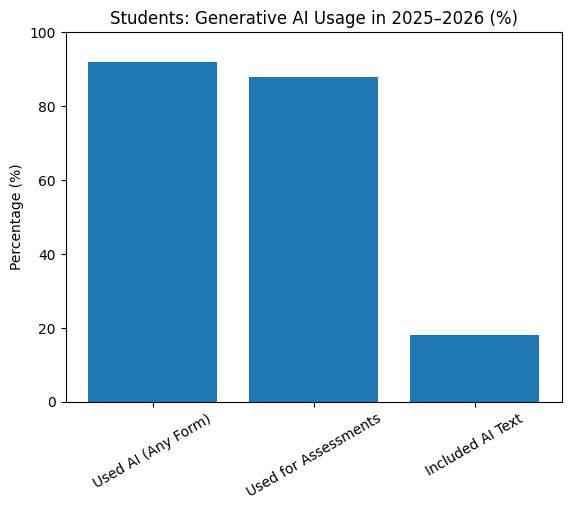
For students, AI disclosure in 2026 is no longer hypothetical. It is grounded in usage data. According to the HEPI/Kortext Student Generative AI Survey 2025, based on 1,041 undergraduates, 92% reported using AI in some capacity, 88% said they used generative AI for assessments, and 18% acknowledged including AI-generated text directly in submitted work. At that adoption level, institutional response shifts from prohibition to regulation.
Universities are increasingly treating non-disclosure as a transparency issue rather than a plagiarism issue. A paper may contain original analysis and still violate policy if AI assistance was required to be declared but was not. That reframing moves the debate toward process integrity instead of content originality alone.
Students also operate within detection environments that come with their own statistical caveats. Turnitin’s documentation on AI writing detection in the new enhanced Similarity Report explains that low-percentage AI indicators are displayed with an asterisk rather than a precise figure in the 1–19% range to reduce misinterpretation. That design choice signals that probability outputs are not definitive proof.
In practice, students are balancing three procedural layers:
- Instructor policy language specifying what AI use is permitted or restricted
- Submission-level disclosure requirements such as checkboxes or written statements
- Review triggers where detection signals prompt closer faculty evaluation
The gray areas remain consistent across institutions. Common student uses include:
- AI-assisted brainstorming and outline generation
- Sentence-level clarity edits and structural smoothing
- Rephrasing for tone or flow adjustments
- Partial drafting followed by significant human revision
In 2026, the safest standard for students is procedural alignment. If a syllabus requires acknowledgment of AI assistance at any stage, disclosure protects academic standing and reduces the risk of escalation during review.
Educators: Governance, Fairness, and Enforcement
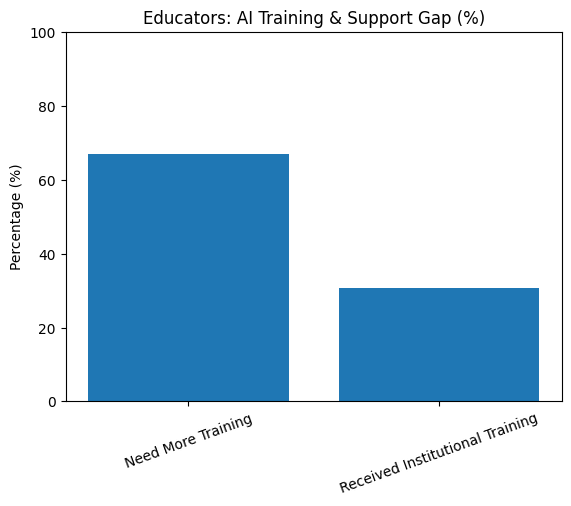
For educators, AI disclosure in 2026 is less about guessing who used a tool and more about designing policies that can withstand scale. The policy shift is visible in public guidance from major institutions. For example, the University of Oxford’s guidance on AI use in assessments states that generative AI may be used only where explicitly permitted and must be acknowledged when required. That conditional model is increasingly common.
Enforcement also sits inside a detection framework that is explicitly probabilistic. Turnitin’s official documentation on AI writing detection in the enhanced Similarity Report explains that its indicator is not a determination of misconduct and that low-percentage ranges are displayed cautiously to reduce misinterpretation. For educators, that means scores function as review triggers, not conclusions.
Across institutions, governance patterns are becoming more structured rather than more punitive. Common educator-level adjustments include:
- Assignment-specific AI rules that clarify what forms of assistance are allowed
- Mandatory disclosure statements embedded directly in submission workflows
- Process-based evaluation including draft history, version tracking, or reflective commentary
- Escalation pathways that require contextual review before misconduct charges
Some departments are also reintroducing short oral explanations for major written work, especially in capstone or thesis-adjacent assignments. These sessions typically last 5–15 minutes and focus on argument structure, source selection, and revision logic. The emphasis shifts from stylistic smoothness to demonstrated comprehension.
In 2026, the educator challenge is balancing innovation with fairness. Disclosure works best when it is clearly defined, consistently applied, and tied to a review process that respects both faculty judgment and documented limits of detection tools.
Marketing Teams: Transparency, Performance, and Brand Risk
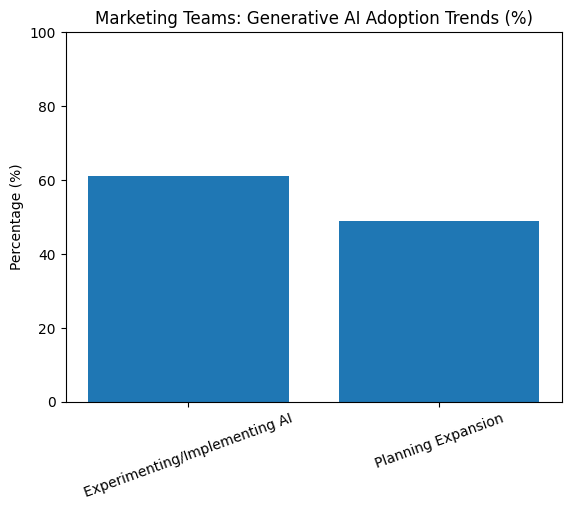
For marketing teams, the AI disclosure question in 2026 is not about academic integrity. It is about brand positioning, workflow efficiency, and measurable performance. Generative AI is now embedded into content production at scale. According to the Salesforce State of Marketing Report, a majority of marketing organizations report active experimentation or implementation of generative AI across campaign planning, content drafting, and personalization.
Adoption data reinforces that AI-assisted drafting is no longer fringe. The HubSpot AI marketing statistics overview notes that a significant percentage of marketers now use AI for content creation, email copy, and social media writing. In most corporate environments, AI is treated as production infrastructure rather than authorship substitution.
That reality shapes disclosure norms. In commercial marketing, the audience typically evaluates:
- Relevance and clarity of messaging
- Accuracy of claims
- Brand consistency across channels
- Performance metrics such as CTR and conversion rate
What audiences rarely evaluate is drafting method. Unlike sponsored content disclosures, there is currently no broad regulatory requirement in most jurisdictions mandating public AI attribution for standard marketing copy.
That said, disclosure becomes strategic in specific contexts:
- Executive thought leadership pieces
- Highly editorial brand publications
- Industries with elevated trust expectations, such as finance or healthcare
- Campaigns explicitly promoting AI capability
In 2026, marketing teams treat AI disclosure as a trust calculation rather than a compliance default. If the value proposition centers on human voice and originality, transparency may strengthen credibility. If the value proposition centers on performance and utility, disclosure often remains internal.
For marketing departments, the central question is not “Did AI assist?” It is “Would disclosure change audience trust or regulatory exposure?” The answer varies by brand, sector, and positioning.
Agencies: Contracts, Liability, and Client Expectations
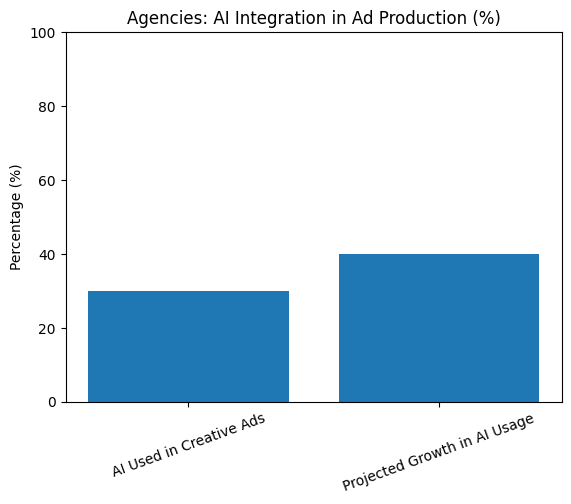
For agencies, AI disclosure in 2026 is less a public-facing ethics question and more a contract-and-liability question. The reason is simple: generative AI has already entered mainstream creative production at measurable scale. The ANA report on generative AI for video ads found that 30% of creative ads were built from scratch or enhanced using generative AI, and it projected that figure would rise to nearly 40%. Once AI becomes that common in production, clients start asking what exactly they are paying for, and whether AI use needs to be stated.
That question is landing inside commercial relationships, not blog comment sections. Agencies are seeing more procurement and legal teams want clarity on tool usage, data handling, and IP risk. At the same time, marketing leaders are pressuring agencies to invest in AI capability. In WARC coverage on the agency AI gap, 52% of marketing leaders said they want more AI tech investment from creative agencies if they are to be seen as a good partner, with 48% saying the same for media agencies.
In practice, AI disclosure is now a commercial control point. Agencies that treat it as an onboarding item tend to reduce disputes later, especially when clients have restrictive clauses or high sensitivity brands.
Common 2026 agency governance moves include:
- Proposal-level clarity stating whether AI may assist drafting, ideation, editing, or asset generation
- Client-specific “AI allowed / AI restricted” matrices tied to campaign type and channel
- Red-team review for claims, citations, and regulated language when AI touches copy
- Usage documentation kept internally, even when public disclosure is not required
The business pressure is also structural. Major agency networks are pushing AI-enabled production models that change how brands engage with agencies. Reuters reported that WPP launched an AI-driven platform to help brands plan, create, and publish campaigns, reflecting how AI is reshaping agency-client dynamics and expectations around speed, cost, and ownership.
For agencies in 2026, the disclosure question is ultimately contractual: if a client requires transparency, disclose. If a client prohibits AI, comply or renegotiate scope. The safest agency posture is not blanket disclosure everywhere, but written alignment on what “AI assistance” means for that relationship.
Creators: Authenticity, Platform Rules, and Audience Trust
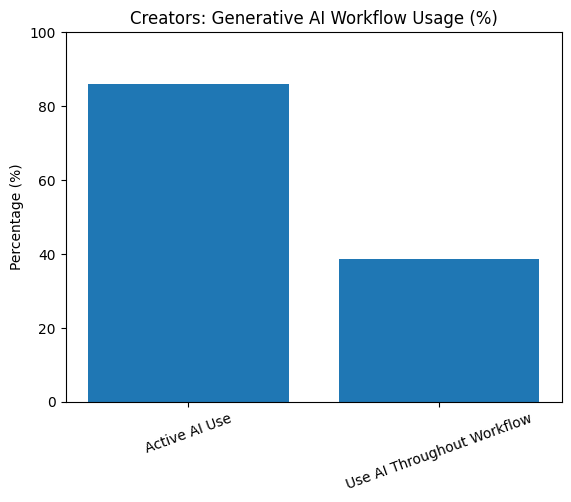
For creators, AI disclosure in 2026 is shaped less by theory and more by platform mechanics. The scale is no longer small. Adobe’s newsroom release for the Adobe Creators’ Toolkit Report reported that 86% of creators are actively using creative generative AI, with 76% saying it accelerated the growth of their business or follower base. That level of adoption means disclosure decisions happen inside real workflows, not hypothetical debates.
At the workflow level, usage looks layered rather than absolute. Digiday coverage of how creators are using generative AI cited a Wondercraft survey in which 38.7% of creators said they use AI throughout their workflow and 44.2% use AI in parts of their process. That split matters because most creator output is a blend of human direction and machine assistance, not a clean “AI vs human” binary.
Disclosure also depends on what the platform considers materially meaningful. YouTube’s policy page on disclosing altered or synthetic content requires disclosure when content is meaningfully altered or synthetically generated and appears realistic. YouTube has also clarified that it does not require disclosure for productivity uses like scripts, ideas, or captions in its announcement on how creators disclose AI-generated content.
TikTok draws the line more directly around realism. TikTok’s help page About AI-generated content states creators must label AI-generated content that contains realistic images, audio, and video. That pushes disclosure into a platform setting, not a personal preference setting.
In 2026, creators tend to make disclosure decisions based on a small set of practical triggers:
- Platform labeling requirements for realistic synthetic media, face swaps, voice cloning, or altered scenes
- Audience expectation when a creator’s value is personal voice, lived experience, or commentary credibility
- Format risk for news-like explainers versus entertainment, lifestyle, or product-driven content
- Brand partnership sensitivity when sponsors expect a clearly human-created endorsement script
The main creator insight is that disclosure is no longer a single yes-or-no statement. In 2026 it is a context rule: realistic synthetic media often requires labeling, productivity assistance often does not, and trust-heavy niches benefit from transparency more than trend-driven niches do.
Freelancers: Client Boundaries, Pricing Pressure, and Proof of Process
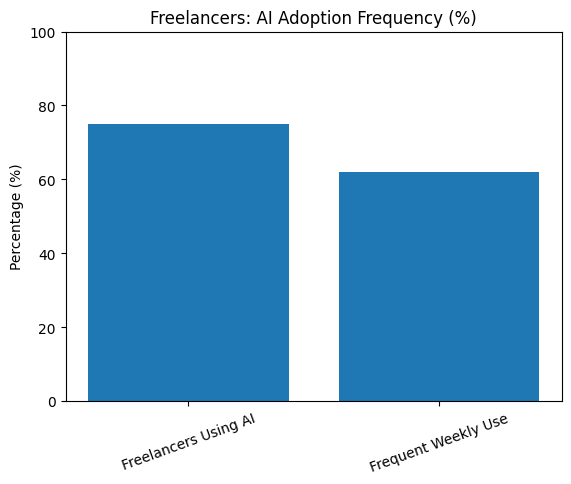
For freelancers, AI disclosure in 2026 sits inside a simple tension: clients want speed and polish, but they also want to feel like they are paying for human judgment. Usage rates make this hard to ignore. A survey summarized in 75% of US freelancers are using generative AI reported that 75% use generative AI tools, with 33% saying they use them all the time and 25% using them sometimes. When adoption looks like this, silence stops being a neutral choice and starts becoming a boundary question.
The freelance reality is also more mature than “AI makes you faster.” Upwork research on how freelancers are leading AI adoption reported that 54% of skilled freelancers rate themselves advanced or expert in using AI tools for work, and 62% use AI tools at least several times per week. That creates a new baseline expectation for turnaround times, which can quietly compress pricing if a scope is not defined clearly.
At the same time, the market impact is uneven. Evidence summarized in the Brookings analysis Is generative AI a job killer? Evidence from the freelance market reported that freelancers in occupations more exposed to generative AI saw a 2% decline in the number of contracts and a 5% drop in earnings after the release of new AI software in 2022. That does not mean every freelancer loses. It means clients are recalibrating what they value and what they are willing to pay for.
In 2026, the safest freelance play is clarity on boundaries, not dramatic disclosure labels. The points that reduce friction most often are practical:
- Contract clarity on whether AI is allowed for outlining, editing, summarizing, or drafting
- Scope definitions that separate “drafting” from “final voice” so clients understand what they are buying
- Quality controls such as fact-check steps and human revision standards, stated upfront
- Process receipts like briefs, revision notes, and tracked changes that show human ownership
Freelancers also face a pricing perception issue: if a client assumes AI means “instant,” they may try to negotiate fees downward. That is why disclosure should be framed as workflow governance. If a client bans AI, comply or renegotiate. If a client allows it, the value story should still center on human judgment, domain expertise, and QA.
In 2026, freelancers do best when they treat AI disclosure as alignment. The win is not confessing tool use. The win is preventing mismatched expectations that turn into disputes later.
Where Responsible AI Workflows Fit Into 2026 Disclosure Standards
AI writing disclosure in 2026 is less about confession and more about process design. Across universities, agencies, marketing teams, and freelance contracts, the recurring theme is documentation. Institutions and clients are not asking whether tools were touched at all. They are asking whether the final output reflects accountable authorship.
That distinction matters because most disclosure tension arises at the workflow level, not the sentence level. Brainstorming assistance, structural outlining, clarity edits, and tone refinement sit on a spectrum of involvement. The more structured and traceable the workflow, the easier it becomes to explain where human judgment shaped the result.
This is where process-oriented tools become relevant. Platforms designed around rewriting transparency, tone calibration, and iterative refinement create a clearer separation between draft generation and final authorship. Instead of replacing voice, they help align it.
For teams that want internal clarity without public overstatement, systems like WriteBros.ai position AI as an editing and consistency layer rather than an authorship substitute. That framing aligns with how 2026 policies are evolving: tools are permitted, but accountability remains human.
The practical advantage is not concealment. It is coherence. When AI workflows are intentional, documented, and bounded, disclosure becomes easier to navigate because the line between assistance and authorship is defined before questions arise.
Frequently Asked Questions About AI Writing Disclosure (2026)
Is AI writing disclosure legally required in 2026?
Does using AI automatically reduce authorship credibility?
How do detection tools affect disclosure decisions?
Should marketing content disclose AI assistance?
What is the safest way to integrate AI without risking misrepresentation?
Will AI disclosure norms tighten further after 2026?
The Practical Takeaway for 2026 AI Disclosure Standards
AI disclosure debates in 2026 point to one central reality: generative tools are not being removed from professional or academic life, they are being normalized through policy. Across universities, agencies, marketing departments, creator platforms, and freelance contracts, the pattern is consistent. AI is no longer treated as an anomaly. It is treated as infrastructure that requires boundaries.
What has changed is not usage but formalization. Disclosure clauses are appearing in syllabi and client agreements. Platform labeling rules now define when synthetic media must be identified. Detection systems are increasingly framed as probabilistic indicators rather than proof engines. The common thread is governance, not prohibition.
For students, disclosure is procedural alignment. When a syllabus requires acknowledgment, transparency protects academic standing. For educators, clarity of definition reduces disputes and keeps enforcement sustainable. Governance that defines acceptable assistance works better than vague warnings.
For marketing teams and agencies, disclosure becomes strategic and contractual. Most commercial audiences evaluate outcomes, not drafting methods, but client agreements and brand positioning can change that calculus. Written alignment during onboarding prevents downstream friction.
For creators and freelancers, the decision turns on trust and platform rules. Realistic synthetic media may require labeling under platform policies, while productivity assistance often does not. The practical safeguard is expectation alignment: know what your audience, platform, or client requires before silence becomes misinterpretation.
Entering 2026, the pattern is clear. AI writing is not a temporary disruption. It is an embedded workflow layer managed through disclosure standards, review processes, and evolving definitions of authorship.
Sources
- HEPI/Kortext Student Generative AI Survey 2025
- Turnitin AI writing detection guidance
- University of Oxford guidance on AI use in assessments
- Salesforce State of Marketing Report
- ANA report on generative AI in advertising
- YouTube policy on disclosing altered or synthetic content
- TikTok AI-generated content labeling policy
- Staffing Industry report on freelancer AI adoption
- Upwork research on freelancers and AI usage
- Brookings analysis on generative AI and the freelance market