What Makes AI Systems Trust Certain Pages Enough to Cite Them in 2026

Highlights
- AI systems evaluate pages differently from search engines.
- Generic content rarely becomes citation-worthy.
- Structure affects extraction and summarization.
- Original insights improve retrieval value.
- Human refinement strengthens AI visibility.
What Makes AI Systems Trust Certain Pages Enough to Cite Them
The pages getting cited inside ChatGPT, Google AI Overviews, Perplexity, and Copilot are often not the pages most people expect. Many highly optimized articles still remain invisible in AI-generated answers while smaller, clearer, and more focused pages quietly appear instead.
That shift is forcing publishers to rethink what visibility actually means in 2026. Traditional SEO was mostly built around discoverability. If a page ranked highly enough, users could eventually find it. AI-generated search changes the equation because the system increasingly decides which sources deserve to become part of the answer itself.
This creates a second filtering layer beyond rankings alone. A page can still perform well in search while failing completely in AI citation environments because the content is difficult to interpret, too generic, structurally confusing, or weak during summarization.
Citation-worthy content is content that AI systems can confidently extract, summarize, attribute, and reuse without increasing ambiguity or weakening trust.
That definition matters because generative AI systems do not behave exactly like search engines. A traditional search engine retrieves and organizes pages. An AI system has a more difficult job. It must retrieve information, compare competing explanations, synthesize meaning, compress large amounts of material into a smaller response, and decide whether the source feels trustworthy enough to reference publicly.
Google’s own documentation around AI-generated search experiences hints at this change directly. AI systems may break a query into multiple related searches across supporting subtopics before forming a response. That means a page is no longer judged only against one keyword. It may also be evaluated against the surrounding informational context needed to complete the final answer.
This is one reason generic SEO content increasingly struggles inside AI-generated answers. Many articles technically cover the topic, but the information is buried beneath filler introductions, repetitive phrasing, bloated formatting, or mechanically structured sections. AI systems generally prefer pages that reduce interpretation effort instead of increasing it.
Traditional SEO gets a page discovered. Citation-worthy content gets a page reused.
The pressure behind this shift is growing rapidly because AI-assisted search behavior is accelerating across industries. Recent research tracking generative AI adoption trends shows increasing reliance on AI systems for information synthesis, summarization, and research support. More users now consume generated answers before visiting the original source material itself.
User behavior research around AI-assisted information seeking points toward the same direction. People increasingly rely on generative systems because summarized answers reduce the effort required to compare sources manually. That puts enormous pressure on AI systems to choose sources that already communicate ideas clearly and efficiently.
The websites earning the most citations are therefore often not the ones publishing the highest volume of content. They are usually the ones explaining ideas with the least friction. Their structure is clearer. Their claims are easier to attribute. Their explanations require less semantic untangling before the AI system can safely reuse them.
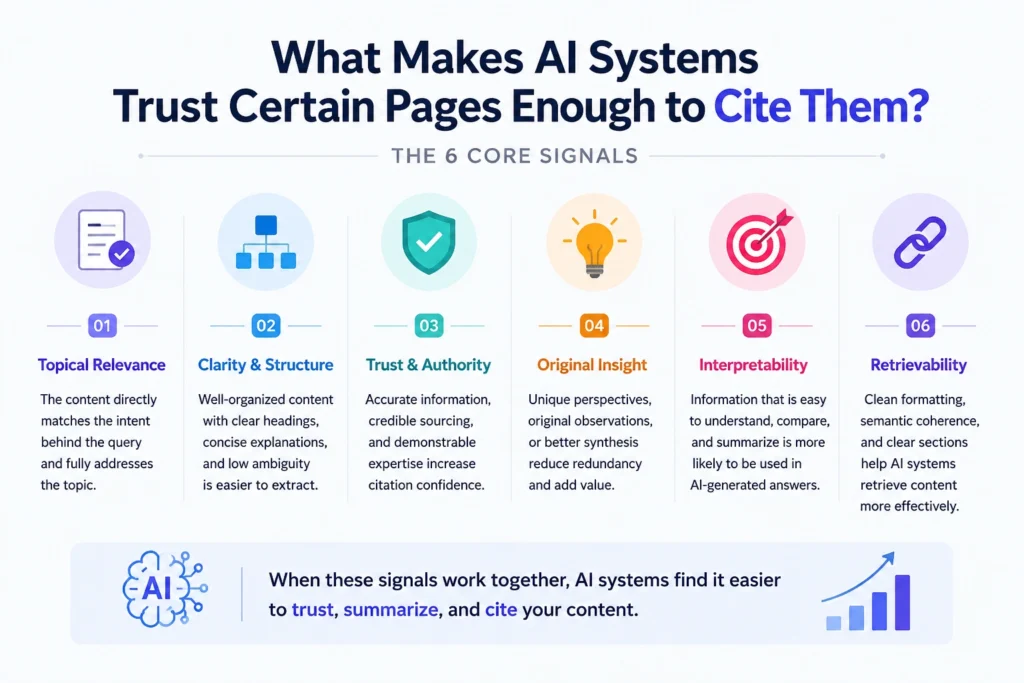
AI Systems Do Not Cite Pages the Same Way Search Engines Rank Them
Ranking is not the same as being trusted inside an answer. A search result can be visible, but an AI citation has to survive retrieval, comparison, compression, and attribution before it appears.
Traditional search gives users a list of pages and lets them decide which one deserves attention. AI-generated answers are different because the system makes part of that decision before the user sees the response. It chooses which sources help form the answer, which claims are safe to reuse, and which passages can be summarized without losing meaning.
This is why a high-ranking article can still fail inside Google AI Overviews, ChatGPT, Perplexity, or Copilot. The page may be discoverable, but the information may not be clean enough to extract. The article may cover the topic, but the useful claim may be buried under setup language, generic transitions, or sections that repeat what every competing page already says.
Traditional search asks whether a page should be shown. AI citation asks whether a page should be reused.
Google’s explanation of AI search features makes this clearer. AI systems can use related searches and supporting subtopics to build an answer, which means the source has to help with more than one obvious keyword. It has to fit into a broader answer structure.
That broader structure changes what strong content looks like. It is no longer enough to mention the right terms. A citation-worthy page has to make the relationship between ideas easy to understand. It needs direct claims, clean explanations, clear section flow, and enough context for the system to connect the page to the final answer without guessing.
The practical difference
SEO helps a page become a candidate. Strong structure, clarity, originality, and attribution confidence help that page become a source.
Research into trustworthiness in retrieval-augmented generation points to the same issue. When generative systems depend on retrieved sources, the quality of those sources affects factuality, robustness, transparency, and answer reliability. Weak source material creates weaker answer confidence.
For publishers, that means citation potential increasingly depends on the passage level. The model may not need the whole article. It may need one paragraph, one definition, one comparison, or one explanation that answers a specific part of the query. If that passage is unclear, repetitive, or hard to attribute, a competing page can win the citation instead.
The strongest pages make reuse easier. They do not force the system to dig through long introductions before reaching the point. They do not hide the main explanation inside vague context. They do not rely on inflated wording when a sharper sentence would carry more meaning.
This is why short, direct sections often outperform bloated ones in AI citation environments. The model is trying to reduce uncertainty. A clearer page gives the system fewer reasons to skip, reinterpret, or replace it with a cleaner source.
AI visibility therefore requires a different editorial standard. Ranking gets the page into the room. Citation-worthiness determines whether the page is trusted enough to speak.
Generic Content Rarely Becomes Citation-Worthy
One of the biggest reasons pages disappear from AI-generated answers is that they sound too similar to everything else already published online.
This is becoming a major problem across AI-assisted publishing. Large language models made content production dramatically faster, but they also flooded the internet with articles that follow nearly identical structure, pacing, wording, and conclusions. Many pages now technically cover the topic while contributing very little distinctive value.
AI systems increasingly struggle to justify citing those pages because they do not clearly stand apart from competing sources. If dozens of articles explain the same concept using similar phrasing and structure, the model has very little reason to favor one version over another.
Many AI-generated articles fail not because they are inaccurate, but because they are structurally forgettable.
This creates a subtle but important retrieval problem. AI systems are designed to reduce uncertainty during synthesis. Generic content increases uncertainty because the page offers little informational differentiation. The article becomes another interchangeable variation of an already saturated answer pattern.
Research around retrieval trustworthiness in generative systems repeatedly points toward the importance of source quality during answer generation. Weakly differentiated pages reduce retrieval value because they contribute little additional clarity during synthesis.
Generic content often reveals itself through predictable patterns:
- repetitive sentence rhythm
- vague transitions repeated across sections
- broad explanations without interpretation
- keyword-focused phrasing over clarity
- overly neutral editorial tone
- templated structures copied from existing ranking pages
Individually, those signals may seem harmless. Together, they create content that feels statistically averaged. The article may still be readable, but it no longer gives the AI system a compelling reason to cite it instead of another source.
Distinctiveness is becoming part of retrieval value. The clearer and more identifiable the interpretation becomes, the easier it is for AI systems to attribute the source confidently.
This is one reason smaller niche websites sometimes outperform larger publishers in AI-generated answers. The smaller page may communicate the idea more directly. It may offer stronger examples, cleaner framing, or sharper synthesis than a bigger site publishing high-volume but interchangeable content.
User behavior trends reinforce this shift further. Studies around AI-assisted information seeking suggest that people increasingly rely on generated summaries because they reduce the effort required to compare fragmented information manually. That pressure encourages AI systems to prioritize pages that already communicate ideas clearly and efficiently.
Citation-worthy pages usually contribute something recognizable:
a sharper insight, a stronger explanation, a clearer framework, a more useful example, or a more direct interpretation of the topic itself.
The strongest pages increasingly feel edited instead of generated. Their structure adapts naturally to the idea being explained. Their writing sounds interpreted by someone who understands the topic rather than assembled from predictable internet language patterns.
Clear Structure Makes Content Easier for AI Systems to Extract
AI systems do not consume pages the same way humans do. They break information into segments, compare passages across sources, and search for the cleanest explanation path during summarization.
This is one reason structure quietly became one of the strongest signals in AI visibility. A page may contain useful information, but if the explanation is buried beneath oversized introductions, vague transitions, or scattered formatting, the retrieval system has to work harder to isolate meaning.
Citation-worthy pages usually reduce that friction. Their headings match the informational intent of the section below them. Their definitions appear early. Their paragraphs move directly toward the explanation instead of circling around it through unnecessary setup language.
AI systems increasingly reward pages that make interpretation feel effortless.
This creates a major shift away from older SEO writing habits. Many traditional ranking strategies encouraged maximum topical coverage, which often produced bloated articles designed to appear comprehensive rather than understandable. AI retrieval systems gain very little from that kind of structural noise.
Research into retrieval reliability in generative systems repeatedly points toward the importance of semantic coherence during synthesis. Strong retrieval quality depends heavily on whether source material is logically organized and easy to isolate at the passage level.
This is why answer-first writing is becoming increasingly valuable. Instead of slowly building toward the point, stronger pages communicate the explanation early, then expand with supporting detail afterward. The structure itself helps the model identify reusable meaning more efficiently.
Small formatting decisions now matter more than many publishers realize:
- clear section hierarchy improves contextual understanding
- shorter paragraphs reduce extraction difficulty
- specific headings strengthen topical alignment
- direct definitions improve summarization accuracy
- clean formatting reduces semantic noise during retrieval
Weak structure creates the opposite effect. Long uninterrupted text walls increase ambiguity. Vague section titles reduce clarity. Overly dense paragraphs make it harder for retrieval systems to isolate which claim actually matters.
Citation-worthy content often feels easier to navigate before the reader consciously notices why. The article guides interpretation naturally. Each section reduces uncertainty instead of introducing more cognitive friction.
This becomes especially important because AI systems increasingly compare multiple competing passages simultaneously. If another page explains the same idea in a cleaner and more extractable format, the model has a stronger reason to prioritize that source instead.
User behavior research around AI-assisted information seeking suggests that users increasingly prefer synthesized answers because they reduce the effort required to navigate fragmented information manually. That same pressure influences how retrieval systems evaluate usefulness internally.
The clearest pages increasingly win because they reduce work for both the machine and the reader at the same time.
Original Observations Increase Citation Confidence
AI systems have less reason to cite pages that merely repeat the same consensus. The stronger page is usually the one that explains the issue with clearer judgment, sharper context, or more useful interpretation.
Originality does not always mean publishing proprietary data or running a formal study. In many cases, originality shows up through the way a page interprets the topic. A strong article may connect two ideas competitors treat separately, explain a pattern more directly, or give readers a practical distinction that makes the subject easier to understand.
That kind of editorial judgment matters because AI systems compare sources during synthesis. If five pages say roughly the same thing, the system has little reason to cite the most generic version. A page with stronger interpretation gives the model something more useful to reuse.
Citation-worthy pages usually contribute something difficult to replace.
This is where many SEO articles fall apart. They summarize the top-ranking pages, rearrange the same points, and publish a version that feels complete but not necessary. The content may be accurate, but it does not give an AI system a strong reason to treat it as a preferred source.
Research into trustworthy retrieval systems shows that generative outputs depend heavily on the quality, coherence, and reliability of source material. In publishing terms, this means pages with clearer synthesis and stronger interpretive value can give AI systems more confidence during answer construction.
Original observations also reduce redundancy. Retrieval systems do not gain much from selecting multiple pages that repeat the same wording and structure. A page that introduces a sharper distinction, cleaner framework, or more specific example adds more informational value to the generated answer.
A useful test: if your page disappeared tomorrow, would the internet lose a clearer explanation, or would dozens of nearly identical articles remain?
Strong pages often contain small but meaningful editorial moves. They define terms in a cleaner way. They explain why one common assumption is wrong. They show what changes in 2026 instead of repeating evergreen advice from older search content. These details make the article feel like a source, not just a summary.
This is also why examples matter. A page that says “structure is important” is easy to replace. A page that explains how unclear headings, oversized intros, and buried definitions weaken AI extraction gives the system a more concrete explanation to work with.
User research into generative search behavior supports this direction because people turn to AI tools for synthesis, comparison, and interpretation. If users expect AI systems to simplify complex information, then AI systems need sources that already help with that simplification.
Original observations make content more useful during that process. They give the model clearer language, stronger distinctions, and more meaningful context to cite. They also make the page more memorable to human readers, which reinforces the same trust signals AI systems are trying to approximate.
The strongest citation-worthy content does not merely answer the query. It improves the answer by adding interpretation that competing pages do not provide.
Human-Refined Content Usually Performs Better in AI Search
AI systems increasingly reward pages that feel interpreted, intentional, and editorially refined instead of statistically generated from repetitive internet patterns.
One of the biggest misconceptions in modern publishing is the belief that faster AI generation automatically leads to stronger visibility. In practice, raw AI output often creates the opposite effect. The content becomes technically complete while still lacking the clarity, structure, and differentiation that retrieval systems rely on during summarization.
Many AI-generated drafts share the same fingerprints:
- overly smooth sentence rhythm
- predictable transitions
- broad conceptual summaries
- repeated structural templates
- low informational density
- minimal editorial interpretation
Even when the information is accurate, the writing can still feel statistically averaged. AI systems increasingly detect this indirectly because the content resembles thousands of other pages generated from similar language patterns and optimization formulas.
Human refinement is becoming less of a stylistic advantage and more of a retrieval advantage.
Research into trustworthiness and retrieval quality in generative systems repeatedly shows that semantic clarity and source coherence affect downstream answer quality directly. Weak structure creates more opportunities for ambiguity during synthesis.
This is why many publishers are beginning to shift toward refinement-focused workflows instead of generation-focused workflows alone. The strongest content teams increasingly use AI for acceleration while relying on human editing to strengthen interpretation, improve structure, sharpen explanations, and reduce repetitive language before publication.
The difference becomes obvious when reading citation-worthy pages. The writing feels deliberate. The pacing varies naturally. The article sounds like someone is guiding the reader through the idea instead of mechanically assembling topic coverage from a checklist.
The future of AI-visible publishing is probably not fully human or fully AI. It is increasingly a hybrid process where AI accelerates drafting while human refinement strengthens clarity, differentiation, and trust.
This is also why rewriting and refinement tools are becoming more important in modern content workflows. Platforms like WriteBros.ai are increasingly useful because the goal is no longer just generating content quickly. The bigger challenge is making AI-assisted writing feel clearer, less repetitive, more naturally structured, and more trustworthy during retrieval.
User behavior trends reinforce the same shift. Research around AI-assisted information seeking shows that people increasingly prefer concise synthesized answers when researching complex topics. That pressures AI systems to prioritize source material that already communicates efficiently and clearly.
Citation-worthy content therefore tends to balance two goals at the same time. It needs to remain easy for machines to summarize while still feeling genuinely useful and readable to humans. Pages that satisfy only one side of that equation increasingly struggle in AI search environments.
The strongest content in 2026 will likely come from workflows that combine AI efficiency with strong editorial refinement. AI can accelerate production, but trust, interpretation, clarity, and differentiation still determine whether a page becomes part of the final answer.
Frequently Asked Questions
AI citation visibility is still evolving rapidly, but several patterns are already becoming clear across Google AI Overviews, ChatGPT, Perplexity, and other generative search systems.
Why do some high-ranking pages never appear in AI-generated answers?
Ranking and citation are not the same thing. A page can rank well in traditional search while still failing AI retrieval because the information is difficult to extract, structurally confusing, too generic, or weak during summarization. AI systems increasingly prioritize interpretability and attribution confidence alongside visibility.
What makes content citation-worthy to AI systems?
Citation-worthy content usually combines clear structure, direct explanations, low ambiguity, strong informational density, and original interpretation. The strongest pages often make ideas easier to summarize without oversimplifying the meaning of the source.
Does AI-generated content automatically perform poorly in AI search?
No. The problem is usually not AI assistance itself but the lack of refinement after generation. Weak AI content tends to feel repetitive, statistically generic, or structurally over-templated. Human editing, stronger synthesis, and clearer formatting often improve citation potential significantly.
Why does structure matter so much for AI citations?
AI systems increasingly retrieve information at the passage level rather than evaluating entire pages holistically. Clean headings, concise explanations, answer-first formatting, and low-friction structure make extraction and summarization easier during response generation.
Can smaller websites outperform large publishers in AI search?
Yes. AI systems do not always prioritize the largest brand. In many cases, a smaller page may explain the concept more clearly, reduce ambiguity more effectively, or provide stronger informational compression during synthesis. Distinctiveness and interpretability increasingly matter alongside authority.
What is the biggest mistake publishers make with AI-assisted content?
One of the biggest mistakes is publishing raw AI output too quickly. Many teams focus heavily on production speed while overlooking editorial refinement, structural clarity, and informational differentiation. The result is content that technically covers the topic but contributes very little retrieval value.