Why Most AI Content Fails (And 8 Fixes Top Teams Can Do Before Publishing)
Highlights
- Publishing too early weakens AI content quality.
- More content does not guarantee better results.
- Clear intent improves rankings and engagement.
- Voice consistency builds audience trust.
- Strong structure improves readability.
AI content fails for a simple reason. Most of it goes live before it is actually ready. The draft looks fine, reads clean, and checks the boxes, so it gets published.
The problem shows up after. Pages do not rank the way teams expect. People skim and leave. Nothing really sticks.
This is not an AI issue. It is a process issue. When content skips refinement, small gaps in intent, structure, and clarity start to compound.
The teams that get results handle this differently. They treat every draft as unfinished work and tighten it before publishing. That is where the real difference happens.
Why Most AI Content Fails (And 8 Fixes Top Teams Can Do Before Publishing)
AI content is everywhere, yet performance remains inconsistent.
Teams are publishing faster than ever, but many pieces fail to rank, engage, or convert.
The difference often comes down to what happens before publishing, not after.
AI Content Is Everywhere in 2026, But Performance Still Falls Short
AI has removed the biggest barrier to content production. Teams can now generate blog posts, landing pages, and entire resource hubs in hours instead of weeks.
What has not improved at the same pace is how that content performs once it goes live. Rankings are slower to climb, engagement drops faster, and conversion rates remain unpredictable.
This creates a gap that is easy to miss. On the surface, output looks strong. Content calendars are full, publishing cadence is consistent, and teams feel productive.
Underneath, however, many of those pages fail to meet user intent, lack depth, or feel too similar to everything else already ranking.
This is why performance issues today are rarely tied to how content is generated. They are tied to how content is prepared before publishing.
The Real Reason Why Most AI Content Fails – It Isn’t What Top Teams Expect
Many assume AI content fails because it is detectable or lacks originality, but those are rarely the main issues affecting performance.
What teams blame
AI detection, duplicate phrasing, or the idea that search engines penalize generated content.
What actually happens
Content misses intent, lacks clarity, and follows predictable structures that fail to engage real readers.
Most AI-generated pages are structurally correct but strategically weak. They answer questions broadly without committing to a clear direction, which makes them easy to ignore.
The result is content that looks complete on the surface but does not stand out, does not persuade, and does not rank competitively.
The 8 Fixes Top Teams Apply Before Publishing
Strong teams do not treat AI drafts as finished work. They treat them as a starting point, then run each piece through a small set of checks before it goes live.
These fixes are not complicated, but they are consistent. Each one closes a common gap between content that looks acceptable and content that actually performs.
Taken together, these eight fixes turn AI content from a fast draft into something much more publishable, credible, and useful.
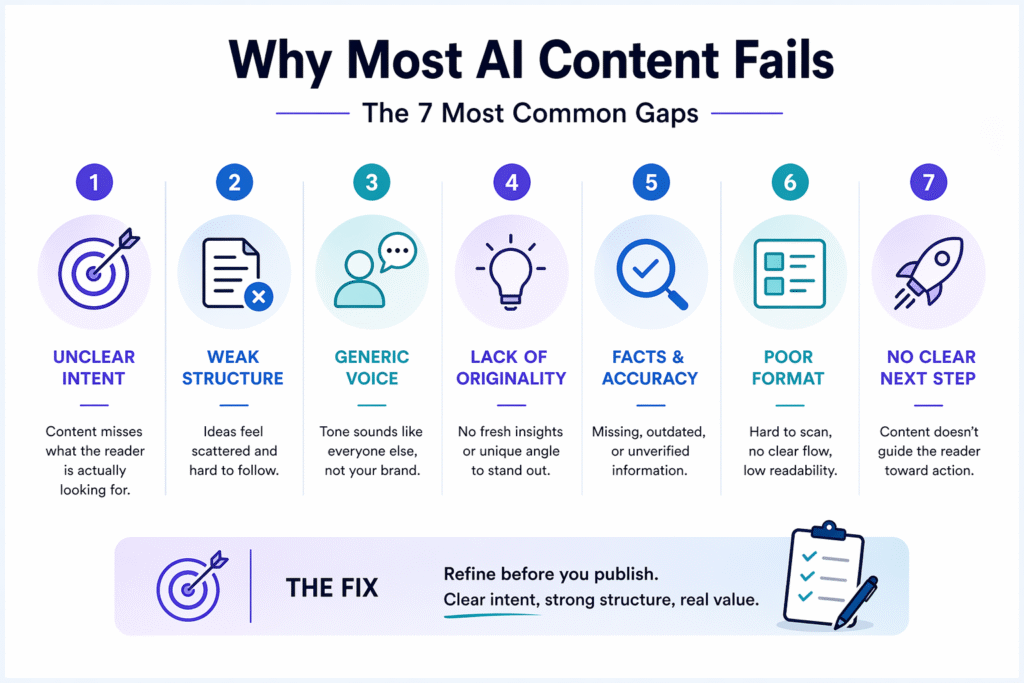
Align Content With a Single, Clear Search Intent
Most AI content tries to cover too much at once. It mixes explanations, advice, and comparisons in a way that feels complete but does not match what the reader actually came for.
This usually happens because AI generates content based on broad prompts, not a tightly defined goal. The result is a page that answers several questions halfway instead of one question well.
What goes wrong
A single article tries to be informational, transactional, and opinion-based at the same time, which weakens its ability to rank or convert.
What to aim for
Each page should serve one dominant intent, whether that is explaining, comparing, or helping the reader take action.
When intent is clear, everything else improves. Structure becomes tighter, messaging becomes more direct, and the reader moves through the content without confusion.
Fix 2Rewrite for Brand Voice Consistency
AI-generated content tends to sound neutral and interchangeable. It reads clearly, but it does not reflect how a brand actually communicates.
This becomes a problem when multiple pieces are published together. Instead of building familiarity, the content feels disconnected, as if it came from different sources.
Strong teams do not just edit for grammar. They rewrite sections to match how the brand speaks, whether that is direct, conversational, or more analytical.
When voice is consistent, content feels more intentional. Readers recognize patterns in how ideas are explained, which makes the experience smoother and easier to trust.
Fix 3Remove AI Structure Patterns That Kill Engagement
AI-generated content often follows predictable structures. It introduces a topic, explains it in a balanced way, and wraps up cleanly, but the flow feels too familiar.
Readers may not consciously notice this pattern, but they respond to it. The content feels repetitive, easy to skim past, and not worth spending time on.
High-performing content: clear angle → focused argument → strong takeaway
Top teams break these patterns early. They adjust the structure so each section builds toward a point instead of simply covering a topic.
This makes the content feel more deliberate. Instead of repeating what is already known, it guides the reader toward something specific.
If a section feels predictable, it usually needs restructuring, not just rewriting.
Fix 4Add Real Examples That AI Cannot Fabricate
AI-generated content tends to rely on safe, generic examples. They sound correct, but they do not add much value because they could apply to almost anything.
This makes the content feel distant. Readers may understand the point, but they do not fully connect with it.
Generic example
A business improved its content strategy and saw better engagement.
Real example
A SaaS team reduced bounce rate after rewriting product pages to match specific user intent.
Top teams add details that AI cannot easily generate. They reference actual workflows, small changes, and outcomes that feel grounded.
These examples do not need to be long. They just need to be specific enough to show that the insight comes from real use, not general knowledge.
Fix 5Optimize for Skimmability Without Losing Depth
AI content often leans in one of two directions. It is either too dense, making it hard to scan, or too simplified, making it feel shallow.
Readers do not engage with content in a straight line. They scan first, then decide where to slow down. If structure does not support that behavior, engagement drops quickly.
Top teams structure content so key ideas are easy to spot. They use spacing, clear headings, and controlled paragraph length to guide the reader.
This does not mean reducing depth. It means making depth easier to access without forcing the reader to work for it.
Fix 6Inject Original Insights or Contrarian Angles
AI content usually reflects the safest version of a topic. It summarizes what is already common, which makes the final piece sound polished but familiar.
That is a problem because readers do not remember content that simply repeats what they have already seen. Strong teams improve drafts by adding a sharper point of view or a more specific interpretation of the issue.
This does not require a dramatic opinion. Sometimes the strongest angle is a small but clear shift in framing, especially when it helps the reader see the topic in a more practical way.
Once a page includes an original angle, the rest of the content becomes easier to shape. The structure feels more focused, the examples become more purposeful, and the takeaway carries more weight.
Fix 7Validate Facts, Data, and Claims Before Publishing
AI can produce confident-sounding statements that feel accurate at a glance. The problem is that clarity and confidence do not guarantee that the details are actually correct.
This becomes risky when a draft includes statistics, product claims, industry trends, or references to how something works. A small factual error can weaken the whole piece, even if the rest of the writing is strong.
Top teams treat fact-checking as part of editing, not a separate cleanup step. That keeps the final draft stronger and prevents weak claims from slipping through because they sounded polished enough to trust.
Fix 8Build a Pre-Publish Content Workflow
Editing content one piece at a time is not enough. Without a clear process, quality becomes inconsistent and depends too much on who reviews the draft.
Top teams rely on a simple workflow that every piece goes through before publishing. This keeps standards consistent even as content volume increases.
The process does not need to be complex. What matters is that every piece follows the same steps, so quality does not depend on guesswork.
What Top Teams Do Differently With AI Content
High-performing teams are not defined by the tools they use. They are defined by how they approach content before it goes live.
Instead of relying on output speed, they focus on clarity, structure, and consistency at every stage of the process.
- They treat AI drafts as a starting point, not a finished product.
- They focus on one clear intent per page instead of covering everything at once.
- They refine structure and voice before thinking about publishing.
- They add specific examples and insights that make content feel grounded.
- They follow a consistent workflow so quality does not vary from piece to piece.
These differences may seem small on their own, but together they change how content performs once it is published.
The Future of AI Content Is Less About Generation and More About Refinement
AI has already solved the problem of producing content quickly. What teams are dealing with now is a different challenge: how to turn fast output into something sharp, credible, and useful enough to compete.
That is why refinement is becoming the real advantage. The teams that perform well are not the ones generating the most content. They are the ones improving drafts with stronger structure, clearer positioning, better examples, and tighter editorial control.
Publishing raw output quickly just because it is easy to produce.
Turning rough drafts into content that feels deliberate and well-developed.
Editorial judgment becomes more important than generation speed alone.
As content volume keeps rising, the pages that stand out will be the ones that feel more focused and more human in their decision-making. That does not mean avoiding AI. It means using it with more discipline before anything gets published, often supported by tools like WriteBros.ai to refine tone and clarity.
Frequently Asked Questions
Why does most AI content fail to perform?
Most AI content fails because it is published too early. It often lacks clear intent, strong structure, and original insight. Without refinement, the content may look complete but does not stand out or engage readers effectively.
Is AI-generated content bad for SEO?
AI-generated content is not inherently bad for SEO. Performance depends on how well the content matches user intent, provides value, and is structured. Proper editing and refinement make a significant difference in how it ranks.
What is the biggest mistake teams make with AI content?
The biggest mistake is treating AI output as a finished draft. Teams often focus on fixing grammar instead of improving structure, clarity, and positioning, which leads to content that feels generic.
How can teams improve AI content before publishing?
Teams can improve AI content by aligning it with a single intent, refining the structure, adding real examples, checking facts, and ensuring consistent voice. A simple workflow helps apply these steps consistently.
Does publishing more AI content lead to better results?
Publishing more content does not guarantee better performance. If quality is not maintained, it can scale underperforming pages. Strong results come from refining fewer pieces properly rather than publishing many unfinished ones.
AI Content Does Not Fail — Publishing It Too Early Does
Most AI content problems are not caused by the tool itself. They come from skipping the steps that turn a draft into something worth publishing.
When teams rush content live, they carry over unclear intent, weak structure, and generic messaging. These issues are subtle, but they compound once the content is exposed to real readers.
The fixes are not complex. They are simply applied with more consistency. Each step adds clarity, focus, and credibility to the final piece.