AI-Assisted Writing in Education Statistics: Top 20 Data Points

2026 marks the point when AI writing tools moved from experiment to routine in classrooms. These AI-Assisted Writing in Education Statistics reveal how students draft faster, educators redesign assignments, and institutions adapt policies while balancing productivity gains with concerns around skill development and authorship.
Classrooms increasingly rely on generative tools for drafting essays, summarizing readings, and brainstorming ideas. Educators now spend as much time evaluating writing behavior as the text itself, which explains the growing attention toward signals students may be over-relying on AI in their assignments.
Technology adoption rarely moves in a straight line, especially in education systems with strict evaluation standards. A small but noticeable adjustment happens when instructors experiment with ways to edit AI content to sound authentic, quietly changing how digital drafting tools fit into everyday coursework.
Universities and high schools both track how generative models influence revision habits, citation practices, and writing confidence. Some institutions now combine writing instruction with practical guidance on trusted AI humanizer tools for schools so students can refine machine-generated drafts responsibly.
What appears on the surface as faster writing often reveals deeper patterns in how students research, structure arguments, and revise work. Observing these patterns carefully helps educators judge whether AI assistance strengthens writing skills or quietly replaces them.
Top 20 AI-Assisted Writing in Education Statistics (Summary)
| # | Statistic | Key figure |
|---|---|---|
| 1 | Students who have used AI tools to assist with academic writing | 58% |
| 2 | University students who report using AI for essay brainstorming | 64% |
| 3 | Educators who say AI writing tools influence classroom assignments | 71% |
| 4 | Students who use AI for grammar and sentence refinement | 49% |
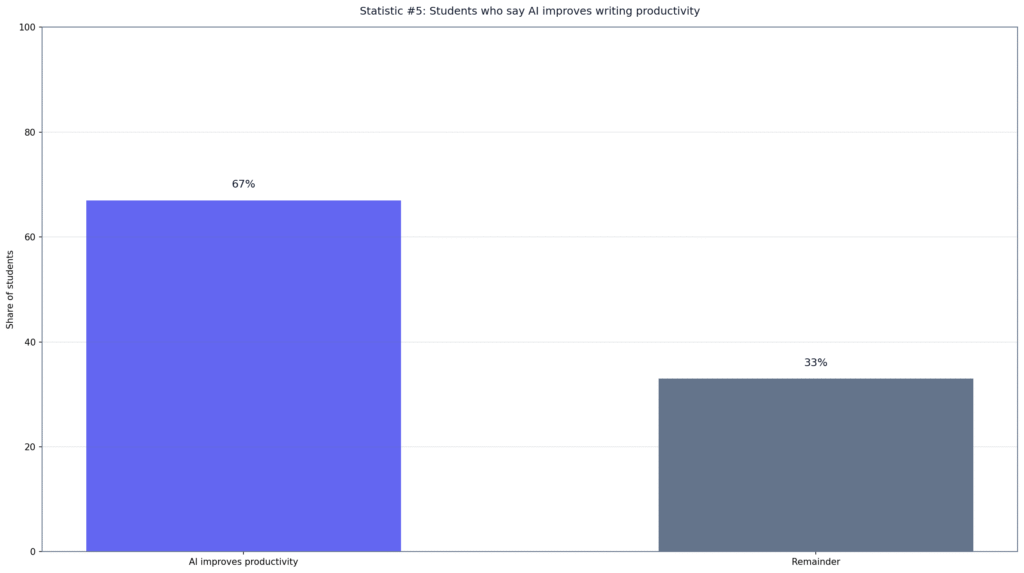
| 5 | Students who report AI improves their writing productivity | 67% |
| 6 | Educators concerned AI assistance may reduce independent writing practice | 63% |
| 7 | Students who use AI to summarize academic research articles | 52% |
| 8 | Schools implementing AI writing guidelines or policies | 46% |
| 9 | Students who say AI tools help them overcome writer’s block | 61% |
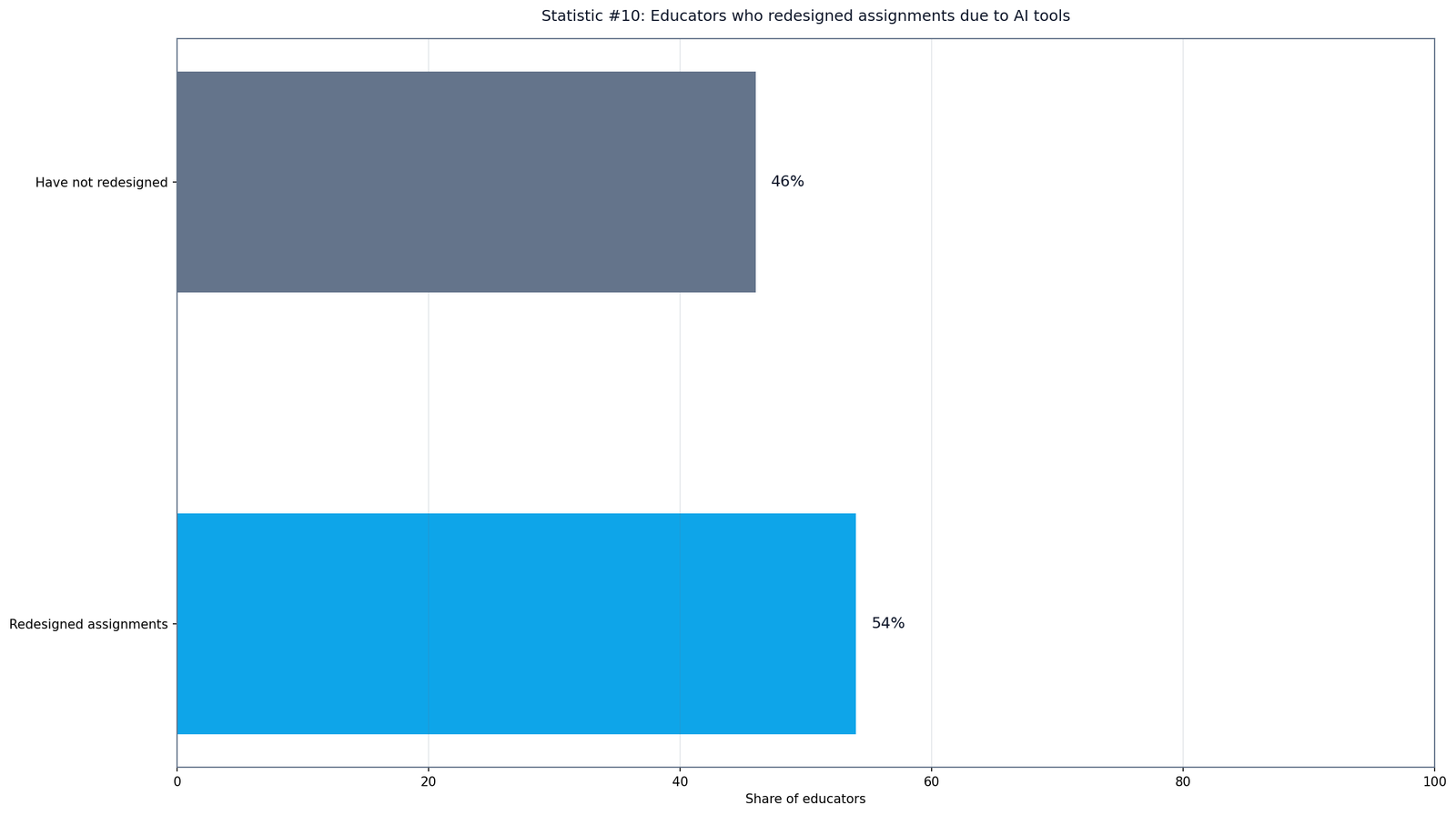
| 10 | Educators who have redesigned assignments due to AI tools | 54% |
| 11 | Students who use AI tools to generate essay outlines | 57% |
| 12 | Students who revise AI generated drafts before submission | 72% |
| 13 | Teachers who believe AI writing tools can support learning when supervised | 59% |
| 14 | Students who rely on AI to check citations and structure | 38% |
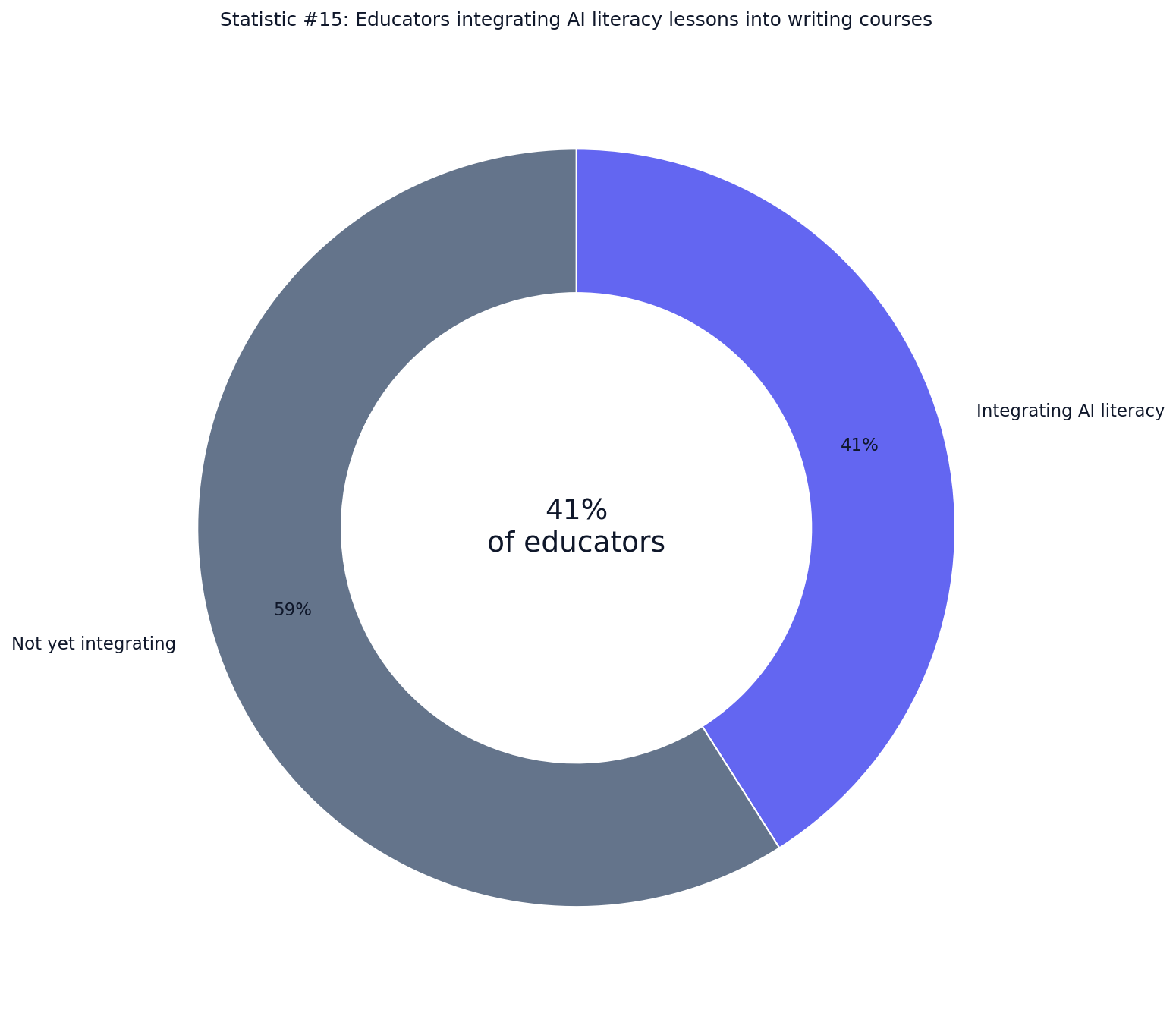
| 15 | Educators integrating AI literacy lessons into writing courses | 41% |
| 16 | Students who say AI tools help them write faster drafts | 69% |
| 17 | Schools exploring AI detection or writing verification systems | 44% |
| 18 | Students who use AI to paraphrase or simplify academic language | 47% |
| 19 | Educators who report mixed outcomes from AI writing adoption | 56% |
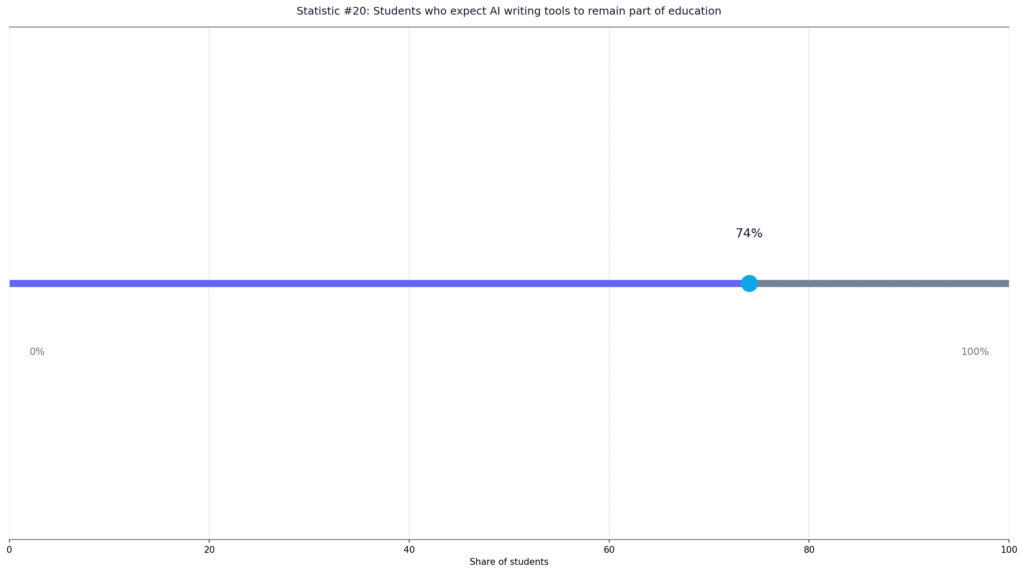
| 20 | Students who expect AI writing tools to remain part of education | 74% |
Top 20 AI-Assisted Writing in Education Statistics and the Road Ahead
AI-Assisted Writing in Education Statistics #1. Students already treat AI writing help as normal
58% of students using AI tools for academic writing signals that assisted drafting has moved well past the trial phase. That matters because once a habit reaches majority use, it starts shaping classroom expectations rather than sitting at the edges. Teachers then begin reading student work with a different lens, especially when familiar over-reliance signals start showing up across drafts.
The number rises because writing pressure now meets instant support in one window, often before a student opens notes or assigned readings. AI reduces the friction of beginning, but it also reduces the pause where topic understanding usually develops. That tradeoff explains why early convenience can slowly turn into weaker independent planning.
In practice, 58% of students does not mean most submissions are fully machine written, but it does mean AI has become a default checkpoint in the writing process. The more common this becomes, the more value moves toward revision quality, source judgment, and personal reasoning that feels genuinely owned. That makes the implication clear: teaching students how to use AI well now matters almost as much as teaching them how to write without it, with long term skill development as the implication.
AI-Assisted Writing in Education Statistics #2. Brainstorming is the gateway use case
64% of university students using AI for essay brainstorming shows that ideation has become the safest entry point for academic use. Students tend to justify this stage as harmless because it feels like help with starting, not help with thinking. Yet the opening stage shapes everything that follows, including argument direction, evidence choice, and confidence in the final claim.
This number behaves the way it does because brainstorming is where uncertainty feels most uncomfortable and where AI gives the fastest emotional relief. A blank page can feel bigger than the assignment itself, so students reach for structure before they reach for depth. Tools that promise quick prompts or sample angles become attractive, especially when learners have not yet built strong prewriting habits or learned how to sound authentic after getting that initial push.
The human contrast is subtle but important, since a student generated idea usually carries personal tension, curiosity, or doubt that machine suggestions flatten. With 64% of university students leaning on AI at the starting line, originality increasingly depends on what happens after the prompt list appears. That leaves a practical implication for educators: assignments need to evaluate how students shaped the idea, not just whether they arrived at one, with process visibility as the implication.
AI-Assisted Writing in Education Statistics #3. Assignment design is already reacting
71% of educators saying AI writing tools influence classroom assignments suggests the response is no longer theoretical. Once teachers begin adjusting prompts, rubrics, or in class writing conditions, the technology has already changed the ecosystem. The statistic points less to novelty and more to a quiet redesign of what counts as valid student work.
The pressure behind this response comes from a simple causal chain: higher student use creates more uncertainty, and uncertainty pushes instructors to change the task itself. Teachers tend to redesign not because every student misuses AI, but because the boundary between support and substitution is hard to see after submission. That is why so many schools now discuss disclosure, revision logs, or staged drafting.
The human side is that most educators still want writing to reveal judgment, struggle, and growth rather than polished fluency alone. When 71% of educators feel assignment design has been touched by AI, the issue is not only detection but the preservation of meaningful learning signals. The implication is that assessment will keep moving toward observable process and defensible reasoning rather than clean final copy by itself, with assignment redesign as the implication.
AI-Assisted Writing in Education Statistics #4. Sentence polishing remains a major attraction
49% of students using AI for grammar and sentence refinement shows that language polish is nearly as attractive as idea generation. This is the kind of help many learners view as practical and low risk because it seems close to spellcheck, only stronger. Still, tone, phrasing, and rhythm are where personal voice quietly lives, so refinement can change more than students think.
The number sits high because line editing is repetitive, time consuming, and emotionally loaded for students who worry their writing sounds weak. AI gives instant reassurance, which feels useful when deadlines are close and confidence is thin. That speed can be helpful, but it also encourages students to accept cleaner wording before asking whether the sentence still sounds like them.
The human contrast shows up when a rough but real sentence carries intent that polished AI phrasing smooths away. With 49% of students relying on refinement help, classrooms may see fewer visible language mistakes but also fewer clues to how a writer actually thinks. The implication is that educators will need to teach revision as a voice preserving activity, not only an error removal task, with authorship clarity as the implication.
AI-Assisted Writing in Education Statistics #5. Productivity gains are what students feel first
67% of students saying AI improves writing productivity explains why adoption continues even where policy remains unsettled. Time saved is easy to notice, easy to defend, and easy to repeat the next time work piles up. Once students feel they can move from prompt to draft faster, AI becomes less of an experiment and more of a routine support layer.
This pattern makes sense because productivity is the most visible benefit and the hardest one to argue against during busy academic weeks. Students do not always measure better thinking, but they do notice faster starts, quicker summaries, and cleaner restructuring. That makes AI feel effective even when the deeper learning value is mixed, which is why many institutions are now comparing these habits with curated lists of trusted school tools.
The human contrast is that productive writing and meaningful writing are not always the same thing, even when both produce finished pages. With 67% of students prioritizing speed gains, the real question becomes what part of the writing process is being shortened and what cognitive work disappears with it. The implication is that schools will increasingly judge AI use not by speed alone but by whether faster drafting still leads to deeper learning, with productivity balance as the implication.
AI-Assisted Writing in Education Statistics #6. Concern over reduced practice remains strong
63% of educators worrying that AI may reduce independent writing practice shows the central fear has not really changed. Teachers are less alarmed by the tool itself than by what repeated tool use may slowly replace. Writing develops through repetition, hesitation, and revision, so any shortcut that removes those reps can affect long term skill growth.
The concern stays high because practice is cumulative and fragile, especially for students still building argument structure or academic confidence. When AI handles the messy early drafting stage, learners may submit cleaner work without building the internal habits that made earlier writers stronger over time. That helps explain why anxiety persists even among instructors who accept some AI use in principle.
The human contrast is simple: a student who struggles through a rough draft often remembers more than one who glides to a polished paragraph with assistance. With 63% of educators focused on lost practice, the issue is less whether AI can improve a page and more whether it weakens the person behind the page. The implication is that schools will keep searching for ways to preserve productive struggle inside AI assisted workflows, with skill retention as the implication.
AI-Assisted Writing in Education Statistics #7. Summarization is becoming a default academic shortcut
52% of students using AI to summarize academic research articles points to a habit that feels efficient but changes how reading works. Summaries save time, yet they can also narrow a student’s contact with nuance, method, and uncertainty in the original source. In research based writing, those details often matter more than the headline takeaway.
This figure climbs because academic texts are dense, slow, and sometimes intimidating, especially outside a student’s strongest subject area. AI lowers the entry barrier by turning a long paper into a quick set of claims, which feels immediately useful during deadline pressure. The catch is that condensed understanding can make citations look informed while leaving interpretation thin.
The human contrast appears when students move from reading to writing, since strong writers usually notice tension, limitation, and wording choices that summaries tend to iron out. Once 52% of students rely on AI summaries, the gap widens between appearing prepared and actually engaging with the research. The implication is that educators may need to assess source handling more directly, not just whether sources were mentioned on the page, with reading depth as the implication.
AI-Assisted Writing in Education Statistics #8. Policy development is still catching up
46% of schools implementing AI writing guidelines or policies suggests institutional response is active but still incomplete. That leaves a wide middle ground where students and staff use powerful tools without consistent expectations. In education, ambiguity rarely stays neutral for long because it quickly turns into uneven enforcement and mixed classroom norms.
The number remains below half because policy takes longer than adoption, especially when technology changes faster than school governance. Leaders need to balance ethics, equity, academic integrity, and practicality, and that slows formal decisions. Meanwhile students keep using AI, so practice evolves first and documentation follows behind.
The human contrast shows up in the classroom experience, since one instructor may welcome disclosed AI support while another treats similar use as misconduct. With 46% of schools formalizing guidance, the real divide is no longer awareness but consistency. The implication is that the next phase of AI in education will depend less on whether tools exist and more on whether institutions can create rules that feel usable, fair, and teachable, with policy clarity as the implication.
AI-Assisted Writing in Education Statistics #9. Writer’s block is where AI feels most personally helpful
61% of students saying AI helps them overcome writer’s block reveals why the technology feels supportive rather than merely efficient. Blocked writing is emotional as much as technical, and AI offers motion at the exact moment a student feels stuck. That emotional lift can matter almost more than the words it actually generates.
The figure is high because writer’s block combines fear, time pressure, and uncertainty into one frustrating pause. AI breaks that pause with suggestions, structure, or a rough first sentence, which reduces the mental weight of starting. Once that relief works a few times, students begin trusting the tool as a confidence aid, not just a drafting tool.
The human contrast is that true breakthrough writing often comes from wrestling with confusion until a personal angle finally appears. When 61% of students use AI to bypass that friction, they may gain momentum but lose some of the discovery that makes writing intellectually useful. The implication is that educators should distinguish between AI as a nudge and AI as a substitute for the thinking that blockage sometimes forces, with confidence scaffolding as the implication.
AI-Assisted Writing in Education Statistics #10. Assignment redesign is already operational
54% of educators having redesigned assignments because of AI tools shows that classroom adaptation is no longer just strategic talk. More than half changing the task itself means instructors see old formats as easier to game or less revealing of real learning. That matters because assessment design usually changes only when the pressure becomes impossible to ignore.
The number sits where it does because redesign takes work, and many teachers are balancing experimentation with existing course loads and institutional limits. Still, enough instructors have decided that the cost of unchanged assignments is higher than the cost of revising them. Oral defenses, process notes, staged drafts, and in class writing all become more attractive under those conditions.
The human contrast is that redesigned assignments try to recover something machines cannot easily fake, namely judgment under visible conditions. Once 54% of educators make those changes, AI stops being a side issue and starts shaping pedagogy itself. The implication is that writing instruction will increasingly reward transparent process, reflection, and live reasoning instead of polished text alone, with assessment resilience as the implication.
AI-Assisted Writing in Education Statistics #11. Outlining is becoming a quiet handoff point
57% of students using AI tools to generate essay outlines shows how early structural decisions are being outsourced. An outline looks harmless because it is not a finished paragraph, but it often determines argument order, emphasis, and logical flow. Once structure is suggested externally, the final paper can inherit that logic all the way through.
This number grows because outlining sits between thinking and drafting, which makes it feel efficient rather than ethically loaded. Students who struggle to organize ideas can get immediate scaffolding, and that is genuinely useful in many cases. The issue is that external structure can become invisible dependence if students stop learning how to build one for themselves.
The human contrast is that a self made outline usually reflects personal uncertainty, priorities, and the writer’s own route into the topic. When 57% of students start from AI generated scaffolds, essays may become smoother but more similar in logic and cadence. The implication is that educators may need to examine planning artifacts more closely if they want to preserve genuine intellectual organization, with structural ownership as the implication.
AI-Assisted Writing in Education Statistics #12. Revision still separates support from surrender
72% of students revising AI generated drafts before submission is one of the more encouraging figures in the set. It suggests many learners do not simply copy output and move on, but instead treat AI as raw material. That distinction matters because revision is where ownership can return, even after a machine helped start the work.
The number is high because students know unedited AI text can sound generic, overconfident, or stylistically out of place in academic settings. Revising becomes both a quality control step and a self protection habit. In other words, students are not just improving the draft, they are also trying to make it believable and aligned with assignment expectations.
The human contrast is that genuine revision changes substance, not only wording, and that remains the important test. If 72% of students are revising, the next question is how deep those revisions go and whether thinking actually improved underneath the surface edits. The implication is that educational value now sits less in whether AI touched the first draft and more in what the student changed afterward, with revision depth as the implication.
AI-Assisted Writing in Education Statistics #13. Supervised use still has meaningful support
59% of teachers believing AI writing tools can support learning when supervised shows the debate is not simply divided into yes or no camps. A slim majority accepting guided use suggests many educators see a workable middle path. That matters because durable classroom practice usually grows from cautious acceptance rather than unrestricted enthusiasm.
This pattern appears because teachers can see genuine value in feedback, organization, and accessibility support when guardrails are present. Supervision reduces the fear that AI will quietly replace thinking while still allowing students to benefit from help at specific points. The result is a more conditional form of trust, built on oversight rather than optimism.
The human contrast is that supervision keeps the student’s judgment in the foreground, which is where learning still has to happen. When 59% of teachers support managed use, the signal is that educators are willing to work with AI as long as it remains visibly subordinate to the student’s own reasoning. The implication is that future policy may lean toward coached use models instead of blanket permission or blanket prohibition, with supervised integration as the implication.
AI-Assisted Writing in Education Statistics #14. Citation help remains a secondary but telling use
38% of students relying on AI to check citations and structure may look modest beside the larger adoption figures, but it reveals a very practical trust signal. Students are willing to hand over the technical framing of academic work even when they still write much of the content themselves. That matters because structure and citation choices strongly affect perceived credibility.
The number stays lower than brainstorming or drafting because these tasks are narrower and typically come later in the process. Even so, citation formatting is tedious and easy to get wrong, so AI becomes attractive as a finishing assistant. Once students see it clean up references or improve organization, that trust can expand into heavier forms of dependence.
The human contrast is that citation work teaches attention to source quality and argumentative discipline, not just punctuation rules. With 38% of students using AI at this stage, the risk is that compliance improves while intellectual care with sources stays shallow. The implication is that educators may need to evaluate citation judgment separately from citation accuracy, with scholarly discipline as the implication.
AI-Assisted Writing in Education Statistics #15. AI literacy is entering the writing curriculum
41% of educators integrating AI literacy lessons into writing courses shows a curricular response that is still emerging but already meaningful. When four in ten teachers start teaching tool judgment alongside composition, AI has clearly moved into the core conversation. The classroom is no longer deciding whether students encounter AI, only whether they learn to use it with care.
This figure is still below half because curriculum changes take planning time, faculty confidence, and room inside already crowded courses. Some instructors are still learning the tools themselves, which makes formal instruction harder to deliver. Yet the number keeps rising because unmanaged use creates more problems than guided conversation does.
The human contrast is that literacy instruction asks students to explain choices, limitations, and tradeoffs rather than hide the tool behind polished output. As 41% of educators bring AI literacy into writing teaching, the educational goal widens from producing text to understanding authorship in a machine assisted environment. The implication is that future writing courses may assess responsible tool use as part of writing competence itself, with literacy expansion as the implication.
AI-Assisted Writing in Education Statistics #16. Faster drafting is now an expected benefit
69% of students saying AI helps them write faster drafts shows speed has become one of the clearest perceived advantages. Drafting used to expose uncertainty in real time, but AI compresses that visible struggle into a much shorter window. For students balancing coursework, work, and deadlines, that time compression feels genuinely valuable.
The number is high because drafting speed is easy to feel immediately, unlike deeper gains in reasoning or source evaluation. Students notice the minutes saved, the quicker transitions between sections, and the reduced pressure of producing a rough first version. That kind of relief creates repeat behavior even when the final educational benefit is harder to measure.
The human contrast is that slow drafting can reveal what a student does not yet understand, and fast drafting can hide it. When 69% of students value faster first versions, educators have to ask whether speed is shortening only the mechanical work or also the thinking work. The implication is that writing pedagogy will need to separate efficiency gains from genuine comprehension gains much more carefully, with drafting transparency as the implication.
AI-Assisted Writing in Education Statistics #17. Verification systems are rising alongside adoption
44% of schools exploring AI detection or writing verification systems suggests institutions are still searching for confidence, not final answers. Detection interest rises when trust in the submitted text falls, even if the available tools remain imperfect. That makes this figure less a story of enforcement and more a story of unresolved institutional uncertainty.
The number grows because schools need a response mechanism while policy, pedagogy, and student norms are still in motion. Verification systems offer the appeal of visible control, especially when faculty feel under equipped to judge AI use from writing alone. Yet exploration does not always become reliance, since many educators also worry about false positives and limited context.
The human contrast is that authentic student writing carries messiness, inconsistency, and developmental clues that software may misread. With 44% of schools exploring verification tools, the deeper issue is whether institutions can protect integrity without making honest students feel permanently suspect. The implication is that technical oversight will likely remain supplementary rather than sufficient, with trust calibration as the implication.
AI-Assisted Writing in Education Statistics #18. Paraphrasing support sits close to the integrity line
47% of students using AI to paraphrase or simplify academic language shows how often clarity needs blur into authorship questions. Many learners experience dense academic prose as a barrier, so simplification feels practical rather than suspicious. Still, rewording is one of the places where support can slide most easily into substitution.
This figure makes sense because paraphrasing solves two problems at once: comprehension and expression. Students can understand a source more quickly and also produce language that sounds more polished or more accessible. The trouble is that simplified phrasing may drift far enough from the student’s own voice that the final sentence no longer reflects genuine understanding.
The human contrast is that real paraphrasing requires absorbing meaning and then rebuilding it through one’s own mental structure. Once 47% of students let AI handle that transformation, the page may look clearer even while the learning underneath becomes thinner. The implication is that educators will keep treating paraphrase support as a high attention zone where transparency and source comprehension matter most, with integrity pressure as the implication.
AI-Assisted Writing in Education Statistics #19. Mixed outcomes are now the most realistic educator view
56% of educators reporting mixed outcomes from AI writing adoption captures the mood more accurately than either optimism or panic. In most classrooms, the technology helps some students, complicates learning for others, and changes teaching for nearly everyone. That kind of uneven result is exactly what mature adoption usually looks like.
The figure lands here because AI improves access, momentum, and confidence for many learners while also weakening independence, voice, or depth in some cases. Educators are seeing both sides at once, often within the same assignment or even the same student. That makes broad claims less persuasive than context based judgment.
The human contrast is that teachers are evaluating not just finished text but changes in student behavior, engagement, and growth over time. When 56% of educators describe the impact as mixed, they are acknowledging complexity rather than uncertainty. The implication is that institutions will need flexible guidance that leaves room for discipline differences, student variation, and evolving classroom evidence instead of relying on one universal rule, with contextual judgment as the implication.
AI-Assisted Writing in Education Statistics #20. Students already assume AI will stay
74% of students expecting AI writing tools to remain part of education is a strong signal that this is no longer seen as a temporary disruption. Once students treat a technology as permanent, they build habits and expectations around it. That expectation changes how they prepare for assignments, how they judge school support, and how they define writing help.
The number is this high because AI has moved quickly from novelty to infrastructure in the student imagination. Even where rules are unsettled, the tools are already embedded in study routines, peer conversations, and broader digital culture. Students therefore plan for continued use not because every policy permits it, but because the technology now feels woven into academic life.
The human contrast is that permanence does not automatically mean maturity, and education still has to decide what responsible use should look like. With 74% of students assuming AI is here to stay, the strategic question moves from resistance to governance, literacy, and meaningful boundaries. The implication is that the next few years will be defined less by adoption itself and more by whether schools can shape that permanence into something educationally defensible, with long range integration as the implication.
What these AI-assisted writing in education statistics suggest for the next stage of classroom writing
Most of these figures point in the same direction: AI is becoming ordinary faster than institutions can normalize its use. The numbers feel less like a temporary spike and more like a redistribution of where writing effort now happens.
Students appear to value AI most at moments of friction, such as starting, organizing, simplifying, and accelerating drafts. Educators, meanwhile, seem most focused on protecting the slower forms of effort that still build durable writing skill.
That tension explains why policy, literacy instruction, and assignment redesign now move alongside adoption rather than behind it. The real divide is no longer between use and non use, but between visible, guided use and quiet dependence.
What comes next will likely be shaped by how clearly schools define authorship, revision, and acceptable assistance inside real classroom conditions. AI-assisted writing in education statistics now read less like isolated facts and more like an early map of how academic writing is being renegotiated.
Sources
- HEPI student generative AI survey 2026 report page
- HEPI full PDF on student generative AI survey 2026
- HEPI student generative AI survey 2025 report page
- HEPI analysis of evolving student attitudes toward institutional AI support
- HEPI commentary on widespread undergraduate generative AI use
- UNESCO survey on higher education AI guidance development
- UNESCO overview of artificial intelligence in education
- UNESCO guidance on AI and learner rights in education
- UNESCO perspective on AI and the future of education
- eCampus News report on growing GenAI adoption in higher education
- eCampus News article on acknowledging AI use in academic work
- eCampus News discussion of AI tools for student academic goals