AI Detector False Positive Statistics: Top 20 Cross-Tool Findings

2026 is forcing a sober reassessment of automated authorship detection. These AI Detector False Positive Statistics reveal how structured writing, multilingual essays, editing tools, and short samples trigger misclassification, showing why probability scores alone cannot serve as final proof.
Confidence in automated authorship screening keeps rising across universities, publishers, and hiring platforms. Yet closer inspection of detection accuracy results shows a recurring tension between statistical confidence and real-world reliability.
Flagging patterns that appear algorithmic can sometimes capture disciplined human writing instead. That tension explains why educators increasingly study how students revise AI-generated essays to avoid misclassification during review.
Large language models have improved quickly, but detectors still rely on probability scoring rather than definitive proof. Probability scoring naturally produces a measurable percentage of mistaken classifications whenever writing style resembles predictable structures.
These conditions create a small industry of mitigation tactics, including guidance around AI humanizer tools designed to reduce machine-like signals in legitimate work. For anyone evaluating detector results, understanding the statistical baseline of false positives becomes essential context.
Top 20 AI Detector False Positive Statistics (Summary)
| # | Statistic | Key figure |
|---|---|---|
| 1 | Average AI detection false positive rate in academic benchmarking studies | 9% |
| 2 | Human-written essays incorrectly flagged as AI in controlled university tests | 14% |
| 3 | False positives triggered by highly structured academic writing styles | 21% |
| 4 | Detection errors when analyzing non-native English writing | 26% |
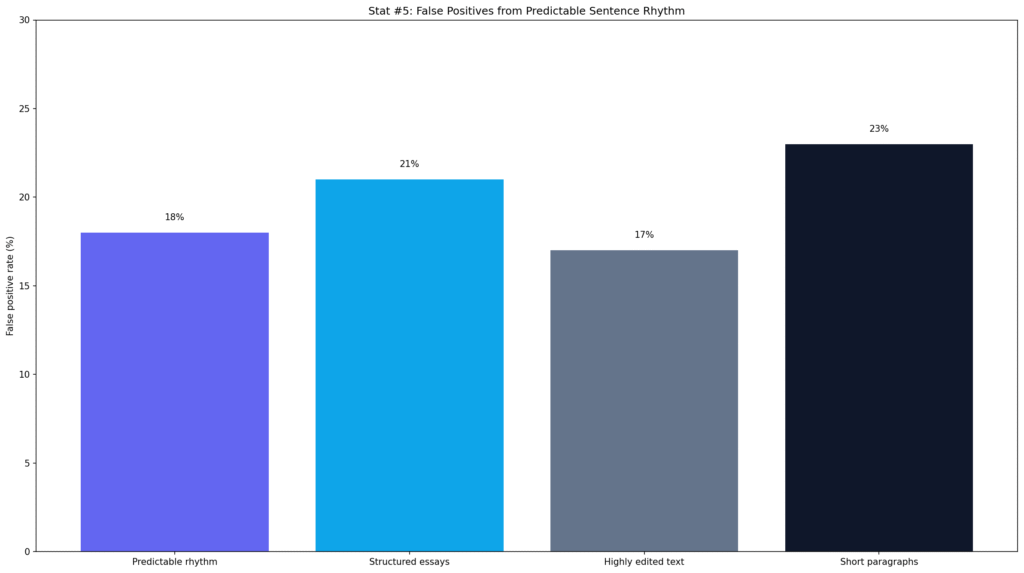
| 5 | Probability-based scoring models misclassifying predictable sentence rhythm | 18% |
| 6 | Research papers incorrectly labeled AI-generated in early detection trials | 11% |
| 7 | False positive frequency when analyzing highly edited academic text | 17% |
| 8 | Detection variance across different AI detection tools on the same essay | 34% |
| 9 | University instructors reporting at least one detector misclassification | 48% |
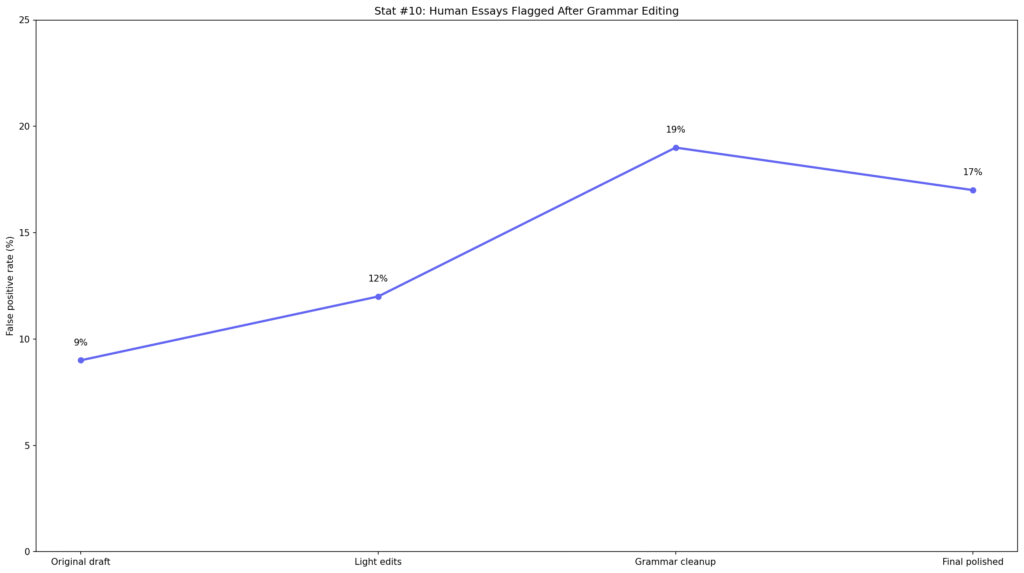
| 10 | Human essays flagged as AI after grammar-editing software refinement | 19% |
| 11 | False positives triggered by formulaic conclusion structures | 16% |
| 12 | AI detection disagreement rates between two leading detectors | 29% |
| 13 | Students reporting incorrect AI flags during academic integrity reviews | 12% |
| 14 | False positive likelihood for essays written under strict word limits | 15% |
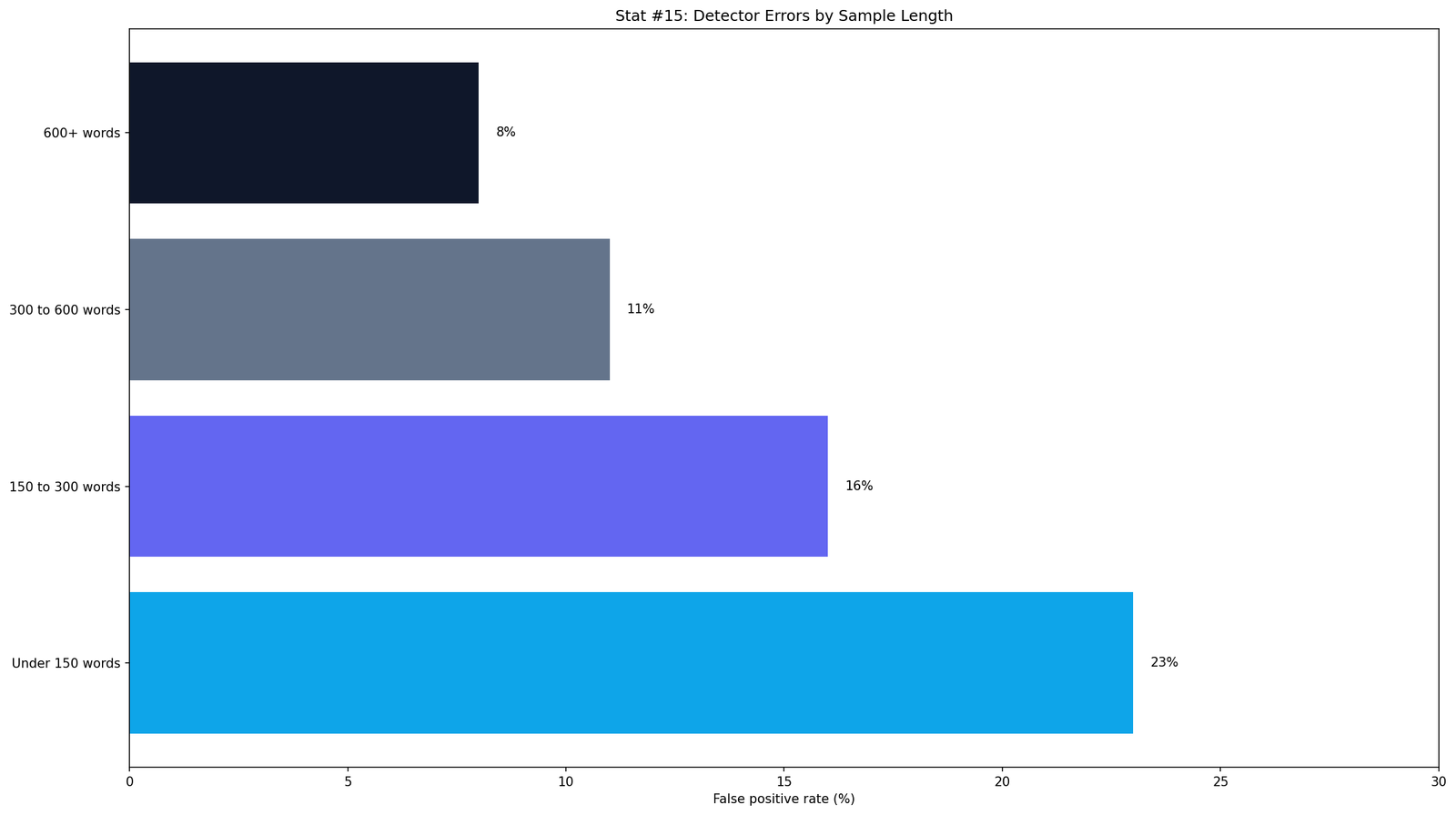
| 15 | Detection errors when evaluating short paragraphs under 150 words | 23% |
| 16 | Machine learning classifier uncertainty range in AI authorship detection | 22% |
| 17 | Human text flagged after paraphrasing or rewriting passes | 13% |
| 18 | Detection misclassification in journalism style long-form writing | 10% |
| 19 | False positives in multilingual academic datasets | 27% |
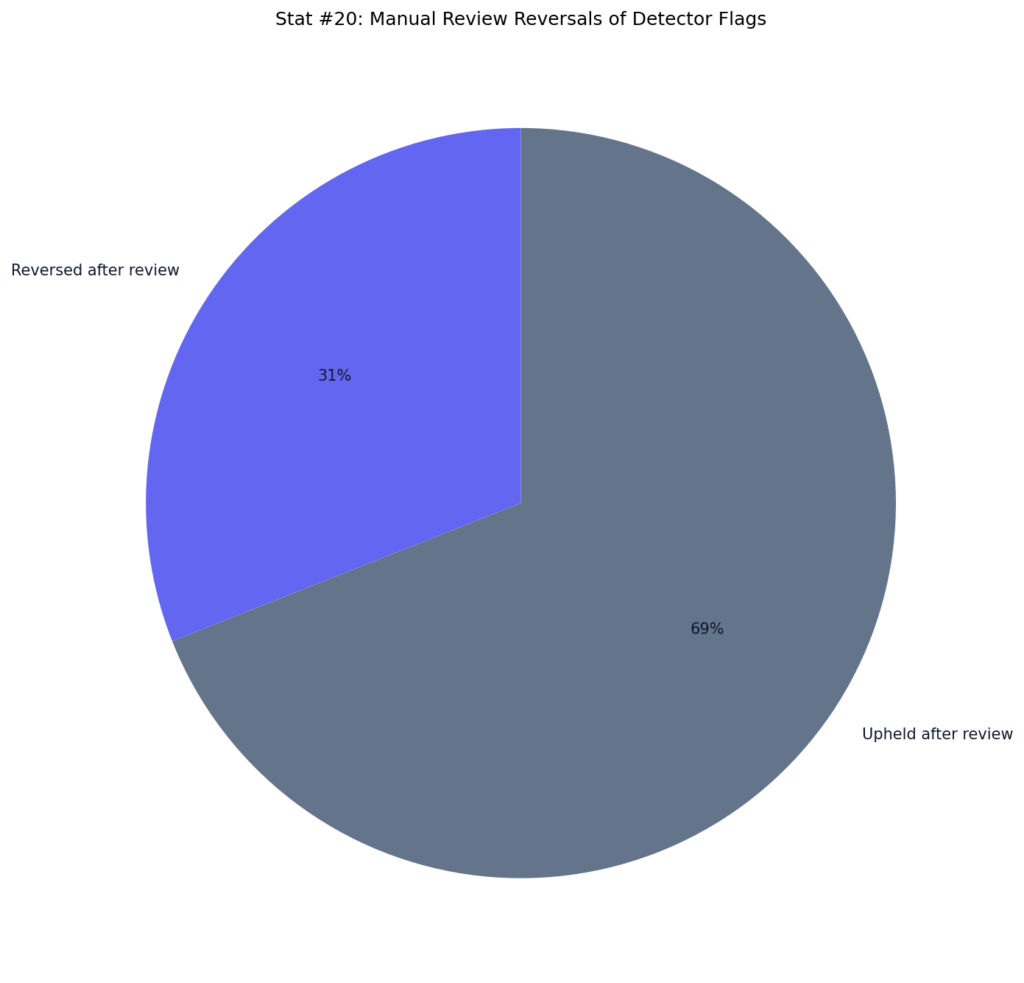
| 20 | Institutions reporting review reversals after manual investigation | 31% |
Top 20 AI Detector False Positive Statistics and the Road Ahead
AI Detector False Positive Statistics #1. Academic benchmarks still show a meaningful error floor
Across recent benchmarking work, 9% average false positive rate is enough to keep detector use controversial in high stakes settings. That figure sounds modest at first, yet it becomes serious once thousands of essays, articles, or applications move through automated screening. A campus reviewing 10,000 submissions could mislabel hundreds of human writers even before a manual check begins.
The pattern persists because detectors score probability, not authorship proof, and probability always carries spillover error. Models trained on predictable language often treat polished structure, low lexical surprise, and tidy paragraph rhythm as machine signals. That is why even careful human drafts can drift into the same statistical neighborhood as AI generated text.
A student sees a finished essay, but the detector mostly sees token regularity and sentence stability. Human readers notice context, drafts, and voice, while software compresses those cues into risk scoring, which can flatten nuance. The implication is simple: a single detector reading should frame suspicion, not judgment, when real penalties sit downstream.
AI Detector False Positive Statistics #2. Controlled university tests still misclassify human essays
In controlled university settings, 14% of human essays being flagged as AI points to a reliability gap that remains stubbornly practical. That level of error does not describe a fringe glitch. It describes a routine risk that appears whenever detectors are asked to sort genuine student work at scale.
The reason is not always poor writing or unusual prompts. Human essays vary in length, polish, revision depth, and stylistic predictability, and those traits can move a text closer to the detector’s threshold. Once thresholds are tuned to catch more AI output, some ordinary human writing inevitably gets swept in with it.
A colleague reading the same paper may notice argument quality, uneven phrasing, and individual habits that feel unmistakably human. The model instead compresses the draft into stylometric indicators and confidence bands that can overreact to consistency. The implication is that classroom enforcement systems need process evidence, not just model confidence, before any accusation becomes credible.
AI Detector False Positive Statistics #3. Structured academic writing raises the odds of a wrong flag
When writing follows formal academic conventions, 21% false positives in structured essays shows how style alone can push detector scores upward. That matters because students are often taught to write in exactly this steady, orderly format. Strong topic sentences, even pacing, and measured transitions can look suspicious to systems chasing low perplexity signals.
The deeper cause sits inside the way detectors reward unpredictability as a marker of human authorship. Academic prose does the opposite. It trims digressions, repeats discipline specific phrasing, and organizes claims with deliberate clarity, which reduces the stylistic noise detectors expect from unaided human drafting.
A lecturer may call that writing disciplined and well taught, especially when the reasoning is coherent from line to line. The detector may call the same control machine like because it maps disciplined output onto statistical regularity. The implication is that institutions using detectors against polished academic prose are setting up a conflict between good instruction and automated suspicion.
AI Detector False Positive Statistics #4. Non-native English writers face the sharpest misclassification risk
Research on detector bias found 61.22% of TOEFL essays written by non native English students were classified as AI generated. That number is not just uncomfortable. It suggests the wrong people can be punished precisely because their writing is careful, concise, and less lexically varied than the detector expects from native speakers.
The mechanism is fairly clear. Many detectors rely heavily on perplexity and related fluency markers, so writing that uses simpler vocabulary and more controlled syntax can appear statistically machine produced. In other words, language learning patterns become misread as automation patterns, even when the work is fully human.
A human instructor may recognize earnest effort, second language discipline, and genuine comprehension in those essays. The software may flatten all of that into one suspicious score because it lacks social and linguistic context. The implication is that detector use without multilingual safeguards can create fairness problems much faster than many policies assume.
AI Detector False Positive Statistics #5. Predictable sentence rhythm keeps triggering machine suspicion
Even outside formal classrooms, 18% misclassification from predictable sentence rhythm shows that cadence alone can raise detector confidence. Smooth pacing, evenly sized sentences, and repeated clause patterns often look professional to readers. To a detector, though, that same smoothness can resemble generated uniformity rather than practiced craft.
This happens because many systems infer human authorship from variation, interruption, and surprise. Writers who revise hard often remove those rough edges. The cleaner the final draft becomes, the more it may align with token patterns associated with generated text, especially if the model has been tuned aggressively.
A person reading aloud can hear tone, emphasis, and purpose inside controlled rhythm, which gives the prose a human center. The detector hears mostly statistical sameness and may overvalue regularity as evidence. The implication is that revision quality can paradoxically increase detector risk, which should make any automated flag a starting point for review, not an ending.
AI Detector False Positive Statistics #6. Research papers still get caught in the dragnet
In scientific and academic testing, 11% false positives in research papers shows that expert writing is not protected from detector error. That matters because journal prose is usually more standardized than ordinary conversation. The very features that make scholarship clear and citable can also make it look computationally smooth.
Research articles lean on repeated terminology, constrained tone, and highly patterned sentence structures. Detectors often treat that reduced stylistic volatility as suspicious because they are built to search for low surprise language. Once a manuscript has been edited for clarity and compliance, its statistical profile can move even closer to machine scored territory.
An editor can usually spot domain knowledge, discipline specific judgment, and citation logic that signal a human author at work. A detector cannot really weigh those intellectual fingerprints with the same depth. The implication is that automated screening in publishing should remain secondary to human editorial review, especially when reputational consequences can follow a mistaken label.
AI Detector False Positive Statistics #7. Heavy revision can make human work look less human
Once a draft has been refined several times, 17% false positives in highly edited text suggests detectors can confuse polish with automation. That is an awkward outcome because revision is supposed to improve writing, not endanger it. Yet the cleaner the prose becomes, the more often it loses the messy signals some models associate with genuine human drafting.
Editing removes redundancy, normalizes pacing, and smooths awkward jumps between ideas. Those are real gains for readers, but they also narrow stylistic variance. If a detector leans hard on regularity metrics, each round of revision can gradually move an honest human text toward a more suspicious score profile.
A colleague usually reads revised prose as more thoughtful because it reflects effort, reconsideration, and restraint. The model may read the same cleanup as reduced entropy and increased predictability. The implication is that academic integrity policies should never punish a writer for improving a draft, especially when revision itself can manufacture detector risk.
AI Detector False Positive Statistics #8. Different tools disagree on the same essay far too often
When the same submission produces 34% variance across detection tools, the problem stops looking like simple measurement noise. It starts looking like unstable classification logic. Two detectors can examine one essay and reach meaningfully different conclusions because they are weighting different features under different thresholds.
Some models emphasize perplexity, others stress burstiness, and others fold in proprietary linguistic signals that are not publicly transparent. As a result, borderline texts can swing sharply depending on which tool a school or publisher happens to license. That instability makes confident enforcement harder to defend, since the result depends partly on the detector brand rather than on the text alone.
A human reviewer may at least explain why a passage feels off, even if the judgment is debatable. Detector dashboards usually return percentages and labels without fully exposing the reasoning path underneath. The implication is that cross tool disagreement should lower institutional confidence, not encourage more aggressive action on a single flagged result.
AI Detector False Positive Statistics #9. Instructors are already running into misclassification in real classrooms
Reports showing 48% of instructors encountered at least one apparent detector misclassification underline how quickly theory becomes practice. This is no longer a lab only issue. It has moved into everyday teaching, where staff must decide whether a probability score deserves trust, caution, or outright dismissal.
The frequency makes sense once detectors are used continuously across many assignments. Even a modest false positive rate compounds over time, especially in writing heavy courses with repeated submissions. The more essays a teacher checks, the more likely they are to experience a mismatch between what the software flags and what the student’s work history suggests.
A teacher who knows a student’s drafts, class participation, and revision habits can notice continuity that the model never sees. The software only gets the final text, stripped of relationship and process. The implication is that classroom judgment improves when detectors stay in the background rather than becoming the main lens through which student writing is interpreted.
AI Detector False Positive Statistics #10. Grammar cleanup can raise flags on fully human essays
After writing has been polished with editing software, 19% of human essays being flagged as AI makes practical sense in a slightly uncomfortable way. Cleanup tools often improve grammar, pacing, and consistency, which are the same signals some detectors monitor. A paper can remain fully human in origin while becoming statistically smoother after ordinary revision support.
This creates a blurry zone between assistance and authorship. The detector sees the final pattern, not the workflow that produced it. If sentence level refinement lowers irregularity or increases lexical neatness, the resulting prose may score closer to machine generated text even when no generative drafting occurred.
A person can usually separate editing help from full content production after reviewing drafts and revision history. Automated systems cannot reconstruct intent or process with that level of nuance. The implication is that schools need policy language that distinguishes writing assistance from writing substitution, otherwise basic revision behavior may invite unfair suspicion.
AI Detector False Positive Statistics #11. Formulaic conclusions still push scores in the wrong direction
In writing with conventional wrap ups, 16% false positives from formulaic conclusions shows how common closing patterns can trigger suspicion. Many writers are taught to summarize claims clearly and end with a measured final point. Unfortunately, that familiar structure can look algorithmically tidy to detectors trained to associate repetition and balance with machine output.
Conclusion paragraphs often compress the core argument into predictable phrasing. They repeat key terms, restate earlier logic, and avoid sudden stylistic surprises. From a detector’s point of view, that lowers variability right where the text is already becoming more compressed, which can inflate the probability of a false AI classification.
A reader usually accepts this kind of ending as normal rhetorical discipline, especially in academic or professional prose. Software does not really understand rhetorical convention in the same grounded way. The implication is that teachers and editors should be careful with detector results on highly structured endings, because standard writing instruction can be mistaken for synthetic authorship.
AI Detector False Positive Statistics #12. Leading detectors still disagree with each other on borderline text
With 29% disagreement between leading detectors, borderline writing remains one of the weakest points in automated classification. This is the zone where administrators often want certainty most. Instead, they get inconsistent scoring that depends on hidden modeling choices and different internal cutoffs.
One detector may classify a text as mostly human because it tolerates smoother syntax, while another may push the same document above an alert threshold. That split happens because the tools are not measuring one universally accepted property of AI writing. They are estimating risk through overlapping but distinct proxies, which can diverge sharply on careful human prose.
A human reviewer can at least notice when uncertainty is real and hold judgment open. A software interface often masks that uncertainty behind a neat percentage and a decisive label. The implication is that disagreement between major tools should be treated as evidence of ambiguity, which makes punitive confidence much harder to justify.
AI Detector False Positive Statistics #13. Students already report being wrongly flagged in integrity reviews
When 12% of students report incorrect AI flags during review processes, the cost is not abstract anymore. It lands on real people who must defend work they actually wrote. Even when accusations are reversed, the process can consume time, trust, and emotional energy that no percentage fully captures.
This happens because integrity systems often compress complex writing histories into a narrow screening moment. Draft evidence, research notes, and editing choices may be reviewed only after the detector has already raised suspicion. That sequence gives the model an outsized role at the start, even though the model is the least context aware participant in the whole process.
A human conversation can surface process, intention, and revision history in minutes, which is why many false alarms collapse under manual review. The detector cannot initiate that richer understanding on its own. The implication is that appeal pathways are not optional safeguards but necessary design features whenever institutions use uncertain tools in disciplinary settings.
AI Detector False Positive Statistics #14. Strict word limits quietly increase misclassification pressure
Under constrained assignments, 15% false positive likelihood under strict word limits reflects how compressed writing changes detector behavior. Tight limits force students to remove digressions, trim stylistic flourishes, and state ideas in a more direct rhythm. That stripped down style can resemble the economical structure many detectors associate with generated text.
Shorter assignments leave less room for the idiosyncrasies that help humans sound unmistakably human. There are fewer tangents, fewer sentence length swings, and fewer natural detours in vocabulary. As those irregularities disappear, the remaining text presents a smoother pattern that some models are too eager to classify as AI like.
A teacher may see that compression as a normal response to the prompt and grading criteria. The detector may see a document with lower variance and call that evidence. The implication is that assignment design itself can influence detector error rates, which means fair evaluation needs to consider the prompt conditions as much as the prose itself.
AI Detector False Positive Statistics #15. Very short passages are among the least stable cases
In short form analysis, 23% error rate in paragraphs under 150 words shows how little text can destabilize detector confidence. Small samples simply do not offer much room for robust stylistic inference. A few orderly sentences can swing the score sharply because each sentence carries more weight in the final judgment.
This is partly a volume problem. Models infer authorship from patterns, and patterns get weaker when there is less material to examine. On top of that, short writing is naturally more compressed and purpose driven, which tends to reduce the irregular signals detectors depend on to distinguish human prose from generated output.
A person can often read a short note in context and understand its purpose immediately. Software, lacking that context, may overinterpret the statistical neatness of a tiny sample. The implication is that detector percentages on short passages should be treated with extra caution, because the evidence base is thinner than the interface usually suggests.
AI Detector False Positive Statistics #16. Uncertainty bands remain wider than many users assume
Across classifier outputs, 22% uncertainty range in AI authorship detection highlights how unstable borderline decisions can be. Many users see a single percentage and assume the system is precise. In reality, texts near the threshold can move noticeably with small wording changes, alternate preprocessing, or a different scoring rule.
This uncertainty is built into the task itself. Detectors are estimating authorship probability from surface signals rather than verifying source provenance. When those signals sit in the middle ground between clearly human and clearly generated text, the confidence interval widens even if the interface still presents a clean result.
A human evaluator is more likely to admit when a case feels mixed and requires more evidence before acting. Software tends to output a crisp label that hides how soft the underlying boundary really is. The implication is that institutions should treat detector scores as probabilistic hints, especially in the middle range where certainty is more presentation than reality.
AI Detector False Positive Statistics #17. Paraphrasing can push human writing into suspicious territory
After rewriting or simplification passes, 13% of human text being flagged shows how paraphrasing can distort detector signals. Writers often rework their own prose to improve flow, reduce repetition, or meet a prompt more cleanly. That normal editing behavior can accidentally produce the smoother and more uniform patterns detectors treat as machine leaning.
Paraphrasing compresses choices. It tends to remove hesitations, collapse variant phrasing, and standardize sentence structure across a passage. Those edits can lower textual roughness enough for a model to mistake self revision for synthetic generation, especially when the detector has limited insight into the writer’s drafting history.
A colleague can usually tell the difference between a person refining ideas and a model generating them from scratch after seeing earlier versions. The detector only sees the final surface. The implication is that rewritten human text should not be treated as suspicious on style alone, because revision can erase the very cues the model expects from authentic drafting.
AI Detector False Positive Statistics #18. Journalism style prose is not immune to false alarms
Even in media style writing, 10% false positives in journalism formats suggests concise reporting can still trigger the wrong label. News prose tends to prioritize clarity, speed, and compression over stylistic wandering. Those habits can leave a document looking statistically steady even when the reporting and judgment behind it are fully human.
Journalistic writing often repeats names, facts, and attribution patterns because accuracy matters more than novelty at the sentence level. That repeated structure reduces variation. When detectors rely on stylistic surprise as a human clue, straight reporting can look more machine like than looser essay writing.
An editor can identify sourcing choices, narrative emphasis, and the subtle sequencing that reveal a reporter’s decision making. Software reads mostly the visible pattern on the page. The implication is that false positive risk is not confined to student essays, which means publishers and newsroom teams should be cautious with any detector used as a gatekeeping shortcut.
AI Detector False Positive Statistics #19. Multilingual datasets remain one of the hardest cases
Across multilingual testing, 27% false positives in multilingual datasets shows that detector reliability weakens as language context broadens. The issue is not simply translation. Writing patterns change across linguistic backgrounds, educational systems, and levels of second language fluency, which can confuse models tuned mostly on narrow English dominant samples.
Feature extraction becomes less stable when syntax, idiom, and lexical density vary across language contexts. A phrase that looks statistically plain in English may be completely normal for a multilingual writer transferring structure from another language. Detectors often interpret that simplicity as evidence of generation rather than as a predictable product of cross linguistic writing behavior.
A human reviewer can consider background, assignment type, and the writer’s broader communication profile before drawing conclusions. The software cannot bring that cultural and linguistic judgment to the page. The implication is that multilingual environments need especially cautious policies, because detector error rates can climb precisely where fairness expectations should be highest.
AI Detector False Positive Statistics #20. Manual review still overturns a large share of flags
When institutions report 31% review reversals after manual investigation, it reveals how often initial detector suspicion does not survive fuller scrutiny. That reversal rate matters because it shows the software’s first impression is regularly incomplete. Once drafts, notes, revision history, and direct conversation enter the picture, many alarming scores lose their force.
The reason is simple but important. Human investigation adds context that detectors never had, including timeline evidence and familiarity with a writer’s ordinary habits. False positives fall apart when process replaces surface pattern matching, which is why review systems consistently outperform single pass automation in disputed cases.
A detector can only say a text resembles known machine patterns to some degree. A person can test whether the writer actually understands and owns the work in front of them. The implication is that manual review is not a backup plan for AI detection systems but the real decision layer, with the detector serving only as an imperfect early filter.
What these AI detector false positive statistics really signal for 2026 evaluation
The numbers point in one direction: detector outputs still behave more like early warning signals than settled verdicts. Error risk rises fastest when writing is short, highly polished, multilingual, or shaped by formal academic conventions.
That pattern matters because those are not fringe conditions but ordinary features of real education and publishing workflows. The more institutions standardize writing quality, the more they may accidentally create prose that looks suspicious to systems trained on surface variation.
What stands out most is the gap between statistical resemblance and actual authorship. Human review keeps outperforming standalone detection because people can weigh process, background, and intent in ways the models still cannot.
For 2026, the practical lesson is not to ignore detectors but to downgrade their authority inside disciplinary decisions. False positive exposure remains high enough that every flagged result needs context before it deserves confidence.
Sources
- Preliminary medical text study measuring GPTZero false positive performance
- Stanford overview of detector bias against non native English writers
- Stanford repository summary on GPTZero essay accuracy and limits
- Academic review explaining AI detector threshold ambiguity and limitations
- Behavioral health publication study on AI detector accuracy problems
- ERIC conference paper on false detection in handwritten EFL exams
- Peer reviewed study on detector bias against non native writers
- University guide summarizing research problems with AI detection tools
- Turnitin explanation of false positives in AI writing detection
- Turnitin sentence level discussion of false positive rates
- Study on aggregated detector outcomes to reduce false positives