AI Writing Support Tools for Students Statistics: Top 20 Adoption Metrics

2026 marks the moment AI writing support quietly became standard academic infrastructure. These statistics map how students now rely on tools for explanation, summaries, editing, and research ideation, revealing where support improves learning and where institutions still struggle to keep pace.
Student writing support has moved from a fringe convenience to a near-default layer in academic work, which makes the category harder to judge at a glance. The more interesting question now is not whether these tools are present, but how their use lines up with professor expectations as campuses try to define acceptable help.
What stands out in this set is how quickly assistance has spread from rough drafting into summarizing, concept clarification, and research support. That matters because the same tool can look harmless in one workflow and risky in school policies that still treat writing help as a blurry category.
Usage keeps climbing, yet confidence in guidance still lags, which leaves students making judgment calls in spaces that feel partly approved and partly improvised. A practical aside here: the strongest patterns tend to come from tools used for revision and explanation, not just from whatever gets marketed as the smartest chatbot.
That is also why this table is worth reading as a map of behavior rather than a simple popularity list. Some of the sharpest signals sit in editing, support outside study hours, and the pull of paraphraser tools that promise cleaner language without doing the thinking for the student.
Top 20 AI Writing Support Tools for Students Statistics (Summary)
| # | Statistic | Key figure |
|---|---|---|
| 1 | Students using AI in some form in 2026 | 97% |
| 2 | Students using generative AI to help with assessed work in 2026 | 94% |
| 3 | Students saying AI use for assessments rose from 2024 to 2025 | 53% to 88% |
| 4 | Students using AI to explain concepts for assessments in 2025 | 58% |
| 5 | Students using AI to summarize a relevant article in 2025 | 48% |
| 6 | Students using AI to suggest research ideas in 2025 | 41% |
| 7 | Students using AI to structure thoughts in 2025 | 39% |
| 8 | Students enhancing and editing writing with AI tools in 2025 | 39% |
| 9 | Students using AI for translation or language support in 2025 | 35% |
| 10 | Students saying AI saves them time in 2026 | 45% |
| 11 | Students saying AI improves the quality of their work in 2026 | 47% |
| 12 | Students saying AI gives instant support in 2026 | 40% |
| 13 | Students saying AI gives support outside traditional study hours in 2026 | 32% |
| 14 | Students weekly using AI to discover and understand traditional sources in 2026 | 53% |
| 15 | Students saying AI has improved their student experience in 2026 | 49% |
| 16 | Students saying AI skills are essential to thrive today in 2026 | 68% |
| 17 | Students who feel teaching staff help develop AI skills for future careers in 2026 | 48% |
| 18 | Students saying their institution provides AI tools in 2026 | 38% |
| 19 | Students who think their institution should provide AI tools in 2026 | 50% |
| 20 | Students surveyed by Turnitin and Tyton Partners who said they use AI writing in 2024 | 59% |
Top 20 AI Writing Support Tools for Students Statistics and the Road Ahead
AI Writing Support Tools for Students Statistics #1. AI use is nearly universal among students
95% of students reported using AI in at least one way in the 2026 HEPI survey, which makes nonuse the real outlier. That number tells you these tools are no longer sitting at the edge of student workflows waiting for early adopters to test them. They now behave more like standard academic infrastructure, turning up whenever students brainstorm, revise, or clarify unfamiliar material.
The reason the figure climbed so high is partly convenience and partly habit formation across the last two academic years. Once students learn that a tool can compress searching, explanation, and cleanup into one place, the barrier to repeat use drops quickly. What starts as occasional curiosity turns into routine support, especially when deadlines stack and campus guidance remains uneven.
For editors and academic teams, the practical implication is that baseline assumptions have changed, because AI exposure now describes nearly the whole student body. Human judgment still decides whether use stays helpful or drifts into overreliance, yet the tools themselves are already embedded. That means future policy, product design, and student support should be built for a world where AI use is normal, which is the implication.
AI Writing Support Tools for Students Statistics #2. Assessed work now draws heavily on generative AI support
94% of students said they use generative AI to help with assessed work in 2026, which pushes support tools directly into graded academic activity. That matters more than general use because assessed work is where institutions draw their sharpest lines around fairness, originality, and permitted assistance. The figure suggests AI has moved from optional side help into the core zone where marks, standards, and student anxiety all meet.
This level of use grows when students see AI as modular help rather than full automation. Many are not simply asking for essays, but using tools to explain readings, shape ideas, check phrasing, and reduce time spent stuck at the start. That narrower framing makes adoption feel safer and more defensible, even when policy language still leaves gray areas.
The human contrast here is important, because students still want their submitted work to sound like them and align with course expectations. Yet when almost everyone is drawing on support during assessed tasks, the real editorial question becomes how that help is bounded and documented. Institutions that ignore that change will keep reacting after the fact rather than designing clear rules before misuse becomes the only visible story, which is the implication.
AI Writing Support Tools for Students Statistics #3. Assessment use surged within a single year
53% to 88% of students reported using generative AI for assessments from 2024 to 2025, which is a remarkably fast jump for one academic year. Numbers like that rarely move without a broader change in campus behavior, access, and social acceptability. The rise shows that once students saw peers using these tools successfully, hesitation gave way to normalization at speed.
The jump also reflects how quickly tool interfaces improved during that period. Better prompts, simpler outputs, and more familiar brand names lowered the learning curve, so students could use AI without treating it like specialist software. At the same time, rising workload pressure made time-saving support feel less experimental and more like a practical response to ordinary academic strain.
From an editorial standpoint, rapid growth matters because it compresses the window institutions have to shape good habits. Human writing processes usually evolve slowly, but this adoption curve did not wait for neat policy development or consistent staff training. When usage expands that quickly, guidance has to move from abstract principle to concrete examples of acceptable help, because lagging clarity invites confusion at scale, which is the implication.
AI Writing Support Tools for Students Statistics #4. Concept explanation remains the top academic use case
58% of students used generative AI to explain concepts for assessments in 2025, making explanation the most common academic function in the HEPI results. That pattern is revealing because it points to AI as a comprehension aid before it becomes a writing shortcut. Students often hit friction not at the typing stage, but earlier, when a reading, theory, or method simply does not click on first pass.
Explanation tools spread because they answer a very human problem, which is embarrassment, delay, and uncertainty around asking for help. A student can rephrase the same question several times, ask for a simpler version, or request examples without feeling exposed in class. That makes AI especially attractive in subjects where students need repeated clarification before they can write anything worth submitting.
The editorial implication is that support tools win when they help students think through material, not just polish the final paragraph. Human understanding still needs to anchor the work, or the output becomes tidy language resting on weak comprehension. Products and policies that encourage explanation, source checking, and follow-up questioning will support stronger academic habits than tools positioned mainly as draft generators, which is the implication.
AI Writing Support Tools for Students Statistics #5. Article summarization has become a mainstream study shortcut
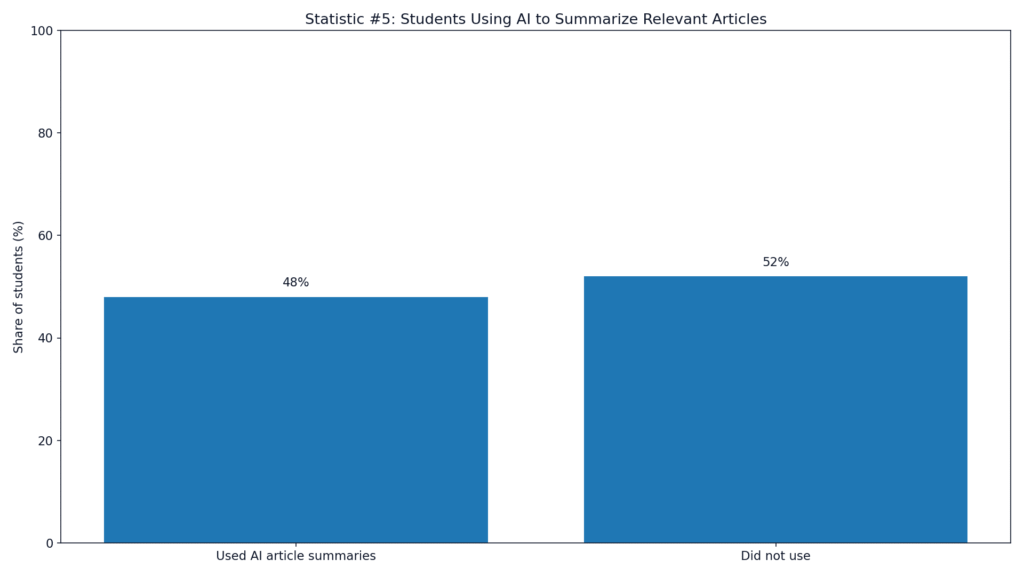
48% of students used generative AI to summarize a relevant article for assessed work in 2025, placing summarization just behind concept explanation. That statistic matters because it captures a point where reading support and writing support begin to overlap. Once a tool can condense dense material quickly, it influences not only comprehension but also what students choose to read fully, skim, or skip.
Summarization grows fast because academic reading is time heavy and often written in language students need to unpack before they can use it. AI offers a shortcut into the text, turning a difficult article into a workable overview that feels easier to manage under deadline pressure. The tradeoff, of course, is that compressed summaries can flatten nuance, miss method details, or quietly misstate a source.
The human contrast is easy to see here, because a careful reader notices tone, uncertainty, and emphasis that a clean summary may smooth over. Students still need that slower interpretive layer if they want arguments to hold up under close marking. Support tools that treat summarization as the starting point rather than the finished understanding will be more useful in academic settings, which is the implication.
AI Writing Support Tools for Students Statistics #6. Research idea generation is now a common support function
41% of students used generative AI to suggest research ideas for assessed work in 2025, which puts ideation squarely inside normal study behavior. That figure matters because the earliest stage of writing often determines the quality of everything that follows. Students who cannot narrow a topic, frame a question, or spot a workable angle are exactly the ones most likely to reach for quick support.
Idea generation catches on because it reduces the blank-page problem without forcing students straight into finished prose. A tool can surface directions, examples, or angles that make a topic feel more approachable, especially when the assignment brief is broad or abstract. That makes AI feel less like a substitute writer and more like a brainstorming partner that keeps momentum alive.
The human check still matters, though, because plausible ideas are not always relevant, original, or methodologically sound. Students need to evaluate whether a suggestion fits the course, the evidence base, and the teacher’s expectations rather than treating novelty as quality. Support tools that help users test and refine ideas, rather than just produce more of them, will create stronger academic outcomes over time, which is the implication.
AI Writing Support Tools for Students Statistics #7. Structuring thoughts has become a major use case
39% of students used generative AI to structure their thoughts for assessed work in 2025, which shows how often support is needed before drafting begins. This is a useful statistic because structure problems are easy to underestimate when people focus only on wording or grammar. Many students know roughly what they want to say, yet struggle to organize points into a sequence that feels coherent enough to write.
AI fits that moment well because it can turn messy notes into a proposed outline very quickly. That gives students a visible starting shape, which lowers cognitive friction and helps them move from scattered ideas into something that resembles an argument. In practice, the value is less about brilliance and more about reducing the mental drag that keeps a paper from getting underway.
The human contrast is that real structure depends on judgment, not only order. A generated outline can look tidy while still missing emphasis, evidence hierarchy, or the teacher’s preferred logic. Editors, educators, and product teams should treat outlining support as useful scaffolding, but they should still encourage students to reshape that scaffold with their own reasoning, which is the implication.
AI Writing Support Tools for Students Statistics #8. Editing support has become nearly as common as structuring help
39% of students used AI tools to enhance and edit their writing in 2025, placing revision support high on the overall usage list. That is important because editing feels less controversial to many students than generating full text. A tool that smooths grammar, sharpens phrasing, or improves readability can be framed as assistance with delivery rather than authorship.
This kind of use spreads because revision is repetitive, time consuming, and often difficult to do well on your own after staring at the same paragraph too long. Students are especially likely to value tools that can spot awkward wording or clumsy flow when the deadline is near and mental fatigue has set in. The appeal comes from speed, but also from the sense that polished language signals competence.
The risk is that edited prose can look stronger than the thinking underneath it. Human revision catches tone, argument quality, and audience fit in ways automated cleanup still handles unevenly. For that reason, the best support tools will keep editing attached to clarity and meaning rather than encouraging cosmetic polish as a substitute for real intellectual work, which is the implication.
AI Writing Support Tools for Students Statistics #9. Language support is a practical driver of adoption
35% of students used AI for translation or language support in 2025, which makes linguistic assistance one of the more established functions in the broader toolset. That matters because language friction is rarely just a surface problem in academic work. It affects confidence, reading speed, precision, and whether a student can express ideas at the level a course expects.
Translation and language help spread because they solve a direct, tangible problem with very little setup. A student can clarify a phrase, check wording, or move between languages in seconds, which feels immediately useful in a way that abstract AI promises often do not. That practicality makes this category sticky, especially for multilingual users or anyone writing under pressure in formal academic English.
The human side remains essential because language is tied to meaning, nuance, and disciplinary convention. Tools can help students get closer to fluent expression, but they cannot fully replace a learner’s own sense of emphasis or context. Products that position language support as confidence-building assistance, rather than invisible substitution, will create more durable trust in education, which is the implication.
AI Writing Support Tools for Students Statistics #10. Time saving remains the strongest perceived benefit
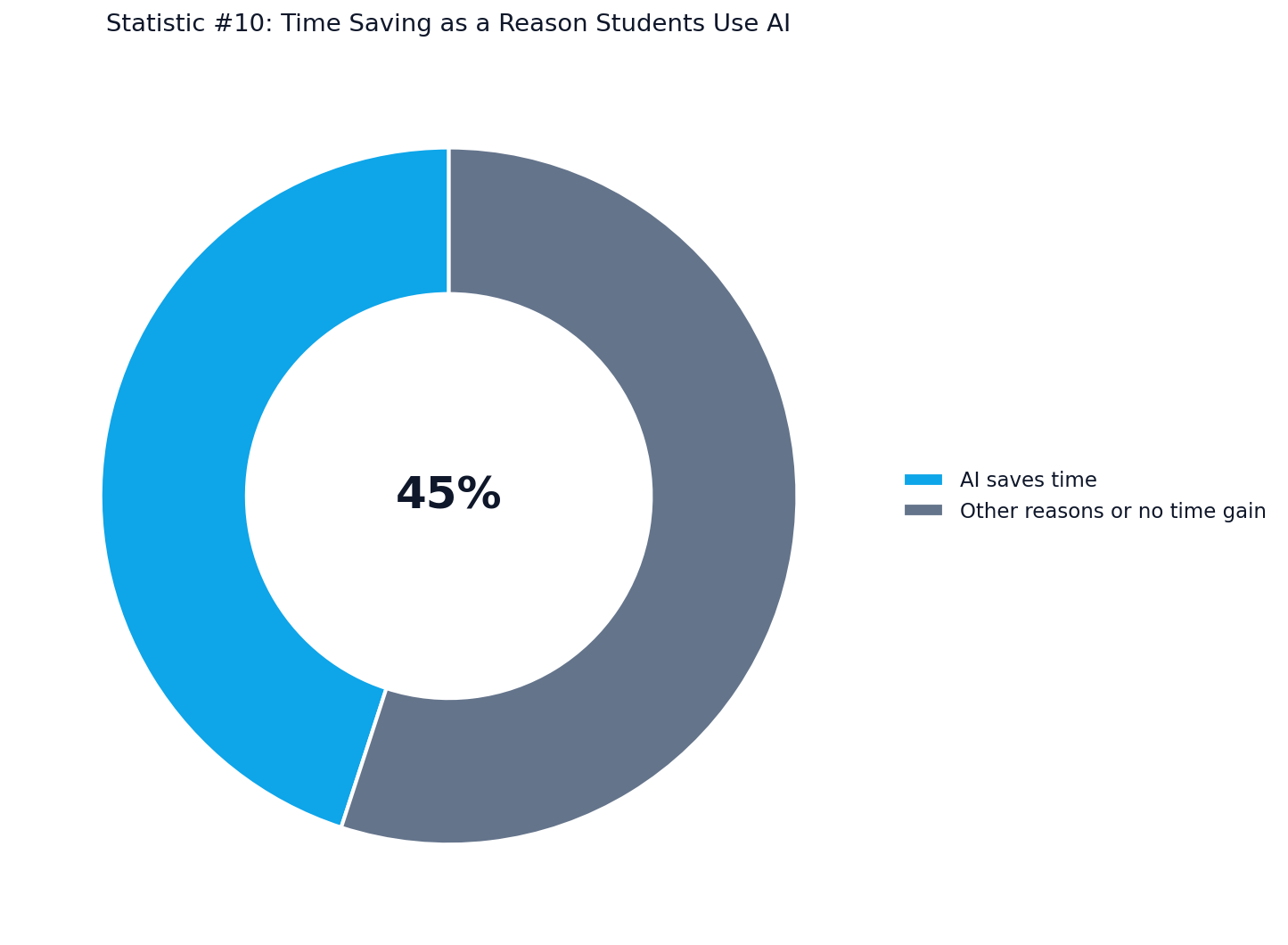
45% of students said saving time was a reason they were more likely to use AI tools for their studies in 2026. That figure stands near the top because time pressure is the condition that quietly shapes almost every student workflow. When support tools promise faster starts, quicker clarification, and less drag during revision, they meet a need students feel every week rather than occasionally.
The appeal of time saving has grown because academic work now happens in a more fragmented environment. Students juggle classes, paid work, commuting, and digital overload, so any tool that shortens low-value friction gets folded into routine behavior quickly. AI does especially well here because it can collapse several small tasks into one interaction, which makes the gain feel immediate.
The human contrast is that faster does not always mean better, even if it feels better in the moment. Some tasks genuinely benefit from compression, while others lose depth when students move too quickly through reading, note-making, or reflection. The practical lesson is to design support around removing wasted effort without stripping out the slow thinking that good academic work still needs, which is the implication.
AI Writing Support Tools for Students Statistics #11. Quality improvement is nearly as persuasive as saving time
47% of students said improving the quality of their work was a reason they were more likely to use AI in 2026. That number matters because it shows students are not only chasing convenience. They also believe support tools can help them produce work that reads more clearly, feels more complete, and meets academic expectations with less visible roughness.
This perception grows because AI is especially good at making writing look more finished, even when it is used for narrow tasks. Better phrasing, stronger transitions, and quicker clarification can create an immediate sense of improvement that students notice right away. Once they connect the tool with cleaner output, it becomes part of how they manage quality under pressure.
The human contrast is that perceived quality and actual quality do not always match. A polished paragraph can still carry weak reasoning, thin evidence, or borrowed logic that would not survive close scrutiny from a good marker. The practical implication is that support tools should help students strengthen substance alongside style, or they risk producing confidence that outruns competence, which is the implication.
AI Writing Support Tools for Students Statistics #12. Instant support is now a defining part of the value proposition
40% of students said instant support made them more likely to use AI tools for their studies in 2026. That figure captures one of AI’s most practical advantages over slower institutional help channels. Students do not always need a deep tutoring session in the moment; sometimes they need an answer, a clarification, or a nudge forward within seconds.
Instant support matters because academic friction often appears in short bursts. A student gets stuck on one concept, one sentence, or one reading cue, and losing momentum at that point can derail the next hour of work. AI performs well in those small moments because it is available immediately, and that availability changes how students manage study flow.
The human contrast is that fast help can feel reassuring even when it is incomplete or slightly off. Real academic guidance still requires verification, context, and sometimes the slower give-and-take of talking through uncertainty with a teacher or peer. Support products that combine speed with prompts for checking sources and testing understanding will be stronger than tools that simply reward immediacy, which is the implication.
AI Writing Support Tools for Students Statistics #13. After-hours access remains a meaningful advantage
32% of students said support outside traditional study hours made them more likely to use AI tools in 2026. That number is revealing because it points to a structural gap rather than a novelty feature. Academic help is still shaped by office hours, staff capacity, and uneven access, while students often do their heaviest work late at night or in irregular gaps during the week.
After-hours support becomes valuable when deadlines compress and ordinary campus services are unavailable. A student working at midnight does not care that better guidance might exist tomorrow if the assignment is due before then. AI fits that reality by staying available during the hours when stress is highest and institutional responsiveness is usually lowest.
The human contrast is that constant availability can make tools feel more dependable than actual people, even when the advice is thinner. That is a real behavioral advantage for AI, and institutions should take it seriously rather than treating it as a minor convenience. The implication is that human support systems need to think more like the student schedule, or automated help will keep filling that gap by default.
AI Writing Support Tools for Students Statistics #14. AI is increasingly used to reach traditional sources, not just replace them
53% of students said they use AI weekly to discover and understand traditional sources in 2026. That statistic matters because it complicates the simple story that AI always pulls students away from books, articles, and lecture material. In many cases, the tool is acting as a bridge into conventional resources rather than a substitute for them.
This pattern makes sense because students often need help locating the entry point into a source, not just the source itself. AI can summarize a concept, identify likely topics, and explain what to look for before a student returns to textbooks, papers, or lecture notes with better orientation. That lowers the threshold for engaging with harder material that might otherwise feel too slow or too dense.
The human contrast is that discovery support still needs critical reading to finish the job. Students can use AI to approach traditional sources more efficiently, but they cannot outsource interpretation without losing depth. The practical implication is that educators should channel this behavior toward source literacy, since AI-assisted entry into real materials can strengthen study habits when it is handled carefully, which is the implication.
AI Writing Support Tools for Students Statistics #15. Student experience gains are real, but far from universal
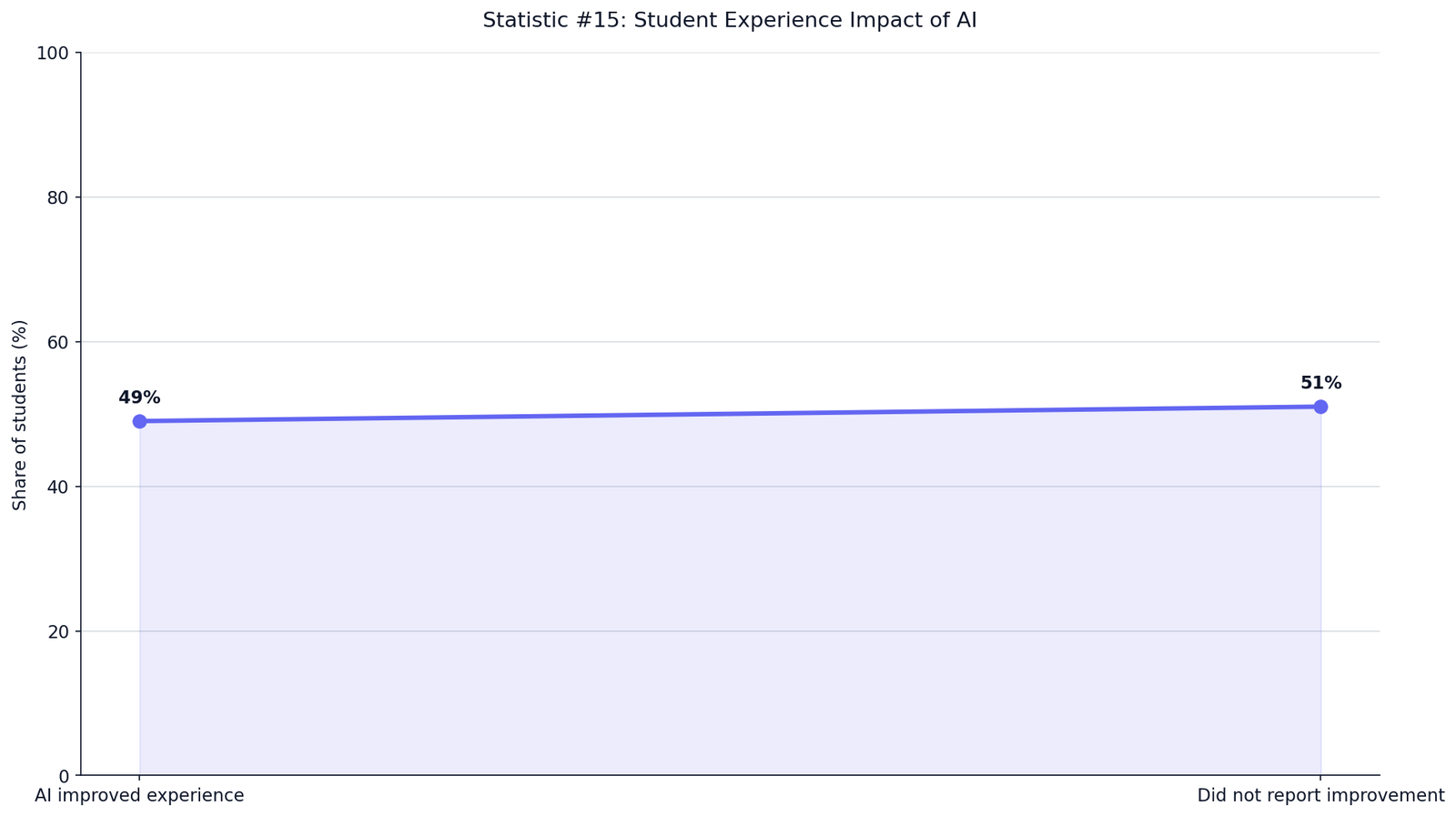
49% of students believed AI had improved their student experience in 2026, which places the category close to a split judgment rather than a sweeping endorsement. That is a useful figure because it keeps the story balanced. AI clearly helps many students, yet the absence of a stronger majority shows that benefit is still mixed, conditional, and tied to how the tools are used.
The positive side comes from familiar drivers such as saved time, better understanding, and instant access to help. Those benefits are concrete enough that students can feel them in their daily routines, which is why the category keeps expanding even under policy uncertainty. At the same time, concerns around fairness, skills erosion, and social isolation keep the experience from looking uniformly positive.
The human contrast is visible here because students are not evaluating features in the abstract. They are weighing convenience against trust, speed against depth, and support against dependency in the middle of real academic pressure. The implication is that the next phase of tool adoption will depend less on novelty and more on whether support systems can preserve real learning while still reducing friction, which is the implication.
AI Writing Support Tools for Students Statistics #16. Students increasingly see AI literacy as a life skill
68% of students agreed that understanding and using generative AI effectively is essential to thrive in today’s world in 2026. That is a large majority, and it changes the frame from optional software knowledge to expected modern competence. Students are not treating AI purely as a classroom aid anymore; they are linking it to employability, adaptability, and future relevance.
This belief grows because AI now appears across study, work, and everyday digital life rather than in one isolated context. Once students encounter similar tools in academic writing, search, productivity platforms, and job discussions, it becomes easy to see AI fluency as part of the general skillset adults are expected to carry. The category starts to feel less like a tech specialty and more like baseline literacy.
The human contrast is that literacy does not mean passive dependence. Students still need judgment, restraint, and the ability to decide when AI support helps and when it narrows thinking too much. The implication is that institutions should teach AI use as a reflective skill, because students already believe the competency matters whether campuses have fully caught up or not, which is the implication.
AI Writing Support Tools for Students Statistics #17. Staff support still trails student expectations
48% of students felt teaching staff were helping them develop AI skills for future careers in 2026. That means fewer than half of students feel clearly supported in an area most of them already view as important. The gap matters because students are not only asking whether AI is allowed; they are also asking who will help them use it well.
This number stays modest because institutional adaptation moves more slowly than student adoption. Staff need training, time, and confidence before they can teach responsible AI use consistently across courses, and those conditions are not evenly distributed. The result is a familiar mismatch where students are already using the tools daily while formal guidance still feels partial or uneven.
The human contrast is sharp here because students often learn from peers, experimentation, and the tools themselves when staff support feels thin. That can encourage agility, but it can also leave quality, ethics, and good habits to chance. The implication is that colleges need to translate broad policy into practical instruction, or students will keep building AI habits without enough expert shaping, which is the implication.
AI Writing Support Tools for Students Statistics #18. Institutional tool provision is growing, but still not widespread
38% of students said their institution currently provides AI tools for them to use in 2026. That is a meaningful increase from earlier survey waves, yet it still leaves most students outside formal institutional provision. The figure matters because access through a university often comes with stronger privacy, clearer legitimacy, and a more direct link to approved academic use.
Provision grows when institutions realize students are already using outside tools anyway. Offering access is one way to shape safer practice, reduce inequity, and move support into environments the institution can at least partly govern. Even so, rollout takes money, procurement decisions, staff alignment, and policy work, which is why adoption at the institutional level still lags student behavior.
The human contrast is that students do not pause their needs while campuses negotiate infrastructure. If official tools are missing, they simply reach for whatever is easiest to access on their own. The implication is that institutional provision is not just a technical convenience but a chance to steer quality, equity, and responsible use before unofficial habits become the default standard, which is the implication.
AI Writing Support Tools for Students Statistics #19. Demand for institution-backed tools remains ahead of supply
50% of students said their institution should provide AI tools in 2026, which sits clearly above the 38% who said those tools are currently provided. That gap is one of the more useful planning signals in the whole set. It tells you students are not merely tolerating AI support but actively expecting institutions to take some responsibility for access and guidance.
This expectation grows because unmanaged access creates uneven conditions. Some students can afford premium tools, some rely on limited free versions, and others avoid them because they are unsure what is acceptable. Institution-backed provision feels fairer because it promises a more consistent baseline and suggests the university is willing to support responsible use rather than simply police misuse.
The human contrast is that demand for tools is also demand for reassurance. Students want to know which systems are acceptable, what level of help is sensible, and whether support can be used without stepping outside academic norms. The implication is that institutions should read tool demand as a request for structure as much as a request for software, which is the implication.
AI Writing Support Tools for Students Statistics #20. Students still lead regular AI adoption across higher education
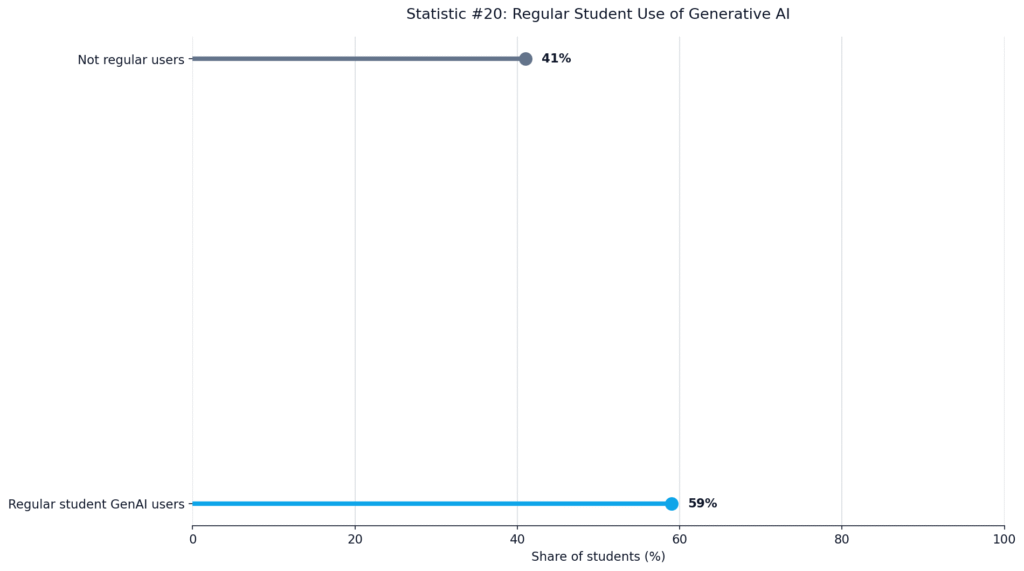
59% of students surveyed in Tyton Partners’ 2024 Time for Class study were regular generative AI users, placing students ahead of instructors and administrators. That figure matters because it shows the adoption story is not only about tools, but also about who moves fastest when a new support layer becomes available. Students are usually closest to the practical friction of everyday academic work, so they feel the benefit first.
Regular use rises among students because the payoff is immediate and personal. A tool that speeds drafting, clarifies sources, or reduces hesitation around starting an assignment becomes useful long before formal institutional systems fully react. Instructors and administrators may evaluate policy, risk, and workload effects, but students are deciding whether the tool helps tonight’s actual task.
The human contrast is that fast student adoption creates pressure on the rest of the system to catch up. When the learner group moves ahead of staff practice and institutional provision, confusion becomes built into the experience rather than sitting at the margins. The implication is that higher education cannot treat student AI use as a temporary trend, because regular use is already established at scale, which is the implication.
What these AI Writing Support Tools for Students Statistics suggest for the next phase of academic support
These numbers point to a student market that is no longer experimenting at the edges, but reorganizing ordinary academic work around faster explanation, quicker structuring, and on-demand support. The pattern that stands out most is not raw adoption alone, but the way support tools have settled into small repeatable tasks that feel defensible and useful.
That matters because categories built around everyday friction usually last longer than categories built around novelty. Students are using AI where writing slows down, where reading becomes dense, and where institutional help is least available, which makes the behavior more durable than a passing hype cycle.
At the same time, the surveys show that trust, policy clarity, and staff guidance are still trailing student behavior. The long-term winners in this space will likely be the tools and institutions that reduce friction without hollowing out comprehension, authorship, or source judgment.
So the road ahead looks less like a battle over whether students will use AI and more like a design question around how they will use it well. In practice, the most useful support ecosystem will be the one that treats AI as guided academic infrastructure rather than either a miracle shortcut or a forbidden shadow system.
Sources
- HEPI student generative AI survey 2026 executive summary and report
- HEPI full PDF with 2026 student AI use figures
- HEPI student generative AI survey 2025 report overview
- HEPI full PDF with 2025 assessment support data
- Turnitin summary citing Tyton Partners student AI writing usage
- Turnitin press release on Time for Class findings
- Tyton Partners overview of the Time for Class 2024 study
- Time for Class 2024 PDF with student adoption benchmarks
- UNESCO guidance for generative AI in education and research
- UNESCO artificial intelligence in education overview and policy context