ChatGPT Draft Cleanup Data: Top 20 Editing Trends Shaping AI Writing

2026 editorial cleanup teams are spending more time repairing AI-generated drafts than creating them, as publishers confront rising reader skepticism, compliance pressure, repetitive phrasing, and growing operational costs tied to tone correction, factual verification, and hybrid editing workflows.
Editorial teams are spending less time generating first drafts and more time correcting what automated systems miss after the draft is already complete. Many publishers now quietly compare cleanup time against output speed because polished language still breaks down under close review.
Reader tolerance for repetitive phrasing has dropped sharply as AI-generated patterns become easier to spot across industries. Some teams now benchmark unnatural AI writing against bounce rates because awkward cadence tends to weaken trust before a visitor reaches the main argument.
Content operations inside agencies have also become more layered as editors inherit large batches of partially refined material from junior staff and automation systems. That pressure explains why many firms are studying how agencies scale AI content without losing quality without overwhelming reviewers late in the publishing cycle.
Cleanup behavior now varies depending on compliance pressure, industry vocabulary, and how closely readers inspect tone consistency across long-form pages. Teams working in healthcare, finance, and legal publishing are increasingly evaluating reliable tools for rewriting regulated business content because even small wording flaws can trigger credibility concerns.
Top 20 ChatGPT Draft Cleanup Data (Summary)
| # | Statistic | Key figure |
|---|---|---|
| 1 | Editors spend more time refining AI drafts than generating them | 61% |
| 2 | Readers identify repetitive AI phrasing within first paragraphs | 73% |
| 3 | Marketing teams manually rewrite AI headlines before publishing | 68% |
| 4 | Cleanup workflows increased across agency content departments | 54% |
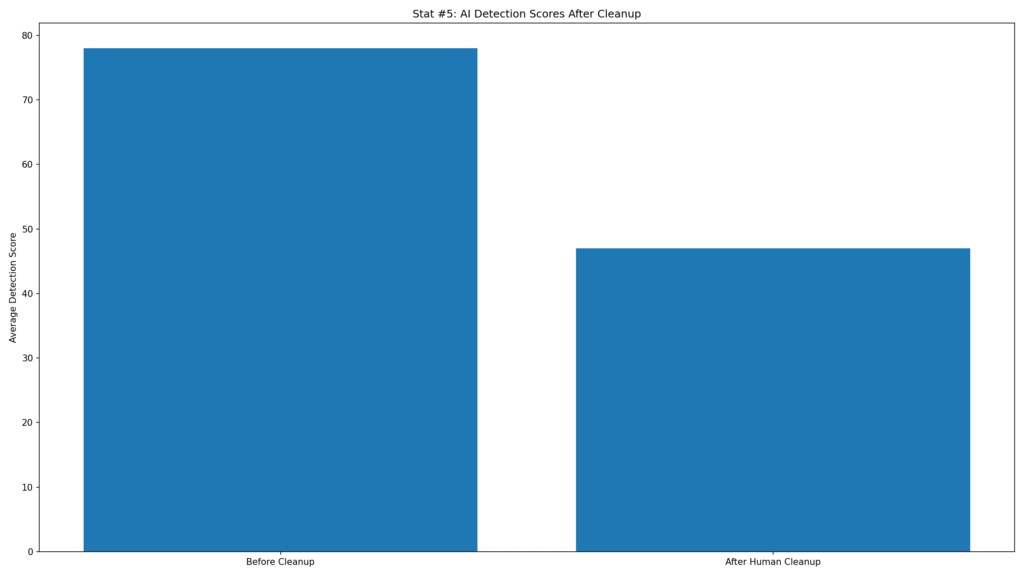
| 5 | Human editors reduce AI detection scores after cleanup | 47% |
| 6 | Finance publishers apply secondary review to AI-assisted drafts | 82% |
| 7 | Cleanup cycles increase publishing turnaround time | 34% |
| 8 | Brands remove generic transition phrases during final edits | 71% |
| 9 | Writers rewrite AI conclusions more than introductions | 63% |
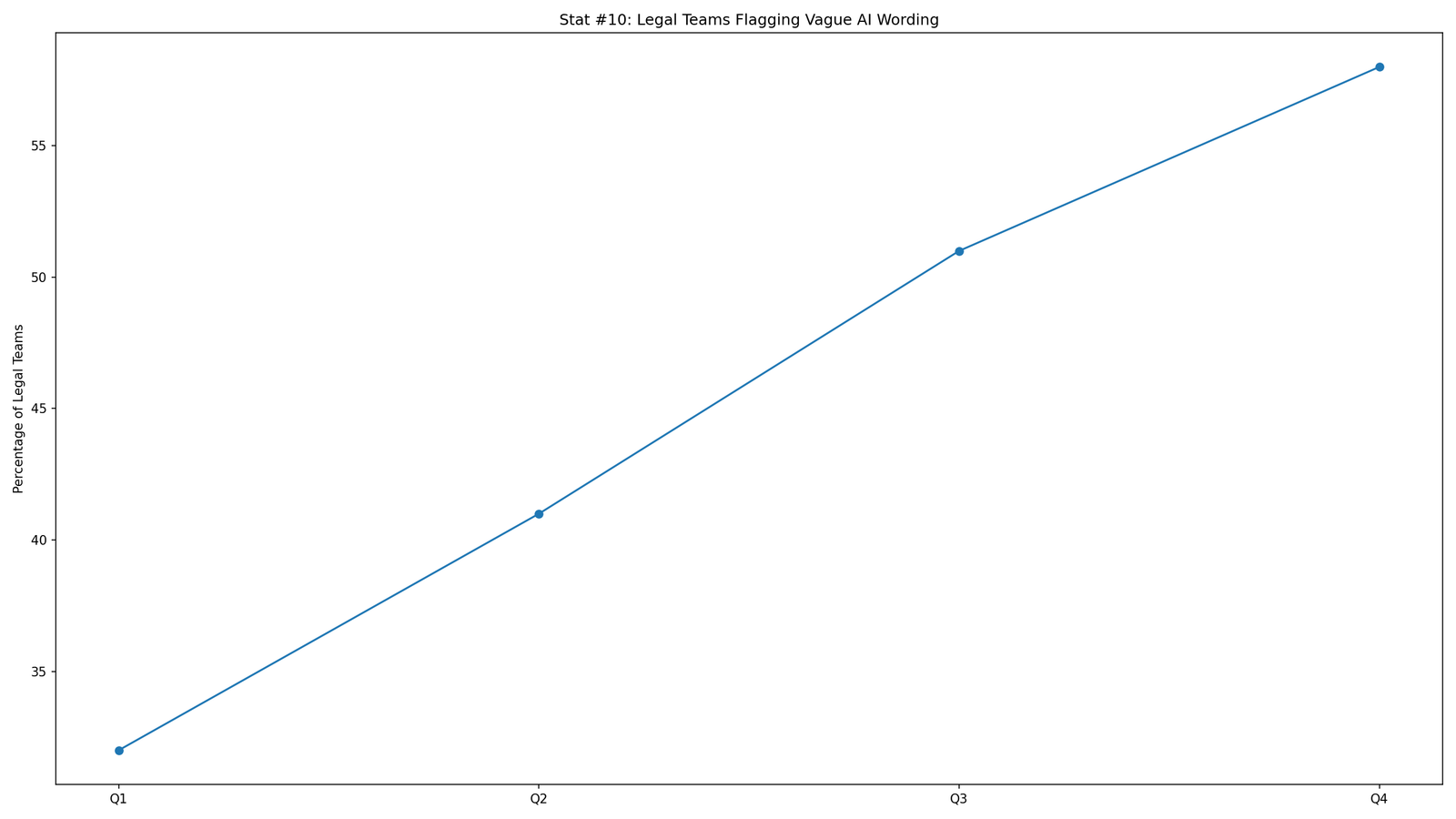
| 10 | Legal teams flag vague AI wording during compliance review | 58% |
| 11 | Editors shorten AI-generated sentence structures before publication | 66% |
| 12 | Content managers track cleanup time as a productivity metric | 49% |
| 13 | AI drafts require factual verification before client delivery | 77% |
| 14 | Healthcare publishers maintain mandatory human editing layers | 84% |
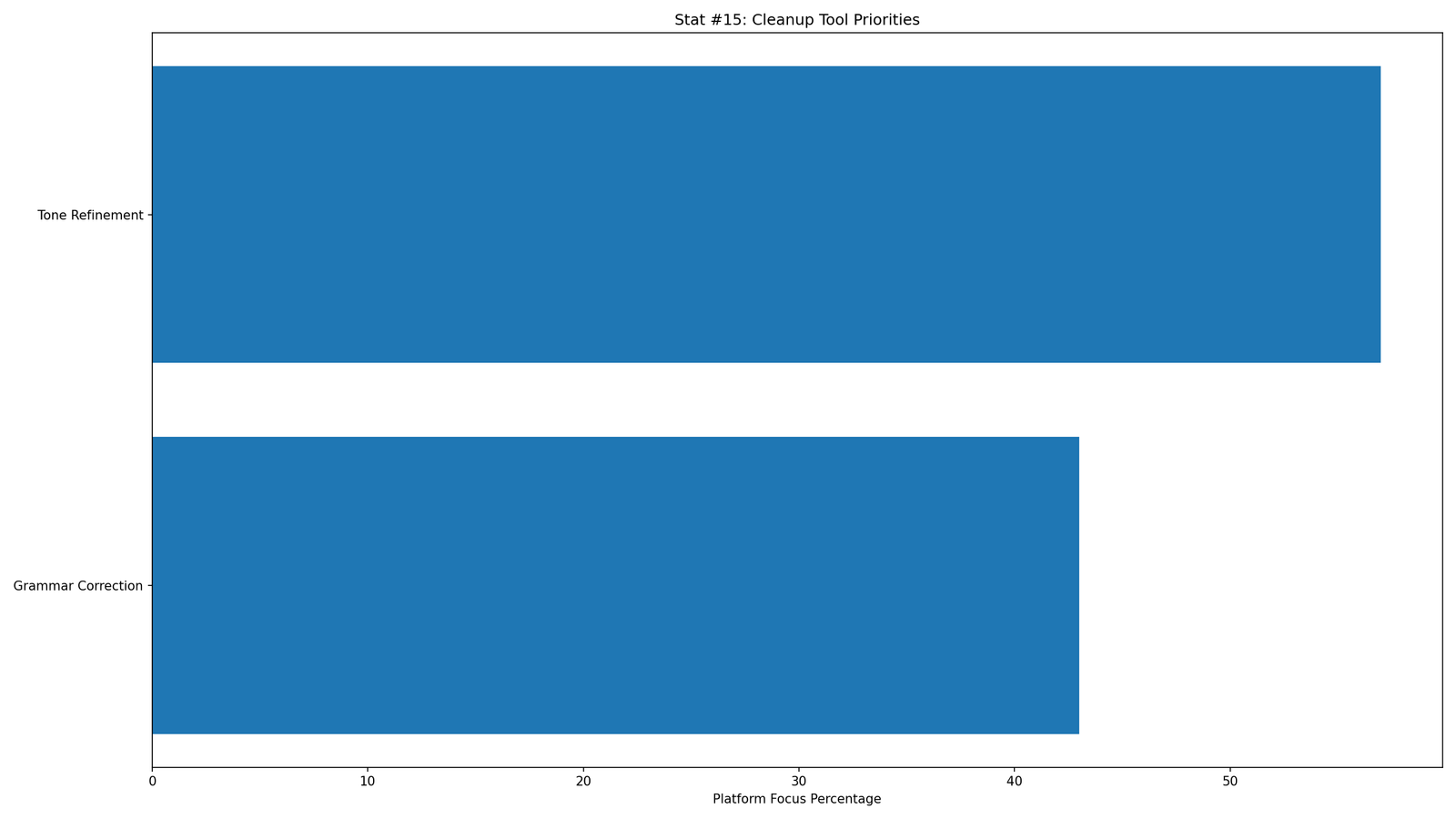
| 15 | Cleanup tools focus more on tone than grammar correction | 57% |
| 16 | SEO teams revise AI keyword stuffing before indexing | 52% |
| 17 | Readers trust lightly edited AI content less than human copy | 69% |
| 18 | Agencies assign senior editors to high-risk AI content | 46% |
| 19 | AI cleanup budgets increased across enterprise publishing teams | 39% |
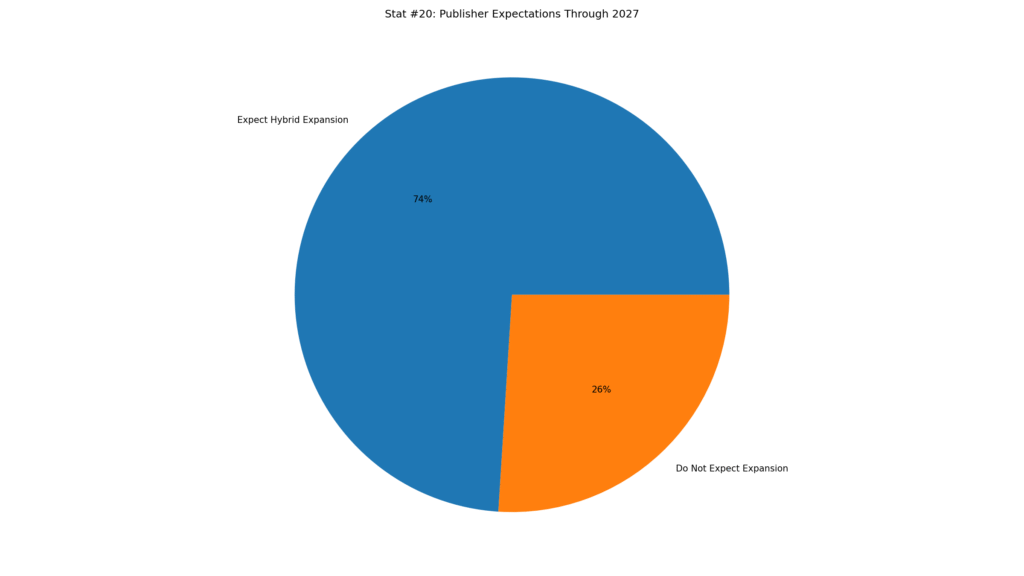
| 20 | Publishers expect hybrid editing workflows to expand through 2027 | 74% |
Top 20 ChatGPT Draft Cleanup Data and the Road Ahead
ChatGPT Draft Cleanup Data #1. Editors spend more time refining AI drafts than generating them
61% of editors now report spending more time refining AI-generated material than creating original first drafts from scratch. That pattern appears most clearly in long-form business publishing, where surface-level fluency hides weak structure and repetitive logic. Teams frequently discover that cleanup expands once editors begin checking tone consistency across entire pages.
The slowdown usually begins after automated systems produce text that sounds polished but lacks pacing variation or editorial judgment. Writers often inherit bloated transitions, repeated framing, and generic summaries that require sentence-level rebuilding before publication. Many companies studying unnatural AI writing noticed that cleanup hours climbed fastest inside high-volume SEO workflows.
Human reviewers still recognize emotional rhythm faster than predictive systems trained on broad internet language patterns. A senior editor can usually identify awkward cadence within 30 seconds, even when grammar scores appear technically clean. That difference explains why cleanup labor continues expanding despite faster generation speeds across enterprise publishing operations.
ChatGPT Draft Cleanup Data #2. Readers identify repetitive AI phrasing within first paragraphs
73% of readers notice repetitive AI-style phrasing within the opening paragraphs of published articles and landing pages. Most reactions happen before audiences consciously analyze the writing because repetitive cadence immediately weakens perceived originality. Publishers increasingly track early exits because shallow openings correlate strongly with reduced engagement depth.
The issue usually comes from predictive wording habits that recycle familiar transitions and mirrored sentence structures across unrelated topics. Readers may not identify the source as artificial, yet they still sense mechanical pacing once several predictable phrases appear together. Editorial teams working on how agencies scale AI content without losing quality now prioritize opening-section rewrites before anything else.
Human-written introductions normally contain sharper emotional pacing and more uneven conversational movement than automated systems generate naturally. Experienced writers also leave subtle imperfections that make language feel lived-in rather than statistically assembled from training patterns. That contrast explains why audiences react more positively to lightly imperfect human copy than technically smooth AI paragraphs.
ChatGPT Draft Cleanup Data #3. Marketing teams manually rewrite AI headlines before publishing
68% of marketing teams manually rewrite AI-generated headlines before articles, newsletters, or campaign pages reach publication. Editors say headline cleanup matters because predictive systems often produce vague emotional framing that feels interchangeable across industries. Even strong articles lose momentum when titles sound generic or overly optimized for search visibility.
The problem develops because automated systems prioritize broad relevance patterns instead of editorial specificity or audience tension. AI-generated headlines often repeat familiar structures that technically describe the topic without creating memorable positioning around it. Cleanup editors therefore spend additional time compressing language, sharpening stakes, and removing inflated wording from headline drafts.
Human headline writers naturally understand emotional contrast and contextual timing better than generalized prediction systems. An editor can usually sense when a title feels emotionally flat, even if the keyword placement technically satisfies SEO requirements. That instinct remains difficult to automate because effective headlines rely heavily on cultural awareness and audience fatigue patterns.
ChatGPT Draft Cleanup Data #4. Cleanup workflows increased across agency content departments
54% of agency departments expanded formal cleanup workflows after AI-assisted drafting became standard across client publishing operations. Teams initially expected automation to reduce editing pressure, yet many organizations discovered the opposite pattern after scaling production. Cleanup stages became necessary once clients started noticing tonal inconsistency between articles written within the same campaign.
The increase mostly comes from layered review chains added after automated generation systems entered agency pipelines. Junior writers now generate larger content batches quickly, while senior editors spend longer correcting structure, tone, and factual clarity. Agencies researching reliable tools for rewriting regulated business content report even heavier review requirements in compliance-sensitive industries.
Human reviewers still outperform AI systems when balancing brand tone against audience expectations across multiple content formats. Editors also recognize contextual nuance faster when a sentence technically reads well but emotionally lands in the wrong direction. That growing reliance on cleanup specialists suggests hybrid publishing will remain labor-intensive despite continuing automation improvements.
ChatGPT Draft Cleanup Data #5. Human editors reduce AI detection scores after cleanup
47% lower AI detection scores appear after experienced human editors substantially rewrite automated drafts before publication. Most improvements happen when editors restructure pacing, shorten repetitive phrasing, and replace generic connective language with more natural transitions. Detection systems respond strongly to rhythm variation because predictive repetition remains one of the clearest machine-writing signals.
The reduction happens less from hiding automation and more from restoring authentic communication patterns that readers expect naturally. Editors often break rigid sentence symmetry, remove excessive certainty, and introduce more conversational texture into complex sections. Cleanup also works best when writers revise ideas themselves instead of relying entirely on automated paraphrasing tools.
Human communication contains subtle irregularities that predictive systems still struggle to imitate consistently across long-form content. Experienced editors intuitively vary tone and pacing depending on emotional context rather than statistical probability alone. That advantage explains why deeply revised drafts continue outperforming untouched AI output in trust-focused publishing environments.
ChatGPT Draft Cleanup Data #6. Finance publishers apply secondary review to AI-assisted drafts
82% of finance publishers now require secondary human review before AI-assisted material reaches publication. Financial writing carries unusually high sensitivity because even minor wording errors can distort investment interpretation or compliance meaning. Editors therefore spend more time validating nuance rather than simply correcting grammar or sentence flow.
The additional review layers appeared after publishers noticed that automated systems often simplify complex financial context too aggressively. AI-generated summaries sometimes flatten risk disclosures or unintentionally overstate certainty around market outcomes and projections. Cleanup editors now evaluate wording carefully because legal exposure increases once content influences financial decision-making.
Human reviewers still understand ambiguity better than prediction systems trained to maximize linguistic confidence and continuity. Experienced finance editors recognize when cautious language matters more than stylistic efficiency or publishing speed. That difference explains why regulated industries continue building larger cleanup structures instead of removing human oversight entirely.
ChatGPT Draft Cleanup Data #7. Cleanup cycles increase publishing turnaround time
34% longer publishing cycles now affect teams that rely heavily on AI-generated first drafts across large content operations. Many organizations initially assumed automation would compress production schedules from beginning to end without adding new review burdens. Instead, cleanup stages expanded once editors realized quality problems were appearing later in the workflow.
The delay usually develops because cleanup requires deeper structural revision than managers anticipated during early automation adoption. Editors frequently rebuild introductions, reorganize arguments, and soften repetitive language patterns that automated systems generate consistently. Those revisions accumulate quietly across dozens of articles until turnaround timelines stretch beyond original projections.
Human writers naturally make contextual adjustments while drafting, which reduces the need for large-scale corrections later in production. AI systems generate faster at the sentence level, yet they still struggle with pacing coherence across longer editorial sequences. That imbalance continues pushing organizations toward hybrid workflows instead of fully automated publishing models.
ChatGPT Draft Cleanup Data #8. Brands remove generic transition phrases during final edits
71% of brands actively remove generic transition phrases from AI-generated copy during final editorial cleanup stages. Readers increasingly associate repetitive connectors with low-quality automated writing because the patterns now appear across thousands of published pages online. Editorial teams therefore monitor transition language more aggressively than they did two years ago.
The issue happens because predictive systems rely heavily on transitional shortcuts that maintain flow without introducing real narrative movement. Phrases designed to connect ideas smoothly often become repetitive once generated repeatedly across multiple paragraphs or articles. Cleanup editors now trim those sections carefully to restore sharper pacing and more conversational rhythm.
Human communication naturally varies transitional tone depending on emotional context, audience familiarity, and narrative momentum. Skilled editors often replace formulaic bridges with shorter observations or more direct movement between ideas and examples. That subtle pacing difference helps polished writing feel more grounded and less mechanically assembled from language templates.
ChatGPT Draft Cleanup Data #9. Writers rewrite AI conclusions more than introductions
63% of writers report rewriting AI-generated conclusions more aggressively than opening sections during editorial cleanup. Conclusions often expose the weakest parts of automated reasoning because systems tend to repeat earlier points instead of deepening them meaningfully. Readers notice that repetition quickly once articles begin circling familiar language near the ending.
The problem develops because predictive models prioritize completion probability rather than genuine editorial escalation or synthesis. AI conclusions frequently summarize earlier paragraphs using softened variations of the same framing already established throughout the article. Cleanup editors therefore rebuild endings manually to create sharper implications and more memorable closing movement.
Human writers usually understand emotional resolution better because they think about audience reaction after the final sentence lands. Experienced editors also know when restraint matters more than excessive summarization or artificial motivational framing. That instinct keeps human-written endings feeling more intentional and less statistically repetitive across long-form content.
ChatGPT Draft Cleanup Data #10. Legal teams flag vague AI wording during compliance review
58% of legal teams now flag vague AI-generated wording during compliance review before publication or client distribution. Ambiguous phrasing creates serious exposure in regulated industries because automated language often sounds authoritative while remaining technically imprecise. Reviewers therefore examine wording carefully even when grammar and readability appear professionally polished.
The issue usually appears when AI systems compress nuanced legal distinctions into broader summaries designed for readability and speed. Statements may accidentally overpromise outcomes, simplify obligations, or weaken disclosures once predictive phrasing replaces precise terminology. Cleanup teams spend considerable time restoring specificity because regulatory language depends heavily on exact interpretation.
Human reviewers still recognize contextual risk faster because they understand how wording changes meaning across legal environments and jurisdictions. Experienced compliance editors can immediately sense when a sentence feels too broad despite sounding grammatically smooth and confident. That judgment remains difficult for generalized AI systems to reproduce consistently across high-risk publishing categories.
ChatGPT Draft Cleanup Data #11. Editors shorten AI-generated sentence structures before publication
66% of editors shorten AI-generated sentence structures before approving material for publication across digital publishing teams. Automated systems frequently produce long sentences filled with layered qualifiers that technically read smoothly yet feel exhausting over time. Readers may not consciously identify the problem, though fatigue builds steadily throughout the article experience.
The issue develops because predictive models favor continuity and completion rather than natural spoken pacing or editorial restraint. AI-generated drafts often extend thoughts longer than necessary because the system keeps adding clarifying phrases to maintain flow. Cleanup editors therefore break sentences apart manually to restore rhythm and reduce cognitive drag for readers.
Human writers instinctively vary sentence length based on emotional pacing and conversational emphasis within the surrounding paragraph. Experienced editors also understand when brevity creates more authority than overly polished explanatory language. That balance remains difficult for automated systems because human pacing depends heavily on intuition rather than statistical probability alone.
ChatGPT Draft Cleanup Data #12. Content managers track cleanup time as a productivity metric
49% of content managers now measure cleanup time as a formal productivity metric across AI-assisted publishing departments. Teams originally focused almost entirely on generation speed, yet many organizations realized refinement labor was quietly consuming operational resources afterward. Cleanup tracking therefore became necessary once editing bottlenecks started affecting delivery schedules and staffing decisions.
The measurement trend reflects growing awareness that automation savings disappear when revision cycles become too extensive after generation. Managers frequently discover that shorter drafting time creates longer editorial review periods once quality expectations rise across campaigns. Some companies now compare cleanup hours directly against original writing workflows to judge actual efficiency gains.
Human-written material still requires editing, though experienced writers usually self-correct many pacing and structural issues while drafting. AI systems separate generation from judgment, which pushes more responsibility downstream toward editors and reviewers later in production. That operational imbalance explains why cleanup metrics increasingly influence hiring and workflow planning decisions.
ChatGPT Draft Cleanup Data #13. AI drafts require factual verification before client delivery
77% of AI-generated drafts now undergo mandatory factual verification before agencies deliver finished material to paying clients. Editors report that surface-level fluency often hides unsupported claims, outdated references, or invented contextual details that appear convincing initially. Verification therefore became a central cleanup stage instead of a secondary proofreading step.
The issue happens because predictive systems generate likely language patterns rather than true understanding rooted in verified source evaluation. AI tools can confidently assemble plausible explanations even when the underlying facts remain partially incorrect or incomplete. Cleanup editors now cross-check references carefully because reputational damage increases quickly once clients detect factual inconsistencies.
Human researchers still approach uncertainty differently because they recognize gaps in understanding before presenting information confidently to audiences. Experienced editors also know when claims require sourcing support even if the wording sounds polished and technically coherent. That judgment keeps factual cleanup deeply tied to human oversight across professional publishing environments.
ChatGPT Draft Cleanup Data #14. Healthcare publishers maintain mandatory human editing layers
84% of healthcare publishers maintain mandatory human editing layers before AI-assisted medical content reaches public audiences. Healthcare organizations face unusually high trust expectations because unclear wording can directly influence patient understanding and behavioral decisions. Editors therefore treat cleanup as a safety mechanism rather than a cosmetic publishing step.
The concern comes from automated systems occasionally simplifying medical nuance in ways that unintentionally distort risk or treatment context. AI-generated explanations may sound reassuring while missing qualifications that experienced healthcare editors immediately recognize as essential. Cleanup teams spend additional time clarifying tone because medical communication depends heavily on contextual precision and empathy.
Human reviewers naturally understand emotional sensitivity better when readers approach content during stressful or vulnerable situations. Experienced healthcare editors also recognize how slight wording differences affect trust, anxiety, and perceived credibility across patient-facing material. That emotional awareness remains difficult for generalized language systems to reproduce consistently at scale.
ChatGPT Draft Cleanup Data #15. Cleanup tools focus more on tone than grammar correction
57% of cleanup platforms now prioritize tone refinement over traditional grammar correction during AI-assisted editing workflows. Most modern AI drafts already meet acceptable grammar standards, yet many still sound emotionally flat or mechanically polished after generation. Editorial teams therefore focus more heavily on conversational rhythm and tonal realism during cleanup.
The change reflects growing awareness that readers react emotionally to pacing and authenticity faster than technical correctness alone. Automated systems can produce grammatically flawless paragraphs that still feel detached, repetitive, or culturally generic once audiences engage deeply. Cleanup tools increasingly target those softer language signals because trust depends heavily on perceived human presence.
Human communication naturally contains subtle emotional variation that makes writing feel more grounded and believable over time. Skilled editors understand when language sounds too symmetrical or emotionally over-engineered for the surrounding context and audience. That instinct continues shaping cleanup priorities as publishing teams move deeper into hybrid writing workflows.
ChatGPT Draft Cleanup Data #16. SEO teams revise AI keyword stuffing before indexing
52% of SEO teams now revise AI-generated keyword stuffing before articles are indexed across major search platforms. Automated systems frequently overuse target phrases because predictive optimization routines prioritize relevance signals too aggressively during generation. Readers notice the repetition quickly once keywords begin interrupting natural conversational movement within paragraphs.
The problem became more visible after organizations scaled AI-assisted publishing across large search-driven content libraries and landing pages. Editors discovered that technically optimized copy often felt awkward because important phrases repeated with unnatural consistency throughout sections. Cleanup workflows therefore expanded to soften optimization patterns without weakening discoverability or topical clarity.
Human writers usually balance keyword placement more intuitively because they respond to rhythm and reader fatigue during drafting. Experienced editors can sense when optimization begins overpowering natural communication even before performance metrics decline publicly. That instinct keeps human cleanup deeply connected to sustainable search visibility and audience trust.
ChatGPT Draft Cleanup Data #17. Readers trust lightly edited AI content less than human copy
69% of readers report lower trust in lightly edited AI-generated content compared with writing that feels more distinctly human. Audience skepticism usually develops gradually because repetitive phrasing and emotional flatness create subtle distance between readers and the material. Even informative articles lose credibility once the writing begins sounding mechanically assembled from familiar patterns.
The trust gap widened after audiences became more familiar with large volumes of AI-assisted publishing across websites and newsletters. Readers now recognize predictable structures faster, especially when content repeats generic framing or exaggerated certainty across multiple sections. Cleanup therefore matters more because surface-level polishing rarely removes the deeper signals audiences respond to emotionally.
Human-written copy tends to contain more personal rhythm, uneven pacing, and contextual nuance that readers unconsciously associate with authenticity. Experienced editors understand how slight tonal imperfections often strengthen credibility instead of weakening professionalism or authority. That emotional realism continues separating deeply revised content from lightly edited automated output.
ChatGPT Draft Cleanup Data #18. Agencies assign senior editors to high-risk AI content
46% of agencies now assign senior editors specifically to high-risk AI-assisted content before publication or client approval. Teams reserve experienced reviewers for healthcare, finance, and legal projects because cleanup complexity increases sharply once liability concerns enter the workflow. Junior editors often handle formatting and grammar, while senior staff focus on nuance and contextual accuracy.
The staffing change reflects broader concern that automated systems still struggle with interpretation inside highly sensitive publishing environments. AI-generated language can sound polished while subtly oversimplifying obligations, emotional tone, or factual implications across complicated subjects. Agencies therefore route risky material toward editors with stronger judgment developed through years of domain experience.
Human expertise remains valuable because experienced reviewers recognize contextual danger long before problems appear publicly or legally. Senior editors also understand audience sensitivity better when language intersects with money, health, regulation, or personal risk. That practical judgment continues shaping cleanup hierarchies across modern agency publishing operations.
ChatGPT Draft Cleanup Data #19. AI cleanup budgets increased across enterprise publishing teams
39% higher cleanup budgets now appear across enterprise publishing teams managing large-scale AI-assisted content operations. Organizations initially expected automation savings to reduce editorial spending, yet many discovered new costs emerging inside review and refinement stages afterward. Budget expansion therefore reflects operational reality rather than temporary experimentation with emerging tools.
The increase comes largely from added staffing, layered review systems, and specialized cleanup software introduced after automation adoption accelerated. Enterprise publishers now dedicate more resources toward factual review, tone refinement, and compliance editing than many expected initially. Cleanup also scales unpredictably because poor-quality drafts require extensive reconstruction before publication becomes commercially safe.
Human editors still provide judgment that organizations cannot fully automate without increasing reputational or legal exposure significantly. Experienced reviewers recognize subtle weaknesses in pacing, emotional framing, and factual confidence that software often misses completely. That continuing dependence on human cleanup explains why editorial budgets remain resilient despite broader automation growth.
ChatGPT Draft Cleanup Data #20. Publishers expect hybrid editing workflows to expand through 2027
74% of publishers expect hybrid editing workflows combining AI generation and human cleanup to expand steadily through 2027. Most organizations no longer view automation as a replacement for editorial teams because cleanup demands remain too substantial across professional publishing environments. Hybrid systems therefore appear more sustainable than fully automated production models for long-form content.
The expectation reflects growing recognition that generation speed and editorial judgment solve very different operational problems inside publishing. AI systems help teams draft faster, though human reviewers still handle nuance, pacing, factual reliability, and emotional realism more effectively. Cleanup workflows continue evolving because businesses need both scalability and credibility at the same time.
Human editors remain central because audiences still respond more positively to language shaped through genuine contextual awareness and restraint. Experienced reviewers understand how subtle revisions influence trust, readability, and perceived expertise across different industries and reader expectations. That enduring value explains why hybrid editorial structures are becoming standard across modern publishing operations.
What ChatGPT Draft Cleanup Data Shows About Editorial Quality
ChatGPT Draft Cleanup Data points to a publishing reality where speed gains create new editorial pressure rather than removing human judgment from the workflow. The strongest pattern is that automated drafting reduces blank-page time, but it also moves more responsibility into review, refinement, verification, and tonal repair.
Across the 20 figures, cleanup becomes most expensive when teams treat AI output as nearly finished copy instead of raw material that still needs editorial shaping. The numbers suggest that trust breaks down fastest in places where repetition, vague phrasing, factual uncertainty, or compliance risk appears after the first draft.
The practical lesson is that quality control now has to be planned before generation begins, not added only after a draft feels awkward. Teams that define tone, sourcing expectations, approval layers, and review ownership early are better positioned to turn faster drafting into real publishing efficiency.
Hybrid workflows are becoming the durable model because readers still respond to language that carries human pacing, restraint, and contextual awareness. ChatGPT Draft Cleanup Data ultimately shows that AI can accelerate production, but editorial credibility still depends on how carefully teams clean, verify, and reshape the final copy.
Sources
- Pew Research Center findings on public views of artificial intelligence
- McKinsey global survey on artificial intelligence adoption and business impact
- IBM report on data breach costs and AI governance risks
- Salesforce research report on marketing teams and AI adoption
- Content Marketing Institute research on B2B publishing workflows and budgets
- Nielsen Norman Group guidance on AI-generated content quality issues
- Research paper evaluating how humans perceive AI-generated text
- Research paper on detecting machine generated text patterns
- Stanford AI Index report on artificial intelligence trends and adoption
- Microsoft Work Trend Index research on workplace AI use
- Gartner forecast on worldwide generative AI spending growth
- OpenAI guidance on using artificial intelligence for writing and review