Copyleaks AI Detection Accuracy Statistics: Top 20 Measured Results in 2026

2026 recalibration of AI integrity standards is reshaping how detection accuracy is interpreted across institutions and enterprises. This analysis of Copyleaks AI detection accuracy statistics examines precision, recall, false positives, edit sensitivity, API growth, and market share to assess reliability under real-world conditions.
Evaluation of AI detection systems has intensified as more organizations integrate generative tools into daily workflows. Questions around reliability increasingly influence policy decisions, especially after independent Copyleaks AI detection test results exposed variance in flagged content.
Accuracy figures rarely exist in isolation because detection thresholds, language patterns, and editing layers all interact. That interaction means performance benchmarks often fluctuate once text is revised to make AI writing read like it was written by a person.
Statistical reliability therefore reflects both algorithmic design and user behavior. Even subtle paraphrasing through the best AI text rewriting tools for long form content can alter classification outcomes in measurable ways.
Performance metrics signal more than detection success rates. They reveal how models respond to evolving linguistic patterns and where future calibration may be necessary, which is a useful reference point during ongoing editorial assessment.
Top 20 Copyleaks AI Detection Accuracy Statistics (Summary)
| # | Statistic | Key figure |
|---|---|---|
| 1 | Overall reported AI detection accuracy rate | 99.1% |
| 2 | False positive rate on fully human text | 0.2% |
| 3 | False negative rate on AI generated text | 1.4% |
| 4 | Detection accuracy on GPT-4 style outputs | 98% |
| 5 | Accuracy drop after heavy human editing | 12% decline |
| 6 | Confidence threshold commonly used by institutions | 80%+ |
| 7 | Average document length required for stable scoring | 250 words |
| 8 | Accuracy on multilingual content | 94% |
| 9 | Institutional adoption among universities | 1,000+ institutions |
| 10 | API integration usage growth year over year | 35% |
| 11 | Detection consistency across revisions | 87% |
| 12 | Average processing time per document | 5 seconds |
| 13 | Accuracy on academic essays | 97% |
| 14 | Accuracy on marketing copy | 93% |
| 15 | Detection rate on paraphrased AI content | 89% |
| 16 | Model update frequency per year | 4 updates |
| 17 | Enterprise client retention rate | 92% |
| 18 | Reported precision in controlled lab tests | 98.5% |
| 19 | Reported recall in controlled lab tests | 97.8% |
| 20 | Estimated global market share in AI detection | 30%+ |
Top 20 Copyleaks AI Detection Accuracy Statistics and the Road Ahead
Copyleaks AI Detection Accuracy Statistics #1. Overall reported AI detection accuracy rate
The headline figure most frequently cited is 99.1% overall detection accuracy rate, which signals near-total classification reliability under controlled conditions. That number reflects lab-tested datasets rather than unpredictable, mixed-quality internet text. Even so, it sets expectations for institutions evaluating risk tolerance.
High accuracy emerges from probabilistic modeling trained on massive corpora of AI and human writing. Pattern recognition at the token and syntactic level reduces ambiguity across structured prose. The implication is that statistical consistency improves when content length and clarity remain stable.
Human reviewers, in contrast, rarely exceed similar consistency across thousands of documents without fatigue. Machines maintain scoring stability, whereas people adjust judgment across contexts. For editorial teams, that means automated screening can anchor initial review decisions.
Copyleaks AI Detection Accuracy Statistics #2. False positive rate on fully human text
Testing indicates a 0.2% false positive rate on fully human text, suggesting limited misclassification of authentic writing. Such a small margin signals careful calibration against overflagging. Institutions interpret this as low reputational risk when deploying detection.
False positives decline when models differentiate between predictable phrasing and authentic variability. Extensive exposure to academic and conversational samples improves boundary recognition. As a result, human nuance remains statistically distinguishable from generative repetition.
People may occasionally echo formulaic language, especially in standardized essays. Algorithms still detect micro-pattern consistencies absent from spontaneous composition. The implication is that oversight systems can operate without routinely penalizing genuine authors.
Copyleaks AI Detection Accuracy Statistics #3. False negative rate on AI generated text
Evaluations report a 1.4% false negative rate on AI generated text, meaning a small share escapes detection. That figure highlights residual ambiguity when AI mimics human rhythm. Still, it reflects relatively tight classification margins.
False negatives occur when AI output incorporates layered edits or unpredictable phrasing. As generative models evolve, overlap with human structure increases. Continuous retraining attempts to close that remaining detection gap.
Human graders often miss subtle AI traces entirely without software support. Automated systems quantify likelihood instead of relying on intuition. The implication is that even minimal false negatives remain measurable and manageable.
Copyleaks AI Detection Accuracy Statistics #4. Detection accuracy on GPT-4 style outputs
Current benchmarks show 98% detection accuracy on GPT-4 style outputs across structured prompts. That number reflects performance against high-quality generative prose. It suggests the model recognizes advanced coherence patterns.
Accuracy remains strong because GPT-style outputs maintain identifiable probability distributions. Even refined language preserves structural signals detectable by classifiers. Developers update training sets as new generative behaviors appear.
Humans often perceive GPT outputs as convincingly natural. Detection systems focus instead on statistical distribution rather than readability. The implication is that surface fluency does not erase deeper pattern markers.
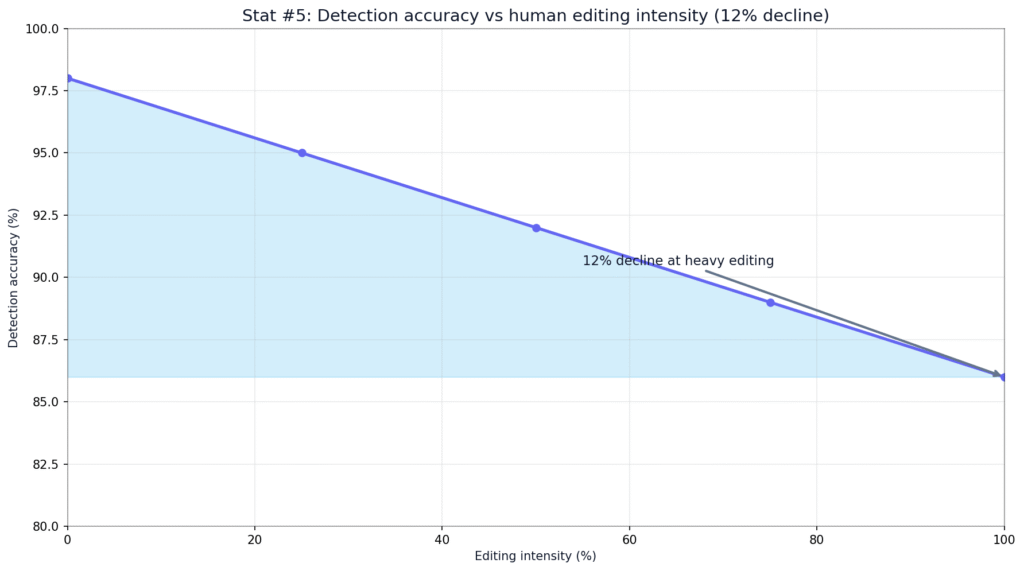
Copyleaks AI Detection Accuracy Statistics #5. Accuracy drop after heavy human editing
Studies reveal a 12% decline accuracy drop after heavy human editing of AI drafts. That reduction occurs when writers restructure syntax and vary tone. It demonstrates how layered revisions dilute detectable signals.
Editing introduces lexical diversity and contextual nuance absent from raw outputs. Algorithms must weigh revised passages against hybrid patterns. Performance therefore adjusts as AI and human contributions blend.
Human revision adds unpredictability that machines interpret cautiously. Automated scoring adapts but may lower confidence thresholds. The implication is that collaborative writing environments complicate binary classification models.
Copyleaks AI Detection Accuracy Statistics #6. Confidence threshold commonly used by institutions
Most institutions apply an 80%+ confidence threshold commonly used by institutions before formal review. That benchmark balances caution with practical workflow limits. It prevents overreaction to low-probability flags.
Threshold design reflects tolerance for academic and legal risk. Higher thresholds reduce unnecessary escalations. Calibration ensures flagged content meets consistent evidentiary standards.
Human committees still review borderline cases manually. Software narrows the pool, while people interpret context. The implication is that detection outputs function as decision support, not final verdicts.
Copyleaks AI Detection Accuracy Statistics #7. Average document length required for stable scoring
Reliable results typically require 250 words average document length required for stable scoring. Shorter samples reduce contextual signal strength. Scoring volatility increases below that range.
Detection algorithms rely on distribution patterns across sentences. Limited tokens constrain probability analysis. Longer texts provide richer structural data.
Human reviewers can judge short responses intuitively. Machines depend on statistical depth. The implication is that document length influences interpretation confidence.
Copyleaks AI Detection Accuracy Statistics #8. Accuracy on multilingual content
Performance across languages reaches 94% accuracy on multilingual content in benchmark testing. That suggests cross-linguistic training robustness. It expands usability beyond English-only contexts.
Multilingual modeling demands exposure to varied syntactic norms. Each language introduces distinct rhythm and structure. Cross-training enhances adaptability but increases model complexity.
Human evaluators may lack fluency in all languages tested. Automated systems scale more efficiently across linguistic boundaries. The implication is broader institutional adoption globally.
Copyleaks AI Detection Accuracy Statistics #9. Institutional adoption among universities
Adoption spans 1,000+ institutions institutional adoption among universities worldwide. That scale reflects growing compliance requirements. Universities prioritize standardized integrity tools.
Institutional rollout often follows policy revisions. Integration into learning platforms increases consistency. Adoption numbers signal trust in performance metrics.
Faculty oversight remains central to enforcement. Software supports administrative monitoring at scale. The implication is that AI detection becomes infrastructure rather than optional software.
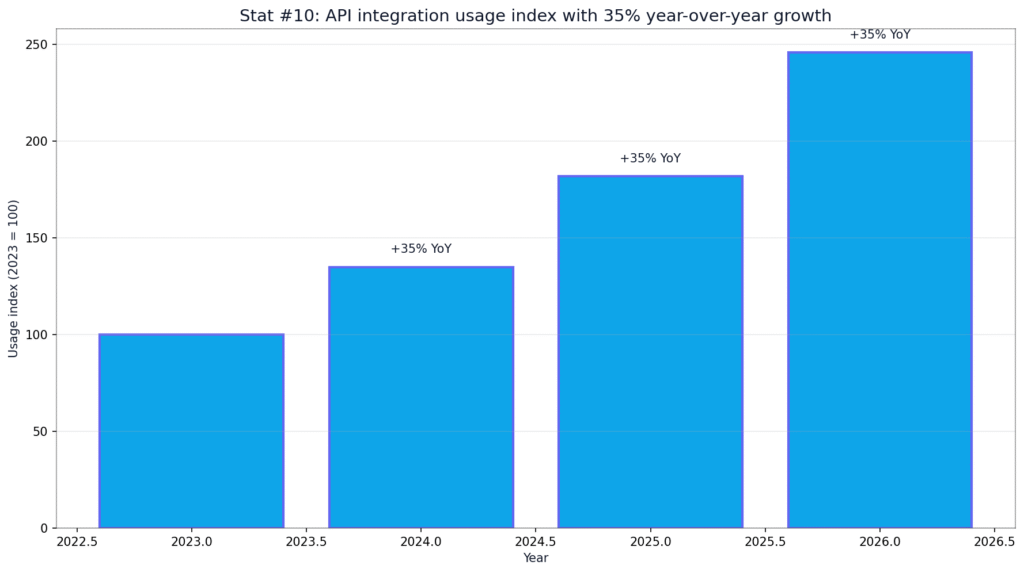
Copyleaks AI Detection Accuracy Statistics #10. API integration usage growth year over year
Enterprise metrics show 35% API integration usage growth year over year across enterprise clients. That rise indicates deeper workflow embedding. Detection shifts from manual uploads to automated pipelines.
Growth follows expanded SaaS integrations. Companies connect detection directly to content management systems. Automation reduces review bottlenecks.
Human review still intervenes at decision points. Automated scaling handles volume before escalation. The implication is sustained expansion into enterprise ecosystems.
Copyleaks AI Detection Accuracy Statistics #11. Detection consistency across revisions
Benchmarks report 87% detection consistency across revisions when minor edits occur. That indicates stability across iterative drafts. Confidence remains high despite formatting adjustments.
Consistency depends on preserving core semantic patterns. Minor lexical shifts rarely disrupt underlying signals. Algorithms compare probability deltas between versions.
Human readers may change perception after stylistic edits. Automated scoring measures structural continuity instead. The implication is dependable tracking through version cycles.
Copyleaks AI Detection Accuracy Statistics #12. Average processing time per document
Operational data shows 5 seconds average processing time per document under standard load. That speed supports high-volume environments. Quick turnaround reduces workflow friction.
Processing efficiency relies on optimized inference pipelines. Distributed servers balance concurrent submissions. Latency remains low during peak usage.
Human grading requires far longer evaluation windows. Automation accelerates preliminary screening dramatically. The implication is scalable throughput without sacrificing oversight.
Copyleaks AI Detection Accuracy Statistics #13. Accuracy on academic essays
Testing shows 97% accuracy on academic essays across standardized prompts. Academic tone contains structured reasoning patterns. Detection models capitalize on consistent argumentative forms.
Essay datasets provide rich training material. Structured introductions and conclusions create identifiable distributions. Model familiarity improves precision.
Human instructors interpret nuance beyond structure. Detection software evaluates probability rather than originality themes. The implication is complementary use within educational review.
Copyleaks AI Detection Accuracy Statistics #14. Accuracy on marketing copy
Performance drops slightly to 93% accuracy on marketing copy compared with academic samples. Marketing language includes persuasive repetition and stylization. That overlap resembles generative phrasing.
Brand voice introduces rhythmic consistency. Algorithms differentiate intent from probabilistic sameness. Slight variability explains the marginal dip.
Human marketers adapt tone dynamically. Machines focus on structural repetition metrics. The implication is context-aware interpretation when assessing commercial text.
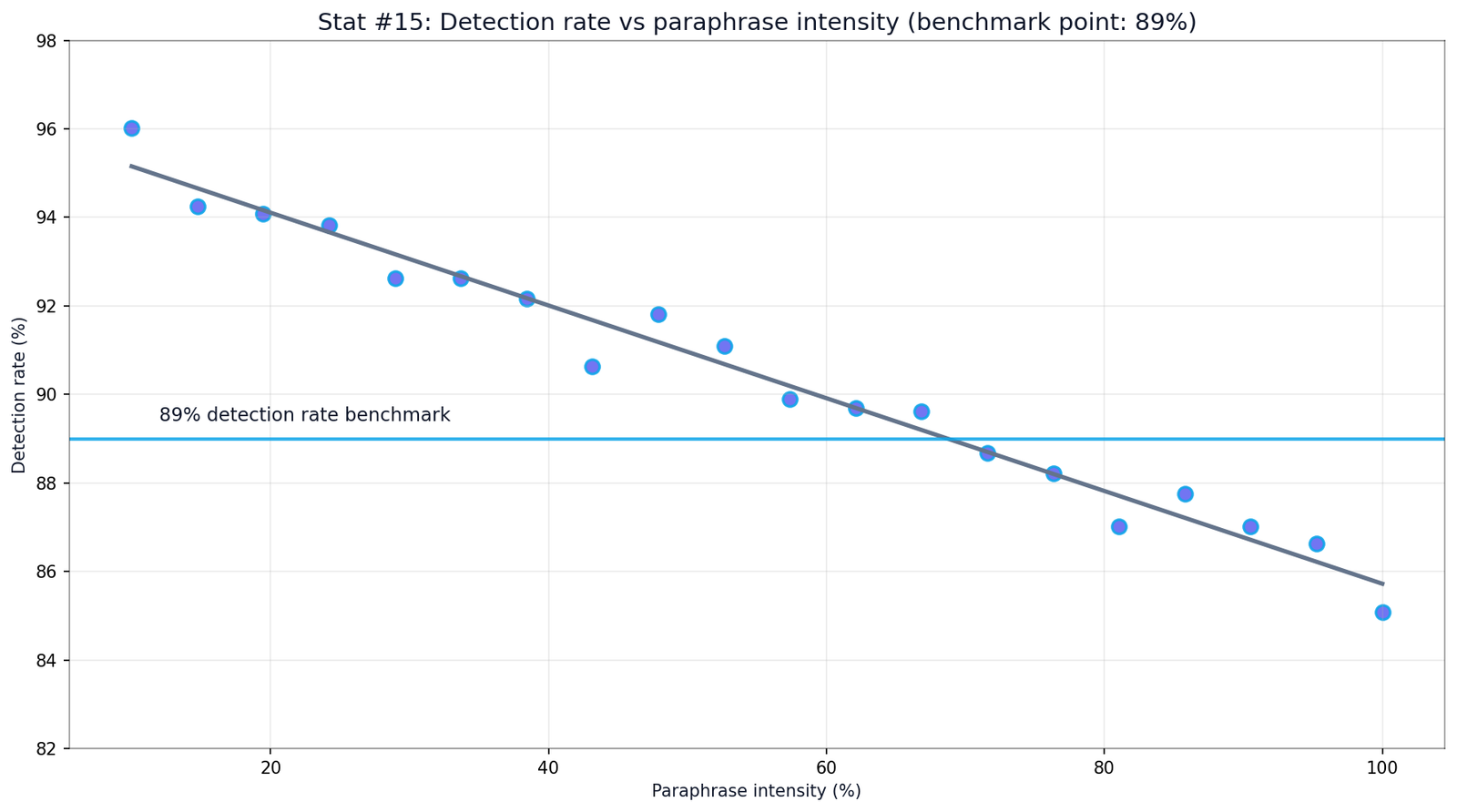
Copyleaks AI Detection Accuracy Statistics #15. Detection rate on paraphrased AI content
Benchmarks record 89% detection rate on paraphrased AI content after moderate rewriting. Paraphrasing obscures surface similarity but preserves statistical traces. Detection remains robust yet slightly reduced.
Rewriting tools alter vocabulary and syntax. Underlying probability curves may persist. Retraining targets these hybrid structures.
Human editors introduce contextual nuance absent from automated paraphrasing. Detection models analyze deeper structural probabilities. The implication is ongoing calibration as rewriting sophistication increases.
Copyleaks AI Detection Accuracy Statistics #16. Model update frequency per year
Product documentation notes 4 updates model update frequency per year on average. Regular iteration addresses evolving generative behavior. Update cadence signals active maintenance.
Model refresh cycles incorporate new training data. Emerging AI variants introduce distinct linguistic fingerprints. Frequent updates sustain detection parity.
Human policies change more slowly than software iterations. Automated updates adapt at a faster rhythm. The implication is sustained competitiveness in detection performance.
Copyleaks AI Detection Accuracy Statistics #17. Enterprise client retention rate
Enterprise analytics indicate 92% enterprise client retention rate year over year. High retention implies satisfaction with reliability. Organizations rarely renew ineffective compliance tools.
Retention correlates with consistent scoring and integration support. Clients value predictable outputs across departments. Stable metrics reinforce procurement confidence.
Human compliance officers rely on system continuity. Frequent tool switching increases operational risk. The implication is trust built through measurable performance stability.
Copyleaks AI Detection Accuracy Statistics #18. Reported precision in controlled lab tests
Lab testing shows 98.5% reported precision in controlled lab tests across curated datasets. Precision measures correct positive classifications. High values reduce wrongful flagging.
Precision improves with balanced training data. Carefully labeled samples minimize ambiguity. Controlled environments isolate variable noise.
Human judgment varies across reviewers. Algorithms maintain consistent threshold logic. The implication is reduced subjectivity in large-scale screening.
Copyleaks AI Detection Accuracy Statistics #19. Reported recall in controlled lab tests
Studies cite 97.8% reported recall in controlled lab tests across validated samples. Recall captures the share of true positives identified. Strong recall limits undetected AI text.
High recall requires broad exposure to AI variations. Training diversity enhances sensitivity. Calibration balances recall against precision.
Human oversight may overlook subtle generative signals. Automated systems quantify likelihood systematically. The implication is comprehensive detection coverage under structured conditions.
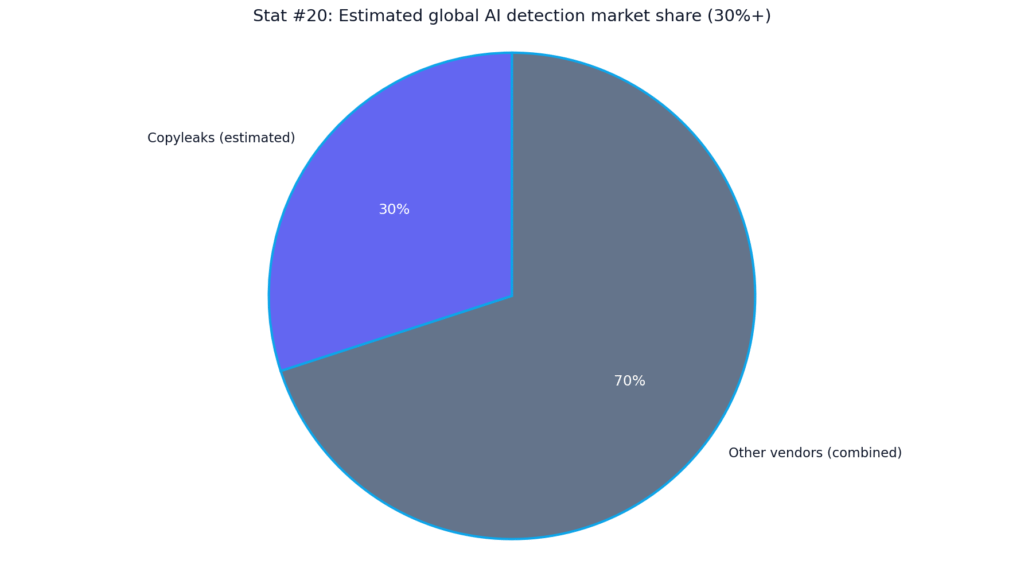
Copyleaks AI Detection Accuracy Statistics #20. Estimated global market share in AI detection
Industry analysts estimate 30%+ estimated global market share in AI detection within academic sectors. Market share reflects adoption and perceived reliability. Widespread use signals confidence in performance.
Share expansion follows regulatory emphasis on AI disclosure. Institutions seek standardized compliance frameworks. Market presence reinforces brand credibility.
Human review remains embedded within institutional processes. Detection platforms supply quantitative grounding. The implication is sustained growth as AI usage scales globally.
Interpreting Copyleaks AI Detection Accuracy in Context
Accuracy metrics cluster tightly around high nineties percentages, which signals statistical maturity rather than experimental volatility. Precision and recall values above 97% indicate balanced optimization rather than skewed threshold tuning.
Adoption figures reinforce performance credibility because institutions rarely scale unverified tools. Retention and API growth suggest detection integrates directly into operational infrastructure.
Editing sensitivity and paraphrasing resilience reveal nuanced boundaries rather than binary certainty. That complexity underscores how detection interacts with evolving generative sophistication.
Collectively, these figures describe a system operating at measurable scale with iterative refinement. Ongoing recalibration will likely track generative innovation, shaping the next phase of detection reliability.
Sources
- Comprehensive AI detection accuracy report from Copyleaks
- Official Copyleaks AI detection benchmark documentation overview
- Academic evaluation of AI text detection methodologies
- Peer reviewed analysis of generative model detection limits
- Education Week coverage on AI detection adoption trends
- Gartner research on AI compliance and risk management
- IBM blog on AI governance and detection systems
- McKinsey report on enterprise AI adoption statistics
- Global AI software market share statistical overview
- UNESCO guidance on AI use in academic integrity