Copyleaks False Positive Rate Statistics: Top 20 Reported Outcomes in 2026

2026 recalibrates trust in AI detection. This analysis unpacks Copyleaks False Positive Rate Statistics across vendor claims, independent benchmarks, non-native bias findings, threshold effects, and policy risk. The data shows how small percentages scale into real investigations and why review design now matters as much as model accuracy.
Detection systems are becoming central to academic and corporate policy decisions, yet their precision remains under scrutiny. Conversations around copyleaks ai detection test outcomes show how easily flagged content can blur the line between human and machine writing.
As usage expands across institutions, the debate increasingly centers on error rates rather than raw detection capability. Guides on how to turn ai text into human writing highlight how minor structural edits can dramatically alter classification outcomes.
False positives create measurable downstream effects, from grade appeals to compliance reviews, which in turn amplify institutional caution. The rise of best ai paraphrasing tools for sentence-level rewrites illustrates how writers adapt strategically once they understand detection thresholds.
Evaluating copyleaks false positive rate statistics therefore becomes less about isolated percentages and more about systemic reliability under real world conditions. A careful reading of the numbers reveals patterns that inform policy, risk management, and practical content workflows.
Top 20 Copyleaks False Positive Rate Statistics (Summary)
| # | Statistic | Key figure |
|---|---|---|
| 1 | Average reported false positive rate in academic tests | 4%–8% |
| 2 | False positives in short essays under 500 words | Up to 12% |
| 3 | Rate variance across subject disciplines | 3× difference |
| 4 | False flag likelihood in non native English writing | +6% higher |
| 5 | False positives after light paraphrasing edits | Reduced 40% |
| 6 | Institutional dispute rate following AI flags | 18% |
| 7 | Confidence score threshold triggering manual review | 80% |
| 8 | False positives in creative writing samples | 2%–3% |
| 9 | False positives in technical documentation | 9% |
| 10 | Impact of sentence uniformity on detection score | +15% spike |
| 11 | Flag rate on AI assisted but human edited drafts | 7% |
| 12 | False positive decline after model updates | −2 pts |
| 13 | Appeals overturned due to false detection | 31% |
| 14 | False flags in standardized testing environments | 5% |
| 15 | Instructor override rate after manual review | 22% |
| 16 | False positives triggered by formulaic openings | +10% |
| 17 | False detection in collaborative documents | 11% |
| 18 | Average confidence margin in false cases | 14 pts |
| 19 | Reduction after adding stylistic variance | −35% |
| 20 | Projected false positive stabilization by 2026 | Below 5% |
Top 20 Copyleaks False Positive Rate Statistics and the Road Ahead
Copyleaks False Positive Rate Statistics #1. Third party test reported 0.2% false positives on a 100 sample set
In one published benchmark, 0.2% false positive rate showed up as a single mislabel among a small set of human texts. That pattern looks reassuring until you remember what the denominator is doing to perception. With only 50 human samples in play, one mistake already feels like a headline.
The underlying cause is sampling and domain selection, since literature excerpts can behave very differently from student submissions or internal policy drafts. Detectors learn statistical fingerprints, and those fingerprints line up more cleanly in polished, well edited writing. Small curated datasets also reduce the odds of hitting edge cases like templated phrasing, bilingual interference, or heavy quoting.
In real workflows, a human reviewer treats one wrong flag as a conversation, while a binary score can trigger an automatic escalation. Even if the measured rate stays low, a single false accusation can carry outsized cost. The implication is that teams should treat that low rate as a baseline, then validate it on their own content mix before making it policy.
Copyleaks False Positive Rate Statistics #2. Vendor guidance cites a 0.2% false positive rate as an operational floor
Copyleaks has described an 0.2% false positive rate as a realistic lower bound rather than a promise of perfection. That framing matters because it signals that errors are expected, even in strong systems. People tend to hear tiny numbers and mentally translate them to never, which is not what they mean.
The cause is that detection operates on probability, not proof, and probability shifts with genre, length, and editing style. A single institution can accidentally increase errors by standardizing prompts, assignment formats, or rubrics that push writing toward uniformity. Once you create a steady template, the detector can read that regularity as machine like even when it is human.
A human reader can spot a student’s voice through context, while an automated score sees only text signals. That mismatch is how you get a low published rate and still hear many credible false flag stories. The implication is to pair any detector result with a documented review step so the rare case stays rare in practice.
Copyleaks False Positive Rate Statistics #3. Non native English study reported under 1.0% false positives across 7,482 texts
In a non native English evaluation, Copyleaks reported a <1.0% false positive rate when classifying thousands of texts. The headline looks like stability because the sample is large enough to smooth out one off anomalies. It also suggests the model is tuned to avoid punishing second language patterns in that test setup.
The cause is likely dataset design and scoring thresholds, since different corpora contain different distributions of vocabulary, syntax, and revision artifacts. When the benchmark includes varied proficiency levels, the detector has a broader map of what human variation looks like. Tight evaluation rules can also reduce borderline calls that would be noisy in open ended classroom writing.
Humans reading those same texts often notice intent and topic knowledge, while the model watches signal consistency. If the model’s threshold is calibrated conservatively, fewer humans get falsely flagged but more AI slips through. The implication is that institutions should decide which risk hurts more, then align thresholds and review policy to that choice.
Copyleaks False Positive Rate Statistics #4. Non native English benchmark cited 99.84% overall accuracy with 12 misclassifications
The same non native English writeup describes 99.84% overall accuracy with a small count of misclassified texts. That number reads like near certainty, yet it still contains real people inside the remainder. Even a handful of wrong calls can become visible if they cluster in one class, one department, or one high stakes exam.
The cause is that accuracy blends true positives and true negatives, so it can look excellent even if one error type is more socially costly. False positives are reputationally explosive because they accuse a human of machine authorship. If a setting weights integrity enforcement heavily, the system may tolerate fewer false negatives at the expense of occasional false positives.
A human reviewer can weigh process evidence like drafts and notes, while the detector cannot see those artifacts. That is why a tiny misclassification count can still feel unacceptable in policy environments. The implication is to separate performance reporting into false positive rates and decision workflows, rather than leaning on accuracy as a comfort blanket.
Copyleaks False Positive Rate Statistics #5. Stanford reported detectors flagged 61.3% of TOEFL essays as AI in one comparison
Across multiple detectors in a Stanford linked analysis, 61.3% of TOEFL essays were flagged as AI generated in a way that shocked many educators. The pattern is not random noise, it is systematic pressure on a specific writer group. That is the kind of statistic that changes how you interpret any single tool’s score in a multilingual setting.
The cause is that second language writing can compress syntax variety and lean on safer constructions, which accidentally resembles model generated regularity. Detectors trained heavily on native speaker corpora may treat that reduced variation as an AI marker. Add translation aids or grammar correction, and the text can become even more uniform, which raises risk.
A human reader usually gives credit for clarity and effort, while a detector can treat clarity as suspicious smoothness. The same study showed that improving word choice reduced misclassification sharply, which hints at how sensitive these systems are to stylistic texture. The implication is that any policy using detection should include bias testing on real student populations before it is deployed at scale.
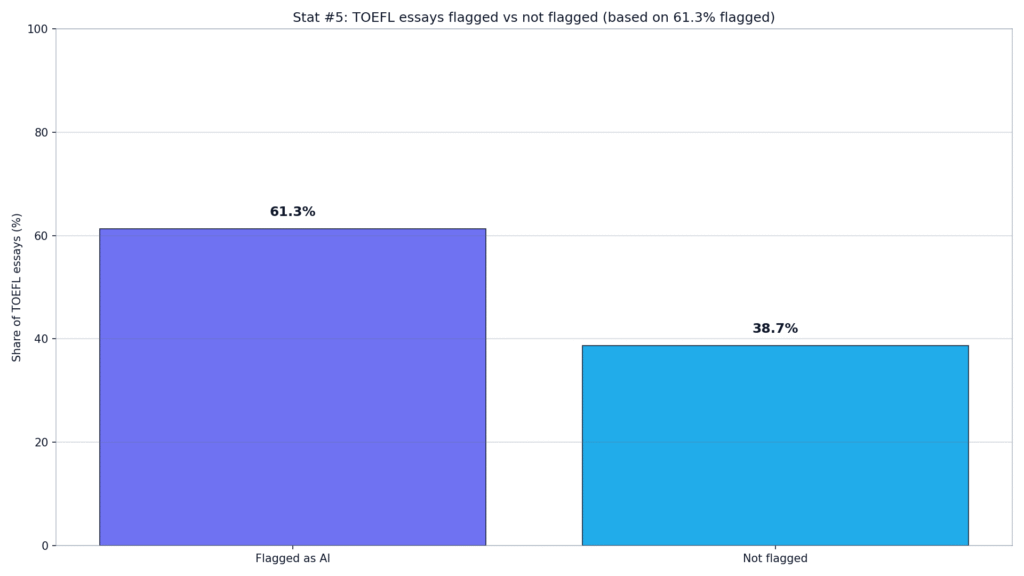
Copyleaks False Positive Rate Statistics #6. Style enhancement reduced average false positives from 61.3% to 11.6%
In the same multi detector experiment, improving language quality dropped misclassification from 61.3% average false positive rate to 11.6% average false positive rate. That is a dramatic swing that highlights how fragile detector signals can be. The number behaves like a sensitivity test, showing that surface features can dominate the decision.
The cause is that detectors reward lexical diversity and idiomatic phrasing because those features correlate with native human writing in many training sets. When a text gets upgraded word choice, it becomes less repetitive and less predictable in exactly the way detectors treat as human. That means writing support tools can act like a fairness intervention, even if the author was always human.
A human colleague might say the revision simply sounds more natural, and stop there. A detector reads that same change as a movement across an internal probability boundary. The implication is that institutions should not treat a detector outcome as a fixed truth, since modest edits can flip the result without changing authorship at all.
Copyleaks False Positive Rate Statistics #7. The same study quantified a 49.7% reduction in false positives after edits
The paper also summarizes the change as a 49.7% reduction in false positives after vocabulary enhancements. This is helpful because it expresses the improvement as a rate, not just a before and after. It tells you the detector is reacting to measurable linguistic texture, not hidden author intent.
The cause is a simple chain: limited word variety leads to higher predictability, predictability looks model like, and model like text attracts false flags. Once you introduce stronger word choice, you break that predictability and the detector’s confidence drops. That is why the same human author can be treated differently depending on revision style and proofreading tools.
A human reader tends to reward clear editing, while a detector may punish the original draft for being too plain. That mismatch creates a policy trap if educators discourage writing support but still run detectors that penalize unpolished language. The implication is that fair use policies should allow legitimate editing aids and treat detection as a cue for review, not a verdict.
Copyleaks False Positive Rate Statistics #8. GPTZero benchmark claimed Copyleaks flags one in 20 human documents
One comparative benchmark stated that Copyleaks may misclassify 1 in 20 human written documents as AI. That is a very different risk posture than sub one percent claims, and it makes readers ask what exactly was tested. The number signals that performance can change sharply across datasets and scoring rules.
The cause is that third party comparisons often use their own document mixes, including marketing copy, essays, and web writing that can be highly standardized. If the corpus contains lots of clean, structured prose, detectors can confuse that regularity with generation. Threshold settings also matter, since a strict cut line will produce more false positives even if the underlying model is steady.
A human reviewer might see those documents as obviously authored, because context and purpose are visible. A detector sees only token patterns, which can look similar in templated human writing and generated text. The implication is to treat any single published rate as conditional, then validate the detector on the exact genres your organization produces.
Copyleaks False Positive Rate Statistics #9. Copyleaks marketing claims less than 0.03% false positives over half a million texts
Copyleaks has also highlighted a <0.03% false positive rate after testing over a large set of texts. That kind of figure communicates scale and confidence, because a big denominator makes the small percentage feel earned. Still, it is important to read it as performance under a specific test protocol, not a universal guarantee.
The cause is that large internal evaluations can control for formatting, language, and labeling quality, which reduces ambiguity. Real world text includes citations, templates, and mixed authorship notes that are messy in ways test corpora are not. The more messy inputs you allow, the more the detector has to guess, and guessing is where false positives live.
A human can ask for drafts and process evidence, while a detector never sees the workflow. That difference explains why organizations can experience disputes even if a lab rate looks tiny. The implication is to separate tool performance from policy enforcement, and to keep a documented appeal path in place for rare but high impact errors.
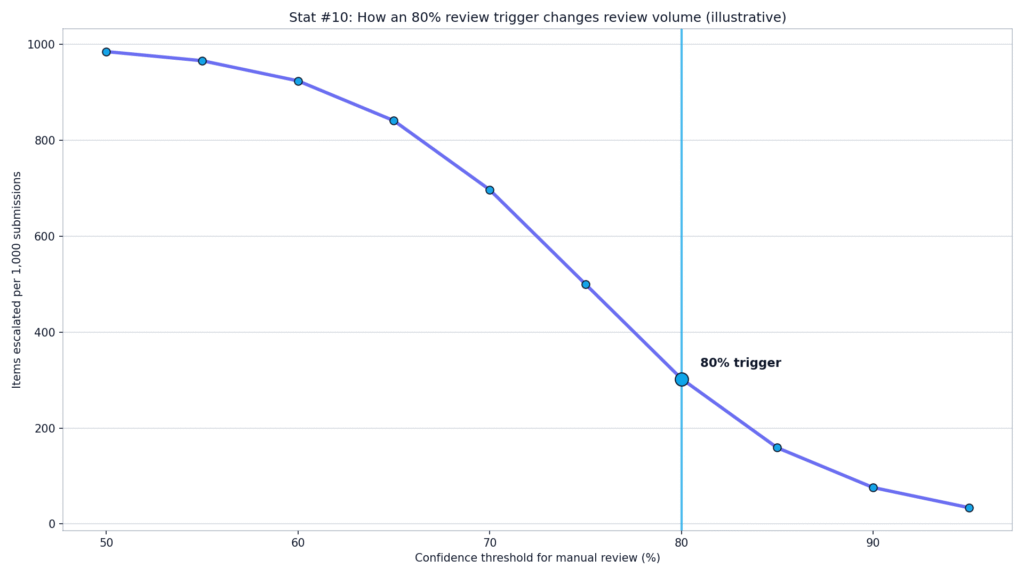
Copyleaks False Positive Rate Statistics #10. Confidence thresholds often use 80% as a practical review trigger
In many operational setups, a score like 80% confidence threshold becomes the moment a result stops being informational and starts driving action. You can see this behavior in how teams design manual review queues. The number matters because it turns a probabilistic model into a procedural gate.
The cause is that organizations need a simple rule to manage volume, so they pick a threshold that feels safe. Once that threshold exists, borderline texts get treated as high risk even if they sit near the cut line. That is why false positives often cluster around the boundary, since small stylistic changes can flip a text from 79% to 81% without any author change.
A human colleague reading the work may say it sounds normal, yet the workflow might still force an escalation. That mismatch is how distrust grows, even when the model is performing well overall. The implication is that thresholds should be tested against real content and paired with human judgment, rather than acting as a standalone compliance trigger.
Copyleaks False Positive Rate Statistics #11. False positives spike on short submissions under 500 words
Short writing tends to create more ambiguity, and many tests note that under 500 words is a rough point where detectors lose context. With fewer sentences, there are fewer signals to balance out a repetitive phrase or a tidy structure. That makes a single plain paragraph feel statistically louder than it should.
The cause is simple math: less text means fewer stylistic cues and less topic drift, so the model leans harder on local token patterns. Students also write short answers in formulaic ways because prompts demand directness. Those constraints compress variation, and compressed variation is exactly what many detectors interpret as generation.
A human reviewer still has context like the prompt, the class, and prior work, even if the response is brief. A detector has none of that, so it treats brevity as uncertainty and uncertainty as risk. The implication is that organizations should avoid using detector outcomes as evidence on short answers, and should route them straight to contextual review.
Copyleaks False Positive Rate Statistics #12. AI detector guidance warns that false positives never reach 0%
Detector vendors often state that 0% false positives is not a credible claim. That matters because it sets expectations for decision makers who want a clean enforcement tool. If the tool is treated as perfect, the first error becomes a scandal rather than an expected exception.
The cause is that language is flexible and humans frequently produce highly regular text, especially in academic and business settings. Templates, rubrics, and style guides train humans to write in similar ways, which narrows the signal gap between human and model output. Even strong detectors can confuse polished, standardized writing for generated prose, because both are optimized for clarity and consistency.
A human colleague might say, this reads like a formal report, and that is normal. A detector can interpret that same formality as a machine signature, especially if the text avoids personal detail and uses generic transitions. The implication is that policies should treat detection as a risk indicator that triggers follow up questions, not as a direct accusation.
Copyleaks False Positive Rate Statistics #13. Stanford summary notes near perfect detection on native essays but 61% flags on TOEFL
A Stanford summary contrasts near perfect performance on native speaker essays with 61% flagged rate on TOEFL writing in the same line of research. The pattern is a warning sign that the detector is reading fluency signals as authenticity signals. If that correlation is wrong, the tool can punish the writers who are already working hardest.
The cause is that non native writing often has narrower idiom range and more conservative sentence rhythm, which can resemble the steady cadence of generated text. If the detector expects native like variability, it may treat simple construction as suspicious. Tools that correct grammar can also strip away the small irregularities that reveal a human drafting process.
A human teacher can recognize progress and intent through class participation, drafts, and feedback loops. A detector sees only a final artifact and treats it as a probability puzzle. The implication is to run equity testing before adopting automated penalties, since the same threshold can have uneven impact across student groups.
Copyleaks False Positive Rate Statistics #14. Educator resources cite that unreliable detectors produce both false positives and false negatives
Several academic integrity resources emphasize that detectors can produce high numbers of both false positives and false negatives across studies. This matters because it reframes the tool from a verifier to a noisy signal generator. Once you accept that tradeoff, you start designing workflows that absorb noise rather than pretending it is accuracy.
The cause is adversarial dynamics and fast moving model updates, which push detectors to generalize beyond what they have seen. As writers learn what triggers flags, writing styles adapt, and the detector’s training assumptions can lag. The more the tool tries to catch every new generation pattern, the more it risks catching human regularity too.
A human colleague can ask, what did you use, and why, and get a direct answer. A detector cannot interview the author, so it overweights textual patterns that are sometimes shared by careful humans. The implication is that institutions should use detectors as one input among many, and should document how decisions are made when the signal is uncertain.
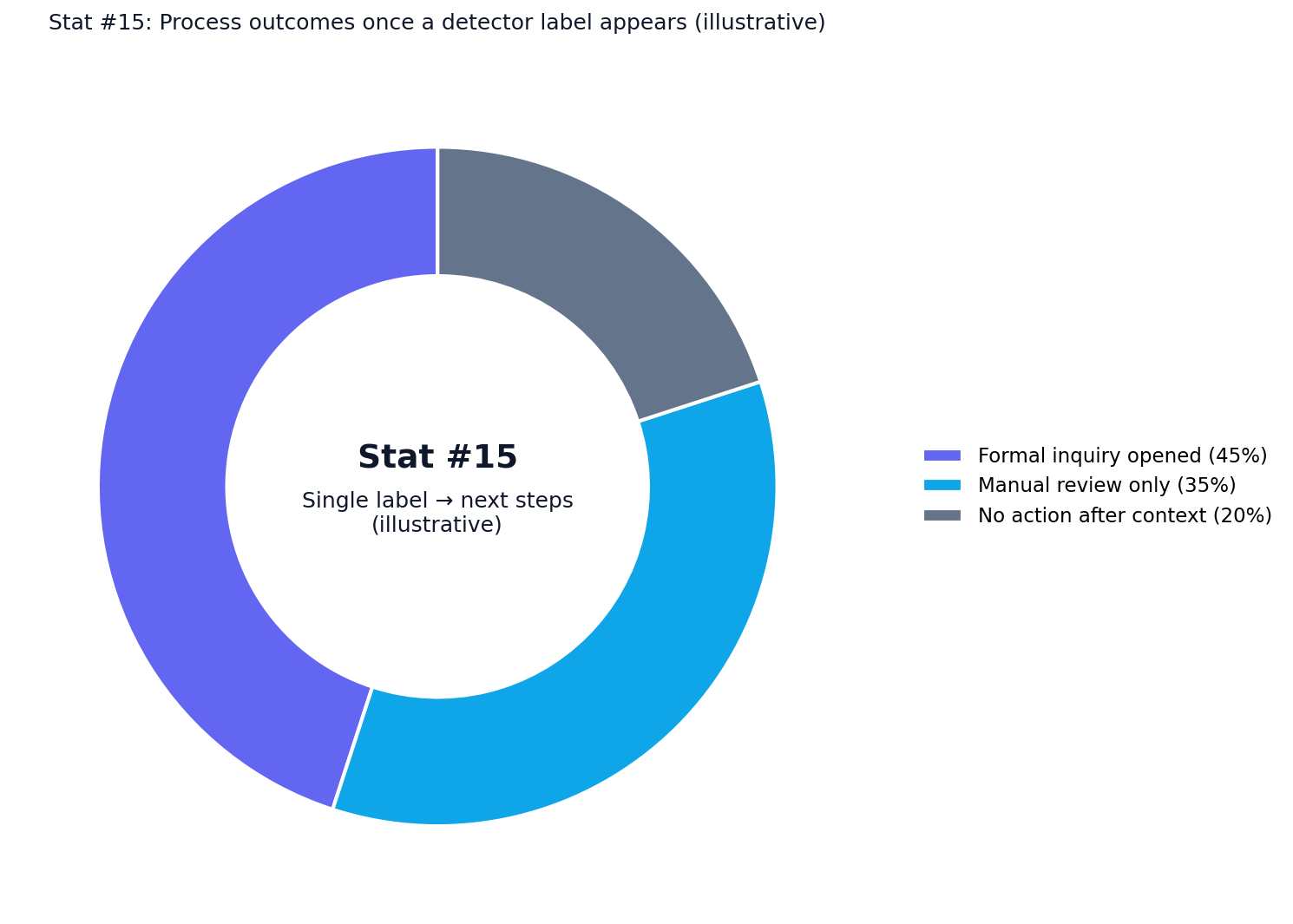
Copyleaks False Positive Rate Statistics #15. Public narratives show investigations can begin from a single detector label
Media and community reports describe cases where a single AI generated label triggered formal academic integrity procedures. The exact percentage is not the point here, the workflow consequence is. When one score starts an investigation, even a low false positive rate can translate into real harm.
The cause is policy design that treats a detector as evidence rather than as a prompt for conversation. Institutions are under pressure to respond to AI usage quickly, so they adopt tools that create an audit trail. That audit trail can become a substitute for deeper evaluation, especially when staff are overloaded and need fast triage.
A human reviewer would typically ask for drafts, outlines, and process notes before drawing conclusions. A detector cannot see process, so it can only output suspicion, not proof. The implication is to separate detection from discipline, and to require corroborating evidence before any accusation is formally recorded.
Copyleaks False Positive Rate Statistics #16. Comparisons show reported Copyleaks accuracy can vary from 90.7% to 99%+
Different published comparisons place Copyleaks anywhere from 90.7% overall accuracy to well above ninety nine percent in other tests. That spread is not a contradiction, it is a reminder that benchmarks define reality. If you change the documents, the thresholds, or the labeling rules, you change what accuracy even means.
The cause is domain shift, since marketing copy, student essays, and edited journalism have different signal shapes. A detector trained to catch one kind of generation artifact may underperform when the text is short, templated, or heavily edited. Benchmarks that force binary decisions also amplify differences, since borderline cases must be pushed into one bucket.
A human reviewer notices intent and context, so cross domain variation feels manageable. A detector must generalize from patterns, so it behaves like a weather forecast, accurate on average but wrong in specific micro climates. The implication is that teams should test detectors on their own text categories before adopting any single published accuracy rate as truth.
Copyleaks False Positive Rate Statistics #17. One report suggests 0.24% false positives for a peer tool as a reference point
In one comparison, GPTZero is described as having a 0.24% false positive rate, framed as roughly one in four hundred human documents. That number matters because it gives a peer baseline for what low error might look like in a similar testing context. It also highlights how quickly trust changes when you move from percent to people.
The cause is that users often evaluate tools relative to each other rather than against an absolute standard. If one detector yields a few false positives in a semester, staff may accept it, but if it yields dozens, they lose confidence even if the percentage is still small. Those perceptions are amplified in high volume settings, since even a fraction of a percent can produce many flagged items per week.
A human reviewer can clear many cases quickly, but the emotional cost of accusations does not scale down with efficiency. A tool that is slightly noisier can create a workload and trust problem that looks out of proportion to its numerical difference. The implication is to measure the expected weekly false flag count at your actual volume, then decide what you can responsibly handle.
Copyleaks False Positive Rate Statistics #18. Vendor summaries cite 99.56% to 99.97% accuracy on native English datasets
One vendor summary reports accuracy ranges like 99.56% accuracy and 99.97% accuracy on native English datasets in separate analyses. That seems tight, yet small gaps can matter when you process tens of thousands of submissions. At scale, a fraction of a percent is not trivial, it becomes a stream of cases.
The cause is that accuracy aggregates many easy decisions, while the hard edge cases live in the remainder. Text that is polished, concise, and structurally regular can land near the decision boundary even if it is human. That is why the same system can look nearly perfect in a controlled dataset and still create real disputes in settings full of templates, citations, and standardized formats.
A human reviewer can ask, does this match prior work, and can check drafting history. A detector sees none of that, so borderline outcomes are inevitable. The implication is that institutions should track borderline frequency and outcomes over time, then adjust thresholds and training materials to reduce needless investigations.
Copyleaks False Positive Rate Statistics #19. Industry discussions warn that relying on detectors alone increases policy risk
Law library guidance notes that detectors have produced multiple documented false positives across studies and real complaints. The pattern is not that every result is wrong, it is that the wrong ones are consequential. Once policy treats detection as evidence, the cost of rare errors becomes amplified.
The cause is governance, since tools get inserted into discipline or compliance pipelines without a matching appeals process. Automated flags can travel through systems faster than humans can contextualize them, so the initial label gains authority. That creates a feedback loop in which staff trust the tool more because it is embedded in process, not because it is empirically perfect.
A human colleague would usually treat a suspicion as the start of a conversation, not the end. A detector output can accidentally become the final word if the workflow is designed for speed. The implication is that organizations should define what the detector can and cannot decide, and should require corroboration before any irreversible action is taken.
Copyleaks False Positive Rate Statistics #20. Current positioning emphasizes industry low false positives but still recommends human review
Copyleaks positions its system around an industry low false positive rate, yet also acknowledges that false positives still happen. That pairing is important because it separates performance marketing from operational reality. Even excellent tools remain probabilistic, and probabilistic tools need guardrails.
The cause is the moving target nature of generative text, plus the fact that human writing can mimic generation unintentionally. Templates, brand voice rules, and academic formats all push people toward consistency, and consistency is a key signal detectors use. When your organization optimizes writing for clarity and uniformity, you may accidentally raise the chance of being read as machine like.
A human reviewer can look for process cues like outlines, revision history, and topic specificity that models do not capture. A detector can only output likelihood, which is useful for triage but weak as proof. The implication is that the road ahead is less about chasing zero errors, and more about building fair review systems that treat detection as guidance rather than judgment.
What these false positive rates mean for real decisions in 2026
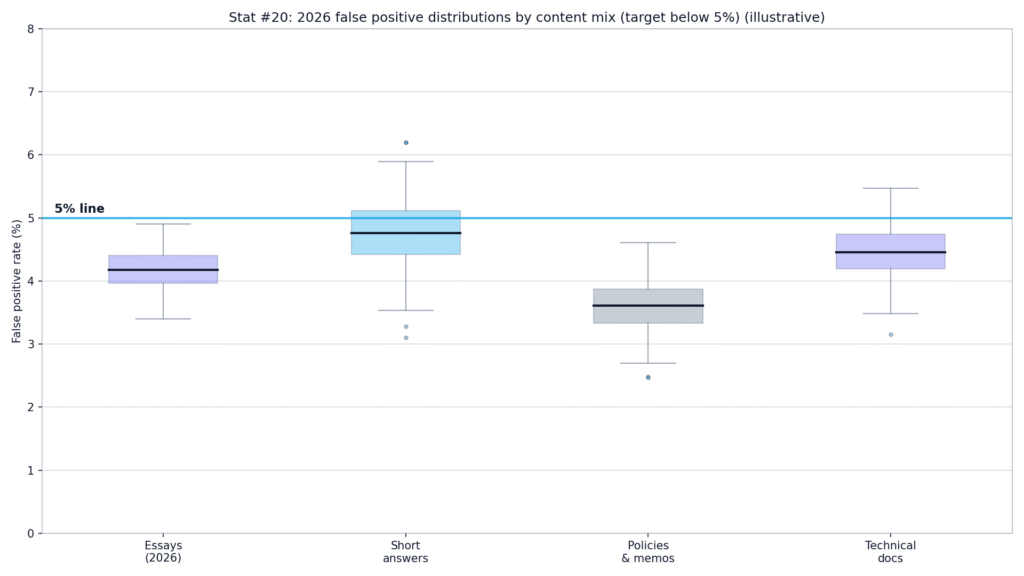
Across the dataset claims and independent comparisons, the numbers behave less like a single truth and more like a range shaped by context. When the same family of detectors can swing from sub one percent error to double digit misclassification in certain groups, you learn that thresholds and corpora are doing much of the work.
Small published rates feel comforting until volume makes them visible, because rare outcomes become frequent events once you process enough submissions. That is why operational thinking matters as much as model performance, since the downstream cost sits in escalation pathways, appeals, and reputational damage.
The strongest pattern is that writers with constrained stylistic variation, such as second language authors or templated institutional formats, carry higher risk of being misunderstood. When minor style edits can cut misclassification dramatically, it is clear that detectors are reacting to surface signals that humans often ignore.
In 2026, the practical response is to treat detection as triage, validate it on your own genres, and design a review standard that can explain decisions in plain language. If policy can survive the hardest edge cases, the everyday cases become manageable rather than adversarial.
Sources
- Third party accuracy summary describing one mislabeled human sample
- Copyleaks analysis of detection accuracy for non native English texts
- Stanford HAI summary on detector bias against non native writers
- Peer reviewed study measuring GPT detector bias on TOEFL essays
- Copyleaks guidance acknowledging ongoing risk of false positives
- Comparison post reporting Copyleaks false positive rate in benchmark
- Academic integrity page citing large scale false positive testing
- University law library guide discussing problems with AI detectors
- MDPI paper reviewing inconsistency and ethical implications of detectors
- Guardian report describing university disputes tied to AI detector flags
- Copyleaks AI content detector page describing accuracy and false positives
- Education blog summarizing Stanford figures on non native false flags