How to Fix a Copyleaks AI Score: 15 Corrective Actions

In 2026, detection scores can hinge on structure, rhythm, and lexical patterns rather than intent. Research published in Science Advances shows AI text can be identified through statistical regularities, reinforcing why targeted revisions can lower flagged probability without compromising clarity.
How to Fix Copyleaks AI Score: 15 Practical Corrections
You ran your document through Copyleaks and the result wasn’t what you expected. A high AI probability score can feel frustrating, especially if you know the work is your own and you’re now questioning what triggered it.
Part of the issue is that detection tools rely on pattern recognition, not intent. Even human writing can be flagged as AI, especially when it follows predictable structures or polished academic phrasing.
Writers working in structured formats are even more exposed, particularly when they use best AI rewriters for academic and structured writing without refining the output. If you’ve noticed how often Copyleaks flags human writing, this guide walks you through 15 specific actions to lower the score without compromising clarity or substance.
| # | Strategy focus | Practical takeaway |
|---|---|---|
| 1 | Sentence variation | Break repetitive rhythms and introduce natural pacing shifts in paragraph flow. |
| 2 | Structural looseness | Reduce overly rigid formatting so the text feels less templated and more organic. |
| 3 | Specific detail layering | Add concrete, contextual elements that signal lived or situational awareness. |
| 4 | Micro-imperfections | Introduce subtle human inconsistencies that soften overly optimized phrasing. |
| 5 | Lexical unpredictability | Swap predictable vocabulary for more nuanced or varied word choices. |
| 6 | Paragraph asymmetry | Avoid uniform paragraph length to reduce machine-like formatting patterns. |
| 7 | Contextual qualifiers | Use conditional framing and situational nuance instead of absolute claims. |
| 8 | Natural transitions | Replace formulaic connectors with smoother, conversational flow between ideas. |
| 9 | Mixed sentence density | Blend short and longer constructions to disrupt statistical uniformity. |
| 10 | Voice recalibration | Adjust tone so it aligns with a real speaker rather than neutral output. |
| 11 | Claim grounding | Support statements with reasoning instead of broad, generic assertions. |
| 12 | Redundancy pruning | Remove filler phrasing that signals automated expansion. |
| 13 | Idea compression | Tighten sections that feel over-explained or mechanically elaborated. |
| 14 | Intentional emphasis | Highlight key ideas selectively rather than evenly distributing weight. |
| 15 | Final human pass | Conduct a deliberate manual review focused on flow, rhythm, and clarity. |
15 Practical Corrections to How to Fix Copyleaks AI Score
How to Fix Copyleaks AI Score – Strategy #1: Sentence variation
One of the fastest ways to reduce a high detection result is to vary your sentence structure in a deliberate, thoughtful way that feels natural rather than mechanical. Many drafts that trigger AI probability tools rely on evenly sized sentences that follow a predictable rhythm, which creates statistical uniformity even if the ideas themselves are strong. When you revise, read the paragraph aloud and adjust pacing so that longer, layered sentences sit beside shorter reflective ones, allowing the flow to feel more human and less formula-driven.
This works because detection systems often calculate consistency across sentence length and syntactic arrangement, and uniformity tends to resemble generated text patterns. In practice, this might mean breaking up a long explanatory block with a brief clarifying thought, then following it with a more developed sentence that expands context in a natural way. The goal is not randomness, but intentional variation that mirrors how real writers think, pause, elaborate, and then continue building their point.
How to Fix Copyleaks AI Score – Strategy #2: Structural looseness
Highly structured formatting, especially when every paragraph follows the same logical progression, can unintentionally resemble automated writing templates. If each section opens with a topic sentence, moves into explanation, and ends with a tidy summary in identical proportions, the pattern becomes statistically visible. Loosening that structure slightly, perhaps by embedding explanation within the opening or allowing the closing thought to introduce nuance instead of summary, can make the piece feel more organic.
Detection models tend to reward irregularity because human writing rarely conforms to perfect symmetry across multiple paragraphs. In revision, you might combine two smaller sections into one layered argument, or allow a paragraph to expand further than expected if the idea genuinely requires depth. The emphasis should remain on clarity, yet the structure should reflect natural cognitive flow rather than a rigid instructional template repeated fifteen times in a row.
How to Fix Copyleaks AI Score – Strategy #3: Specific detail layering
Generic phrasing is one of the strongest signals that a text may have been generated, because broad statements lack contextual fingerprints. Adding precise examples, situational details, or brief references to realistic scenarios introduces texture that statistical systems interpret as less formulaic. Instead of stating that a result may appear inaccurate, describe what that looks like in practice, including how a writer might feel or what kind of document was being analyzed.
This approach strengthens both credibility and detection resilience because it moves the text away from abstract generalities into lived or situational territory. For instance, you might explain how a graduate student reviewing a flagged research draft noticed that repeated transitional phrases created an artificial rhythm. Details such as document type, revision behavior, or contextual constraints create variation that aligns more closely with authentic human authorship patterns.
How to Fix Copyleaks AI Score – Strategy #4: Micro-imperfections
Perfectly polished phrasing, especially when sustained across an entire article, can inadvertently resemble model output because it lacks the small inconsistencies that characterize human expression. Real writers occasionally hedge, clarify mid-sentence, or adjust tone as they refine an idea, and those subtle shifts create irregularity. Introducing measured nuance, such as conditional language or reflective phrasing, prevents the text from sounding overly optimized.
This does not mean inserting errors or reducing quality, but rather allowing complexity to remain visible instead of smoothing every edge. You might retain a qualifying clause that shows hesitation, or expand on a thought that complicates the original claim instead of simplifying it for symmetry. Those micro-adjustments signal cognitive presence, which in turn can reduce the likelihood that the text will align too closely with automated pattern signatures.
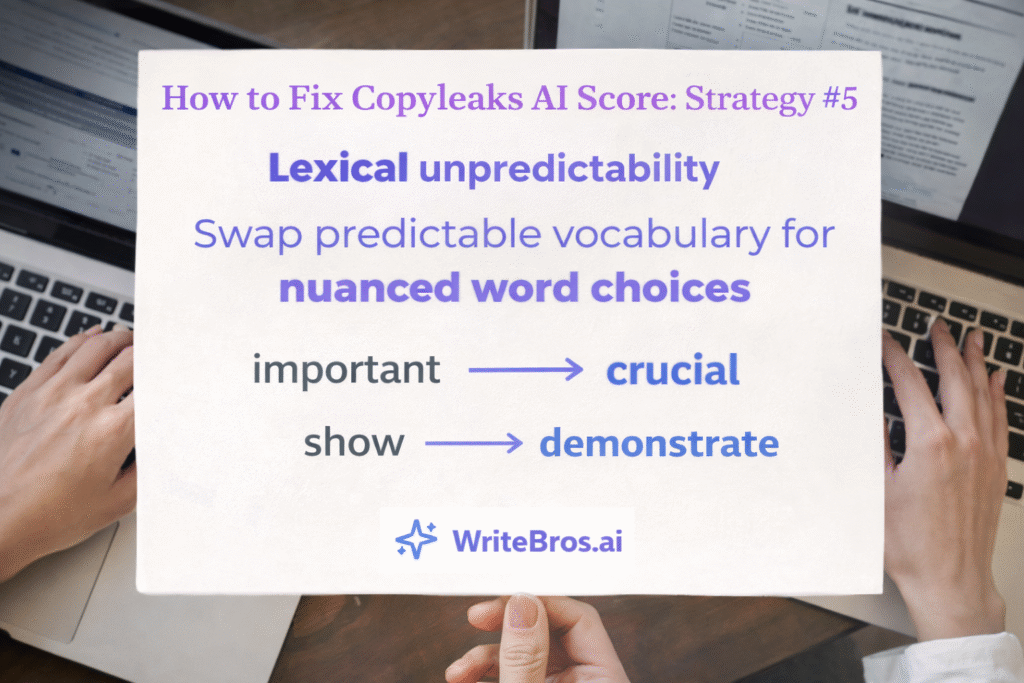
How to Fix Copyleaks AI Score – Strategy #5: Lexical unpredictability
Repeated reliance on high-frequency academic or instructional vocabulary can contribute to detection signals because language models often default to those same common word sets. Reviewing your draft for recurring phrases and substituting more precise or context-aware wording introduces lexical diversity. The change should reflect meaning rather than novelty, ensuring that each substitution deepens clarity instead of simply rotating synonyms.
When applied carefully, lexical unpredictability disrupts frequency-based calculations that detection tools rely upon to estimate probability. For example, if every section uses identical transition cues and identical evaluative adjectives, replacing some with more nuanced alternatives can reduce repetition density. Over the course of a long article, these adjustments accumulate, creating a linguistic profile that feels distinctly authored rather than statistically patterned.
How to Fix Copyleaks AI Score – Strategy #6: Paragraph asymmetry
Uniform paragraph length is surprisingly common in generated drafts, especially when each idea receives nearly identical word allocation. When every block contains roughly the same number of sentences and occupies similar visual space, the presentation can appear algorithmically balanced. Allowing some paragraphs to expand and others to remain tighter creates a more authentic rhythm that mirrors how humans naturally allocate attention.
During revision, consider whether certain arguments genuinely require more elaboration, while others function effectively with restrained explanation. A longer analytical paragraph followed by a concise reflective one introduces structural irregularity that statistical systems may interpret as human variance. Over time, these differences compound, helping the overall piece move away from symmetrical formatting that often correlates with elevated AI probability scores.
How to Fix Copyleaks AI Score – Strategy #7: Contextual qualifiers
Absolute claims, especially when repeated throughout an article, can signal generic generation because they lack situational anchoring. Incorporating contextual qualifiers such as conditional language or boundary-setting phrases introduces realism and complexity into your reasoning. This adjustment encourages a more nuanced tone that reflects how real writers account for variability rather than presenting uniform certainty.
In practical terms, you might specify when a correction is most effective or clarify the limitations of a particular revision method. That added nuance disrupts binary framing and introduces layered reasoning, which statistical models often associate with authentic authorship. Contextual qualifiers also enhance credibility, since they demonstrate awareness of edge cases instead of assuming universal applicability.
How to Fix Copyleaks AI Score – Strategy #8: Natural transitions
Overly formulaic connectors, especially when repeated predictably from section to section, contribute to a mechanical reading experience. Detection systems can identify transitional redundancy, particularly when the same linking phrases appear at the beginning of multiple paragraphs. Revising transitions so they flow organically from the previous idea helps break repetitive patterns and supports narrative continuity.
Rather than inserting standardized connectors, allow each transition to emerge from the specific logic of the argument being developed. This might involve referencing the previous point directly or expanding on an implied tension that naturally bridges two ideas. Such tailored transitions introduce variability and cohesion simultaneously, reducing structural repetition that may elevate AI detection metrics.
How to Fix Copyleaks AI Score – Strategy #9: Mixed sentence density
Sentence density refers to how much information is packed into a single construction, and consistent density across an entire piece can resemble generated text. If every sentence contains similar clause layering and explanatory breadth, the uniformity becomes measurable. Mixing denser analytical sentences with lighter explanatory ones introduces texture that aligns more closely with human drafting habits.
While revising, evaluate whether certain sections could benefit from consolidation, allowing ideas to intertwine within a single expansive sentence. In other areas, separating concepts into distinct statements may enhance clarity while simultaneously varying density. This alternating pattern reflects authentic cognitive processing, where emphasis and elaboration fluctuate depending on the importance of the point being expressed.
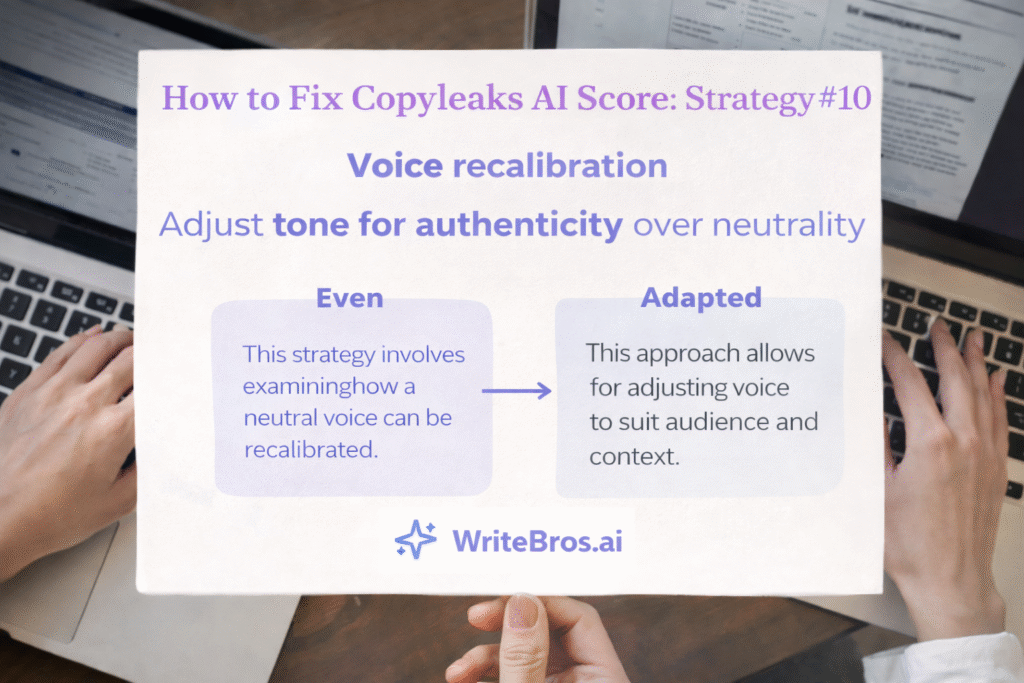
How to Fix Copyleaks AI Score – Strategy #10: Voice recalibration
A neutral, evenly toned voice throughout an entire document can mirror model output because it lacks personal modulation. Adjusting tone to reflect audience awareness, disciplinary expectations, or situational intent introduces dynamic variation. Even subtle shifts in emphasis, perspective, or framing can reduce the sense that the text was produced from a single tonal template.
For example, an instructional section might adopt a more advisory tone, while an analytical segment may lean into reflective reasoning that acknowledges complexity. These calibrated changes demonstrate intentional authorship rather than automated uniformity. When voice reflects purpose, the resulting draft often feels more grounded and less statistically aligned with generalized generation patterns.
How to Fix Copyleaks AI Score – Strategy #11: Claim grounding
Broad assertions without explanation can resemble generated filler, especially when they appear repeatedly without supporting logic. Grounding each claim in reasoning, illustration, or brief justification introduces argumentative depth that detection systems may interpret as more human. Instead of presenting conclusions as self-evident, articulate the pathway that leads to them.
This might involve unpacking why a structural revision affects detection outcomes or clarifying how lexical diversity alters statistical calculations. When readers can trace the reasoning behind each recommendation, the text gains dimensionality. That dimensionality reduces the impression of automated expansion and reinforces the sense that the ideas emerged through deliberate analytical thought.
How to Fix Copyleaks AI Score – Strategy #12: Redundancy pruning
Generated drafts frequently include subtle repetition, especially when expanding on ideas to meet length targets. Identifying and removing overlapping phrases, duplicated explanations, or unnecessarily restated points can significantly alter the statistical footprint of a document. Pruning redundancy tightens the prose and reduces repetitive patterns that detection models may flag.
During revision, examine whether two consecutive sentences communicate essentially the same idea with minor variation. Consolidating them into a single, well-developed sentence both enhances clarity and decreases repetition density. Over the course of a full article, this pruning process can meaningfully shift the document away from patterns associated with automated verbosity.
How to Fix Copyleaks AI Score – Strategy #13: Idea compression
Length alone does not determine detection outcomes, but inflated explanation without proportional insight can contribute to elevated scores. Compressing ideas so that each sentence carries substantive value reduces unnecessary expansion. This refinement strengthens the argumentative core while also altering the distribution of informational density across the draft.
In practice, you might condense a three-sentence elaboration into a single layered construction that preserves nuance while eliminating filler. Such compression demonstrates editorial intention, which contrasts with automated lengthening tendencies. The result is a more concise, purposeful text whose structure reflects deliberate prioritization rather than mechanical extension.
How to Fix Copyleaks AI Score – Strategy #14: Intentional emphasis
When every point receives equal weight and emphasis, the resulting document can feel evenly optimized in a way that resembles generated output. Introducing hierarchy through selective elaboration or strategic restraint signals editorial judgment. Emphasizing key insights while allowing secondary details to remain concise creates a more authentic distribution of focus.
This variation mirrors real writing behavior, where authors naturally devote more space to complex arguments and less to supporting observations. Over time, intentional emphasis reshapes the article’s internal balance, making it less symmetrical and more reflective of human prioritization. That asymmetry can contribute to lowering automated probability assessments.
How to Fix Copyleaks AI Score – Strategy #15: Final human pass
After structural and lexical revisions are complete, conducting a deliberate manual review can consolidate all prior adjustments. Reading the document slowly, ideally aloud, allows you to detect rhythmic repetition, tonal uniformity, or sections that feel mechanically expanded. This comprehensive pass integrates variation across multiple levels of the text.
Often, subtle inconsistencies become visible only during this reflective review stage, when you experience the draft as a continuous narrative rather than isolated segments. Addressing those lingering uniformities ensures that the entire piece aligns with natural cognitive flow. A thorough final pass therefore serves as the cumulative safeguard against elevated AI probability indicators.
Common mistakes
- Overcorrecting the draft by injecting random sentence changes without understanding why the score was high in the first place, which often creates awkward phrasing and disrupts clarity while still leaving detectable structural uniformity intact.
- Relying entirely on automated rewriting tools without performing a thoughtful manual revision, which can compound repetitive patterns instead of resolving them and may even increase statistical similarity to generated output.
- Assuming that lowering complexity alone will reduce the score, even though simplified language that remains structurally uniform can still trigger pattern-based detection systems.
- Adding unnecessary filler in an attempt to appear more human, which frequently results in redundancy and extended explanations that resemble automated expansion rather than authentic elaboration.
- Maintaining identical paragraph lengths throughout the document, inadvertently reinforcing symmetrical formatting that statistical models may associate with machine-generated consistency.
- Ignoring tonal variation across sections, leading to a flat and evenly calibrated voice that lacks contextual modulation and may align too closely with generalized language model patterns.
Edge cases
In some cases, highly technical or formally structured academic writing may continue to produce elevated probability scores despite thoughtful revision, simply because the discipline itself favors predictable phrasing and standardized argumentation. When working within strict formatting constraints, focus on nuanced reasoning, layered explanation, and varied sentence density rather than attempting to disrupt structural requirements that are institutionally mandated.
Similarly, shorter documents can produce volatile results because limited text provides less variability for detection systems to evaluate, which may skew probability assessments. In such scenarios, concentrate on strengthening clarity and authentic flow rather than chasing numerical perfection, since minor statistical shifts can disproportionately affect brief submissions.
Supporting tools
- Readable editing software that highlights repetitive phrasing and sentence length patterns, allowing you to identify uniform structures that may contribute to elevated probability assessments.
- Manual text comparison tools that display lexical frequency distribution, helping you detect overused transition phrases or recurring academic vocabulary clusters.
- Grammar and style checkers that emphasize tone consistency and redundancy, supporting a more intentional revision process without enforcing rigid templates.
- Read-aloud applications that convert text to speech, enabling you to hear rhythmic repetition or mechanical pacing that might not be obvious during silent review.
- Version tracking platforms that allow side-by-side comparison of drafts, making it easier to observe structural changes and assess whether variation has meaningfully increased.
- WriteBros.ai, which assists in refining AI-assisted drafts through structured revision workflows designed to enhance natural flow and reduce statistical uniformity.
Ready to Transform Your AI Content?
Try WriteBros.ai and make your AI-generated content truly human.
Conclusion
Lowering a high detection result requires more than surface edits, since statistical tools evaluate rhythm, structure, and linguistic distribution across the entire document. By applying layered variation, nuanced reasoning, and intentional structural adjustments, you gradually reshape the text into a profile that more closely mirrors authentic human drafting patterns.
The objective is not to chase perfection or manipulate a number in isolation, but to refine clarity and intentionality at every level of composition. When each revision reflects genuine thought and editorial judgment, the resulting document naturally aligns with human expression rather than mechanical uniformity.
Did You Know?
If you want to fix a Copyleaks AI score, begin with structure and pacing before you touch word choice, because uniform paragraph length and repeated sentence cadence can keep a draft statistically predictable even after you rewrite a few lines.
Let one section expand with layered reasoning, allow the next to narrow for emphasis, and connect ideas with transitions that reflect the specific logic of your argument, since that uneven progression mirrors how people naturally draft, rethink, and revise over time.
Ready to Transform Your AI Content?