How to Humanize AI Writing for Students: 15 Practical Strategies

Students increasingly rely on AI drafts, yet human editing remains essential for authentic academic voice. Research such as the Patterns journal study on AI detector bias against non-native writers highlights how rigid AI patterns trigger detection, reinforcing the need for thoughtful human revision.
How to Humanize AI Writing for Students: 15 Practical Strategies
Many students rely on AI tools to draft essays, research summaries, and assignments, yet the results can sound mechanical or overly polished. Learning how to adjust tone and structure with practical human writing tips helps transform stiff AI drafts into work that reads naturally.
The problem happens because AI tends to follow predictable patterns, consistent phrasing, and balanced sentence structures that feel unnatural in student writing. Exploring best AI humanizer tools can reveal how subtle changes in rhythm, vocabulary, and flow make text sound more personal.
Students also face growing scrutiny from detection systems that flag writing when patterns appear overly automated. Understanding GPTZero detection limitations and applying clear editing strategies can help ensure assignments read authentically while keeping the student’s voice intact.
| # | Strategy focus | Practical takeaway |
|---|---|---|
| 1 | Start with a personal angle | Rewrite the opening so it reflects a student perspective rather than a generic explanation. |
| 2 | Break predictable sentence patterns | Vary sentence length and structure to remove the mechanical rhythm common in AI drafts. |
| 3 | Add real classroom context | Insert references to coursework, lectures, or assignments to ground the writing in real experience. |
| 4 | Replace generic transitions | Swap predictable connectors with more natural phrasing to improve flow. |
| 5 | Adjust vocabulary naturally | Use wording that fits a student voice instead of overly formal or textbook phrasing. |
| 6 | Introduce small imperfections | Allow subtle variation in phrasing so the text feels less algorithmic. |
| 7 | Use concrete examples | Replace abstract explanations with simple examples tied to the topic. |
| 8 | Rewrite paragraphs for flow | Reorganize ideas so the progression mirrors how a student might naturally explain them. |
| 9 | Reduce repetitive wording | Identify phrases the AI repeats and rewrite them with varied language. |
| 10 | Add subtle opinion | Introduce mild perspective or interpretation to move beyond neutral explanations. |
| 11 | Integrate natural questions | Occasionally frame ideas through questions that reflect curiosity or analysis. |
| 12 | Mix short and long paragraphs | Adjust paragraph length to avoid uniform blocks that signal automated writing. |
| 13 | Connect ideas more casually | Use conversational linking phrases that mirror real writing habits. |
| 14 | Edit aloud for rhythm | Reading the text aloud helps catch unnatural phrasing and robotic cadence. |
| 15 | Finalize with human revision | Perform a full read-through to ensure the final version reflects a genuine student voice. |
15 Practical Strategies to Humanize AI Writing for Students
How to Humanize AI Writing for Students – Strategy #1: Start with a personal angle
Students often begin with an AI-generated introduction that sounds balanced and informative but strangely distant from the way real assignments usually open. A practical way to humanize the writing is to reshape the opening so it reflects a student perspective, gradually introducing the topic through a small observation, classroom moment, or curiosity that naturally leads into the main argument. This subtle framing immediately signals that the writing comes from someone thinking through the subject rather than a system summarizing information.
This technique works well because academic writing from students rarely begins with perfectly structured summaries that appear fully formed from the first line. Imagine rewriting a generated paragraph about climate policy so it begins with a reflection from a recent lecture discussion or group debate before moving toward the broader topic. The introduction becomes less mechanical and more grounded in a believable academic experience that mirrors the way students typically develop ideas.
How to Humanize AI Writing for Students – Strategy #2: Break predictable sentence patterns
AI systems frequently generate paragraphs that rely on very consistent sentence length and structure, which creates a rhythm that feels unusually even when compared with real student writing. One of the most effective adjustments is to deliberately vary sentence construction so some thoughts unfold slowly while others deliver shorter reflections that naturally interrupt the pattern. The resulting paragraph begins to resemble a student working through an explanation rather than a system producing evenly balanced statements.
Consider revising a paragraph where every sentence begins with a similar structure such as “This shows that” or “This suggests that,” since that repetition often triggers detection patterns. A humanized version might introduce one longer explanatory sentence followed by a shorter clarification and then a reflective observation that connects the idea back to the assignment topic. That uneven rhythm quietly removes the algorithmic tone that automated writing tends to produce.
How to Humanize AI Writing for Students – Strategy #3: Add real classroom context
AI drafts frequently describe concepts in broad academic language that feels detached from how students actually encounter topics during coursework. Adding references to lectures, class readings, or project discussions brings the writing closer to the environment where the ideas were learned and makes the narrative feel more authentic. Instead of sounding like a textbook summary, the paragraph begins to resemble a student reflecting on how the concept appeared during study or conversation.
This method works well because most assignments are built around class material rather than purely abstract explanations. A generated paragraph explaining supply and demand could mention how the professor illustrated the concept using a real product example during a lecture discussion. That small addition grounds the text in a believable academic setting while keeping the original explanation intact.
How to Humanize AI Writing for Students – Strategy #4: Replace generic transitions
Many AI generated drafts rely on transitions that appear extremely polished yet oddly repetitive, often repeating phrases that sound overly formal or overly symmetrical. Revising those transitions so they flow more casually between ideas allows the text to breathe in a way that resembles natural student reasoning. Instead of moving mechanically from point to point, the paragraph begins to feel like a gradual exploration of the topic.
Imagine a section where every paragraph begins with phrases such as “Furthermore,” “Moreover,” or “In addition,” because that pattern quickly reveals automated structure. A more natural revision might introduce ideas with softer connections such as brief clarifications, reflections on the previous argument, or small contextual phrases. The writing then develops in a way that mirrors how students actually expand their arguments.
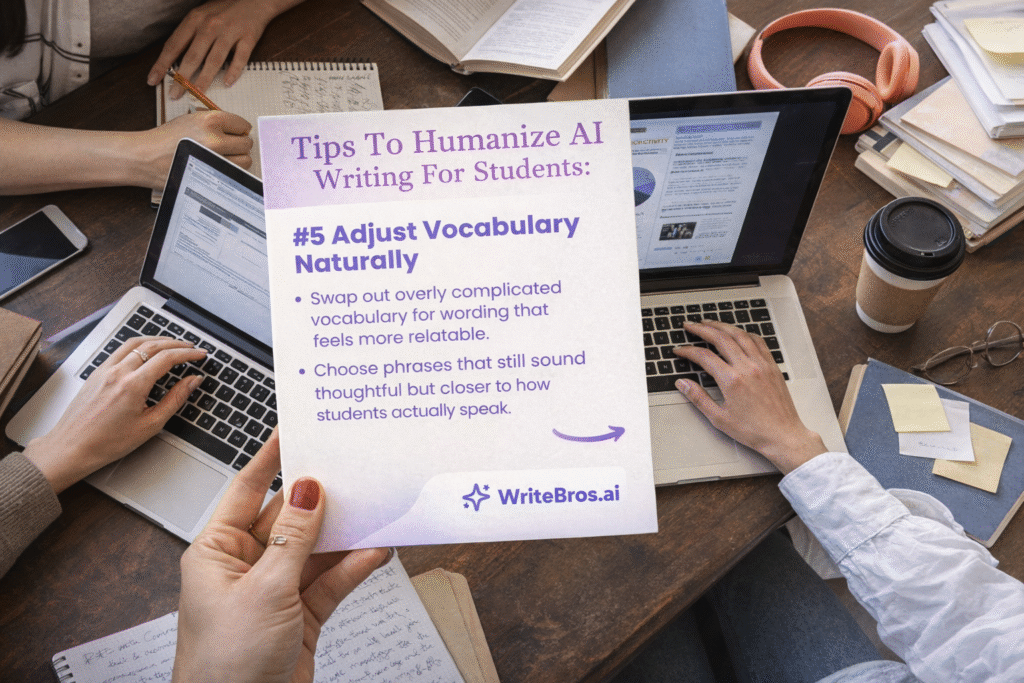
How to Humanize AI Writing for Students – Strategy #5: Adjust vocabulary naturally
AI systems often produce vocabulary that sounds academically correct yet slightly exaggerated compared with how students normally write. Humanizing the text requires reviewing those word choices and replacing the most formal expressions with alternatives that still sound thoughtful but closer to natural academic conversation. The overall tone remains intelligent while avoiding the polished uniformity that automated systems often create.
For example, a generated sentence might describe a topic using complex phrasing that feels more suited to a research paper than an undergraduate essay. Rewriting that sentence with simpler wording while keeping the same meaning can immediately make the paragraph feel more believable. The adjustment helps the text match the voice a student would realistically use while discussing the subject.
How to Humanize AI Writing for Students – Strategy #6: Introduce small imperfections
AI generated paragraphs often appear unusually balanced because every idea is explained with the same clarity and completeness. Introducing subtle variation in phrasing or explanation can help the writing feel more natural, allowing some ideas to be expressed briefly while others receive more detailed discussion. This unevenness reflects how real students organize thoughts when drafting assignments.
A paragraph explaining social media influence might begin with a concise observation and then expand into a longer explanation of the concept. The contrast between those sentences produces a rhythm that resembles genuine student reasoning rather than automated text generation. That slight irregularity removes the overly polished quality that detection systems sometimes identify.
How to Humanize AI Writing for Students – Strategy #7: Use concrete examples
AI writing frequently explains ideas in abstract terms because the system attempts to cover the topic broadly without anchoring it in specific situations. Students can humanize the text by inserting a short, relatable example that illustrates how the concept appears in real life or academic discussion. The explanation becomes easier to follow because readers can picture the idea instead of interpreting a general description.
Imagine a paragraph discussing marketing psychology that includes a brief reference to a familiar advertising campaign or classroom case study. The example connects theory with something tangible and transforms the paragraph into a reflection rather than a summary. That grounded perspective signals authentic engagement with the subject.
How to Humanize AI Writing for Students – Strategy #8: Rewrite paragraphs for flow
AI generated drafts sometimes organize information logically but not necessarily in the sequence a student would naturally develop while writing. Rearranging sentences so ideas unfold gradually can improve the flow and make the argument easier to follow. Instead of presenting conclusions too early, the paragraph allows the explanation to build naturally.
Consider moving a key insight toward the end of the paragraph after the supporting context has been introduced. This mirrors the way students often explain ideas while thinking through them step by step. The revised structure removes the overly tidy presentation that automated systems tend to produce.
How to Humanize AI Writing for Students – Strategy #9: Reduce repetitive wording
AI drafts often repeat the same phrasing throughout an essay because the system maintains consistency while explaining related points. Students can improve the natural quality of the text by identifying those repeated phrases and replacing them with varied wording that preserves meaning. The writing becomes more dynamic and less predictable.
For example, a paragraph discussing research findings might repeatedly use a phrase such as “This demonstrates that.” Revising several of those sentences with alternative phrasing introduces subtle variety that mirrors authentic writing habits. The paragraph feels less automated because the vocabulary evolves throughout the explanation.
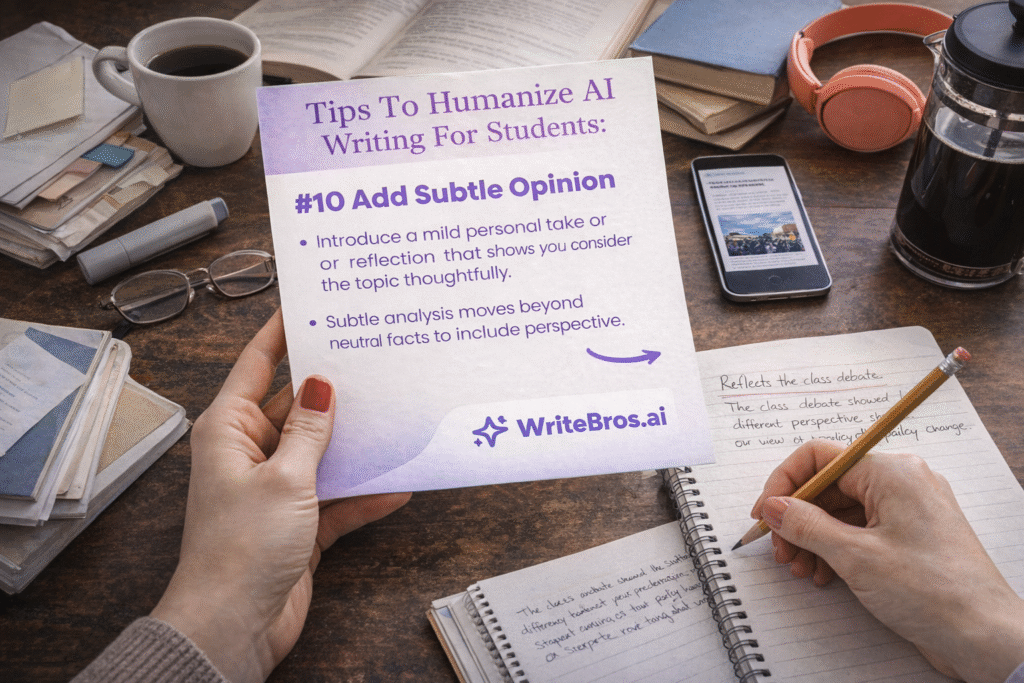
How to Humanize AI Writing for Students – Strategy #10: Add subtle opinion
Many AI generated explanations remain completely neutral, presenting information without acknowledging interpretation or reflection. Introducing a mild analytical perspective helps the writing sound more like a student engaging with the topic rather than summarizing facts. The key is keeping the observation balanced so the essay remains academically appropriate.
A paragraph about environmental policy might include a brief sentence reflecting on how the argument connects with a recent class debate. That small perspective shows that the writer is thinking through the material rather than repeating information. Readers begin to recognize the presence of an individual voice.
How to Humanize AI Writing for Students – Strategy #11: Integrate natural questions
Students often explore ideas through curiosity, which means their writing occasionally raises thoughtful questions before presenting conclusions. Adding one reflective question within a paragraph can help the text feel more exploratory and less rigidly structured than AI generated explanations. The technique introduces a sense of intellectual curiosity that readers recognize as human reasoning.
For instance, a discussion of technological change might briefly ask whether certain innovations genuinely improve everyday life or simply reshape existing habits. That moment of reflection breaks the predictable structure of the paragraph and encourages deeper consideration of the topic. The writing then reads like a student thinking through possibilities rather than summarizing research.
How to Humanize AI Writing for Students – Strategy #12: Mix short and long paragraphs
AI systems tend to produce paragraphs of very similar length because they distribute information evenly across the essay. Human writing rarely follows such symmetry, since some ideas require longer explanation while others can be expressed briefly. Adjusting paragraph length creates a more organic structure that resembles natural writing patterns.
A complex concept might require a longer paragraph that gradually develops the explanation through several examples. The next idea could appear in a shorter paragraph that quickly introduces a supporting observation. This variation removes the uniform block structure that automated drafts often produce.
How to Humanize AI Writing for Students – Strategy #13: Connect ideas more casually
AI writing frequently links arguments with transitions that sound perfectly structured but slightly detached from everyday language. Rewriting those connections so they resemble conversational academic reasoning helps the essay feel more authentic. The writing flows naturally as ideas evolve rather than appearing assembled from rigid sections.
Imagine revising a section where each paragraph begins with a formal transition that sounds overly deliberate. A more natural version might reference the previous idea briefly before continuing the discussion. The essay begins to resemble a thoughtful explanation rather than a carefully formatted outline.
How to Humanize AI Writing for Students – Strategy #14: Edit aloud for rhythm
Reading an AI generated draft aloud often reveals patterns that are difficult to notice when scanning the text silently. Sentences may sound unusually symmetrical or overly formal when spoken, which makes those sections easier to identify and revise. Listening to the rhythm of the writing helps students recognize moments where the tone feels mechanical.
During revision, a student might notice that several sentences follow the same cadence or begin with similar phrases. Adjusting those lines while hearing the paragraph spoken can produce a more natural rhythm. The final version reads smoothly and feels closer to authentic speech patterns.
How to Humanize AI Writing for Students – Strategy #15: Finalize with human revision
Even after multiple edits, AI generated drafts benefit from a final review that focuses entirely on voice and clarity. This stage allows students to examine the essay as a whole, ensuring that transitions feel natural and arguments unfold logically. The goal is to confirm that the text reflects genuine reasoning rather than automated phrasing.
A careful final read often reveals subtle issues such as repeated wording or sections that sound overly polished. Adjusting those areas completes the humanization process and ensures the assignment reads like original academic work. The finished essay maintains clarity while carrying the natural tone of student writing.
Common mistakes
- Students sometimes assume that running text through a single rewriting tool automatically solves the problem, which often leads to minimal edits that leave the original AI structure intact. This happens because the draft still follows predictable phrasing patterns and balanced sentence structures that detection systems recognize, meaning the final essay still reads as automated writing despite small vocabulary changes.
- Another common mistake appears when students only edit the introduction and conclusion while leaving the middle sections untouched. Those unchanged paragraphs continue to display the consistent rhythm and phrasing patterns typical of AI output, which can cause the entire assignment to feel inconsistent and ultimately undermine the effort to make the writing sound natural.
- Many students focus only on replacing individual words rather than revising sentence structure or paragraph organization. While vocabulary variation may slightly change the surface appearance of the text, the deeper structural patterns remain unchanged, which means the writing still follows the same predictable arrangement generated by AI systems.
- Some writers attempt to add complex vocabulary or academic phrases in order to make the text appear more sophisticated. This often backfires because the resulting language sounds exaggerated or unnatural for student writing, making the essay feel less authentic rather than more believable.
- Another mistake occurs when students insert unrelated examples or anecdotes that do not connect clearly with the main argument. Although the intention is to make the writing appear more human, the lack of relevance can make the essay seem disorganized and reduce the clarity of the overall explanation.
- Students occasionally forget to read the entire essay after editing individual sections. Without a final review, the text may contain uneven tone changes, repeated ideas, or awkward transitions that reveal how the writing was assembled rather than developed naturally.
Edge cases
Some assignments require extremely formal academic tone, particularly in research papers or advanced university courses. In these situations the goal is not to make the writing conversational but to remove the overly symmetrical structure that AI systems often generate while still maintaining scholarly clarity and discipline. Humanizing the text therefore focuses on improving flow, integrating thoughtful analysis, and slightly varying phrasing rather than dramatically changing tone.
Another edge case appears when students use AI primarily for outlining or brainstorming rather than full drafting. In these scenarios the writing already contains substantial human input, so the editing process focuses more on smoothing transitions and clarifying ideas rather than rewriting entire paragraphs. The result is a balanced workflow where AI supports organization while the student voice remains dominant.
Supporting tools
- Grammar and style checking tools help students identify repetitive phrasing, awkward sentence structures, and overly complex wording that might have originated from automated drafts. Reviewing these suggestions during editing allows writers to refine the text gradually while keeping their own voice intact.
- Paraphrasing tools designed for academic writing can assist in restructuring sentences that feel overly mechanical without changing the meaning of the original explanation. When used carefully, these tools help break predictable AI patterns and introduce natural variation in sentence construction.
- Readability analyzers highlight areas where sentences become too dense or overly formal for typical student assignments. Adjusting those sections improves clarity and ensures the writing matches the tone expected in coursework rather than sounding like a research report.
- Outline planning tools allow students to reorganize AI generated drafts into more natural argument progression before editing the language itself. Revising the structure first helps the essay develop ideas gradually instead of presenting them in the rigid sequence typical of automated output.
- Voice analysis tools examine rhythm, repetition, and sentence balance within a document so writers can identify passages that sound unusually uniform. Addressing those sections during revision improves the authenticity of the final text.
- WriteBros.ai helps refine AI generated drafts by restructuring sentences, adjusting tone, and improving the natural flow of writing so students can transform mechanical text into assignments that read clearly and authentically.
Ready to Transform Your AI Content?
Try WriteBros.ai and make your AI-generated content truly human.
Conclusion
Humanizing AI writing for students ultimately centers on transforming structured drafts into authentic academic explanations that reflect personal reasoning and classroom experience. Through thoughtful editing of sentence rhythm, vocabulary choices, paragraph flow, and contextual examples, students can turn automated outputs into assignments that read naturally while maintaining clarity and analytical depth.
The goal is not perfection but intention, since real writing evolves through revision, reflection, and gradual refinement of ideas. When students treat AI drafts as a starting point rather than a finished product, the final essay becomes a genuine expression of understanding rather than a predictable block of generated text.
Did You Know?
Students editing AI drafts usually hunt for “robotic” words, but instructors often pick up on the repeated shape of the writing before they notice any single phrase. If each paragraph opens with a clean claim, follows with two similarly paced explanations, and lands with the same neatly packaged takeaway, the result can feel statistically uniform, even when the content is accurate and the argument is your own.
Structure edits tend to help more than synonym swaps because student writing rarely keeps perfect consistency from section to section. Let one paragraph stay short and practical, let the next stretch with a longer clarification woven into the middle, and let another circle the idea briefly before landing it, since varied pacing is a normal result of real thinking and real revision.
Ready to Transform Your AI Content?