How to Make Content Pass AI Detectors: 15 Editorial Adjustments

2026 editorial insight: detection systems rely on probabilistic language patterns, meaning small stylistic edits can shift results. Research from the University of Maryland confirms detection relies on statistical text signals in its GLTR study , which explains why structural revisions matter.
How to Make Content Pass AI Detectors: 15 Practical Editorial Fixes
Many writers run strong drafts through AI scanners only to see them flagged despite careful work. The problem often traces back to subtle AI writing patterns that trigger detection even when the ideas and research are entirely original.
Detection systems rely on probability signals rather than true authorship verification, which means ordinary phrasing can sometimes resemble automated writing structures. This confusion explains why many people experiment with AI humanizer tools after their content receives unexpected AI scores.
Understanding how detectors evaluate text makes the editing process far easier and far less frustrating. Data from the GPTZero AI detection study results also shows that small editorial changes can significantly alter detection outcomes.
| # | Strategy focus | Practical takeaway |
|---|---|---|
| 1 | Sentence rhythm variation | Mix shorter and longer sentences to prevent repetitive cadence that detectors often flag as machine-like. |
| 2 | Natural transitions | Use subtle conversational transitions to create a more organic flow between ideas. |
| 3 | Context layering | Add clarifying details and contextual framing so sections read like human reasoning rather than compressed summaries. |
| 4 | Specific examples | Introduce grounded examples or scenarios that reflect real editorial thinking. |
| 5 | Paragraph asymmetry | Avoid identical paragraph structures and allow natural variation in length and pacing. |
| 6 | Idea sequencing | Reorder sentences where needed so explanations unfold more like human thought. |
| 7 | Soft qualifiers | Use occasional nuance or uncertainty to break rigid certainty patterns common in generated text. |
| 8 | Editorial voice cues | Introduce subtle tone shifts that resemble how editors guide readers through a concept. |
| 9 | Sentence compression control | Expand overly dense lines that compress too many ideas into a single structure. |
| 10 | Clause diversity | Blend simple and compound structures so paragraphs avoid predictable syntactic repetition. |
| 11 | Reasoning transparency | Explain the logic behind statements instead of presenting conclusions alone. |
| 12 | Structural irregularity | Let sections evolve naturally rather than repeating the same template throughout the draft. |
| 13 | Editorial framing | Frame insights the way an editor would when guiding readers through analysis. |
| 14 | Narrative continuity | Ensure paragraphs connect logically so the text reads as an unfolding explanation. |
| 15 | Revision layering | Run multiple editorial passes that refine tone, rhythm, and phrasing instead of relying on one edit. |
15 Practical Editorial Adjustments to Make Content Pass AI Detectors
How to Make Content Pass AI Detectors – Strategy #1: Sentence rhythm variation
One reliable way to make content pass AI detectors begins with adjusting sentence rhythm so the writing avoids predictable pacing that many automated systems associate with generated text. Many drafts unintentionally fall into repeating sentence lengths or mirrored phrasing structures, which can create patterns that statistical models interpret as artificial writing signals rather than natural editorial flow.
Writers who revise rhythm deliberately usually notice that small structural adjustments transform the way text reads to both humans and algorithms. Introducing a mix of shorter reflections, extended explanations, and transitional clarifications allows the paragraph to breathe and unfold more organically, which weakens the uniform patterns that detection tools frequently rely on when evaluating probability scores.
How to Make Content Pass AI Detectors – Strategy #2: Natural transitions
Another effective technique for learning how to make content pass AI detectors involves improving the way ideas transition from one sentence or paragraph to the next. Automated text frequently jumps between concepts in a mechanical progression, while human writing tends to guide the reader through reasoning with subtle connectors that explain why one thought leads naturally to another.
Adding phrases that clarify relationships between ideas helps create a sense of editorial direction rather than simple information stacking. When readers can follow the progression of thought through connective language that explains cause, contrast, or clarification, the structure begins to resemble natural analytical writing instead of the rigid sequencing that detection systems often flag.
How to Make Content Pass AI Detectors – Strategy #3: Context layering
Context layering plays an important role in learning how to make content pass AI detectors because purely summarized statements often resemble the compressed style used by language models. Expanding those statements with clarifying background, situational reasoning, or short narrative framing introduces the kind of contextual richness that typically appears in human editorial work.
When writers explain why a point matters or under what circumstances it applies, the text gains dimension that algorithmic writing frequently lacks. Detection systems evaluate probability distributions across phrases, so contextual expansion helps disrupt repetitive statistical patterns and replaces them with more varied, explanatory language that resembles thoughtful human analysis.
How to Make Content Pass AI Detectors – Strategy #4: Specific examples
Using grounded examples is another dependable method for writers studying how to make content pass AI detectors in real editorial environments. Generic descriptions frequently appear in automated writing because models summarize information broadly, while human writers naturally illustrate ideas through situations, observations, or explanatory comparisons.
Introducing concrete scenarios changes the language distribution within the paragraph and encourages more natural phrasing that emerges during explanation. When a writer walks readers through a believable situation, such as describing how a paragraph revision altered detection results during testing, the writing gains the texture of lived reasoning rather than abstract summarization.
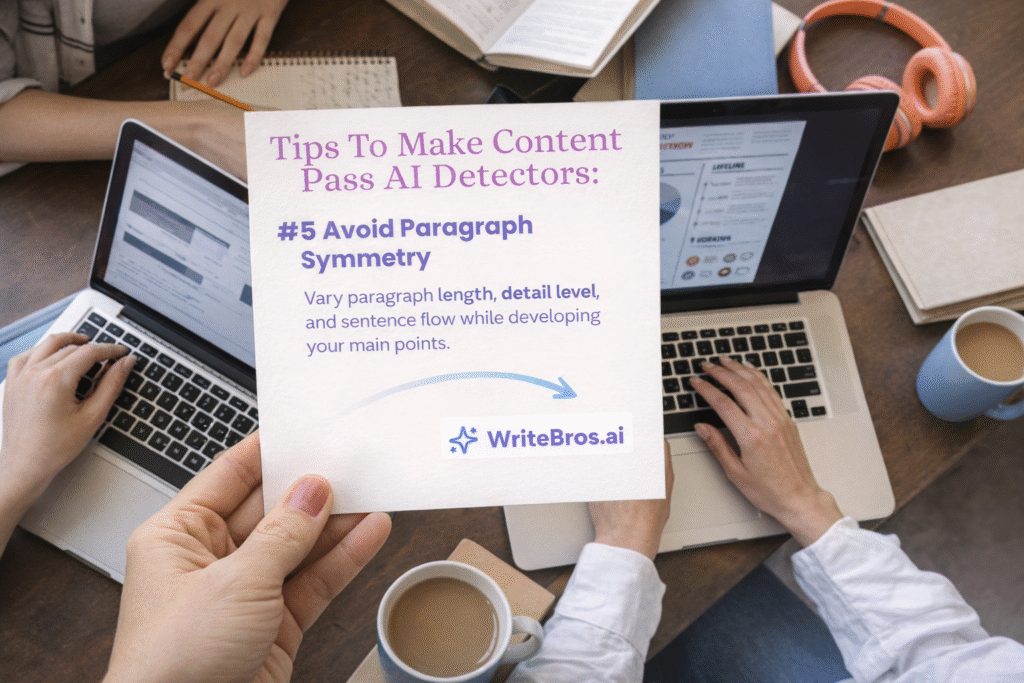
How to Make Content Pass AI Detectors – Strategy #5: Paragraph asymmetry
Paragraph asymmetry refers to intentionally allowing paragraphs to vary in size, pacing, and structural composition when refining how to make content pass AI detectors. Generated drafts often follow extremely consistent paragraph lengths because models produce balanced blocks of text that repeat similar sentence counts and informational density.
Human writing rarely maintains that level of structural symmetry across long passages, especially during analytical explanation. Allowing one paragraph to explore context more deeply while another focuses on interpretation introduces variation that mirrors authentic editorial thinking, which in turn reduces the statistical regularity that detection systems sometimes associate with automated writing.
How to Make Content Pass AI Detectors – Strategy #6: Idea sequencing
Learning how to make content pass AI detectors also requires examining the order in which ideas appear inside each paragraph. AI-generated drafts frequently present information in a rigidly logical sequence that feels compressed and overly tidy, whereas human reasoning tends to unfold through clarification, reconsideration, and gradual explanation.
Rearranging sentences so that explanation builds naturally can dramatically improve how the text is interpreted by detection systems. When a paragraph begins with observation, expands through interpretation, and then finishes with a reflective insight, the progression mirrors the way people typically construct arguments while thinking through complex ideas.
How to Make Content Pass AI Detectors – Strategy #7: Soft qualifiers
Soft qualifiers are subtle language cues that introduce nuance into a statement, and they can significantly improve efforts to make content pass AI detectors. Generated writing frequently expresses ideas with confident certainty, which creates an unusually consistent tone that statistical detectors sometimes identify as algorithmic language patterns.
Introducing thoughtful nuance through measured phrasing reflects the natural uncertainty present in analytical thinking. When a writer acknowledges limitations, possibilities, or contextual conditions around a statement, the paragraph begins to resemble reflective editorial reasoning rather than rigid informational output.
How to Make Content Pass AI Detectors – Strategy #8: Editorial voice cues
Developing editorial voice cues can greatly influence how successfully a draft makes content pass AI detectors during evaluation. Human writers often guide readers through material using tonal signals that indicate reflection, interpretation, or emphasis, whereas generated writing sometimes remains tonally neutral throughout long sections.
Adding subtle voice elements such as reflective commentary or explanatory framing introduces natural variation into the writing. These cues simulate the presence of an editor actively shaping the narrative, which helps break the monotone linguistic patterns that automated systems sometimes rely on when assessing whether text appears machine produced.
How to Make Content Pass AI Detectors – Strategy #9: Sentence compression control
Sentence compression occurs when several ideas are condensed into tightly structured lines that resemble the summarization patterns frequently produced by language models. Writers refining how to make content pass AI detectors benefit from identifying these compressed sentences and expanding them into more naturally paced explanations.
Expanding compressed statements allows the reasoning to unfold gradually instead of appearing as dense informational bundles. This revision style introduces varied clause structures and additional context, which reduces the probability patterns that detectors sometimes interpret as indicators of automated writing.
How to Make Content Pass AI Detectors – Strategy #10: Clause diversity
Clause diversity plays a subtle yet meaningful role in efforts to make content pass AI detectors because repetitive grammatical structures can create detectable statistical signals. Many automated drafts rely heavily on similar sentence constructions, particularly compound structures that repeat predictable conjunction patterns.
Varying clause types introduces syntactic diversity that resembles natural speech and editorial explanation. When a paragraph blends descriptive phrases, reflective clauses, and explanatory segments, the resulting language distribution becomes more irregular, which weakens the predictable structural patterns detection systems are trained to identify.

How to Make Content Pass AI Detectors – Strategy #11: Reasoning transparency
Reasoning transparency refers to explaining the logic behind statements rather than presenting conclusions alone, which is a powerful method for writers learning how to make content pass AI detectors. Generated text often delivers polished conclusions without exposing the reasoning steps that led to those conclusions.
When writers articulate the thought process that connects evidence to interpretation, the writing begins to resemble authentic analytical dialogue. This transparency introduces natural phrasing variations and contextual detail, which disrupts the highly compressed reasoning patterns that automated text sometimes produces.
How to Make Content Pass AI Detectors – Strategy #12: Structural irregularity
Structural irregularity is another valuable editorial principle for anyone attempting to make content pass AI detectors during final revisions. Many generated drafts follow predictable organizational templates where each paragraph mirrors the same internal structure and informational pacing.
Allowing the structure to evolve naturally across sections helps replicate the organic development found in human writing. Some paragraphs might explore background context, others may present interpretation or reflection, and that variation prevents the rigid structural symmetry that detection tools sometimes identify.
How to Make Content Pass AI Detectors – Strategy #13: Editorial framing
Editorial framing helps writers guide readers through complex information in a way that resembles professional commentary rather than automated explanation. This technique supports the broader goal of learning how to make content pass AI detectors because it introduces interpretive voice and narrative direction.
When information is framed through explanation that clarifies significance, the writing develops a sense of perspective. Readers feel that an editor is actively interpreting the material rather than simply listing information, which reduces the mechanical tone that detection systems often associate with generated content.
How to Make Content Pass AI Detectors – Strategy #14: Narrative continuity
Narrative continuity ensures that each paragraph builds logically upon the previous one while guiding readers through a coherent progression of ideas. Writers working on how to make content pass AI detectors frequently discover that abrupt topic transitions can create unnatural patterns within detection algorithms.
Strengthening the connections between sections allows the text to develop as a flowing explanation rather than a sequence of isolated information blocks. This continuity encourages varied phrasing and natural conceptual bridges, which helps weaken the rigid segmentation patterns sometimes found in automated writing.
How to Make Content Pass AI Detectors – Strategy #15: Revision layering
Revision layering is often the final step for writers seeking to consistently make content pass AI detectors across multiple tools. Instead of relying on a single editing pass, effective revisions occur through several stages that focus on rhythm, clarity, reasoning, and stylistic nuance.
Each revision layer introduces additional natural variation into the text, gradually replacing predictable phrasing patterns with more human editorial characteristics. Over time the document develops the irregular cadence, contextual richness, and explanatory depth that naturally appear in thoughtful human writing.
Common mistakes
- Overediting text to remove every trace of AI structure can sometimes create writing that feels artificially complex and unnatural, which ironically introduces new statistical anomalies that detectors interpret as suspicious patterns rather than authentic human language.
- Relying entirely on automated rewriting tools without reviewing the output carefully often leads to paragraphs that still maintain the same structural rhythm as the original draft, leaving many of the detectable probability patterns unchanged.
- Attempting to trick detection systems through aggressive synonym replacement usually produces awkward phrasing that disrupts readability and signals unnatural vocabulary usage, which can raise additional red flags during evaluation.
- Ignoring paragraph structure while focusing only on sentence-level edits leaves deeper statistical patterns untouched, since many detectors analyze broader linguistic distributions that extend across entire paragraphs and sections.
- Publishing content immediately after generation without a thoughtful editorial review often results in predictable patterns that remain embedded in the text, especially when drafts follow uniform sentence structures throughout the article.
- Assuming that a single successful detector result guarantees universal success can be misleading, since different platforms analyze language patterns differently and may flag text that passed another system.
Edge cases
Some forms of writing naturally resemble patterns that detection tools associate with automated text, even when the content is entirely original. Technical documentation, instructional guides, and highly structured academic writing frequently use consistent phrasing patterns that statistical systems may misinterpret as generated language.
In these situations the goal should not be to dramatically change the tone or purpose of the writing but to introduce subtle human elements that maintain clarity while reducing repetitive structures. Small contextual expansions, reflective explanations, or examples can help preserve the integrity of the information while improving detection outcomes.
Supporting tools
- Language editing platforms can help writers identify repetitive sentence structures that unintentionally create detectable patterns. These tools highlight structural similarities across paragraphs so editors can introduce rhythm variation and contextual expansion during revision.
- Readability analysis tools offer insight into sentence length variation, clause distribution, and paragraph pacing. Reviewing these metrics can help writers identify sections that appear overly uniform, which is often a characteristic associated with generated text.
- Grammar review software helps refine sentence flow while preserving clarity and tone. Careful grammar adjustments can reduce rigid phrasing patterns and replace them with more natural linguistic variation.
- Plagiarism and originality checkers help confirm that the ideas and language remain unique during revision. Maintaining originality strengthens the credibility of the text and supports editorial authenticity.
- Content analysis platforms evaluate stylistic consistency and highlight sections that appear overly mechanical or compressed. These insights allow writers to expand reasoning and introduce narrative context.
- WriteBros.ai offers editorial rewriting and structural refinement tools that help reshape generated drafts into more natural writing patterns, focusing on rhythm variation, contextual layering, and narrative flow rather than simple word substitution.
Ready to Transform Your AI Content?
Try WriteBros.ai and make your AI-generated content truly human.
Conclusion
Understanding how to make content pass AI detectors is less about manipulating algorithms and more about refining the natural characteristics of thoughtful writing. When sentences vary in rhythm, ideas unfold through explanation, and examples add contextual depth, the text begins to reflect authentic editorial reasoning rather than compressed automated output.
The goal is not perfection or rigid formula but intentional editing that allows the writer’s reasoning to appear clearly on the page. When revisions emphasize clarity, narrative continuity, and genuine explanation, the writing develops the natural irregularities that both readers and detection systems recognize as human expression.
Did You Know?
Writers trying to make content pass AI detectors usually hunt for robotic wording, but many tools respond to the repeated “shape” of your paragraphs more than the exact vocabulary. If each section starts with a tidy thesis, follows with two evenly paced explanations, and ends with the same neat takeaway line, the rhythm can resemble machine output even when the content is accurate and genuinely authored.
Revising structure tends to help more than swapping synonyms because human writing rarely keeps perfect consistency from paragraph to paragraph. Allow one paragraph to stay short and practical, let the next stretch with a longer clarification woven into the middle, and let another circle the idea before landing it, since varied pacing is a normal result of real thinking and real editorial work.
Ready to Transform Your AI Content?