How to Make Text Pass GPTZero: 15 Editorial Improvements
In 2026, detection scrutiny is tighter than ever. This guide breaks down how to make text pass GPTZero through editorial refinement, grounded in findings like those in the Stanford study on large language models published in Nature , which examines identifiable AI patterns in generated text.
How to Make Text Pass GPTZero: 15 Editorial Improvements
You run your draft through a detector, and suddenly your own writing looks suspicious. If you are trying to figure out how to make text pass GPTZero without stripping out your voice, you are not alone.
Part of the confusion comes from why AI detectors disagree in the first place, even when they scan the exact same paragraph. Add in inconsistent scoring models and automated pattern checks, and it becomes harder to know whether you should revise structure, tone, or something else entirely.
That is why it helps to look at both rewriting techniques and tool data, from best AI humanizer tools for GPTZero review insights to real Turnitin AI detection performance data. Below, you will find 15 practical editorial improvements that focus on clarity, rhythm, and authenticity rather than gimmicks.
| # | Strategy focus | Practical takeaway |
|---|---|---|
| 1 | Sentence rhythm | Vary length and cadence so the writing feels less mechanical and more natural. |
| 2 | Specific detail | Replace vague claims with concrete examples that sound lived-in. |
| 3 | Structural breaks | Use natural transitions instead of formulaic connectors. |
| 4 | Voice ownership | Adjust tone so it reflects a clear perspective rather than neutral filler. |
| 5 | Predictable phrasing | Swap out overused patterns for more direct language. |
| 6 | Paragraph flow | Build ideas gradually so each section feels intentional. |
| 7 | Context layering | Add nuance instead of stacking generic explanations. |
| 8 | Editorial trimming | Cut redundant lines that inflate similarity signals. |
| 9 | Original framing | Introduce angles that reflect your thinking, not templated summaries. |
| 10 | Data grounding | Reference performance insights to guide revisions with evidence. |
| 11 | Sentence openings | Avoid repetitive starters that signal pattern generation. |
| 12 | Balanced complexity | Blend simple and layered sentences for a more human pace. |
| 13 | Intentional imperfections | Allow natural phrasing quirks instead of polishing every edge flat. |
| 14 | Manual revision | Edit thoughtfully instead of relying on automated rewrites alone. |
| 15 | Final calibration | Run iterative checks and refine only what genuinely reads unnatural. |
15 Editorial Improvements to Make Text Pass GPTZero
How to Make Text Pass GPTZero – Strategy #1: Refine sentence rhythm
When you focus on how to make text pass GPTZero, one of the first adjustments to examine is sentence rhythm, because predictable cadence often triggers detection patterns more than individual word choice. Drafts that rely on evenly sized sentences, arranged in tidy clusters, can read as mechanically generated even if the ideas are original and thoughtful. Varying sentence length, weaving shorter clauses into longer constructions, and allowing natural pauses through commas and transitions creates movement that mirrors how people genuinely think and write.
This works because human writing rarely maintains perfect balance from line to line, and subtle irregularity signals authorship rather than automation. Imagine a section where every sentence runs fifteen words long, each one structured subject-verb-object without deviation, which quietly accumulates a detectable pattern. Introducing layered phrases, clarifying asides, and occasional shifts in pacing disrupts that uniformity and helps the text feel considered rather than manufactured.
How to Make Text Pass GPTZero – Strategy #2: Add concrete specificity
If you are serious about how to make text pass GPTZero, you need to replace abstract generalities with grounded details that reflect lived context. Broad statements such as “this improves quality” or “writers should revise carefully” resemble templated language because they lack texture and situational framing. By inserting specific scenarios, measurable constraints, or realistic examples drawn from experience, you give the detector fewer generic patterns to flag.
Specificity works because it introduces variability that generic summaries tend to avoid, which in turn reduces similarity to common training outputs. Consider how different a paragraph feels when it references a particular draft, a late-night revision session, or a concrete editorial dilemma rather than vague advice. Those details do not merely decorate the writing, they anchor it in a context that feels distinctly human and far less formulaic.
How to Make Text Pass GPTZero – Strategy #3: Rework structural transitions
Understanding how to make text pass GPTZero also means reconsidering the way ideas connect from one paragraph to the next, since overly tidy transitions often resemble automated scaffolding. Phrases like “in conclusion” or “moreover” repeated in predictable intervals can form patterns that appear algorithmic rather than organic. Instead, allow transitions to emerge from the logic of the argument itself, letting one idea naturally imply the next without announcing the shift in a rigid way.
This approach works because authentic writing frequently relies on implicit connections rather than explicit signposting at every turn. When a paragraph subtly builds on a previous claim through nuance or contrast, it feels like a continuation of thought instead of a template slot being filled. That fluid progression reduces mechanical signals and strengthens coherence at the same time.
How to Make Text Pass GPTZero – Strategy #4: Clarify personal perspective
A key element in how to make text pass GPTZero lies in demonstrating a clear point of view, since neutral and detached exposition often resembles large language model output. Text that hovers at a distance, summarizing ideas without committing to interpretation, can appear statistically balanced in a way that detectors associate with AI. Introducing measured perspective, even in analytical writing, signals authorship through judgment and prioritization.
This does not require dramatic opinions, but it does involve subtle positioning that shows why certain points matter more than others. For example, explaining why one revision technique proved more reliable in practice than a competing method introduces evaluation rather than mere description. That evaluative layer complicates the pattern profile of the text and aligns it more closely with human reasoning.
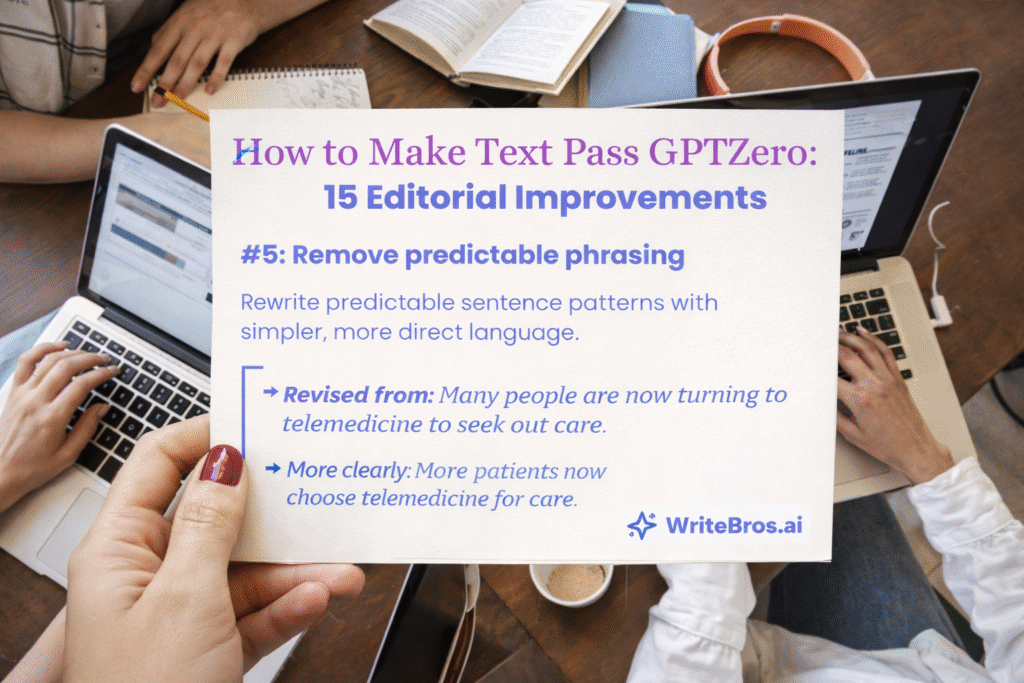
How to Make Text Pass GPTZero – Strategy #5: Remove predictable phrasing
Another practical step in how to make text pass GPTZero involves scanning for predictable phrasing that frequently appears in automated outputs. Expressions that sound polished yet interchangeable, especially those that summarize without depth, can accumulate into a recognizable pattern. Rewriting these sections with simpler language, or restructuring them entirely, reduces repetition and restores authenticity.
This works because detectors often rely on probabilistic familiarity, identifying sequences that statistically resemble machine-generated text. When you replace stock phrases with wording that reflects your own cadence and decision-making process, you introduce variability that is harder to classify. The goal is not to sound unusual for its own sake, but to sound genuinely intentional.
How to Make Text Pass GPTZero – Strategy #6: Deepen paragraph development
Exploring how to make text pass GPTZero requires attention to paragraph development, since shallow blocks of text often resemble automated summaries. When each paragraph presents a claim and immediately moves on without elaboration, the writing can feel compressed and pattern-driven. Expanding ideas with layered explanation, contextual clarification, and nuanced extension makes the structure less uniform and more reflective of genuine thought.
This depth signals human drafting because people tend to circle ideas, refine them, and add perspective as they go. A paragraph that introduces a concept, complicates it, and then resolves it mirrors real cognitive movement rather than scripted output. That internal progression reduces the appearance of formulaic construction.
How to Make Text Pass GPTZero – Strategy #7: Layer contextual nuance
When considering how to make text pass GPTZero, contextual nuance becomes essential because flat explanations often mirror training data summaries. Text that acknowledges limitations, counterpoints, or situational boundaries demonstrates awareness beyond surface description. Adding these clarifications increases dimensionality and disrupts overly neat narrative arcs.
Nuance works because it introduces tension and qualification, which are hallmarks of human reasoning rather than statistical averaging. For instance, noting when a strategy may fail or require adjustment prevents the text from sounding universally optimized. That subtle imperfection enhances credibility and lowers detection risk simultaneously.
How to Make Text Pass GPTZero – Strategy #8: Trim redundancy thoughtfully
Part of learning how to make text pass GPTZero involves identifying and trimming redundancy that inflates similarity signals. Repetition of ideas in slightly altered wording can resemble algorithmic paraphrasing, especially when it follows a predictable pattern. Careful editing that removes excess reinforcement keeps the prose focused and less repetitive.
Thoughtful trimming does not mean stripping out depth, but rather consolidating overlapping sentences into clearer, singular expressions. When each line advances the argument instead of echoing it, the writing feels sharper and more deliberate. That precision reduces statistical repetition without sacrificing clarity.
How to Make Text Pass GPTZero – Strategy #9: Reframe common angles
If you want to understand how to make text pass GPTZero, consider reframing common angles instead of repeating widely circulated advice. Standard explanations that mirror countless online guides increase the likelihood of similarity matches. Introducing a distinct framing, even on familiar topics, changes the structural fingerprint of the text.
This reframing might involve focusing on process rather than outcome, or exploring tradeoffs instead of benefits. Those shifts in emphasis generate fresh combinations of ideas that are less likely to align with known templates. As a result, the writing gains originality in both substance and structure.
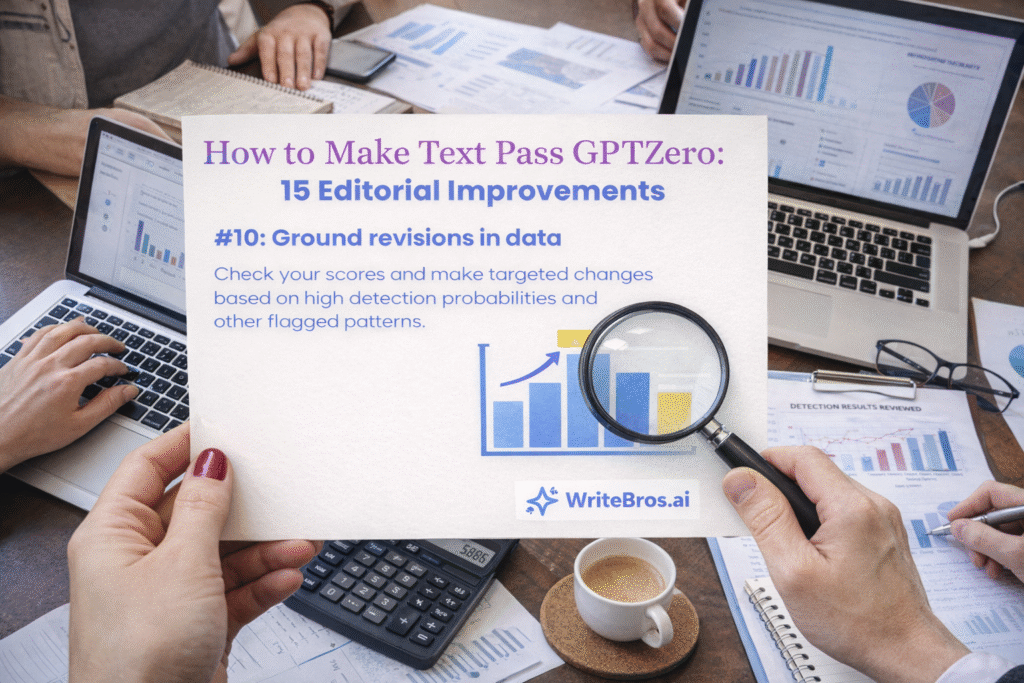
How to Make Text Pass GPTZero – Strategy #10: Ground revisions in data
An overlooked component of how to make text pass GPTZero is grounding revisions in observable patterns rather than intuition alone. Reviewing detection feedback and identifying where scores spike provides a practical starting point for improvement. This evidence-based method keeps changes targeted instead of arbitrary.
When you adjust sentences that consistently trigger higher probabilities, you move beyond guesswork and toward measurable refinement. That targeted editing reduces unnecessary rewriting and preserves authentic voice. Over time, this calibrated approach builds drafts that are both stronger and less likely to be misclassified.
How to Make Text Pass GPTZero – Strategy #11: Vary sentence openings
Anyone studying how to make text pass GPTZero should examine sentence openings, since repetitive starters create recognizable patterns. Beginning multiple sentences with the same structure, such as identical transitional phrases or pronoun-led clauses, introduces uniformity that detectors can flag. Shifting openings to include dependent clauses, contextual frames, or descriptive setups introduces diversity in construction.
This variation reflects the uneven rhythm of real drafting, where ideas unfold in flexible order rather than strict repetition. A paragraph that alternates between narrative framing and analytical commentary feels less templated. That structural diversity subtly reshapes the statistical profile of the text.
How to Make Text Pass GPTZero – Strategy #12: Balance complexity levels
In the process of learning how to make text pass GPTZero, balancing complexity levels across sentences becomes increasingly important. Text composed entirely of long, intricate sentences can appear optimized, while exclusively short lines may feel artificially simplified. Blending layered explanations with clearer, more direct statements creates a more natural progression.
This balance mirrors how writers alternate between unpacking ideas and summarizing them. Readers benefit from that modulation, and detectors encounter less uniformity in sentence structure. The result is prose that feels fluid rather than engineered.
How to Make Text Pass GPTZero – Strategy #13: Allow natural irregularities
Understanding how to make text pass GPTZero includes recognizing that minor irregularities often enhance authenticity. Perfectly polished paragraphs with seamless symmetry can resemble optimized output rather than evolving drafts. Allowing subtle asymmetry in phrasing or emphasis introduces a trace of human variability.
This does not mean embracing errors, but rather resisting the urge to flatten every distinctive turn of phrase. When writing retains slight unpredictability, it communicates individuality. That individuality reduces alignment with common generation patterns.
How to Make Text Pass GPTZero – Strategy #14: Prioritize manual revision
A dependable tactic in how to make text pass GPTZero is prioritizing manual revision over automated rewriting loops. Relying exclusively on tools to paraphrase flagged sections can create new patterns that remain detectable. Reading aloud, restructuring arguments, and rethinking emphasis produces more authentic change.
Manual revision encourages deeper engagement with meaning rather than surface substitution. When you rewrite a section with intention, the resulting phrasing reflects your reasoning process. That cognitive imprint distinguishes the text from purely statistical recombination.
How to Make Text Pass GPTZero – Strategy #15: Calibrate with iterative checks
The final layer in how to make text pass GPTZero involves iterative calibration rather than a single pass through a detector. Checking a draft, revising selectively, and reassessing allows you to observe patterns in how changes affect probability scores. This cyclical method refines the text without overcorrecting it.
Iteration works because it isolates which adjustments genuinely influence classification outcomes. Instead of rewriting entire sections impulsively, you make measured edits grounded in feedback. That restraint preserves voice while steadily reducing risk signals.
Common mistakes
- Overcorrecting every sentence after a single high score, which often leads to awkward phrasing and diluted meaning, because writers react to fear rather than analyzing which specific structural patterns triggered the detection in the first place.
- Relying entirely on automated rewriters to paraphrase flagged sections, creating layered paraphrases that still follow predictable statistical structures and therefore remain vulnerable to detection.
- Stripping out all personality in an attempt to sound neutral and safe, which ironically increases similarity to generic training data and reduces the individuality detectors look for.
- Ignoring paragraph-level patterns and focusing only on individual sentences, even though structural repetition across sections frequently contributes more to classification signals than isolated wording.
- Repeating common advice found in multiple online guides without reframing or contextualizing it, which raises similarity risk through thematic duplication rather than exact phrasing.
- Making sweeping changes without rechecking incrementally, leading to unnecessary rewrites that complicate the draft without meaningfully lowering detection probability.
Edge cases
Some highly technical or formula-driven writing may register elevated scores simply because it follows strict conventions, such as standardized definitions or regulatory language that cannot be significantly altered. In those cases, improving clarity and documentation of sources can help contextualize similarity without distorting required phrasing.
Additionally, very short texts sometimes produce unstable probabilities, since limited content gives detectors fewer signals to evaluate. Expanding explanations thoughtfully, rather than compressing them, can stabilize results and reduce misclassification.
Supporting tools
- Detection dashboards that visualize probability scores across sections, helping you identify whether issues cluster around specific paragraphs or structural patterns rather than random wording.
- Readability analyzers that measure sentence length variation and structural complexity, offering insight into rhythm and pacing adjustments that may influence classification outcomes.
- Version comparison tools that highlight line-by-line changes, allowing you to observe whether revisions meaningfully alter structure instead of merely swapping synonyms.
- Outline mapping software that displays argument flow visually, which can reveal repetitive transitions or overly symmetrical section design.
- Data logs that track detection results across drafts, helping you recognize trends and avoid overreacting to isolated fluctuations.
- WriteBros.ai, which supports structured editorial refinement by focusing on clarity, rhythm, and perspective rather than superficial paraphrasing.
Ready to Transform Your AI Content?
Try WriteBros.ai and make your AI-generated content truly human.
Conclusion
Learning how to make text pass GPTZero ultimately centers on improving the writing itself rather than gaming a system. When rhythm, specificity, perspective, and structure align naturally, detection scores tend to follow without extreme intervention.
Perfection is not the objective, and overcorrection can undermine clarity as easily as underediting. Intentional revision, grounded in observation and restraint, produces work that stands on its own merit regardless of automated classification.
Did You Know?
If you are trying to make text pass GPTZero, focusing strictly on vocabulary swaps can miss what the system is really reacting to, since the score is strongly influenced by how consistent your sentence patterns remain from the opening line to the last paragraph. A draft can be entirely yours and still read as “machine-like” when it maintains identical rhythm, similar clause balance, and evenly sized paragraphs that never change pace based on what is actually difficult to explain. That steady sameness is easy for an algorithm to quantify, even though a human reader might simply interpret it as tidy writing and never notice the pattern.
Revisions that add context, deepen explanation, and let your reasoning evolve inside a paragraph often matter more, because real writing commonly includes small course corrections, clarifying phrases, and emphasis that changes depending on the point you are making at that moment. Think of the difference between a draft that cleanly states three points in the same structure every time, and a draft that lingers on one tricky idea while moving faster through a simpler one, since that unevenness mirrors how people actually compose under real constraints. When your text reflects a natural drafting process rather than a perfectly smoothed output, the statistical signals often begin to align more closely with human writing.
Ready to Transform Your AI Content?