How to Reduce Copyleaks AI Percentage: 15 Revision Methods

Writers looking to lower AI detection scores can apply structured revision methods that disrupt predictable language patterns, a concern echoed in research on automated text classification published in Nature Machine Intelligence , which highlights how statistical regularities influence model outputs.
How to Reduce Copyleaks AI Percentage: 15 Practical Revision Methods
If you are trying to figure out how to reduce Copyleaks AI percentage, you have likely watched your draft get flagged higher than expected. That spike can feel frustrating, especially after reviewing AI detection accuracy benchmarks that suggest your writing should fall within a safer range.
The issue often comes down to structure, repetition, and predictable phrasing patterns that detection models recognize quickly. Even after testing different tools and reading a best AI humanizer tools for Copyleaks review, small mechanical signals in your sentences can still push the percentage upward.
Performance metrics also vary depending on tone, format, and subject matter, which is clear when reviewing Copyleaks AI detection performance statistics. This guide walks through fifteen revision methods you can apply immediately so your draft reads more naturally and scores lower without changing your core message.
| # | Strategy focus | Practical takeaway |
|---|---|---|
| 1 | Sentence length variation | Break predictable rhythm patterns so your draft feels less mechanically generated. |
| 2 | Structural reshaping | Reorder ideas and adjust flow to reduce formulaic paragraph sequencing. |
| 3 | Contextual specificity | Add concrete details that make the writing feel grounded rather than abstract. |
| 4 | Reduced repetition | Eliminate recurring phrasing that signals automated drafting. |
| 5 | Natural transitions | Replace robotic connectors with conversational bridges. |
| 6 | Voice adjustments | Shift between active and passive structures to disrupt uniform tone. |
| 7 | Precision edits | Tighten vague language to improve authenticity signals. |
| 8 | Paragraph pacing | Adjust paragraph density so sections feel less uniformly generated. |
| 9 | Data integration | Blend statistics naturally into prose instead of stacking them mechanically. |
| 10 | Personal nuance | Introduce subtle opinion or interpretation to reduce generic tone. |
| 11 | Lexical diversity | Expand vocabulary range to avoid repeated word clusters. |
| 12 | Tone recalibration | Soften overly polished phrasing so it sounds less algorithmic. |
| 13 | Idea compression | Remove filler explanations that inflate pattern recognition signals. |
| 14 | Logical reshuffling | Change sequencing of supporting points to avoid template flow. |
| 15 | Final manual review | Read aloud and refine cadence to catch residual mechanical phrasing. |
15 Practical Methods to Reduce Copyleaks AI Percentage
How to Reduce Copyleaks AI Percentage – Strategy #1: Sentence length variation
One of the most reliable ways to reduce Copyleaks AI percentage is to intentionally vary your sentence length so the rhythm of your writing no longer follows a predictable, evenly spaced pattern that automated systems can easily cluster. Instead of stacking medium-length sentences in a uniform cadence, combine longer explanatory lines with shorter clarifications and occasional compound constructions that feel organic rather than mechanically balanced. When you review your draft, look for sections where every sentence appears structurally similar and deliberately adjust the pacing so the flow mirrors natural human thinking rather than statistical symmetry.
This works because detection systems often measure consistency in syntax depth and clause structure, and a highly uniform rhythm can elevate probability scores even when the content itself is sound. For example, if three consecutive sentences follow a subject-verb-object pattern with similar word counts, rewriting one into a layered sentence with a dependent clause can subtly disrupt the detectable pattern without changing meaning. The key is moderation, since erratic variation can appear forced, so aim for thoughtful contrast rather than chaotic restructuring.
How to Reduce Copyleaks AI Percentage – Strategy #2: Structural reshaping
Another effective method to reduce Copyleaks AI percentage involves reshaping the structure of your paragraphs so that ideas unfold in a less formulaic sequence than typical AI-generated drafts. Instead of presenting a claim followed by a predictable explanation and then a summary, consider weaving context into the opening line and allowing your reasoning to develop gradually through layered commentary. When paragraphs feel templated, shifting the order of explanation and interpretation can significantly alter how detection models classify the text.
Structural reshaping works because pattern recognition tools evaluate not only wording but also organizational logic across multiple sentences. If every paragraph mirrors the same introduction-body-conclusion format, the repetition becomes statistically visible, even when vocabulary changes. By reordering supporting details or integrating examples earlier in the discussion, you create structural diversity that reads more like authentic editorial reasoning than a standardized output.
How to Reduce Copyleaks AI Percentage – Strategy #3: Contextual specificity
Adding contextual specificity is a powerful way to reduce Copyleaks AI percentage because generic phrasing tends to resemble large-scale language model outputs trained on broad, non-specific data. When you replace abstract statements with concrete scenarios, defined constraints, or situational qualifiers, the text gains dimensionality that feels less algorithmic and more experience-driven. Rather than writing in sweeping generalities, embed subtle details that clarify scope and perspective without drifting into unnecessary length.
This approach works because detection systems often associate vague generalizations with automated drafting patterns, especially when those generalizations appear repeatedly across a document. For instance, substituting a broad claim about writing improvement with a description of how an editor revised a technical paragraph introduces nuance that models struggle to categorize as templated. Specificity signals individual reasoning, which lowers the probability that the text is statistically aligned with mass-generated phrasing.
How to Reduce Copyleaks AI Percentage – Strategy #4: Reduced repetition
To reduce Copyleaks AI percentage effectively, you must identify and eliminate subtle repetition that accumulates across your draft, particularly repeated phrases that seem harmless in isolation but become conspicuous when viewed collectively. AI-generated content often recycles transitional language and similar clause structures, which can raise detection scores even if the topic evolves logically. During revision, scan for recurring expressions and replace them with alternative constructions that preserve clarity while altering surface patterns.
This strategy works because detection algorithms evaluate frequency distribution of phrases and semantic clusters over the entire document. When the same connector or descriptive structure appears multiple times within short proximity, the repetition strengthens pattern recognition signals. Diversifying phrasing and adjusting sentence architecture diffuses those signals, creating a more varied linguistic footprint that aligns more closely with human drafting habits.
How to Reduce Copyleaks AI Percentage – Strategy #5: Natural transitions
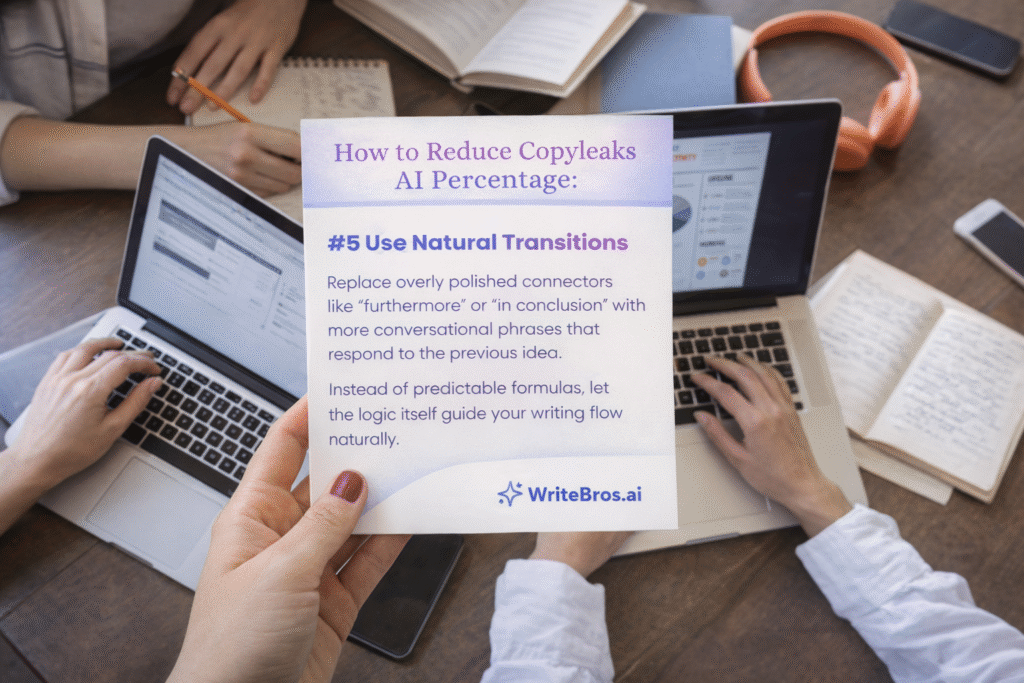
Natural transitions play a significant role in efforts to reduce Copyleaks AI percentage because overly polished connectors can resemble automated sequencing rather than spontaneous reasoning. Instead of relying on predictable bridge phrases, allow transitions to emerge from the logic of the argument itself, using contextual cues that feel conversational rather than formulaic. When transitions are woven into the substance of the paragraph, they appear less like structural placeholders and more like genuine thought progression.
This works because detection tools often flag uniform transition patterns that repeat across multiple sections of a document. If each paragraph begins with a similar connective phrase, the statistical regularity contributes to higher probability scores. Rewriting transitions so they respond directly to the preceding idea disrupts that repetition and produces a flow that feels organically assembled rather than systematically generated.
How to Reduce Copyleaks AI Percentage – Strategy #6: Voice adjustments
Adjusting narrative voice is an important technique when learning how to reduce Copyleaks AI percentage, since drafts that remain consistently neutral and evenly toned can resemble standardized outputs. Introducing subtle shifts between active and passive constructions, or blending analytical commentary with reflective observation, creates tonal variation that feels more human. The objective is not to change your message but to prevent uniform delivery that appears statistically optimized.
Voice adjustments work because detection models evaluate consistency in stylistic markers across entire passages. When tone remains identical from beginning to end, the continuity strengthens machine-like predictability signals. Alternating sentence emphasis and varying grammatical focus introduces complexity that mirrors authentic writing behavior rather than algorithmic uniformity.
How to Reduce Copyleaks AI Percentage – Strategy #7: Precision edits
Precision editing can meaningfully reduce Copyleaks AI percentage by tightening vague phrasing that otherwise contributes to generalized language patterns. When sentences rely on broad descriptors or filler expressions, they resemble high-frequency constructions commonly found in automated outputs. Replacing loose language with deliberate wording sharpens the prose and decreases resemblance to generic model predictions.
This technique works because specificity changes statistical distribution of tokens within a document. For example, substituting a general verb with a more exact alternative reduces overlap with common language clusters that detection systems monitor. Careful refinement enhances authenticity while maintaining coherence and preserving your intended meaning.
How to Reduce Copyleaks AI Percentage – Strategy #8: Paragraph pacing
Paragraph pacing influences efforts to reduce Copyleaks AI percentage because evenly sized blocks of text can appear artificially balanced. When every section contains a similar number of sentences and follows an identical rhythm, structural symmetry becomes detectable. Introducing variation in paragraph density allows the document to reflect natural shifts in emphasis and elaboration.
Detection tools analyze distribution patterns across entire documents, not isolated sentences. If pacing remains constant throughout, it reinforces predictability metrics that contribute to elevated scores. Adjusting paragraph length and flow subtly breaks that symmetry, making the writing feel less standardized and more organically composed.
How to Reduce Copyleaks AI Percentage – Strategy #9: Data integration
Integrating data thoughtfully can help reduce Copyleaks AI percentage because mechanical stacking of statistics often resembles automated drafting templates. Rather than presenting figures in rapid succession, weave them into narrative commentary that explains context and implications. This approach transforms raw data into interpreted insight rather than formulaic reporting.
When numbers are embedded naturally within analytical discussion, the text avoids the repetitive patterns associated with structured AI summaries. Detection systems often register sequences of similar numeric constructions as signals of templated output. By blending data into varied sentence forms, you maintain informational value while softening detectable regularity.
How to Reduce Copyleaks AI Percentage – Strategy #10: Personal nuance
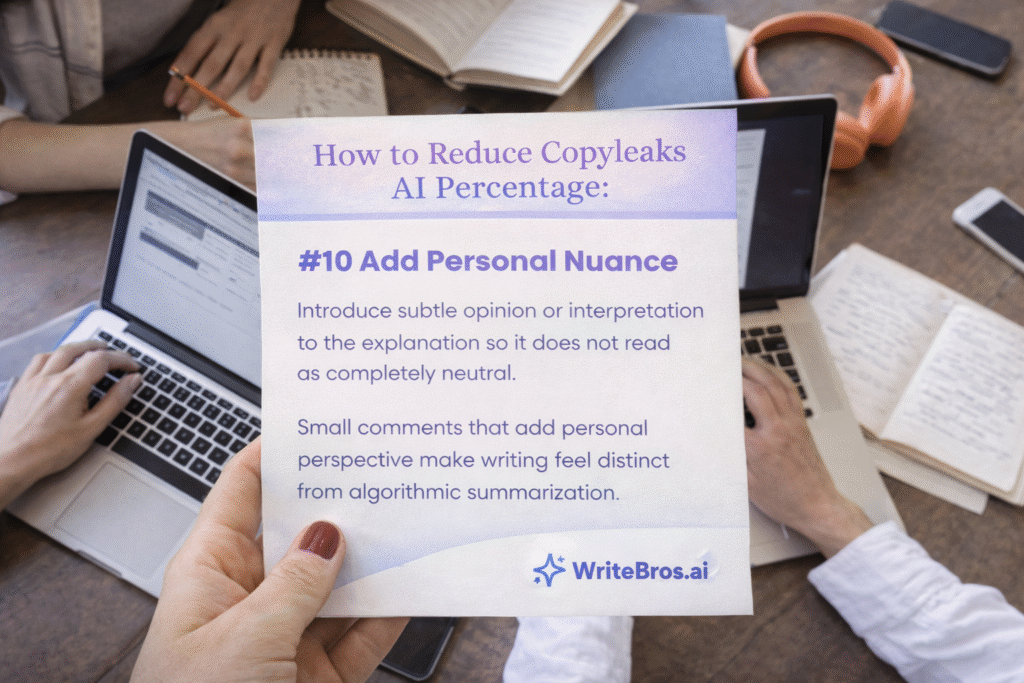
Introducing measured personal nuance can assist in reducing Copyleaks AI percentage because purely neutral exposition frequently mirrors large-scale language model output. Adding interpretive commentary, conditional framing, or subtle perspective statements makes the text feel less algorithmically detached. The nuance should enhance clarity without turning the draft into opinion-driven writing.
This works because detection models compare tonal consistency against broad training data distributions. When a passage includes slight perspective shifts or reflective phrasing, it diverges from standardized neutrality patterns. Thoughtful nuance introduces irregularity that aligns more closely with authentic human reasoning processes.
How to Reduce Copyleaks AI Percentage – Strategy #11: Lexical diversity
Expanding lexical diversity is central to reducing Copyleaks AI percentage because repeated vocabulary clusters can resemble common model-generated phrasing. Instead of recycling identical descriptors, vary word choice while preserving precision and tone. Strategic substitution broadens the linguistic footprint of your document.
Detection systems often calculate probability distributions based on token repetition across text segments. When certain words recur with high frequency, the repetition contributes to detectable uniformity. Diversifying vocabulary disrupts those patterns and creates a distribution that appears less algorithmically optimized.
How to Reduce Copyleaks AI Percentage – Strategy #12: Tone recalibration
Tone recalibration can reduce Copyleaks AI percentage by softening overly polished or excessively formal phrasing that resembles automated refinement. When sentences feel uniformly optimized, they may align closely with predictive language models. Introducing slight conversational texture restores natural variation.
This recalibration works because detection models assess tonal smoothness and predictability across passages. Perfectly balanced sentences with identical cadence elevate machine-likeness indicators. Subtle tonal shifts introduce irregularities that mirror authentic drafting habits.
How to Reduce Copyleaks AI Percentage – Strategy #13: Idea compression
Compressing ideas thoughtfully helps reduce Copyleaks AI percentage because unnecessary elaboration often produces redundant syntactic patterns. When explanations extend beyond what is required, structural repetition increases. Streamlining arguments reduces exposure to repeated language signals.
Detection systems evaluate density and repetition across documents rather than isolated lines. Trimming filler phrases removes predictable constructions that accumulate statistical weight. Concise clarity therefore lowers detectable uniformity without sacrificing substance.
How to Reduce Copyleaks AI Percentage – Strategy #14: Logical reshuffling
Logical reshuffling can meaningfully reduce Copyleaks AI percentage by altering the order in which supporting points appear within a discussion. AI-generated drafts frequently follow predictable reasoning sequences that models recognize quickly. Rearranging supporting details introduces structural unpredictability.
This works because pattern recognition extends beyond wording into argument flow. When ideas unfold in an unconventional but coherent order, the structure deviates from standardized templates. That deviation reduces alignment with common generative patterns.
How to Reduce Copyleaks AI Percentage – Strategy #15: Final manual review
A deliberate manual review remains one of the most dependable ways to reduce Copyleaks AI percentage because automated drafts often contain subtle rhythmic uniformity that is easier to detect aloud than on screen. Reading your text slowly allows you to identify repeated phrasing and balanced sentence patterns. Revising based on auditory cadence introduces organic variation.
This final pass works because human editing naturally introduces minor inconsistencies that models do not easily categorize as machine-generated. Small shifts in emphasis, pacing, and clause order accumulate across the document. Those refinements collectively reduce detectable regularity and improve authenticity.
Common mistakes
- Relying solely on automated rewriting tools without manual review often leads to superficial variation that fails to address deeper structural uniformity, which detection systems can still identify through consistent rhythm and predictable sequencing across paragraphs.
- Overcorrecting sentence structure by introducing erratic variation can create awkward phrasing that feels unnatural, which may reduce readability and draw attention to revision patterns rather than lowering statistical detectability.
- Ignoring repeated transitions throughout the document allows subtle phrase clustering to accumulate, reinforcing pattern recognition signals that elevate probability scores even when individual sentences appear revised.
- Leaving generic language untouched contributes to broad, high-frequency phrasing that aligns closely with model training data distributions, thereby increasing the likelihood of elevated detection percentages.
- Maintaining identical paragraph lengths throughout the article introduces visual and structural symmetry that can strengthen algorithmic predictability signals.
- Failing to review the document holistically often means missing cumulative repetition patterns that only become visible when the entire draft is examined as a single linguistic dataset.
Edge cases
Some technical or academic formats may still register higher percentages even after extensive revision because standardized terminology and citation structures naturally limit stylistic variation. In those situations, reducing probability scores may require careful integration of explanatory commentary that adds contextual framing without altering required terminology.
Similarly, highly concise documents can appear statistically dense due to compressed phrasing patterns, which makes subtle variation more important than dramatic rewriting. The goal in these cases is controlled refinement rather than aggressive restructuring, ensuring compliance with format expectations while gradually diffusing detectable uniformity.
Supporting tools
- Text analysis software that visualizes sentence length distribution can reveal structural uniformity patterns that are not immediately obvious during manual review, helping writers adjust rhythm more strategically.
- Advanced grammar editors with style variation insights allow you to detect repeated clause structures and rephrase them thoughtfully without sacrificing clarity or precision.
- Readability scoring platforms provide data on sentence complexity and pacing, which can guide adjustments that introduce organic variation into otherwise uniform drafts.
- Version comparison tools enable side-by-side evaluation of revisions so you can confirm that structural changes meaningfully alter linguistic patterns.
- Content audit dashboards that track phrase frequency help identify recurring connectors and descriptors across entire documents.
- WriteBros.ai supports structured humanization workflows that combine pattern disruption, tone adjustment, and contextual refinement to reduce detectable regularity while maintaining meaning.
Ready to Transform Your AI Content?
Try WriteBros.ai and make your AI-generated content truly human.
Conclusion
Learning how to reduce Copyleaks AI percentage ultimately comes down to disrupting predictable linguistic patterns while preserving clarity and intent. Small structural adjustments, when applied consistently across a document, can meaningfully alter statistical signals without changing your core argument.
Perfection is not required, since the objective is thoughtful refinement rather than dramatic rewriting. With careful revision and deliberate variation, your writing can maintain its substance while presenting a more natural, less mechanically uniform profile.
Did You Know?
If you are applying How to Reduce Copyleaks AI Percentage, begin with structural recalibration instead of word substitution, since evenly sized paragraphs and repeated sentence scaffolds can maintain a stable detection profile even when the draft appears different on the surface.
Let some sections stretch with layered clarification while others tighten for emphasis, vary clause positioning so grammatical patterns shift across paragraphs, and reduce mirrored openings that repeat the same syntactic frame, because organic imbalance is more typical of human drafting than perfectly uniform structure.
Ready to Transform Your AI Content?