How to Reduce Winston AI False Positives: 15 Verification Steps

Updated for 2026: Writers facing detection errors can follow practical steps to reduce Winston AI false positives and verify authenticity. Research in the Nature Machine Intelligence study on AI text detection reliability shows classifiers can mislabel human writing, reinforcing the need for verification workflows .
How to Reduce Winston AI False Positives: 15 Practical Verification Steps
Getting flagged by Winston AI when your writing is fully human can feel frustrating and confusing. The growing volume of false positive statistics shows this problem happens far more often than most writers expect.
Detection systems rely on probability patterns, which means structured or highly polished writing sometimes triggers automated suspicion. Many editors now combine manual review with AI rewriter tools to reduce patterns that systems mistakenly interpret as machine generated.
The goal is not to trick detection software but to verify authenticity and remove signals that lead to incorrect scoring. Understanding current detection error rates helps clarify why structured validation steps can dramatically lower Winston AI false positives.
| # | Strategy focus | Practical takeaway |
|---|---|---|
| 1 | Run a baseline scan | Start with an initial check to understand the system’s current confidence score and identify which sections may be triggering suspicion. |
| 2 | Inspect sentence uniformity | Look for overly consistent sentence structures and vary rhythm to prevent patterns that automated scoring systems interpret as machine-like. |
| 3 | Review vocabulary repetition | Identify repeated phrasing or predictable word choices and introduce natural variety to mimic typical human drafting habits. |
| 4 | Adjust paragraph rhythm | Balance long and short paragraphs so the structure reflects natural thinking rather than perfectly formatted output. |
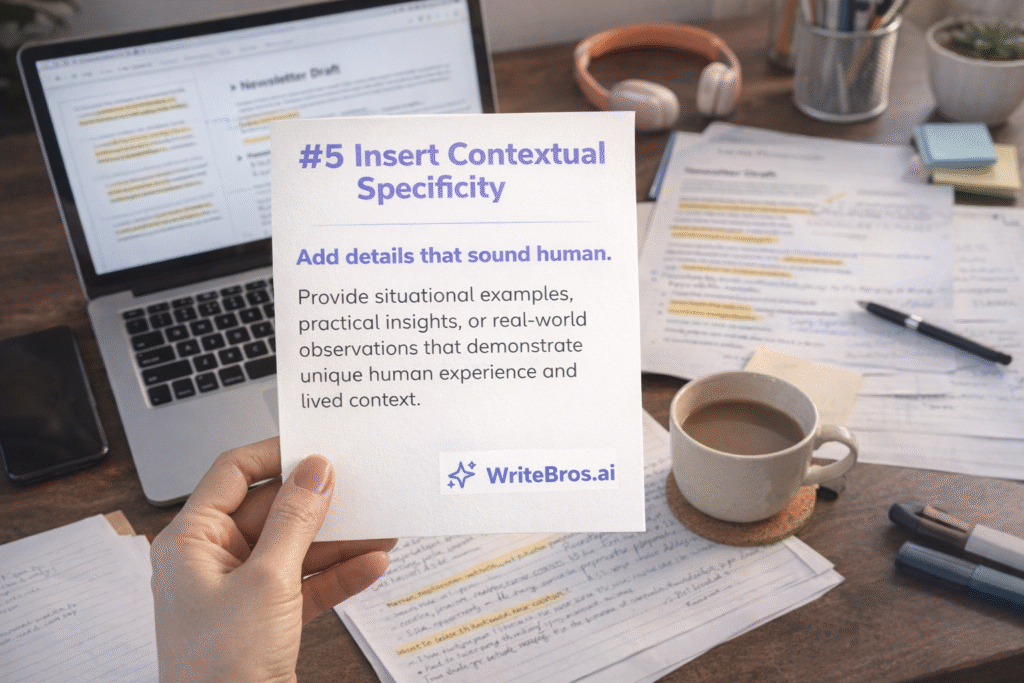
| 5 | Insert contextual specificity | Add situational details or concrete references that demonstrate human reasoning and lived context. |
| 6 | Evaluate transition patterns | Replace overly smooth transitions with more natural conversational flow that reflects real editorial drafting. |
| 7 | Break predictable phrasing | Rework sections that follow formulaic writing structures so the language feels less algorithmically organized. |
| 8 | Introduce structural variation | Combine different sentence lengths and formats to reduce statistical patterns associated with automated text. |
| 9 | Recheck high-risk passages | Focus edits on segments flagged by early scans rather than rewriting the entire document unnecessarily. |
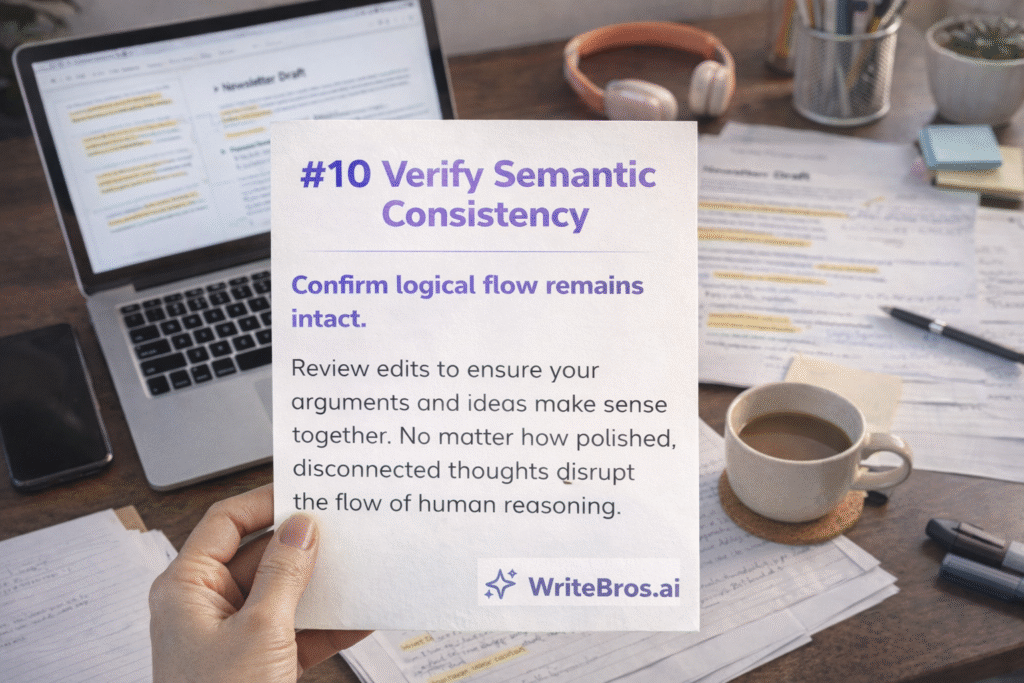
| 10 | Verify semantic consistency | Ensure edits maintain logical flow so revisions do not create unnatural language that triggers new flags. |
| 11 | Add editorial nuance | Introduce subtle opinion, hesitation, or explanation that reflects genuine human reasoning. |
| 12 | Check readability balance | Maintain clarity without producing text that is overly polished or statistically predictable. |
| 13 | Cross-check detection tools | Compare results across multiple systems to confirm whether a flag reflects a real issue or a scoring anomaly. |
| 14 | Review formatting signals | Minor formatting elements such as list density or repeated patterns can influence scoring and should be evaluated. |
| 15 | Perform a final validation pass | Conduct a last scan after revisions to confirm the document reads naturally and avoids the signals that caused the initial flag. |
15 Practical Strategies to Reduce Winston AI False Positives
How to Reduce Winston AI False Positives – Strategy #1: Run a baseline scan
Before making any edits, start with a baseline scan so you understand exactly how the system interprets the text in its current form and which sections appear most suspicious. Detection tools do not evaluate writing evenly, and certain passages often produce disproportionate influence on the overall score. Running an initial scan provides a reference point that guides your editing process and helps you avoid unnecessary changes to sections that already read naturally.
Many writers skip this step and immediately begin rewriting the entire document, which wastes time and sometimes introduces new patterns that increase the score rather than lowering it. When you know which paragraphs trigger the highest confidence signals, you can focus on targeted adjustments rather than broad revisions that dilute the original voice. This simple verification step creates a controlled workflow and turns the detection score into a diagnostic tool rather than a mysterious obstacle.
How to Reduce Winston AI False Positives – Strategy #2: Inspect sentence uniformity
Detection systems frequently look for consistent structural patterns across sentences, which means paragraphs with nearly identical sentence length and rhythm may unintentionally resemble algorithmic writing. Human writers naturally alternate between longer explanations and shorter clarifications, but carefully edited text sometimes becomes too symmetrical. Reviewing sentence uniformity allows you to identify areas where structural repetition might appear statistically unusual.
Adjusting this pattern does not require rewriting entire paragraphs, because even small changes in phrasing or clause structure can significantly alter the rhythm of a passage. Introducing varied sentence openings, descriptive clauses, or explanatory segments can restore a more organic cadence that resembles authentic drafting. When readers move through a paragraph that feels uneven in a natural way, detection systems tend to interpret it as human reasoning rather than mechanical output.
How to Reduce Winston AI False Positives – Strategy #3: Review vocabulary repetition
Repeated vocabulary across consecutive sentences can produce an artificial signal that detection systems interpret as automated language generation. Writers sometimes repeat specific terms for clarity or emphasis, but algorithms may interpret those repeated patterns as evidence of machine-like probability selection. Carefully reviewing vocabulary distribution across the document helps identify words or phrases that appear too frequently within short spans.
Replacing a few of those repeated expressions with natural alternatives creates a subtle but important shift in linguistic variety that resembles authentic writing behavior. Human authors often introduce slight variation in terminology even when discussing the same concept, which produces the uneven linguistic patterns that detectors expect from organic text. These small adjustments can dramatically reduce statistical repetition without altering the original meaning of the passage.
How to Reduce Winston AI False Positives – Strategy #4: Adjust paragraph rhythm
Paragraph structure contributes more to detection scoring than many writers realize because uniform paragraph length often appears algorithmic. A document where every paragraph contains nearly identical line counts or sentence totals may unintentionally mirror patterns common in generated content. Evaluating paragraph rhythm allows you to identify sections that appear overly balanced or predictably structured.
Breaking this uniformity can be as simple as expanding a key explanation in one section while condensing another area that contains repetitive clarification. Human writing tends to stretch when ideas become complex and compress when information is straightforward, which produces irregular structural flow. Detection systems often interpret this natural imbalance as evidence of authentic drafting rather than machine-generated formatting.
How to Reduce Winston AI False Positives – Strategy #5: Insert contextual specificity
Generic explanations often trigger detection flags because automated systems generate text that relies heavily on broad generalizations. When content lacks contextual anchors such as situational examples, practical details, or nuanced clarifications, the writing can resemble probability-driven output. Adding contextual specificity signals that the author understands the subject in a grounded and practical way.
These details might include subtle references to workflow situations, editorial decisions, or practical observations that demonstrate real human reasoning. Even a single descriptive clarification inside a paragraph can shift the statistical signature of the text toward authentic authorship. When readers sense that a passage reflects experience or reflection rather than formulaic explanation, detection models often reach the same conclusion.
How to Reduce Winston AI False Positives – Strategy #6: Evaluate transition patterns
Transitions that appear too smooth or overly predictable can sometimes signal automated generation because language models frequently rely on familiar linking phrases. While clear transitions help readability, repeated use of identical connectors may produce patterns that detectors recognize as algorithmic sequencing. Evaluating how ideas move from one sentence to the next helps reveal places where the flow might appear overly engineered.
Replacing repetitive transitions with more varied phrasing or integrating ideas directly into longer sentences creates a more natural progression between concepts. Human writers often move between thoughts with uneven connections, sometimes circling an idea before reaching a conclusion. That imperfect movement mirrors authentic reasoning and reduces the statistical signals that detection tools associate with automated writing.
How to Reduce Winston AI False Positives – Strategy #7: Break predictable phrasing
Predictable phrasing occurs when sentences follow the same rhetorical formula repeatedly, such as presenting an explanation followed immediately by a structured conclusion in identical wording. Detection systems recognize these patterns because language models frequently rely on similar construction templates across many outputs. Reviewing sections for formulaic sentence construction can reveal subtle repetition that otherwise goes unnoticed.
Breaking these patterns might mean combining ideas into longer sentences, inserting clarifying clauses, or rearranging the order in which information appears. Natural writing rarely maintains a perfect explanatory rhythm because human thought tends to wander slightly before settling into conclusions. Allowing the language to reflect that natural thought process introduces irregularity that detection algorithms often interpret as authentic human composition.
How to Reduce Winston AI False Positives – Strategy #8: Introduce structural variation
Structural variation refers to the deliberate use of different sentence forms, clause arrangements, and narrative pacing throughout a document. When every sentence follows the same grammatical template, the text may resemble machine-generated probability patterns rather than human reasoning. Introducing variation creates the subtle unpredictability that naturally emerges in organic writing.
This does not require dramatic stylistic changes, because small adjustments in sentence openings or clause placement can significantly alter the statistical profile of a paragraph. Writers often begin sentences with context, questions, or clarifying statements when drafting naturally, which produces structural diversity. Detection systems interpret that diversity as evidence of genuine composition rather than automated generation.
How to Reduce Winston AI False Positives – Strategy #9: Recheck high-risk passages
Some sections of a document contribute far more heavily to the overall detection score than others, particularly paragraphs containing technical explanations or very formal language. These high-risk passages often concentrate the statistical signals that detectors associate with generated text. Identifying and rechecking those areas allows you to correct specific patterns without rewriting the entire document.
Carefully revising these passages often involves expanding explanations, adjusting phrasing, or introducing contextual nuance that reflects genuine reasoning. When a previously flagged paragraph begins to read more like a natural thought process rather than a condensed summary, the detection score frequently drops across the entire document. Targeted revisions create efficiency and preserve the integrity of sections that already perform well.
How to Reduce Winston AI False Positives – Strategy #10: Verify semantic consistency
After making structural or linguistic edits, it is important to verify that the meaning of the text remains logically consistent. Detection-focused revisions sometimes introduce awkward phrasing or conceptual gaps that create unnatural language patterns. Reviewing semantic flow ensures that the writing still communicates ideas clearly and coherently.
Readers and detection systems both respond poorly to sentences that appear technically correct but logically disconnected from surrounding context. Ensuring that every revision maintains a natural explanation prevents the document from developing new signals that might increase suspicion. A consistent narrative structure reinforces the impression that the text reflects deliberate human reasoning rather than mechanical adjustment.
How to Reduce Winston AI False Positives – Strategy #11: Add editorial nuance
Editorial nuance refers to subtle language choices that reveal the author’s interpretation or perspective on the topic. Detection systems often interpret purely neutral explanations as algorithmic because generated content frequently avoids subjective phrasing. Introducing thoughtful nuance can signal that the text reflects human reasoning and interpretation.
This nuance might appear through clarifying remarks, gentle uncertainty, or reflective observations that expand on the original explanation. Human writers naturally include these elements when thinking through ideas, which produces slight tonal variation throughout a passage. That tonal diversity makes the writing feel conversational and authentic rather than mechanically constructed.
How to Reduce Winston AI False Positives – Strategy #12: Check readability balance
Extremely polished writing sometimes triggers detection flags because it lacks the small irregularities that appear in natural drafting. While clarity remains important, a document that reads with perfect uniformity may resemble algorithmic optimization. Evaluating readability balance ensures that the text feels fluid without becoming overly symmetrical.
Maintaining this balance may involve adding clarifying phrases, expanding certain ideas, or slightly adjusting sentence rhythm so the document reflects natural thinking patterns. Readers rarely process information in perfectly structured segments, and authentic writing often mirrors that mental flow. When readability reflects realistic reasoning patterns, detection systems are less likely to misinterpret the text.
How to Reduce Winston AI False Positives – Strategy #13: Cross-check detection tools
Different detection systems rely on different statistical models, which means the same document can receive dramatically different scores across platforms. Relying on a single result may therefore produce a misleading impression of the text’s authenticity. Cross-checking multiple systems provides a broader perspective on how the writing is interpreted.
If several detectors report similar results, the flagged patterns likely require revision, but if only one system raises concern the issue may reflect a scoring anomaly. Comparing results allows writers to distinguish genuine signals from algorithmic inconsistencies. This verification step prevents unnecessary rewriting and provides a clearer understanding of how the document behaves across detection environments.
How to Reduce Winston AI False Positives – Strategy #14: Review formatting signals
Formatting choices such as consistent bullet lists, repetitive paragraph lengths, or uniform heading structures can influence detection models in subtle ways. These patterns sometimes resemble the output of automated generation systems that rely on structured formatting templates. Reviewing formatting signals helps ensure that the visual structure of the document does not unintentionally resemble algorithmic output.
Introducing slight variation in formatting, spacing, or structural organization can produce a more natural editorial layout. Human authors frequently adjust formatting organically as ideas develop, which results in minor irregularities across the page. Those irregularities mirror authentic drafting behavior and help reduce signals that detection systems associate with machine-generated formatting.
How to Reduce Winston AI False Positives – Strategy #15: Perform a final validation pass
The final validation pass confirms that the document reads naturally after all revisions have been completed. Detection-focused editing sometimes introduces unintended patterns, and a final scan ensures those changes have not created new signals. Reviewing the entire document as a unified piece of writing helps identify subtle inconsistencies.
This step also provides reassurance that the content maintains clarity, coherence, and natural language flow across every section. Running a final verification scan allows you to confirm that earlier flags have been resolved and that the document performs consistently across evaluation tools. Completing this process ensures the writing reflects authentic human reasoning rather than mechanical adjustment.
Common mistakes
- Many writers immediately rewrite the entire document after seeing a detection flag, assuming the text must be fundamentally flawed. This reaction usually wastes time and introduces new structural patterns that may increase suspicion rather than resolve the original issue, because the actual trigger may exist in only one or two paragraphs.
- Another frequent mistake involves focusing exclusively on vocabulary changes while ignoring structural patterns in sentences and paragraphs. Detection systems often rely more heavily on rhythm and structural repetition than on individual words, so superficial synonym replacement rarely produces meaningful improvements in detection scores.
- Some writers remove all nuance or stylistic personality in an attempt to make their writing appear neutral and factual. Ironically, this strategy can produce the opposite result because overly neutral language resembles algorithmic output, which increases the likelihood of a false positive flag.
- Relying on a single detection platform without verifying results across multiple tools creates a misleading view of authenticity. Each platform uses different statistical thresholds and evaluation models, so one isolated result should never determine whether a document truly requires revision.
- Excessive editing can also create problems because constant rewrites may gradually distort the natural voice of the document. When revisions focus only on reducing detection scores instead of preserving authentic expression, the text may become mechanically structured and trigger new algorithmic signals.
- Finally, some writers assume that detection systems operate with perfect accuracy and treat every flag as definitive proof of generated content. In reality these tools rely on probability estimates, which means even well-written human text can occasionally produce unexpected scores.
Edge cases
Some forms of writing naturally resemble algorithmic patterns because they rely on precise structure, consistent terminology, or formulaic explanation. Academic summaries, technical documentation, and highly standardized business writing may therefore trigger occasional flags even when the content is completely original. In these cases the issue does not reflect a lack of authenticity but rather the statistical similarity between structured human writing and model-generated output.
Another edge case appears in carefully edited publications where multiple revisions remove irregularities from the text. When editors streamline language for clarity, they may unintentionally produce uniform sentence rhythm or repeated structural patterns. Restoring subtle variation through contextual details or explanatory nuance often resolves these situations without compromising the professionalism of the writing.
Supporting tools
- Editing environments with readability analysis features can help writers identify repetitive sentence structures or vocabulary patterns that might influence detection scores. These tools highlight rhythm inconsistencies and structural repetition, making it easier to spot areas that require natural variation.
- Document comparison tools allow writers to examine revisions across multiple drafts and identify where structural patterns begin to emerge. Viewing these changes over time often reveals how small edits gradually create repetitive language patterns that detection systems may interpret incorrectly.
- Advanced grammar platforms with style suggestions can help diversify sentence openings and reduce repetitive phrasing across paragraphs. While their primary purpose is clarity, the structural diversity they introduce can also reduce statistical signals associated with automated generation.
- Multi-detector comparison dashboards provide side-by-side analysis across different detection models, allowing writers to understand how each system interprets the same text. This broader perspective helps distinguish genuine patterns from scoring anomalies produced by a single platform.
- Content auditing tools designed for editorial teams can analyze paragraph length variation, transition usage, and vocabulary distribution across long documents. These insights help writers adjust structure without rewriting entire sections unnecessarily.
- WriteBros.ai provides structured rewriting and editing workflows designed to adapt AI-assisted drafts into natural, human-sounding writing. The platform helps refine tone, pacing, and linguistic variation so content maintains authenticity while reducing patterns that commonly trigger detection flags.
Ready to Transform Your AI Content?
Try WriteBros.ai and make your AI-generated content truly human.
Conclusion
Reducing Winston AI false positives begins with understanding that detection tools evaluate statistical writing patterns rather than actual authorship. Once you recognize that these systems rely on rhythm, structure, and linguistic variation, the process of improving scores becomes a practical editing exercise rather than a confusing guessing game.
Effective verification focuses on clarity, natural variation, and thoughtful revision rather than aggressive rewriting. Writers who approach the process with patience and careful observation usually discover that small adjustments produce meaningful improvements. Authentic writing rarely requires perfection, only enough natural irregularity to reflect real human reasoning.
Did You Know?
People trying to reduce Winston AI false positives often rewrite a handful of lines or swap synonyms, yet detectors frequently react more to consistent structure across the entire page than to any single sentence in isolation. If your paragraphs move in the same three-step order, keep similar sentence-length ranges, and rely on the same transition style, the writing can read as algorithmically consistent even when it sounds smooth.
Edits that reshape how ideas unfold tend to work better because they introduce the uneven cadence humans naturally produce while explaining something. Let one paragraph stay concise and practical, let the next expand with a clarification tucked inside a long sentence, and let another wander briefly before landing the point, because that asymmetry breaks the template feeling Winston’s pattern scoring often misreads as machine output.
Ready to Transform Your AI Content?