Student Attitudes Toward AI-Generated Writing: Top 20 Survey Signals

2026 is marking the point where AI writing stops feeling experimental and starts shaping everyday academic behavior. This analysis tracks how students actually use generative tools, where attitudes remain conflicted, and what the data suggests for grading, policy clarity, and writing instruction.
What keeps surfacing in current survey data is not simple enthusiasm or simple resistance, but a messy middle where students treat generative tools as useful, risky, and increasingly normal at the same time. That tension matters because it changes how instructors read intent, how policies land, and how closely campuses need to align with what professors expect from students using AI.
Across newer findings, convenience keeps pulling usage upward even as trust remains conditional and highly situational. The pattern looks even sharper once writing support moves beyond essays into tone, clarity, and communication tasks like humanize AI emails to parents, where students can see the practical upside immediately.
There is also a noticeable difference between using AI as a quiet drafting aid and seeing it as something that can fully replace judgment, which most students still seem reluctant to endorse without caveats. That is part of why tool choice keeps showing up in editorial assessment, especially in conversations around the most reliable AI humanizer tools for educator writing and whether assistance stays supportive rather than dominant.
What follows is best read as a live snapshot of behavior meeting policy, not a settled consensus. A small practical note helps here too: whenever a figure points in two directions at once, it usually signals that classroom rules are lagging behind actual writing habits.
Top 20 Student Attitudes Toward AI-Generated Writing (Summary)
| # | Statistic | Key figure |
|---|---|---|
| 1 | Students using AI to help complete assessments | 94% |
| 2 | Students who have used AI in some form | 92% |
| 3 | Students using AI to generate text | 64% |
| 4 | Students saying responsible AI use is essential for future career success | 62% |
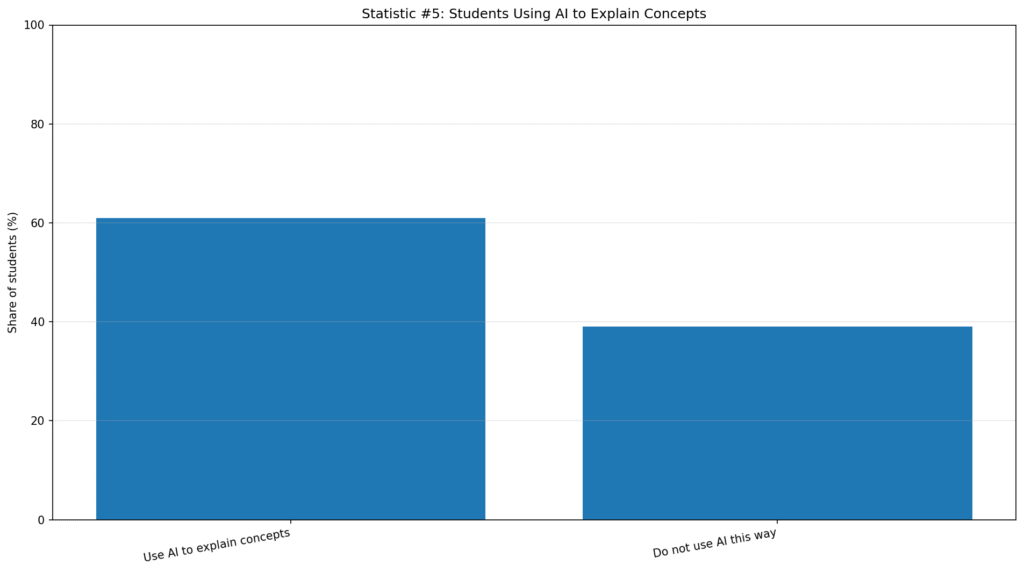
| 5 | Students using AI to explain concepts while preparing assessed work | 61% |
| 6 | Students who have used AI on assignments or exams | 56% |
| 7 | Students saying AI has mixed effects on learning and critical thinking | 55% |
| 8 | Students who say AI use on schoolwork or exams counts as cheating or plagiarism | 54% |
| 9 | Students wanting more education on ethical AI use | 53% |
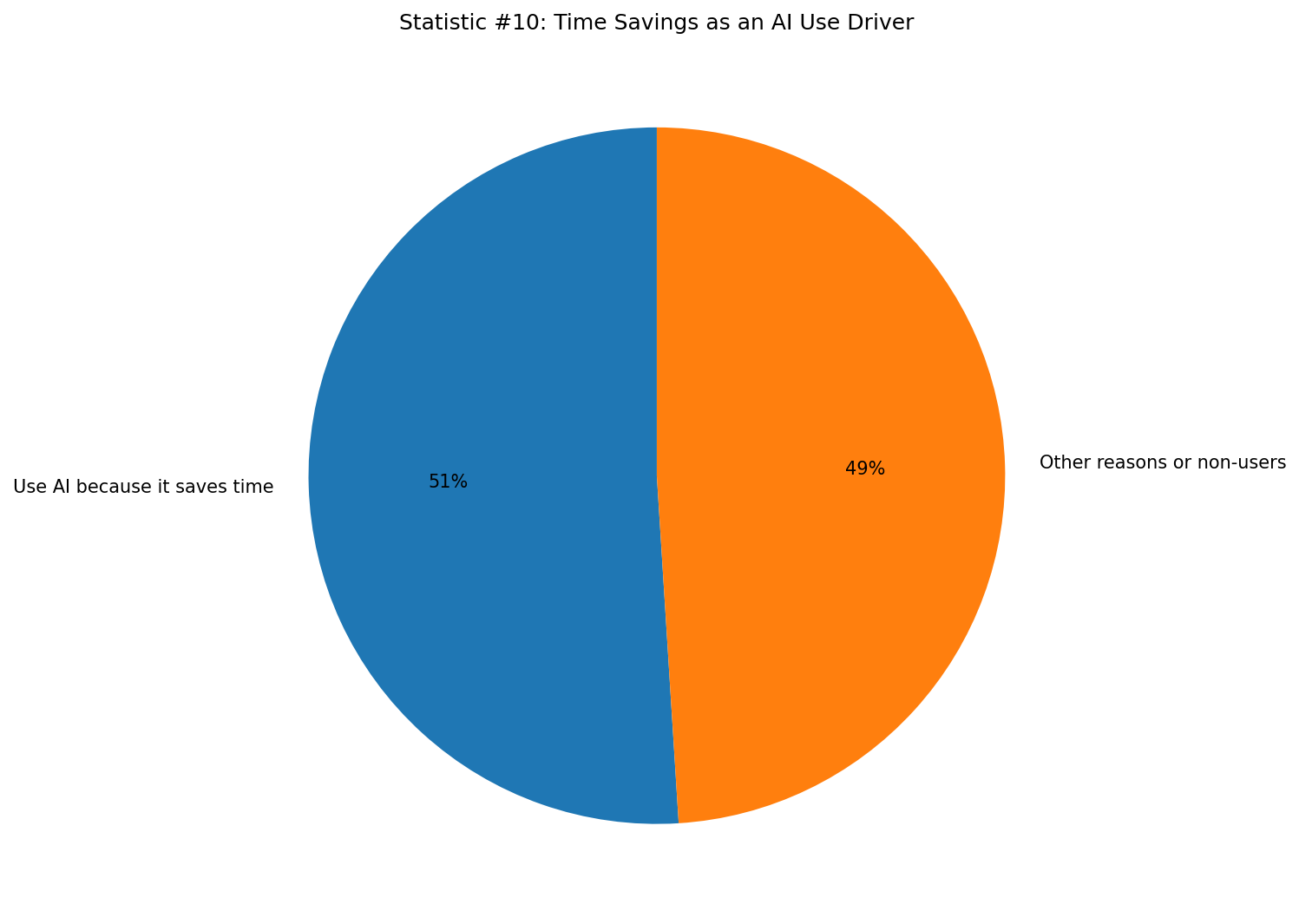
| 10 | Students using AI because it saves time | 51% |
| 11 | Students using AI to improve the quality of their work | 50% |
| 12 | Students saying learning AI is the most important skill they will gain in college | 50% |
| 13 | Students using AI to summarize relevant articles for assessed work | 48% |
| 14 | Students using generative AI tools at least weekly | 42% |
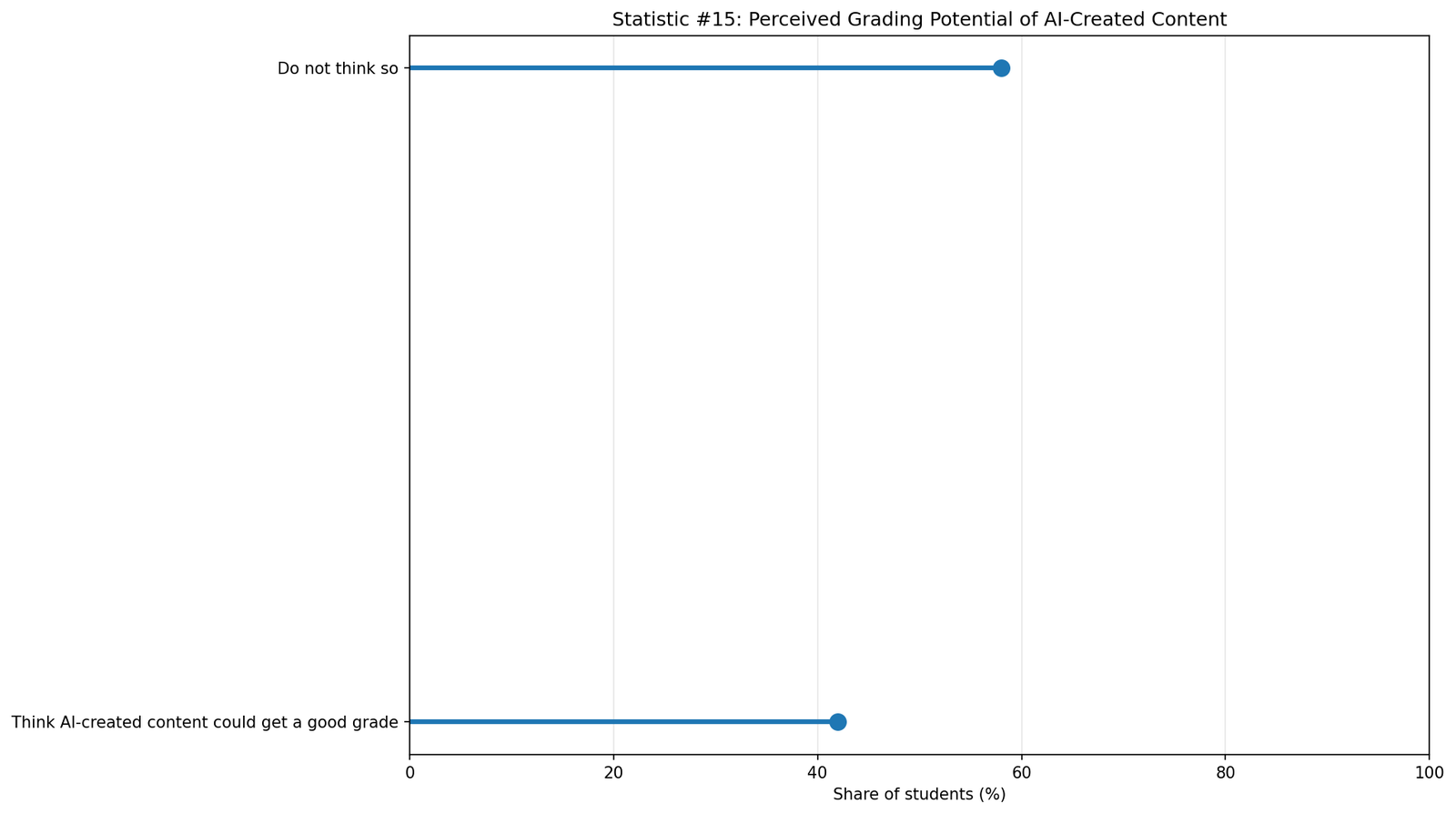
| 15 | Students who think AI-created content could get a good grade in their subject | 42% |
| 16 | Students using AI to structure their thoughts for assessed work | 39% |
| 17 | Students using AI to search the internet while preparing assessed work | 36% |
| 18 | Students unclear on when they are permitted to use generative AI in class | 31% |
| 19 | Students somewhat positive about faculty using AI for teaching tasks | 29% |
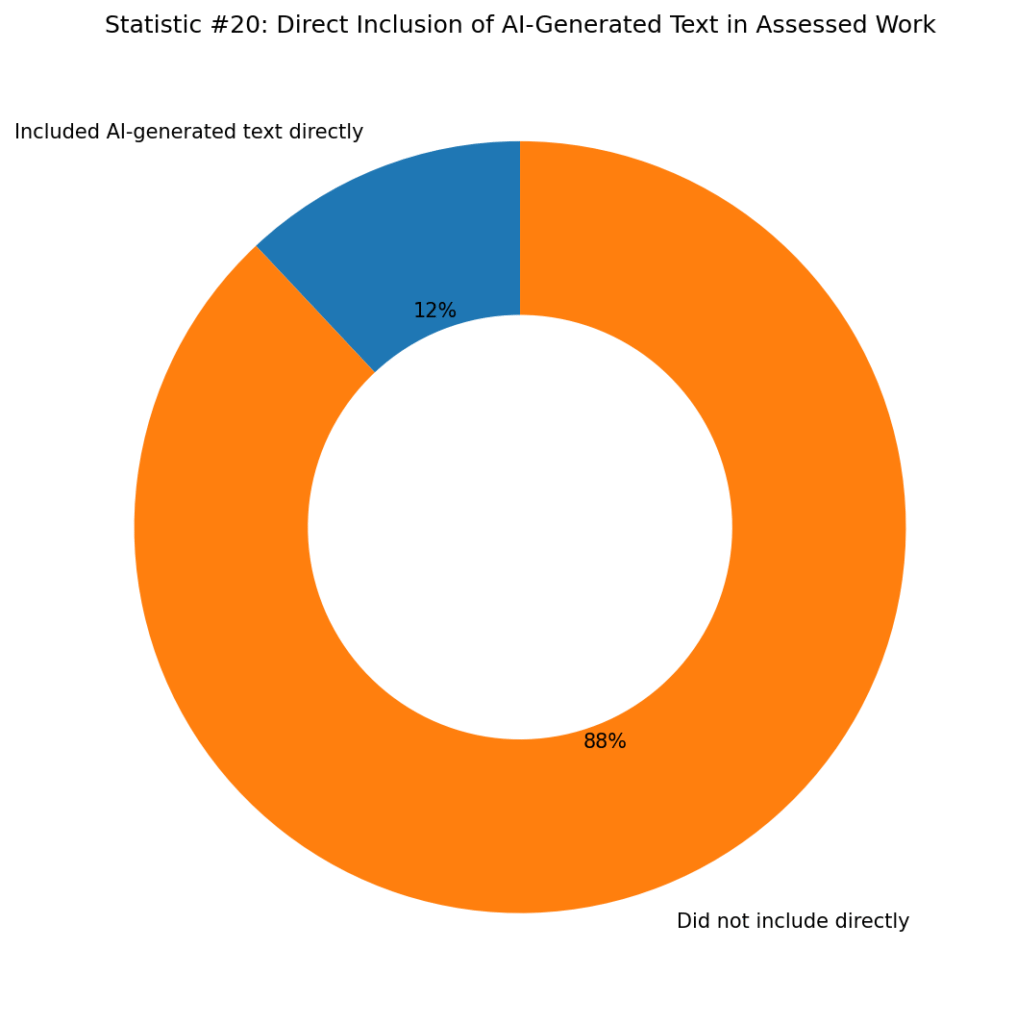
| 20 | Students who have included AI-generated text directly in assessed work | 12% |
Top 20 Student Attitudes Toward AI-Generated Writing and the Road Ahead
Student Attitudes Toward AI-Generated Writing #1. Assessed work has become routine AI territory
94% of students using AI for assessed work shows the tool now sits inside ordinary academic writing routines. What stands out is not novelty, but how quickly students have absorbed AI into the basic mechanics of finishing coursework. That matters because attitudes tend to soften once a behavior feels ordinary.
The reason is straightforward. Coursework still rewards speed, structure, and quick clarification, and AI compresses those tasks into a few prompts. Under deadline pressure, students are less likely to debate principles and more likely to use whatever keeps work moving.
Human drafting still includes false starts, slow thinking, and awkward revision, while AI removes much of that friction for 94% of students. That saves energy, but it can also reduce the productive struggle that helps writing become specific and memorable. The implication is that policy now has to govern routine assistance rather than exceptional misuse, which pushes institutions toward clearer boundaries and sturdier assessment design.
Student Attitudes Toward AI-Generated Writing #2. General use is nearly universal
92% of students reporting some form of AI use shows how fully these tools have entered everyday study habits. A figure this high suggests attitudes have moved past curiosity and into practical acceptance. Once use becomes widespread, the real question becomes how students define acceptable help.
The behavior makes sense. AI now sits where students already work, from browsers to writing apps, so experimentation carries very little effort. Low friction changes perception, because tools that are always available start to feel like ordinary academic utilities.
Traditional study still asks for searching, sorting, and drafting from scratch, while AI reduces that setup work for 92% of students. Students may still prefer their own judgment at key moments, yet they increasingly let AI handle the setup layer. The implication is that institutions need less disbelief about student use and more precise teaching on disclosure, boundaries, and what genuine authorship should still look like in practice.
Student Attitudes Toward AI-Generated Writing #3. Text generation feels useful but not fully trusted
64% of students using AI to generate text points to comfort with machine drafting, even if full trust remains limited. Students clearly see value in getting words on the page faster. At the same time, the number stops short of total adoption, which tells you caution still survives.
That middle position is revealing. Generating text solves the hardest opening problem in writing, especially when students feel stuck, tired, or unsure how to begin. Yet many still hesitate to rely on raw output because tone, accuracy, and originality remain exposed weaknesses.
Human writing carries voice, hesitation, and unevenness, while AI offers instant fluency to 64% of students who want momentum first. The tradeoff is that smoother drafting can tempt students to confuse polished language with solid thinking. The implication is that educators should pay closer attention to revision process and reasoning trails, because those are harder to outsource than the first version of a paragraph.
Student Attitudes Toward AI-Generated Writing #4. Career logic is shaping student approval
62% of students saying responsible AI use matters for future career success shows a notably pragmatic attitude. Many students are not treating AI as a campus-only shortcut. They are reading it as a workplace skill that will follow them beyond school.
That belief grows from the labor market students see around them. Job talk now regularly includes automation, productivity tools, and expectations that graduates can work alongside intelligent systems. When careers appear to reward fluency with AI, resistance starts to look less principled and more risky.
Older models of writing education center human judgment alone, while career-facing students increasingly connect employability to 62% of students endorsing responsible AI use. The human part still matters, because employers care whether people can verify, decide, and communicate under pressure. The implication is that colleges cannot frame AI only as a misconduct problem anymore, because students are already interpreting it as part of professional readiness.
Student Attitudes Toward AI-Generated Writing #5. Explanation support is one of the strongest draws
61% of students using AI to explain concepts suggests the strongest appeal is not copying but comprehension support. That is an important distinction. Students often turn to AI first when they need a simpler path into difficult material.
The pattern is easy to understand. Explanations from lectures, readings, or textbooks can feel dense, and AI offers immediate rewording without the embarrassment of asking basic questions. That kind of instant clarification makes the tool feel helpful even to students who remain skeptical of AI-written prose.
Human teaching gives nuance, context, and live follow-up, while AI delivers quick interpretation for 61% of students seeking clarity on demand. The risk is that simplified explanation can create an illusion of mastery before students have tested whether they truly understand the idea. The implication is that classrooms should distinguish clearly between using AI to unlock comprehension and using it to replace the thinking that assessment is supposed to measure.
Student Attitudes Toward AI-Generated Writing #6. Direct use on assignments has crossed into the mainstream
56% of students having used AI on assignments or exams shows that direct academic use has crossed a meaningful line. This is no longer rare experimentation at the margins. It is common enough to shape peer norms and instructor expectations at the same time.
The cause is partly structural. Once students believe classmates are using AI, the pressure to abstain weakens because nonuse begins to feel like self-imposed disadvantage. That social normalization matters almost as much as the technology itself.
Unaided work still asks students to carry the full load of recall, drafting, and time management, while AI lightens that burden for 56% of students. The problem is that students may justify borderline use as fairness rather than misconduct when they think everyone else is already doing it. The implication is that policy has to be visible, course-specific, and consistently enforced or students will keep filling the silence with their own rules.
Student Attitudes Toward AI-Generated Writing #7. Many students see gains and losses at the same time
55% of students saying AI has mixed effects on learning and critical thinking captures the mood better than simple optimism does. Students are not uniformly dazzled. Many seem to recognize that convenience and intellectual cost can arrive together in the same study session.
That ambivalence follows direct experience. AI helps with speed, organization, and first drafts, yet it can also short-circuit the slower mental work that builds confidence and analysis. Students notice both sides because they feel the benefit immediately and the downside more gradually over weeks.
Human learning deepens through repetition, confusion, and revision, while AI removes some of that friction for 55% of students who see mixed effects. The challenge is that reduced struggle can feel productive in the moment even when long-term retention weakens later. The implication is that institutions should treat student ambivalence as useful evidence, because it supports more balanced guidance than either panic or unqualified enthusiasm.
Student Attitudes Toward AI-Generated Writing #8. Ethical consensus remains thin
54% of students calling AI use on schoolwork or exams cheating or plagiarism shows the ethical picture remains unsettled. A majority still draws a moral line. Yet the narrowness of that majority also suggests the line is not holding firmly across classrooms.
This split is understandable. Students can see obvious misuse when AI substitutes for knowledge, but many also see limited assistance as no different from tutoring or editing help. Ambiguity grows whenever rules describe intent poorly or vary from one instructor to the next in real courses.
Human authorship carries visible effort and ownership, while tool-assisted work muddies that boundary for 54% of students who still read some use as cheating. The result is not just disagreement, but confusion over where legitimate support ends and unacceptable substitution begins. The implication is that schools need definitions tied to tasks and learning goals, because abstract moral language leaves too much room for self-serving interpretation.
Student Attitudes Toward AI-Generated Writing #9. Students want clearer ethical instruction
53% of students wanting more education on ethical AI use shows demand for guidance has not kept pace with adoption. Students are not only asking what the tool can do. They are also asking how to use it without crossing lines they cannot clearly see in daily work.
That request reflects uncertainty rather than simple caution. Many students now encounter AI in multiple classes, but the rules, examples, and expectations still vary widely across departments and instructors. When policies are inconsistent, students naturally look for broader frameworks they can trust and actually apply.
Human mentoring gives context and judgment, while static policy statements rarely answer the practical questions raised by 53% of students seeking ethical guidance. Students need concrete examples of acceptable prompting, revision, citation, and disclosure, not vague warnings. The implication is that institutions should treat AI literacy as a teachable skill set, because moral uncertainty shrinks only when guidance becomes specific and usable.
Student Attitudes Toward AI-Generated Writing #10. Time savings remain the strongest practical incentive
51% of students using AI because it saves time shows efficiency remains the most persuasive selling point. Students do not need a grand theory to adopt a tool that clears a crowded workload faster. Time pressure alone can change attitudes more quickly than formal policy ever will.
The cause is built into student life. Coursework, jobs, commuting, and family duties compete for attention, so anything that shortens the path to a usable draft gains immediate value. In that setting, convenience does not feel lazy to students. It feels necessary.
Human writing asks for searching, planning, and rewriting across hours, while AI compresses those steps for 51% of students chasing efficiency. The downside is that speed can become its own justification, even when the assignment was meant to slow thinking down. The implication is that educators should design more process-visible work, because students will keep choosing faster tools whenever the task rewards output more than reflection.
Student Attitudes Toward AI-Generated Writing #11. Better quality is a major part of the appeal
50% of students using AI to improve work quality shows the tool is being judged as an enhancer, not just a shortcut. Many students believe AI can make their writing cleaner and more organized. That belief matters because quality-based use tends to feel easier to defend than speed-based use.
The appeal is understandable. Students worry about clarity, grammar, structure, and sounding capable, and AI offers instant polish in all four areas. When a tool appears to raise the finish level quickly, students start treating it like standard support rather than risky assistance.
Human revision builds taste and discernment slowly, while AI offers immediate refinement for 50% of students hoping their work will read better. The concern is that students may outsource the judgment required to decide why a sentence improves instead of accepting the smoother version. The implication is that writing instruction should keep emphasizing explanation and choice, because quality gains matter most when students can account for them themselves.
Student Attitudes Toward AI-Generated Writing #12. AI fluency is being ranked as a core college outcome
50% of students saying AI may be the most important skill they gain in college reveals how far the conversation has moved. Students are not merely asking whether AI belongs in education. Many are already ranking AI fluency alongside traditional academic outcomes.
This view grows from a wider sense of acceleration. Students see workplaces adopting generative tools quickly, and they assume colleges will look outdated if training lags too far behind. In that context, learning AI can feel less optional than mastering a new research platform once did.
Traditional college value rests on human reasoning, discussion, and domain knowledge, while future-facing students connect competitiveness to 50% of students prioritizing AI skill. The tension is that technical fluency without judgment can still produce weak decisions and shallow work. The implication is that institutions should teach AI as a companion skill anchored to disciplinary reasoning, rather than presenting it as either a miracle tool or a threat alone.
Student Attitudes Toward AI-Generated Writing #13. Summaries are changing how students approach reading
48% of students using AI to summarize relevant articles shows how quickly reading support has become part of writing preparation. Summarization lowers the entry cost of complex material. That makes the tool especially attractive when students face dense sources under time pressure.
The pattern follows familiar academic strain. Long readings can be valuable, but they also demand time, patience, and confidence that many students do not always have in abundance. AI offers a shortcut into the main ideas, so it feels like a practical way to get unstuck.
Human reading develops judgment through attention to nuance, citation, and argument shape, while AI offers compressed takeaways to 48% of students seeking quicker orientation. The danger is that summaries can hide uncertainty or flatten distinctions that matter for real analysis. The implication is that educators should teach students to treat AI summaries as starting points for reading, not as replacements for the source itself.
Student Attitudes Toward AI-Generated Writing #14. Weekly use is turning into habit
42% of students using generative AI at least weekly suggests the habit is no longer occasional for a large minority. Regularity changes attitude. Once students return to a tool every week, they start building routines around it rather than treating it as backup support.
That frequency reflects repeated payoff. If AI consistently helps with planning, explaining, or polishing, the barrier to reuse falls with every successful interaction. Familiarity then becomes its own driver, because students trust what has already saved them time or confusion before.
Human study habits usually develop around library searches, notes, and draft cycles, while AI now sits inside weekly workflows for 42% of students. The more routine the use becomes, the easier it is for dependence to hide behind productivity language. The implication is that schools should pay attention not just to whether students use AI, but to how habitual the use has become across an entire semester.
Student Attitudes Toward AI-Generated Writing #15. Students think polished AI text can still score well
42% of students thinking AI-created content could earn a good grade shows respect for the output even where trust stays partial. Students may criticize AI in theory and still believe it can perform convincingly in practice. That gap between principle and expectation is worth noticing.
The reason is plain enough. Many assignments still reward coherence, structure, and surface fluency, which generative systems can produce quickly. If grading emphasizes polished delivery more than genuine reasoning, students naturally conclude AI can compete.
Human writing reveals uncertainty, originality, and lived perspective, while machine text can mimic competence well enough for 42% of students to expect solid marks. That does not mean students think AI is better, only that they think many rubrics fail to separate polish from thought. The implication is that assessment needs stronger signals of reasoning, process, and personal accountability if institutions want grades to reflect learning rather than presentation alone.
Student Attitudes Toward AI-Generated Writing #16. Structure help matters almost as much as drafting help
39% of students using AI to structure their thoughts suggests organization is one of the tool’s most valued functions. Many students are not asking AI to finish the argument for them. They are asking it to turn scattered ideas into a workable frame.
That use case makes sense because structure is where many drafts stall. Students may understand material reasonably well and still struggle to order points, sequence evidence, or build a clear progression. AI feels helpful there because it supplies shape before it supplies content.
Human outlining builds logic through deliberate choices, while AI offers ready-made frameworks to 39% of students who want coherence quickly. The risk is subtle: borrowed structure can also import borrowed emphasis and narrow the student’s own route through the topic. The implication is that instructors should teach students to treat AI outlines as provisional scaffolds, not invisible architectures that quietly determine the final paper.
Student Attitudes Toward AI-Generated Writing #17. AI is starting to mediate research discovery
36% of students using AI to search the internet for assessed work shows the tool is expanding beyond writing help into information gathering. Students increasingly see AI as a front door to research tasks. That broadens its role from assistant to intermediary across the whole prep process.
The appeal is obvious. Search engines return long lists that require filtering, while conversational AI packages answers into quicker pathways and cleaner summaries. When students are rushed, that guided route can feel more manageable than traditional searching done from scratch.
Human research usually builds patience through source comparison and credibility checks, while AI search simplifies discovery for 36% of students looking for speed. The concern is that convenience can hide weak sourcing, invented citations, or overconfident summaries that students fail to verify. The implication is that research instruction now has to cover AI-mediated searching directly, because students are already treating it as part of normal academic prep.
Student Attitudes Toward AI-Generated Writing #18. Permission is still unclear for too many students
31% of students being unclear on when generative AI is permitted shows policy communication still breaks down in practice. Nearly a third of students lacking clarity is not a minor issue. It means uncertainty is built into the decision environment before writing even begins on an assignment.
The underlying cause is inconsistency. Rules vary across courses, wording differs across syllabi, and some instructors discuss AI directly while others barely mention it. Students then fill the gaps with guesswork, peer assumptions, and whatever seems unlikely to trigger trouble later.
Human judgment works better when boundaries are visible, while uncertainty distorts choices for 31% of students who are unsure what counts as allowed use. Some will stay overly cautious, and others will drift into misuse without feeling they crossed a clear line. The implication is that institutions need plain-language policies reinforced inside each course, because ambiguity quietly produces both anxiety and preventable misconduct.
Student Attitudes Toward AI-Generated Writing #19. Faculty use earns cautious approval rather than enthusiasm
29% of students feeling somewhat positive about faculty using AI for teaching tasks signals cautious openness rather than full approval. Students are not rejecting instructor use outright. They seem willing to accept it when the benefit feels visible and the human role remains intact.
That caution is understandable. Students may welcome faster feedback or clearer materials, yet they also worry that too much automation will make teaching feel distant or generic. Trust depends heavily on whether AI appears to support the instructor or replace the instructor’s attention.
Human teaching carries responsiveness, judgment, and care, while AI-assisted teaching can feel efficient but thinner to 29% of students offering moderate support. Students tolerate automation more easily when they can still sense a teacher’s personal investment in comments and course design. The implication is that faculty use of AI should stay transparent and visibly supervised, because perceived distance can erode confidence faster than technical efficiency builds it.
Student Attitudes Toward AI-Generated Writing #20. Direct insertion remains a minority practice with outsized meaning
12% of students admitting they have included AI-generated text directly in assessed work may look small, but it is still a serious signal. Direct insertion remains a minority behavior, yet it has grown enough to matter. Even limited admission rates can indicate broader normalization around the edges.
The pattern likely reflects a threshold effect. Many students may accept AI for ideas, summaries, or structure but hesitate once the tool starts supplying final wording. Crossing from assistance into direct submission feels morally and institutionally riskier, so the number drops sharply.
Human writing leaves traces of ownership and struggle, while direct machine text removes that labor for 12% of students willing to use it verbatim. That smaller group matters because it tests how well policies distinguish support from substitution in real coursework. The implication is that detection alone will not solve the issue, since prevention depends more on clear norms, better assignment design, and stronger student understanding of authorship.
Student attitudes are settling into a pragmatic middle rather than a simple pro or anti AI position
The strongest pattern across these figures is normalization, with usage climbing faster than moral certainty or policy clarity. Students increasingly treat AI as part of the writing environment, yet they still reserve judgment on when support becomes substitution.
That split explains why comprehension, structure, and speed lead adoption more convincingly than direct text insertion does. Students appear most comfortable when AI feels like a guide beside their own effort, not a stand-in for it.
The educational risk is not only cheating, but quiet dependency that grows inside ordinary routines and remains easy to rationalize. Once that habit hardens, assessment rubrics built for polish and output start rewarding the wrong signals.
The road ahead points toward clearer disclosure rules, more process-based assignments, and better teaching on how judgment should interact with automation. Institutions that respond with precision rather than panic will be in a stronger position to protect learning without ignoring how students already write.
Sources
- Student Generative AI Survey 2026 full report PDF
- Student Generative Artificial Intelligence Survey 2026 overview
- Student Generative AI Survey 2025 key findings
- College students have used AI survey findings
- Time for Class 2025 student AI report
- What 2025 student behavior trends reveal
- Building an AI ready workforce in higher education
- High school students use generative artificial intelligence
- Majority of high school students use generative AI
- Professors scramble to save critical thinking
- AI cheating question dividing universities and students
- Generative AI in higher education uncertain students
- University students attitudes toward artificial intelligence