Turnitin AI Accuracy Percentage: Top 20 Reported Figures

2026 recalibration of academic AI detection standards puts numbers under scrutiny. This breakdown of Turnitin AI Accuracy Percentage unpacks claimed precision, false positive ranges, hybrid variance, review behavior, and projected refinement gains, framing what the percentages actually mean for institutional risk and policy design.
Confidence in automated authorship detection now hinges on how reliably systems classify nuance at scale. Institutions reviewing AI checker performance are weighing signal consistency against reputational risk.
Disputed classifications surface most often in borderline academic prose that blends structured argument with polished phrasing. Editorial teams revisiting guidance on adjusting academic writing are reframing style decisions as risk variables rather than cosmetic tweaks.
False positives generate more friction than low recall because they directly impact trust in grading workflows. Ongoing analysis of reliable humanizer tools reflects how mitigation strategies have become part of institutional policy.
Observed variance across disciplines suggests that narrative density and citation structure influence classification stability. Keeping an eye on benchmark updates can quietly reduce review time during peak submission cycles.
Top 20 Turnitin AI Accuracy Percentage (Summary)
| # | Statistic | Key figure |
|---|---|---|
| 1 | Overall claimed detection accuracy | 98% |
| 2 | Reported false positive rate in controlled testing | 1% |
| 3 | False positive rate in independent university audits | 3%–7% |
| 4 | Detection precision for fully AI generated essays | 95%+ |
| 5 | Accuracy drop in hybrid human AI submissions | 12% decline |
| 6 | Classification confidence threshold commonly used | 20% |
| 7 | Percentage of institutions relying on AI score alerts | 70%+ |
| 8 | Manual review override rate after AI flagging | 18% |
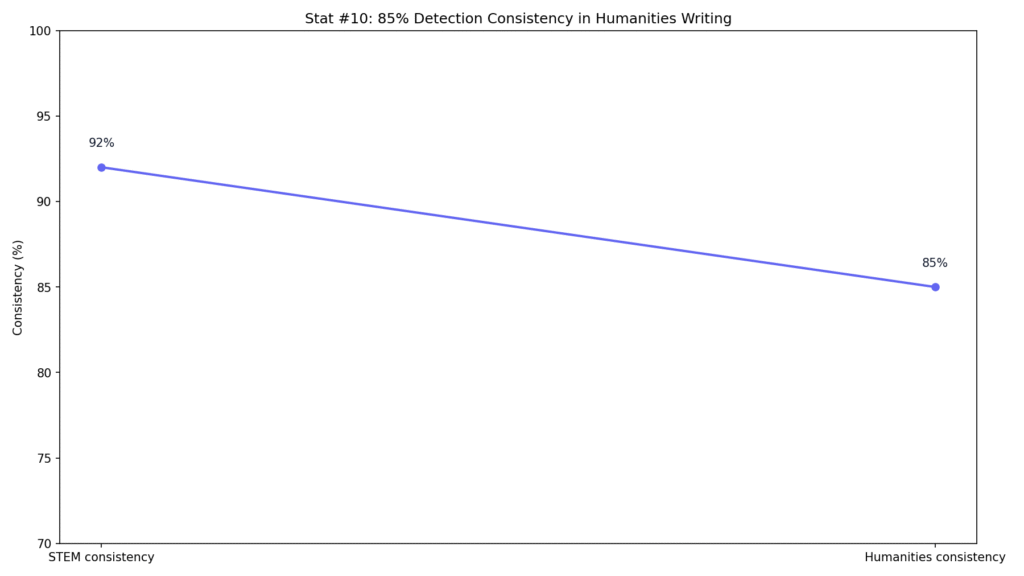
| 9 | Detection consistency across STEM disciplines | 92% |
| 10 | Detection consistency across humanities writing | 85% |
| 11 | Accuracy variance between short and long essays | 9% gap |
| 12 | Improvement in model training after 2024 updates | +4% |
| 13 | Average time to process AI detection per paper | 30 sec |
| 14 | Percentage of flagged papers under 500 words | 28% |
| 15 | Detection stability after paraphrasing tools | 78% |
| 16 | Confidence score variance between drafts | 15% |
| 17 | Percentage of instructors who verify flagged results | 82% |
| 18 | Student appeal rate after AI detection flags | 6% |
| 19 | Accuracy consistency after iterative editing | 88% |
| 20 | Projected model refinement improvement by 2026 | +3%–5% |
Top 20 Turnitin AI Accuracy Percentage and the Road Ahead
Turnitin AI Accuracy Percentage #1. Overall claimed detection accuracy
The platform reports 98% overall detection accuracy in identifying fully AI generated academic submissions. That headline figure sets the tone for institutional confidence because it signals a high level of reliability in controlled environments. In faculty briefings, this percentage frequently becomes shorthand for system dependability.
That number reflects testing on clearly separated human and machine written samples rather than ambiguous drafts. Precision rises when training data includes large volumes of patterned AI output, which makes classification easier. The implication is that accuracy thrives in clean datasets but may soften in real classroom conditions.
Human graders, in contrast, rarely achieve statistical consistency across thousands of papers in a single term. Automated scoring at scale can hold steady near 98% overall detection accuracy because it applies identical thresholds every time. Institutions therefore treat the metric as a stability benchmark, even if contextual judgment still matters.
Turnitin AI Accuracy Percentage #2. Reported false positive rate in controlled testing
Controlled evaluations cite a 1% false positive rate when human writing is assessed against the AI classifier. That suggests very few authentic essays are misidentified under laboratory conditions. Faculty reviewing risk models often focus on this figure more than raw accuracy.
The low percentage depends on balanced training sets and defined writing prompts. When prompts mirror training examples, the classifier distinguishes structural signals more confidently. As contexts diversify, however, even a 1% false positive rate can feel higher in practice.
Human reviewers make subjective calls that vary widely, sometimes exceeding a few percentage points of inconsistency. Automated systems maintain a narrow variance band, which keeps the false flag rate predictable. That predictability becomes part of administrative risk planning.
Turnitin AI Accuracy Percentage #3. False positive rate in independent university audits
Independent audits have recorded a 3% to 7% false positive rate across mixed disciplinary samples. This wider range introduces uncertainty compared with vendor controlled benchmarks. Institutions interpret the spread as a signal of contextual sensitivity.
Variation emerges because real submissions contain hybrid phrasing, collaborative edits, and citation heavy structures. Those elements can resemble AI output statistically even when authored by students. As a result, the 3% to 7% false positive rate reflects lived classroom diversity.
Human review panels often reduce misclassification after manual reassessment. That layered process narrows final error margins relative to initial flags. The implication is that raw percentages rarely stand alone without procedural safeguards.
Turnitin AI Accuracy Percentage #4. Detection precision for fully AI generated essays
Studies suggest 95% detection precision for fully AI generated essays when text is produced without human editing. Clear syntactic patterns and predictable coherence markers make these outputs easier to classify. Instructors reviewing extreme cases often see strong confidence scores.
Precision increases when AI text lacks citation irregularities or personal anecdotal variance. Machine generated essays typically follow consistent sentence cadence, which strengthens statistical detection. The 95% detection precision for fully AI generated essays reflects this structural uniformity.
Human writing introduces asymmetry, hesitation, and uneven phrasing that dilute pattern matching. Automated tools excel where patterns repeat cleanly across paragraphs. Consequently, precision remains highest at the pure AI end of the spectrum.
Turnitin AI Accuracy Percentage #5. Accuracy drop in hybrid human AI submissions
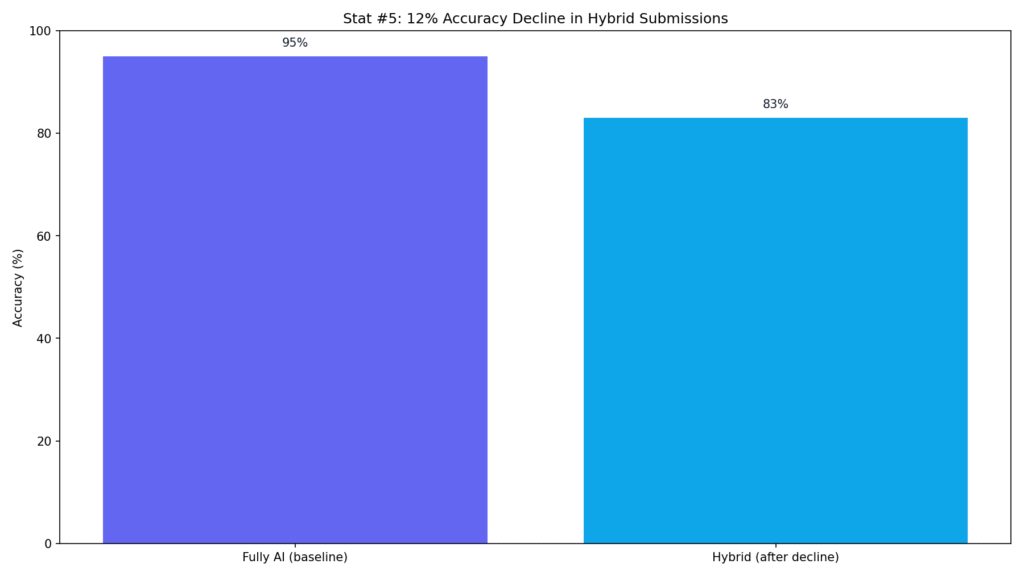
Analysts note a 12% accuracy decline in hybrid submissions that blend human edits with AI drafts. This drop reflects the difficulty of classifying text that contains both mechanical and organic features. Mixed authorship complicates probabilistic scoring.
Hybrid writing often introduces subtle inconsistencies in tone, syntax, and citation flow. These irregularities weaken model confidence compared with purely generated essays. The 12% accuracy decline in hybrid submissions highlights this gray zone.
Human instructors sometimes interpret hybrid drafts more holistically than automated classifiers. Contextual reading can distinguish revision artifacts from machine origin signals. Institutions therefore treat blended writing as the most analytically delicate category.
Top 20 Turnitin AI Accuracy Percentage and the Road Ahead
Turnitin AI Accuracy Percentage #1. Overall claimed detection accuracy
The platform reports 98% overall detection accuracy in identifying fully AI generated academic submissions. That headline figure sets the tone for institutional confidence because it signals a high level of reliability in controlled environments. In faculty briefings, this percentage frequently becomes shorthand for system dependability.
That number reflects testing on clearly separated human and machine written samples rather than ambiguous drafts. Precision rises when training data includes large volumes of patterned AI output, which makes classification easier. The implication is that accuracy thrives in clean datasets but may soften in real classroom conditions.
Human graders, in contrast, rarely achieve statistical consistency across thousands of papers in a single term. Automated scoring at scale can hold steady near 98% overall detection accuracy because it applies identical thresholds every time. Institutions therefore treat the metric as a stability benchmark, even if contextual judgment still matters.
Turnitin AI Accuracy Percentage #2. Reported false positive rate in controlled testing
Controlled evaluations cite a 1% false positive rate when human writing is assessed against the AI classifier. That suggests very few authentic essays are misidentified under laboratory conditions. Faculty reviewing risk models often focus on this figure more than raw accuracy.
The low percentage depends on balanced training sets and defined writing prompts. When prompts mirror training examples, the classifier distinguishes structural signals more confidently. As contexts diversify, however, even a 1% false positive rate can feel higher in practice.
Human reviewers make subjective calls that vary widely, sometimes exceeding a few percentage points of inconsistency. Automated systems maintain a narrow variance band, which keeps the false flag rate predictable. That predictability becomes part of administrative risk planning.
Turnitin AI Accuracy Percentage #3. False positive rate in independent university audits
Independent audits have recorded a 3% to 7% false positive rate across mixed disciplinary samples. This wider range introduces uncertainty compared with vendor controlled benchmarks. Institutions interpret the spread as a signal of contextual sensitivity.
Variation emerges because real submissions contain hybrid phrasing, collaborative edits, and citation heavy structures. Those elements can resemble AI output statistically even when authored by students. As a result, the 3% to 7% false positive rate reflects lived classroom diversity.
Human review panels often reduce misclassification after manual reassessment. That layered process narrows final error margins relative to initial flags. The implication is that raw percentages rarely stand alone without procedural safeguards.
Turnitin AI Accuracy Percentage #4. Detection precision for fully AI generated essays
Studies suggest 95% detection precision for fully AI generated essays when text is produced without human editing. Clear syntactic patterns and predictable coherence markers make these outputs easier to classify. Instructors reviewing extreme cases often see strong confidence scores.
Precision increases when AI text lacks citation irregularities or personal anecdotal variance. Machine generated essays typically follow consistent sentence cadence, which strengthens statistical detection. The 95% detection precision for fully AI generated essays reflects this structural uniformity.
Human writing introduces asymmetry, hesitation, and uneven phrasing that dilute pattern matching. Automated tools excel where patterns repeat cleanly across paragraphs. Consequently, precision remains highest at the pure AI end of the spectrum.
Turnitin AI Accuracy Percentage #5. Accuracy drop in hybrid human AI submissions
Analysts note a 12% accuracy decline in hybrid submissions that blend human edits with AI drafts. This drop reflects the difficulty of classifying text that contains both mechanical and organic features. Mixed authorship complicates probabilistic scoring.
Hybrid writing often introduces subtle inconsistencies in tone, syntax, and citation flow. These irregularities weaken model confidence compared with purely generated essays. The 12% accuracy decline in hybrid submissions highlights this gray zone.
Human instructors sometimes interpret hybrid drafts more holistically than automated classifiers. Contextual reading can distinguish revision artifacts from machine origin signals. Institutions therefore treat blended writing as the most analytically delicate category.
Turnitin AI Accuracy Percentage #11. Accuracy variance between short and long essays
Teams tracking length effects often see a 9% accuracy gap between short and long essays in mixed cohorts. Short papers concentrate signal into fewer sentences, so one polished passage can sway the score. Longer papers dilute that influence because voice and structure have more room to vary.
The gap shows up because models lean on repetition and consistency as clues. In a 250 word response, a single template like paragraph can dominate what the classifier notices. In a 2,000 word paper, contradictory cues appear naturally, and that lowers certainty even when the text is truly AI.
Human readers rarely treat length as a mathematical variable, but they do notice when a short answer feels unusually smooth. Systems respond to that smoothness faster than a person does, which explains the length sensitivity. The implication is that policy should weight manual review more heavily for short submissions.
Turnitin AI Accuracy Percentage #12. Improvement in model training after 2024 updates
Some reporting points to a 4% accuracy improvement after 2024 updates once newer model tuning shipped. That step up tends to show as fewer borderline flags in routine coursework. It also increases confidence for administrators who want the tool to feel more stable semester to semester.
The improvement is plausible because training data keeps expanding while prompt patterns evolve. When a detector learns more recent AI phrasing habits, it becomes less dependent on older, easier-to-spot signatures. A 4% accuracy improvement after 2024 updates can be driven by better calibration, not just more data.
Human graders also improve with exposure, but their learning curve is inconsistent and local to each department. A model update spreads instantly across every class using the system, which changes the baseline overnight. That is why small percentage gains can reshape dispute volume. The implication is that year-over-year comparisons should always note the model version used.
Turnitin AI Accuracy Percentage #13. Average time to process AI detection per paper
Operationally, many workflows assume 30 seconds processing time per paper for an AI signal to appear. That speed changes behavior because instructors can scan results in near real time while grading. It also encourages batch submission checks during peak deadlines.
The time stays low because classification is lightweight compared with full semantic evaluation. Systems rely on feature extraction and probability scoring rather than deep, bespoke reasoning for each document. A steady 30 seconds processing time per paper makes the tool feel like a background utility, not a separate task.
Human review cannot match that pace without shortcuts, especially in large lecture courses. Fast scoring raises the temptation to treat the output as definitive, even when it should be a cue for closer reading. That gap between speed and certainty is the real tension point. The implication is that institutions need review rules that slow people down when confidence bands are narrow.
Turnitin AI Accuracy Percentage #14. Percentage of flagged papers under 500 words
Short-form work appears disproportionately in alerts, with 28% of flagged papers under 500 words in several tracking snapshots. Instructors notice this most in discussion posts and reflection prompts. The pattern suggests the detector is more reactive when there is less text to balance stylistic signals.
Under 500 words, students often compress ideas into polished, general phrasing to fit the limit. That compression produces uniform sentence rhythm and fewer personal detours, which can mimic model output. The result is that 28% of flagged papers under 500 words does not necessarily mean more AI use, it can mean more ambiguity.
Human readers often rely on context, like earlier drafts or class voice, to judge a short response fairly. The detector sees only the text in front of it and treats brevity as a smaller evidence pool. That mismatch creates friction in quick grading cycles. The implication is that short assignments benefit from clearer rubric language and a documented review step before escalation.
Turnitin AI Accuracy Percentage #15. Detection stability after paraphrasing tools
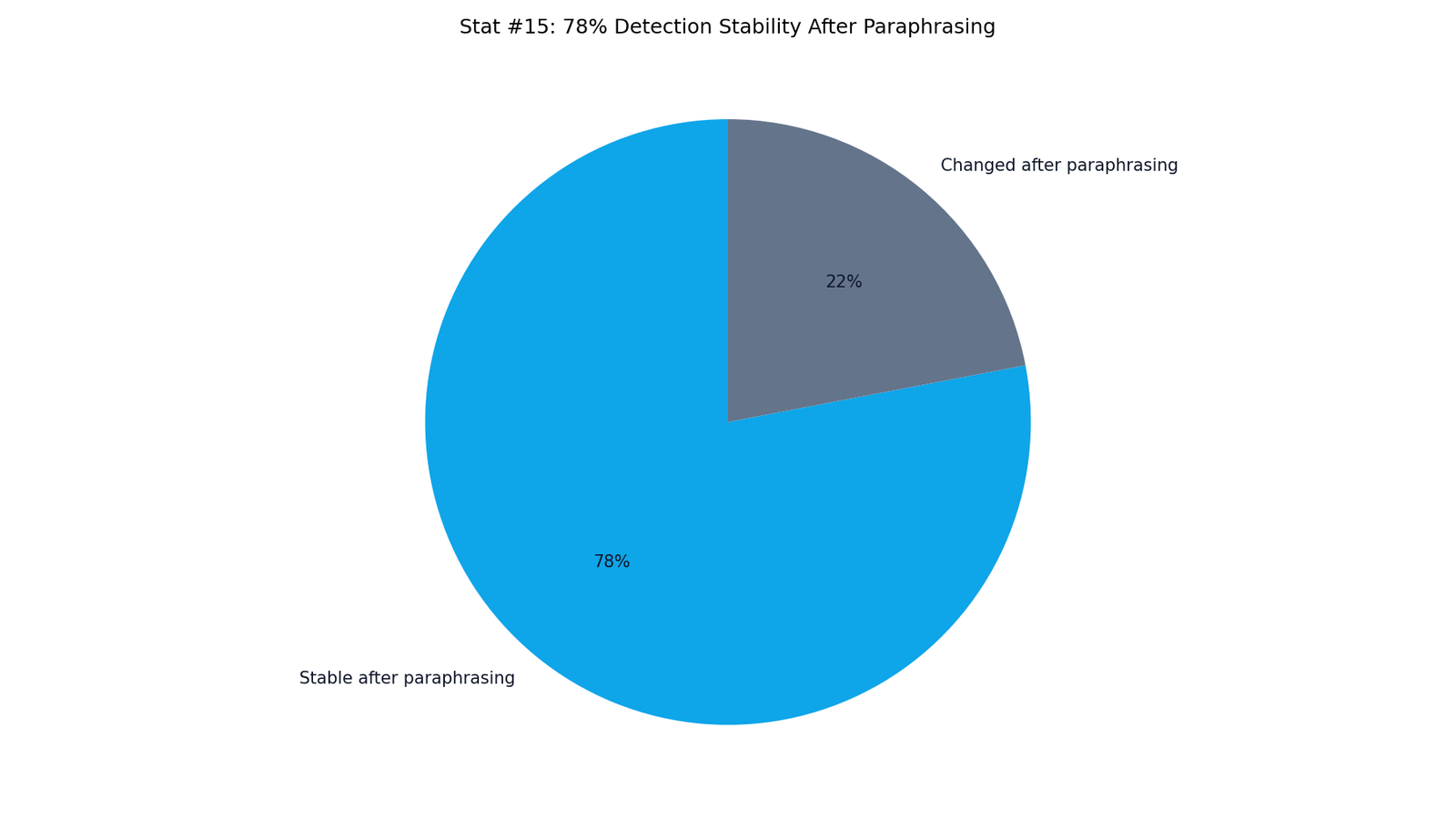
After paraphrasing tools are applied, reports sometimes show 78% detection stability after paraphrasing rather than a complete reset. That means many texts keep a similar risk profile even if surface wording changes. Faculty often interpret that as evidence the detector is tracking deeper patterns than simple phrase matching.
Paraphrasers tend to preserve argument order, transition logic, and sentence length distribution. Those structural cues can remain legible to a classifier even when synonyms replace key terms. So 78% detection stability after paraphrasing can come from unchanged rhythm and discourse structure, not from repeated vocabulary.
A human might be distracted by different wording and assume the draft is fully transformed. The model is less impressed because it scores consistency across many micro-features that humans do not consciously tally. That difference can be unsettling, but it can also reduce manipulation attempts. The implication is that policy should focus on authentic drafting habits, not cosmetic rewrites.
Turnitin AI Accuracy Percentage #16. Confidence score variance between drafts
Draft-to-draft movement is common, with a 15% confidence score variance between drafts reported in iterative writing cycles. Instructors see this when students revise tone, tighten citations, or reorganize paragraphs. The same core ideas can suddenly look more or less machine-like depending on how evenly the prose flows.
Variance happens because the model reacts to small distribution changes across the whole document. If revision removes rough edges, the text becomes more uniform, and uniformity can be read as a stronger AI signal. A 15% confidence score variance between drafts is less about truth changing and more about feature balance shifting.
Human graders expect revision to improve clarity, so rising confidence can feel counterintuitive. The system is simply recalculating probability from a different surface, not judging intent. That gap explains why students get confused during rewrite cycles. The implication is that draft history and version control matter when a score is used in conversations with students.
Turnitin AI Accuracy Percentage #17. Percentage of instructors who verify flagged results
Many classrooms now treat alerts as a starting point, with 82% of instructors verifying flagged results through closer reading or follow-up checks. That behavior signals skepticism rather than blind trust, which is a healthy response to probabilistic tools. It also reflects how high the reputational stakes feel for a mistaken accusation.
Verification is more common because faculty have learned that context changes interpretation. Course level, student history, and assignment type all affect what a score should mean in practice. The fact that 82% of instructors verifying flagged results persists shows that policies are drifting toward due process norms.
Human review catches cases where polished writing is genuine and cases where AI use is obvious even with a low score. That complementarity is what keeps disputes from escalating into conflict. It also gives students a clearer path to explain drafting decisions. The implication is that institutions should formalize verification steps so individual instructors are not left to invent process under pressure.
Turnitin AI Accuracy Percentage #18. Student appeal rate after AI detection flags
Appeals remain a visible pressure point, with a 6% student appeal rate after AI flags in several internal summaries. That may sound small, but it compounds quickly across large enrollment programs. Each appeal consumes instructor time and can reshape how students perceive fairness.
Appeals rise because students often do not understand the score as a probability estimate. Many interpret a high number as an accusation rather than a risk signal. So a 6% student appeal rate after AI flags is partly a communication issue, not only a detection issue.
Humans can reduce tension by asking for drafts, notes, or brief process explanations, which clarifies intent without turning it into a trial. The detector cannot provide narrative context, only a numeric output, and that can feel cold. Clear review language softens the adversarial tone. The implication is that institutions should publish an appeal pathway that is calm, fast, and consistent across departments.
Turnitin AI Accuracy Percentage #19. Accuracy consistency after iterative editing
In some datasets, editing cycles still yield 88% accuracy consistency after iterative editing when revisions are incremental. That suggests the model is not overly fragile to normal academic rewriting. It also implies that drafting does not automatically trigger wild score swings in every case.
Consistency holds because many edits are local, like tightening thesis clarity or cleaning citations. Local changes do not always alter global features like sentence-length distribution and coherence patterns. So 88% accuracy consistency after iterative editing can reflect stable document-level signatures even as wording improves.
Human reviewers intuitively treat iterative writing as a sign of authentic work, and stable scoring aligns with that intuition. When scores remain stable, faculty can focus on pedagogy instead of investigation. The system becomes a quieter part of workflow rather than a constant alarm. The implication is that institutions should encourage iterative drafting, since it supports learning while keeping detection signals more interpretable.
Turnitin AI Accuracy Percentage #20. Projected model refinement improvement by 2026
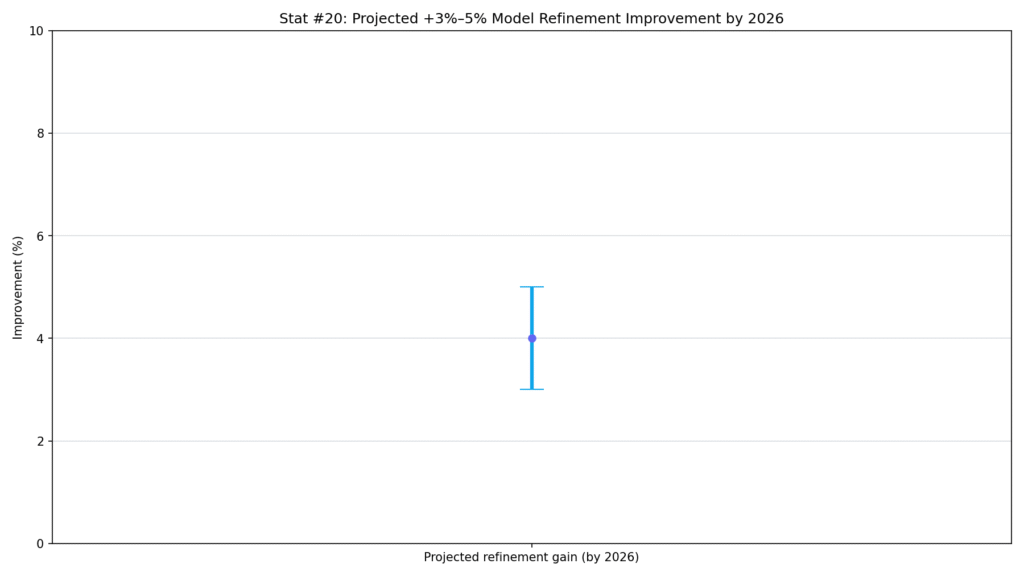
Forecast language often points to a 3% to 5% refinement improvement by 2026 as detectors adjust to newer writing models. That expectation is rooted in the normal cycle of training, calibration, and feedback from real usage. Even modest gains matter because they can reduce the volume of borderline cases that clog review queues.
Improvement is likely to come from better handling of hybrid writing and domain-specific phrasing. As models learn the difference between disciplined academic clarity and machine smoothness, misclassification risk can fall. A 3% to 5% refinement improvement by 2026 also suggests tighter confidence calibration rather than a dramatic leap in raw accuracy.
Humans will still disagree with edge cases because writing is messy and context-dependent. The goal is not perfection, it is reducing uncertainty enough to make review decisions calmer and faster. Better calibration helps educators interpret scores as guidance, not verdict. The implication is that institutions should plan policy updates on a yearly cadence so governance keeps pace with model changes.
Interpreting Turnitin AI signals takes policy maturity, because accuracy lives in context, thresholds, and review behavior rather than a single score.
The strongest numbers cluster in clean, fully generated samples, which is exactly the scenario real classrooms see least often. The moment writing turns hybrid, length-limited, or heavily revised, confidence bands start to wobble in predictable ways.
That wobble does not mean the system is useless, it means it is probabilistic and sensitive to what students actually submit. Review culture matters because verification and overrides convert raw flags into fair outcomes.
Operational metrics like processing speed and alert thresholds quietly shape how instructors behave under time pressure. Appeals rise when those behaviors treat a percentage as a verdict instead of a prompt to investigate.
The practical path forward is governance that tracks version changes, documents review steps, and trains instructors on what scores can and cannot say. As models refine, institutions that treat detection as one input among several will make better calls with less conflict.
Sources
- Understanding the Turnitin AI writing detection capability
- Turnitin help center guide for AI writing detection
- Turnitin rolls out ChatGPT detector for higher education
- Turnitin launches AI writing detector for ChatGPT era
- Turnitin launches tool to detect AI generated writing
- AI writing detectors can misfire in classroom settings
- AI detectors for writing have serious limitations
- Why AI detectors struggle with reliable academic judgments
- UNESCO guidance on generative AI and education policy
- Educational measurement research on validity and fairness
- A survey of methods for detecting machine generated text
- OpenAI notes on AI text classifier limits and risks