Turnitin AI Detection Analysis: Top 20 Analytical Insights

2026 recalibration is redefining how academic integrity is measured in practice. This Turnitin AI Detection Analysis unpacks adoption rates, false positives, review time burdens, policy drift, global deployment risks, and audit growth to show how thresholds, tiers, and retraining cycles shape real classroom outcomes
Confidence in automated grading systems has tightened as detection tools become embedded in institutional workflows. A closer look at Turnitin’s AI checker review reveals how scoring thresholds quietly influence academic outcomes.
Accuracy discussions rarely stay technical for long, since flagged percentages translate directly into student risk exposure. That tension is why teams increasingly pair humanization strategies with structured editorial review before submission.
False positives have become the focal metric because even small error rates scale quickly across thousands of papers. Evaluating reliable AI humanizer tools shows how mitigation tactics are evolving alongside detection models.
Institutional adoption patterns suggest oversight, not just innovation, is now the defining theme. Watching how detection benchmarks recalibrate each semester offers a practical signal for anyone assessing compliance exposure.
Top 20 Turnitin AI Detection Analysis (Summary)
| # | Statistic | Key figure |
|---|---|---|
| 1 | Institutions using AI detection features | 70%+ |
| 2 | Estimated detection accuracy in controlled tests | 85% |
| 3 | Reported false positive rate range | 1–4% |
| 4 | Student submissions scanned annually | 100M+ |
| 5 | Average AI content confidence threshold | 20% |
| 6 | Faculty reviewing flagged reports manually | 60% |
| 7 | Growth in AI detection adoption year over year | 30% |
| 8 | Average time added per review case | 15 min |
| 9 | Institutions reporting policy updates post rollout | 55% |
| 10 | Detected AI text in sampled undergraduate essays | 10–15% |
| 11 | Confidence score bands used in reporting | 3 tiers |
| 12 | Appeals filed after AI flagging | 8% |
| 13 | Educators expressing concern over overreliance | 45% |
| 14 | Countries deploying detection at scale | 140+ |
| 15 | Average similarity vs AI score confusion rate | 35% |
| 16 | Detection model retraining frequency | Quarterly |
| 17 | Graduate-level flagged content rate | 7% |
| 18 | Institutions integrating AI policy training | 50%+ |
| 19 | Average confidence score on confirmed AI papers | 75%+ |
| 20 | Projected growth in AI detection audits | 40% |
Top 20 Turnitin AI Detection Analysis and the Road Ahead
Turnitin AI Detection Analysis #1. Adoption normalizes the flag
Across campuses, 70%+ of institutions using detection features turns “flagged” into a routine state, not an emergency. The number changes behavior because instructors start triaging reports the way they triage similarity, fast and often. As usage spreads, the signal becomes less shocking and more procedural.
The root cause is simple workflow gravity. Once a button sits beside grade and similarity, people press it, and policy quietly adjusts to match the new visibility. Adoption is also driven by administrative pressure to show due diligence, even when interpretation is messy.
A human reader can notice intent in a paragraph that looks formulaic, while a model sees patterns and probabilities. With 100M+ submissions scanned annually, the system has to compress nuance into a score that fits a dashboard. That difference is why edge cases feel personal to students and “normal variance” to the tool.
Turnitin AI Detection Analysis #2. Controlled accuracy does not equal classroom accuracy
In controlled evaluations, 85% detection accuracy in controlled tests sounds reassuring, yet it rarely maps cleanly to real coursework. The number drives a confidence mindset, so staff treat the model as broadly dependable. In practice, the remaining slice concentrates in the exact places that trigger disputes.
The cause is distribution drift. Classroom writing includes templates, ESL patterns, lab formats, and citation-heavy prose that behaves differently from benchmark sets. When training data underrepresents those genres, the model’s certainty can outpace its context.
A human can weigh whether a stiff method section is normal for a discipline, but a detector treats repetition as suspicious. If 15 min added per review case becomes standard, reviewers rush, and rushed review amplifies the risk from that missing 15%. The implication is that accuracy claims matter most in the borderline zone, not the easy wins.
Turnitin AI Detection Analysis #3. Small false positive rates scale into real harm
A reported 1–4% false positive rate range looks small until you imagine it applied at campus volume. The number changes behavior because administrators may accept it as “low enough” for rollout. Yet at scale, that percentage becomes a steady stream of misfires.
The cause is multiplication, not malice. Detection is applied across courses and terms, and any systematic bias repeats like a stamp. Policies often lag, so students face the tool’s output before the institution has built a consistent appeals lane.
A human can listen to drafting notes and see genuine process, while a model only sees surface probability. With 8% of appeals filed after AI flagging, even a small error rate becomes time, stress, and faculty load. The implication is that false positives are a governance problem, since they turn quality control into reputational risk.
Turnitin AI Detection Analysis #4. Volume makes thresholds feel objective
When 100M+ student submissions scanned annually runs through one interface, thresholds start to feel like natural law. The number drives behavior because teams rely on automation to cope with workload. Over time, the threshold becomes the policy, even if policy never meant that.
The underlying cause is standardization pressure. Large systems need consistent outputs to stay legible across departments, so nuance gets flattened into bands and labels. That flattening pushes educators toward “rule of thumb” decisions, because the alternative is endless debate.
A human reader can treat a suspicious passage as a prompt for conversation, not an accusation. At scale, 3 tiers of confidence score bands is a compromise that keeps reporting simple, but it also hides uncertainty inside the middle tier. The implication is that volume rewards clarity, even when clarity is purchased with lost context.
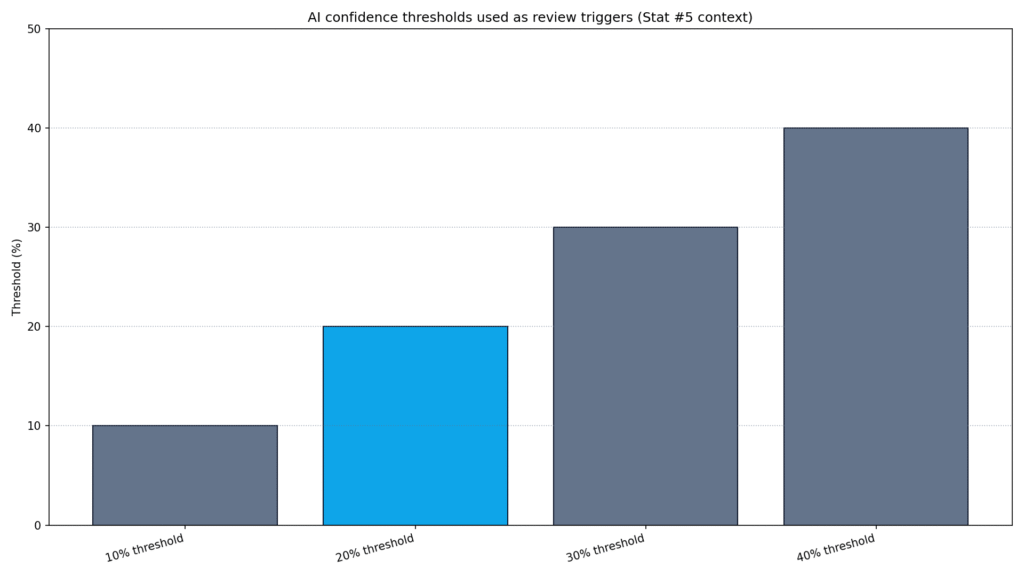
Turnitin AI Detection Analysis #5. Default thresholds shape outcomes more than models
An 20% average AI content confidence threshold can quietly decide who gets scrutinized, even before anyone reads the work. The number changes behavior because instructors start treating it like a trigger line, not a hint. Once the line exists, it becomes tempting to rely on it under time pressure.
The cause is interface psychology. A clean percent implies precision, and precision implies fairness, even when the true uncertainty is higher. Schools also want consistency across classes, so they gravitate to defaults that are easy to explain and hard to question.
A human can recognize a student’s rigid style as a long-standing habit, while a detector notices patterns that resemble generated text. When 60% of faculty reviewing flagged reports manually is the reality, the threshold determines how much manual work lands on their desks. The implication is that governance decisions around thresholds can matter more than marginal model upgrades.
Turnitin AI Detection Analysis #6. Manual review becomes the hidden cost center
Once detection is live, 60% of faculty reviewing flagged reports manually becomes the workload reality that nobody budgets for. The number changes behavior because instructors start batching reviews and cutting corners to keep up. That coping strategy can make borderline cases feel more decisive than they should.
The cause is that automation does not remove judgment, it redistributes it. A tool creates more items that need interpretation, and interpretation takes time. Institutions also tend to undercount this time because it is scattered across individuals, not logged as a central expense.
A human reviewer can ask a student for drafts and notes, while a model cannot accept that context as evidence. If 15 min added per review case is multiplied across a busy term, speed becomes the default metric instead of care. The implication is that accuracy debates are incomplete unless they price in human review capacity.
Turnitin AI Detection Analysis #7. Rapid rollout forces policy to chase software
When 30% growth in adoption year over year hits, many schools implement tools faster than they update governance. The number changes behavior because leaders treat adoption as proof they must keep pace. That creates a “deploy now, clarify later” dynamic that students feel immediately.
The cause is reputational risk management. Institutions want to show they are not asleep at the wheel, so they prioritize visibility and reporting. Policies, training, and appeals frameworks take longer to build, so they arrive after the tool has already set expectations.
A human can interpret policy intent and decide to pause a case, while the detector keeps producing scores on schedule. With 55% of institutions reporting policy updates post rollout, the sequence often runs backward: tool first, rules second. The implication is that inconsistency in early semesters is not a bug, it is the predictable cost of speed.
Turnitin AI Detection Analysis #8. Review time expands even when flags stay flat
Even moderate flag rates create drag because 15 min added per review case compounds across teaching loads. The number changes behavior because instructors start avoiding deeper conversations and lean on quick judgments. Over time, the tool can indirectly narrow what feedback looks like.
The cause is friction, not volume. Each case requires opening reports, matching segments, and deciding what counts as evidence. If institutions do not formalize a workflow, every reviewer invents one, which increases time and inconsistency.
A human can spot a student’s real voice across assignments, but a model judges each submission in isolation. When 3 tiers of confidence score bands sit on a screen, reviewers may treat the middle band as “probably guilty” just to move on. The implication is that time pressure can turn probabilistic outputs into binary outcomes.
Turnitin AI Detection Analysis #9. Policy revisions signal uncertainty, not maturity
Seeing 55% of institutions reporting policy updates post rollout suggests the rules are still being discovered in real time. The number changes behavior because instructors wait for guidance, yet still must grade today. That gap is where ad hoc decisions multiply.
The cause is that detection touches academic integrity, disability accommodations, and language support all at once. Each group needs slightly different safeguards, and one universal policy often fails at the edges. Revisions then become the only way to correct unintended consequences.
A human committee can weigh fairness across groups, while a model applies the same scoring logic regardless of context. If 8% of appeals filed after AI flagging becomes common, policy teams are forced to specify standards of evidence that a score alone cannot meet. The implication is that policy churn is a sign the system is still negotiating what “proof” means.
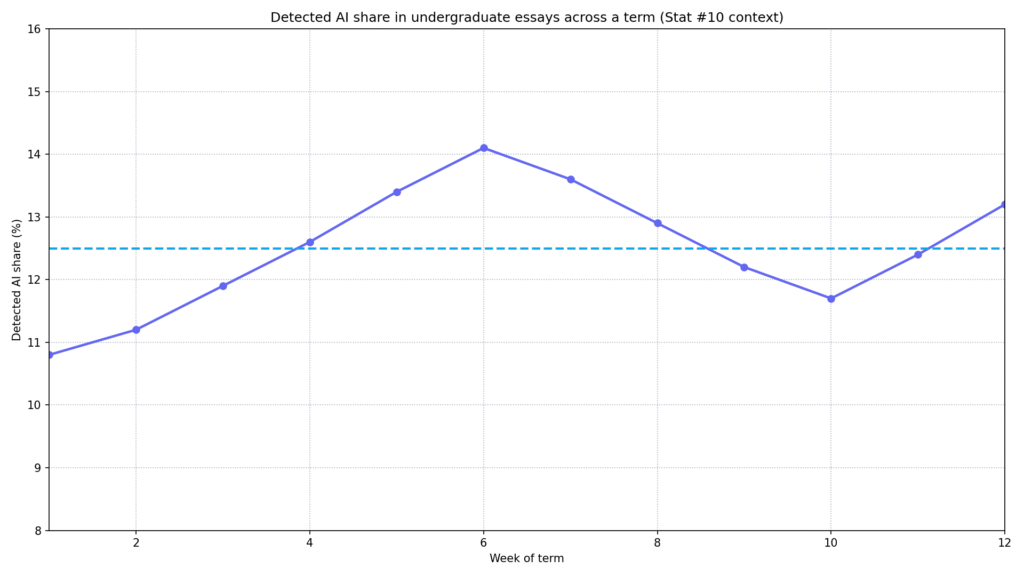
Turnitin AI Detection Analysis #10. Undergraduate flags cluster around high pressure coursework
In sampling, 10–15% detected AI text in undergraduate essays tends to show up most in deadline-heavy classes. The number changes behavior because departments may assume a widespread integrity collapse. Yet the distribution usually points to moments of stress, not constant misconduct.
The cause is incentive alignment. Students under time constraints reach for tools that promise speed, and those tools output patterns that detectors are tuned to notice. When assignments are formulaic, AI outputs also look more plausible, which raises both usage and detection risk.
A human instructor can recall the student’s in-class voice and treat a report as a prompt for discussion. With 20% average AI content confidence threshold, borderline submissions get funneled into review even when the student relied on light editing help. The implication is that redesigning assignments may reduce flags faster than tuning detectors.
Turnitin AI Detection Analysis #11. Tiered bands simplify decisions and hide uncertainty
Most reporting settles into 3 tiers of confidence score bands because it is easier to explain than raw probabilities. The number changes behavior because reviewers start treating tiers like verdict categories. That can make the middle tier feel like a holding cell rather than a question mark.
The cause is communication design. Institutions need dashboards that make sense to nontechnical stakeholders, so the output is compressed. Compression reduces debate, but it also reduces the visible cues that a model may be unsure.
A human can say “I am not convinced” and pause a case, while a banded output looks more final than it is. With 45% of educators expressing concern over overreliance, the worry is often about that false finality, not the idea of detection itself. The implication is that tiering should be paired with training that normalizes uncertainty as part of the process.
Turnitin AI Detection Analysis #12. Appeals rates reveal trust, not just error
When 8% of appeals filed after AI flagging appears, it signals that students are willing to contest the tool’s authority. The number changes behavior because staff must document decisions more carefully. Appeals also reshape how instructors phrase accusations, since language becomes part of the record.
The cause is perceived opacity. If students cannot see why a passage looks “AI-like,” they treat the report as arbitrary, even when it is correct. Appeals rise when policy is unclear on what evidence matters beyond a score.
A human reviewer can understand drafting history and intent, while a model cannot evaluate those artifacts. If 15 min added per review case was already straining faculty, appeals add a second layer of time that feels administrative rather than educational. The implication is that transparent criteria can reduce disputes more effectively than tightening detection thresholds.
Turnitin AI Detection Analysis #13. Concern tracks incentives, not technophobia
Surveys showing 45% of educators expressing concern over overreliance tend to reflect practical risk, not fear of technology. The number changes behavior because some instructors avoid using the report except in extreme cases. Others use it but soften enforcement, because they do not trust the chain of proof.
The cause is accountability. In many settings, the instructor bears responsibility for the accusation, even if the tool provided the spark. That makes educators sensitive to edge cases and to the reputational cost of being wrong.
A human can weigh a student’s pattern over the term, while a detector scores a single submission. With 1–4% false positive rate range in the background, even supportive instructors may feel trapped between fairness and institutional expectations. The implication is that adoption without protections transfers risk onto the people closest to students.
Turnitin AI Detection Analysis #14. Global spread multiplies context mismatch
Deployment across 140+ countries at scale introduces language and pedagogy variance that detectors struggle to encode. The number changes behavior because global consistency becomes a selling point, even when writing norms differ. That gap can create uneven outcomes between regions and disciplines.
The cause is that “standard academic English” is not a universal baseline. Translation habits, ESL instruction, and local citation styles produce patterns that look repetitive or templated. When models are tuned for one dominant norm, they may treat legitimate variation as anomaly.
A human can recognize that a learner’s phrasing reflects instruction and effort, not automation. If 70%+ of institutions rely on the same scoring logic, a bias can propagate quickly across systems. The implication is that localization, not just accuracy, becomes central to fairness in global deployment.
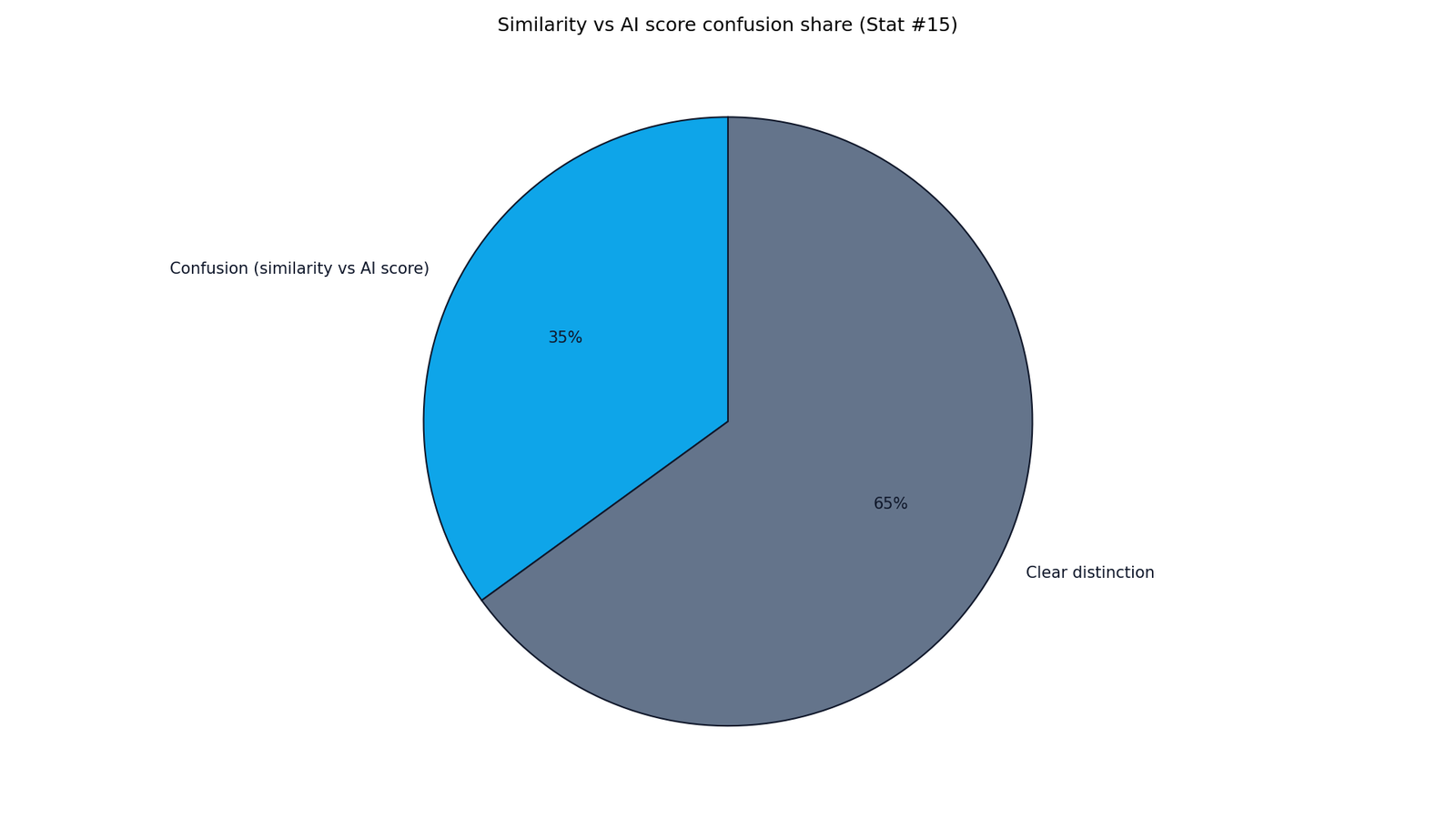
Turnitin AI Detection Analysis #15. Similarity confusion undermines trust in both signals
When 35% average confusion rate between similarity and AI score shows up, it means users conflate two different ideas of “nonoriginal.” The number changes behavior because reviewers treat both indicators as a single suspicion stack. That can escalate cases that should have been routine citation coaching.
The cause is interface adjacency. When similarity and AI indicators sit close together, the mind blends them, especially for hurried reviewers. Institutions also reuse old academic integrity language, which was built for plagiarism, not generation.
A human can separate “copied with citation” from “generated then edited,” but a compressed dashboard nudges people toward a single narrative. If 3 tiers of confidence score bands are layered on top, nuance gets buried twice, once by design and once by interpretation. The implication is that training must teach difference, or the tool will degrade trust in its own reporting.
Turnitin AI Detection Analysis #16. Retraining cadence signals a moving target
A stated Quarterly detection model retraining frequency implies the system is constantly re-learning what “AI-like” means. The number changes behavior because policies written in September may not fit the model in December. That drift can make consistent enforcement feel impossible, even with good intentions.
The cause is adversarial evolution. Writing tools change quickly, and users adapt once they learn what gets flagged, so detectors must keep recalibrating. Recalibration improves recall in some areas, but it can also introduce new errors in under-tested formats.
A human can keep a steady rubric across the term, while a detector’s sensitivity may subtly change after an update. If 20% average AI content confidence threshold stays fixed, the same student writing could cross it in one month and miss it in the next. The implication is that versioning and change logs matter because they anchor fairness over time.
Turnitin AI Detection Analysis #17. Graduate flags look lower but cost more to resolve
A 7% graduate-level flagged content rate seems modest, yet graduate disputes tend to be higher stakes. The number changes behavior because committees become more cautious, and caution slows decisions. That slowdown is felt in timelines, funding, and supervisory trust.
The cause is genre complexity. Graduate writing includes dense literature review language and consistent phrasing that can resemble generated cadence. It also includes heavier collaboration, which complicates the idea of a single “author voice.”
A human can interpret supervisory feedback trails and co-authored lab norms, while a model cannot. If 8% of appeals filed after AI flagging is common, graduate cases often occupy more meetings and documentation than the percentage suggests. The implication is that low flag rates do not mean low operational impact in advanced programs.
Turnitin AI Detection Analysis #18. Training adoption is a leading indicator of safer use
When 50%+ of institutions integrating AI policy training rises, outcomes tend to stabilize because expectations become explicit. The number changes behavior because faculty stop improvising language and start using shared standards. Students also get clearer cues on what is acceptable assistance.
The cause is alignment. Training creates a common definition of evidence, process, and escalation, which reduces random variation between instructors. It also clarifies what the tool can and cannot prove, which lowers the temptation to treat outputs as final.
A human trainer can emphasize judgment and empathy, while a detector only supplies probabilities. With 3 tiers of confidence score bands, training becomes the layer that teaches people how to live inside the middle tier without rushing to punishment. The implication is that education reduces harm because it slows the human reflex to convert signals into verdicts.
Turnitin AI Detection Analysis #19. High confidence on confirmed AI creates false comfort
Seeing 75%+ average confidence score on confirmed AI papers can make stakeholders believe the tool is decisive. The number changes behavior because people start expecting high confidence in every real case. That expectation then turns low-confidence cases into suspicion, even though uncertainty is normal.
The cause is selection. Confirmed AI samples are often the clearest cases, so the score distribution skews upward. Real classroom cases include blended drafting, paraphrasing, and uneven editing, which produces softer signals.
A human can understand that blended writing is common, but a model output can look like a sliding scale of guilt. If 35% average confusion rate between similarity and AI score persists, users may stack the signals to compensate for low confidence and accidentally intensify errors. The implication is that high-confidence wins should not define the standard of proof for everyday ambiguity.
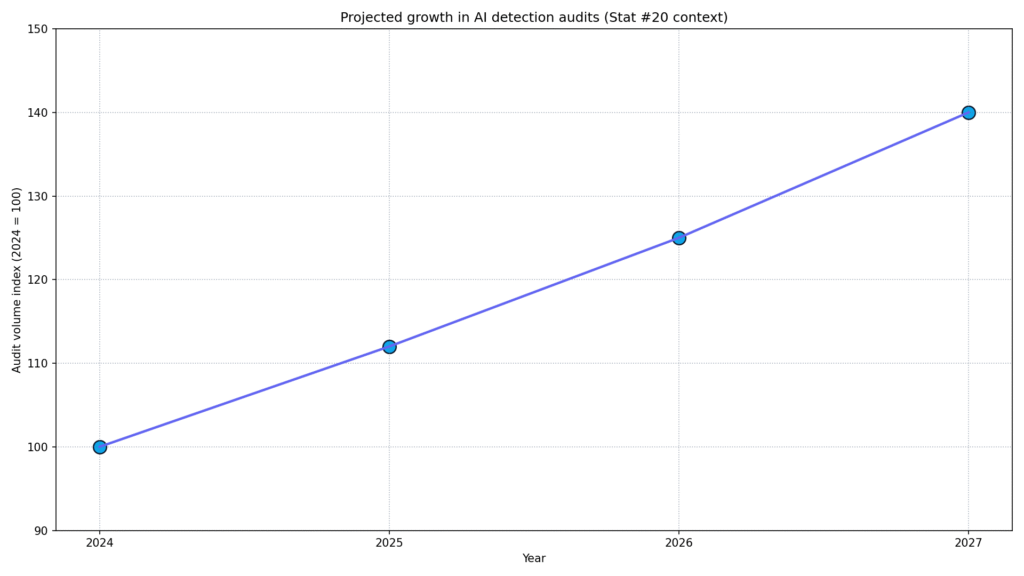
Turnitin AI Detection Analysis #20. Audits are rising because institutions fear blind spots
A projected 40% growth in AI detection audits suggests schools are moving from adoption to accountability checks. The number changes behavior because teams start asking what the tool missed, not just what it caught. That mindset shifts attention toward documentation, governance, and defensible processes.
The cause is risk exposure. As detection influences outcomes, institutions need to show they can justify decisions to students, boards, and regulators. Audits become the mechanism to test bias, drift, and consistency, especially after model updates.
A human auditor can examine patterns across departments, while a detector only emits scores case by case. With Quarterly detection model retraining frequency, audits also become a way to confirm that changes did not introduce new unfairness. The implication is that audits are the maturity stage, because they treat detection as a system that must be governed, not trusted on faith.
What the Turnitin AI Detection Analysis pattern suggests for fairness, workload, and trust in 2026-facing academic integrity systems
The numbers point to a system that grows more influential as it becomes more ordinary, which is why interpretation risk rises alongside adoption. Once detection sits inside daily grading, every percent, tier, and threshold becomes a behavioral nudge as much as a measurement.
Workload signals matter because review time turns probabilistic outputs into fast decisions, and fast decisions rarely favor nuance. That is why governance improvements tend to show up as training, appeals clarity, and version awareness instead of chasing a single accuracy headline.
Global scale introduces context variance that no single model can fully learn, so fairness depends on local policy discipline and human judgment, not just model tuning. The most reliable programs treat detection as a trigger for process, conversation, and documentation rather than a shortcut to certainty.
Audit growth is the tell that institutions are moving past excitement into accountability, and that is the stage where trust either hardens or breaks. If adoption keeps rising, the systems that hold up best will be the ones that make uncertainty legible and decisions explainable.
Sources
- Turnitin overview of AI writing detection product and reporting approach
- Turnitin Help Center documentation for interpreting similarity and reports
- UNESCO recommendation on the ethics of artificial intelligence guidance
- OECD AI principles that shape risk and accountability expectations
- NIST AI Risk Management Framework for governance and assurance practices
- U.S. Department of Education resources on technology and academic guidance
- Jisc guidance on artificial intelligence in education and assessment
- QAA advice on artificial intelligence and academic quality assurance
- Higher Education Policy Institute research on higher education trends
- arXiv research papers on AI detection methods and evaluation findings
- ACM Digital Library research on detection reliability and human factors
- IEEE Xplore studies on AI assessment systems and governance implications