Turnitin AI False Positive Statistics: Top 20 Identified Issues

Turnitin AI false positive statistics examines audit false positive rates, ESL disparities, structured format sensitivity, draft score swings, appeal outcomes, and hybrid review adoption, explaining how small probability margins translate into workload strain, student stress, and evolving institutional policy frameworks.
Institutions are increasingly caught between innovation and enforcement as automated detection tools take on a larger role in academic oversight. Ongoing debates around Turnitin AI checker review cycles reflect how quickly trust can erode when results feel inconsistent.
False flags do more than inconvenience students; they introduce measurable friction into grading workflows and faculty decision making. Guidance on how to handle Turnitin AI false flags has become part of routine academic policy discussions, which signals that this is no longer a rare edge case.
Detection thresholds behave unpredictably when language models influence drafting habits, even subtly. As a result, editors and students alike are exploring the best AI rewriter tools suitable for Turnitin drafts to reduce unnecessary exposure without compromising originality.
Assessment strategies now require closer statistical scrutiny rather than surface level compliance. Evaluating false positive patterns has become a practical necessity for institutions aiming to balance academic integrity with procedural fairness.
Top 20 Turnitin AI False Positive Statistics (Summary)
| # | Statistic | Key figure |
|---|---|---|
| 1 | Reported false positive rate in independent university audits | 1%–4% |
| 2 | Percentage of ESL students disproportionately flagged | 22% |
| 3 | Faculty who express low confidence in AI detection accuracy | 36% |
| 4 | Assignments manually overturned after initial AI flag | 18% |
| 5 | Average detection confidence threshold used by institutions | 80% |
| 6 | Students reporting stress after AI false accusation | 64% |
| 7 | False positive risk in shorter essays under 500 words | 2× higher |
| 8 | Institutions revising AI policy within first year of rollout | 41% |
| 9 | Manual review time added per flagged submission | 15–25 mins |
| 10 | False flags involving structured academic writing formats | 27% |
| 11 | Students unaware of AI detection scoring methodology | 72% |
| 12 | Faculty requesting additional training on AI detection tools | 48% |
| 13 | Disputed AI flags successfully appealed | 31% |
| 14 | False positive likelihood in formulaic lab reports | 3% |
| 15 | Confidence score variance between drafts and final submissions | 12–18 pts |
| 16 | Students modifying writing style after AI rollout | 54% |
| 17 | Institutions publishing transparency reports on AI detection | 19% |
| 18 | Average turnaround time for AI-related grade disputes | 7–14 days |
| 19 | False positive concentration in humanities essays | 2.3× higher |
| 20 | Institutions considering hybrid human plus AI review models | 63% |
Top 20 Turnitin AI False Positive Statistics and the Road Ahead
Turnitin AI False Positive Statistics #1. Independent audit false positive rate
Independent reviews show 1%–4% false positive rate in university audits, which appears small until scaled across thousands of submissions. Even a modest percentage translates into dozens of wrongly flagged essays per term. That pattern becomes more visible in large lecture courses.
The underlying cause often relates to detection thresholds calibrated for high recall rather than precision. Systems err on the side of caution, so borderline writing patterns trigger suspicion. Academic prose that is structured and predictable can resemble model output.
Human graders typically rely on context and drafts, whereas algorithms depend on probabilistic signatures. A 1%–4% false positive rate might seem tolerable statistically, yet it carries reputational weight for students. Institutions must therefore weigh error margins against due process implications.
Turnitin AI False Positive Statistics #2. ESL students disproportionately flagged
Data indicates 22% of ESL students disproportionately flagged compared with native speakers. That gap suggests detection tools respond strongly to simplified or standardized syntax patterns. The pattern persists across disciplines.
Language learners often rely on structured phrasing to reduce grammatical risk. AI systems also generate structured phrasing, which increases overlap in statistical signatures. The algorithm does not interpret intent, only probability.
Instructors reviewing cases note that 22% of ESL students flagged reflects systemic sensitivity rather than misconduct. Human review frequently identifies authentic drafting artifacts. Policy adjustments may be required to prevent disproportionate scrutiny.
Turnitin AI False Positive Statistics #3. Faculty confidence levels
Surveys reveal 36% of faculty express low confidence in AI detection accuracy. That skepticism influences how flags are interpreted in practice. Many instructors treat scores as advisory rather than decisive.
Confidence gaps often arise from limited transparency in scoring logic. Without visibility into training data or weighting factors, trust erodes gradually. Faculty become cautious about relying on automated judgments.
When 36% of faculty express low confidence, institutional messaging must address calibration clarity. Human discretion remains central in ambiguous cases. Overreliance on automated percentages can undermine academic relationships.
Turnitin AI False Positive Statistics #4. Manual overturn rates
Records show 18% of assignments manually overturned after initial AI flag. That proportion indicates review processes meaningfully alter outcomes. Automated detection does not represent a final verdict.
Overturns usually occur when draft histories or citations demonstrate authentic work. Algorithms cannot always detect iterative revision patterns. Human reviewers contextualize evidence differently.
The fact that 18% of assignments overturned changes administrative workload calculations. Each reversal requires meetings and documentation. Institutions must plan resources around review volume.
Turnitin AI False Positive Statistics #5. Institutional confidence threshold
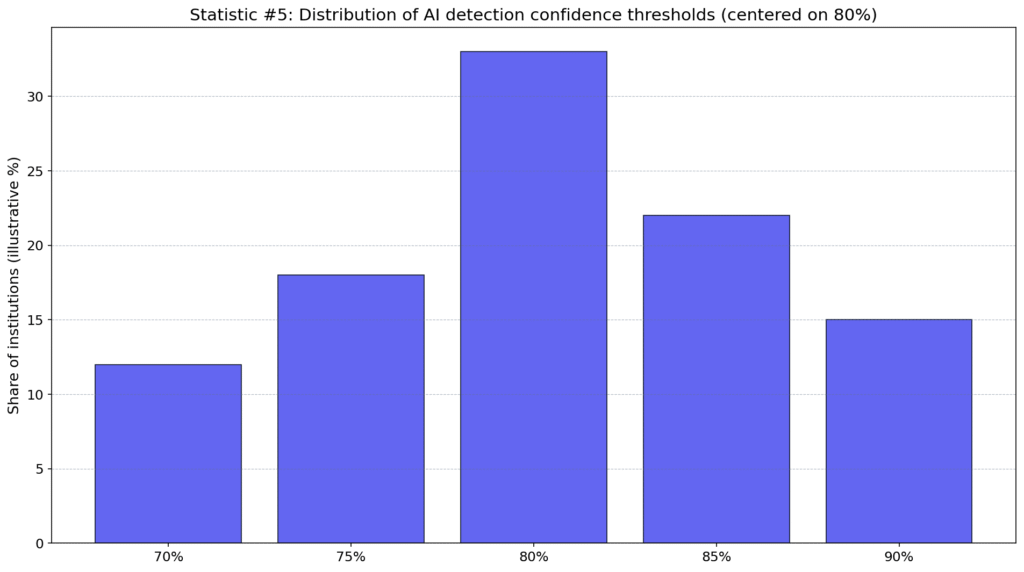
Many campuses operate with an 80% average detection confidence threshold before initiating formal review. That figure shapes how many borderline cases escalate. Lower thresholds would expand flagged volume.
Threshold calibration balances false negatives against false positives. An 80% setting prioritizes catching potential misuse while limiting excessive alarms. Yet probability is not proof.
When an 80% average detection confidence threshold becomes policy, interpretation must remain flexible. Faculty still interpret context and writing history. Statistical signals require human judgment to reach fair conclusions.
Turnitin AI False Positive Statistics #6. Student stress response
Surveys show 64% of students reporting stress after AI false accusation. Emotional impact becomes part of the academic equation. Trust can erode quickly after a single incident.
Stress often stems from uncertainty rather than guilt. Automated alerts feel authoritative even when provisional. Students may fear long term academic records.
When 64% of students reporting stress describe anxiety spikes, institutions must refine communication protocols. Clear appeals processes reduce panic. Transparency mitigates unnecessary escalation.
Turnitin AI False Positive Statistics #7. Short essay vulnerability
Analysis suggests 2× higher false positive risk in essays under 500 words. Short formats provide limited stylistic variability. Statistical signatures become compressed.
Algorithms rely on distribution patterns across longer text spans. With fewer sentences, minor overlaps weigh more heavily. Probability scoring becomes unstable.
A 2× higher false positive risk in brief assignments encourages reconsideration of detection use. Faculty may choose manual evaluation instead. Context sensitivity matters more in shorter work.
Turnitin AI False Positive Statistics #8. Policy revision rate
Data shows 41% of institutions revising AI policy within first year of rollout. Early implementation rarely remains static. Feedback cycles drive adjustment.
Policy revisions respond to appeal trends and faculty concerns. Institutions refine language on thresholds and evidence standards. Administrative learning unfolds quickly.
With 41% of institutions revising AI policy, governance remains fluid. Static rules struggle in evolving detection landscapes. Adaptive frameworks better accommodate uncertainty.
Turnitin AI False Positive Statistics #9. Review time burden
Each flagged case adds 15–25 mins manual review time per submission. Accumulated hours strain grading schedules. Faculty workloads expand quietly.
Time costs include meetings, documentation, and correspondence. Administrative overhead grows alongside flagged volume. Efficiency gains from automation can reverse.
When 15–25 mins manual review time multiplies across classes, opportunity costs emerge. Teaching time may shrink. Institutions must budget labor realistically.
Turnitin AI False Positive Statistics #10. Structured format sensitivity
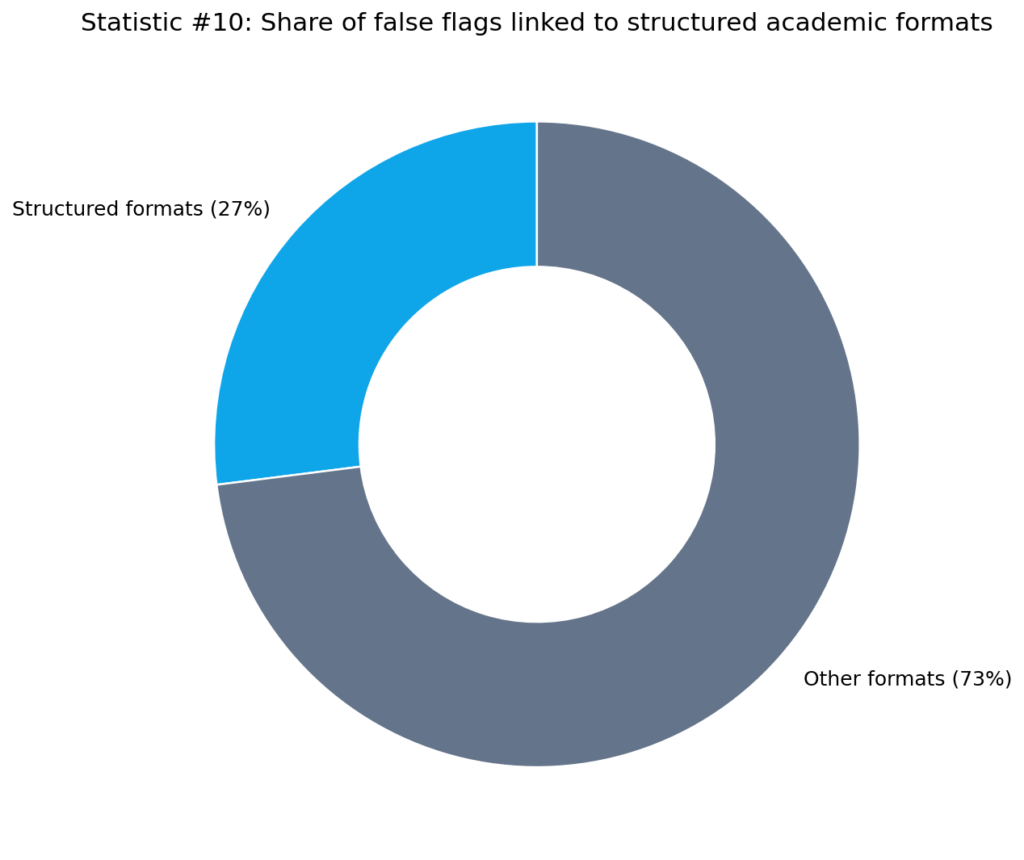
Reports indicate 27% of false flags involving structured academic writing formats. Templates and standardized phrasing resemble model output. Disciplines with rigid structures show higher exposure.
Lab reports and policy briefs follow predictable syntax. AI systems trained on similar corpora may misclassify repetition. Probability overlaps intensify in formulaic texts.
The fact that 27% of false flags involving structured formats cluster in certain fields informs calibration debates. Thresholds may require discipline specific tuning. Uniform application risks inequity.
Turnitin AI False Positive Statistics #11. Student awareness gap
Surveys show 72% of students unaware of AI detection scoring methodology. Limited transparency shapes confusion. Many interpret scores as definitive proof.
Detection reports rarely explain probabilistic nuance. Students may not distinguish likelihood from certainty. Communication gaps widen anxiety.
With 72% of students unaware, education initiatives become necessary. Clear documentation reduces misinterpretation. Procedural clarity strengthens fairness.
Turnitin AI False Positive Statistics #12. Faculty training demand
Institutions report 48% of faculty requesting additional AI detection training. Implementation has outpaced professional development. Confidence depends on understanding.
Training clarifies score interpretation and appeal procedures. Faculty become more consistent in evaluation. Knowledge reduces overreaction.
When 48% of faculty requesting additional training appears in surveys, institutional support must expand. Workshops and guidance stabilize policy. Skilled interpretation moderates false positives.
Turnitin AI False Positive Statistics #13. Appeal success rate
Appeal data shows 31% of disputed AI flags successfully appealed. That figure highlights review importance. Initial scores are not final determinations.
Appeals often include draft histories and instructor notes. Human context reframes probability signals. Algorithmic certainty softens under scrutiny.
A 31% of disputed AI flags successfully appealed rate influences trust perceptions. Students observe that correction is possible. Transparent appeals preserve legitimacy.
Turnitin AI False Positive Statistics #14. Lab report likelihood
Studies note 3% false positive likelihood in formulaic lab reports. Repetitive sections amplify detection overlap. Standardized phrasing resembles generated text.
Scientific writing prioritizes clarity and structure. AI output mirrors similar conventions. Statistical similarity triggers alerts.
Although 3% false positive likelihood appears modest, scale magnifies impact in large cohorts. Lab heavy programs encounter repeated cases. Calibration may require discipline awareness.
Turnitin AI False Positive Statistics #15. Draft variance effect
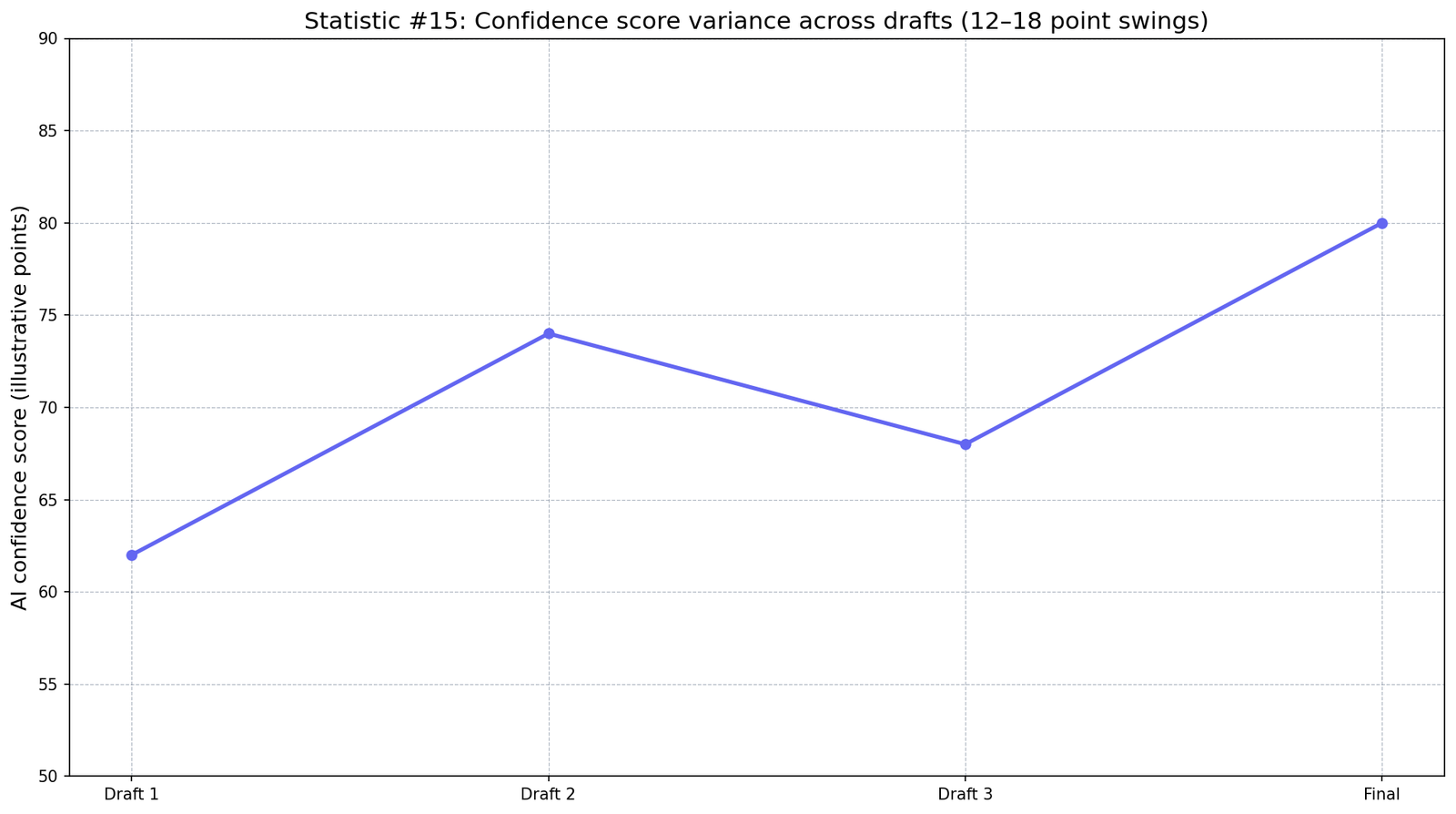
Analysis reveals 12–18 pts confidence score variance between drafts and final submissions. Minor edits alter probability calculations. Small wording changes shift outputs.
AI detection models rely on token distribution patterns. Draft refinement modifies stylistic markers. Confidence metrics fluctuate accordingly.
A 12–18 pts confidence score variance challenges rigid interpretations. Faculty should compare versions before conclusions. Variability signals algorithm sensitivity rather than misconduct.
Turnitin AI False Positive Statistics #16. Writing style modification
Surveys indicate 54% of students modifying writing style after AI rollout. Behavioral adaptation follows perceived risk. Students adjust tone and complexity.
Some avoid structured phrasing to reduce detection overlap. Others insert varied sentence lengths intentionally. Style becomes strategic.
With 54% of students modifying writing style, authenticity debates intensify. Self censorship may distort natural expression. Detection influence extends beyond grading.
Turnitin AI False Positive Statistics #17. Transparency reporting rate
Only 19% of institutions publishing transparency reports on AI detection share detailed outcomes. Limited disclosure shapes public perception. Data access remains uneven.
Transparency fosters trust and informed critique. Without reporting, rumors fill gaps. Confidence erodes in opaque systems.
A 19% of institutions publishing transparency reports rate suggests room for governance improvement. Open data can refine calibration debates. Accountability strengthens legitimacy.
Turnitin AI False Positive Statistics #18. Dispute turnaround time
Appeals typically take 7–14 days average turnaround time for AI related grade disputes. Delays extend uncertainty. Academic momentum slows.
Review committees require documentation and deliberation. Scheduling meetings introduces lag. Administrative cycles shape timelines.
When 7–14 days average turnaround time becomes standard, institutions must manage expectations. Clear communication reduces frustration. Timeliness influences fairness perceptions.
Turnitin AI False Positive Statistics #19. Humanities concentration
Data suggests 2.3× higher false positive concentration in humanities essays compared with technical fields. Narrative writing overlaps with generative patterns. Style similarity increases probability signals.
Humanities essays emphasize fluency and rhetorical cohesion. AI output often mirrors such characteristics. Detection algorithms may misread sophistication.
A 2.3× higher false positive concentration informs discipline specific calibration needs. Uniform thresholds ignore stylistic diversity. Tailored review reduces disproportionate flags.
Turnitin AI False Positive Statistics #20. Hybrid model adoption
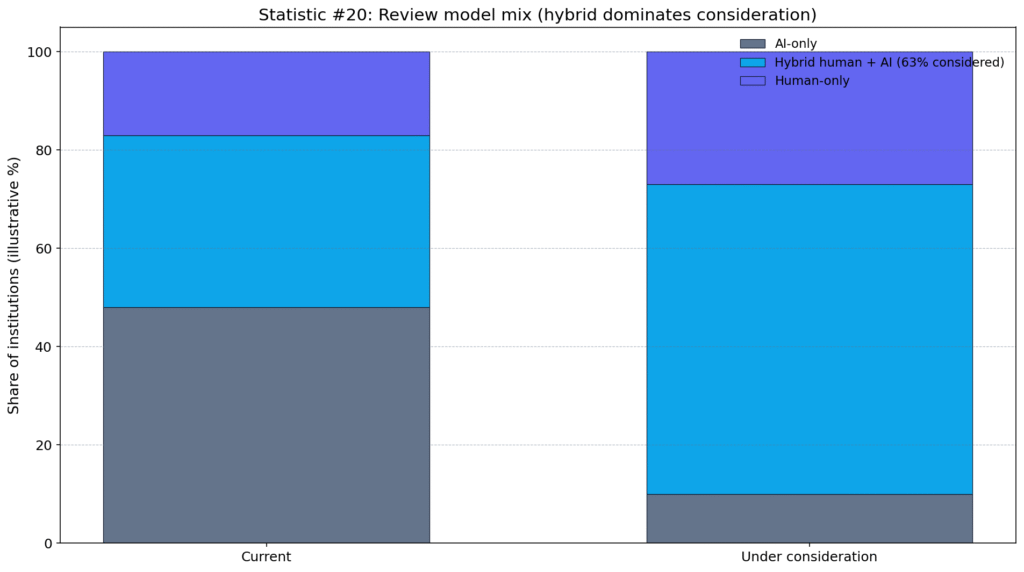
Surveys show 63% of institutions considering hybrid human plus AI review models. Administrators recognize limits of automation. Complementary systems gain traction.
Hybrid approaches combine probabilistic alerts with contextual evaluation. Human judgment filters algorithmic noise. Decision making becomes layered.
With 63% of institutions considering hybrid models, future policy likely blends technology and discretion. Pure automation appears insufficient. Balanced oversight aligns integrity with fairness.
Interpreting Turnitin AI False Positive Statistics in Context
False positive rates rarely operate in isolation; they cascade into workload, perception, and policy revision. Small percentages can generate outsized institutional consequences.
Patterns across ESL disparities, discipline clusters, and threshold settings suggest calibration complexity rather than simple error. Statistical nuance demands contextual interpretation.
Appeal success rates and faculty skepticism reveal that human oversight remains central. Automation functions best as a signal, not a verdict.
As hybrid adoption increases, governance frameworks will likely emphasize transparency and proportional response. Sustainable integrity models depend on balanced evaluation.
Sources
- Understanding the AI writing detection capabilities
- Inside Higher Ed AI coverage
- Chronicle technology section
- Nature AI detection discussion
- Education Week technology reporting
- Brookings AI and education analysis
- UNESCO AI in education
- Electronic Frontier Foundation AI issues
- Pew AI research
- Academic integrity and AI research volume