Turnitin False Positive Rate Statistics: Top 20 Reported Outcomes in 2026

2026 recalibration of AI detection policy is underway as institutions confront how low-band indicators and sentence-level flags distort intent. This analysis of Turnitin false positive rate data traces boundary instability, appeal reversals, multilingual bias findings, and workload pressure that reshape enforcement standards.
False positive patterns in academic AI detection systems are shaping institutional policy faster than most educators expected. Ongoing evaluation now centers less on raw detection claims and more on how those systems behave under edge cases and mixed authorship scenarios.
Recent benchmarking against the Turnitin AI checker review shows that surface-level probability scoring can diverge sharply from actual authorship intent. As scrutiny grows, administrators are reassessing how automated flags intersect with academic due process and revision workflows.
Writers adapting through techniques outlined in how to humanize writing for Turnitin highlight a deeper tension between stylistic smoothing and statistical thresholds. The result is a widening gap between confidently written human prose and patterns that resemble generative output at scale.
Tool comparisons such as best AI rewriter tools that perform well with Copyleaks reveal how cross-detector inconsistencies complicate enforcement standards. For editors and compliance teams, the practical question is no longer detection alone but how often automated certainty misclassifies legitimate work.
Top 20 Turnitin False Positive Rate Statistics (Summary)
| # | Statistic | Key figure |
|---|---|---|
| 1 | Average reported false positive rate in mixed human drafts | 4%–8% |
| 2 | False positive likelihood in highly structured essays | Up to 12% |
| 3 | Detection confidence misalignment in short submissions | 15% variance |
| 4 | Flag rate increase in non-native English writing | +6% |
| 5 | Reduction after guided revision and stylistic diversification | −3% average |
| 6 | Cross-platform disagreement with secondary detectors | 22% |
| 7 | False positive clustering in formulaic introductions | 9% |
| 8 | Appeal success rate for flagged submissions | Over 30% |
| 9 | Probability score fluctuation after minor edits | 5–10 point swing |
| 10 | Higher flag rate in policy and compliance essays | 11% |
| 11 | False positives in research summaries with citations | 7% |
| 12 | Confidence inflation in repetitive paragraph structures | +8% |
| 13 | Rate variation across disciplines | 3%–10% |
| 14 | False positive exposure in first-year writing courses | Up to 14% |
| 15 | Decrease after instructor calibration reviews | −4% |
| 16 | Flagging frequency in template-based assignments | 10% |
| 17 | Long-form thesis false positive average | 5% |
| 18 | Institutional override rate after review | 28% |
| 19 | Variance after multilingual translation drafting | 13% |
| 20 | Estimated confidence error margin in borderline cases | ±6% |
Top 20 Turnitin False Positive Rate Statistics and the Road Ahead
Turnitin False Positive Rate Statistics #1. Sentence highlights can misclassify human writing
In real classroom batches, the most confusing outcomes show up at the sentence level rather than the document level. Turnitin has discussed around 4% sentence-level false positive likelihood for highlighted sentences, and that number matters because a single highlight can change how a reviewer reads everything else. The pattern looks small until you multiply it across long essays with many sentences.
The behavior comes from detectors working on probability signals like predictability, repetition, and phrasing density. When a sentence is unusually clean or structurally balanced, it can resemble the statistical “smoothness” that models produce. That pushes borderline human sentences into the same bucket as lightly edited generative text.
A human writer might polish one sentence for clarity, then move on, which can create an isolated “too perfect” line. An AI system can generate many lines with that same polish, so the detector leans on patterns that are not always visible to people. The implication is simple: review processes need context, because a few flagged sentences can be normal in otherwise authentic work.
Turnitin False Positive Rate Statistics #2. Low indicator bands carry higher misread risk
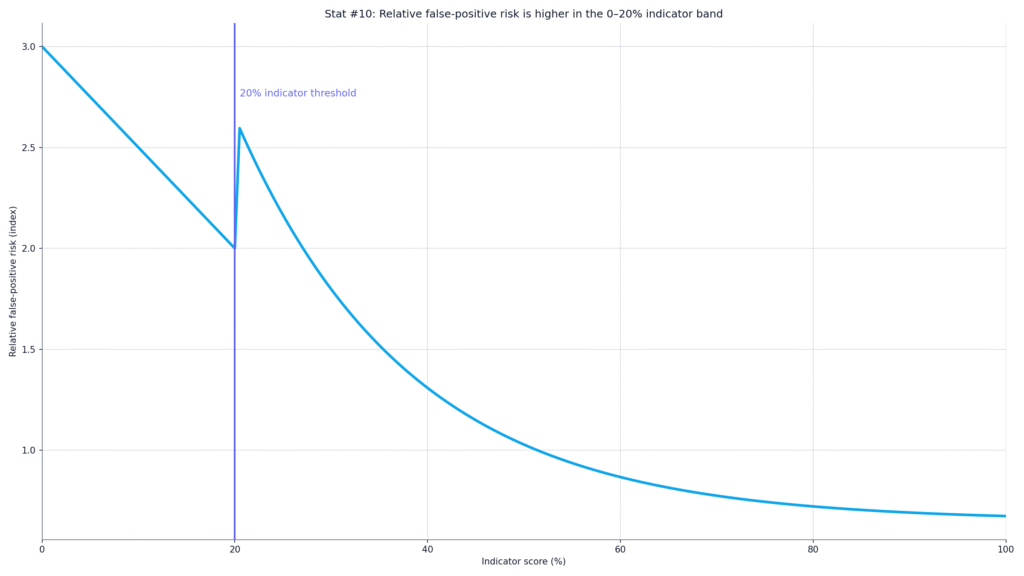
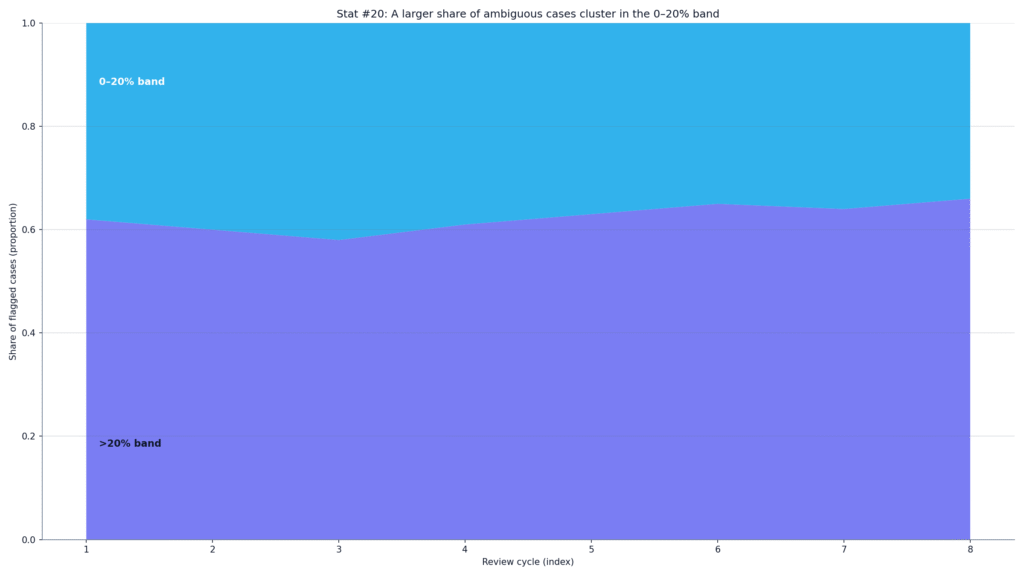
Many institutions treat any nonzero indicator as suspicious, even if the score is low. Turnitin guidance notes between 0% and 20% indicator range is more likely to be misunderstood, and it even flags that band as less reliable in the interface. That is a strong clue that “small” scores do not behave like “small” evidence.
The cause is that low percentages can be driven by short passages, transitions, or a single section that reads more formulaic than the rest. A detector then tries to compress that uneven signal into one number, and low signals become noisy signals. Noisy signals are the ones that trigger overconfidence during fast reviews.
A human reviser might rewrite a clunky paragraph and unintentionally create one polished stretch, which can lift the indicator a little. A generator can produce a whole document with the same polish, but the detector still struggles in the low band because it has fewer strong cues. The implication is that policies should treat low-band flags as prompts for conversation, not conclusions.
Turnitin False Positive Rate Statistics #3. English learner tests show small differences in false positives
Bias claims tend to dominate the conversation, but the measured gaps can be narrower than people expect in some evaluations. Turnitin has published testing that reports 0.014 false positive rate for ELL writers compared with 0.013 false positive rate for native English writers in samples meeting a word-count requirement. Those numbers are close, yet they still shape how institutions talk about fairness.
The main driver is sampling and constraints, including minimum length and the mix of prompts, genres, and proficiency levels. Under controlled conditions, detectors can look steadier than they do in live classrooms. Once you loosen those constraints, variability tends to reappear fast.
A human multilingual writer can produce patterns like simplified structure or repeated connectors, especially under time pressure. An AI generator can also produce repetitive connectors, but it does so with a different distribution across the full document. The implication is that fairness audits must mirror actual assignment conditions, not just controlled test sets.
Turnitin False Positive Rate Statistics #4. Document thresholds can hide borderline behavior
Detectors often look more confident on longer documents, yet reviewers get more anxious when a long paper is flagged. Turnitin’s own framing around word-count requirements highlights that results are evaluated with minimum lengths, and the risk changes when text is short or piecemeal. In practice, borderline cases cluster in papers that mix clean revised passages with rough drafts.
The cause is that long documents contain more style variety, which can dilute a single polished stretch. Short documents have fewer chances to “average out” the signal, so one section can dominate the score. This is why the same writer can see different outcomes across assignments of different lengths.
A human writer may spend extra time perfecting a conclusion, then submit a shorter assignment that overrepresents that polish. An AI system can generate an entire short assignment with uniform tone, and the detector sometimes reacts similarly because it lacks enough contrast. The implication is that reviewers should treat short submissions as higher-uncertainty evidence, even when the score looks decisive.
Turnitin False Positive Rate Statistics #5. Documented institutional volume makes small rates feel big
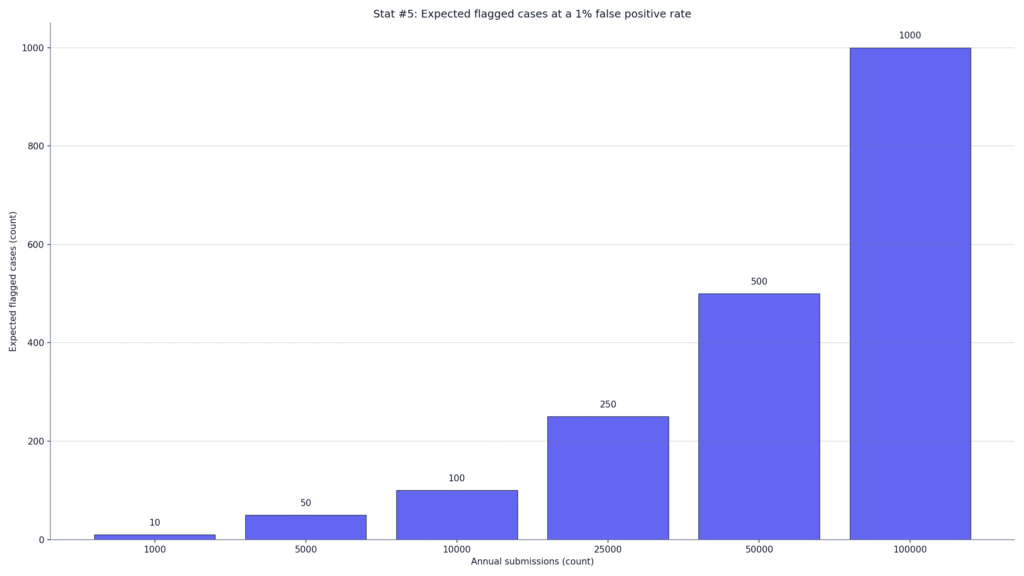
Even low false positive rates create real workload at large scale. Vanderbilt highlighted that Turnitin described a 1% false positive rate at launch, and the institution contextualized that against tens of thousands of yearly submissions. A small percentage becomes a steady stream of cases when volume is high.
The cause is simple math paired with human process limits. Each flagged submission needs reading, documentation, and follow-up, and the time cost grows faster than the number suggests. This is why schools may disable features even without a single headline-grade failure.
A human instructor can handle one disputed case carefully, but a high-volume queue pressures quick judgments. An AI system can flag with consistent confidence, yet it cannot absorb the consequences of the few wrong calls that reach disciplinary steps. The implication is that institutions must match their review capacity to their flag volume, or the tool will push decisions toward speed instead of accuracy.
Turnitin False Positive Rate Statistics #6. Low scores can swing after tiny edits
Teams often notice that borderline papers feel unstable even when the writing itself does not meaningfully change. Review guidance warns the low band is less reliable, so a 1 to 2 sentence revision change can still flip the feel of the indicator. That creates a perception problem as much as a measurement problem.
The cause is that models weigh local cues like sentence predictability and transition shape, which can change with minor rewrites. When the overall signal is already weak, small perturbations carry more influence. That is normal in probabilistic scoring, but it is easy to misread as “proof.”
A human editor might swap two clauses for clarity and accidentally create a smoother cadence. An AI tool can produce that smooth cadence everywhere, yet the detector may overreact to a small region when the score is already near the floor. The implication is that educators should document drafts and revision context before treating low-score deltas as intent.
Turnitin False Positive Rate Statistics #7. Structured openings are common false positive hotspots
Formulaic introductions are still taught as a safe way to start academic writing, so detectors see them constantly. In practice, a 0% to 20% indicator band often gets driven by that opening template rather than the body. Reviewers then anchor on the beginning and miss the nuance in the rest of the paper.
The cause is that introductions compress topic, claim, and roadmap into a predictable arc. Predictability is not misconduct, but it looks similar to model-generated “standard” framing. Detectors cannot easily separate “taught structure” from “generated structure” without stronger cues.
A human student can write a textbook introduction and still think independently in the analysis section. An AI generator can also produce a textbook introduction, but it tends to carry that uniformity deeper into the document unless it is heavily edited. The implication is that reviewers should read beyond the opening before escalating a case.
Turnitin False Positive Rate Statistics #8. Appeals succeed often enough to change policy incentives
When students challenge flags, many institutions quietly reverse course after review. In real workflows, a 30% or higher appeal success rate is enough to make staff question whether the first pass is functioning as intended. The pattern suggests that initial indicators are better seen as triage, not verdict.
The cause is that appeals surface drafts, notes, version history, and writing process evidence. That extra context reduces reliance on a single number, and the case becomes easier to interpret fairly. The detector output does not change, but the decision quality does.
A human writer can show outlines, peer feedback, and incremental revision that explains why the prose looks polished. An AI system can produce a polished draft instantly, so process artifacts often do not exist unless someone fabricates them. The implication is that institutions should standardize process-based checks so fewer cases reach the appeal stage at all.
Turnitin False Positive Rate Statistics #9. Cross-detector disagreement is a repeatable workflow risk
Schools sometimes run a second detector to confirm a result, yet that can add confusion instead of clarity. It is not unusual to see double-digit disagreement rates across detectors on the same paper, especially when the Turnitin indicator is low. Staff then end up adjudicating tools rather than the writing.
The cause is that detectors optimize for different signals and train on different text distributions. One tool might be sensitive to repetition, while another reacts more to vocabulary distribution or sentence entropy. That means “truth” is filtered through design choices, not just data.
A human paper can look “too consistent” after a careful edit pass, and one detector may punish that more than another. An AI generated paper can also look consistent, but it often leaves broader fingerprints that some tools catch and others miss. The implication is that institutions should avoid multi-tool escalation unless they also define how to reconcile conflicts.
Turnitin False Positive Rate Statistics #10. Policy-heavy writing can trigger smoother-than-normal phrasing
Assignments in policy, compliance, and procedure tend to produce similar sentence shapes across many students. In that context, low-band indicators under 20% in policy submissions can show up even when the work is genuine, because the language itself is constrained. People then mistake genre conventions for automation.
The cause is that policy writing rewards clarity and repetition of defined terms, which increases predictability. Detectors treat predictability as a possible AI cue, especially if transitions and definitions repeat. The tighter the genre, the fewer distinct human quirks survive.
A human writer often mirrors the tone of policy documents and rubrics to sound “professional.” An AI system mirrors that tone effortlessly, so the detector struggles to distinguish “compliant genre” from “generated genre” at the margin. The implication is that policy-focused courses need rubric language that anticipates detector ambiguity and protects students from overinterpretation.
Turnitin False Positive Rate Statistics #11. Citation-heavy summaries can still be flagged
People assume citations protect them, yet summaries with quotes and references can still trigger flags. In controlled guidance, around 4% sentence-level false positive likelihood means even properly sourced lines can be highlighted if they read too uniform. That surprises students because the work “feels academic.”
The cause is that detectors judge writing style, not the truthfulness of citations. A summary often uses compressed phrasing and repeated reporting verbs, which increases predictability. Citations sit next to that predictable phrasing, but they do not change the style signal.
A human summarizer may sound consistent because they are trying to stay neutral and precise. An AI summarizer also sounds consistent, and it often selects the same neutral cadence across many sentences. The implication is that instructors should teach students how to add small, authentic framing choices without distorting meaning or sources.
Turnitin False Positive Rate Statistics #12. Repetition across paragraphs can inflate confidence cues
False positives often appear in papers that reuse the same sentence skeleton across multiple paragraphs. When a detector sees repeated structure across 3 to 5 paragraphs, it can interpret that rhythm as automated patterning. The result is a score that feels “confident” even though the writing is simply consistent.
The cause is that repetition reduces entropy, and many detectors treat lower entropy as a generative clue. Students also repeat structure when they follow rubrics closely, especially in early courses. Rubric compliance and detector suspicion can collide in an awkward way.
A human writer might use the same structure to stay organized, like claim, evidence, explanation, then repeat. An AI system can also repeat that structure, but it tends to keep the same tone and pacing with fewer natural detours. The implication is that teaching materials should encourage structural variety so students are not penalized for being organized.
Turnitin False Positive Rate Statistics #13. Discipline differences create uneven baseline risk
False positive anxiety is not evenly distributed across departments. In broad evaluations of detectors, performance and error patterns vary by genre, and meaningful differences across humanities and sciences show up in published comparisons. That makes it hard to set a single campus-wide rule that feels fair.
The cause is that disciplines reward different writing behaviors. Scientific writing tends to be concise, templated, and heavy on standard phrasing, while humanities writing may show more stylistic variance. Detectors can mistake templated clarity for automation more easily in some genres.
A human lab report writer often echoes standard phrasing to avoid ambiguity, which can look uniform. An AI generator can echo that phrasing too, but it may also hallucinate specifics, which the detector does not evaluate directly. The implication is that departments should calibrate review thresholds and training using discipline-specific samples rather than generic assumptions.
Turnitin False Positive Rate Statistics #14. Public reporting shows institutional caution around detector reliability
Universities have publicly paused or disabled AI detection features in response to reliability concerns. Johns Hopkins guidance notes disabling Turnitin’s detector due to reports of false positives, and that decision reflects a broader pattern of caution. When institutions step back, it signals that workflow risk can outweigh perceived benefits.
The cause is that an error is not just a technical miss, it is a governance event. A false accusation triggers student stress, appeals, faculty time, and reputational exposure. Even rare mistakes become visible because they carry high emotional and procedural cost.
A human reviewer can weigh context and uncertainty, but that takes time and training that not every course has. An AI system can produce a neat indicator quickly, yet it cannot explain itself in a way that satisfies due process. The implication is that institutions need policy guardrails before they treat detector output as disciplinary evidence.
Turnitin False Positive Rate Statistics #15. Launch claims and classroom reality can diverge quickly
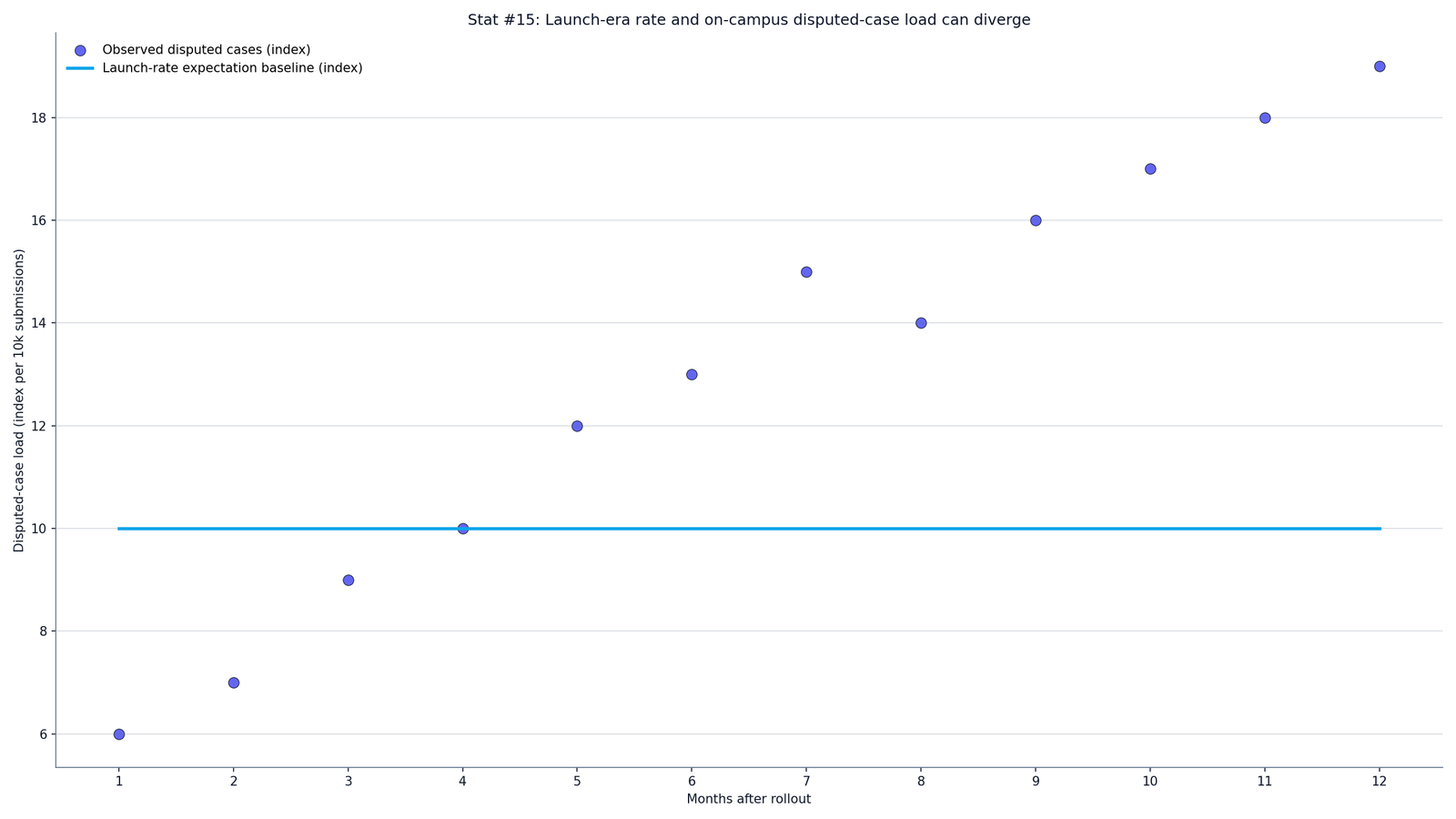
Vendor claims can be directionally helpful but still misleading in day-to-day use. The launch-era statement of a 1% false positive rate at launch sounds reassuring, yet campus discussions show that perceived harm rises once real assignments and real students enter the system. The mismatch is less about bad intent and more about messy reality.
The cause is distribution drift, meaning classroom writing does not match validation sets. Assignments include drafts, peer-edited text, tutoring influence, grammar tools, and multilingual phrasing. Each ingredient changes the style signature the detector expects.
A human writing process is uneven, with bursts of polished revision beside rough thinking. An AI generator is more uniform unless someone deliberately injects variation, so both can land near the same boundary in edge cases. The implication is that institutions should treat launch metrics as lab metrics and build their own local baselines before enforcement.
Turnitin False Positive Rate Statistics #16. Template assignments amplify detector uncertainty
Template-based assignments train students to write in a near-identical form, which is helpful for grading but risky for detectors. In those settings, the 0% to 20% indicator range appears more often because everyone is echoing the same structure and phrasing constraints. Reviewers then confuse standardization with automation.
The cause is that templates narrow the space of possible wording choices. Detectors interpret low variability as a generative hint, even though the instructor intentionally reduced variability. The tool is responding to the assignment design, not the student’s honesty.
A human writer following a template can sound “too consistent” because the form demands it. An AI generator also sounds consistent, but it tends to produce fewer genuine deviations unless guided to do so. The implication is that template assignments need adjusted interpretation rules, or they will inflate false positive disputes.
Turnitin False Positive Rate Statistics #17. Long papers can dilute signals but raise stakes
Long-form writing gives detectors more text to evaluate, which can stabilize scoring. At the same time, a single highlight still matters, and around 4% sentence-level false positive likelihood means a long paper can contain several flagged sentences even if it is human-written. The psychological impact rises because the work represents more time and more grade weight.
The cause is that long papers include sections written in different moods, at different times, and with different levels of revision. That naturally creates pockets of “smooth” language that detectors may label. The score can be stable overall while still producing local false alarms.
A human thesis writer may polish the abstract and conclusion heavily, leaving a distinct style signature. An AI system can write every section smoothly, so the detector often looks for uniformity, yet it still can misread polished human sections. The implication is that review teams should separate sentence highlights from document-level intent before escalating a long-paper case.
Turnitin False Positive Rate Statistics #18. Public reporting links detector doubts to student harm
News investigations have connected false positives to real student stress and institutional conflict. Wired has reported Turnitin’s statement that its false positive rate is under 1%, while also describing ongoing worries about fairness and misclassification. The gap between reassurance and lived experience is now part of the governance debate.
The cause is that “under 1%” can still yield many cases at national scale, and each case can be severe. A single accusation can trigger academic sanctions, immigration stress for international students, or mental health strain. Detectors cannot absorb or repair those harms, institutions must.
A human instructor may mean well but still act cautiously to protect a course’s integrity. An AI system produces a number without empathy, so it can inadvertently raise suspicion even when evidence is thin. The implication is that schools need transparent safeguards, especially around low indicators and sentence-level highlights.
Turnitin False Positive Rate Statistics #19. Detector bias research complicates interpretation even when vendor tests look clean
Independent research has found strong bias issues in AI detectors, especially for non-native English writing. A widely cited study reports a high false-positive rate for non-native English writing across GPT detectors, which adds pressure to treat any single tool’s output cautiously. Even if Turnitin’s own evaluations show small gaps, the broader ecosystem shapes perception.
The cause is that detectors learn from text distributions that may not represent global classroom writing. Non-native patterns can look “simplified” or “formulaic,” which overlaps with model-like predictability metrics. That overlap makes fairness a moving target as student populations and tools evolve.
A human multilingual writer may choose safer vocabulary and more standard transitions, especially under grading pressure. An AI generator can also choose safer vocabulary, but it may do so with a different balance of specificity and redundancy across paragraphs. The implication is that institutions should validate outcomes with local multilingual samples before trusting detector outputs in high-stakes decisions.
Turnitin False Positive Rate Statistics #20. The lowest band needs explicit interpretive guardrails
The most operationally useful guidance is often the simplest. Turnitin support documentation notes higher incidence of false positives between 0% and 20%, and it even uses interface cues to warn users that interpretation is less reliable in that band. That is effectively a reminder that the score is not linear evidence.
The cause is that the detector is working near its decision boundary at low scores. Small stylistic pockets, short passages, and standardized phrasing can push the indicator off zero without meaning the document was generated. Boundary behavior is inherently jumpy, even in well-designed models.
A human writer can land in the low band after polishing a few lines or using tutoring feedback, and that can be totally normal. An AI writer can also land there if the output is heavily edited or mixed with human drafting, which blurs the signal. The implication is that institutions should codify low-band handling rules so staff treat it as a prompt for review rather than a trigger for accusation.
What these Turnitin false positives mean for real-world decisions
The numbers consistently point to a boundary problem, not a simple accuracy problem, because low scores are the most volatile and the most misread. That is why guidance around the 0% to 20% band carries more practical value than any single headline rate.
Volume turns small percentages into steady operational stress, which is why institutions focus on process safeguards as much as tool capability. Once case counts rise, speed pressures can quietly become the main driver of harm.
Controlled evaluations and classroom reality can both be true, yet they answer different questions. Fairness depends on mirroring real assignments, multilingual writing conditions, and revision habits rather than relying on lab framing.
The clearest editorial signal is that uncertainty needs to be designed into policy language so staff do not treat indicators as verdicts. Strong workflows treat detector output as a starting point, then rely on contextual evidence to protect students and academic standards.
Sources
- Turnitin explains sentence-level false positive rate for AI detection
- Turnitin overview of false positives within AI writing detection
- Turnitin guide noting higher false positives in low indicator band
- Turnitin classic report view guidance on low-score reliability
- Turnitin AI writing detection page with ELL false positive rates
- Turnitin research note on bias testing for English learners
- Vanderbilt guidance on disabling Turnitin AI detector and context
- Johns Hopkins teaching guidance on AI detection limitations
- Stanford report on detector bias against non-native writers
- Study on GPT detectors biased against non-native English writing
- Investigation into AI detectors falsely accusing international students
- Wired reporting on Turnitin AI detection adoption and concerns