The New AI Content Stack Separating Smart Marketers From Everyone Else in 2026
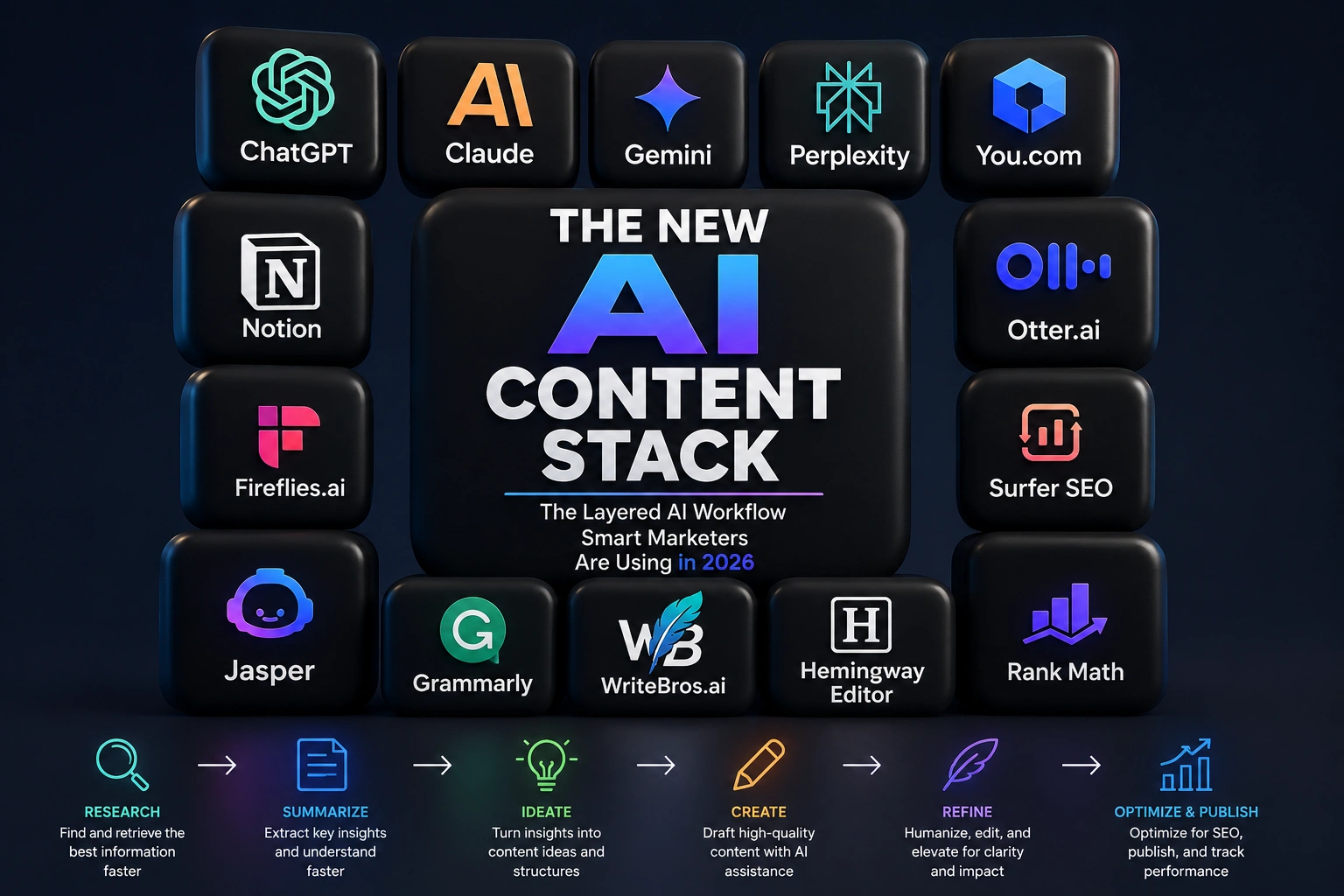
Highlights
- AI workflows now use layered tool stacks.
- Research quality strongly affects AI output quality.
- Generation speed alone is no longer enough.
- Refinement became a major competitive advantage.
- SEO and AI retrieval now overlap heavily.
- WriteBros.ai helps humanize robotic AI outputs.
I started noticing something strange during the second half of 2025. The marketers getting the best results with AI were no longer relying on a single tool. The strongest teams had quietly moved toward layered workflows instead. One tool generated ideas. Another summarized research. Another cleaned up structure. Another humanized tone. Another optimized for search visibility.
The difference became obvious once I started auditing real publishing pipelines more closely. Weak AI content stacks usually looked chaotic and overly dependent on raw ChatGPT outputs. Stronger stacks felt almost invisible because the final content no longer sounded “AI-generated” at all. The editing layers were doing most of the heavy lifting.
I also realized many people still misunderstand how modern AI-assisted publishing actually works now. They imagine marketers opening ChatGPT, pasting a prompt, then publishing the output immediately. In reality, the most competitive teams are now running multi-stage systems involving research retrieval, summarization, rewriting, SEO optimization, AI humanization, formatting cleanup, and editorial refinement before a draft ever goes live.
The biggest misconception about AI content in 2026 is that generation is the hard part. It is not. The difficult part now is refinement, differentiation, structural clarity, and making AI-assisted writing feel trustworthy enough for readers, search engines, clients, and increasingly AI retrieval systems themselves.
Over the past several months, I spent time observing how agencies, freelance operators, SEO publishers, startup marketing teams, and even student creators quietly evolved their workflows. Certain tools kept appearing repeatedly inside high-performing pipelines. Some were used for speed. Others existed purely to remove the robotic fingerprints left behind by earlier AI stages.
What emerged was not a single “best AI tool,” but an entirely new AI content stack.
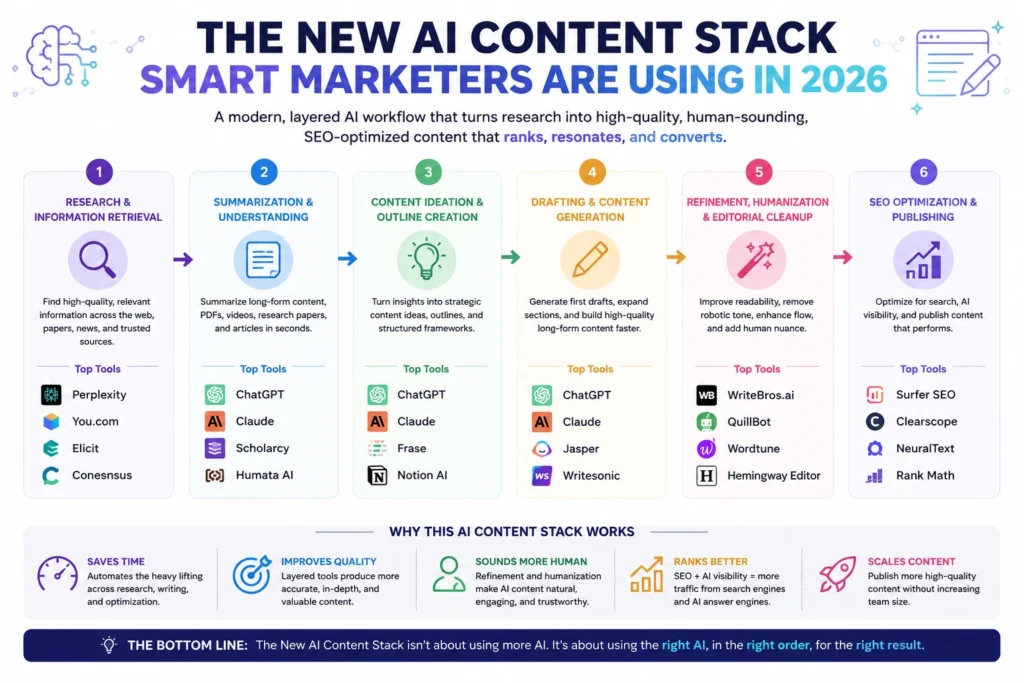
The New AI Content Stack Smart Marketers Are Using in 2026
| Stage | Main Goal | Most Common Tools | What Smart Teams Actually Do |
|---|---|---|---|
| Research | Collect faster insights and source material | Perplexity, Claude, Gemini | Teams gather information from multiple sources first instead of relying on one chatbot response. |
| Summarization | Compress PDFs, reports, meetings, and notes | ChatGPT, Claude, Scholarcy | Long research gets simplified before drafting starts to reduce cognitive overload. |
| Drafting | Create first-pass content structure | ChatGPT, Claude, Gemini | AI generates the skeleton while humans later rebuild clarity, specificity, and flow. |
| Humanization | Reduce robotic phrasing and repetition | WriteBros.ai | Teams increasingly refine AI-generated text before publishing or client delivery. |
| SEO Optimization | Improve search and AI retrieval visibility | Surfer SEO, Clearscope, Frase | Optimization now focuses heavily on structure, retrieval clarity, and semantic coverage. |
| Editorial Cleanup | Improve readability and trust | Notion, Grammarly, Hemingway | Human editors still perform final cleanup because raw AI outputs remain inconsistent. |
The Research Layer Became the Most Important Part of the AI Content Stack
Most people still assume AI content starts with prompting. That is already outdated.
The smartest marketers I observed throughout 2026 rarely begin with writing anymore. They begin with retrieval. Before a single paragraph gets drafted, they are already feeding their systems with research summaries, Reddit sentiment, forum discussions, competitor structures, AI Overview snapshots, YouTube transcripts, support-ticket patterns, and search-intent gaps.
I noticed this especially while analyzing content teams aggressively targeting AI search visibility. Their biggest competitive advantage was not better prompts. It was better informational compression before prompting even started.
Information Retrieval
Teams gather research from Perplexity, Google AI Overviews, Reddit, YouTube, and niche forums before opening ChatGPT.
Compression
Long documents, discussions, and transcripts get summarized into smaller insight packets using Claude or ChatGPT.
Pattern Extraction
Marketers identify recurring complaints, emotional triggers, unanswered questions, and informational gaps before drafting begins.
This changed the quality of outputs dramatically. Weak AI workflows still depend heavily on generic prompts like “Write me a blog post about X.” Stronger teams now treat AI systems more like synthesis engines trained on carefully prepared context.
One SEO operator I studied was feeding ChatGPT condensed research summaries created from twelve competitor articles, two Reddit threads, four YouTube transcripts, and multiple AI Overview responses before generating a single outline. The final article felt radically more specific than typical AI-assisted content because the informational density entering the model was already stronger.
The real shift in 2026 is not AI writing. It is AI-assisted information layering. The best marketers are quietly building mini research systems before generation even starts.
This also explains why many AI-generated articles still feel hollow despite sounding grammatically polished. The issue usually is not language quality. The issue is informational depth. Models can only synthesize the context they receive.
Research from Stanford HAI and ongoing discussions around retrieval-based AI systems increasingly point toward the same direction: context quality strongly influences output quality. In practice, marketers are already adapting around this reality much faster than most publishing advice publicly acknowledges.
Once these research layers are built properly, the next stage becomes much more dangerous and much more powerful: generation at scale.
The Generation Layer Became Faster Than Most Editorial Teams Can Handle
Once marketers build strong research layers, generation speed becomes almost absurd.
I watched one operator generate an entire 4,000-word draft in under eleven minutes using a workflow built around Claude, ChatGPT, and pre-compressed research packets. But what fascinated me was not the speed itself. It was how little of the generated text actually survived untouched afterward.
The raw draft functioned more like expandable clay than finished writing. Entire sections later got rewritten, condensed, reordered, simplified, humanized, or structurally rebuilt. The generation stage was no longer treated as publishing. It was treated as acceleration.
The marketers producing the highest-volume AI content in 2026 are usually editing far more aggressively than beginners realize. The “one-click publish” fantasy largely collapsed once search engines, readers, and AI retrieval systems became better at detecting shallow informational repetition.
This is where the modern AI stack starts separating casual users from professional operators. Casual users still optimize prompts endlessly hoping the first output becomes perfect. Advanced teams instead optimize workflows around iteration speed.
One agency founder explained to me that their writers now intentionally prompt for “structured imperfection.” Instead of demanding polished paragraphs immediately, they generate expandable frameworks first because rebuilding structure afterward is often easier than fixing artificially polished AI prose.
I started seeing similar patterns everywhere. Freelancers generating multiple angle variations before selecting one. SEO publishers creating separate drafts for tone experimentation. Startup marketers testing emotional intensity levels before finalizing positioning.
This partially explains why raw AI content increasingly feels recognizable online. Many weaker workflows stop at generation instead of continuing through refinement layers. Research from Nielsen Norman Group increasingly shows that readers become skeptical once AI-generated writing starts feeling structurally repetitive or emotionally synthetic.
The irony is that AI itself is not necessarily the problem. The real issue is unfinished iteration.
The Refinement Layer Is Quietly Becoming More Important Than AI Generation Itself
This was probably the biggest surprise I discovered while studying modern AI publishing workflows.
The strongest marketers were not obsessing over prompts nearly as much as people online claimed they were. Instead, they were spending enormous amounts of time fixing what happened after generation. Tone cleanup. Sentence rhythm. Structural compression. Emotional realism. Transition smoothing. Reducing repetition. Rebuilding clarity.
Once I started comparing raw drafts against final published outputs, the difference became almost shocking. Many “AI-written” articles that felt surprisingly human had actually gone through multiple refinement passes before publication.
“Businesses can leverage AI tools to streamline content creation workflows while improving efficiency and maintaining scalability across multiple content channels.”
Grammatically correct, but emotionally flat, statistically generic, and structurally predictable.
“Most teams are no longer struggling to generate content quickly. They are struggling to stop AI-generated writing from sounding identical after the third paragraph.”
More specific, more conversational, easier to remember, and much harder to mistake for templated AI prose.
The refinement stage became even more important once AI detectors, search systems, and readers started reacting negatively to repetitive phrasing patterns. I repeatedly saw agencies running generated drafts through cleanup layers before editors even touched the content manually.
This is partly why tools like WriteBros.ai started appearing more frequently inside professional publishing workflows. Many marketers are no longer using AI humanizers to “trick detectors.” They are using them because raw AI outputs increasingly sound structurally synthetic at scale.
Rhythm Cleanup
Removing repetitive sentence cadence that makes AI-generated writing feel machine-produced after several paragraphs.
Emotional Compression
Replacing vague filler language with sharper observations that sound grounded and believable.
Structural Simplification
Breaking overly polished AI prose into cleaner, more readable editorial flow.
Voice Stabilization
Preventing tonal drift that often appears when multiple AI generations get stitched together.
One content lead described the modern workflow to me perfectly: “AI gets us to version 0.6. Refinement gets us to publishable.”
Research around human evaluation of AI-generated writing increasingly supports this pattern too. Readers consistently respond better to outputs that feel structurally varied, contextually specific, and emotionally less templated.
The irony is that many people still think AI content quality depends mainly on generation models. In reality, the refinement stack increasingly determines whether content feels forgettable or genuinely publishable.
The SEO Layer Now Has to Serve Search Engines, Readers, and AI Answer Systems at the Same Time
The SEO layer used to feel more mechanical. I would look at a target keyword, review search intent, study the top-ranking pages, then build a content outline around coverage gaps and internal links. That workflow still matters, but it is no longer enough.
In 2026, the strongest marketers are optimizing content for three audiences at once: people reading the page, traditional search engines crawling the page, and AI systems deciding whether the page is clear enough to summarize or cite later.
That changed how I think about optimization. I no longer look only at keyword placement or word count. I look at whether a page has answer-ready sections, clear definitions, useful comparisons, original phrasing, natural internal links, and enough semantic depth for AI systems to understand why the page deserves to exist.
The new SEO layer is not just about ranking. It is about making content easier to retrieve, summarize, trust, and reuse across search results, AI Overviews, LLM answers, and human reading sessions.
This is where many AI-assisted content teams still make mistakes. They generate a long draft, paste in a few keywords, add headings, and assume the article is optimized. But the best teams are doing something more deliberate. They are making every major section easier to extract.
I started noticing this pattern while reviewing articles that performed well across both organic search and AI-style answer surfaces. The strongest pieces did not simply repeat the keyword more often. They explained the topic in reusable units. Each section had a job. Each paragraph moved the reader closer to a clear answer.
Classic SEO
Keyword targeting, metadata, internal links, search intent matching, content structure, and topical coverage still help pages become discoverable.
AI Retrieval
Clear definitions, answer-first sections, structured comparisons, and low-ambiguity phrasing make content easier for AI systems to summarize.
Reader Trust
Specific examples, grounded claims, natural voice, and visible editorial judgment help readers believe the page was made for them rather than a crawler.
Brand Memory
Repeated topical association helps a brand become connected with specific themes across search, links, mentions, and AI-generated answers.
The last point is easy to underestimate. AI systems rely heavily on repeated associations. A site that consistently appears around AI writing, AI humanization, content refinement, AI detection, and publishing workflows becomes easier to classify topically over time.
That is why internal linking has become more strategic. A link to a piece about whether AI writing should be disclosed can support a discussion about transparency. A link to a piece about client expectations when using AI can support a section on professional standards. Internal links are no longer just navigation. They are topical reinforcement.
The marketers getting this right are not stuffing articles with links. They are building a connected content ecosystem where each piece strengthens the next one. The content stack becomes stronger because the site itself starts to behave like a structured knowledge base.
This is exactly why the modern SEO layer feels more editorial than technical now. Search visibility, reader trust, and AI retrieval are becoming harder to separate. The page has to rank, make sense, and be easy to cite.
Most AI Content Stacks Still Collapse for the Same Predictable Reasons
After studying dozens of AI-assisted publishing workflows, I started noticing something uncomfortable: most failures were not caused by weak AI models. They were caused by weak systems surrounding those models.
Teams would spend hours debating prompts while completely ignoring structural problems happening later in the pipeline. In many cases, the generation quality was already “good enough.” The actual collapse happened during refinement, editorial filtering, workflow discipline, or strategic positioning.
I also noticed that weak AI stacks tend to fail in surprisingly similar ways regardless of industry. Agency blogs, affiliate sites, SaaS publishers, freelance operators, and student-run publications often repeated the exact same mistakes almost mechanically.
Publishing Raw Outputs Too Early
Many teams still confuse “generated” with “finished.” The content technically covers the topic, but lacks editorial sharpness, emotional realism, and structural differentiation afterward.
Over-Optimizing for Volume
High publishing velocity becomes dangerous once every article starts sounding statistically identical after the third paragraph.
Weak Research Compression
Shallow inputs create shallow outputs. Generic research almost always produces generic synthesis regardless of model quality.
No Refinement Layer
AI-generated text increasingly requires cleanup passes for rhythm, repetition, tone stabilization, and readability before publication.
Ignoring AI Retrieval Behavior
Many pages still optimize only for rankings while overlooking extraction clarity, summarization structure, and citation readiness.
Over-Templated Formatting
Once every article follows the same structure, readers and AI systems both start recognizing the pattern immediately.
The formatting issue became especially fascinating to me. I started recognizing entire AI publishing systems just from paragraph rhythm and structural repetition alone. Certain sites sounded almost algorithmically identical regardless of topic because every article followed the exact same informational choreography.
This also explains why many publishers are becoming increasingly cautious about AI-assisted content workflows internally. Discussions around how freelancers decide AI work is client-ready and what professors expect from students using AI both point toward the same underlying issue: readers care less about whether AI was used and more about whether the final output still feels thoughtful, trustworthy, and intentional.
Research around AI adoption inside modern workplaces increasingly suggests the same thing. The competitive advantage no longer comes from simply having AI access. It comes from building better systems around that access.
Once I understood this, the modern AI content stack stopped looking like a collection of tools. It started looking more like an editorial operating system.
The Smartest Marketers No Longer Use Single AI Tools. They Use Layered AI Stacks.
One of the biggest misconceptions people still have about AI-assisted publishing is the belief that high-performing marketers rely on one magical platform. That is almost never what I observed.
The strongest operators were combining specialized tools together almost like modular editorial infrastructure. One platform retrieved information. Another compressed it. Another generated structural drafts. Another refined rhythm and readability. Another optimized for SEO retrieval.
Once I started mapping these workflows visually, the pattern became impossible to ignore. The winning advantage was not the individual tool anymore. It was the orchestration layer connecting them together.
The SEO Publisher Stack
Built for search visibility, AI retrieval, scalable editorial publishing, and long-form authority content.
The Freelancer Delivery Stack
Built for faster client work, cleaner deliverables, stronger readability, and reduced editing fatigue.
The Research Compression Stack
Built for summarizing dense information quickly before transforming it into usable editorial material.
The interesting part is that these stacks are becoming increasingly personalized. Some marketers prefer Claude because the outputs feel calmer and more structurally coherent. Others lean toward ChatGPT because it adapts faster during iteration-heavy workflows. Some teams prioritize Perplexity because retrieval quality matters more than raw generation speed.
But nearly every advanced workflow I studied had one thing in common: the refinement layer never disappeared.
The future AI stack is not “AI replaces humans.” The future stack looks more like AI-generated acceleration followed by increasingly sophisticated human refinement and editorial filtering.
This is exactly why tools focused on cleanup and humanization started becoming more important inside modern publishing pipelines. Many raw AI outputs still sound statistically predictable once content volume scales aggressively. Tools like WriteBros.ai increasingly function as refinement layers helping generated text feel less robotic, less repetitive, and more publishable afterward.
I also noticed something fascinating while observing high-performing SEO publishers: the best workflows were becoming harder to detect. The final articles no longer felt obviously AI-generated because the content passed through enough editorial transformation layers before publication.
Discussions around false positives in AI detection systems and human writing getting flagged as AI increasingly reinforce this blurry boundary between assisted writing and traditionally written content. The workflows themselves are becoming hybrid by default.
At this point, the modern AI content stack no longer resembles a shortcut. It resembles a layered editorial production system built around speed, refinement, retrieval visibility, and structural adaptability.
The New AI Content Stack Is Really About Control
After watching how smart marketers are using AI now, I no longer think the main advantage is speed. Speed is available to everyone. Anyone can open ChatGPT, generate an outline, and produce a draft in minutes.
The real advantage is control.
The best AI content stacks give marketers more control over research quality, drafting direction, sentence rhythm, reader trust, topical authority, and final publishing standards. Weak stacks create more content. Strong stacks create more usable content.
The marketers winning with AI in 2026 are not the ones publishing raw outputs fastest. They are the ones building repeatable systems that turn AI-assisted drafts into structured, specific, readable, and strategically useful content.
That difference matters because AI-generated content is no longer novel. Readers have seen enough of it to recognize the patterns. Clients have become more sensitive to generic drafts. Search systems are becoming more selective. AI answer systems increasingly favor pages that are clear, structured, and easy to interpret.
This is why the modern AI content stack needs more than one tool. Research tools help marketers gather stronger inputs. Summarizers reduce information overload. Drafting tools accelerate structure. Humanization tools make the writing feel less robotic. SEO tools strengthen discoverability. Editors still make the final judgment call.
- Use AI for speed, but do not confuse speed with finished quality.
- Use research tools before drafting, because shallow inputs almost always create shallow outputs.
- Use summarization before generation, especially when working with long reports, transcripts, or competitor research.
- Use refinement tools after generation, because raw AI drafts often carry repetitive rhythm and generic phrasing.
- Use SEO tools carefully, but keep the page readable enough for humans and interpretable enough for AI systems.
The biggest mistake I see is treating the stack like a pile of subscriptions. That misses the point. A content stack is not valuable because it has more tools. It is valuable because each tool has a defined job inside the workflow.
A strong stack might use Perplexity for research, Claude for summarization, ChatGPT for drafting, WriteBros.ai for humanizing robotic AI outputs, Surfer SEO for optimization, and a human editor for final judgment. A weak stack might use the same tools and still publish forgettable content because there is no editorial system connecting them.
That is the part many teams still miss. AI does not automatically create better content. It creates faster drafts. The quality comes from what happens after the first draft appears.
This is also why conversations around AI writing disclosure, client expectations when using AI, and the speed versus originality tradeoff are becoming more important. The market is no longer impressed by AI usage alone. It cares whether the final work feels credible, useful, and worth reading.
The future of AI content is not one-click publishing. It is layered production, tighter refinement, better context, and smarter human judgment guiding every stage of the stack.
Frequently Asked Questions
Modern AI content workflows are becoming more layered, specialized, and editorially driven. Most high-performing teams now combine multiple tools together instead of relying on a single AI platform.
What is an AI content stack?
An AI content stack is a collection of tools used together across different stages of content production. Instead of relying on one platform alone, marketers combine research tools, summarizers, drafting systems, SEO optimization platforms, refinement tools, and editorial cleanup workflows into one publishing pipeline.
Why are marketers using multiple AI tools instead of one?
Most AI tools specialize in different tasks. Some perform better for research retrieval, others handle long-form drafting more effectively, while others focus on readability, SEO structure, or refinement. Layered workflows usually produce stronger results than relying on one system for everything.
What is the most important layer inside a modern AI content stack?
Surprisingly, many advanced teams now consider refinement the most important layer. Generation speed is no longer rare. The real competitive advantage increasingly comes from improving structure, readability, specificity, emotional realism, and editorial clarity after the first draft is generated.
Why does AI-generated content often feel repetitive?
Many AI systems statistically favor predictable sentence rhythm, safe phrasing patterns, and structurally repetitive transitions. Without cleanup and refinement, long-form AI-generated content often starts sounding mechanically similar after several paragraphs.
How are marketers making AI-generated writing sound more human?
Many workflows now include humanization and refinement stages after generation. Some teams manually rewrite sections, while others use tools like WriteBros.ai to reduce robotic phrasing, repetitive structure, and overly synthetic tone patterns before publication.
Does SEO still matter in AI-assisted publishing?
Yes, but optimization is evolving. Modern SEO now overlaps heavily with AI retrieval visibility, answer extraction, readability, topical authority, and semantic clarity. Pages increasingly need to work well for readers, search engines, and AI answer systems simultaneously.
Will AI replace human writers completely?
Most professional workflows suggest the opposite direction. AI increasingly accelerates drafting and research, but human judgment still drives refinement, editorial quality, emotional realism, positioning, originality, and final publishing decisions.
Disclaimer. This article reflects publicly available product documentation, pricing information, independent observations, workflow analysis, and user-reported experiences available at the time of writing. AI tools, model behavior, SEO systems, retrieval mechanisms, and publishing workflows may evolve rapidly as platforms continue updating their capabilities. WriteBros.ai and the author are not affiliated with most tools mentioned unless explicitly stated. This article does not constitute legal, academic, employment, compliance, or professional publishing advice, and readers should independently evaluate AI-assisted workflows before using them for business, client, academic, or commercial purposes.