Academic AI Writing Usage Statistics: Top 20 Key Measures

2026 marks the moment academic AI writing moved from experiment to infrastructure. These statistics map how students draft, revise, and structure assignments with AI, how faculty policies are adapting, and why tone, detection concerns, and editorial judgment now define the future of university writing.
Universities have entered a strange calibration period with generative tools. Faculty expectations are quietly evolving as instructors interpret what responsible use actually looks like in practice, reflected in discussions around what professors expect from students using AI.
Student behavior mirrors that uncertainty, moving between experimentation and restraint depending on course policy and peer norms. Editing, rather than full generation, has become a common middle ground.
Teaching staff have begun adapting classroom materials in response to these behaviors. Guidance around tone and clarity increasingly appears in institutional resources such as how to rewrite AI classroom announcements, which signals a broader normalization of assisted writing.
At the same time, verification concerns remain active across departments. Practical evaluation strategies now include reviewing outputs produced through tools similar to the most accurate AI humanizer tools for education content, especially during integrity reviews.
Editorial analysis of usage patterns shows a familiar technology adoption curve emerging. Early experimentation tends to cluster in writing-intensive courses.
Departments tied to research methodology or humanities writing have displayed the most active debate. Administrative guidance is slowly catching up with classroom reality.
Some instructors now treat assisted drafting as a skill that must be taught rather than banned outright. The conversation increasingly centers on editing literacy.
For institutions tracking academic integrity, the numbers below help frame how usage, oversight, and expectations continue evolving.
Top 20 Academic AI Writing Usage Statistics (Summary)
| # | Statistic | Key figure |
|---|---|---|
| 1 | University students reporting AI assistance in written assignments | 67% |
| 2 | Students using AI primarily for editing rather than drafting | 54% |
| 3 | Professors allowing limited AI usage under structured guidelines | 42% |
| 4 | Students who say AI improves clarity in academic writing | 71% |
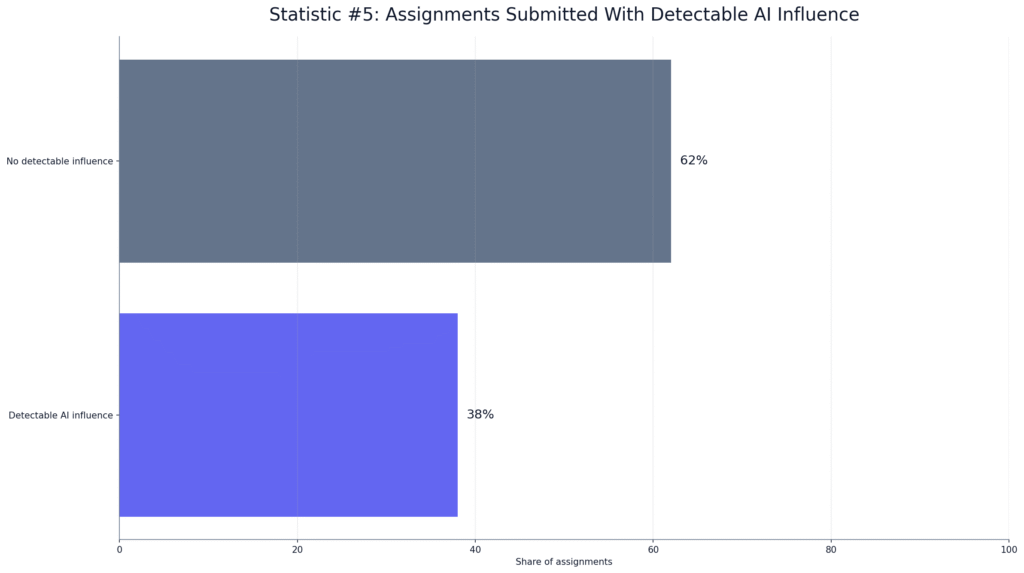
| 5 | Assignments submitted with detectable AI influence | 38% |
| 6 | Students revising AI drafts multiple times before submission | 49% |
| 7 | Faculty expressing concern over AI-generated academic tone | 63% |
| 8 | Universities publishing official AI writing policies | 58% |
| 9 | Students combining AI drafts with manual rewriting | 61% |
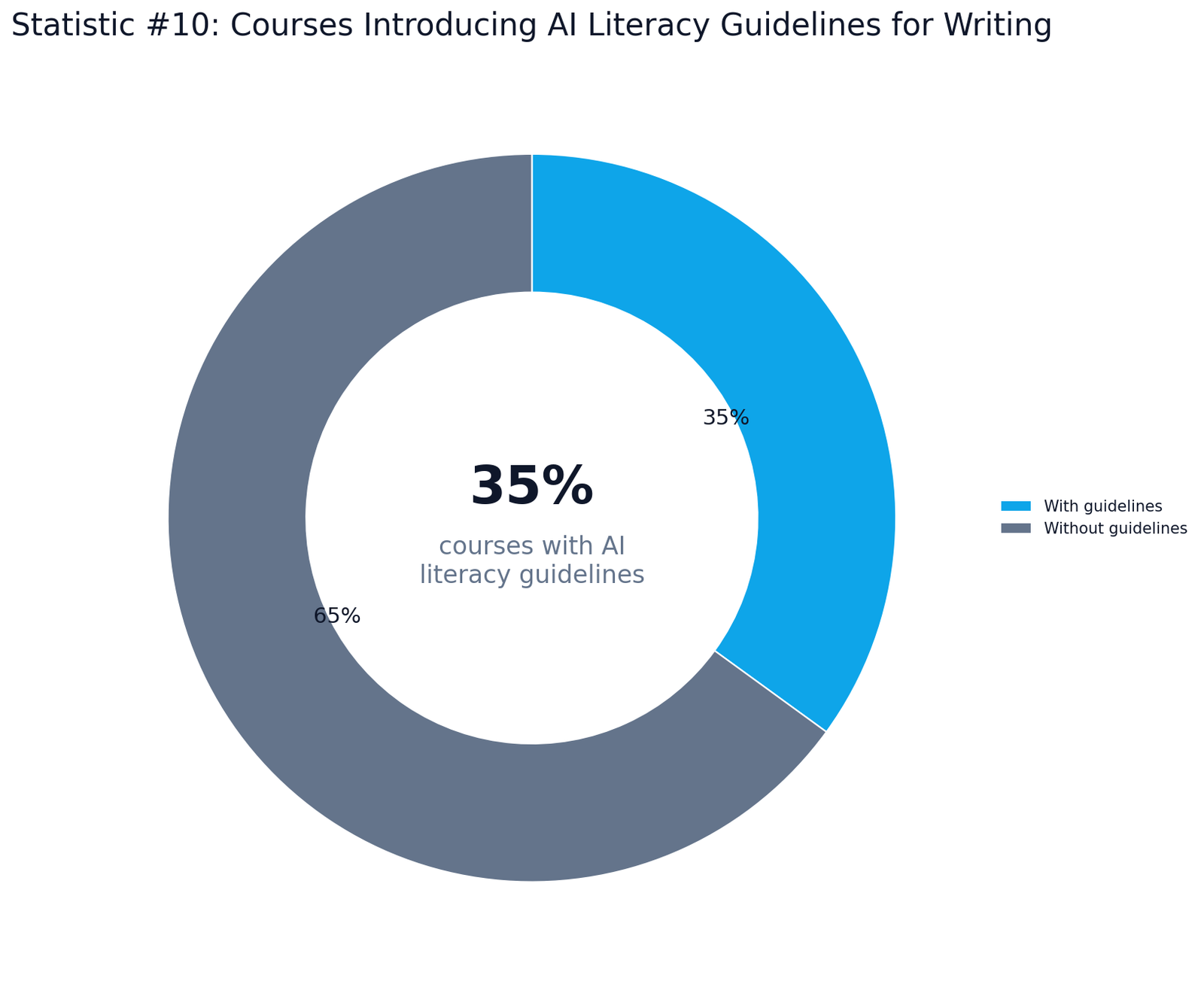
| 10 | Courses introducing AI literacy guidelines for writing | 35% |
| 11 | Students who say AI helps overcome writer’s block | 74% |
| 12 | Academic essays beginning with AI-assisted outlines | 46% |
| 13 | Students who rewrite AI text to avoid detection tools | 41% |
| 14 | Faculty reporting increased editing quality in submissions | 52% |
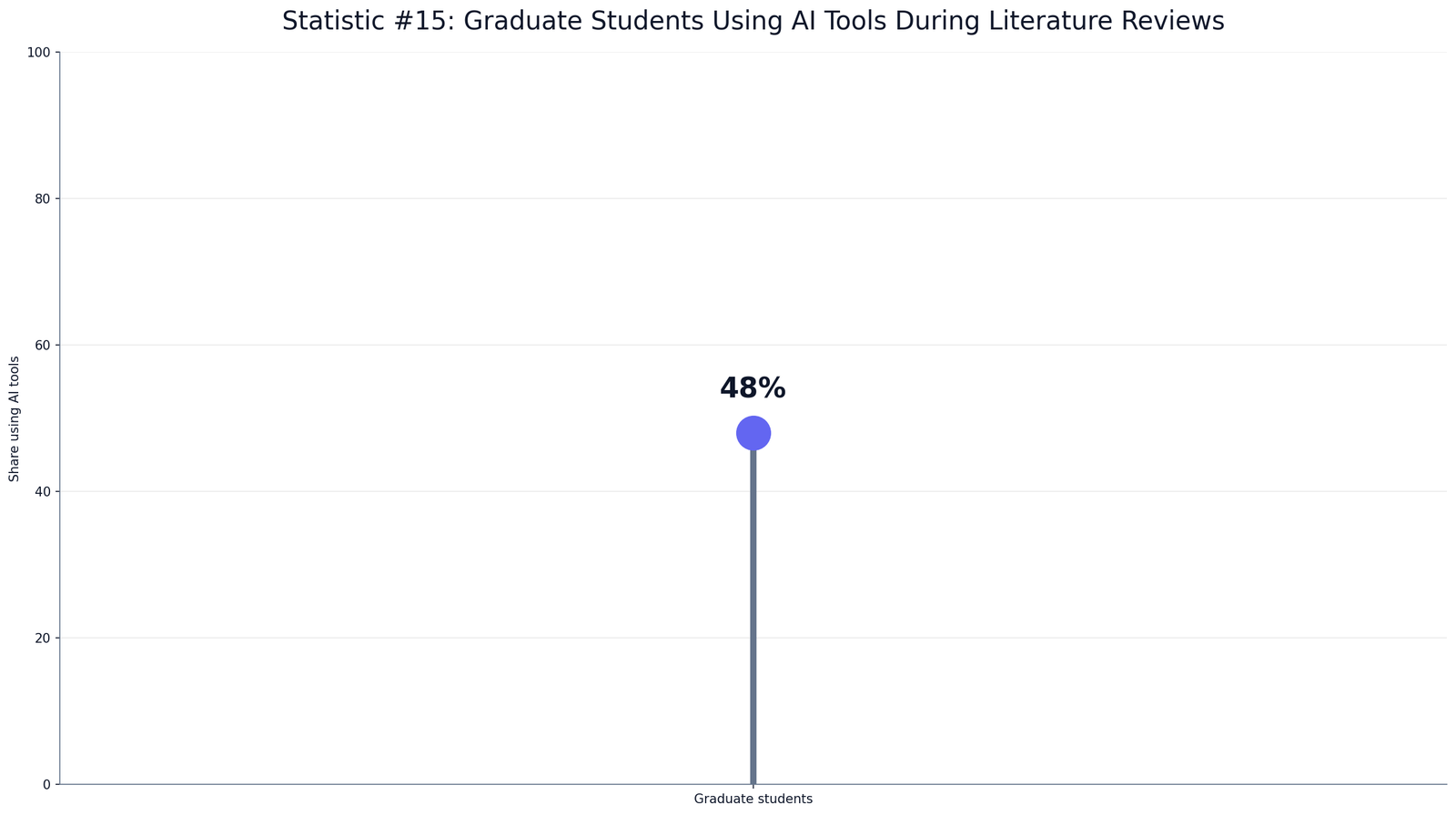
| 15 | Graduate students using AI tools during literature reviews | 48% |
| 16 | Students relying on AI to restructure complex paragraphs | 57% |
| 17 | Academic departments actively studying AI writing patterns | 29% |
| 18 | Students concerned about AI detection in coursework | 64% |
| 19 | Assignments revised through AI editing tools after drafting | 59% |
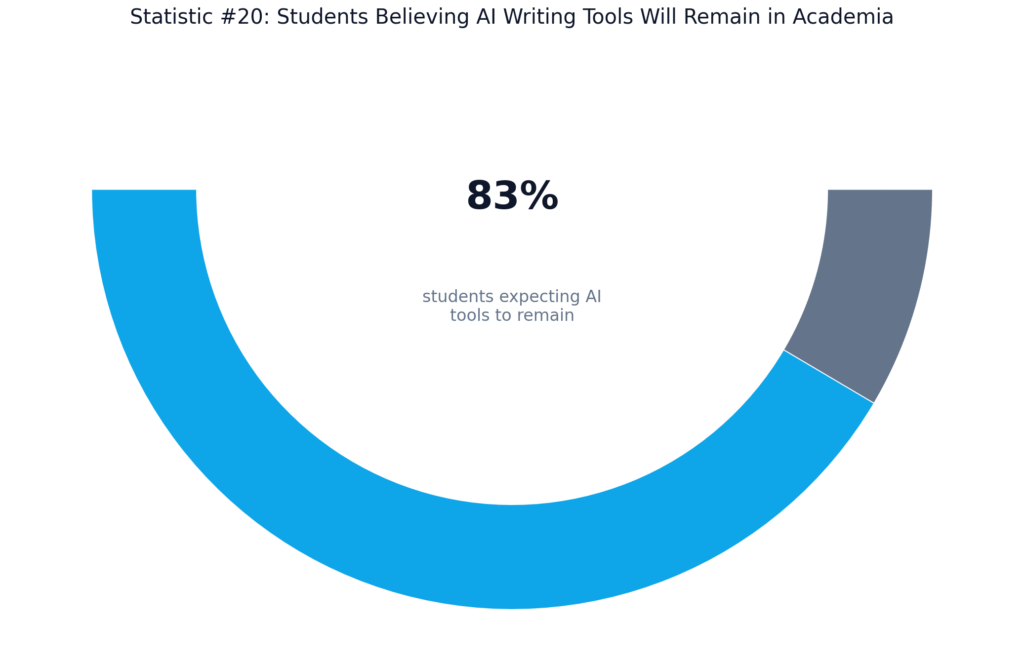
| 20 | Students believing AI writing tools will remain in academia | 83% |
Top 20 Academic AI Writing Usage Statistics and the Road Ahead
Academic AI Writing Usage Statistics #1. University students reporting AI assistance in written assignments
67% of university students reporting AI assistance in written assignments points to routine use rather than novelty. That level suggests assisted writing has moved into everyday coursework, especially in draft-heavy classes. It also tells editors and faculty that AI use is now something to manage, not simply spot.
The behavior behind that figure usually starts with pressure, speed, and uncertainty around academic phrasing. Students reach for AI when deadlines stack up, instructions feel vague, or an opening paragraph refuses to cooperate. Research on higher education AI adoption now reads less like a warning label and more like a map of actual study habits.
The human contrast is revealing because students still submit work under their own name, even when software helps shape the early draft. A figure like 67% of university students means the real editorial question is how much judgment survives after assistance enters the process. Institutions that respond with clearer boundaries, revision teaching, and transparent disclosure rules will be in a stronger position, and that carries a direct implication.
Academic AI Writing Usage Statistics #2. Students using AI primarily for editing rather than drafting
54% of students using AI primarily for editing rather than drafting shows a more restrained pattern than many critics expected. The tool is being used to smooth awkward sentences, tighten wording, and fix structure after ideas already exist. That matters because editing support looks different from full text generation in both intent and academic risk.
This pattern tends to emerge when students know instructors can recognize canned prose but still want help polishing their work. Editing feels safer because it keeps ownership closer to the student while still saving time on clunky sections. In practice, that means academic AI often behaves more like a fast copy desk than a ghostwriter.
The human side remains central because revision still requires taste, subject knowledge, and a sense of what sounds plausible in a course context. When 54% of students lean on AI at the editing stage, they are usually trying to sound clearer, not disappear from the page completely. Faculty policy that separates drafting, revising, and proofreading will evaluate this behavior more accurately, and that leads to a practical implication.
Academic AI Writing Usage Statistics #3. Professors allowing limited AI usage under structured guidelines
42% of professors allowing limited AI usage under structured guidelines suggests the classroom is moving toward negotiated use, not total acceptance. That figure sits in a middle zone where faculty are cautious but no longer pretending the tools are absent. The result is a patchwork environment in which permission depends heavily on task design and instructor trust.
The cause is straightforward enough because outright bans are hard to enforce and broad approval feels risky. Many instructors now prefer rules that permit brainstorming, outlining, or language cleanup while blocking invisible authorship. You can see the same logic in conversations around what professors expect from students using AI, where transparency matters more than slogans.
The human contrast appears in grading, since faculty still want to hear a student thinking on the page rather than a polished machine pattern. A figure like 42% of professors shows acceptance is conditional and still tied to evidence of genuine reasoning. Schools that translate those conditions into assignment-level guidance will reduce confusion faster, and that creates an important implication.
Academic AI Writing Usage Statistics #4. Students who say AI improves clarity in academic writing
71% of students saying AI improves clarity in academic writing captures one of the technology’s strongest appeals. Many learners are not chasing brilliance so much as they are chasing coherence, especially under academic pressure. Clarity is where AI feels immediately useful because sentence-level cleanup produces visible gains fast.
The number rises because academic writing rewards control, concision, and formal structure, all areas where students often feel exposed. AI can reorganize a messy paragraph, simplify repetition, and offer a cleaner sequence of claims in seconds. That does not mean the reasoning improves automatically, but it does explain why usage sticks.
The human contrast is that clear prose still needs a clear mind behind it, and polished wording can hide weak analysis just as easily as it can reveal strong thinking. When 71% of students report clarity gains, editors should read that as a surface-level strength with uneven intellectual depth underneath. Assessment models that separate expression quality from argument quality will judge these outputs more fairly, and that is the real implication.
Academic AI Writing Usage Statistics #5. Assignments submitted with detectable AI influence
38% of assignments submitted with detectable AI influence suggests assisted writing is not staying at the brainstorming stage. A share that large means traces of machine phrasing, structure, or revision are reaching final coursework with regularity. Detection, then, becomes less of a rare integrity event and more of a recurring editorial signal.
The cause sits in the gap between policy language and student workflow. Learners often revise with AI late in the process, assuming light edits will not matter, or they simply underestimate how much stylistic residue remains. Support materials similar to how to rewrite AI classroom announcements show why tone cleanup and natural revision now sit near the center of academic use.
The human contrast is that detectable influence does not always equal dishonest intent, because some flagged work began as legitimate student writing. Still, once 38% of assignments carry visible AI fingerprints, institutions need more than binary suspicion to interpret them well. Better review processes, disclosure norms, and revision evidence will matter more than panic, and that ends with a clear implication.
Academic AI Writing Usage Statistics #6. Students revising AI drafts multiple times before submission
49% of students revising AI drafts multiple times before submission suggests many are not pasting and walking away. Repeated revision means the machine output is being treated as raw material rather than a finished essay. That pattern makes academic AI use slower, more editorial, and harder to classify in simple yes-or-no terms.
The cause usually comes down to fit. Initial AI prose often sounds broad, slightly generic, or too polished for the assignment, so students keep adjusting wording, citations, and examples until it feels less exposed. In other words, the revision loop exists because machine fluency is not the same thing as classroom credibility.
The human contrast matters because every extra pass adds more student judgment, even when the starting point came from software. Once 49% of students are revising AI outputs repeatedly, the more useful question is how those edits changed substance, not whether assistance appeared at all. Institutions that ask for drafts, notes, or process comments will evaluate this pattern more intelligently, and that has a clear implication.
Academic AI Writing Usage Statistics #7. Faculty expressing concern over AI-generated academic tone
63% of faculty expressing concern over AI-generated academic tone shows that style remains one of the biggest friction points. Instructors are not only looking for factual accuracy or policy compliance. They are also reacting to prose that feels oddly flattened, overconfident, or detached from the student voice they expect.
This happens because AI defaults toward smooth, generalized phrasing that sounds competent without sounding situated. Academic writing, though, often needs disciplinary nuance, selective hesitation, and evidence that the writer actually understands the course conversation. Faculty pick up on tonal mismatch long before they can prove where it came from.
The human contrast is easy to hear in stronger student work, which usually contains specific emphasis, small imperfections, and a real sense of position. When 63% of faculty flag concerns over tone, they are really responding to missing texture more than missing grammar. Teaching students how to revise for rhythm, specificity, and plausible voice will matter more than pure detection, and that produces a lasting implication.
Academic AI Writing Usage Statistics #8. Universities publishing official AI writing policies
58% of universities publishing official AI writing policies suggests institutions are finally moving from reaction into administration. Once policy passes the halfway mark, AI stops being a niche classroom issue and becomes part of standard governance. That matters because formal rules shape student confidence as much as they shape discipline.
The rise in published policies comes from growing usage, inconsistent faculty responses, and pressure to define acceptable help. Universities have realized that silence creates more risk than imperfect guidance. Even a cautious policy gives departments a common language for disclosure, limits, and revision expectations.
The human contrast is that students still experience these rules locally through individual modules, not abstract institutional language. So while 58% of universities may have a written policy, the lived reality can still feel uneven from class to class. Schools that connect policy to sample assignments, model disclosures, and course-specific examples will reduce confusion far better, and that becomes the practical implication.
Academic AI Writing Usage Statistics #9. Students combining AI drafts with manual rewriting
61% of students combining AI drafts with manual rewriting points to a blended writing process rather than a fully automated one. The workflow usually begins with machine assistance but does not end there. Students are still cutting, swapping, reshaping, and localizing the language before submission.
This pattern appears because raw AI text rarely lands cleanly inside real academic settings. It may miss the reading, ignore the rubric, or sound too generic for a seminar paper, so students intervene to make it believable. Manual rewriting becomes the bridge between machine fluency and assignment reality.
The human contrast is that rewriting can either restore ownership or simply disguise dependence, and those are not the same thing. Once 61% of students are mixing generated drafts with human revision, institutions need criteria that judge process quality instead of assuming all hybrid work is equivalent. Rubrics that reward source use, argument development, and revision transparency will handle that gray zone better, and that leads to a meaningful implication.
Academic AI Writing Usage Statistics #10. Courses introducing AI literacy guidelines for writing
35% of courses introducing AI literacy guidelines for writing shows support is growing, though it still trails usage by a wide margin. Students are already using the tools faster than curricula are explaining them. That mismatch leaves many learners to figure out acceptable practice from rumor, trial, and accidental overreach.
The slower rollout happens because course redesign takes time and faculty confidence varies sharply across departments. Some instructors can discuss prompt quality, revision ethics, and disclosure easily, while others are still deciding what counts as misuse. As a result, literacy guidance appears unevenly, often in the most writing-intensive classes first.
The human contrast is that students usually want fewer surprises, not fewer rules. When only 35% of courses offer explicit AI literacy guidance, uncertainty itself becomes part of the academic burden. Institutions that treat AI instruction as part of writing education rather than an optional add-on will close that gap faster, and that ends with an obvious implication.
Academic AI Writing Usage Statistics #11. Students who say AI helps overcome writer’s block
74% of students saying AI helps overcome writer’s block explains why the tool spreads so quickly in academic settings. Starting is often the hardest part of writing, not because students lack ideas, but because they struggle to convert scattered thoughts into a usable opening. AI reduces that friction almost instantly, which makes the benefit feel practical rather than abstract.
The cause is rooted in cognitive load. Faced with a blank page, vague prompt, and looming deadline, students often want momentum more than perfection, and AI offers a quick push toward structure. Even a weak generated start can be enough to break paralysis and get the drafting process moving.
The human contrast is that overcoming writer’s block is not the same as building an argument. When 74% of students use AI to get unstuck, they are solving an entry problem, not automatically improving reasoning, evidence, or originality. Courses that teach opening strategies, outline moves, and low-stakes drafting will reduce unhealthy dependence more effectively, and that carries a useful implication.
Academic AI Writing Usage Statistics #12. Academic essays beginning with AI-assisted outlines
46% of academic essays beginning with AI-assisted outlines shows the influence of these tools starts earlier than the final wording. Structure is becoming one of the main access points for machine help. That matters because outlines quietly shape argument order, evidence hierarchy, and even what students think belongs in a paper.
The pattern makes sense because outlining is hard to teach and easy to outsource. Students often know the topic but not the sequence, so AI offers an immediate skeleton they can react to. Once that scaffold exists, the writer tends to follow its logic, even when they later replace most of the sentences.
The human contrast is that a student can still write every paragraph personally while inheriting the paper’s overall architecture from a tool. So when 46% of academic essays begin with AI-assisted outlines, authorship becomes less visible but not less important. Instructors who ask students to justify their structure choices will get closer to genuine thinking, and that ends with a strong implication.
Academic AI Writing Usage Statistics #13. Students who rewrite AI text to avoid detection tools
41% of students rewriting AI text to avoid detection tools points to anxiety as much as intent. This is not just a story of evasion. It is also a sign that students believe machine-like phrasing can trigger suspicion, even in work they have substantially revised.
The behavior grows when policies are vague, detection narratives are loud, and students lack confidence in what acceptable revision looks like. Rewriting becomes a defensive act, aimed at sounding more natural, less uniform, and less exposed to false signals. That turns style into a risk-management strategy rather than a purely rhetorical one.
The human contrast is uncomfortable because rewriting can reflect either legitimate editing or deliberate concealment, and institutions do not always distinguish between them well. Once 41% of students are adjusting text with detection in mind, the system is shaping writing behavior directly. Clear disclosure rules and evidence-based review will do more good than suspicion alone, and that is the broader implication.
Academic AI Writing Usage Statistics #14. Faculty reporting increased editing quality in submissions
52% of faculty reporting increased editing quality in submissions suggests AI’s influence is not being felt only as a threat. Many instructors are noticing cleaner syntax, tighter organization, and fewer obvious language errors. That can make papers easier to read, even when deeper concerns remain unresolved.
The cause is fairly direct because AI is very good at surface polish. It catches repetition, evens out paragraph transitions, and proposes cleaner phrasing faster than many students can manage alone under pressure. As a result, the visible finish of academic writing improves before its reasoning necessarily does.
The human contrast is that elegant copy can still contain thin analysis, weak evidence, or borrowed logic. So when 52% of faculty notice better editing quality, they are often seeing stronger presentation rather than stronger scholarship. Rubrics that separate polish from intellectual substance will keep evaluation grounded, and that creates a useful implication for future assessment design.
Academic AI Writing Usage Statistics #15. Graduate students using AI tools during literature reviews
48% of graduate students using AI tools during literature reviews shows adoption is not limited to undergraduates chasing easier drafts. At advanced levels, the attraction is usually volume and synthesis rather than sentence production. Literature review work is dense, repetitive, and time-heavy, so AI enters as a research organizer before it appears as a writer.
The cause lies in scale. Graduate students face long reading lists, overlapping debates, and pressure to identify patterns quickly, and AI can summarize, cluster, or extract themes at a pace humans cannot match alone. That makes it useful, though not automatically reliable, in early-stage evidence handling.
The human contrast is still decisive because literature reviews depend on interpretation, credibility judgment, and disciplinary nuance. When 48% of graduate students bring AI into that stage, the risk is less bad grammar and more shallow synthesis dressed as mastery. Programs that teach verification alongside AI-assisted review will protect research quality better, and that leads to a serious implication.
Academic AI Writing Usage Statistics #16. Students relying on AI to restructure complex paragraphs
57% of students relying on AI to restructure complex paragraphs shows that local revision is one of the tool’s most durable uses. Paragraph-level repair feels low risk, highly visible, and immediately rewarding. Students can see the before and after clearly, which makes the value proposition easy to trust.
The cause is that paragraph organization is where many academic writers lose control. They may understand the reading but still struggle to order claims, evidence, and explanation in a way that sounds deliberate. AI steps into that gap by reordering sentences, tightening transitions, and offering a clearer logic pattern.
The human contrast is that restructured prose can sound stronger than the thinking behind it if the writer never checks whether the paragraph still reflects their meaning. Once 57% of students lean on AI for paragraph repair, educators should treat organization as a teachable skill under pressure. Revision pedagogy that slows students down at the paragraph level will matter more, and that leads to a practical implication.
Academic AI Writing Usage Statistics #17. Academic departments actively studying AI writing patterns
29% of academic departments actively studying AI writing patterns may look modest, but it signals a serious institutional turn. Once departments begin tracking how writing changes, AI becomes a subject of inquiry instead of a passing disruption. That creates the conditions for policy grounded in evidence rather than anecdotes.
The lower share reflects practical constraints. Departments need time, staff attention, and a reason to move from informal concern to formal investigation, so study activity tends to begin where writing is central to assessment or integrity disputes are rising. In other words, research follows pressure.
The human contrast is that students and faculty are already adapting daily, even where formal study has not yet started. So 29% of academic departments likely understates how much observation is happening informally in marking, advising, and curriculum meetings. Institutions that convert those observations into structured review will adjust faster and more fairly, and that produces a clear implication.
Academic AI Writing Usage Statistics #18. Students concerned about AI detection in coursework
64% of students concerned about AI detection in coursework shows fear is now part of the writing environment. That concern affects behavior long before any formal review occurs. Students begin editing for suspicion, second-guessing legitimate phrasing, and worrying that fluent prose might look machine-made.
The cause is not only tool usage itself. It also comes from public stories of false positives, uneven instructor responses, and limited clarity around what evidence actually matters in academic integrity decisions. Detection becomes psychologically powerful when the process surrounding it feels harder to predict than the software.
The human contrast is that anxious students often revise more defensively than dishonestly. Once 64% of students are worried about detection, institutions have created a climate where fear shapes writing choices alongside learning goals. More transparent review procedures, draft histories, and calmer communication will reduce that distortion, and that is the implication that matters most.
Academic AI Writing Usage Statistics #19. Assignments revised through AI editing tools after drafting
59% of assignments revised through AI editing tools after drafting confirms that post-draft intervention is becoming standard practice. Many students are still generating the original material themselves, then inviting AI into the polishing phase. That timing matters because it places AI closer to copyediting than composition in a large share of cases.
The behavior grows because revision is where students feel both fatigue and vulnerability. After the hard thinking is done, they want help spotting awkward phrasing, repetition, and structural drag without starting over. AI fits neatly into that final-stage cleanup window.
The human contrast is that a student-written draft can become noticeably less personal after heavy automated editing. So when 59% of assignments pass through AI revision after drafting, voice erosion becomes a bigger issue than authorship alone. Writing instruction that protects clarity without flattening individuality will become more valuable, and that leaves institutions with a useful implication.
Academic AI Writing Usage Statistics #20. Students believing AI writing tools will remain in academia
83% of students believing AI writing tools will remain in academia shows expectations have already settled into permanence. Students are no longer treating these systems like a temporary loophole or a trend that will fade after one academic cycle. They see them as part of the future study environment, for better or worse.
The cause is cumulative exposure. Once learners encounter AI in search, summarization, drafting, feedback, and institutional messaging, it begins to look embedded rather than optional. Even students with reservations can tell the infrastructure around academic writing is changing.
The human contrast is that permanence does not automatically mean trust. When 83% of students expect AI writing tools to stay, they are recognizing direction more than endorsing every consequence of that direction. Universities that plan for long-term integration with stronger writing instruction, clearer boundaries, and real accountability will be more credible, and that final pattern carries the clearest implication.
Academic AI Writing Usage Statistics show a move from one-off experimentation to managed, high-friction integration across coursework, policy, revision, and institutional oversight
The strongest pattern across these figures is not simple growth but normalization under tension. Students are using AI across drafting, outlining, editing, and restructuring, yet faculty and institutions are still deciding which parts of that workflow feel educationally defensible.
That is why the numbers do not point in one clean direction. Usage is high, policy is catching up, and anxiety around tone, detection, and authorship is rising at the same time.
The resulting academic environment feels less like adoption and more like ongoing negotiation. Human judgment remains the scarce resource, even when software now handles more of the visible writing labor.
For 2026, the real divide is no longer between users and non-users. It sits between institutions that teach students how to work with AI responsibly and institutions that leave them to improvise, and that is where the next practical implication sits.
Sources
- Student Generative AI Survey 2026 full report PDF
- Student Generative AI Survey 2025 policy note
- HEPI overview of the 2026 student survey
- HEPI overview of the 2025 student survey
- Digital Education Council global AI student survey
- Key results from DEC global student survey
- EDUCAUSE 2025 students and technology survey
- EDUCAUSE AI landscape study for higher education
- EDUCAUSE horizon report teaching and learning edition
- Turnitin summary of 2024 education AI findings
- Turnitin guidance on responsible AI writing use
- Turnitin strategies for evaluating student AI use