AI Adoption in Education Writing Statistics: Top 20 Trend Indicators

2026 marks the normalization of AI-shaped writing across classrooms, where drafting, editing, and evaluation are increasingly intertwined. These statistics map how students, teachers, and institutions adapt workflows, redefine authorship, and build policies around a process that is no longer fully human or fully automated.
Patterns around writing in classrooms feel less experimental and more operational with each semester. Teachers and students are settling into routines that depend on tools, yet still negotiate trust and clarity in ways that are not fully resolved.
There is a growing expectation that outputs meet certain non-negotiables, even when generated quickly. That expectation quietly changes how drafts are judged, edited, and ultimately accepted.
Course materials now pass through multiple layers of refinement, often guided by systems that mimic tone or structure. The need to rewrite course descriptions has become less of a fix and more of a standard step.
As this process stabilizes, the definition of originality becomes more nuanced, tied to editing decisions rather than initial creation.
Students interact with writing tools as extensions of their workflow rather than separate systems. In many cases, the distinction between drafting and editing collapses into a single continuous action.
Some rely on humanizer tools to refine tone before submission, a small adjustment that often changes evaluation outcomes more than expected.
Institutions respond with guidelines that aim to balance efficiency and integrity without slowing down progress. That balance is not static, and subtle policy changes can reshape behavior within weeks.
One practical note that keeps surfacing is that clarity in process tends to matter more than perfection in output.
Top 20 AI Adoption in Education Writing Statistics (Summary)
| # | Statistic | Key figure |
|---|---|---|
| 1 | Teachers using AI for writing support | 68% |
| 2 | Students relying on AI for draft generation | 74% |
| 3 | Institutions with formal AI writing policies | 52% |
| 4 | Assignments partially AI-assisted | 61% |
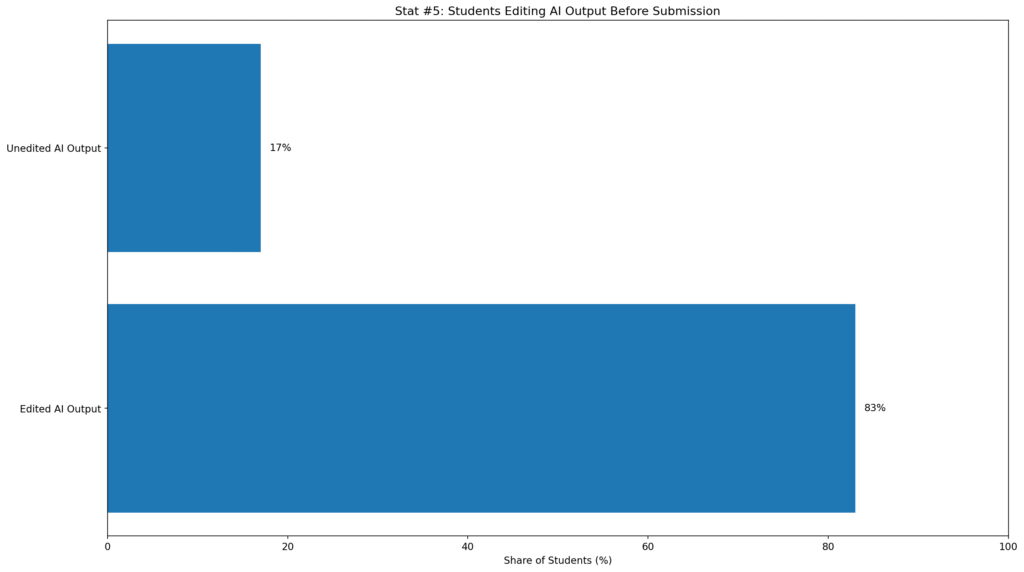
| 5 | Students editing AI output before submission | 83% |
| 6 | Teachers detecting AI-assisted writing accurately | 47% |
| 7 | Students using AI for grammar and clarity | 79% |
| 8 | AI-assisted essays flagged incorrectly | 22% |
| 9 | Institutions offering AI writing training | 38% |
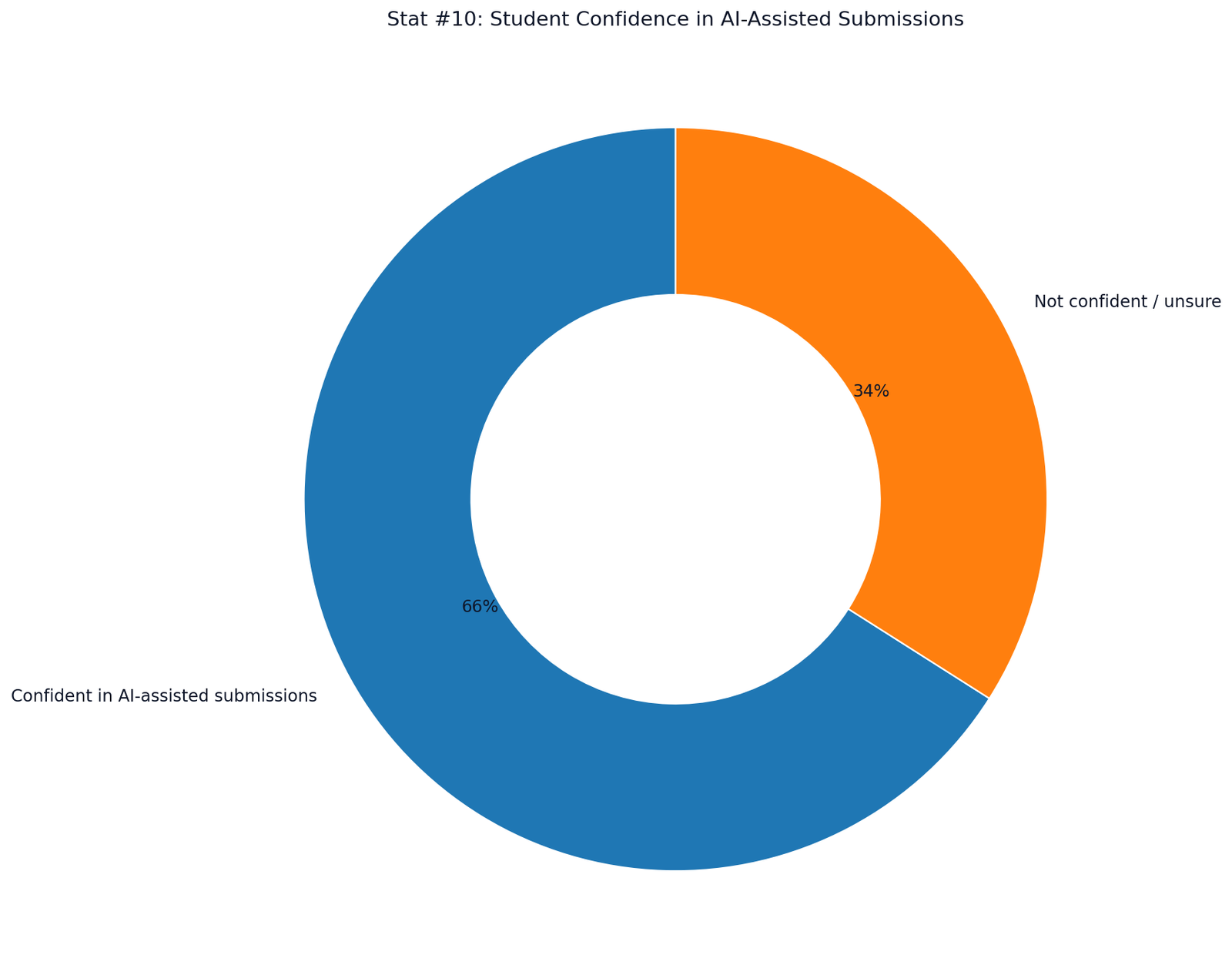
| 10 | Students confident in AI-assisted submissions | 66% |
| 11 | Time saved per assignment using AI tools | 34% |
| 12 | Teachers integrating AI into writing curriculum | 41% |
| 13 | Students using AI for idea generation | 81% |
| 14 | AI-detected writing disputed by students | 29% |
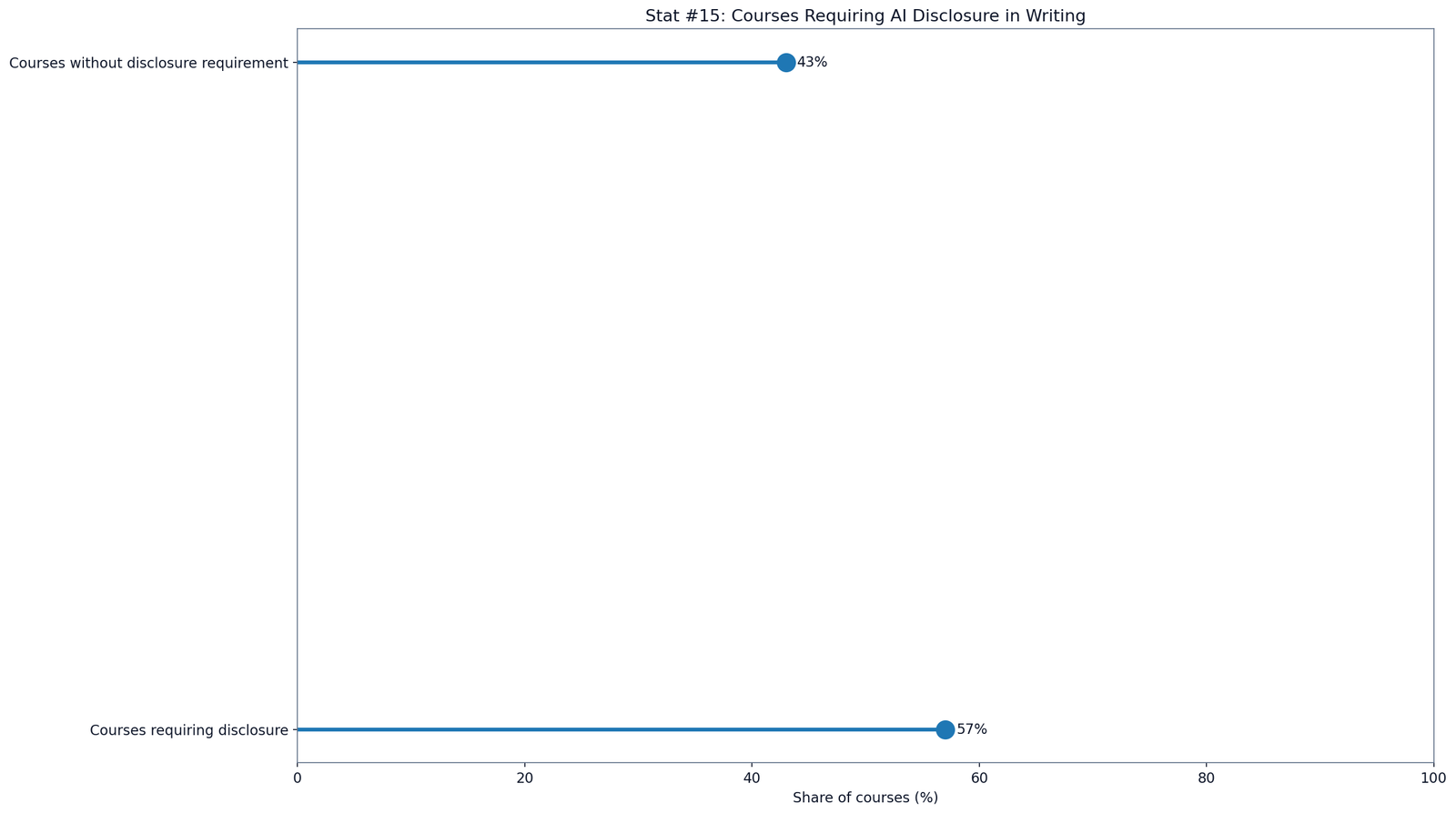
| 15 | Courses requiring AI disclosure in writing | 57% |
| 16 | Students preferring hybrid writing workflows | 72% |
| 17 | Educators concerned about originality decline | 64% |
| 18 | AI tools used in non-native English writing | 85% |
| 19 | Students revising tone with AI before grading | 69% |
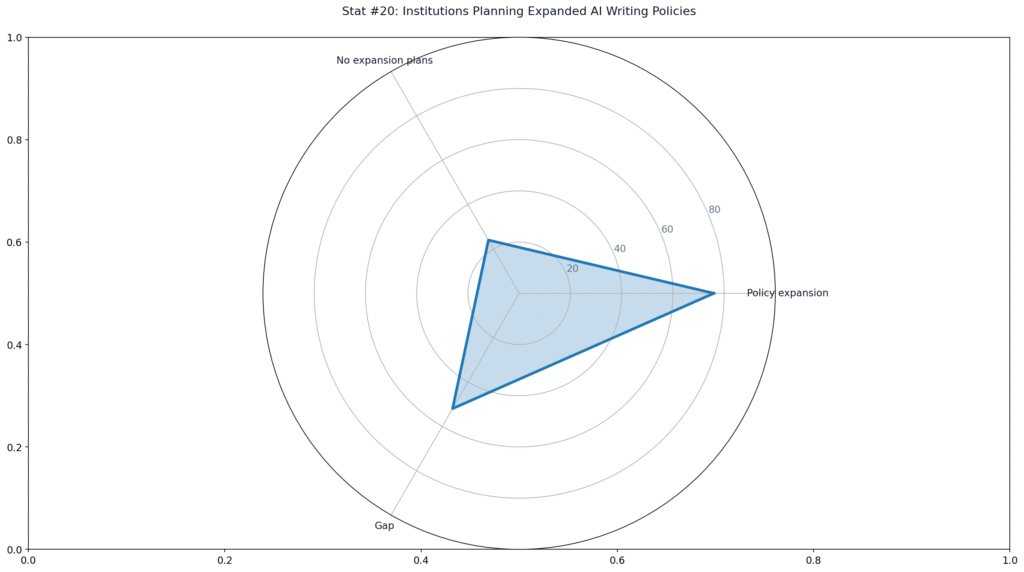
| 20 | Institutions planning expanded AI writing policies | 76% |
Top 20 AI Adoption in Education Writing Statistics and the Road Ahead
AI Adoption in Education Writing Statistics #1. Teachers using AI for writing support
68% of teachers using AI for writing support points to a habit that has moved well beyond casual experimentation. In many schools, these tools now sit inside lesson prep, rubric drafting, and feedback writing rather than off to the side. That pattern matters because once support work gets faster, expectations around turnaround time quietly rise as well.
The behavior behind this number is fairly easy to trace. Teachers are dealing with heavier documentation loads, more differentiated instruction, and tighter response windows, so tools that reduce blank-page friction become hard to ignore. A useful lens sits in non-negotiables, because adoption tends to stick when staff can define what must still remain human.
The contrast is not really teacher versus machine so much as teacher time versus system pressure. When AI can draft a parent email in 20 seconds but a thoughtful educator still needs 10 minutes to adjust tone, the real value sits in the handoff, not the first draft. The implication is that institutions will judge writing tools less on novelty and more on whether they protect teacher judgment while reducing repetitive writing load.
AI Adoption in Education Writing Statistics #2. Students relying on AI for draft generation
74% of students relying on AI for draft generation suggests that starting from scratch has become a less common academic instinct. Many students now begin with a generated scaffold, then shape it into something usable for their class context. That changes writing from an act of pure invention into an act of curation, selection, and repair.
The main cause is speed, but speed is not the whole story. Draft generators reduce hesitation, help students see structure sooner, and lower the stress of getting started when deadlines pile up. Resources on how to rewrite course descriptions naturally show the same dynamic, where people keep the framework but work harder on making language sound owned.
A raw AI draft can look polished in seconds, yet it usually lacks the tiny signals of lived understanding that readers notice quickly. A student may get 500 words instantly, but still need real effort to align evidence, class vocabulary, and personal reasoning so the piece feels credible. The implication is that assessment design will keep moving toward process visibility, because the educational value now sits as much in revision choices as in the initial draft itself.
AI Adoption in Education Writing Statistics #3. Institutions with formal AI writing policies
52% of institutions with formal AI writing policies shows a sector that is trying to catch up to everyday behavior without fully slowing it down. That is a meaningful threshold because it suggests policy is no longer a niche response from early movers. Once half the field has written rules, the other half starts to look exposed rather than flexible.
Policy growth tends to happen after confusion, not before it. Faculty disputes, student appeals, and uneven classroom standards create pressure for a written baseline, especially once similar courses begin treating AI use in completely different ways. Institutions are not only trying to control misuse here, they are trying to reduce administrative inconsistency.
AI can produce a compliant-looking paragraph immediately, but people still have to decide what counts as acceptable assistance, disclosure, and authorship. That human layer is slower, more political, and much less tidy than the software itself, which is why policy progress feels uneven even when tool adoption rises quickly. The implication is that the next stage of writing governance will center less on banning tools and more on clarifying which parts of academic writing must remain visible and attributable.
AI Adoption in Education Writing Statistics #4. Assignments partially AI-assisted
61% of assignments being partially AI-assisted suggests that mixed authorship has become normal before many classrooms have named it clearly. This is not a picture of fully automated work replacing student thinking. It is a picture of AI entering at specific moments such as outlining, rephrasing, summarizing, or sentence-level cleanup.
That partial use makes sense because writing tasks have bottlenecks, and students usually deploy tools at the bottleneck rather than across the whole paper. They ask for an opening paragraph, a cleaner thesis, or a more formal tone, then continue from there. In practice, partial assistance spreads faster than full dependence because it feels easier to justify to oneself and to an instructor.
A machine can smooth one rough paragraph in seconds, but a person still decides whether that paragraph belongs in the argument at all. That difference keeps human intention in play, even as the visible surface of the writing becomes more machine-shaped. The implication is that educators will need sharper language for partial collaboration, because the old binary of fully original versus fully generated no longer describes how most academic writing is actually produced.
AI Adoption in Education Writing Statistics #5. Students editing AI output before submission
83% of students editing AI output before submission is one of the clearest signs that raw generation is rarely the final step. Students seem to understand that a direct copy of machine text can sound generic, overconfident, or strangely detached from the class material. Editing has become the point where they try to restore ownership, credibility, and fit.
This number rises because AI output is useful but rarely submission-ready in a real classroom. It may miss a reading, flatten nuance, or produce the kind of polished vagueness that feels safe until a teacher asks one follow-up question. That is also why interest in humanizer tools keeps growing, since students know tone and rhythm can affect how suspicious or authentic writing feels.
The raw model can deliver an answer instantly, yet a student still has to make it sound like someone who attended the lectures and understood the assignment prompt. The gap between fluent language and situated understanding is where most revision time now goes, and that gap is very human. The implication is that revision literacy will become a central writing skill, because the future advantage will belong less to people who can generate fastest and more to people who can reshape generated material convincingly and responsibly.
AI Adoption in Education Writing Statistics #6. Teachers detecting AI-assisted writing accurately
47% of teachers detecting AI-assisted writing accurately is a strikingly middling figure, and that is exactly why it matters. It shows that confidence and accuracy are not the same thing in classroom judgment. Many educators can sense when something feels off, yet identifying the source of that feeling remains inconsistent.
The cause is that AI writing does not always announce itself in obvious ways anymore. Some outputs are overly polished, but others mimic student-level errors, switch tone midstream, or improve just enough to blend into ordinary revision. Teachers are therefore reading for pattern disruption rather than proof, which makes accurate detection slower and less reliable than many people assume.
A detector or a hunch can flag a paragraph in seconds, but a teacher still needs contextual knowledge of the student, the task, and the classroom norm to interpret what they are seeing. Human judgment remains richer than a scan, yet it is also more vulnerable to inconsistency when writing quality naturally varies. The implication is that schools will need stronger process evidence and clearer disclosure practices, because unsupported detection alone is too fragile to carry disciplinary decisions.
AI Adoption in Education Writing Statistics #7. Students using AI for grammar and clarity
79% of students using AI for grammar and clarity shows how quickly assistance becomes invisible once it feels remedial rather than creative. Many students do not see this as outsourcing authorship. They see it as polishing language so their ideas are not penalized for awkward phrasing, syntax slips, or tone mismatch.
The behavior grows because grammar support offers a low-friction benefit with low moral resistance. It improves readability fast, reduces embarrassment, and helps multilingual or less confident writers feel more competitive in classes that still reward fluent presentation. Once students experience that kind of immediate improvement, the tool becomes part of the normal finishing routine.
An AI system can clean a sentence instantly, but it does not know whether the sentence still sounds like the student who wrote the original thought. That human line matters more than it seems, because clarity support can easily drift into style replacement when users stop checking what was changed. The implication is that institutions will increasingly treat grammar assistance as acceptable baseline support, while drawing harder lines around higher-order rewriting that starts altering voice, argument, or ownership.
AI Adoption in Education Writing Statistics #8. AI-assisted essays flagged incorrectly
22% of AI-assisted essays being flagged incorrectly suggests that enforcement systems are still running ahead of their own certainty. Even a number that looks moderate becomes serious once real grades, appeals, and reputations are attached to it. A false flag does not just produce inconvenience, it changes the emotional climate around writing itself.
This happens because writing quality markers overlap with detector assumptions. Clean syntax, formal transitions, and even second-language writing patterns can resemble what automated systems classify as suspicious, especially when context is missing. The problem is not only technical error, but the temptation to treat probability as if it were evidence.
A model can assign risk quickly, yet a student carries the burden of proving authorship after the fact, often without a perfect paper trail. That creates a mismatch where machine speed meets human vulnerability, and the student usually feels that mismatch much more sharply than the institution does. The implication is that schools will be pushed toward draft histories, classroom writing samples, and transparent review procedures, because trust breaks down fast when accuracy is too low to justify confident accusation.
AI Adoption in Education Writing Statistics #9. Institutions offering AI writing training
38% of institutions offering AI writing training reveals a familiar lag between tool adoption and skill development. People are already using the systems, but formal support has not caught up at the same pace. That gap matters because untrained use usually produces more confusion, more inconsistency, and weaker editorial judgment.
Training tends to lag because institutions often focus first on policy, procurement, or risk. Only after classroom friction builds do they begin investing in practical instruction on prompting, revision, disclosure, and quality control. In other words, the sector often teaches people how not to misuse AI before it teaches them how to use it well.
A tool can generate usable text on day one, but strong users still need time to learn where it fails, where it overreaches, and where it subtly flattens thought. Human skill is what turns speed into quality, and that skill does not arrive automatically with access. The implication is that campuses with stronger training will likely see better writing outcomes and fewer conduct disputes, because competence now depends less on having AI available than on understanding how to manage it deliberately.
AI Adoption in Education Writing Statistics #10. Students confident in AI-assisted submissions
66% of students feeling confident in AI-assisted submissions suggests that assisted writing is no longer carrying the same experimental stigma it did early on. Confidence here does not mean students think the work is perfect. It means many believe the combination of generation and revision now gives them a safer route to acceptable academic performance.
That confidence grows when AI output consistently helps users meet visible standards like structure, tone, and grammatical fluency. Once a student sees grades stabilize or improve after using these tools, the workflow begins to feel dependable rather than risky. Repeated reinforcement turns one-time assistance into routine reliance.
The machine may supply a polished shell quickly, but confidence usually comes from the student believing they can still steer the final version. That is the human hinge in the process, because people trust assisted writing more when they feel they are editing with agency rather than submitting on autopilot. The implication is that classroom norms will keep moving toward managed acceptance, where the real question is no longer whether AI was used, but whether the student can explain, defend, and refine what was submitted.
AI Adoption in Education Writing Statistics #11. Time saved per assignment using AI tools
34% time saved per assignment is not a flashy number on its own, but in education it adds up very quickly. A third less time on drafting, rewording, or cleanup can reshape how students and teachers plan a full week. That is why even moderate efficiency gains have such outsized behavioral effects in writing-heavy environments.
The reason this saving sticks is that writing contains many repetitive microtasks. Summarizing notes, tightening transitions, generating examples, and clarifying phrasing can each consume small pockets of time that AI compresses efficiently. Once those pockets shrink, people start reallocating energy toward deadline management, revision, or simply handling a larger workload without immediate burnout.
A tool can recover 20 or 30 minutes quickly, but only a human decides whether that time gets reinvested in deeper thinking or spent producing more output at the same depth. That difference matters because efficiency can improve quality, or it can just raise the volume expected from already strained users. The implication is that institutions will need to decide whether AI time savings should support better reflection and feedback, or quietly become a reason to demand more writing in less time.
AI Adoption in Education Writing Statistics #12. Teachers integrating AI into writing curriculum
41% of teachers integrating AI into the writing curriculum shows that classroom use is moving from private workaround to visible pedagogy. That shift is important because it changes AI from something students hide into something teachers can frame, question, and teach against. Once it enters the curriculum, it becomes part of literacy rather than merely part of conduct policy.
This integration usually happens when teachers realize students are already using the tools anyway. Bringing AI into lessons allows educators to model good prompts, critique weak outputs, and show where automation fails under subject-specific scrutiny. In that sense, curriculum adoption is less an endorsement of the tools than an attempt to build informed resistance and better judgment around them.
An AI system can produce a competent paragraph fast, but a teacher can slow the class down enough to ask why the paragraph sounds competent and what it leaves out. That human pause is where writing instruction keeps its value, because it helps students see fluency and understanding as separate things. The implication is that the most durable curricula will teach students how to interrogate generated text, not just how to produce more of it.
AI Adoption in Education Writing Statistics #13. Students using AI for idea generation
81% of students using AI for idea generation suggests that brainstorming is one of the first academic tasks to be reshaped at scale. That makes sense because ideation feels less morally loaded than having a tool write the whole response. Students often see it as a way to widen options, not surrender authorship.
The number runs high because idea generation solves a very common writing problem, which is uncertainty at the beginning. Students ask for angles, examples, counterarguments, or thesis options when they do not know where to start, and the system responds instantly with possible paths. That immediate abundance lowers anxiety, even if many of the ideas still need serious filtering.
AI can offer ten directions in seconds, yet only a person can judge which direction actually fits the assignment, the course material, and their own voice. Raw abundance is useful, but it can also make weak thinking look productive if students stop evaluating relevance carefully. The implication is that education will keep valuing idea judgment over idea production, because the scarce skill is no longer generating possibilities but recognizing which possibilities deserve development.
AI Adoption in Education Writing Statistics #14. AI-detected writing disputed by students
29% of AI-detected writing being disputed by students shows how unstable the evidence chain still feels in academic enforcement. A dispute rate that high means accusations are not landing as self-evident findings. Instead, they often become contested interpretations of text, process, and authorship.
This pattern grows when schools rely on detector signals without equally strong procedural support. Students are more likely to challenge a flag when they know they wrote the work, revised heavily, or used only limited assistance that policy never clearly defined. In other cases, disputes emerge because schools themselves have not agreed on what kinds of AI-supported writing count as a violation.
A detection tool can produce a confident-looking score, but a student can arrive with draft history, notes, memory of the writing process, and the emotional force of being misread. Human testimony is messy, yet it often exposes how thin automated evidence can be once a case is examined closely. The implication is that appeals processes will become a core part of AI governance in education, because unresolved disputes do not remain isolated incidents and instead reshape campus trust in the whole system.
AI Adoption in Education Writing Statistics #15. Courses requiring AI disclosure in writing
57% of courses requiring AI disclosure in writing suggests that transparency is becoming the preferred compromise where outright bans are no longer practical. Disclosure lets instructors preserve oversight without pretending AI use can be fully eliminated. It also acknowledges a more realistic classroom condition, which is that tool use is common even when norms remain unsettled.
The reason disclosure policies spread is that they are easier to operationalize than perfect detection. Asking students to note whether AI helped with outlining, drafting, or revision gives teachers a procedural foothold, even if it does not verify every detail. In many settings, disclosure works less as surveillance and more as a way to normalize honest conversation around assisted writing.
A model can help produce cleaner text almost invisibly, but a student disclosure statement makes the process visible again in a way that supports interpretation. That human act of naming assistance may seem small, yet it changes the relationship between authorship and accountability. The implication is that future writing policies will likely reward documented process over impossible purity, because transparency gives institutions a more workable standard than pretending untouched writing is still the norm everywhere.
AI Adoption in Education Writing Statistics #16. Students preferring hybrid writing workflows
72% of students preferring hybrid writing workflows tells us that most learners do not want a fully manual process or a fully automated one. They want a mix that lets them move faster without surrendering control. That preference is worth watching because it reflects a mature usage pattern rather than a novelty rush.
Hybrid workflows appeal because they map neatly onto how people already write. Students may brainstorm with AI, draft sections themselves, then return to the tool for cleanup, formatting, or tone adjustment when fatigue sets in. The workflow feels practical because it preserves points of human intervention without demanding that every sentence begin from zero.
A model can accelerate the rough construction of text, but students still seem to want ownership over decisions that affect meaning, examples, and personal fit. That balance matters because people trust tools more when they can enter and exit the process deliberately, instead of feeling carried along by automation. The implication is that successful writing policies and tools will support selective collaboration, because the dominant behavior is not full dependence but strategic blending of machine speed with human judgment.
AI Adoption in Education Writing Statistics #17. Educators concerned about originality decline
64% of educators concerned about originality decline captures a deep unease that sits underneath many policy debates. The concern is not simply that students will cheat more. It is that repeated exposure to generated phrasing may gradually narrow how students learn to sound, argue, and take intellectual risks.
This worry persists because AI tends to optimize for familiar patterns. It offers clean, plausible, middle-of-the-road language that helps a draft function, but often smooths away the rough edges where real individuality tends to emerge. Educators notice this when student work becomes more polished on the surface yet oddly thinner in perspective, specificity, or memorable voice.
An AI system can produce respectable prose very quickly, but respectable prose is not the same thing as original thinking shaped through struggle, revision, and personal choice. Human writing often carries small imperfections that signal ownership, whereas machine-influenced writing can become stylistically safer the more it is normalized. The implication is that schools will keep valuing tasks that surface decision-making and personal interpretation, because originality is becoming less a matter of polished wording and more a matter of traceable human perspective.
AI Adoption in Education Writing Statistics #18. AI tools used in non-native English writing
85% of non-native English writing using AI tools highlights one of the clearest cases where utility outruns controversy. For multilingual students, these systems can reduce friction that has little to do with actual subject knowledge. What looks like assistance with wording can function more like access support in courses that still grade heavily on fluency.
The rate is high because AI offers immediate help with grammar, idiom, tone, and sentence structure, all in one place. That matters in academic settings where students may understand the material well but struggle to express it in institutionally preferred English. The tool becomes attractive not because it replaces thought, but because it helps thought survive translation into assessed language.
A machine can refine phrasing quickly, yet only the student knows the intended nuance behind the sentence and whether the new wording still reflects that intent. The human role remains essential because language support can easily become meaning drift if users accept smoother text without checking conceptual accuracy. The implication is that educational policy will need to separate unfair outsourcing from legitimate language support more carefully, because for many learners AI is functioning less as a shortcut and more as a bridge.
AI Adoption in Education Writing Statistics #19. Students revising tone with AI before grading
69% of students revising tone with AI before grading shows how strongly evaluation is tied to presentation, not just substance. Students have learned that sounding clear, formal, and steady can influence how a paper is received. Tone revision has therefore become a defensive move as much as an editorial one.
This behavior grows because tone is one of the hardest elements for students to self-calibrate under pressure. They may know the content but worry that the paper sounds too casual, too flat, too repetitive, or oddly emotional for the assignment. AI offers a fast external mirror, giving them alternate phrasings that seem more aligned with academic expectation.
A tool can recast tone in seconds, but it cannot fully judge whether the revised voice still belongs to the student or matches the conventions of that specific class. Human review is still needed because tonal polish can drift into generic sameness just as easily as it can improve credibility. The implication is that voice management will become a central part of AI-era writing pedagogy, since students are not only asking how to say things better but how to sound acceptable before their work is evaluated.
AI Adoption in Education Writing Statistics #20. Institutions planning expanded AI writing policies
76% of institutions planning expanded AI writing policies suggests that governance is still in a building phase rather than a settled one. Most campuses seem to understand that existing rules are temporary scaffolding, not final architecture. That expectation alone tells us the environment is still moving quickly.
Policy expansion usually follows the same cycle. Tools spread, local conflicts expose gray areas, and administrators realize the first round of guidance was too thin for the range of situations now appearing in classrooms. Planning grows because institutions need clearer language on disclosure, detection, acceptable assistance, appeals, and staff training all at once.
Software evolves quickly, but institutions move through committees, faculty consensus, and uneven implementation across departments, which means the human system always updates more slowly than the tools do. That gap is frustrating, yet it also explains why policy keeps expanding rather than arriving fully formed. The implication is that the next few years of education writing will be shaped less by whether AI enters the classroom and more by how clearly institutions define the terms of living with it.
What these AI Adoption in Education Writing Statistics suggest for the next phase of academic writing
The numbers point to a writing culture that is no longer deciding whether AI belongs, but how visible, limited, and teachable its role should be. Adoption is rising fastest where the tools remove friction from drafting, editing, and language support without fully replacing human judgment.
That makes the real pressure less technical than institutional, since classrooms now need rules that match the mixed workflows students and teachers are already using. The strongest patterns sit in the middle ground, where people want help with speed and polish but still care deeply about voice, fairness, and authorship.
What stands out most is that revision has become the new center of educational writing. Once generation is easy, the meaningful work shifts toward checking fit, disclosing assistance, defending choices, and preserving signals of actual understanding.
The future therefore looks less like full automation and more like managed collaboration with sharper boundaries. Schools that can teach process, support multilingual writers, and handle disputes fairly will probably adapt faster than those still treating AI writing as a simple yes-or-no issue.
Sources
- Global AI student survey findings on higher education usage patterns
- Time for Class research on student technology and learning behavior
- Student generative AI survey covering use in academic work
- Cengage study on how students view AI in education
- Turnitin survey results across educators students and administrators
- Student survey showing how AI is used in learning
- Classroom reporting on generative AI changes in teaching practice
- Student perceptions of generative AI in higher education settings
- UNESCO guidance on generative AI in education and research
- OECD review of artificial intelligence use in education
- Teen and student research on generative AI use patterns
- EDUCAUSE research and analysis on institutional AI adoption