How to Rewrite AI Course Descriptions Naturally: 15 Readability Enhancements

Updated for 2026, rewriting AI course descriptions requires clarity and human tone, supported by findings like a Stanford study on how language simplicity improves comprehension, showing that clearer phrasing directly increases engagement and trust in educational content.
How to Rewrite AI Course Descriptions Naturally: 15 Readability Enhancements
AI-generated course descriptions can feel stiff, repetitive, or disconnected from how real educators communicate. If you’re noticing awkward phrasing or generic language, it’s often tied to common AI content mistakes that make the material harder to trust or engage with.
This happens because AI tends to prioritize structure over nuance, producing content that sounds technically correct but lacks flow or personality. Even when using tools like AI humanizer tools, the output still needs thoughtful revision to match how people actually read and evaluate course offerings.
The goal isn’t to remove AI entirely, but to refine its output so it reads clearly, naturally, and with intention. As reliance grows, reflected in student reliance on AI writing tools data, knowing how to shape course descriptions becomes a practical skill that improves clarity and credibility.
| # | Strategy focus | Practical takeaway |
|---|---|---|
| 1 | Clarify the core promise | Make the main outcome obvious so readers quickly understand what the course delivers. |
| 2 | Simplify sentence structure | Break long sentences into shorter ones to improve flow and reduce mental effort. |
| 3 | Use conversational phrasing | Replace rigid wording with language that sounds like a real instructor speaking. |
| 4 | Remove filler language | Cut vague or repetitive phrases that add length without adding meaning. |
| 5 | Highlight real outcomes | Focus on what learners can actually do after completing the course. |
| 6 | Replace generic terms | Swap broad words with specific, concrete language that paints a clearer picture. |
| 7 | Improve transitions | Connect ideas smoothly so the description reads naturally from start to finish. |
| 8 | Align tone with audience | Adjust wording based on who the course is for, not just the subject itself. |
| 9 | Reduce repetition | Eliminate repeated concepts that make the text feel mechanical. |
| 10 | Add light context | Include small details that help readers understand why the course matters. |
| 11 | Use active voice | Write in a direct style that keeps the reader engaged and oriented. |
| 12 | Balance detail and brevity | Keep descriptions informative without overwhelming the reader. |
| 13 | Vary sentence rhythm | Mix sentence lengths to avoid a robotic or predictable pattern. |
| 14 | Refine opening lines | Start with a clear, engaging sentence that immediately sets expectations. |
| 15 | Polish final wording | Review the full description to ensure consistency, clarity, and natural tone. |
15 Readability Enhancements to Rewrite AI Course Descriptions Naturally
How to Rewrite AI Course Descriptions Naturally – Strategy #1: Clarify the core promise
Start by identifying the single most important outcome the course offers, then make that outcome unmistakably clear in the opening lines, so readers immediately understand what they will gain and why it matters in a practical sense. This works best when the promise is framed in plain language rather than abstract terminology, which often appears in AI-generated drafts. Clear framing reduces hesitation and gives the description a grounded, human starting point.
In real use, this approach prevents confusion that often comes from overly layered introductions that try to explain everything at once, which can overwhelm readers who are scanning quickly. For example, instead of listing multiple learning areas, you would lead with one clear benefit and let the rest support it. The key is resisting the urge to over-explain early, since clarity at the start builds trust and keeps attention.
How to Rewrite AI Course Descriptions Naturally – Strategy #2: Simplify sentence structure
AI outputs frequently rely on long, multi-clause sentences that attempt to sound comprehensive, but end up making the text harder to follow, especially for readers skimming through options. Breaking these into shorter, more direct sentences improves readability and helps each idea stand on its own without being buried. The goal is not to oversimplify the content, but to remove unnecessary structural complexity.
This becomes especially useful when reviewing sections that feel dense or repetitive, since simplifying sentence structure naturally exposes redundant phrasing that can then be removed. A typical example is rewriting a single sentence that tries to explain both the course content and its benefits into two clearer statements. Over time, this habit builds a more natural rhythm that aligns better with how people process information.
How to Rewrite AI Course Descriptions Naturally – Strategy #3: Use conversational phrasing
Course descriptions should feel like they are written by someone who understands the learner’s perspective, which means shifting from formal, distant language to phrasing that feels more direct and relatable. This does not mean being overly casual, but rather choosing words and sentence structures that resemble natural speech patterns. AI drafts often miss this balance, leaning toward either too rigid or too generic.
In practice, this might look like replacing overly formal transitions or technical expressions with simpler wording that still communicates the same idea clearly. For example, instead of stating what the course “aims to facilitate,” you would describe what learners will actually do. This subtle adjustment makes the content feel more approachable without reducing its professionalism.
How to Rewrite AI Course Descriptions Naturally – Strategy #4: Remove filler language
AI-generated text often includes phrases that sound meaningful but add little substance, such as broad statements that do not contribute new information or clarity. Identifying and removing these sections helps tighten the description and keeps the focus on what actually matters to the reader. This step requires careful reading rather than quick edits, since filler can be embedded within otherwise useful sentences.
When applied consistently, removing filler reduces the overall length of the description without losing value, which makes the content easier to scan and understand. A common example is eliminating repeated statements about course quality or structure that do not offer specific insight. The result is a more direct and intentional description that respects the reader’s time.
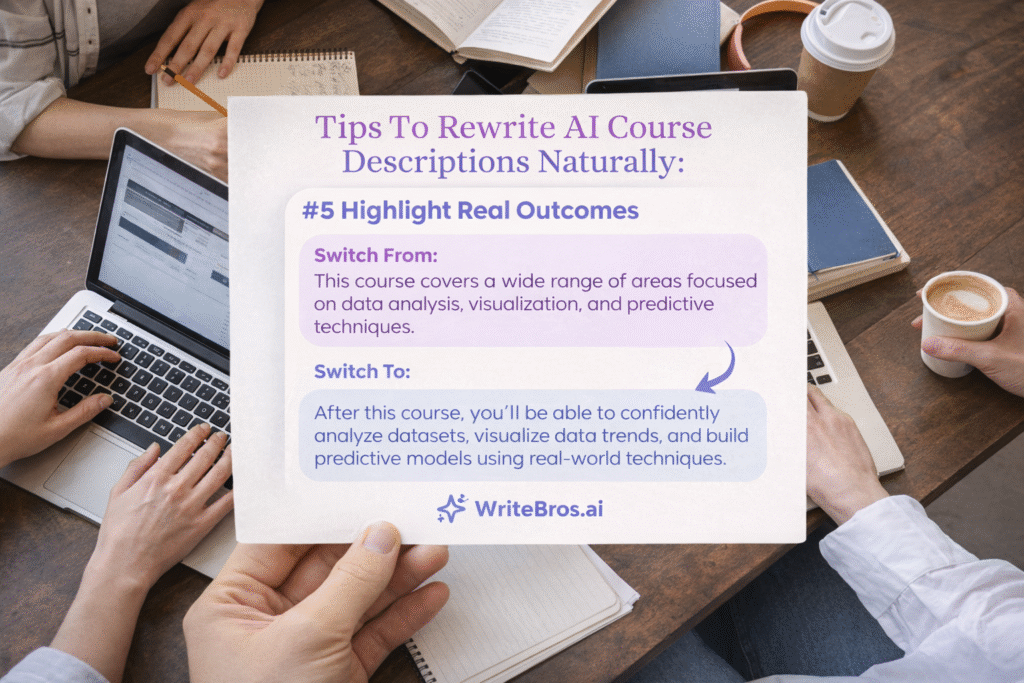
How to Rewrite AI Course Descriptions Naturally – Strategy #5: Highlight real outcomes
Rather than describing what the course includes, focus on what learners will be able to do after completing it, which provides a clearer and more compelling reason to engage. AI drafts tend to list features instead of outcomes, which can make the content feel abstract and less relevant. Shifting the emphasis toward results grounds the description in practical value.
This approach works because readers are naturally outcome-driven, especially when evaluating courses that require time or effort. For example, stating that learners will build a specific skill or complete a tangible task is more effective than listing topics covered. The challenge lies in being specific without overpromising, which requires thoughtful wording.
How to Rewrite AI Course Descriptions Naturally – Strategy #6: Replace generic terms
Generic wording such as “various concepts” or “key strategies” often appears in AI-generated descriptions and weakens clarity because it does not give readers a concrete sense of what to expect. Replacing these with specific terms or examples helps create a clearer mental picture. This requires reviewing each sentence and asking whether it communicates something tangible.
In real scenarios, this might involve naming actual tools, techniques, or outcomes instead of relying on broad language that could apply to any course. For instance, describing a specific process or skill immediately adds credibility. The main constraint is ensuring that specificity does not overwhelm the reader with unnecessary detail.
How to Rewrite AI Course Descriptions Naturally – Strategy #7: Improve transitions
AI-generated text can feel disjointed because ideas are presented in sequence without clear connections, which disrupts the reading flow. Improving transitions helps guide the reader through the description in a way that feels natural and intentional. This involves adding subtle connective phrases that clarify how each idea relates to the next.
In practice, smoother transitions make the description easier to follow, especially when moving between sections such as course overview, outcomes, and structure. For example, a simple bridge between two ideas can prevent the text from feeling abrupt. The goal is not to overuse transitions, but to ensure continuity.
How to Rewrite AI Course Descriptions Naturally – Strategy #8: Align tone with audience
The tone of a course description should reflect the audience it is intended for, which means adjusting language based on their familiarity with the subject and their expectations. AI-generated drafts often default to a neutral tone that does not fully connect with any specific group. Refining tone requires understanding who the course is for.
For example, a beginner audience may need clearer explanations and simpler phrasing, while an advanced audience may prefer concise and direct language. Aligning tone helps the description feel more relevant and engaging. The key is maintaining consistency throughout the entire text.
How to Rewrite AI Course Descriptions Naturally – Strategy #9: Reduce repetition
Repetition is a common issue in AI-generated content, where similar ideas are expressed multiple times using slightly different wording. This can make the description feel longer than necessary and less engaging. Identifying repeated concepts allows you to streamline the text and focus on unique information.
In real use, reducing repetition improves clarity and keeps the reader’s attention, especially when they are comparing multiple courses. For example, removing duplicate statements about course benefits can make the remaining points stronger. The challenge is recognizing repetition that is not immediately obvious.
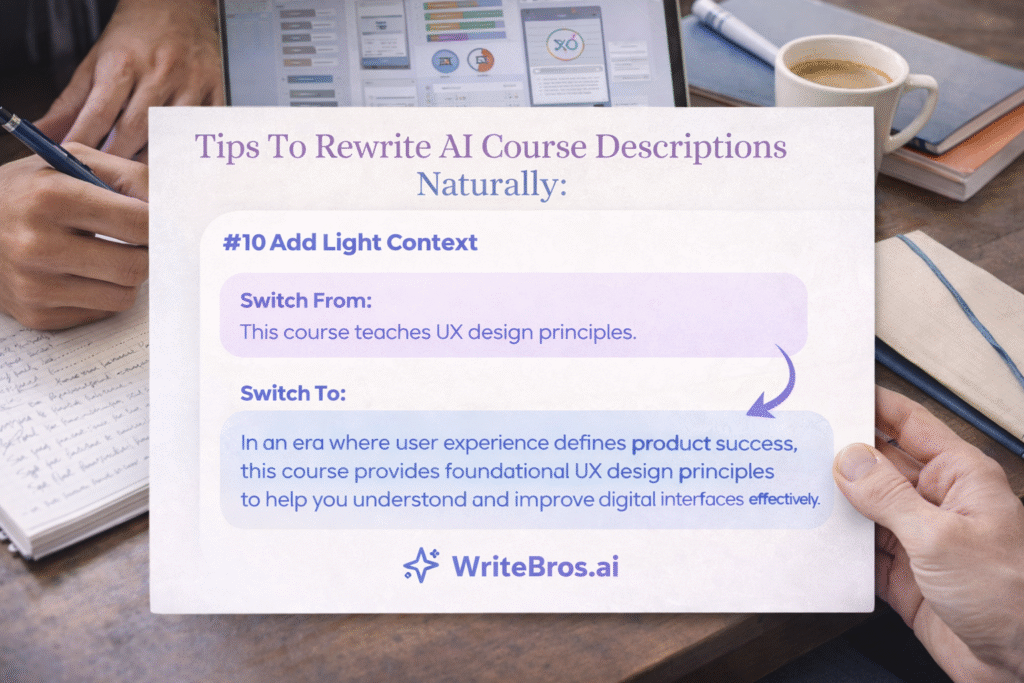
How to Rewrite AI Course Descriptions Naturally – Strategy #10: Add light context
Adding context helps readers understand why the course matters, which is something AI-generated descriptions often lack because they focus heavily on structure. Context can include brief explanations of relevance or practical application. This makes the content feel more grounded.
For example, mentioning how a skill applies in real situations can make the description more meaningful. This does not require long explanations, but rather small additions that provide clarity. The key is keeping the context concise and relevant.
How to Rewrite AI Course Descriptions Naturally – Strategy #11: Use active voice
Active voice makes sentences clearer and more direct, which improves readability and keeps the reader engaged throughout the description. AI-generated text often relies on passive constructions that can feel distant or unclear. Switching to active voice creates a stronger connection between the subject and the action.
In practice, this involves identifying sentences where the action is unclear and rewriting them to be more direct. For example, stating what the learner will do rather than what will be done. This small adjustment can significantly improve clarity.
How to Rewrite AI Course Descriptions Naturally – Strategy #12: Balance detail and brevity
Finding the right balance between providing enough information and keeping the description concise is essential for readability. AI-generated drafts often include too much detail in some areas and too little in others. Adjusting this balance requires careful editing.
In real scenarios, this means focusing on the most important information and removing anything that does not add value. For example, trimming excessive explanations while keeping key points intact. The result is a more focused description.
How to Rewrite AI Course Descriptions Naturally – Strategy #13: Vary sentence rhythm
Monotonous sentence patterns can make AI-generated text feel mechanical, which reduces engagement and readability. Varying sentence length and structure creates a more natural flow that keeps the reader interested. This involves mixing shorter and longer sentences thoughtfully.
In practice, this might mean breaking up repetitive patterns and introducing variation in how ideas are expressed. For example, alternating between descriptive and direct sentences. The goal is to create a rhythm that feels natural.
How to Rewrite AI Course Descriptions Naturally – Strategy #14: Refine opening lines
The opening lines set the tone for the entire description, which makes them especially important to refine. AI-generated openings can feel generic or overly broad, which may not capture attention effectively. Improving this section helps engage the reader immediately.
In real use, a strong opening provides clarity and sets expectations, making the rest of the description easier to follow. For example, starting with a clear statement of purpose. The key is keeping it concise and relevant.
How to Rewrite AI Course Descriptions Naturally – Strategy #15: Polish final wording
Final review ensures that the entire description reads smoothly and consistently, which is essential for a natural tone. AI-generated text can include small inconsistencies that disrupt flow. Polishing the wording helps create a cohesive final version.
This step involves reading the description as a whole and making adjustments where needed. For example, refining phrasing and ensuring consistency. The result is a more polished and professional description.
Common mistakes
- Relying too heavily on AI-generated phrasing without reviewing for clarity often leads to descriptions that feel detached and difficult to read, because the content follows structure rather than natural communication patterns, which can reduce trust.
- Trying to keep every original sentence from the AI draft can result in overly long descriptions that include unnecessary repetition, making it harder for readers to identify what actually matters.
- Focusing only on grammar corrections instead of overall readability misses deeper issues such as tone, flow, and clarity, which are more important for engagement.
- Using overly formal language in an attempt to sound professional can make the description feel distant and less relatable, which reduces connection with the audience.
- Adding too much detail in an effort to be thorough can overwhelm readers and make the description harder to scan, especially when key points are buried.
- Ignoring the audience’s perspective often leads to descriptions that do not align with their needs, making the content less effective overall.
Edge cases
In some cases, such as highly technical or specialized courses, maintaining a certain level of complexity is necessary to accurately describe the content, which means simplification must be applied carefully to avoid losing important details.
Additionally, courses aimed at advanced audiences may require more precise terminology, which can limit how conversational the description can become without reducing clarity or credibility.
Supporting tools
- Editing tools that highlight readability issues can help identify overly complex sentences, allowing for targeted revisions that improve flow without changing the original meaning.
- Grammar checkers provide a baseline for correctness, which supports clarity but should not replace deeper editing for tone and structure.
- Paraphrasing tools can assist in rewording awkward sentences, though they require manual review to ensure natural phrasing.
- Audience analysis tools help refine tone by providing insights into how different groups respond to language.
- Content review workflows allow multiple passes over the description, ensuring that each aspect of readability is addressed systematically.
- WriteBros.ai helps refine AI-generated content by focusing on tone, clarity, and natural flow, making it easier to produce descriptions that feel human and engaging.
Ready to Transform Your AI Content?
Try WriteBros.ai and make your AI-generated content truly human.
Conclusion
Rewriting AI course descriptions naturally is about improving clarity, flow, and relevance so the content feels aligned with how people actually read and evaluate information.
Focusing on intention and thoughtful revision leads to better outcomes than relying solely on automated output, resulting in descriptions that feel more human and effective.
Did You Know?
AI course descriptions can look polished because they follow clean structure and familiar academic wording. Even so, they often miss the natural flow and specificity readers need to quickly understand what a course actually offers.
Revising tone, clarifying outcomes, and smoothing awkward phrasing can improve readability more quickly than expected. Small edits help course descriptions feel more human, making them easier to trust, scan, and understand.
Ready to Transform Your AI Content?