Student Reliance on AI Writing Tools Data: Top 20 Dependency Indicators

2026 signals a normalization phase in student reliance on AI writing tools, where speed, confidence, and workflow design quietly reshape how work gets produced. These patterns reveal not just usage levels, but how thinking, drafting, and evaluation are being redistributed.
Patterns across academic environments show a growing dependence on automated writing support, especially as deadlines compress and expectations expand. Observers tracking professors expect from students using AI often note a widening gap between institutional standards and everyday student workflows.
Usage behaviors suggest that convenience alone does not explain adoption, as cognitive offloading has become part of how students manage complexity. The way learners attempt to humanize AI-generated worksheets reflects a deeper tension between efficiency and originality.
Tool ecosystems continue to expand, creating subtle pressure to keep up with perceived norms rather than explicit requirements. Engagement with curated lists of best AI humanizer tools for brand voice signals that refinement, not just generation, is becoming the expected baseline.
As reliance deepens, evaluation becomes less about whether tools are used and more about how effectively they are integrated into thinking processes. A practical takeaway sits in how small adjustments in workflow can reveal whether assistance enhances understanding or quietly replaces it.
Top 20 Student Reliance on AI Writing Tools Data (Summary)
| # | Statistic | Key figure |
|---|---|---|
| 1 | Students using AI weekly for writing tasks | 68% |
| 2 | Students relying on AI for first drafts | 61% |
| 3 | Students editing AI outputs before submission | 74% |
| 4 | Students using AI under time pressure | 82% |
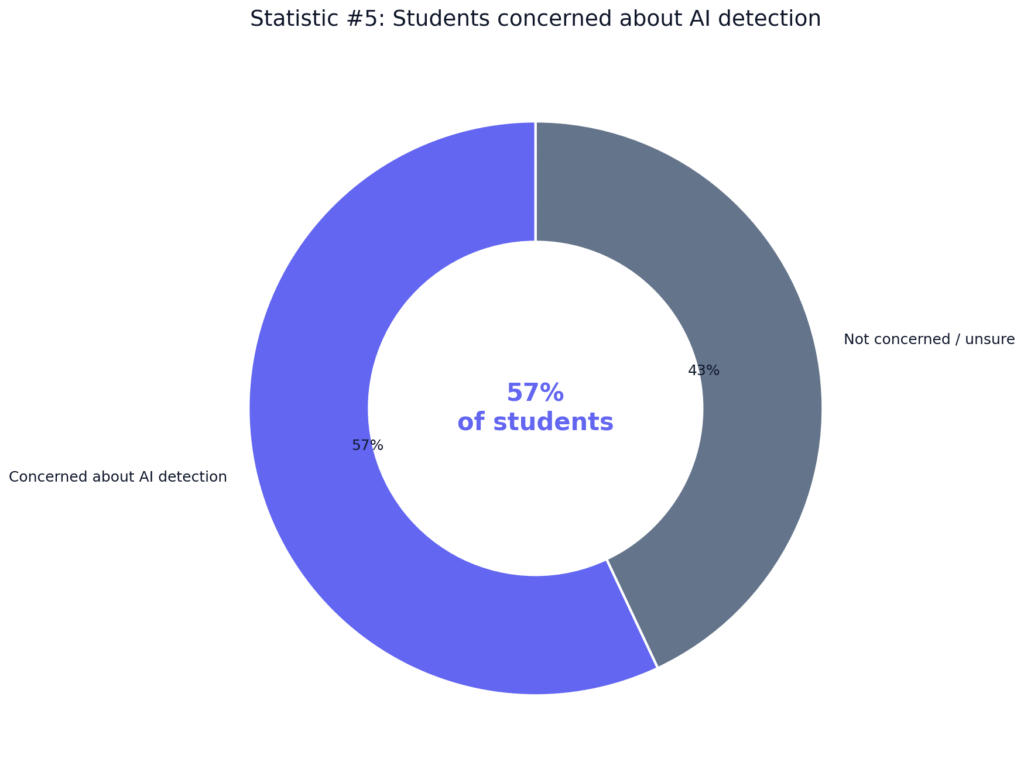
| 5 | Students concerned about AI detection | 57% |
| 6 | Students using AI for grammar correction | 79% |
| 7 | Students trusting AI for citations | 46% |
| 8 | Students using multiple AI tools simultaneously | 52% |
| 9 | Students who skip outlining due to AI | 41% |
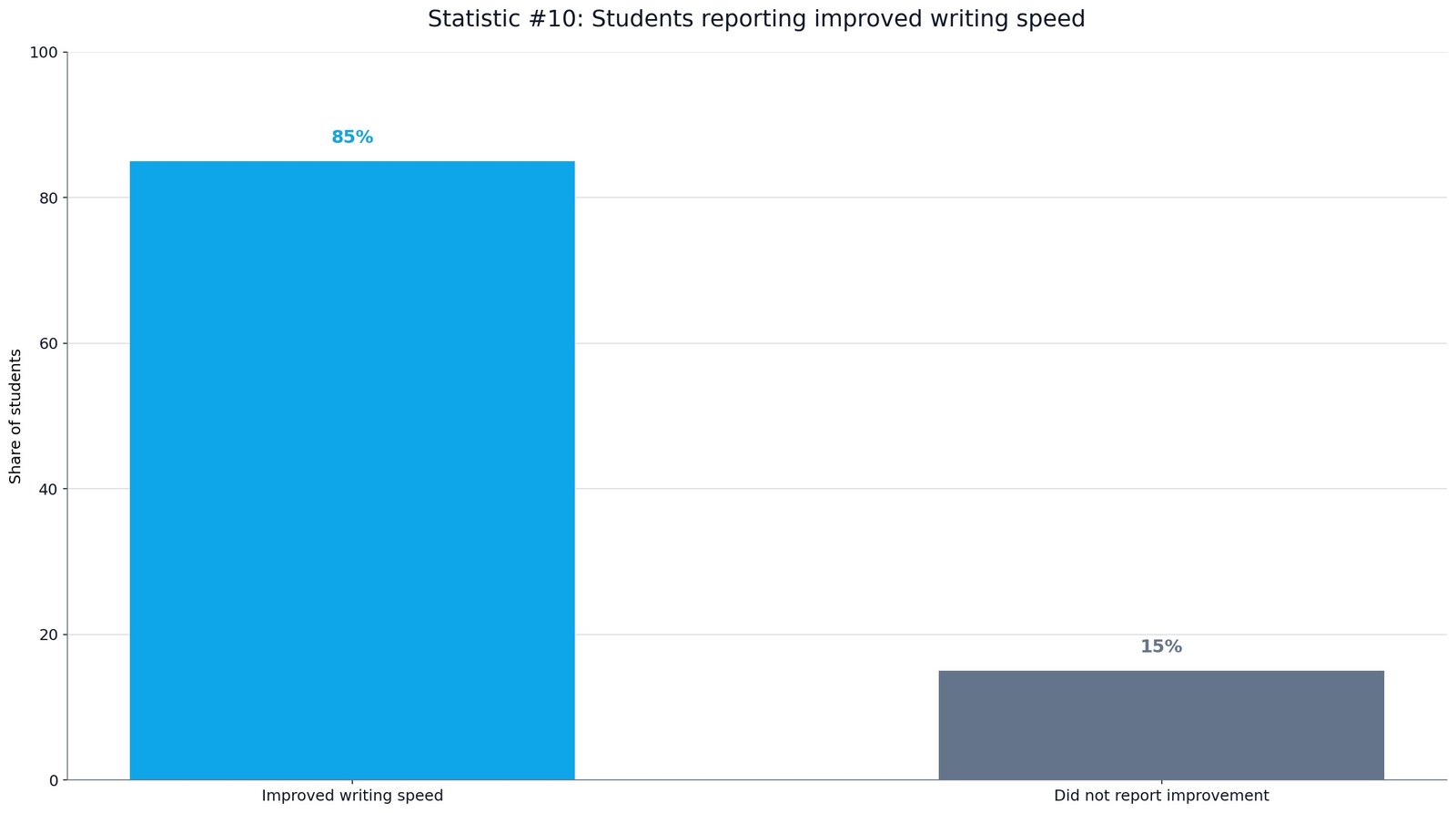
| 10 | Students reporting improved writing speed | 85% |
| 11 | Students feeling less confident without AI | 49% |
| 12 | Students using AI for paraphrasing tasks | 66% |
| 13 | Students checking AI output accuracy | 58% |
| 14 | Students using AI for brainstorming ideas | 72% |
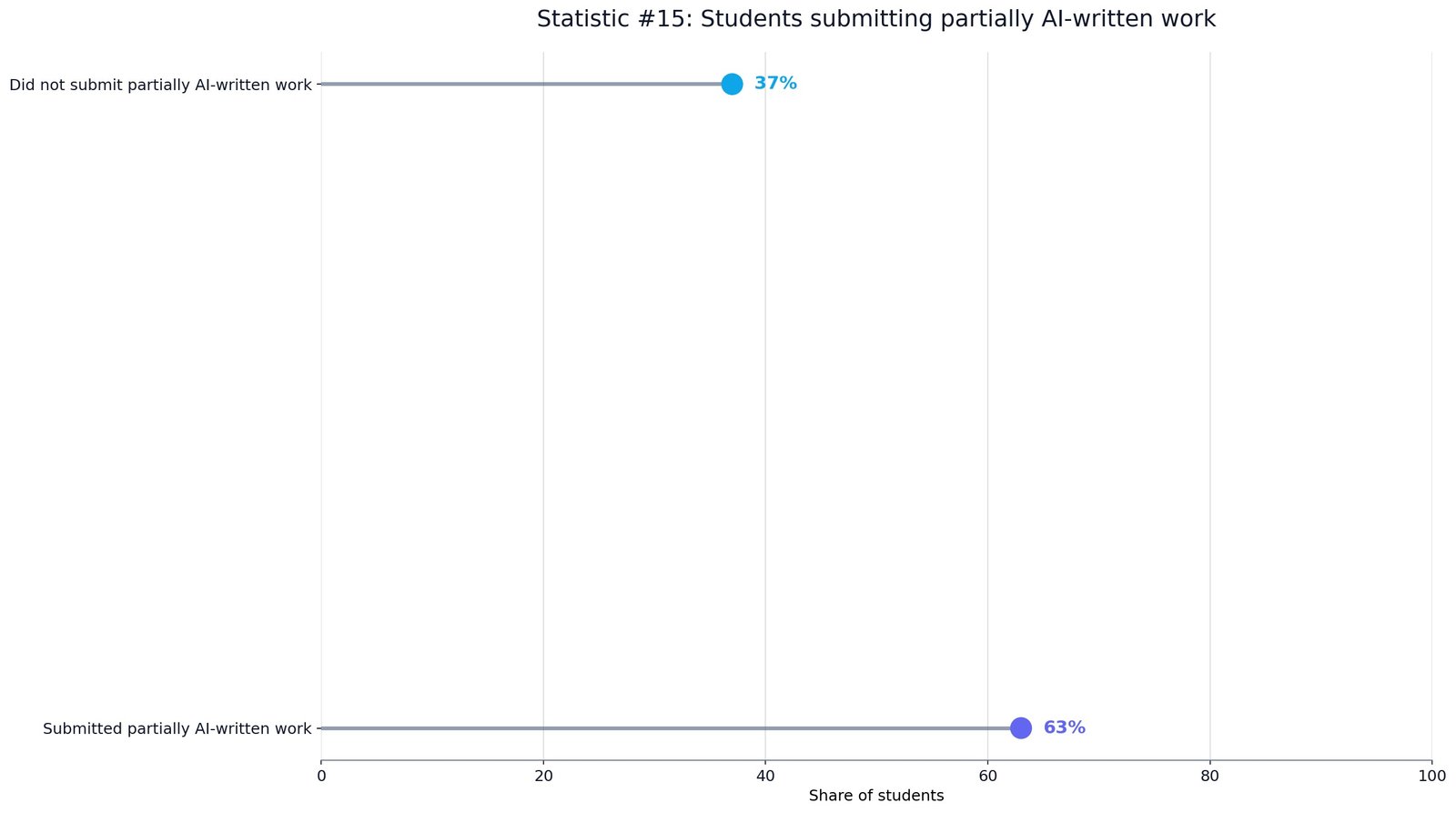
| 15 | Students submitting partially AI-written work | 63% |
| 16 | Students unaware of institutional AI policies | 44% |
| 17 | Students preferring AI over peer feedback | 39% |
| 18 | Students using AI for non-native language support | 54% |
| 19 | Students believing AI improves grades | 62% |
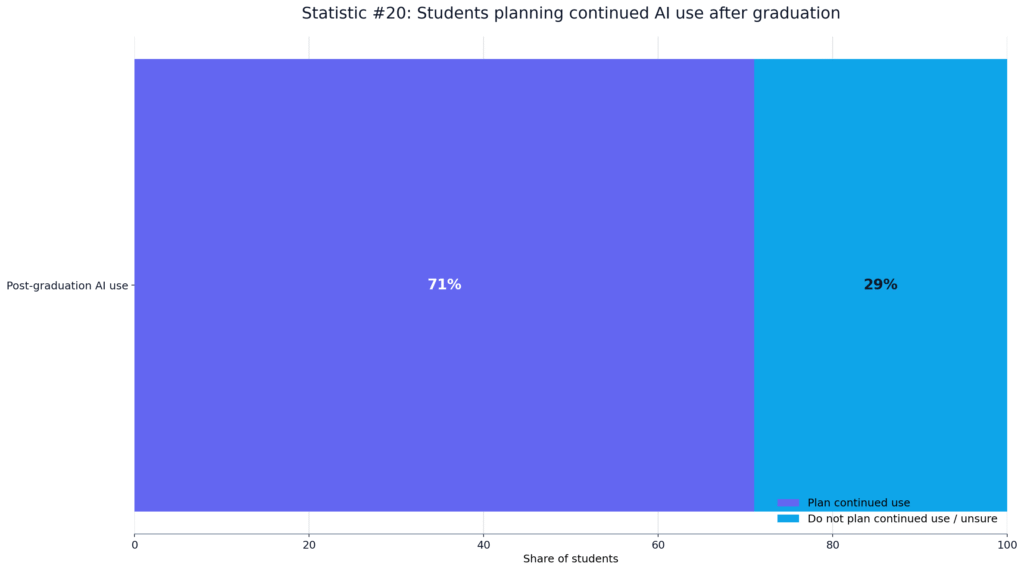
| 20 | Students planning continued AI use after graduation | 71% |
Top 20 Student Reliance on AI Writing Tools Data and the Road Ahead
Student Reliance on AI Writing Tools Data #1. Students using AI weekly for writing tasks
68% of students using AI every week signals routine dependence rather than occasional experimentation. Once a tool enters the weekly study cycle, it starts shaping how assignments are planned, drafted, and revised. That matters because repeated use usually reflects habit, not a one-time response to a hard class.
The behavior grows when coursework stacks up, deadlines narrow, and writing becomes the slowest part of schoolwork. Students reach for AI because it shortens the blank-page phase, lowers friction, and supplies instant language support when energy is thin. Over time, that convenience can become a default, especially where output is rewarded more visibly than process.
A student building ideas slowly from notes works through confusion in view, while a model returns fluent prose in seconds. With 68% of students already using AI weekly, the contrast becomes deliberate thinking versus accelerated assembly. The implication is that classes need routines that keep reasoning visible even when AI stays in the workflow.
Student Reliance on AI Writing Tools Data #2. Students relying on AI for first drafts
61% of students relying on AI for first drafts shows that generation is moving upstream in the writing process. When the opening version comes from a tool, students begin from produced language instead of unfinished thinking. That changes the task from composing ideas to editing ready-made text.
This pattern appears because the first draft is usually the hardest and slowest stage for uncertain writers. AI removes the intimidation of the empty document, offers structure immediately, and creates momentum before understanding is fully settled. The ease is attractive because it solves emotional resistance as much as technical difficulty.
A student drafting from scratch leaves traces of hesitation, trial, and discovery, while a model supplies polished sentences almost instantly. With 61% of students handing the first-pass job to AI, the gap is not polish alone but ownership of early reasoning. The implication is that assignments may need more checkpoints that reveal how ideas were formed before refinement begins.
Student Reliance on AI Writing Tools Data #3. Students editing AI outputs before submission
74% of students editing AI outputs before submission suggests users know raw output alone is risky. They are not simply copying untouched text, which means reliance now includes revision rather than pure generation. That makes usage harder to detect because the final draft may look mixed.
The editing behavior grows from necessity. AI prose can sound flat, generic, or slightly misaligned with class expectations, so students revise tone, examples, and structure to make the material feel safer and more believable. In practice, editing becomes the bridge between speed and acceptability, which is why the tool remains useful even when students distrust it.
A student revising self-written work is sharpening original thought, while a student revising AI text is often adapting outsourced language. With 74% of students modifying outputs before submission, the important divide is whose reasoning produced the base layer. The implication is that evaluation should look past surface polish and pay closer attention to idea development.
Student Reliance on AI Writing Tools Data #4. Students using AI under time pressure
82% of students using AI under time pressure shows urgency as trigger for dependence. When deadlines tighten, the tool becomes less a luxury and more a coping mechanism. That pattern tells us reliance is tied closely to academic pacing, not fascination with new software.
The reason is straightforward. Time pressure narrows patience, reduces tolerance for slow drafting, and makes the fastest workable option feel rational even to students who might prefer writing independently under calmer conditions. AI wins these moments because it converts panic into usable text faster than any peer, tutor, or brainstorming session can.
A student writing late at night still has to wrestle with organization, while a model can return a clean scaffold almost immediately. Since 82% of students turn to AI when pressure spikes, usage looks less like cheating in isolation and more like stress management through automation. The implication is that course design and deadline clustering quietly influence how often AI becomes the fallback.
Student Reliance on AI Writing Tools Data #5. Students concerned about AI detection
57% of students concerned about AI detection reveals a strange mix of reliance and anxiety. Many students are using the tools while remaining unsure whether the finished work will trigger suspicion. That tension matters because fear changes how they edit, paraphrase, and second-guess every sentence.
The concern grows because detection systems are inconsistent, policy language is uneven, and rumors spread faster than clear guidance. Students hear stories of false flags, see classmates swap avoidance tactics, and start treating wording choices as risk management rather than normal revision. Once that happens, attention shifts from learning goals to trying to appear acceptably human.
A student writing honestly from scratch worries about argument quality, while an AI-assisted student may worry first about being accused. With 57% of students already carrying detection concerns, the emotional cost of AI use becomes part of the workflow itself. The implication is that unclear enforcement can deepen dependence while also making writing feel more defensive.
Student Reliance on AI Writing Tools Data #6. Students using AI for grammar correction
79% of students using AI for grammar correction shows that assistance often starts with safe need. Fixing grammar feels safer than asking a model to produce an entire paper, so the tool enters through cleanup rather than authorship. That makes adoption easier because the use case sounds practical and academically defensible.
The pattern grows because grammar problems are visible, repetitive, and frustrating for many students, especially under deadline pressure. AI offers instant repair, catches awkward phrasing, and reduces the embarrassment tied to errors. Once students trust the tool for correction, it becomes easier to invite it into structure, tone, and content decisions too.
A student proofreading alone must spot weaknesses one by one, while a model scans passages in seconds and proposes smoother alternatives. With 79% of students already using AI for grammar, the tool is acting like a gateway rather than a narrow assistant. The implication is that low-risk entry points can quietly expand into much broader writing dependence.
Student Reliance on AI Writing Tools Data #7. Students trusting AI for citations
46% of students trusting AI for citations is lower than some other measures, yet it is still a notable risk signal. Citation work looks mechanical, which makes students more willing to hand it off, even though accuracy matters enormously. That mismatch matters because confidence in formatting can hide weak confidence in source verification.
The behavior appears because citations feel tedious, rule-heavy, and detached from the central argument. Students want speed, AI promises neat references, and the result can look convincing enough to escape quick scrutiny even when details are wrong. The problem is that plausible citation formatting can mask invented authors, broken dates, or mismatched titles.
A student building references manually checks sources line by line, while a model can present polished entries that sound correct without being grounded. Once 46% of students trust AI for citations, the issue becomes credibility, not just convenience. The implication is that citation instruction has to emphasize verification habits, not only style-guide compliance.
Student Reliance on AI Writing Tools Data #8. Students using multiple AI tools simultaneously
52% of students using multiple AI tools at the same time suggests dependence is becoming modular. Instead of trusting one platform fully, students are assembling small stacks for drafting, paraphrasing, grammar, and tone adjustment. That behavior makes reliance deeper because each stage of writing gets assigned to a different system.
This happens because no single tool feels perfect. One model may generate quickly, another may sound smoother, and a third may promise lower detection risk, so students mix them to patch weaknesses. The workflow starts to resemble software orchestration, where the student manages outputs rather than generates every line directly.
A student using one notebook and one draft is moving through a single thinking path, while a stacked AI workflow splits writing into outsourced micro-tasks. With 52% of students already combining tools, dependence becomes more resilient and harder to unwind. The implication is that reliance now reflects an ecosystem habit, not a single-app experiment.
Student Reliance on AI Writing Tools Data #9. Students who skip outlining due to AI
41% of students skipping outlining because of AI shows a subtle but important change in preparation. Outlining usually slows writers down in a useful way because it forces priorities, sequence, and argument shape to appear early. When AI replaces that stage, students may gain speed while losing structural awareness.
The shortcut is tempting because outlines feel abstract and slow compared with a tool that instantly produces paragraphs. Students can ask for a full response, then reverse-engineer the structure afterward, which makes planning seem unnecessary. Over time, that teaches the habit that organization is something retrieved on demand rather than built through thought.
A student outlining manually has to decide what belongs first, while a model quietly makes those decisions in the background. Since 41% of students are skipping outlines, the risk is not weaker formatting but weaker control over argument logic. The implication is that front-end planning may need to become a graded part of the writing process again.
Student Reliance on AI Writing Tools Data #10. Students reporting improved writing speed
85% of students reporting improved writing speed clearly explains why AI keeps spreading. Speed is visible, immediate, and easy to value, especially in academic settings that reward output across many simultaneous tasks. When a tool saves time consistently, students see it less as optional support and more as infrastructure.
The effect appears because AI compresses several slow stages at once. It can suggest structure, generate sentence momentum, repair awkward wording, and keep a draft moving when attention drops, so the total writing cycle feels lighter. Even students who doubt the quality may keep using it because faster progress has real survival value during busy weeks.
A student working alone can improve through slower repetition, while a model reduces delay almost from the first prompt. With 85% of students saying writing becomes faster, speed itself becomes the persuasive argument for continued use. The implication is that any alternative students adopt will need to respect time pressure, not just defend authenticity.
Student Reliance on AI Writing Tools Data #11. Students feeling less confident without AI
49% of students feeling less confident without AI suggests reliance is moving from convenience into self-perception. When nearly half of students doubt their writing more in the tool’s absence, the issue is no longer simple productivity. It becomes a confidence transfer from the writer to the system.
This happens because frequent assistance can quietly shrink tolerance for rough starts, imperfect wording, and the ordinary mess of drafting. AI offers instant reassurance, so students stop practicing the emotional stamina needed to sit with uncertainty and revise through it. Confidence weakens not because ability disappears overnight, but because the habit of independent recovery gets used less.
A student writing unaided has to trust that awkward early sentences can improve, while an AI-assisted student can outsource reassurance immediately. Once 49% of students feel less confident without the tool, dependency starts affecting identity as much as output. The implication is that writing instruction must rebuild self-trust, not only technical skill.
Student Reliance on AI Writing Tools Data #12. Students using AI for paraphrasing tasks
66% of students using AI for paraphrasing shows how often the tool sits inside revision rather than only generation. Paraphrasing sounds modest, yet it touches clarity, originality, and source handling all at once. That makes it a revealing statistic because it blends convenience with academic risk.
The attraction is easy to understand. Students want cleaner wording, faster rephrasing, and help escaping sentences that feel too close to source language, especially when they are tired or unsure of their own phrasing. AI makes that process feel mechanical and safe, even though meaning can drift when wording changes faster than understanding.
A student paraphrasing manually has to digest the source before rewriting it, while a model can rearrange language without fully owning the idea. With 66% of students already using AI for paraphrasing, the pressure point is comprehension, not just wording. The implication is that paraphrase tasks now need stronger emphasis on source understanding and intent.
Student Reliance on AI Writing Tools Data #13. Students checking AI output accuracy
58% of students checking AI output accuracy sounds encouraging at first, because it suggests skepticism remains active. Students are not blindly accepting every answer, which means some review habits are still present. Even so, the number also means a large share may still trust outputs more than the evidence deserves.
The mixed pattern comes from convenience battling caution. Students know AI can invent details, but checking facts takes time, and the whole appeal of the tool is speed, so verification can become selective rather than thorough. In practice, students often review what seems suspicious and let polished-looking claims pass.
A student researching manually tests information before writing, while an AI-assisted student may write first and verify only parts afterward. With 58% of students checking accuracy, the glass is only half full because reliability is still being treated as an optional extra. The implication is that verification habits need to feel inseparable from AI-assisted writing, not secondary to it.
Student Reliance on AI Writing Tools Data #14. Students using AI for brainstorming ideas
72% of students using AI for brainstorming shows reliance reaching idea generation, not just sentence production. Brainstorming is where topics widen, examples surface, and arguments begin taking shape. When a tool enters that stage, it influences not only wording but the menu of possible thoughts.
The behavior grows because brainstorming can feel slow, lonely, and uncertain, especially when students are unsure what an instructor wants. AI offers instant prompts, sample angles, and ready-made directions that reduce the discomfort of not knowing where to begin. That relief is powerful, but it can also narrow originality if everyone starts from similar machine-suggested paths.
A student brainstorming alone may wander before finding a strong idea, while a model offers options that feel coherent from the start. Since 72% of students are already using AI for ideation, the influence begins before a draft even exists. The implication is that originality now depends partly on whether students can question the first ideas AI supplies.
Student Reliance on AI Writing Tools Data #15. Students submitting partially AI-written work
63% of students submitting partially AI-written work shows that blended authorship has become normal rather than exceptional. The finished assignment is neither fully human-built nor fully machine-produced, which makes boundaries harder to describe clearly. That matters because many academic policies still speak as if writing belongs in one category or the other.
The pattern grows because partial use feels easier to justify. Students may ask AI for structure, transitions, or a few difficult sections, then finish the rest themselves and view the result as mostly personal work. That middle ground reduces guilt, yet it also blurs responsibility for what the final text truly represents.
A student writing every sentence carries the full burden of coherence, while a blended draft lets the hardest stretches be outsourced selectively. With 63% of students turning in partly AI-written work, the real issue becomes where authorship begins to thin out. The implication is that schools need clearer language for shared, layered, and partial writing assistance.
Student Reliance on AI Writing Tools Data #16. Students unaware of institutional AI policies
44% of students being unaware of institutional AI policies points to a communication gap rather than a purely behavioral one. Rules can exist on paper and still fail in practice when students do not see, remember, or understand them. That matters because confusion encourages guesswork, and guesswork rarely produces responsible use.
The gap persists because policy notices are often buried in syllabi, written in abstract language, or introduced once without reinforcement. Students pay attention to what affects them immediately, so vague policy wording loses out against the urgent appeal of a tool that solves tonight’s assignment problem. In that environment, convenience becomes clearer than compliance.
A student who knows the rules can at least judge boundaries before using a tool, while an uninformed student is navigating norms almost blindly. When 44% of students do not know the policy, misuse can grow without open defiance. The implication is that institutions need simpler, repeated, assignment-level guidance instead of one-time policy statements.
Student Reliance on AI Writing Tools Data #17. Students preferring AI over peer feedback
39% of students preferring AI over peer feedback suggests speed and predictability are beating human exchange here. Peer feedback can be uneven, awkward, and slow, even when it has value. AI feels easier because it responds instantly, never gets embarrassed, and always responds.
The preference grows when students have had weak peer-review experiences or do not trust classmates to give clear advice. A model offers endless comments without social friction, which makes revision feel private and efficient rather than vulnerable. The tradeoff is that AI feedback may smooth sentences without truly understanding audience, intent, or classroom context.
A classmate reacting to a draft can reveal confusion that comes from real reading, while a model mainly predicts what good feedback should sound like. With 39% of students preferring AI to peers, revision becomes less social and less grounded in actual human response. The implication is that peer review has to become more useful if it is going to compete.
Student Reliance on AI Writing Tools Data #18. Students using AI for non-native language support
54% of students using AI for non-native language support shows why dependence cannot be judged through one moral lens alone. For many learners, the tool is not just a shortcut but a bridge across vocabulary gaps, syntax uncertainty, and tone mismatch. That makes the statistic important because reliance can also reflect access needs.
The behavior grows because traditional support is limited in time and scale. Language centers, tutors, and instructors cannot always provide immediate sentence-level help, while AI is available at any hour and can explain alternatives without embarrassment. Students facing language pressure understandably adopt whatever gives them fluency, clarity, and speed in the moment.
A multilingual student drafting unaided may spend extra time translating intent into acceptable academic English, while a model helps close that gap quickly. With 54% of students using AI for language support, reliance also functions as accommodation in practice. The implication is that policy conversations need to separate unfair advantage from genuine linguistic assistance.
Student Reliance on AI Writing Tools Data #19. Students believing AI improves grades
62% of students believing AI improves grades shows that perception, not just outcome, is fueling continued use. When students think a tool helps performance, they are more likely to justify it, repeat it, and recommend it to others. That belief matters because expectations can drive behavior even before hard evidence catches up.
The belief grows from visible short-term wins. AI can make writing look cleaner, more complete, and more confident, which may produce better marks in classes where polish is rewarded heavily or time pressure limits deeper revision. Students then connect the improved result to the tool and strengthen the habit, whether or not learning improved equally.
A student revising alone may improve gradually and unevenly, while AI can create a faster jump in presentation quality. Once 62% of students believe grades rise with AI help, reliance begins to look rational from the student perspective. The implication is that assessment design should reward thinking traces, not only polished final submissions.
Student Reliance on AI Writing Tools Data #20. Students planning continued AI use after graduation
71% of students planning continued AI use after graduation shows present habits spilling into professional life. Students are not treating these tools as temporary academic crutches that will disappear after school. Instead, they are carrying them forward as part of how writing itself will be done.
This expectation grows because AI already fits the broader workplace story students are hearing. Employers talk about efficiency, digital fluency, and tool familiarity, so continued use feels practical rather than questionable, especially after years of school-based normalization. Once a habit becomes tied to employability, it gains more staying power than a classroom workaround ever could.
A graduate writing alone may see independence as a skill, while an AI-using graduate may see orchestration as the modern skill. Since 71% of students expect to keep using AI beyond school, reliance is becoming a career assumption, not just a semester habit. The implication is that education now shapes long-term tool dependence as much as immediate academic behavior.
What these patterns suggest for writing habits, policy clarity, and student judgment in 2026
The strongest pattern across these figures is that AI enters student writing through pressure points, not abstract enthusiasm. Speed, uncertainty, and friction keep showing up as the real drivers of use.
Once the tools move from grammar help into brainstorming, drafting, and confidence support, the relationship stops looking temporary. Reliance starts to shape how students define writing itself, which is a much bigger change than simple tool adoption.
The most revealing contrast is that students still show caution in some areas while normalizing assistance in many others. That uneven pattern suggests institutions are dealing with mixed habits, where skepticism survives even as dependence deepens.
The road ahead is likely to depend less on banning tools outright and more on making thought processes visible again. The implication is that assignments, feedback loops, and policy language will need to measure judgment as carefully as they measure polished text.
Sources
- What professors expect from students using AI responsibly
- How to humanize AI generated worksheets for class use
- Best AI humanizer tools for brand voice comparisons
- Turnitin resources on AI writing and academic integrity
- EDUCAUSE research and guidance on generative AI adoption
- UNESCO perspectives on generative AI in education systems
- OECD analysis of digital learning and student readiness
- Pew Research findings on technology use and trust
- Inside Higher Ed reporting on campus AI policy debates
- AAC and U resources on writing and assessment