AI-Assisted Lesson Planning Statistics: Top 20 Reported Uses

2026 data reveals lesson planning is quietly being restructured, with teachers reclaiming hours while tightening control over quality, adaptation, and feedback. Adoption is rising fastest where setup work shrinks, yet policy gaps and judgment limits still define how far AI can shape real classroom decisions.
Planning now looks less like a blank page and more like a negotiation between teacher judgment, curriculum pacing, and machine speed. That changes the editorial standard, because what matters is no longer whether automation appears in prep work but whether it follows clear non-negotiables teachers can trust.
Lesson design also reveals a familiar split between convenience and craft. Fast outputs can smooth the rough edges, yet the stronger classrooms still come from prompts, revisions, and explanations that sound human once they reach students.
What stands out in current reporting is how quickly prep support has moved from experimentation into routine workflow. A practical aside matters here: teachers who keep a reusable prompt bank and a light editing checklist usually get cleaner drafts with less cleanup later.
The more useful question now is not whether these tools belong in planning, but where they actually improve judgment and where they simply accelerate average work. That is why an editing toolkit mindset matters, since the best results still come from shaping, trimming, and grounding the draft before it reaches the classroom.
Top 20 AI-Assisted Lesson Planning Statistics (Summary)
| # | Statistic | Key figure |
|---|---|---|
| 1 | Teachers using AI in their work in 2025 | 61% |
| 2 | Teachers already using AI to plan lessons | 38% |
| 3 | Teachers using AI monthly for preparing to teach | 37% |
| 4 | Teachers using AI monthly for worksheets or activities | 33% |
| 5 | Teachers using AI monthly to modify materials for student needs | 28% |
| 6 | Teachers using AI monthly for administrative work | 28% |
| 7 | Teachers using AI monthly to make assessments | 25% |
| 8 | Teachers using AI monthly for grading | 16% |
| 9 | Teachers using AI monthly for one-on-one instruction | 14% |
| 10 | Teachers using AI monthly for student data analysis | 12% |
| 11 | Teachers using AI at least weekly across work tasks | 32% |
| 12 | Average weekly time saved for weekly AI users | 5.9 hours |
| 13 | Average weekly time saved for monthly AI users | 2.9 hours |
| 14 | Time returned per school year for weekly AI users | 6 weeks |
| 15 | Teachers reporting better quality in modified student materials | 64% |
| 16 | Teachers reporting higher-quality insights from student data | 61% |
| 17 | Teachers saying AI improves grading and feedback quality | 57% |
| 18 | Teachers employed at schools with an AI policy | 19% |
| 19 | Teacher AI use at schools with a policy | 70% |
| 20 | Teachers reporting academic-integrity AI policy or guidance | 34% |
Top 20 AI-Assisted Lesson Planning Statistics and the Road Ahead
AI-Assisted Lesson Planning Statistics #1. Teacher AI use has moved into the mainstream
61% of teachers using AI in their work points to a workflow change that is no longer fringe or experimental. What used to look like occasional curiosity now looks more like routine assistance during the school week. That matters because planning habits usually change slowly, so a figure this high suggests teachers feel immediate practical value.
The number climbs because prep work includes many repeatable steps that drain time before real instructional thinking begins. Generating examples, outlining lessons, and reshaping materials are easy places for automation to enter first. Once teachers see those early tasks move faster, adoption spreads because the benefit is felt before a lesson even reaches students.
A machine can draft quickly, but a teacher still reads the room, catches weak phrasing, and notices whether a class will actually connect with the material. That human filter is why broad usage does not mean blind trust. It means AI is becoming a first-pass planning partner, which raises expectations for editing and oversight with clear implication.
AI-Assisted Lesson Planning Statistics #2. Lesson planning is now one of the clearest entry points
38% of teachers using AI to plan lessons shows where adoption becomes tangible rather than abstract. Planning sits close to the center of teaching, so this figure carries more weight than a peripheral task would. It suggests educators are trusting AI with work that shapes classroom flow, not just paperwork.
The reason is straightforward: lesson planning mixes structure, repetition, and constant time pressure. Teachers need objectives, hooks, transitions, checks for understanding, and activity ideas, often under tight scheduling limits. AI fits that environment because it can assemble a usable starting point fast, which lowers the effort needed to begin.
Still, a generated lesson is not the same as a teachable lesson. The human version adjusts for student readiness, school context, and the subtle pacing choices that software cannot see. That gap explains why adoption in planning usually produces editing work instead of instant completion, which is exactly where professional judgment keeps its value and implication.
AI-Assisted Lesson Planning Statistics #3. Preparing to teach remains the most common monthly use case
37% of teachers using AI monthly for preparing to teach shows that the broad planning category has become a dependable habit. This is not daily dependence, yet it is far beyond one-off experimentation. A monthly rhythm usually means the tool has earned a place in real workflow, even if it is not used for every class.
Preparation invites AI because much of it starts with assembly work rather than final judgment. Teachers gather examples, simplify passages, create practice prompts, and map activities before they refine the sequence. AI compresses those early motions, so the teacher can move faster toward the part of planning that actually requires experience.
That distinction matters in practice. A tool can build a decent scaffold, but a teacher knows when a warm-up is too easy, when vocabulary needs frontloading, or when a task will drag. The number therefore signals steady support for preparation rather than surrender of instructional control, which should shape how schools judge usefulness and implication.
AI-Assisted Lesson Planning Statistics #4. Activity generation is becoming a normal planning shortcut
33% of teachers using AI monthly for worksheets or activities reveals how quickly routine content production is shifting. Teachers have always needed fresh practice material, but producing it from scratch takes more time than it appears. When one third of teachers use AI here, it signals that convenience is winning in a very specific planning lane.
The cause is simple enough. Worksheets and activities often follow recognizable patterns, which makes them easier for AI to draft than open-ended teaching moves. The software can produce prompts, examples, and formats quickly, so teachers save effort on setup and spend more time checking whether the task is actually worth assigning.
That last part is where the human difference shows up. A generated worksheet may look polished and still miss the exact misconception students are struggling with in class. So the figure reflects a faster production pipeline, but not an automatic quality guarantee, which is why review remains the real gatekeeper and implication.
AI-Assisted Lesson Planning Statistics #5. Adaptation for student needs is turning into a practical strength
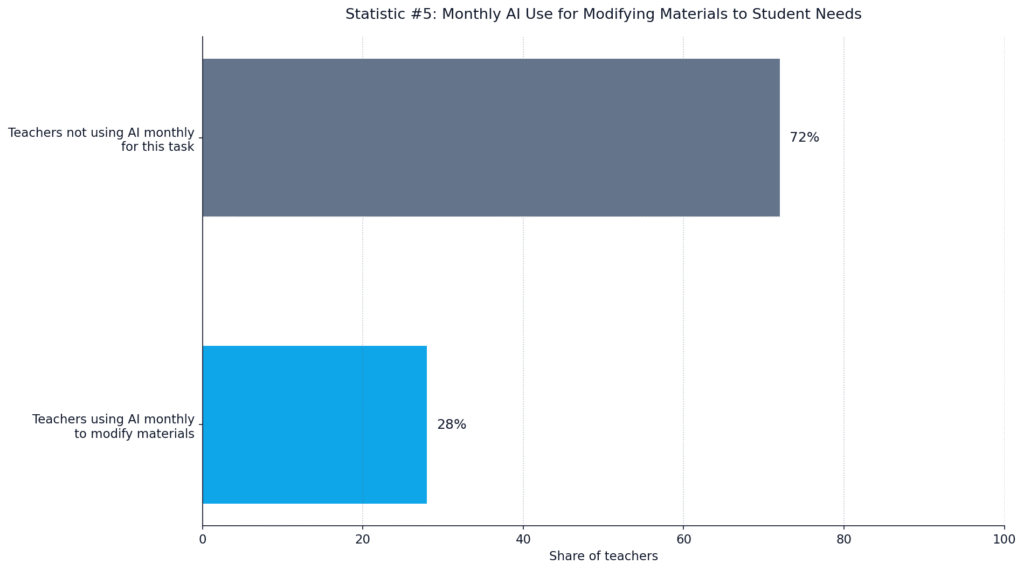
28% of teachers using AI monthly to modify materials for student needs is a smaller figure, but it is strategically important. This is the kind of planning work that directly touches access, pacing, and classroom inclusion. Even moderate adoption here hints that teachers see AI as useful for differentiation, not just speed.
The number grows because adaptation is repetitive, detail-heavy, and hard to finish when time is scarce. Teachers may need simpler wording, alternate reading levels, shorter directions, or revised practice sets for the same lesson. AI helps because it can produce multiple versions quickly, which reduces the friction that usually slows differentiated planning.
Even so, only a teacher knows whether a revision is truly supportive or merely easier on paper. Human judgment catches whether language feels respectful, whether challenge remains intact, and whether the modified version still serves the lesson goal. That is why this statistic points to assisted personalization rather than automated understanding, with strong implication.
AI-Assisted Lesson Planning Statistics #6. Administrative use stays close to planning use
28% of teachers using AI monthly for administrative work shows that classroom prep is not the only place where time pressure is biting. Teachers are also turning to AI for the background tasks that quietly eat into planning time. That overlap matters because admin relief can indirectly improve lesson quality by protecting prep hours.
The figure makes sense when you look at how teaching time gets fragmented. Emails, summaries, parent communication drafts, and routine documentation require attention but rarely reward deep creative effort. AI fits these tasks because it handles format-heavy writing quickly, which reduces friction around low-leverage work.
A human still decides tone, accuracy, and sensitivity, especially when communication touches families or student records. The raw draft may be fast, yet the teacher remains responsible for nuance and context. So this statistic matters for lesson planning precisely because fewer administrative minutes can mean more instructional thinking later, with practical implication.
AI-Assisted Lesson Planning Statistics #7. Assessment building is becoming a measurable workflow gain
25% of teachers using AI monthly to make assessments shows adoption entering a more sensitive layer of teaching work. Assessments shape pacing, review, and what teachers notice next, so the stakes feel higher here than with a simple worksheet. Even at one quarter of teachers, the figure is large enough to signal normalized experimentation.
The number rises because assessment design contains repeatable components that AI can assemble quickly. Question stems, multiple versions, exit tickets, and standards-aligned checks are all easier to draft from a prompt than from scratch. That makes AI attractive when teachers need something usable fast without losing the basic structure of a sound check.
Still, the human side remains decisive. A teacher understands whether an item is misleading, too easy, too language-heavy, or measuring the wrong skill entirely. That means the statistic reflects faster test construction, not outsourced evaluation of student understanding, and that distinction should guide expectations with clear implication.
AI-Assisted Lesson Planning Statistics #8. Grading stays lower because trust is harder to earn
16% of teachers using AI monthly for grading is noticeably lower than planning-related tasks, and that gap is revealing. Teachers appear more willing to let AI draft or organize work than judge student performance directly. Lower adoption here suggests caution rises whenever a tool gets closer to consequences for learners.
The cause is easy to understand. Grading requires accuracy, fairness, and sensitivity to context, especially when student writing, effort, or partial understanding sits in the balance. AI can summarize patterns or suggest comments, but the cost of getting judgment wrong feels much higher than the cost of revising a lesson draft.
Human grading also carries relational weight that software cannot reproduce. A teacher knows when a student improved despite weak polish, or when confusion reflects instruction that needs reteaching rather than punishment. So the lower figure tells a useful story: teachers welcome assistance, but they protect evaluative authority when stakes rise, with strong implication.
AI-Assisted Lesson Planning Statistics #9. One-on-one support remains a narrower use case
14% of teachers using AI monthly for one-on-one instruction shows a slower adoption curve once work becomes highly individualized. This is not surprising, because tutoring-like support depends on timing, relationship, and reading student responses in the moment. AI can help prepare for that interaction, but it does not easily replace the interaction itself.
The number stays modest because individualized instruction is harder to standardize. A teacher needs to respond to hesitation, misunderstanding, confidence, and motivation, often within a few minutes. Those are messy human signals, and they limit how far teachers will trust a tool beyond generating prompts or tailored practice ideas.
In real classrooms, the teacher notices when a student needs reassurance instead of another explanation. Software may provide possible next steps, yet the educator decides what the learner can absorb right now. That makes this statistic less about automation taking over support and more about AI serving as preparation behind the scenes, with implication.
AI-Assisted Lesson Planning Statistics #10. Data analysis is still emerging as a planning habit
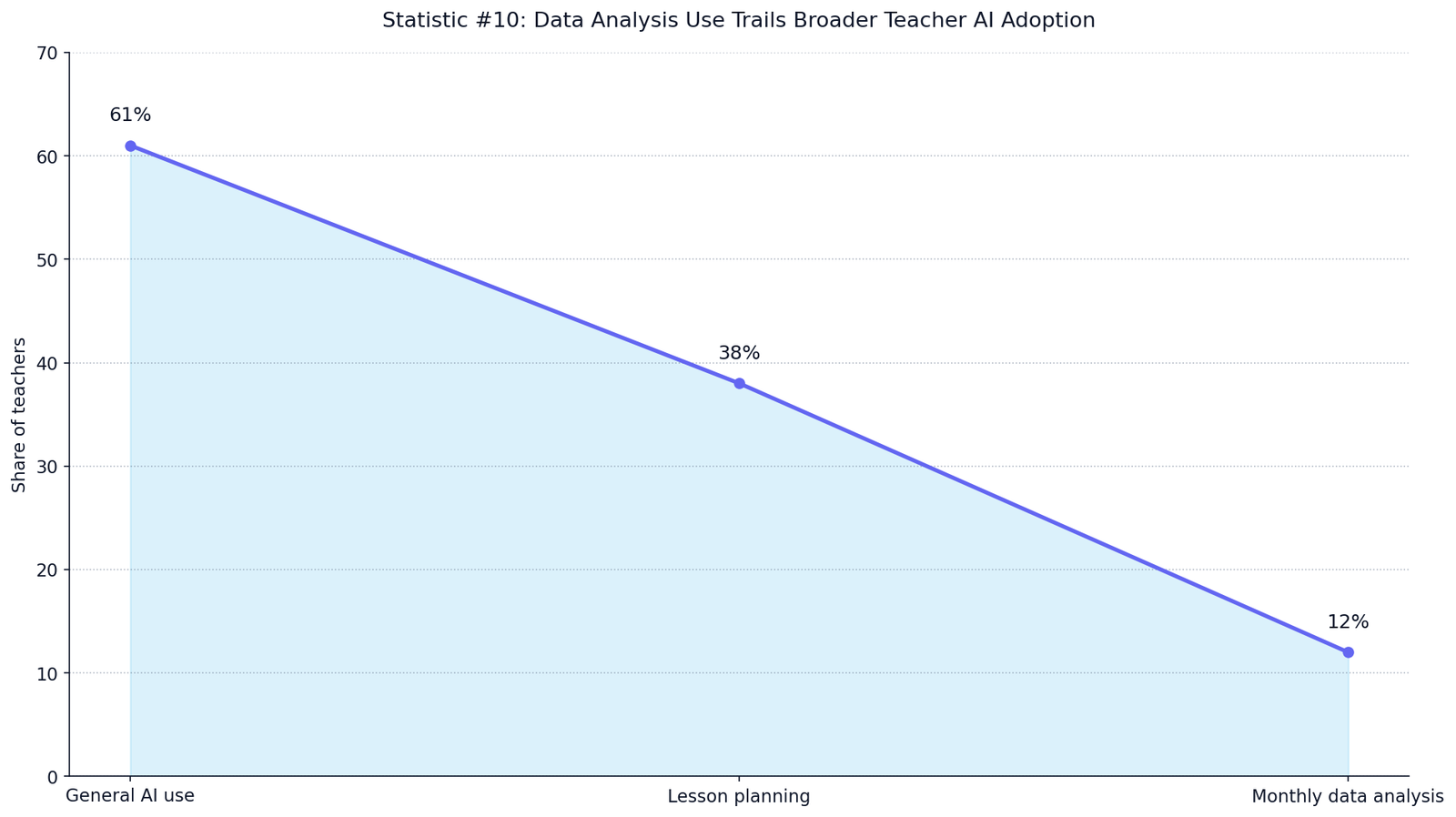
12% of teachers using AI monthly for student data analysis places this use case firmly in early adoption territory. Compared with drafting lessons or activities, interpreting data asks for more caution and stronger trust. That smaller figure suggests teachers are still testing where AI can help them read performance patterns without flattening context.
The slower uptake comes from the nature of the task. Data analysis needs clean inputs, sensible interpretation, and careful connection to actual instructional choices, which is harder than generating text. Teachers may use AI to organize trends or summarize patterns, but many will hesitate until the tool proves it can avoid shallow conclusions.
A teacher can see the student behind the score, which is where the human contrast becomes sharpest. The number alone may look small, yet it signals a frontier where potential is real and confidence is still forming. As trust grows, this area could influence planning more directly, but only where interpretation remains grounded in classroom reality and implication.
AI-Assisted Lesson Planning Statistics #11. Weekly use shows the difference between trial and routine
32% of teachers using AI at least weekly across tasks shows where experimentation hardens into habit. Weekly behavior matters more than occasional use because it reflects workflow integration, not curiosity. Once a tool becomes part of the weekly cycle, it starts influencing how planning time is structured.
This number rises when teachers find repeated value rather than one impressive output. If AI reliably helps with drafts, examples, adaptation, or quick planning fixes, it earns a permanent slot in the routine. That is how tools move from novelty to infrastructure, especially in jobs where every saved minute can be repurposed quickly.
The human contrast becomes clearer here than anywhere else. A teacher who uses AI weekly is not necessarily handing over more control, but is usually building a repeatable process for deciding what to keep, change, or discard. So weekly use signals operational maturity rather than automatic trust, which carries major implication for school support and evaluation.
AI-Assisted Lesson Planning Statistics #12. Regular users report substantial weekly time returns
5.9 hours per week saved by weekly AI users is large enough to alter how a teaching week feels. That is not a tiny convenience tucked into the margins of the day. It is the kind of recovered time that can change whether teachers revise thoughtfully, leave on time, or carry less unfinished work home.
The savings appear because AI handles front-end friction across multiple tasks at once. Instead of staring at an empty document, teachers begin with drafts, options, and organized material that can be edited faster than they can be built from zero. Time compounds when small reductions happen repeatedly across planning, communication, and resource preparation.
Of course, teachers still spend time checking, trimming, and correcting what the tool gives back. The human role is not removed, but the balance changes because more minutes go into refinement rather than initial assembly. That is why this figure matters: it suggests AI is most useful when it clears setup work and leaves judgment intact, with implication.
AI-Assisted Lesson Planning Statistics #13. Even lighter users still report meaningful gains
2.9 hours per week saved by monthly AI users shows that benefits are not limited to power users. Even teachers who use AI less often still recover a noticeable amount of time. That matters because it lowers the threshold for adoption, especially for educators who remain cautious or selective.
The reason is that not every task needs automation to create a measurable effect. A few well-timed uses during heavy prep periods, assessment creation, or material revision can still remove bottlenecks. In practice, modest use can produce disproportionate relief when it arrives exactly where the workload tends to jam.
A human planner still decides which moments deserve the tool and which require full manual effort. That selective behavior is actually a sign of mature use rather than reluctance. The figure suggests schools do not need universal daily dependence to see value, because even occasional assistance can improve planning capacity with real implication.
AI-Assisted Lesson Planning Statistics #14. Time savings add up across the school year
6 weeks per school year returned to weekly AI users turns a weekly benefit into something much easier to grasp. Measured that way, the scale feels less like convenience and more like capacity. A gain that large changes how leaders should think about workload, retention, and the hidden cost of inefficient planning systems.
This annual effect comes from repetition more than drama. Saving small amounts during prep, revision, assessment drafting, and communication does not feel spectacular on any single day. Yet across a full school year, those repeated minutes accumulate into a block of time that would otherwise be lost to setup work.
The human contrast matters here because saved time only becomes meaningful if teachers can redirect it well. Some will use it to improve feedback, differentiate materials, or simply reduce exhaustion enough to plan more clearly. That makes the figure less about machine productivity alone and more about recovered professional breathing room, with strong implication.
AI-Assisted Lesson Planning Statistics #15. Quality gains appear strongest in adapted materials
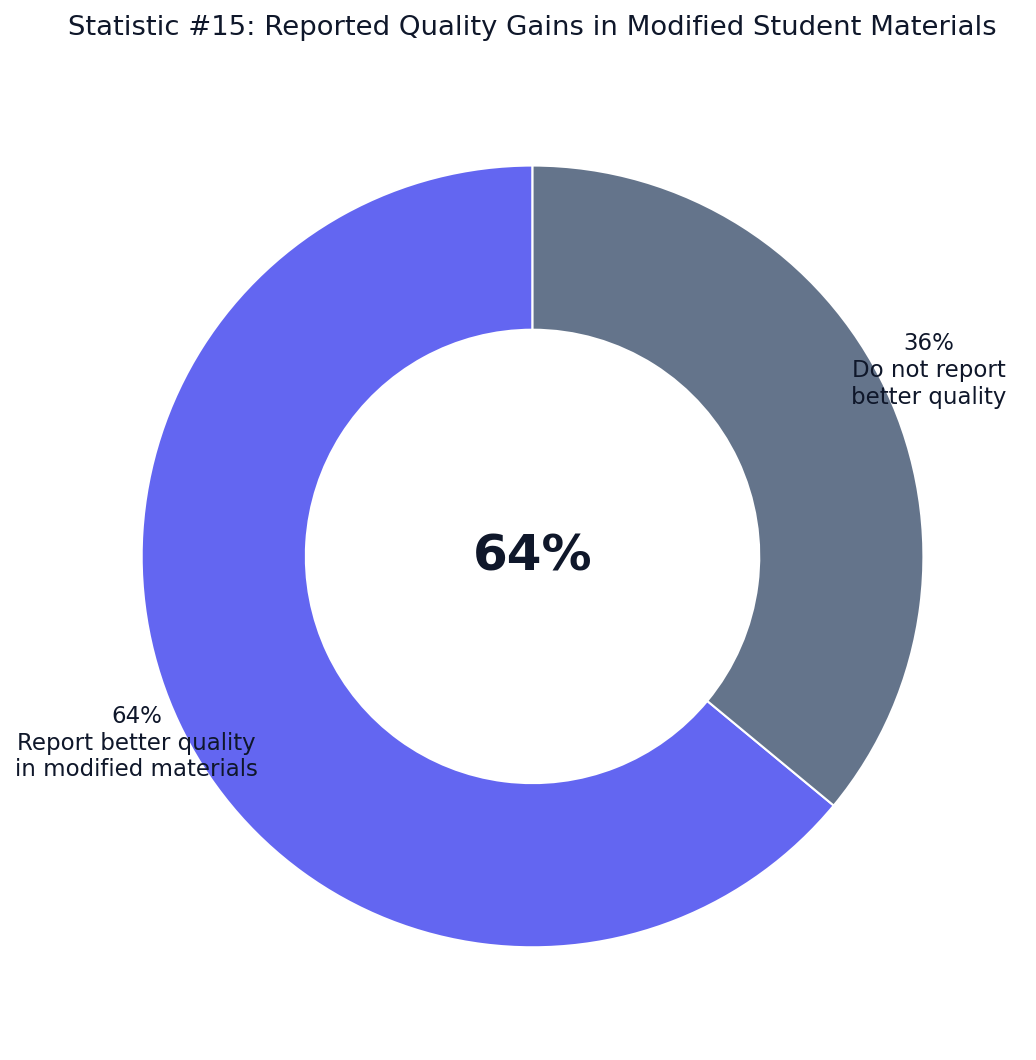
64% of teachers reporting better quality in modified student materials suggests AI may be especially useful where variation is labor-intensive. This is a quality story, not just a speed story. When teachers say adapted materials improve, it implies the tool is helping them produce more responsive versions than time alone would have allowed.
The number likely rises because differentiation often gets squeezed by workload. Teachers may know exactly how materials should change for different learners, yet lack the hours to create every version carefully. AI helps close that gap by generating alternatives quickly, which lets teachers spend their energy evaluating fit instead of formatting multiple drafts.
A human teacher still decides whether the adapted material remains respectful, rigorous, and aligned with the lesson goal. Software can generate options, but it cannot fully understand the student in front of the teacher. So the quality gain matters most when AI expands teacher capacity without weakening teacher judgment, which carries direct classroom implication.
AI-Assisted Lesson Planning Statistics #16. Teachers also report better insights from student data
61% of teachers reporting higher-quality insights from student data suggests AI may help with sense-making, not only content generation. That is notable because interpretation is closer to decision-making than simple drafting. When teachers see better insights, the planning value of AI starts to extend from production into diagnosis.
The number likely reflects how hard it is to sort patterns manually when classes are busy and information is scattered. AI can summarize trends, cluster responses, and surface possible gaps faster than a teacher working alone after hours. That speed can make analysis feel usable rather than aspirational, especially when planning needs to happen quickly.
Still, software cannot fully understand the story behind a student result. A teacher knows whether a weak pattern reflects misunderstanding, low confidence, attendance issues, or a badly designed task. So higher-quality insights only matter when the human interpreter stays in charge of meaning, which is exactly where planning quality gets its implication.
AI-Assisted Lesson Planning Statistics #17. Many teachers see quality gains in grading and feedback
57% of teachers saying AI improves grading and feedback quality adds nuance to the lower adoption rate for grading. Fewer teachers may use AI there regularly, yet many of those who do still see benefits. That combination suggests hesitation is real, but perceived value can be strong once teachers find a safe and limited use case.
The quality gain probably comes from structure and consistency. AI can help teachers generate clearer comment language, organize strengths and weaknesses, or suggest feedback categories that make responses easier to deliver. In heavy grading periods, that support can lift the baseline quality of feedback instead of letting exhaustion flatten it.
The human contrast stays important because students do not merely receive comments, they interpret them emotionally and academically. A teacher understands what tone will encourage effort and what wording may shut a student down. So this figure reflects assisted feedback craft rather than machine empathy, which should shape how schools set boundaries and implication.
AI-Assisted Lesson Planning Statistics #18. Formal policy still trails far behind classroom reality
19% of teachers employed at schools with an AI policy shows how thin institutional structure still is. Adoption is moving much faster than governance, and that mismatch creates avoidable uncertainty. When usage rises without clear policy, teachers end up building norms alone instead of working from shared guidance.
The lag happens because policy takes consensus, training, examples, and administrative confidence, all of which develop more slowly than tool use. Teachers can start experimenting in one afternoon, but schools need time to define acceptable practice and risk boundaries. That delay leaves a wide middle period where use becomes common before expectations become stable.
Human judgment carries even more weight in that vacuum. Individual teachers are left deciding what is responsible, transparent, and instructionally sound without much institutional backup. The figure therefore matters beyond compliance, because weak policy pushes more ethical and practical burden onto classroom professionals, with clear implication.
AI-Assisted Lesson Planning Statistics #19. Policy presence appears to reinforce actual use
70% of teachers using AI at schools with a policy suggests guidance does not necessarily suppress adoption. In fact, it seems to make responsible use easier. That matters because many institutions still treat policy as a brake, when the data hints it may function more like a stabilizer.
The relationship is understandable. Clear rules reduce hesitation, answer basic questions, and help teachers know where experimentation is acceptable. When staff do not have to guess what leadership considers safe or appropriate, they are more likely to use tools with confidence and less likely to hide the behavior.
A human teacher still makes the classroom call, but a policy can remove some of the background uncertainty around that judgment. The contrast here is not human versus machine so much as lone decision-making versus supported professional decision-making. That is why policy can increase use and improve quality at the same time, with strong implication.
AI-Assisted Lesson Planning Statistics #20. Academic-integrity guidance remains limited and uneven
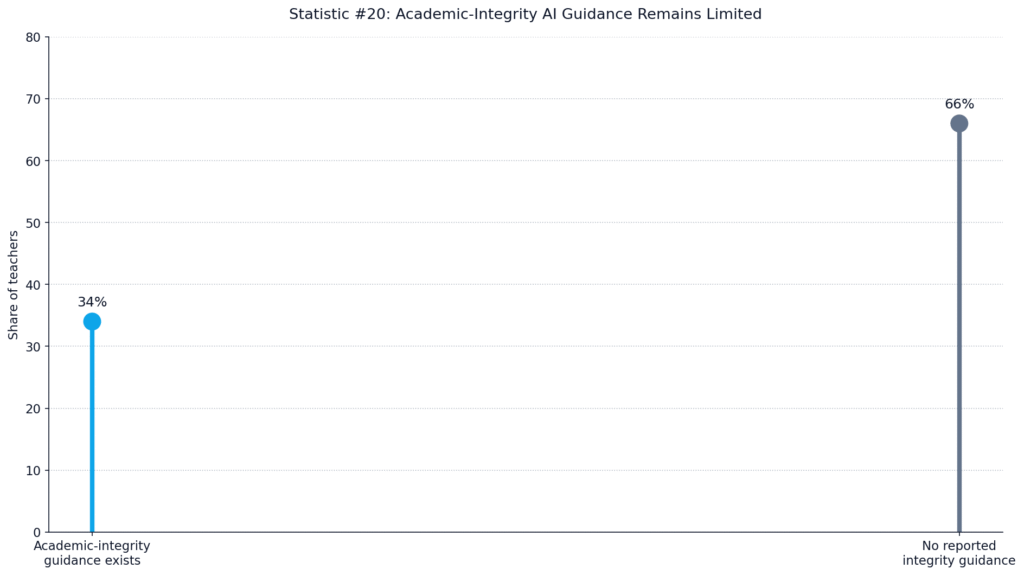
34% of teachers reporting academic-integrity AI policy or guidance shows how incomplete the rulebook still is. For a topic that directly affects assignments, trust, and student discipline, that figure is strikingly low. It means many teachers are navigating cheating questions, acceptable use, and false accusation concerns without much formal support.
The number stays low because integrity guidance is harder to write than general permission statements. Schools need examples, edge cases, and language that distinguishes brainstorming, editing, drafting, and outright substitution. That level of specificity takes work, and many institutions appear to still be catching up.
The human contrast is sharp here because teachers are the ones who must explain and enforce expectations with students face to face. Software cannot resolve fairness questions or rebuild trust after a vague accusation. So this statistic points to a governance problem, not a technical one, and that distinction carries major implication for the next stage of adoption.
AI-assisted lesson planning is maturing fastest where teachers can save setup time without giving up instructional judgment
The strongest pattern across these figures is that adoption clusters around tasks with heavy setup costs and clear editing paths. Teachers appear comfortable using AI where the draft can be checked, reshaped, and anchored in classroom reality before students ever see it.
That helps explain why lesson preparation, activities, adaptation, and admin work sit higher than grading, one-on-one instruction, or data analysis. The closer the tool gets to evaluation, student consequences, or live human interaction, the more teacher caution starts to slow the curve.
Time savings also seem to be the engine beneath the broader trend. Once repeated small efficiencies accumulate into hours each week and weeks across a school year, AI stops looking like novelty and starts looking like infrastructure.
At the same time, the policy figures show that institutional guidance is still lagging behind teacher behavior. The road ahead looks less like a question of whether educators will use AI and more like whether schools will give that use enough clarity, boundaries, and support to improve planning well.
Sources
- Gallup report on teacher AI use and time savings
- Walton Family Foundation summary of the AI dividend
- Walton Family Foundation explainer on six weeks saved
- Gallup K-12 teacher research hub and survey archive
- RAND overview of AI use in schools and guidance
- RAND PDF on school AI guidance and academic integrity
- Education Week reporting on how teachers use AI to save time
- Education Week article on rising teacher classroom AI use
- The 74 coverage of teacher AI use and weekly time saved
- EdSurge reporting on teachers reclaiming time with AI