How to Rewrite AI Ads to Sound Human: 15 Persuasive Adjustments

Updated for 2026, AI ads that feel human consistently outperform generic copy, as shown in a Journal of Marketing Research study on emotional language in advertising, where subtle tone and relatability increased engagement and recall.
How to Rewrite AI Ads to Sound Human: 15 Persuasive Adjustments
AI-generated ads often sound polished but strangely flat, making it harder to connect with real people. You might notice that even when the message is clear, it lacks the warmth and nuance that makes someone pause and pay attention, especially when balancing speed vs originality in fast-paced campaigns.
This happens because AI tends to default to safe, predictable phrasing that avoids risk but also strips away personality. Many teams try to fix this with tools, yet without understanding how to guide them, even the best AI humanizer tools for ad copy can still produce results that feel generic or over-edited.
The good news is that small, deliberate changes can quickly turn stiff AI output into something that feels natural and persuasive. In this guide, you will learn how to reshape tone, structure, and intent so your ads feel grounded and believable, supported by real-world patterns like teacher use of AI writing tools that reveal how people respond to AI-assisted content.
| # | Strategy focus | Practical takeaway |
|---|---|---|
| 1 | Strip generic phrasing | Remove safe, overused lines so the message feels more direct and specific |
| 2 | Anchor in real context | Ground the message in a situation your audience actually recognizes |
| 3 | Use conversational rhythm | Break rigid sentence patterns into something that sounds spoken, not scripted |
| 4 | Replace vague claims | Swap broad promises with concrete, believable details people can picture |
| 5 | Add emotional cues | Introduce subtle feeling without sounding exaggerated or overly dramatic |
| 6 | Shorten and tighten lines | Cut unnecessary words so each sentence carries clear intent |
| 7 | Shift perspective naturally | Balance “you” and “we” to make the message feel less mechanical |
| 8 | Use specific language | Choose precise words instead of filler terms that dilute clarity |
| 9 | Vary sentence structure | Avoid repetition by mixing short and slightly longer phrasing patterns |
| 10 | Introduce subtle imperfection | Allow slight irregularity so the copy feels less robotic and more human |
| 11 | Focus on one idea | Keep each section centered on a single clear message to avoid overload |
| 12 | Use relatable micro-examples | Include small, everyday moments that make the message easier to connect with |
| 13 | Adjust tone for audience | Match the language to how your audience actually speaks and reads |
| 14 | Refine call to action | Make the next step feel natural instead of forced or overly promotional |
| 15 | Read it out loud | Use spoken flow as a final check to catch anything that sounds off |
15 Persuasive Adjustments to Rewrite AI Ads to Sound Human
How to Rewrite AI Ads to Sound Human – Strategy #1: Strip generic phrasing
Start removing phrases that feel safe but empty, since AI tends to rely on wording that sounds polished yet carries very little meaning or distinct voice. You will often find lines that could belong to any brand in any industry, which makes the message blend into everything else people scroll past. Focusing on rewriting these lines into something more specific immediately gives the ad a stronger sense of identity and purpose.
This works because people quickly recognize when language feels interchangeable, even if they cannot explain why it feels off at first glance. Imagine an ad that says “high-quality solutions for your needs” compared to one that describes a specific outcome someone can picture, as the second one naturally holds attention longer. The key is to replace broad phrasing with language that reflects a real scenario, even if that requires more thought during editing.
How to Rewrite AI Ads to Sound Human – Strategy #2: Anchor in real context
Instead of presenting abstract ideas, rewrite the ad so it clearly lives in a situation your audience understands from their daily experience. AI often generates statements that sound correct but lack a setting, which makes it harder for readers to imagine themselves interacting with the product or service. Bringing in context such as time, place, or a familiar moment helps transform the message into something more grounded.
This approach works because people process information more easily when they can mentally place it within a known scenario. Consider an ad that mentions checking your phone during a commute compared to one that stays vague, as the specific version feels closer to real life. Keeping the context simple and relatable ensures the message remains clear without becoming overly detailed or distracting.
How to Rewrite AI Ads to Sound Human – Strategy #3: Use conversational rhythm
AI-generated copy often follows a rigid sentence structure that feels overly balanced, which can make it sound mechanical even if the words themselves are correct. Rewriting the text with a more conversational rhythm introduces natural variation, allowing some sentences to stretch while others remain shorter and more direct. This creates a flow that feels closer to how people actually speak when explaining something casually.
The benefit of this is that readers tend to stay engaged when the pacing feels natural rather than overly controlled. Think of how a friend would explain a product in a quick message, where the phrasing shifts slightly depending on emphasis or tone. Maintaining that rhythm in your edits helps the ad feel less like a script and more like a genuine recommendation.
How to Rewrite AI Ads to Sound Human – Strategy #4: Replace vague claims
Many AI ads rely on broad claims such as “best in class” or “industry leading,” which sound impressive but fail to give readers anything concrete to hold onto. Rewriting these statements into specific descriptions helps clarify what the product actually does and why it matters. This does not require complex detail, but it does require clarity that removes any ambiguity.
This works because people naturally trust information that feels measurable or observable, even in small ways. For example, describing how something saves time in a specific task is more convincing than a general claim about efficiency. Keeping the language grounded ensures that the ad builds credibility instead of relying on empty emphasis.
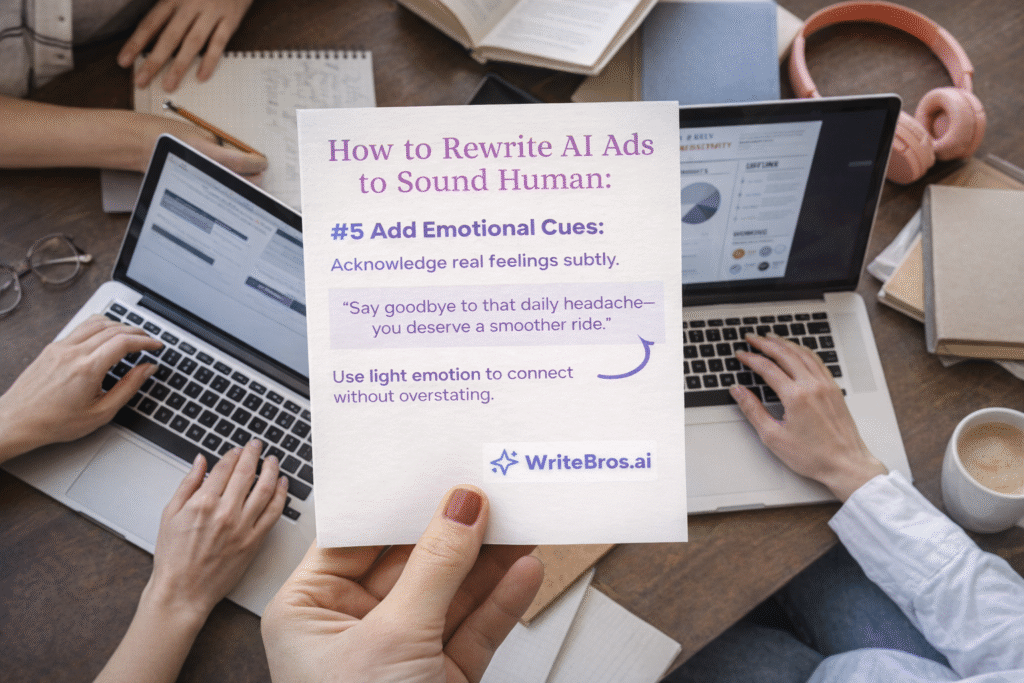
How to Rewrite AI Ads to Sound Human – Strategy #5: Add emotional cues
AI-generated ads often focus heavily on logic while leaving out subtle emotional signals that make a message feel relatable. Rewriting the copy to include light emotional cues, such as relief, curiosity, or quiet satisfaction, can make the message feel more complete. The goal is not to exaggerate emotion, but to reflect how someone might genuinely feel in that situation.
This approach works because decisions are rarely made on logic alone, even when the product itself is practical. Picture an ad that acknowledges the small frustration of a daily inconvenience, which instantly creates a sense of recognition for the reader. Keeping these cues subtle prevents the message from feeling forced while still adding depth to the overall tone.
How to Rewrite AI Ads to Sound Human – Strategy #6: Shorten and tighten lines
AI tends to produce sentences that are longer than necessary, often including extra words that do not add meaning but make the message feel heavier. Editing these lines into tighter phrasing helps improve clarity while also making the ad easier to read quickly. The focus should remain on keeping the core idea intact while removing anything that slows the pace.
This works because readers usually scan ads rather than read them carefully, especially in fast-moving environments like social feeds. A concise sentence allows the main point to land more effectively without requiring extra effort to understand it. Careful trimming ensures the message stays sharp without losing its natural tone.
How to Rewrite AI Ads to Sound Human – Strategy #7: Shift perspective naturally
AI copy often sticks to a single perspective, usually focusing heavily on either the brand or the reader without variation. Rewriting the ad to move naturally between perspectives creates a more dynamic and engaging tone. This can include shifting from “we” to “you” in a way that feels fluid rather than forced.
This helps because it mirrors how real conversations unfold, where attention moves between the speaker and the listener. Imagine a message that acknowledges both what the brand offers and how it fits into the reader’s experience, which feels more balanced. Keeping the transitions subtle ensures the message remains cohesive.
How to Rewrite AI Ads to Sound Human – Strategy #8: Use specific language
Generic wording often weakens AI-generated ads, even when the overall structure is solid. Rewriting the text with more specific language helps sharpen the message and makes it easier to understand quickly. This includes replacing filler terms with words that clearly describe actions, results, or situations.
This works because specificity reduces uncertainty, allowing readers to grasp the value of the message without extra interpretation. For example, describing a feature in simple, direct terms creates a clearer picture than relying on broad descriptors. Maintaining this clarity throughout the ad strengthens its overall impact.
How to Rewrite AI Ads to Sound Human – Strategy #9: Vary sentence structure
AI often repeats similar sentence patterns, which can make the copy feel predictable even when the content changes. Rewriting the structure to include variation introduces a more natural flow that keeps the reader engaged. This does not mean forcing complexity, but rather adjusting how ideas are presented across the text.
This approach works because variation keeps the reader’s attention from drifting, especially when scanning multiple lines quickly. Think of alternating between straightforward statements and slightly more detailed explanations to create a balanced rhythm. Maintaining this variation helps the ad feel more dynamic and less repetitive.
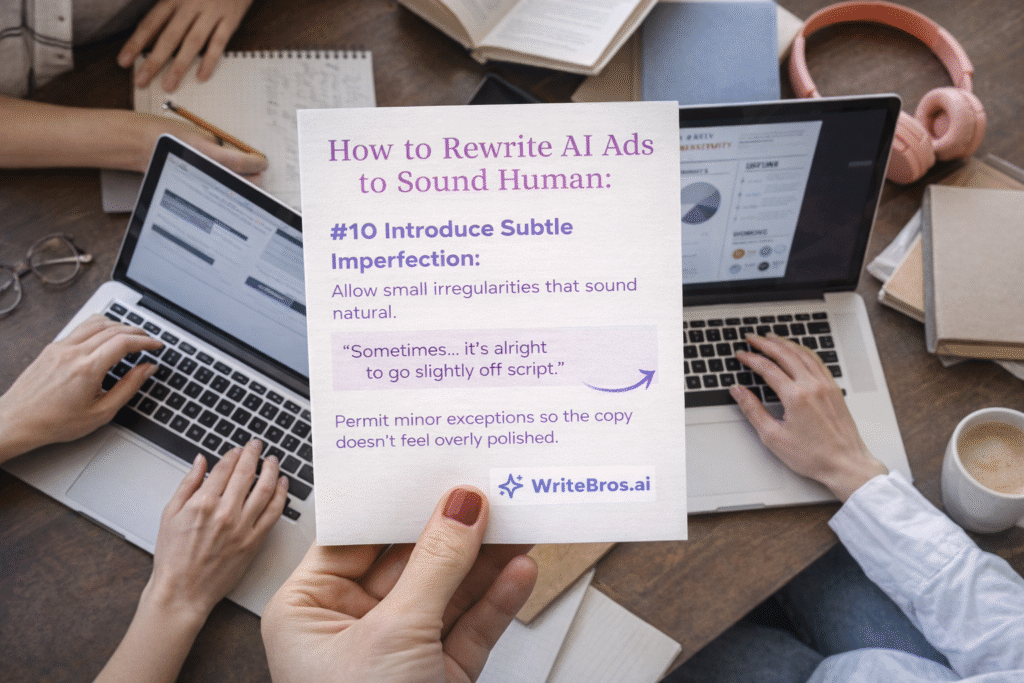
How to Rewrite AI Ads to Sound Human – Strategy #10: Introduce subtle imperfection
AI-generated text can feel overly polished, which sometimes makes it seem less believable or relatable. Rewriting the copy to include slight irregularities in phrasing or tone can make it feel more human. These imperfections should be subtle and intentional, rather than careless or confusing.
This works because real human communication is rarely perfectly structured, and small variations can signal authenticity. Consider how natural speech includes pauses, slight shifts, or informal phrasing that make it feel genuine. Adding these elements carefully helps the ad feel more approachable without losing clarity.
How to Rewrite AI Ads to Sound Human – Strategy #11: Focus on one idea
AI-generated ads sometimes try to include too many points at once, which can dilute the overall message. Rewriting the content to center on a single idea helps create clarity and direction. This makes it easier for the reader to understand what matters most.
This works because people tend to remember one clear message more than several competing ones. For example, highlighting a single benefit allows it to stand out rather than being lost among other details. Keeping the focus narrow ensures the ad remains easy to process.
How to Rewrite AI Ads to Sound Human – Strategy #12: Use relatable micro-examples
Adding small, relatable examples helps transform abstract statements into something more tangible. AI often skips these details, which makes the message feel distant. Rewriting the copy to include simple moments or actions makes it easier to connect with.
This approach works because people relate to familiar situations more easily than general descriptions. A small example can quickly illustrate how something fits into everyday life. Keeping these examples brief ensures they support the message without overwhelming it.
How to Rewrite AI Ads to Sound Human – Strategy #13: Adjust tone for audience
AI-generated content does not always match how a specific audience naturally communicates. Rewriting the tone to reflect how your audience speaks and reads improves relatability. This includes adjusting formality, vocabulary, and pacing.
This works because tone influences how the message is received, even when the information remains the same. For instance, a casual tone may feel more approachable in certain contexts than a formal one. Aligning tone with audience expectations helps the message feel more natural.
How to Rewrite AI Ads to Sound Human – Strategy #14: Refine call to action
AI often produces calls to action that feel overly direct or promotional, which can create resistance. Rewriting these lines to feel more natural helps reduce friction and encourages engagement. The goal is to guide rather than push.
This works because people respond better when they feel they are making a choice rather than being pressured. A softer, more conversational prompt can feel more inviting. Keeping the tone consistent with the rest of the ad ensures a smoother transition.
How to Rewrite AI Ads to Sound Human – Strategy #15: Read it out loud
Reading the ad out loud is one of the simplest ways to identify anything that feels unnatural or awkward. AI-generated text often looks fine on screen but sounds different when spoken. Rewriting based on how it sounds can reveal subtle issues.
This works because spoken language highlights rhythm, tone, and clarity in a way silent reading does not. If a sentence feels difficult to say, it will likely feel difficult to read as well. Using this method as a final check helps refine the overall flow.
Common mistakes
- Relying too heavily on AI output without sufficient editing often results in ads that feel generic, as the initial draft may lack the nuance needed for real engagement and fails to reflect a distinct voice.
- Over-correcting the text by adding too much personality can make the message feel forced, which undermines authenticity and creates a tone that feels inconsistent with the brand.
- Keeping vague claims without clarification can weaken the message, as readers may struggle to understand what makes the offering different or valuable.
- Ignoring the importance of context often leads to ads that feel disconnected, making it harder for readers to relate the message to their own experience.
- Using overly complex language in an attempt to sound professional can reduce clarity, which makes the message harder to process quickly.
- Skipping the final review stage can allow subtle issues to remain, including awkward phrasing or inconsistent tone that affects overall quality.
Edge cases
There are situations where maintaining a slightly more formal tone may be necessary, such as in industries that require precision or compliance. In these cases, the goal is to balance clarity with professionalism while still avoiding overly rigid phrasing.
Some audiences may also expect a more structured style, which means that introducing too much variation could feel out of place. Adjusting the level of informality based on context ensures the message remains appropriate.
Supporting tools
- Editing platforms can help refine tone and structure, allowing you to adjust phrasing while maintaining consistency across multiple pieces of content.
- Readability checkers provide insight into how easily the text can be understood, helping identify areas that may need simplification.
- Voice and tone analyzers offer feedback on how the message may be perceived, which can guide adjustments during the rewriting process.
- Collaboration tools allow multiple reviewers to provide input, ensuring the final version reflects different perspectives.
- Draft comparison tools help track changes and evaluate improvements between versions, making it easier to refine the message step by step.
- WriteBros.ai helps adapt AI-generated text into a more natural tone, supporting the process of refining ads into something that feels more human.
Ready to Transform Your AI Content?
Try WriteBros.ai and make your AI-generated content truly human.
Conclusion
Rewriting AI ads to sound human requires attention to detail, especially in how tone, structure, and clarity come together. Small adjustments can significantly improve how the message is received.
Focusing on intention rather than perfection allows you to refine the content in a way that feels natural. Over time, these adjustments become easier and more intuitive.
Did You Know?
AI ads often feel polished because they rely on predictable structure and safe wording patterns. Even so, they can lack the natural tone and context needed to feel believable and engaging.
Adjusting tone, adding specific detail, and improving flow can strengthen clarity faster than expected. These small changes help ads feel more human and easier to connect with.
Ready to Transform Your AI Content?