Teacher Use of AI Writing Tools Statistics: Top 20 Adoption Signals

2026 classroom writing habits are being reshaped in real time, with teachers quietly embedding AI into planning, grading, and communication while still editing heavily and questioning reliability. Adoption is rising alongside concern, creating a hybrid workflow defined more by control than automation.
Classroom workflows have been quietly restructured as writing assistance becomes embedded into daily teaching routines, often without formal policy catching up. What starts as convenience quickly turns into dependency, especially when time pressure meets high grading volume.
Expectations around originality are now negotiated rather than assumed, and this tension becomes clearer when comparing outputs against ai-assisted writing non-negotiables. Teachers are balancing efficiency with credibility, which introduces new friction points in assessment design.
Adoption is not uniform, with early adopters building entirely new content pipelines while others remain cautious due to detection concerns and institutional guidelines. This gap creates uneven student experiences, especially when some classrooms lean heavily on tools while others prohibit them.
Efforts to refine generated material have led many educators to explore how to humanize ai training materials and compare outputs against trusted ai humanizer tools. Even small adjustments in tone or phrasing can change how work is perceived, which makes consistency harder to maintain.
Top 20 Teacher Use of AI Writing Tools Statistics (Summary)
| # | Statistic | Key figure |
|---|---|---|
| 1 | Teachers using AI tools weekly | 64% |
| 2 | Teachers using AI for lesson planning | 71% |
| 3 | Teachers concerned about AI detection accuracy | 58% |
| 4 | Teachers using AI for grading assistance | 49% |
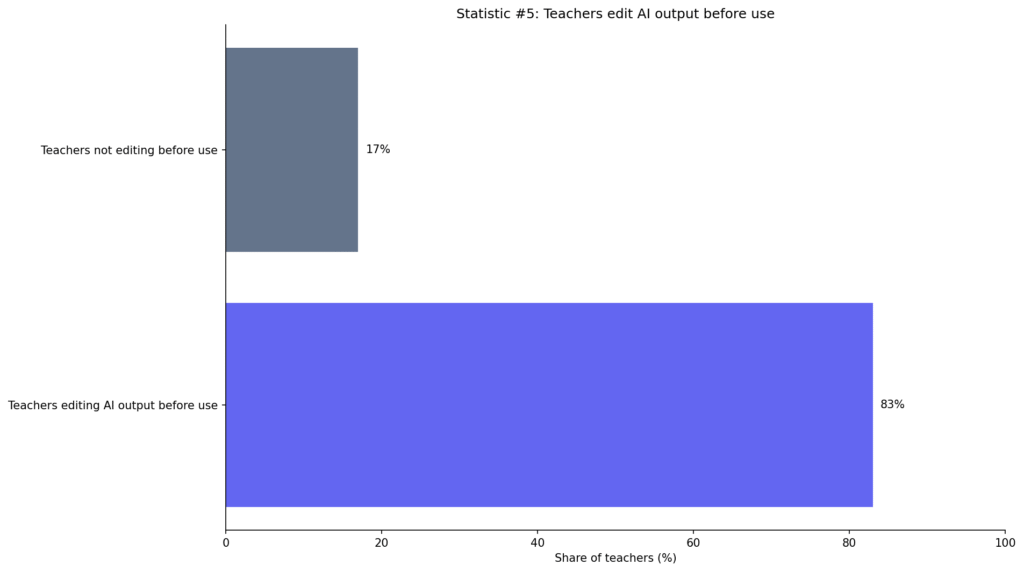
| 5 | Teachers editing AI output before use | 83% |
| 6 | Teachers reporting time savings with AI | 76% |
| 7 | Teachers avoiding AI due to policy uncertainty | 41% |
| 8 | Teachers using AI for student feedback drafts | 52% |
| 9 | Teachers using AI to generate test questions | 67% |
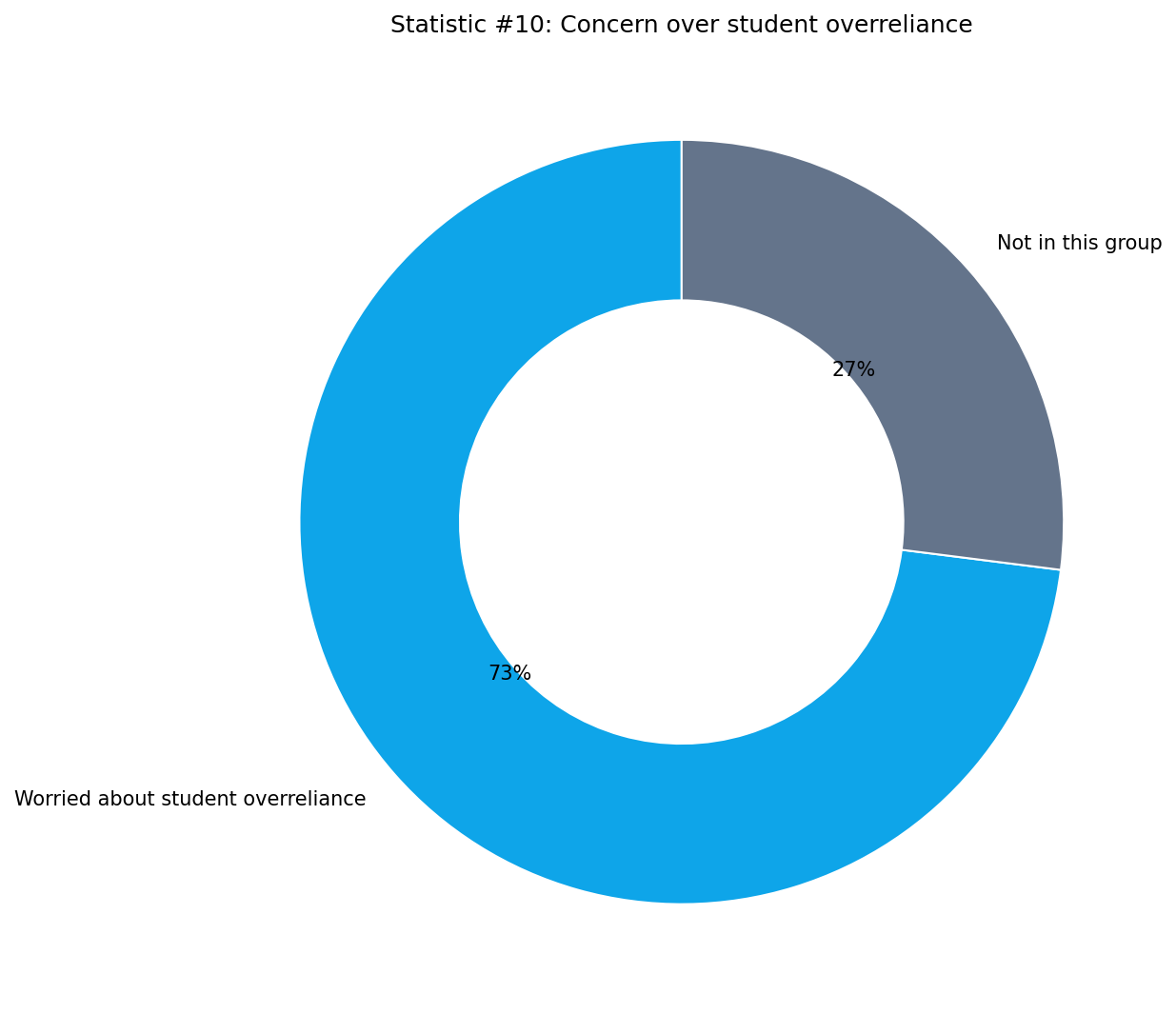
| 10 | Teachers worried about student overreliance | 73% |
| 11 | Teachers integrating AI into curriculum design | 45% |
| 12 | Teachers receiving formal AI training | 29% |
| 13 | Teachers using AI for email communication drafts | 54% |
| 14 | Teachers who trust AI outputs without edits | 12% |
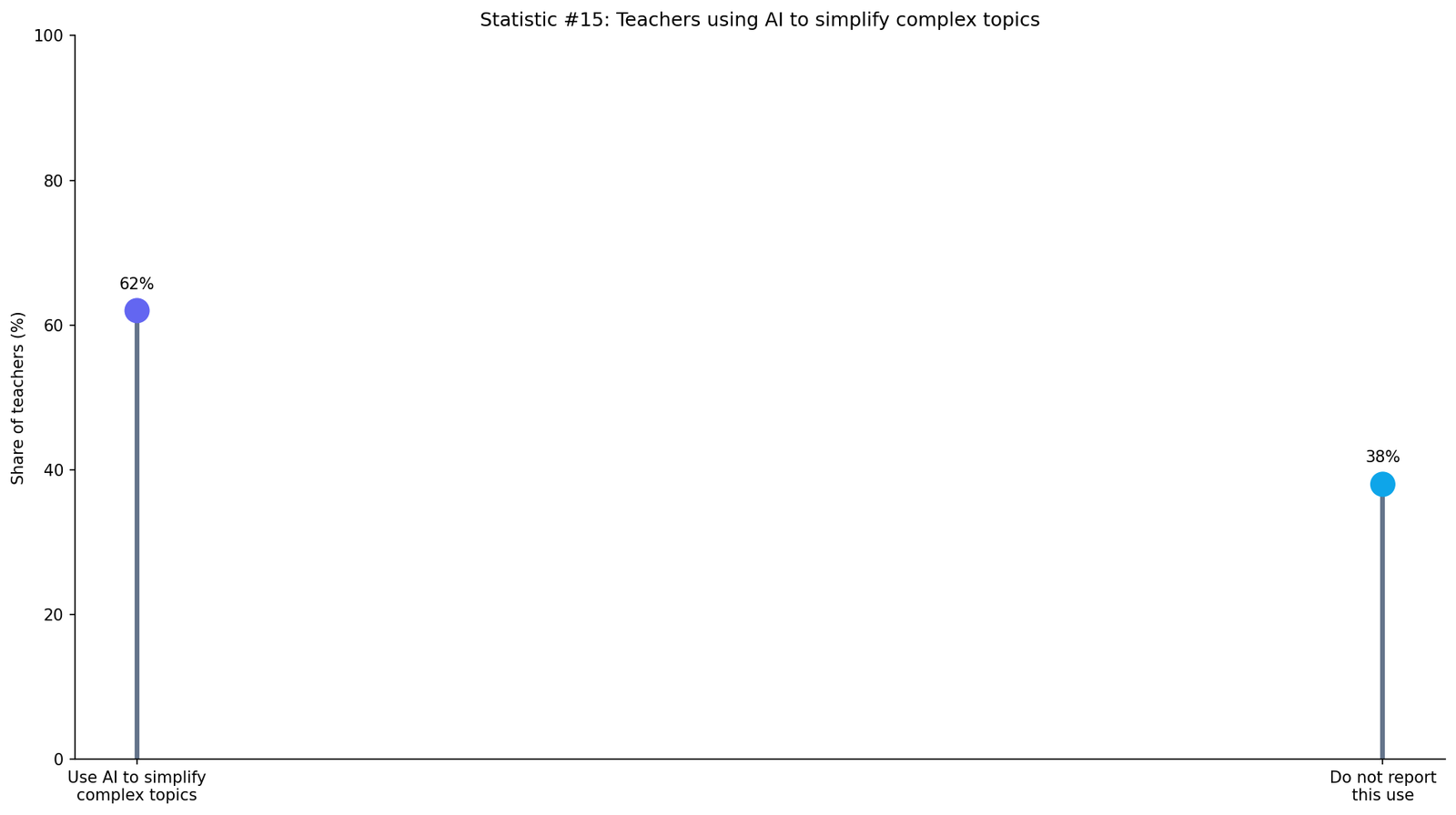
| 15 | Teachers using AI to simplify complex topics | 62% |
| 16 | Teachers who say AI improves productivity | 81% |
| 17 | Teachers concerned about bias in AI outputs | 47% |
| 18 | Teachers using AI for rubric creation | 38% |
| 19 | Teachers who say AI reduces burnout | 69% |
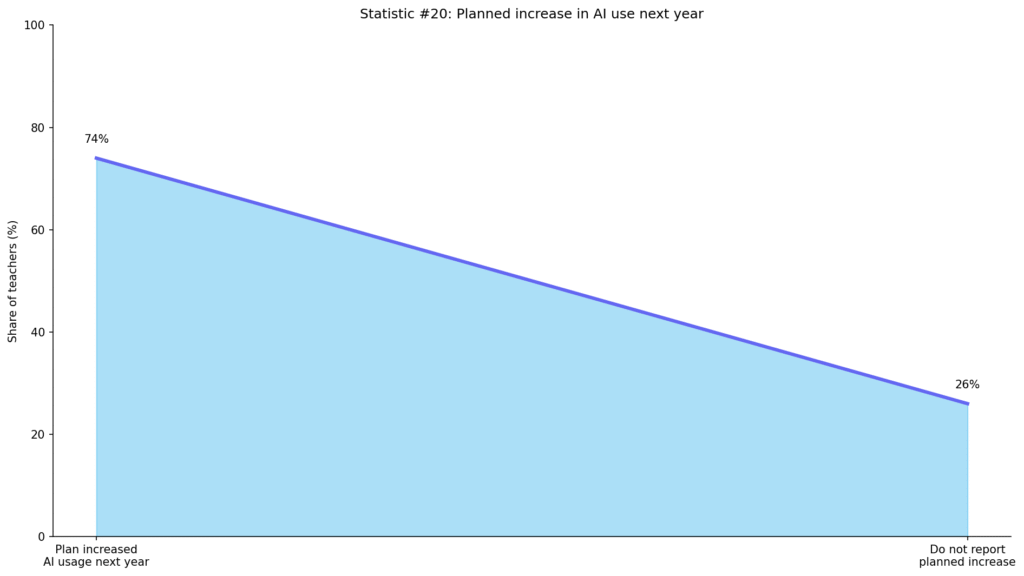
| 20 | Teachers planning increased AI usage next year | 74% |
Top 20 Teacher Use of AI Writing Tools Statistics and the Road Ahead
Teacher Use of AI Writing Tools Statistics #1. Weekly use has become normal
64% of teachers now use AI writing tools weekly, which suggests the habit has moved past curiosity and into routine work. Weekly behavior usually signals that a tool fits naturally inside planning cycles, grading windows, and communication tasks. That matters because school work repeats fast, and teachers tend to keep only tools that save effort more than once.
The main driver is volume rather than novelty. Teachers write instructions, prompts, comments, examples, and parent notes constantly, so an AI draft can reduce the cost of getting started. A pattern like this also aligns with broader writing guardrails, since repeated use works best when teachers know exactly what still needs human judgment.
A machine can offer a rough draft in seconds, but a teacher still decides tone, accuracy, and whether the wording fits actual students. That is why 64% of teachers using AI weekly does not mean classrooms are running on autopilot. The implication is that weekly adoption will keep rising where schools frame AI as steady drafting support rather than a replacement for professional judgment.
Teacher Use of AI Writing Tools Statistics #2. Lesson planning leads most use cases
71% of teachers use AI for lesson planning, which puts planning at the center of educator adoption. That makes sense because lesson planning combines structure, explanation, differentiation, and pacing in one time-heavy task. When pressure builds across multiple classes, teachers naturally look for help at the stage that consumes the widest block of attention.
The cause is practical rather than ideological. Planning requires repeated wording changes, fresh examples, leveled explanations, and fast adaptation for different groups of students. Resources on humanizing training materials matter here too, because teachers rarely want a flat draft that sounds detached from their own classroom rhythm.
AI can propose sequence and wording quickly, but teachers still know which example will land and which activity will fall flat. That contrast explains why 71% of teachers using AI for lesson planning should be read as support for design work, not surrender of instructional thinking. The implication is that planning tools will keep winning adoption when they shorten prep time without flattening teacher voice or local context.
Teacher Use of AI Writing Tools Statistics #3. Detection doubts remain a real brake
58% of teachers are concerned about AI detection accuracy, and that concern keeps the whole category slightly unstable. Even when educators like the convenience, they hesitate if the systems judging student work feel inconsistent. A tool can be useful in one workflow and still create distrust in the wider writing environment.
The reason is easy to understand. Teachers are being asked to manage originality, fairness, and discipline in situations where detection tools can overread polished writing or miss obvious machine assistance. That is also why people compare outputs with trusted rewriting tools, since perception and detection can change after even small editing choices.
A teacher can read for reasoning, voice, and classroom fit in ways a detector cannot fully capture. So 58% of teachers worrying about detection accuracy reflects a judgment gap between automated suspicion and human evaluation. The implication is that schools will keep moving toward process-based assessment and draft evidence whenever confidence in detection remains weaker than confidence in teacher review.
Teacher Use of AI Writing Tools Statistics #4. Grading help is growing but still selective
49% of teachers use AI for grading assistance, which places grading close to the adoption midpoint rather than full comfort. That pattern suggests teachers see value in help with repetitive comments, summaries, and rubric language. It also shows that many still stop short of letting AI handle evaluative language without close review.
The underlying cause is the emotional weight of grading. Feedback is not just text generation, because it carries consequences for confidence, accountability, and perceived fairness. Teachers will often welcome help with phrasing, yet stay cautious because grading is one of the clearest places where human judgment must remain visible.
AI can speed up the wording of comments, but a teacher still reads the work, notices patterns, and decides what kind of response will actually help the student improve. That is why 49% of teachers using AI for grading assistance reflects controlled support rather than hands-off scoring. The implication is that grading adoption will rise most in feedback drafting and rubric language, not in fully automated evaluation decisions.
Teacher Use of AI Writing Tools Statistics #5. Editing remains the rule, not the exception
83% of teachers edit AI output before using it, and that single figure says a lot about how educators really work with these systems. The dominant pattern is not copy, paste, and publish. It is generate, inspect, soften, correct, and reshape until the draft feels usable in a real classroom.
The cause is straightforward. AI can move quickly, but speed also produces generic phrasing, awkward emphasis, and examples that do not match a specific school context. Teachers are therefore treating the output like a rough scaffold, much the way they would revise a shared template before handing it to students or families.
A machine can draft clean sentences, but a teacher adds the nuance, pacing, and trust cues that make writing feel intentional rather than canned. So 83% of teachers editing AI output shows that professional voice still sits after generation, not before it. The implication is that the best educator tools will be the ones built for revision, because drafting alone is clearly not the end of the job.
Teacher Use of AI Writing Tools Statistics #6. Time savings are the clearest payoff
76% of teachers report time savings with AI, which helps explain why adoption keeps widening even in cautious schools. Most education technology fails when it adds setup time or creates more checking work than it removes. AI has stayed relevant because many teachers feel the time difference almost immediately in writing-heavy tasks.
The deeper cause is workload compression. Teachers handle planning, grading, email, documentation, and revisions in narrow time pockets that are constantly interrupted. A tool that shortens early drafting can give back minutes across several tasks, and those minutes stack into something that feels meaningful by the end of a week.
Human judgment still takes the final pass, but the machine removes the blank-page friction that drains energy before the real thinking begins. So 76% of teachers reporting time savings reflects relief from repetitive starts more than relief from the whole job. The implication is that AI uptake will stay strongest in schools where staff evaluate tools through workload reduction instead of novelty or abstract innovation claims.
Teacher Use of AI Writing Tools Statistics #7. Policy uncertainty still slows adoption
41% of teachers avoid AI because policy uncertainty makes the risk feel larger than the convenience. That number shows hesitation is not always technical or philosophical. Sometimes the barrier is simply not knowing what would be defended later if a parent, leader, or colleague questioned the workflow.
The cause is institutional lag. Tools arrived quickly, but many schools moved more slowly on disclosure rules, acceptable uses, documentation, and expectations around edited versus unedited outputs. Teachers who already work under scrutiny are unlikely to adopt confidently when the rules feel implied rather than written down.
A human teacher may know exactly how they are using AI responsibly, yet still avoid it if the policy language remains vague. That is why 41% of teachers stepping back because of uncertainty reflects a governance problem as much as a trust problem. The implication is that clearer guidance will raise adoption faster than promotional training sessions if staff still fear being exposed rather than supported.
Teacher Use of AI Writing Tools Statistics #8. Feedback drafting is becoming a practical use case
52% of teachers use AI for student feedback drafts, which places feedback just over the threshold of common use. That makes sense because feedback is repetitive in form but highly personal in effect. Teachers often need help finding a clear starting structure, even when they already know what each student needs to hear.
The pattern grows from repetition and emotional fatigue. Writing twenty or thirty comments that stay specific, encouraging, and honest can be harder than the academic marking itself. AI reduces the strain of phrasing, especially when teachers want comments to sound direct without turning mechanical or overly harsh.
The teacher still decides what is true, what is fair, and what tone will motivate rather than shut a student down. So 52% of teachers using AI for feedback drafts signals support with language, not delegation of relational work. The implication is that feedback assistance will keep expanding, because this is one of the clearest places where drafting speed and human discretion can work together without much confusion.
Teacher Use of AI Writing Tools Statistics #9. Test question generation is now mainstream
67% of teachers use AI to generate test questions, which shows assessment drafting has become a mainstream workflow. Teachers often need multiple versions, varied difficulty, and fresh wording for the same concept across different groups. AI fits that demand well because question generation rewards speed, variation, and quick rephrasing.
The cause is structural. Assessments require constant wording labor, yet the cognitive lift is not always in inventing every question from nothing. Often the real work lies in checking alignment, difficulty, bias, and whether the item measures the intended skill rather than an accidental reading trick.
A machine can propose ten questions quickly, but a teacher still spots ambiguity, thin distractors, and content that does not match what was actually taught. That is why 67% of teachers using AI for test question generation should be read as drafting support for assessment design, not outsourced pedagogy. The implication is that this use case will keep growing where teachers need more question volume without sacrificing alignment or classroom specificity.
Teacher Use of AI Writing Tools Statistics #10. Student overreliance is the dominant worry
73% of teachers worry about student overreliance, and that concern sits near the center of every school AI conversation. Teachers are not only asking whether students can use the tools. They are asking what happens to reasoning, persistence, and writing fluency if the tool becomes the first move every time.
The reason this concern stays high is that writing is also thinking practice. When students skip the messy early stage of planning and sentence formation too often, teachers lose visibility into how ideas are actually developing. That makes it harder to diagnose misunderstanding, weaker habits, or gaps in confidence that polished output can easily hide.
An AI tool can make a paragraph look finished, but a teacher still notices whether the student can explain choices, revise independently, and sustain an argument aloud. So 73% of teachers worrying about overreliance reflects fear of hidden learning loss more than fear of the software itself. The implication is that classrooms will keep moving toward process evidence and oral checks wherever AI use becomes easy but student thinking becomes harder to see.
Teacher Use of AI Writing Tools Statistics #11. Curriculum design is starting to absorb AI support
45% of teachers integrate AI into curriculum design, which suggests deeper adoption is forming just below majority level. Curriculum work asks for sequencing, standards alignment, pacing, and coherence across time, so teachers are naturally more cautious here than in one-off drafting tasks. Even so, that share is high enough to show AI is beginning to influence the architecture of instruction, not just the paperwork around it.
The cause is growing familiarity. Once teachers trust AI for smaller jobs, some begin extending it into broader planning work such as unit outlines, topic progression, text simplification, or differentiation ideas. The barrier remains higher because curriculum choices affect weeks of teaching, and mistakes echo longer than a bad email or an awkward worksheet prompt.
An AI system can suggest structure, but a teacher knows where students usually stall, which concepts need extra time, and which examples fit local realities. So 45% of teachers using AI in curriculum design still reflects human-led planning with machine support in the margins. The implication is that deeper adoption will depend less on flashy features and more on whether tools can handle coherence without flattening instructional intent.
Teacher Use of AI Writing Tools Statistics #12. Formal training still trails actual use
29% of teachers have received formal AI training, and that gap explains much of the uncertainty surrounding classroom use. Adoption is moving faster than professional development, so many educators are building habits through trial, peer advice, and scattered examples. That usually creates uneven confidence, uneven quality, and uneven policy interpretation across the same school.
The underlying cause is familiar in education technology. Systems are introduced quickly, but time for training competes with everything else schools must already cover. When support arrives late, teachers learn just enough to use AI for immediate tasks, while deeper questions about bias, privacy, prompting, and disclosure stay only partially addressed.
A teacher can become functionally competent without formal training, but competence built informally is often narrow and harder to defend when expectations change. That is why 29% of teachers receiving formal training matters more than the number first appears to. The implication is that schools will keep seeing patchy results until professional development catches up with real usage patterns and gives staff shared standards for responsible writing workflows.
Teacher Use of AI Writing Tools Statistics #13. Email drafting has become a quiet everyday use
54% of teachers use AI for email communication drafts, which shows one of the most ordinary jobs is also one of the most attractive targets for automation. Email takes attention even when the message is short, because teachers are balancing clarity, diplomacy, and the risk of sounding too abrupt. A tool that offers a composed first pass can feel helpful before the school day has properly begun.
The reason this use case grows steadily is simple. Parent replies, admin updates, meeting summaries, and sensitive wording requests all demand mental energy that teachers would rather keep for students. Email also rewards polish more than originality, which makes drafting support easier to accept than in more pedagogically delicate tasks.
Still, teachers adjust tone, remove stiffness, and add context that a generic model cannot possibly know. So 54% of teachers using AI for email drafts reflects relief from routine communication labor, not disengagement from professional relationships. The implication is that administrative writing will remain one of AI’s strongest footholds because the efficiency gain is immediate and the need for human revision stays obvious.
Teacher Use of AI Writing Tools Statistics #14. Blind trust in outputs is still very rare
12% of teachers trust AI outputs without edits, and that low share is one of the most revealing numbers in the set. It suggests that even frequent users still treat AI with caution. In other words, convenience has spread faster than full confidence, which is a healthy sign for professional judgment.
The cause is repeated exposure to small failures. Teachers see generic phrasing, factual slips, mismatched reading levels, and examples that sound plausible but do not quite fit the classroom. After a few of those moments, the sensible habit is revision rather than trust, especially when the audience includes students, families, and supervisors.
A machine can sound polished enough to invite overconfidence, but a teacher notices where the wording misses tone, precision, or instructional intent. That is why 12% of teachers trusting outputs without edits should be read as a minority edge case, not the norm. The implication is that educator AI will keep centering around review tools and editable drafts because schools clearly are not ready to reward blind acceptance of generated text.
Teacher Use of AI Writing Tools Statistics #15. Simplifying difficult topics is a major advantage
62% of teachers use AI to simplify complex topics, which highlights one of the most educationally meaningful writing functions. Teachers constantly need to restate the same idea at different reading levels or from different angles. A tool that can quickly reframe content gives teachers more room to match explanation style to actual learner needs.
The cause is rooted in differentiation pressure. Classrooms contain mixed readiness levels, language backgrounds, and confidence gaps, so one explanation rarely reaches everyone equally well. AI helps because it can produce alternate phrasings quickly, letting teachers compare versions instead of writing each one from scratch after a long day.
What matters, though, is that the teacher still decides whether the simplified version remains accurate and whether it respects the intelligence of the learner. So 62% of teachers using AI to simplify complex topics reflects support for translation across levels, not dilution of subject expertise. The implication is that adoption will deepen where AI helps widen access to hard ideas without quietly stripping away the nuance that students still need to encounter.
Teacher Use of AI Writing Tools Statistics #16. Productivity gains are now widely acknowledged
81% of teachers say AI improves productivity, which makes productivity the broadest area of agreement in this topic. Teachers may disagree on classroom limits, disclosure, or student use, yet many still agree that AI helps work move faster. That wide approval usually appears only when a tool reduces friction across several small tasks instead of solving just one narrow problem.
The cause is cumulative relief. Drafting rubrics, rewriting explanations, preparing parent notes, and reshaping examples each save only a little time on their own. Put together across a full week, those small gains create a noticeable difference in how much energy remains for live teaching and student interaction.
AI can increase output volume, but human teachers still determine whether the extra output is accurate, useful, and worth sharing. So 81% of teachers saying productivity improves reflects smoother workflow, not necessarily better education by default. The implication is that schools will keep embracing AI for staff work where efficiency is visible, while still debating much more cautiously what role it should play in student writing.
Teacher Use of AI Writing Tools Statistics #17. Bias concerns remain too serious to ignore
47% of teachers are concerned about bias in AI outputs, which keeps the issue close to the center of professional caution. That figure is not a fringe objection. It signals that nearly half of teachers see a real risk that polished language can still carry distorted assumptions, cultural narrowness, or uneven framing.
The cause is built into how these systems learn and generalize. AI models produce patterns from existing data, and those patterns can reproduce the imbalances already present in the material they absorbed. Teachers are sensitive to this because wording choices shape belonging, expectations, and whether students feel recognized or reduced to a template.
A machine can generate fluent text that looks neutral on the surface, but a teacher may catch stereotypes, omissions, or examples that quietly exclude the people in front of them. So 47% of teachers worrying about bias reflects necessary skepticism rather than resistance to innovation. The implication is that responsible use will keep depending on review habits strong enough to question even the outputs that sound smooth, confident, and immediately usable.
Teacher Use of AI Writing Tools Statistics #18. Rubric creation is useful but still emerging
38% of teachers use AI for rubric creation, which puts this use case in the emerging rather than dominant category. Rubrics are deceptively hard to write well because they need clear criteria, fair distinctions, and language students can actually interpret. That makes teachers interested in support, but slower to hand over the process entirely.
The cause is that rubric language shapes assessment culture. A weak rubric can confuse expectations, reward the wrong behavior, or make grading harder instead of easier. Teachers may ask AI for a starter framework, yet still rebuild descriptors carefully so the final version matches the class task rather than a generic assignment pattern.
An AI system can draft criteria quickly, but a teacher knows which distinctions are meaningful, teachable, and realistic for the students in front of them. So 38% of teachers using AI for rubric creation suggests curiosity with restraint rather than full procedural trust. The implication is that rubric adoption will grow gradually, especially where teachers want structure support but still see criteria design as one of the profession’s more sensitive writing jobs.
Teacher Use of AI Writing Tools Statistics #19. Burnout relief is part of the appeal
69% of teachers say AI reduces burnout, which shows the conversation is not only about efficiency. Burnout in teaching comes from constant cognitive switching, emotional labor, and the sense that written tasks keep expanding after the school day ends. When a tool lightens even part of that load, teachers often experience the value as emotional relief before they describe it as productivity.
The cause is not that AI makes teaching easy. It is that repetitive drafting and rewriting can drain energy needed for human parts of the job that no system can replace. Reducing friction in admin-heavy writing may leave more patience for conferences, classroom presence, and the slower work of responding thoughtfully to students.
A machine cannot build trust, notice a student’s mood, or handle the emotional texture of teaching, but it can remove some of the exhausting text work around those moments. So 69% of teachers linking AI to lower burnout reflects partial relief in the background labor of the profession. The implication is that adoption will keep growing where staff see AI as protecting human attention rather than competing with it.
Teacher Use of AI Writing Tools Statistics #20. Future use is set to expand further
74% of teachers plan to increase AI usage next year, which makes future growth look less like speculation and more like a continuation of present habits. Intentions at that level usually appear when users have already tested enough workflows to believe the tool belongs in regular practice. This is not the language of passing interest, but of systems becoming quietly embedded.
The cause is cumulative familiarity. Once teachers find reliable uses in planning, communication, feedback, or simplification, it becomes easier to imagine adding one or two more tasks over time. Growth also becomes more likely as peers share prompts, schools refine expectations, and hesitation falls for staff who preferred to watch before acting.
AI may generate the first draft, but future growth still depends on whether teachers feel they remain fully in charge of meaning, standards, and classroom trust. That is why 74% of teachers planning to increase use should be read as conditional confidence, not unconditional enthusiasm. The implication is that the next stage of adoption will reward tools and policies that keep human oversight obvious, practical, and easy to defend.
Teacher use of AI writing tools is expanding fastest where revision, judgment, and workload relief stay closely connected
The strongest pattern across these figures is that teachers are not embracing AI as a finished answer. They are embracing it as a starting layer that reduces repetitive writing labor without removing the need for review.
That is why editing rates, productivity gains, and planned future use can all rise at the same time as concern over bias, policy uncertainty, and student overreliance. Confidence is growing, but it is growing inside a model where human oversight remains the thing that makes the workflow feel safe.
Planning, simplification, email drafting, and question generation are moving faster because they offer visible time return without fully handing over evaluation. Grading, rubric creation, and curriculum design remain more measured because teachers know those tasks carry heavier consequences when wording goes wrong.
The road ahead looks less like replacement and more like selective integration shaped by trust, clarity, and professional discretion. Schools that support those conditions will likely see steadier adoption, better output quality, and fewer artificial fights over whether the tool or the teacher is really in charge.
Sources
- Education Week survey on rising teacher AI adoption
- Gallup results on teacher use and saved time
- Walton Family Foundation report on AI time gains
- Education Week examples of teacher AI workflows
- Education Week on classroom uses including feedback and rubrics
- National survey on educator attitudes toward disclosure
- Education Week on barriers to broader AI adoption
- Education Week data on teacher AI training rates
- Teacher lesson integration poll showing expanding use
- RAND report on uneven adoption of AI tools
- RAND paper on school AI guidance lagging use
- Research on weaknesses in AI lesson planning