How to Humanize AI Training Materials for Staff: 15 Engagement Improvements

Updated for 2026, humanized AI training improves retention and engagement when content feels conversational and relevant, supported by the personalization principle in learning research, showing people learn better from human-like instruction.
How to Humanize AI Training Materials for Staff: 15 Engagement Improvements
AI training materials often feel flat, overly structured, and hard for staff to connect with in real work situations. Even when the information is correct, it can come across as robotic or disconnected from how teams actually learn and apply knowledge.
This usually happens because AI outputs prioritize efficiency over clarity and human tone, which leads to content that lacks context, examples, and practical flow. Without grounding in fair use of AI and thoughtful editing, training materials can feel generic and forgettable.
The good news is that small, intentional adjustments can make AI-generated training far more engaging and usable for staff. This guide walks through practical ways to refine structure, tone, and delivery, supported by insights from best AI humanizer tools and real-world patterns seen in AI writing support tools research.
| # | Strategy focus | Practical takeaway |
|---|---|---|
| 1 | Conversational tone | Rewrite stiff language into natural phrasing staff can easily follow and relate to during training. |
| 2 | Real workplace examples | Add simple scenarios that mirror daily tasks so concepts feel relevant and easier to apply. |
| 3 | Clear structure flow | Organize content in a logical sequence that mirrors how staff learn step by step. |
| 4 | Shorter explanations | Break long sections into smaller pieces so information is easier to absorb and retain. |
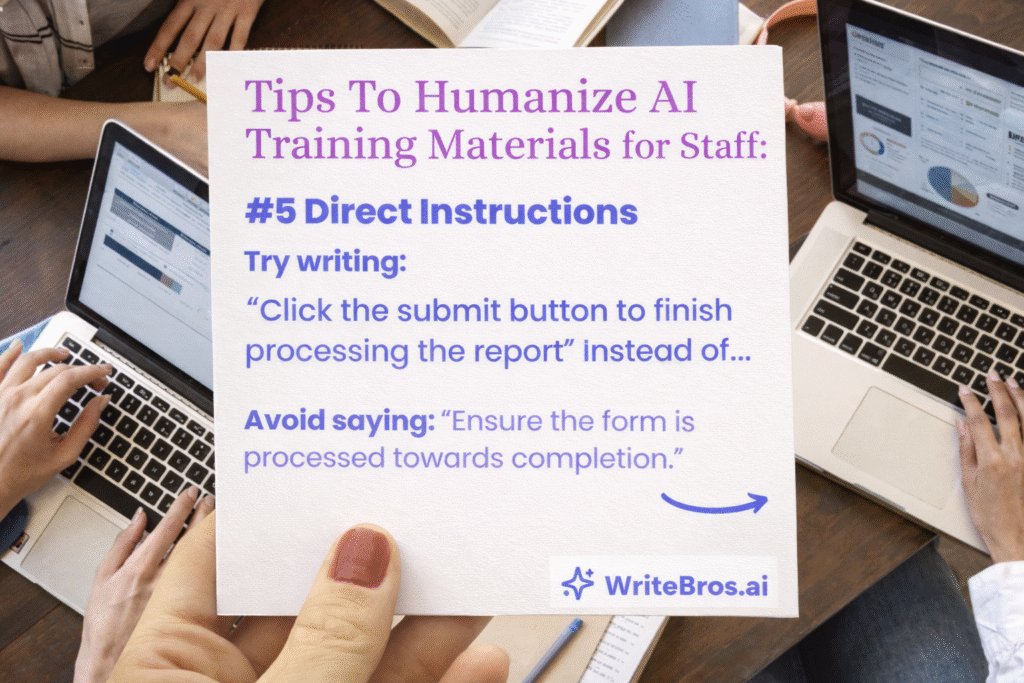
| 5 | Direct instructions | Replace vague wording with clear actions so staff know exactly what to do next. |
| 6 | Human-centered language | Use words that reflect real communication styles instead of overly formal or robotic phrasing. |
| 7 | Context before detail | Explain why something matters before diving into steps so staff stay engaged. |
| 8 | Active voice writing | Keep sentences direct and clear to avoid confusion and improve readability. |
| 9 | Consistent tone | Maintain the same voice throughout to prevent content from feeling stitched together. |
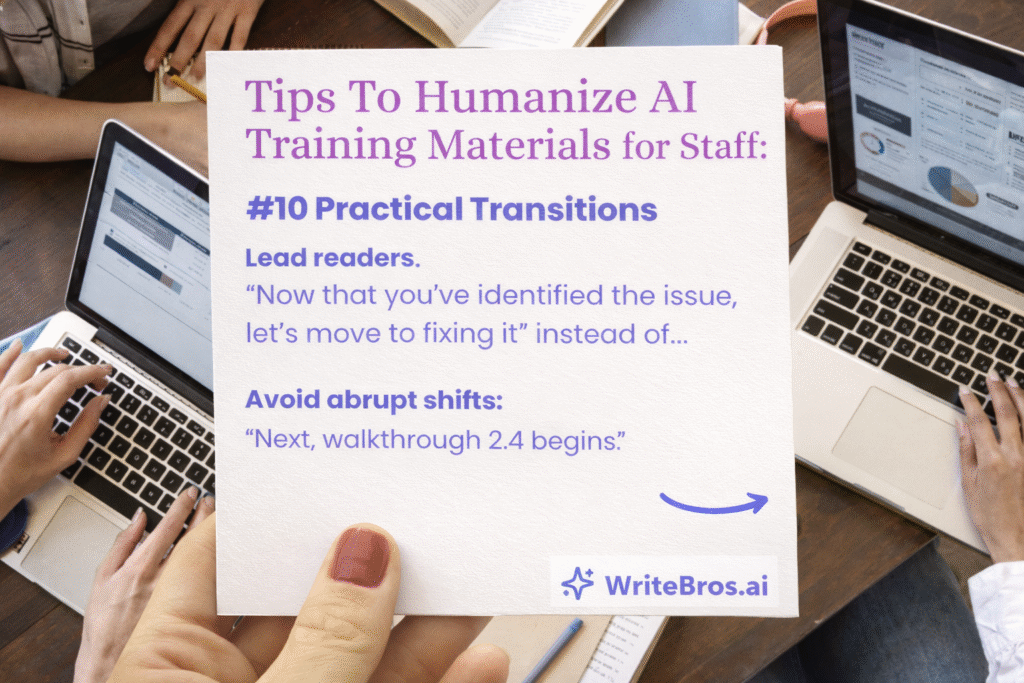
| 10 | Practical transitions | Guide readers between sections so the material flows naturally from one idea to the next. |
| 11 | Relatable phrasing | Adjust wording to match how staff actually speak and think during their workday. |
| 12 | Reduced repetition | Remove duplicate ideas so the material feels sharper and less mechanical. |
| 13 | Clarity over complexity | Simplify technical language without losing meaning so more staff can understand quickly. |
| 14 | Guided learning cues | Add prompts or cues that help staff know what to focus on while reading. |
| 15 | Review and refine | Continuously edit and test materials to keep them aligned with real staff needs. |
15 Engagement Improvements to Humanize AI Training Materials for Staff
How to Humanize AI Training Materials for Staff – Strategy #1: Conversational tone
Start by rewriting rigid or overly formal sentences into language that mirrors how people actually speak during team discussions, since staff tend to engage more when the material feels like guidance from a colleague rather than instructions from a system. This means softening phrasing, adding natural transitions, and allowing sentences to flow in a way that reflects real conversations. When you review AI-generated content, read it out loud and adjust anything that sounds unnatural, overly stiff, or disconnected from how your team communicates daily.
This works because people process familiar language faster, especially in training environments where attention is already divided between learning and applying new tasks. A support team, for example, is far more likely to follow guidance that sounds like their manager explaining a process than a generic instruction block. The main thing to watch is avoiding slang or overly casual phrasing that might reduce clarity or professionalism, especially in formal or compliance-related materials.
How to Humanize AI Training Materials for Staff – Strategy #2: Real workplace examples
Integrate short, realistic scenarios that reflect what staff actually experience in their roles, rather than relying on abstract explanations that feel disconnected from daily work. This could include common customer interactions, internal processes, or small decision-making moments that employees regularly face. When AI content lacks this layer, it often feels incomplete because it explains what something is without showing how it plays out in practice.
Examples work because they bridge the gap between theory and action, allowing staff to mentally rehearse how they would respond in similar situations. In a training module for onboarding, adding a simple scenario about handling a delayed request can make the process far easier to understand. The key is keeping examples grounded and specific without overcomplicating them, since overly detailed scenarios can distract from the main takeaway.
How to Humanize AI Training Materials for Staff – Strategy #3: Clear structure flow
Organize content in a sequence that reflects how someone would naturally learn the topic, moving from context to explanation and then into application. AI outputs often group information in ways that are technically correct but not intuitive, which can make the material feel harder to follow. Restructuring sections into a logical flow helps staff build understanding step by step without needing to backtrack or reinterpret earlier parts.
This improves comprehension because people rely on predictable patterns when processing new information, especially during structured training sessions. A well-ordered guide allows someone to move from understanding a concept into applying it without confusion. Be careful not to over-segment content into too many sections, as this can interrupt flow and make the material feel fragmented instead of cohesive.
How to Humanize AI Training Materials for Staff – Strategy #4: Shorter explanations
Break down dense or overly long explanations into smaller sections that are easier to read and process, while still maintaining full meaning and context. AI-generated text often compresses multiple ideas into a single paragraph, which can overwhelm readers who are trying to absorb information quickly. By dividing content into clearer segments, you give staff the space to understand each idea before moving forward.
This approach supports retention because shorter, focused sections are easier to revisit and remember during real tasks. In training documents used during onboarding, smaller chunks help new staff navigate content without feeling lost. The balance to maintain is ensuring that simplification does not remove necessary detail, since overly trimmed explanations can lead to misunderstandings later on.
How to Humanize AI Training Materials for Staff – Strategy #5: Direct instructions
Replace vague or passive wording with clear, action-oriented language that tells staff exactly what they need to do in a given situation. AI-generated content often uses indirect phrasing, which can leave room for interpretation and reduce confidence during execution. Clear instructions remove that ambiguity and help employees move forward without second-guessing their next step.
This is effective because people prefer clarity when performing tasks, especially when they are still learning a process. A simple instruction such as outlining the exact steps for completing a task is far easier to follow than a general description. The challenge is making sure the instructions remain supportive rather than overly rigid, so staff still feel guided rather than controlled.
How to Humanize AI Training Materials for Staff – Strategy #6: Human-centered language
Focus on wording that reflects real human communication patterns rather than overly technical or detached phrasing, since AI-generated text tends to default to neutral and impersonal tones. This includes using familiar sentence structures, adding small clarifications, and acknowledging the reader as an active participant in the learning process. When the language feels approachable, staff are more likely to stay engaged and follow through with the material.
This works because people respond better to content that feels designed for them rather than content that feels produced at scale without context. In internal training, even small wording changes can make a noticeable difference in how information is received. The important consideration is maintaining clarity and professionalism while still allowing the tone to feel natural and accessible.
How to Humanize AI Training Materials for Staff – Strategy #7: Context before detail
Introduce each section with a brief explanation of why the topic matters before moving into the specific steps or instructions, since this helps staff understand the purpose behind what they are learning. AI content often jumps directly into detail without setting context, which can make the material feel abrupt or disconnected. Providing context first creates a smoother entry point into more complex information.
This improves engagement because people are more motivated to learn when they understand how the information applies to their work. For example, explaining why a process improves efficiency can make the following steps feel more relevant. The key is keeping the context concise so it supports the content without slowing down the overall pace.
How to Humanize AI Training Materials for Staff – Strategy #8: Active voice writing
Rewrite sentences so that the subject clearly performs the action, which makes instructions easier to follow and reduces confusion. AI-generated text often uses passive constructions that can obscure responsibility or make steps feel less direct. Active voice helps create clarity and keeps the material focused on what needs to happen.
This is especially helpful in task-based training where clarity and speed are important for successful execution. Staff can quickly identify what action to take and who is responsible for it. The only caution is avoiding oversimplification, since some processes still require detailed explanation alongside direct language.
How to Humanize AI Training Materials for Staff – Strategy #9: Consistent tone
Ensure that the tone remains steady throughout the entire training material, rather than shifting between formal, casual, and technical styles. AI outputs can vary in tone across sections, which makes the content feel inconsistent and less trustworthy. Reviewing the material as a whole helps align voice and maintain a cohesive experience.
This consistency supports trust because readers feel like they are being guided through a single, unified narrative rather than pieced-together content. In longer training documents, tone consistency becomes even more important for maintaining engagement. The main challenge is identifying subtle tone shifts and smoothing them without losing clarity.
How to Humanize AI Training Materials for Staff – Strategy #10: Practical transitions
Add transitions that guide readers from one idea to the next, helping the material feel continuous rather than segmented. AI-generated content often presents sections as isolated blocks without clear connections between them. Thoughtful transitions create a sense of progression that mirrors how people naturally process information.
This approach improves flow because it reduces the mental effort required to connect ideas across sections. In structured training, transitions help maintain momentum and keep staff engaged from start to finish. The goal is to keep transitions simple and purposeful without making them overly repetitive or distracting.
How to Humanize AI Training Materials for Staff – Strategy #11: Relatable phrasing
Adjust wording so that it reflects how staff naturally think and communicate during their workday, rather than relying on generic or overly formal language. AI-generated text often misses subtle phrasing cues that make content feel familiar and easy to follow. Small changes in wording can make the material feel more relevant and grounded in real experiences.
This works because people connect more easily with language that mirrors their own thought processes. In a customer-facing role, using phrasing that reflects actual conversations can improve understanding and recall. The challenge is balancing relatability with clarity, ensuring the content remains precise and professional.
How to Humanize AI Training Materials for Staff – Strategy #12: Reduced repetition
Review the content to identify and remove repeated ideas or phrasing that make the material feel mechanical or overly long. AI-generated outputs often repeat key points in slightly different ways, which can dilute the impact of the message. Streamlining the content helps maintain focus and improves readability.
This enhances clarity because staff can concentrate on the main ideas without distraction from unnecessary repetition. In training materials, concise content is easier to navigate and apply in real situations. The important balance is ensuring that essential points are still reinforced without becoming redundant.
How to Humanize AI Training Materials for Staff – Strategy #13: Clarity over complexity
Simplify technical language where possible so that more staff can understand the material without additional explanation. AI-generated text can sometimes lean toward complexity, which may not match the audience’s level of familiarity with the topic. Clear language ensures that the content remains accessible and practical.
This is effective because people are more likely to engage with material they can understand immediately without needing to interpret complex terms. In onboarding scenarios, clarity is especially important for building confidence. The key is simplifying without removing important nuances or details that support accurate understanding.
How to Humanize AI Training Materials for Staff – Strategy #14: Guided learning cues
Include subtle prompts or cues that help staff focus on key ideas as they move through the material, such as highlighting important steps or drawing attention to common pitfalls. AI-generated content often presents information evenly, without signaling what matters most. Adding cues helps direct attention and improves learning outcomes.
This works because people benefit from guidance when processing new information, especially in structured environments. In training sessions, cues can help reinforce priorities and support better retention. The challenge is ensuring that cues enhance the content without overwhelming it or creating visual clutter.
How to Humanize AI Training Materials for Staff – Strategy #15: Review and refine
Continuously review and adjust training materials based on feedback and real-world use, since initial drafts rarely capture every nuance of how staff interact with the content. AI-generated material provides a starting point, but refinement ensures it stays relevant and effective over time. Regular updates keep the material aligned with evolving needs.
This ongoing process improves quality because it incorporates real experiences and insights from staff who use the material daily. In practice, feedback from training sessions can reveal gaps or areas for improvement that were not initially obvious. The key is maintaining a consistent review cycle without overcomplicating the process.
Common mistakes
- Relying entirely on AI-generated text without reviewing tone and clarity often leads to materials that feel disconnected from real workplace communication, which can reduce engagement and make staff less likely to trust or apply the information in practical situations.
- Overloading training materials with excessive detail can overwhelm staff and make it harder to identify key takeaways, especially when the content lacks clear structure or prioritization of important concepts.
- Using overly formal or technical language without considering the audience can create unnecessary barriers to understanding, making the material feel less accessible and harder to apply in everyday work scenarios.
- Failing to include real-world examples leaves the content feeling abstract and incomplete, which can make it difficult for staff to connect the information to their actual responsibilities.
- Allowing inconsistent tone across sections can make the material feel fragmented, reducing trust and making it harder for staff to stay engaged throughout the training.
- Neglecting regular updates and feedback loops can result in outdated or less effective materials, which may no longer reflect current processes or staff needs.
Edge cases
In some environments, such as highly regulated industries or compliance-driven training, there is less flexibility in how content can be adjusted, which means humanizing the material must be done carefully without altering required language or legal accuracy. In these cases, small changes in tone, structure, and examples can still improve engagement without compromising compliance.
There are also situations where staff have varying levels of experience, which makes it important to balance simplicity with depth so that the material remains useful for both new and experienced employees. Adapting content to different learning levels can help maintain clarity while still providing meaningful guidance.
Supporting tools
- Editing platforms that allow side-by-side comparison of original and revised content can help identify tone inconsistencies and areas where AI-generated text needs refinement, making the editing process more structured and efficient.
- Readability analysis tools can highlight complex sentences and suggest improvements, helping ensure that training materials remain accessible to a wide range of staff without sacrificing important details.
- Collaboration tools enable teams to review and comment on training materials together, which supports more accurate and relevant updates based on real-world feedback from staff.
- Content organization tools help structure training materials into logical sections, improving flow and making it easier for staff to navigate the information during learning sessions.
- Feedback collection tools allow organizations to gather insights from staff after training sessions, which can inform future revisions and improve overall effectiveness.
- WriteBros.ai helps refine AI-generated content into more natural, human-centered language, making it easier to align training materials with real communication styles while maintaining clarity and structure.
Ready to Transform Your AI Content?
Try WriteBros.ai and make your AI-generated content truly human.
Conclusion
Humanizing AI training materials for staff is ultimately about making information easier to understand, relate to, and apply in real situations, rather than simply presenting accurate content. Small adjustments in tone, structure, and examples can significantly improve how staff engage with and retain information during training.
Perfection is not the goal, since even small improvements can create noticeable differences in how training materials are received and used. With consistent review and thoughtful refinement, AI-generated content can become a reliable foundation for effective and engaging staff training.
Did You Know?
AI training content often feels polished because it follows clean structure and consistent wording. Even when it looks complete, it can still miss the real-world context staff need to understand how to apply the information.
Adjusting tone, adding simple examples, and improving flow can make a noticeable difference faster than expected. Small refinements help training materials feel more relevant, making them easier to follow and more useful during actual work situations.
Ready to Transform Your AI Content?