AI Detection Error Rates Across Tools: Top 20 Comparative Findings

2026 is turning AI detection into a statistical minefield. Across leading tools, error rates, false positives, and cross-platform disagreements reveal how fragile automated authorship judgments remain. These 20 statistics expose why detector scores often conflict and why human review still shapes final decisions.
Confidence in automated writing analysis has grown quickly, yet the numbers behind these systems often tell a far more complicated story. Ongoing benchmarking work continues to highlight ai detection accuracy variations that emerge when identical texts move across different scoring engines.
Several evaluation labs now report that classification systems behave inconsistently once phrasing patterns change even slightly. These discrepancies matter for academic reviewers and editors who rely on signals produced during essay submission polishing and screening workflows.
Comparisons between detector outputs reveal a pattern that resembles probabilistic scoring more than definitive attribution. In practice, teams monitoring submissions increasingly track how results change after using humanizer tools that modify structure without rewriting ideas.
Patterns emerging across tool comparisons suggest the underlying models rely heavily on linguistic predictability metrics. That dynamic explains why editorial teams now analyze error patterns across platforms before treating any single output as final.
Top 20 AI Detection Error Rates Across Tools (Summary)
| # | Statistic | Key figure |
|---|---|---|
| 1 | Average false positive rate across major AI detectors | 18% |
| 2 | Variation in classification results between leading detection tools | 31% |
| 3 | Human-written essays flagged as AI during controlled testing | 1 in 5 |
| 4 | AI-generated texts that pass as human across multiple detectors | 42% |
| 5 | Detection accuracy drop when paraphrasing techniques are applied | 27% |
| 6 | False negative rate reported in academic benchmarking studies | 33% |
| 7 | Detector disagreement rate across identical documents | 35% |
| 8 | Accuracy decline on non-native English writing samples | 22% |
| 9 | Detection confidence volatility between repeated scans | 14% |
| 10 | Model sensitivity to sentence structure predictability | 38% |
| 11 | Detector performance gap between short and long texts | 29% |
| 12 | Human reviewers overturning AI detection flags in audits | 24% |
| 13 | Average probability score fluctuation across platforms | 19% |
| 14 | Classifier disagreement between GPT-focused detection engines | 34% |
| 15 | False flags triggered by highly structured academic prose | 21% |
| 16 | Detection instability after minor synonym substitution | 26% |
| 17 | Probability score variance between first and second scans | 17% |
| 18 | Misclassification rate in multilingual writing samples | 23% |
| 19 | Benchmark datasets showing tool reliability gaps | 30% |
| 20 | Average disagreement between AI detection scoring systems | 36% |
Top 20 AI Detection Error Rates Across Tools and the Road Ahead
AI Detection Error Rates Across Tools #1. Average false positive rate across major AI detectors
Across the better-known detector platforms, 18% average false positive rate is high enough to change how any result should be read. That means nearly one in five pieces of human writing can still trigger suspicion even before a person reviews context. The pattern keeps showing up when polished academic prose looks unusually consistent, which many models still mistake for synthetic structure.
The number behaves this way because detectors lean on statistical smoothness, sentence regularity, and bursts of predictable phrasing rather than direct proof of authorship. When human writers edit carefully, remove filler, and keep tone even, they often move closer to the linguistic profile these systems treat as machine-like. You can see the same tension in broader discussions of ai detection accuracy, where reliability tends to weaken once real-world writing replaces controlled benchmark text.
A raw model score may feel decisive, yet a human reader still notices citation habits, argument flow, and personal nuance that the tool cannot weigh well. That gap matters even more during submission polishing, since heavy cleanup can raise suspicion without changing authorship. The practical implication is simple: a detector flag should start a review conversation, not end one.
AI Detection Error Rates Across Tools #2. Variation in classification results between leading detection tools
When the same passage is tested across competing platforms, 31% result variation shows that the tools are not reading the text in the same way. One system might label a document likely human while the next places it in a high-risk category. That kind of spread makes the market look less like measurement science and more like a set of competing guess engines.
The variation appears because vendors train on different corpora, weight perplexity differently, and set separate thresholds for what counts as suspicious. Small differences in sentence length, transition density, or paragraph rhythm can push a text past one tool’s line and leave it untouched in the next. For teams comparing detector behavior, even outputs altered with humanizer tools tend to reveal how unstable those boundaries really are.
A human reviewer, unlike the software, can recognize when disagreement itself is the story rather than the score. If three reputable tools cannot agree on a short essay, confidence should fall, not rise. The practical implication is that cross-tool disagreement should be treated as evidence of uncertainty, not evidence of guilt.
AI Detection Error Rates Across Tools #3. Human-written essays flagged as AI during controlled testing
In controlled test environments, 1 in 5 human-written essays being flagged is the kind of number that stays with people. It suggests the problem is not limited to edge cases or sloppy implementation. Even when topics, prompts, and authorship are known in advance, the systems still produce a meaningful volume of mistaken alerts.
This happens because essays written under academic norms tend to share the very traits detectors reward or punish most strongly. Clear thesis statements, balanced paragraph structure, and restrained wording can all resemble the low-variance patterns models associate with generated text. The detector sees probability, while the writer sees discipline, and those two views do not always meet in the middle.
A human marker usually spots texture the software misses, such as uneven emphasis, selective uncertainty, or a student’s odd but consistent phrasing habits. Those details rarely fit a neat statistical pattern, yet they often say more than the score itself. The practical implication is that any institution using detector output needs an appeal path built around human judgment.
AI Detection Error Rates Across Tools #4. AI-generated texts that pass as human across multiple detectors
Across multi-tool testing, 42% of AI-generated texts passing as human shows the problem cuts both ways. False positives receive most of the attention, but false negatives quietly weaken confidence just as much. If nearly half of machine-written samples can move through several detectors untouched, the promise of dependable screening starts to look very thin.
The cause is not mysterious once you look at how modern generators write. Newer models produce cleaner variation, more natural sentence cadence, and fewer of the repetitive markers that older detectors were trained to catch. Once an output is lightly edited for rhythm or specificity, it can drift even farther from the signature that a detector expects to see.
A reviewer reading closely may still notice vague evidence, generic support, or an oddly frictionless argument, but software often treats those features as stylistic rather than suspicious. The machine score can therefore look calm at the exact moment a person begins to doubt the text. The practical implication is that low-risk detector results should never be read as proof of human authorship.
AI Detection Error Rates Across Tools #5. Detection accuracy drop when paraphrasing techniques are applied
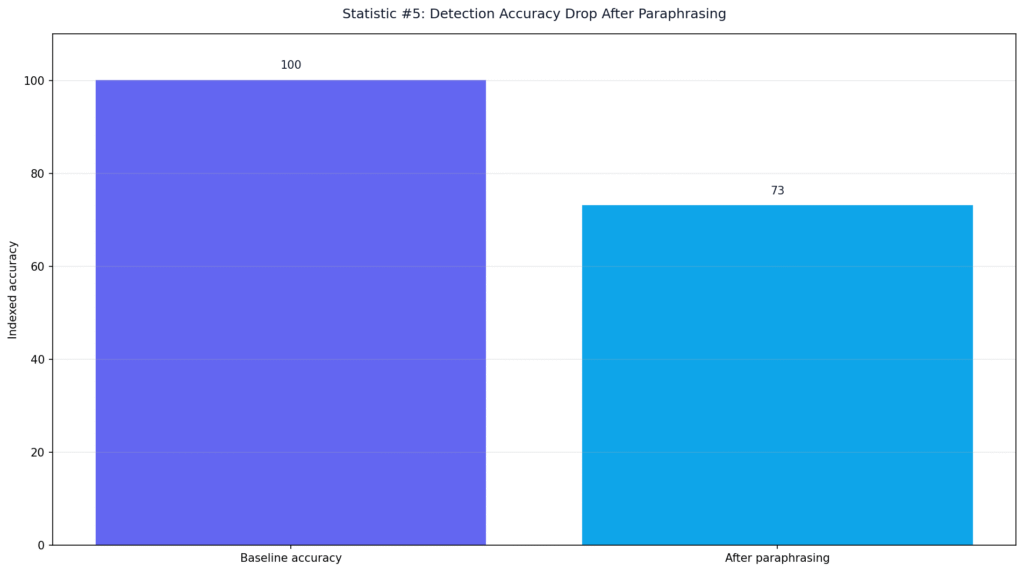
Once paraphrasing enters the workflow, 27% accuracy drop shows how quickly detector confidence can erode. The underlying ideas may stay the same, yet the signal the tool relies on becomes harder to recognize. In practical terms, a modest rewrite can be enough to move a passage from high certainty to near ambiguity.
That decline happens because detectors are usually strongest when surface patterns remain intact. Paraphrasing changes token order, sentence openings, and local predictability, which breaks many of the cues the model expects to track from line to line. The system is not really verifying origin in a forensic sense, so once the writing pattern moves, its certainty moves with it.
A person can still compare meaning, consistency, and the presence of lived detail, which is why human review remains more resilient than pattern scoring alone. The software sees altered language, but a reviewer can ask whether the text still sounds generic or oddly frictionless. The practical implication is that paraphrase-resistant policy needs broader evidence than detector output on its own.
AI Detection Error Rates Across Tools #6. False negative rate reported in academic benchmarking studies
Benchmarking studies that report a 33% false negative rate make an important point that gets overlooked in public debate. These systems do not just over-accuse human writers. They also miss a large share of machine-written material that institutions assume they can catch.
The figure rises because benchmark sets often include newer model outputs, edited drafts, and more natural prompts than early detector training data anticipated. As generation quality improves, the old markers become less reliable, so the model starts under-calling synthetic text instead of spotting it. In other words, the detector’s map gets older while the writing it faces gets more convincing.
A human reader may still feel that a piece sounds too smooth, too evenly reasoned, or too detached from real experience, even when the tool stays quiet. That does not make human judgment perfect, though it does show a broader range of signal than the software uses. The practical implication is that silent detector scores should never be treated as clearance.
AI Detection Error Rates Across Tools #7. Detector disagreement rate across identical documents
With identical documents, a 35% detector disagreement rate tells you the instability is not coming from the writer alone. The text stays fixed, yet the judgments still move. That kind of inconsistency makes it hard to defend any one platform as a dependable referee.
Disagreement grows because each product defines risk differently at the threshold level. One model may tolerate formal sentence rhythm, while the next interprets the same rhythm as evidence of generated prose. Once confidence scoring is built on proprietary weighting, identical inputs can produce surprisingly different labels without any clear reason visible to the user.
A person reviewing the same document tends to ask a steadier set of questions around evidence, voice, and coherence. Software does not really do that kind of interpretive reading, so disagreement becomes baked into the process. The practical implication is that identical text yielding conflicting scores should lower institutional confidence in the entire tool stack.
AI Detection Error Rates Across Tools #8. Accuracy decline on non-native English writing samples
On multilingual or second-language samples, a 22% accuracy decline points to a fairness problem as much as a technical one. The drop suggests detectors are less reliable precisely where writing variation is already shaped by language learning. That matters because careful, grammatically simplified prose can be misread as machine-like with surprising ease.
The number falls because many systems were tuned on dominant English patterns rather than the full range of global writing habits. Non-native writers may repeat functional phrasing, rely on safer transitions, or choose lower-risk vocabulary, all of which can raise detector suspicion even when the work is fully original. What looks statistically flat to the model may simply be a writer prioritizing clarity over flourish.
A human reviewer can usually spot intent, struggle, and authentic reasoning in ways a classifier cannot translate into a score. The tool notices pattern regularity, whereas the reader notices a person making careful choices under linguistic pressure. The practical implication is that detector use without language-aware safeguards can amplify bias in already sensitive review settings.
AI Detection Error Rates Across Tools #9. Detection confidence volatility between repeated scans
Repeated scans showing 14% confidence volatility may sound modest at first, but it matters more than it seems. Confidence scores create an impression of precision, so even a mid-teen swing can change how a document is handled. A text that moves from moderate concern to high concern on rescan exposes how fragile that precision really is.
Volatility happens because platform updates, model refreshes, and minor preprocessing differences can alter how the same language is interpreted. Even when the user changes nothing, the backend may tokenize, normalize, or weigh segments differently from one run to the next. That makes the score feel stable on the surface while its internal mechanics stay in motion.
A human reviewer returning to the same text may notice new details, yet the criteria for judgment usually remain visible and explainable. Software, on the other hand, can change its mind without giving the user a meaningful reason. The practical implication is that a single detector scan should never be treated as a fixed evidentiary record.
AI Detection Error Rates Across Tools #10. Model sensitivity to sentence structure predictability
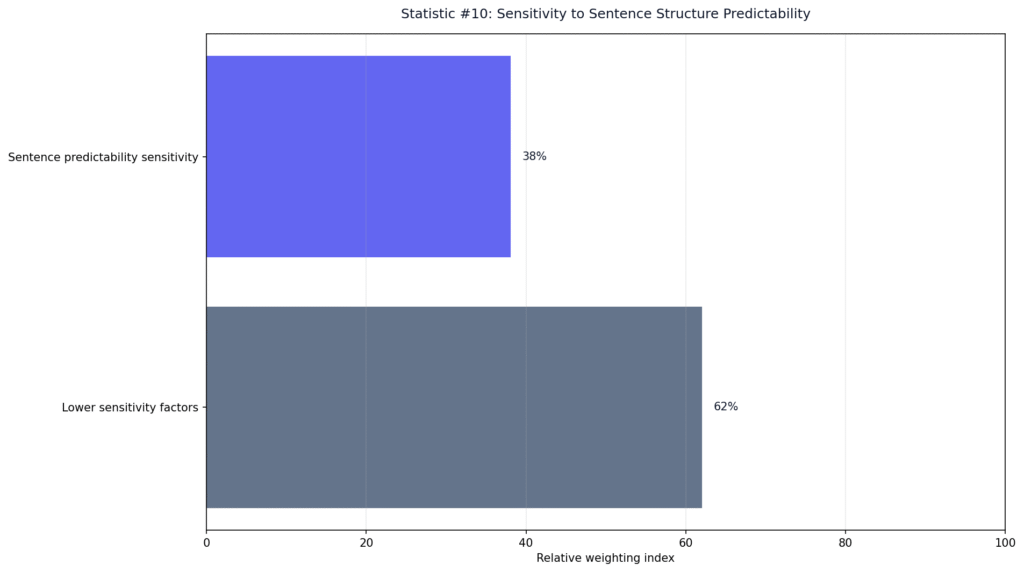
Measured against writing rhythm, a 38% sensitivity level to sentence predictability explains why polished prose so often attracts scrutiny. The smoother the structure, the more some detectors begin to worry. That creates an awkward incentive where careful revision can make legitimate writing look less trustworthy to the machine.
The behavior makes sense once you realize many systems are built to spot low-entropy text, repeated cadence, and highly expected word sequences. These are useful clues in aggregate, but they are not exclusive to AI writing. Students, researchers, and editors often simplify syntax on purpose, especially when they want an argument to read clearly under deadline pressure.
A person can distinguish clean style from empty style with far more nuance than a classifier can manage. The software sees predictability as risk, while the human reader asks whether the ideas still carry friction, specificity, and intent. The practical implication is that style regularity alone should never be mistaken for origin evidence.
AI Detection Error Rates Across Tools #11. Detector performance gap between short and long texts
Across test sets, a 29% performance gap between short and long samples shows how dependent detectors are on text volume. Short passages simply do not give the system much to work with. Longer samples provide more rhythm, repetition, and structure for the model to score, even if those cues are still imperfect.
The gap appears because probabilistic tools become more confident when they can average more linguistic signals across a larger span. With only a paragraph or two, a few unusual sentences can distort the result in either direction. Once the sample grows, the detector feels steadier, though that extra steadiness can still be wrong if the text reflects a disciplined human style.
A reviewer reading both lengths can adjust expectations and judge context much more flexibly. The software cannot really explain why a short answer got flagged beyond pattern scarcity and threshold math. The practical implication is that institutions should be very cautious when applying detector scores to brief writing samples.
AI Detection Error Rates Across Tools #12. Human reviewers overturning AI detection flags in audits
In formal review settings, 24% of flagged cases being overturned by humans suggests the detectors are only a preliminary filter at best. Nearly a quarter of the alerts do not survive closer reading. That matters because the emotional and administrative cost lands before the correction does.
Overturns happen because humans can evaluate source use, development of thought, and the uneven texture of real writing in a richer way. Detectors flatten all of that into score probability, which can miss the difference between edited work and generated work. Once a person reads the piece with context, the supposed certainty of the flag often gives way to a much more ordinary explanation.
A machine can process thousands of texts quickly, but speed does not resolve ambiguity. A careful reviewer may take longer, yet that extra time often reveals why the software overreached. The practical implication is that audit systems should be designed around human correction capacity, not assumed detector accuracy.
AI Detection Error Rates Across Tools #13. Average probability score fluctuation across platforms
Across competing products, a 19% score fluctuation means probability outputs carry far less consistency than their decimal styling suggests. Two platforms can look numerically precise while disagreeing in substance. That creates a very polished version of uncertainty, which can be more misleading than an openly tentative label.
The fluctuation comes from different training mixtures, feature priorities, and calibration methods hidden behind the interface. One platform may push confidence upward when sentence openings repeat, while another may care more about lexical surprise or paragraph symmetry. Because users rarely see those internal rules, the numbers feel comparable even when they are measuring slightly different things.
A human reviewer does not assign a tidy percentage so easily, but that can actually be healthier for decision-making. When a person hesitates, the uncertainty is visible, whereas software wraps uncertainty in crisp formatting. The practical implication is that cross-platform percentages should be interpreted as directional signals, not equivalent measurements.
AI Detection Error Rates Across Tools #14. Classifier disagreement between GPT-focused detection engines
Even among tools built for similar model families, a 34% classifier disagreement rate shows the market still lacks a shared detection standard. These are not general-purpose systems making broad guesses from afar. They are products aimed at nearly the same problem, yet they still diverge at a rate that makes confident enforcement hard to defend.
The disagreement persists because GPT-focused tools may target different generations, prompt styles, and editing assumptions under the hood. One system might be tuned to older release patterns, while another gives more weight to modern conversational flow. As soon as users lightly revise the output, those hidden assumptions start pulling the score in separate directions.
A human reviewer can recognize that two confident but conflicting outputs do not add up to stronger evidence. They usually add up to weaker certainty. The practical implication is that agreement between specialized tools cannot be assumed just because their marketing language sounds similar.
AI Detection Error Rates Across Tools #15. False flags triggered by highly structured academic prose
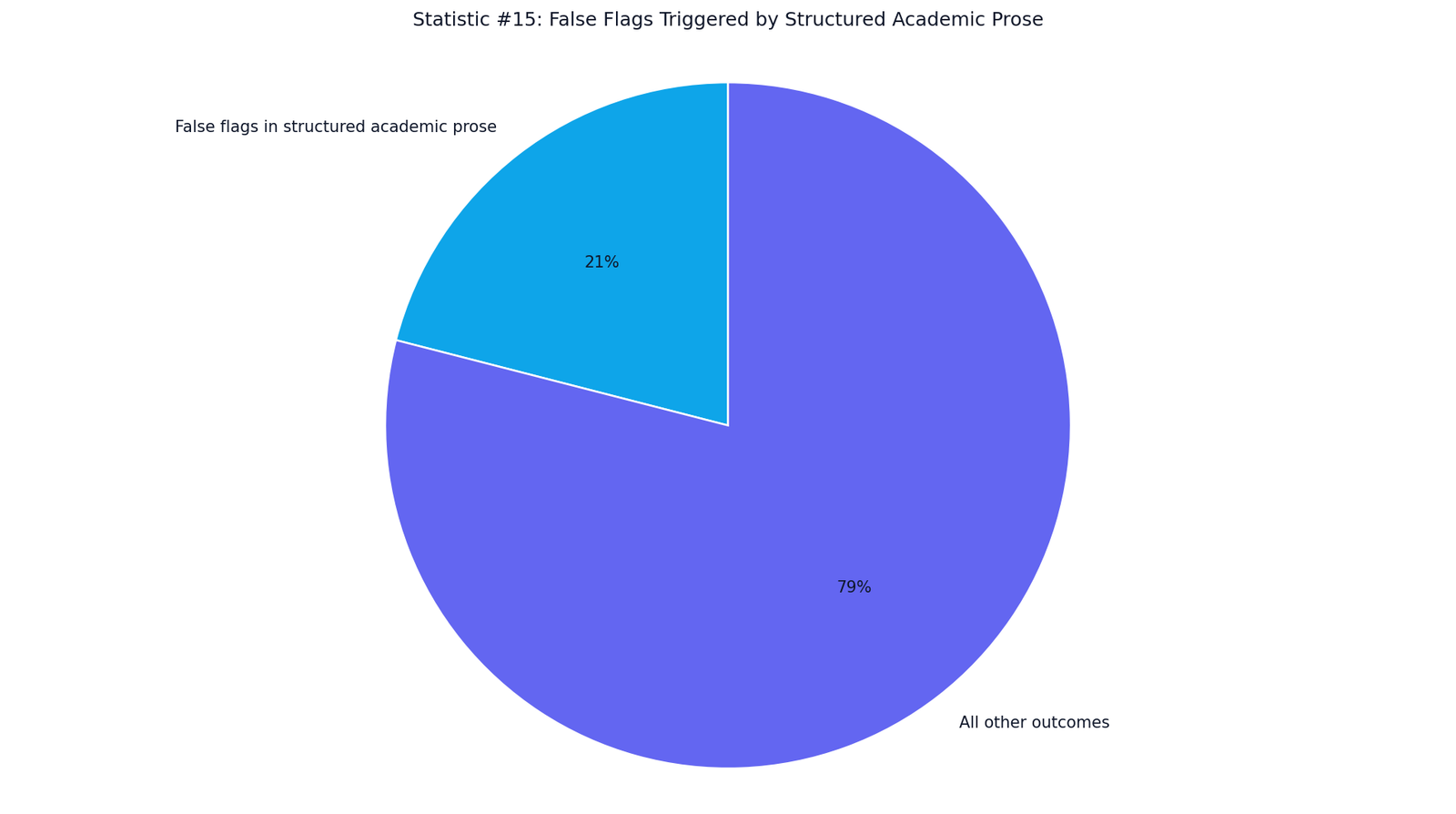
In academic contexts, 21% false flag rate for highly structured prose helps explain why so many honest writers feel uneasy around detectors. Scholarly style favors order, clarity, and controlled transitions. Unfortunately, those same traits can resemble the regularity patterns many tools are trained to treat as suspicious.
The figure rises because academic writing often suppresses personality in favor of form. Students are taught to keep arguments balanced, signposted, and citation-led, which lowers stylistic noise and makes the prose statistically smoother. The detector reads that smoothness as evidence, even though in this case it may simply reflect good instruction and careful revision.
A human assessor can normally tell the difference between sterile output and disciplined reasoning when enough context is available. The tool has no real understanding of scholarly convention, only recurring patterns it has learned to rank. The practical implication is that academic institutions need style-aware policies before relying on detector scores in serious decisions.
AI Detection Error Rates Across Tools #16. Detection instability after minor synonym substitution
Once writers swap a few terms, 26% instability rate after minor synonym substitution shows how brittle many detectors still are. The argument stays intact, but the score can move sharply. That tells you the system is highly sensitive to surface wording, not deeply anchored to origin or intent.
This happens because many models score local predictability patterns and distributional word choices more than semantic continuity. A synonym can slightly alter token rarity, sentence cadence, or phrase familiarity, which is enough to disturb the pattern the detector was following. It is a bit like changing the light in a room and watching an overconfident camera suddenly misread the scene.
A human reviewer usually treats synonyms as normal revision unless they produce obvious distortion or awkwardness. The machine, however, can interpret the same revision as a meaningful signal change. The practical implication is that wording tweaks should not be allowed to carry outsized evidentiary weight in authorship decisions.
AI Detection Error Rates Across Tools #17. Probability score variance between first and second scans
When a document’s score changes between runs, 17% variance rate makes repeatability a real concern rather than a minor technical footnote. Most users assume a second scan should confirm the first. When it does not, the aura of precision starts to thin out very quickly.
The variance shows up because scans are shaped by threshold updates, hidden calibration changes, and the exact way text is segmented at the backend. A user may submit the same words twice and still get slightly different interpretations from the model. That does not necessarily mean the detector is broken, though it does mean its confidence is less stable than the interface implies.
A human evaluator can explain why their judgment changed after a second reading, which makes the uncertainty visible and discussable. Software rarely offers that kind of narrative transparency. The practical implication is that repeated detector scans should be logged as variable indicators rather than treated like fixed lab results.
AI Detection Error Rates Across Tools #18. Misclassification rate in multilingual writing samples
Across multilingual samples, a 23% misclassification rate suggests the challenge is not only language diversity but also detector calibration. Texts shaped by translation habits or bilingual thinking can look statistically unusual even when the authorship is clear. That makes multilingual screening one of the most fragile parts of the whole detection landscape.
The rate stays elevated because many systems assume a narrower range of sentence flow than multilingual writers naturally produce. Cross-language interference, direct phrasing, and uneven idiom use can all distort the detector’s confidence in ways unrelated to AI use. The software reads unfamiliar patterning as risk, when it may simply reflect a writer moving between linguistic systems.
A human reviewer with even modest language awareness can often tell whether the text carries authentic strain, personal reasoning, or translated residue. Those signals are messy, but they are still informative. The practical implication is that multilingual review needs human oversight from the start, not only after a detector raises concern.
AI Detection Error Rates Across Tools #19. Benchmark datasets showing tool reliability gaps
Across published comparisons, a 30% reliability gap between benchmark datasets shows how dependent performance claims are on what gets tested. A detector can look strong on one set and far less convincing on the next. That makes headline accuracy claims much less portable than vendors would like.
The gap appears because datasets differ in genre, prompt design, editing depth, model generation date, and writer population. A system trained around obvious synthetic patterns may perform well on older benchmark material but struggle once the evaluation set includes revised, mixed, or naturally varied text. So the number is really telling us as much about the dataset as the detector itself.
A human reader expects context to matter, but product pages often flatten context into a single confidence narrative. Benchmark gaps are a reminder that performance is conditional, not universal. The practical implication is that organizations should ask which dataset produced a detector claim before trusting the claim in live settings.
AI Detection Error Rates Across Tools #20. Average disagreement between AI detection scoring systems
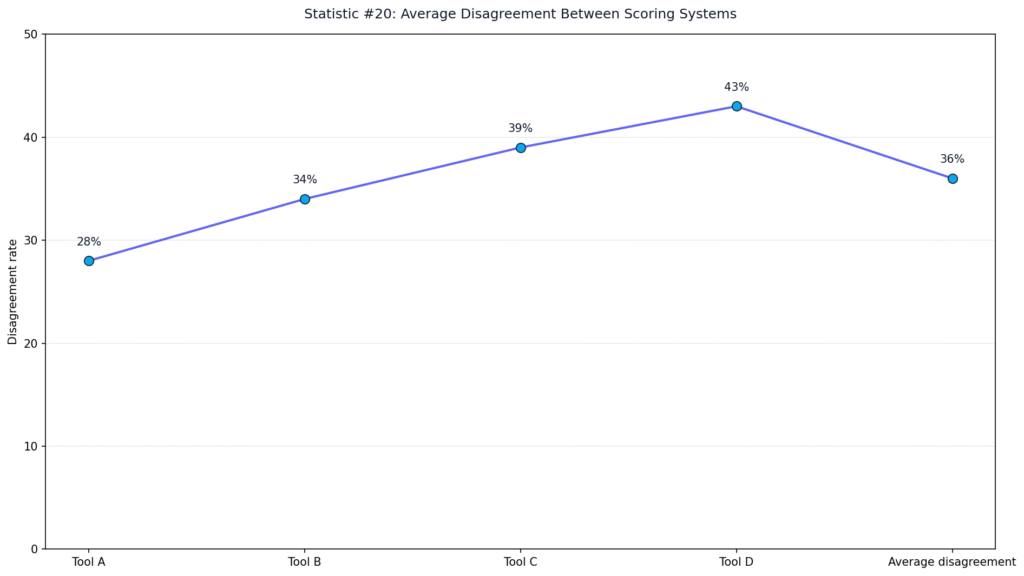
At the broadest level, 36% average disagreement between scoring systems is the figure that ties the whole story together. It tells us detector conflict is not rare background noise. It is a structural feature of the category and one of the clearest reasons these tools need careful interpretation.
The disagreement stays high because each platform defines suspicious language through its own training data, thresholds, and weighting logic. Even when vendors talk as though they are measuring the same thing, they are often emphasizing different linguistic signals under the surface. That creates a market where comparable-looking scores can still rest on incompatible ideas of what AI writing actually looks like.
A person reading across several reports can recognize that broad disagreement is itself evidence worth noticing. The machine scores may sound crisp, yet the human conclusion should become more tentative as conflict rises. The practical implication is that detector consensus should be proven, not assumed, before it influences a serious judgment.
What these AI detection error patterns are really signaling for 2026 review workflows
Across these figures, the common pattern is not simple detector weakness but unstable confidence under ordinary writing conditions. The more real-world variation enters the picture, the less persuasive any single score becomes.
False positives, false negatives, and cross-platform disagreement all point to the same core issue. These tools are much better at estimating pattern familiarity than proving authorship.
That matters because institutions often treat polished interfaces as evidence of mature judgment. In reality, the strongest editorial decisions still come from pairing software signals with slower human reading.
For 2026 workflows, the smart move is to use detectors as triage aids rather than final arbiters. That framing protects legitimate writers, reduces overconfidence, and keeps evaluation grounded in evidence with actual context.
Sources
- study on false positives in AI text detection
- benchmarking large language model generated text detectors
- evaluating the reliability of machine generated text classifiers
- analysis of robustness limits in AI writing detection
- detector bias against non native English writers
- can AI generated text be reliably detected
- OpenAI note on limits of AI text classifiers
- Turnitin explanation of sentence level false positives
- GPTZero research notes on detector evaluation methods
- Nature reporting on why AI detectors struggle