How to Polish AI Essays for Submission: 15 Final Checks

Final edits can transform AI-assisted drafts into clear academic writing. Research supports this: a peer-reviewed study on writing quality shows linguistic revision and structural clarity strongly influence how readers judge essay quality.
How to Polish AI Essays for Submission: 15 Final Checks
Finishing an AI-assisted draft does not mean it is ready to turn in. Many students panic after a Turnitin flag or a last-minute review that exposes awkward phrasing.
The issue usually appears during the final polish stage when structure, tone, and clarity still feel mechanical. That is why many writers experiment with AI humanizer tools to soften rigid language and smooth transitions.
Even then, detectors and grading systems sometimes react unpredictably due to documented misclassification data. The checks below focus on practical edits that make an essay read naturally and confidently before submission.
| # | Strategy focus | Practical takeaway |
|---|---|---|
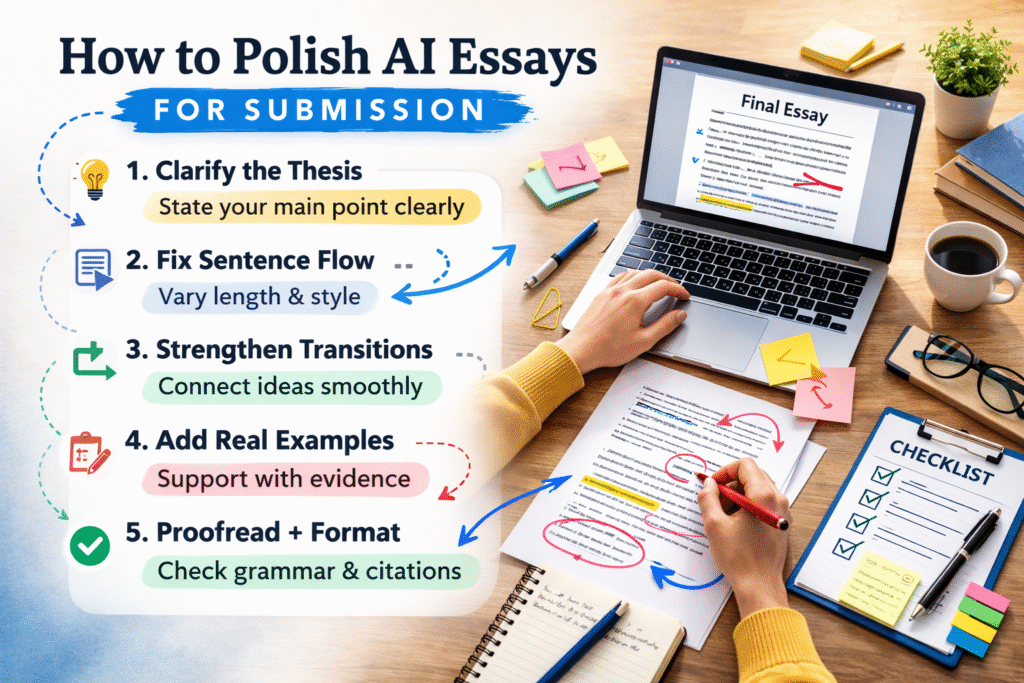
| 1 | Opening paragraph clarity | Make sure the introduction states the core idea plainly so readers immediately understand the essay’s direction. |
| 2 | Natural sentence rhythm | Read sections aloud to identify stiff wording or repetitive sentence structures that sound machine-generated. |
| 3 | Transition consistency | Check that paragraphs connect logically so the argument flows smoothly instead of jumping between ideas. |
| 4 | Paragraph balance | Ensure paragraphs are similar in length and each develops a single clear point. |
| 5 | Specific examples | Replace vague explanations with concrete illustrations that demonstrate the concept clearly. |
| 6 | Vocabulary realism | Swap overly formal words with simpler phrasing that matches normal student writing. |
| 7 | Personal tone adjustment | Add subtle voice cues such as reflective phrases or natural emphasis to avoid a robotic tone. |
| 8 | Repetition cleanup | Scan for repeated phrases or ideas and rewrite them so the essay sounds varied and thoughtful. |
| 9 | Citation alignment | Confirm that sources are formatted correctly and clearly connected to the argument. |
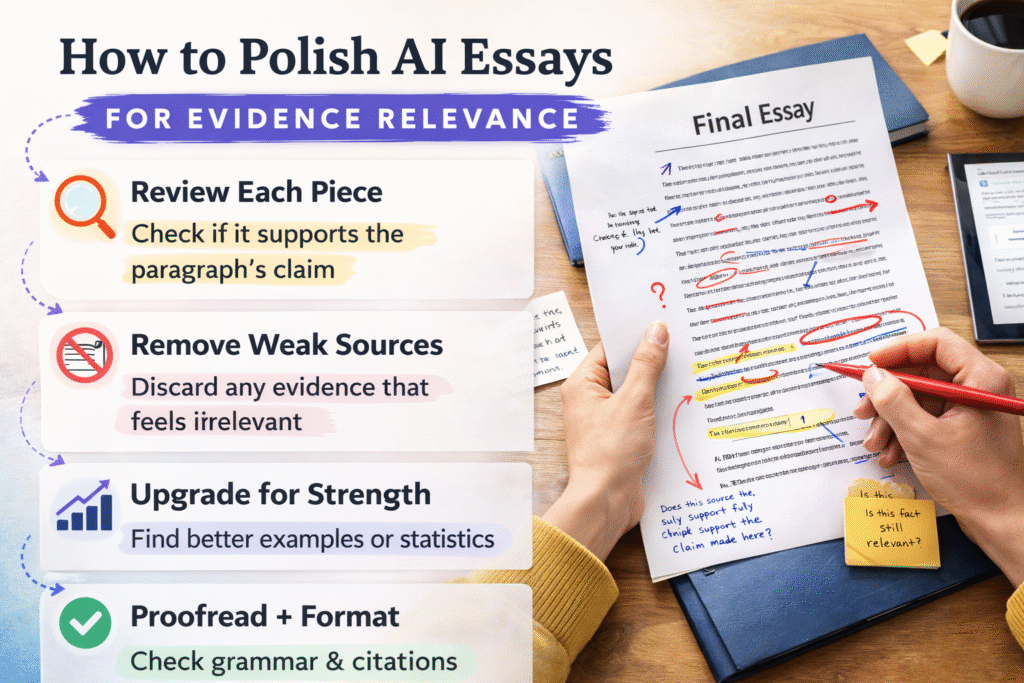
| 10 | Evidence relevance | Verify that every example or statistic directly supports the claim it appears beside. |
| 11 | Conclusion clarity | Rewrite the closing paragraph so it summarizes the argument without repeating earlier sentences. |
| 12 | Grammar precision | Run a final grammar pass to catch punctuation errors or awkward phrasing. |
| 13 | Formatting accuracy | Check headings, spacing, and citation style so the essay matches the required academic format. |
| 14 | Readability test | Review the entire essay quickly to confirm that ideas progress clearly from start to finish. |
| 15 | Final submission review | Take a short break before the last read-through to spot details that are easy to miss when editing continuously. |
15 Practical Checks to Polish AI Essays for Submission
How to Polish AI Essays for Submission – Strategy #1: Clarify the introduction
The opening paragraph determines how confidently the reader enters the essay, which is why polishing this section is one of the most important steps before submission. Many AI-generated introductions sound technically correct yet still feel distant because they summarize the topic instead of guiding the reader into the argument with a clear sense of direction and purpose. A careful rewrite that emphasizes the essay’s central claim and frames the discussion naturally helps transform a mechanical opening into a clear academic introduction that signals control over the topic.
Students frequently notice that their introduction reads like a summary of research rather than a position statement, which happens when early drafts are generated quickly and left mostly untouched during revisions. Expanding the introduction with a brief explanation of the argument, the scope of the essay, and the context surrounding the topic gives the paragraph a more human rhythm and makes the structure feel intentional rather than automated. When the opening clearly explains what the essay will show and why the topic matters, the rest of the paper becomes easier for instructors to follow and evaluate.
How to Polish AI Essays for Submission – Strategy #2: Improve sentence rhythm
AI-assisted drafts frequently contain sentences that are grammatically correct yet strangely uniform, which gives the text a predictable rhythm that attentive readers notice quickly. Polishing the essay requires adjusting sentence structure so the writing flows more naturally through varied lengths, different phrasing patterns, and subtle changes in pacing across paragraphs. Reading the section slowly while paying attention to how each sentence leads into the next makes it easier to identify patterns that sound repetitive or overly structured.
A helpful technique is to combine or expand sentences that feel too abrupt, because longer explanations often create a smoother transition between ideas while making the argument more detailed. Writers sometimes discover that a sentence only sounds mechanical because it lacks a clarifying phrase that explains why a point matters or how it connects to the larger discussion. Once the rhythm of the paragraph begins to feel conversational and balanced rather than robotic, the entire essay starts to read more like thoughtful academic work instead of generated text.
How to Polish AI Essays for Submission – Strategy #3: Strengthen transitions
Transitions quietly control the movement of an essay, yet they are frequently overlooked when polishing AI-assisted drafts because the paragraphs appear logically ordered at first glance. The real issue becomes visible when readers move between sections and notice that ideas jump from one point to another without enough explanation connecting them. Revising transitions means adding context that reminds the reader how the previous argument leads naturally into the next section of discussion.
This process often includes rewriting the opening sentence of a paragraph so it briefly references the idea introduced earlier before presenting a new perspective or supporting point. Writers who take the time to create these small bridges between ideas produce essays that feel intentionally structured rather than loosely assembled from generated paragraphs. When transitions are smooth and purposeful, instructors can follow the argument more easily and spend less effort interpreting how each section contributes to the overall analysis.
How to Polish AI Essays for Submission – Strategy #4: Balance paragraph structure
Paragraph balance affects readability more than most writers realize, particularly in essays that began as AI-generated outlines with uneven blocks of explanation. Some paragraphs may contain only a brief claim while others stretch across several dense ideas, which disrupts the visual and logical rhythm of the essay. Polishing the structure requires dividing long paragraphs into focused sections and expanding shorter ones so each part contributes a clear point to the overall argument.
Writers often find that the most effective paragraphs contain a clear topic sentence followed by explanation and evidence that reinforces the claim introduced at the beginning. When the internal structure follows this pattern, readers can absorb the information more easily because each paragraph communicates a single idea rather than several partially developed thoughts. Balanced paragraphs also make the essay appear more carefully organized, which reinforces the impression that the work was thoughtfully developed rather than generated quickly.
How to Polish AI Essays for Submission – Strategy #5: Add specific examples
AI-generated writing frequently explains concepts in general terms, which creates paragraphs that sound polished yet remain vague when examined closely. One of the most effective polishing techniques is adding specific examples that illustrate how a concept appears in real academic or social contexts. These details transform abstract explanations into concrete observations that make the essay more engaging and easier for readers to understand.
When writers introduce examples such as research findings, classroom scenarios, or real-world applications of a theory, the argument becomes more persuasive because the reader can visualize the idea in practice. The example does not need to be dramatic or complex, yet it should clearly demonstrate how the concept operates outside the essay’s explanation. Including these moments of detail helps the writing sound more thoughtful and analytical, which naturally reduces the mechanical tone associated with early AI drafts.
How to Polish AI Essays for Submission – Strategy #6: Simplify vocabulary
Many AI-generated essays rely on overly formal vocabulary that sounds impressive at first glance but quickly becomes distracting because the language feels inflated. Polishing the essay requires replacing complicated words with simpler expressions that still communicate the idea clearly while matching the tone expected in student writing. This adjustment does not weaken the argument; instead it improves readability and allows the reader to focus on the substance of the discussion.
Writers often notice that certain phrases appear unnecessarily elaborate once they reread the text carefully, especially when multiple academic terms appear in a single sentence. Rewriting those sentences using direct language makes the explanation easier to follow and prevents the essay from sounding artificially sophisticated. A more natural vocabulary helps the writing resemble genuine student analysis rather than a polished but distant generated draft.
How to Polish AI Essays for Submission – Strategy #7: Adjust the personal tone
An essay does not need to include personal stories to feel human, yet subtle tone adjustments can make the writing sound more thoughtful and reflective. AI-assisted drafts sometimes present information in a neutral style that resembles encyclopedia entries rather than academic arguments written by a student exploring a topic. Polishing the tone means adding slight interpretive language that shows the writer evaluating ideas rather than simply listing them.
This can include phrases that clarify the reasoning behind a claim or that explain why a particular perspective is important within the discussion. When the essay shows moments of interpretation and reflection, the reader begins to hear the presence of a writer guiding the analysis. These tonal cues make the essay feel more deliberate and thoughtful, which strengthens the credibility of the argument.
How to Polish AI Essays for Submission – Strategy #8: Remove repeated phrasing
Repetition appears frequently in AI-generated drafts because language models tend to rely on similar phrasing patterns when expanding explanations. During the polishing stage, it becomes important to scan the essay for repeated words or sentence structures that appear multiple times across paragraphs. Revising those sections with varied wording creates a more dynamic reading experience and prevents the essay from sounding predictable.
Writers often discover that repeated phrasing occurs around key terms introduced early in the essay, especially when those ideas are referenced in later sections. Replacing a few of those repetitions with related expressions or clarifying descriptions helps maintain variety while still preserving the central theme of the argument. Once the repetition disappears, the essay feels more fluid and less formulaic.
How to Polish AI Essays for Submission – Strategy #9: Align citations carefully
Citations play an important role in establishing credibility, yet AI-assisted drafts sometimes place references in locations that feel slightly disconnected from the surrounding explanation. Polishing the essay requires reviewing each citation to confirm that the source directly supports the statement it follows. This step ensures that the research appears intentionally integrated rather than automatically inserted during drafting.
Writers can strengthen the connection between evidence and argument by briefly explaining how the cited source contributes to the discussion instead of allowing the reference to stand alone. These small clarifications help the reader understand why the research matters and how it reinforces the essay’s claim. When citations appear purposeful and clearly connected to the analysis, the essay feels more carefully constructed.
How to Polish AI Essays for Submission – Strategy #10: Confirm evidence relevance
Evidence sometimes remains in an essay even after the argument evolves during revisions, which creates sections that feel slightly misaligned with the final thesis. Polishing the essay means reviewing each statistic, quotation, or example to confirm that it directly strengthens the point being made in that paragraph. Removing or replacing evidence that no longer supports the claim keeps the discussion focused and coherent.
Writers frequently notice that a source initially included for background information becomes unnecessary once the argument develops further. Replacing that material with more precise evidence allows the paragraph to contribute more effectively to the overall discussion. When every piece of evidence clearly reinforces the argument, the essay reads with stronger logical consistency.
How to Polish AI Essays for Submission – Strategy #11: Refine the conclusion
The conclusion is often written quickly at the end of the drafting process, which means it sometimes repeats earlier sentences rather than offering a thoughtful closing perspective. Polishing the final paragraph involves rewriting it so the main argument is summarized in a way that feels reflective and deliberate. A well-crafted conclusion reminds the reader why the topic matters and what insight the essay ultimately contributes.
Writers can strengthen the ending by briefly revisiting the central argument and explaining what the discussion reveals about the broader subject. This approach helps the essay conclude with a sense of resolution rather than an abrupt summary of previous points. When the conclusion feels intentional and reflective, the essay leaves a stronger final impression on the reader.
How to Polish AI Essays for Submission – Strategy #12: Perform a grammar review
Grammar errors sometimes remain hidden within AI-assisted drafts because the sentences appear structurally correct at first glance. A careful review helps identify small issues such as misplaced commas, awkward phrasing, or inconsistent verb tense that could distract readers during evaluation. Polishing the grammar ensures that the essay communicates ideas clearly without unnecessary interruptions caused by technical mistakes.
Many writers find that reading the essay slowly from beginning to end makes these small errors easier to detect. During this process it becomes possible to refine sentence structure and clarify wording while correcting punctuation issues. A thorough grammar review strengthens the professionalism of the essay and demonstrates attention to detail.
How to Polish AI Essays for Submission – Strategy #13: Check formatting accuracy
Formatting mistakes can undermine otherwise strong essays because they signal that the final review stage was rushed. Polishing the document requires confirming that spacing, headings, and citation styles follow the guidelines provided for the assignment. These visual details contribute to the overall readability of the essay and help instructors navigate the argument easily.
Writers should review the document layout carefully to ensure that paragraphs are aligned consistently and references appear in the correct format. Even small adjustments such as proper indentation or consistent spacing between sections can make the essay appear more polished. When formatting aligns with academic expectations, the paper looks prepared for submission.
How to Polish AI Essays for Submission – Strategy #14: Test overall readability
After completing detailed revisions, the next step is reviewing the essay from a reader’s perspective rather than an editor’s perspective. This stage focuses on the overall flow of ideas to confirm that the argument progresses naturally from the introduction to the conclusion. Writers often notice new opportunities for improvement when they read the essay continuously rather than examining individual sentences.
This review helps identify sections that feel confusing, overly dense, or disconnected from the main discussion. Adjusting those sections improves clarity and ensures the essay communicates its ideas effectively from start to finish. A smooth reading experience indicates that the earlier polishing steps successfully strengthened the structure.
How to Polish AI Essays for Submission – Strategy #15: Conduct a final review
The last step before submission is stepping away from the essay briefly and returning to it with fresh attention. This short pause allows writers to notice details that may have been overlooked during extended editing sessions. A final review helps confirm that the argument is clear, the structure flows naturally, and the writing feels complete.
When the essay is read again after a break, small improvements often become obvious, such as clarifying a sentence or adjusting the wording of a paragraph transition. These final adjustments ensure the essay communicates its ideas confidently and coherently. Completing this last review provides reassurance that the essay is ready for submission.
Common mistakes
- Many students assume that once an AI-generated draft appears grammatically correct it no longer requires deep revision, which leads to essays that technically read well but still contain awkward phrasing and predictable patterns that instructors recognize quickly during grading.
- Another common mistake occurs when writers only correct grammar and spelling while leaving structural issues unresolved, which causes paragraphs to remain loosely connected and prevents the argument from developing with a clear logical progression.
- Some essays include research sources that were inserted during early drafting but never fully integrated into the discussion, which results in citations that appear disconnected from the surrounding explanation and weaken the credibility of the argument.
- Writers sometimes overlook repetition because individual sentences appear acceptable on their own, yet repeated wording across paragraphs gradually creates a mechanical tone that makes the essay feel formulaic and less engaging.
- Another frequent issue appears when students focus heavily on rewriting sentences while ignoring the overall structure of the essay, which allows transitions and paragraph organization to remain inconsistent throughout the paper.
- Many submissions are rushed at the final stage without a complete read-through, which increases the likelihood that small formatting or clarity issues remain visible to instructors reviewing the assignment.
Edge cases
Some essays require a slightly different polishing process because they depend heavily on technical terminology or specialized research language. In those cases, simplifying vocabulary too aggressively may weaken the precision of the discussion. Writers should focus on improving clarity without removing terms that are necessary for explaining the subject accurately.
There are also assignments that require a strict structural format, such as lab reports or analytical reviews with predetermined headings. When polishing these essays, the priority shifts toward ensuring that each required section communicates its purpose clearly rather than restructuring the argument freely. Understanding the expectations of the assignment helps determine which editing changes are appropriate.
Supporting tools
- Grammar review software helps identify punctuation issues and awkward sentence structures that might remain after multiple revisions. These tools are useful for detecting small errors quickly, although writers should still review suggested changes carefully to ensure the correction matches the intended meaning.
- Readability analysis platforms measure sentence length and structure patterns across a document, helping writers identify sections that may sound repetitive or overly complex. Reviewing these insights can guide small adjustments that improve flow and readability throughout the essay.
- Citation management tools assist with organizing references and generating properly formatted bibliographies, which saves time during the final review stage and reduces the likelihood of formatting errors appearing in the submission.
- Plagiarism checkers allow writers to confirm that paraphrased research is presented appropriately and that quotations are cited correctly. Using these tools before submission helps ensure the essay meets academic integrity standards.
- Document formatting assistants help verify spacing, heading hierarchy, and citation style rules required for academic papers. These utilities are particularly helpful when assignments require specific formatting guidelines such as APA or MLA style.
- WriteBros.ai can assist writers in refining AI-generated drafts so that tone, structure, and phrasing feel more consistent with natural academic writing before the final submission stage.
Ready to Transform Your AI Content?
Try WriteBros.ai and make your AI-generated content truly human.
Conclusion
Polishing an AI-assisted essay before submission ensures that the final version reads clearly, confidently, and naturally. Careful revisions improve structure, strengthen arguments, and remove the subtle patterns that can make generated drafts sound mechanical.
The goal is not to eliminate technology from the writing process but to guide the draft into a thoughtful piece of academic work. With careful attention to clarity and flow, writers can submit essays that reflect deliberate effort and confident analysis.
Did You Know?
People learning how to polish AI essays for submission often assume the final problem is vocabulary, yet the clearer signal usually comes from how smoothly the essay repeats the same pattern of explanation from start to finish. If each paragraph opens with the same tidy confidence, develops evidence with the same measured balance, and closes with the same polished certainty, the paper can still read like generated writing.
Reworking the movement of the draft usually helps more because authentic academic writing rarely unfolds with perfect consistency in every section. Let one part spend more time interpreting evidence, let a later section hesitate briefly before reaching its claim, and allow the final paragraph to arrive more gradually, since that slightly irregular scholarly rhythm makes the essay feel much more credible when it is ready for submission.
Ready to Transform Your AI Content?