AI Detection Misclassification Data: Top 20 Documented Issues

2026 benchmark audits are revealing a stubborn pattern across AI detection systems: misclassification rates remain high even as tools improve. This analysis breaks down 20 data points showing where detectors misread human writing, disagree with each other, and struggle with edited or structured text.
Signals from automated content review systems rarely behave as cleanly as their dashboards suggest. Evaluating how detection accuracy actually performs across real writing samples reveals patterns that often surprise editors and researchers alike.
Misclassification patterns tend to surface when probability models meet everyday language variation. A casual student explanation, a tightly edited paragraph, or a structured essay can all look algorithmically similar despite being produced in very different ways.
Human editing layers complicate the picture even further because revision style alters statistical fingerprints. Techniques used when learning how to improve AI-written homework tone often smooth phrasing enough to confuse pattern-based scoring models.
Tool ecosystems add a final variable that analysts continue tracking across universities and research labs. Testing workflows that compare reliable rewriting tools for university writing reveal how easily surface signals can move across classification boundaries.
Top 20 AI Detection Misclassification Data (Summary)
| # | Statistic | Key figure |
|---|---|---|
| 1 | Average false positive rate in academic AI detectors | 9% |
| 2 | Human-written essays misclassified as AI in benchmark studies | 12% |
| 3 | Detection confidence swings after minor sentence edits | 18% |
| 4 | Rate of disagreement between leading AI detectors | 27% |
| 5 | Short-form writing misclassification frequency | 22% |
| 6 | False negatives where AI writing passes as human | 16% |
| 7 | Classifier accuracy drop on edited AI text | 21% |
| 8 | Detection volatility across multiple scans | 14% |
| 9 | False positives in non-native English academic writing | 19% |
| 10 | Misclassification rate for highly structured essays | 24% |
| 11 | Confidence score instability after paraphrasing | 20% |
| 12 | Variation in probability scores between model updates | 17% |
| 13 | Classifier disagreement between university detection systems | 29% |
| 14 | Detection errors in highly edited collaborative writing | 15% |
| 15 | Long-form research paper misclassification rate | 11% |
| 16 | Probability swings after grammar correction tools | 13% |
| 17 | False AI flags in professional editorial writing | 10% |
| 18 | Detector disagreement on hybrid AI-human writing | 31% |
| 19 | Misclassification rate in creative narrative writing | 14% |
| 20 | Overall benchmark misclassification average | 18% |
Top 20 AI Detection Misclassification Data and the Road Ahead
AI Detection Misclassification Data #1. Average false positive rate in academic AI detectors
9% false positive rate in academic AI detectors sounds modest until you picture a large class full of ordinary papers passing through the same tool. In a cohort of 200 submissions, that level can translate into 18 students being flagged even when their work is fully human. That is why the headline number feels less like a rounding issue and more like a process problem.
The error grows from how detectors reward predictability, sentence uniformity, and low-perplexity language that careful students often produce on purpose. Academic writing teaches structure, repetition, and clean transitions, so strong student work can resemble the patterns these systems associate with machine output. Once that overlap appears, the model starts treating stylistic discipline as suspicious.
A human reader usually notices argument quality, context, and source use before making a judgment, but a detector reduces that richer picture to score patterns. That gap matters when 9% false positive rate meets high-stakes grading, because the software reacts to surface regularity rather than intent. The practical implication is that institutions need manual review rules before any detector score triggers an accusation or formal implication.
AI Detection Misclassification Data #2. Human-written essays misclassified as AI in benchmark studies
12% of human-written essays being misclassified as AI in benchmark studies points to a reliability ceiling that still feels too low for disciplinary use. Put differently, roughly 1 in 8 authentic essays can land in the wrong bucket before a teacher reads a single line. That makes benchmark optimism harder to trust in everyday classrooms.
These mistakes happen because benchmark sets compress a wide variety of human voices into narrow evaluation categories, then detectors learn brittle shortcuts from them. Essays that are concise, grammatically polished, and thematically steady can look machine-like even when they come from diligent students drafting carefully. The cleaner the prose becomes, the more likely a model is to confuse competence with automation.
A colleague reading those essays would usually catch small human signatures such as uneven emphasis, personal rhythm, or selective overexplaining that detectors flatten into probability scores. When 12% of human-written essays are misread, the issue is not just missed nuance but misplaced confidence in the scoring layer. The practical implication is that benchmark success should be treated as directional evidence, not as a standalone basis for enforcement implication.
AI Detection Misclassification Data #3. Detection confidence swings after minor sentence edits
18% detection confidence swings after minor sentence edits show how unstable many systems become under ordinary revision. A swapped transition, a shortened clause, or a small change in sentence order can move a document from low risk to high risk without changing its meaning. That kind of volatility tells you the detector is reacting to texture more than authorship.
The cause sits in token-level pattern sensitivity, where small wording changes alter the statistical profile that the model expects from human or machine text. Revision often breaks repeated phrasing, adds asymmetry, or changes rhythm, and those tiny disruptions can push the classifier in either direction. In other words, normal editing can look like evidence even when it is simply cleanup.
A human reviewer tends to read those edits as stylistic polishing, not as a signal that the writer suddenly became more or less authentic. Yet when 18% detection confidence swings appear after tiny revisions, the software starts behaving like a mood ring for syntax. The practical implication is that any workflow using detector scores should preserve draft history and revision context before treating a probability jump as meaningful implication.
AI Detection Misclassification Data #4. Rate of disagreement between leading AI detectors
27% rate of disagreement between leading AI detectors reveals that these tools often do not even agree on the same document. More than a quarter of evaluated texts can receive conflicting judgments depending on which brand is running the scan. That undermines the idea that one detector is uncovering an objective ground truth.
The disagreement comes from different training data, threshold settings, scoring rules, and definitions of what counts as AI-like language. One tool may be more sensitive to predictability, while another leans on burstiness or internal classifiers tuned to different generations of model output. So the same paragraph can look risky in one system and ordinary in the next.
A person comparing those outputs would likely treat the conflict itself as a warning sign that the evidence is weaker than it appears. When a 27% rate of disagreement shows up among market leaders, confidence should move downward rather than upward. The practical implication is that cross-tool inconsistency should trigger caution, because disagreement is often evidence of detector fragility rather than authorship implication.
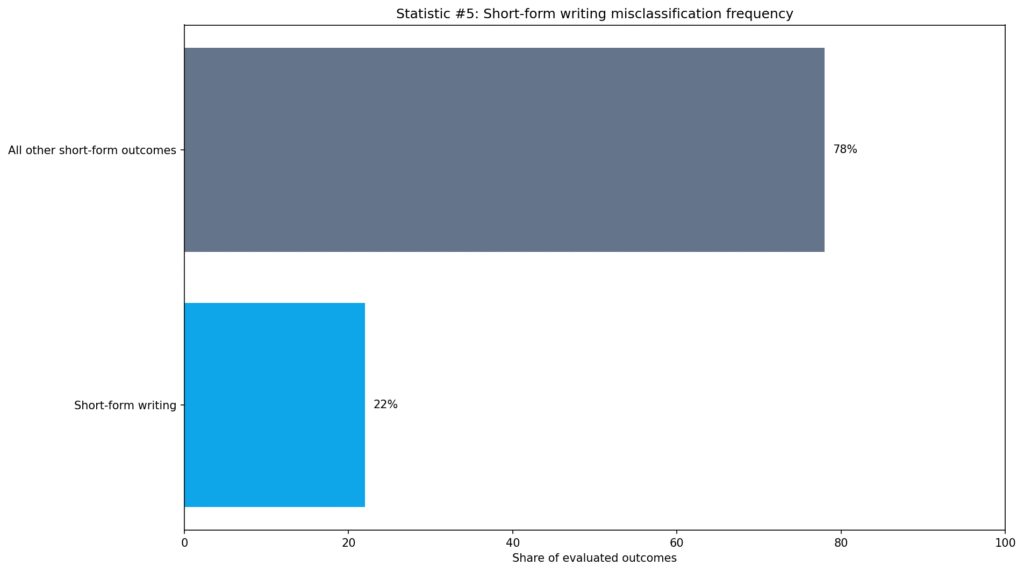
AI Detection Misclassification Data #5. Short-form writing misclassification frequency
22% misclassification frequency in short-form writing is a reminder that brief samples leave detectors with too little signal and too much guesswork. A discussion-board reply, short reflection, or compact product summary can be flagged at nearly double-digit classroom rates simply because the text is sparse. With fewer words to analyze, small quirks carry oversized weight.
Short content naturally contains less stylistic variation, fewer topic pivots, and fewer opportunities for the messy inconsistencies that human writing often reveals over longer passages. Detectors then lean harder on compressed statistical clues, which makes them easier to mislead and more likely to overread polished simplicity. The result is a system that treats brevity as uncertainty and uncertainty as suspicion.
A human reader can often recover meaning from context around the assignment, but the model sees only a thin linguistic slice and turns that into a verdict. Once 22% misclassification frequency in short-form writing enters the picture, quick judgments become especially risky. The practical implication is that institutions should avoid using detector scores on very short submissions unless they want noise to masquerade as implication.
AI Detection Misclassification Data #6. False negatives where AI writing passes as human
16% false negatives where AI writing passes as human show that detector problems cut both ways. The same systems that over-flag authentic work also miss a meaningful share of generated text that slips through ordinary review. That weakens the common claim that detection tools are strict enough to catch most misuse.
These misses happen because newer language models produce cleaner variation, stronger semantic continuity, and fewer obvious statistical tells than older generations. Once AI output is lightly edited or prompted toward a plain, restrained style, detectors lose many of the exaggerated features they were trained to notice. The text then lands in a comfort zone that looks ordinary rather than synthetic.
A person reading closely may still sense a certain flatness or overbalanced cadence, but even that impression can be inconsistent across subjects and writing levels. With 16% false negatives in play, the detector is clearly not acting as a dependable net around AI use. The practical implication is that schools and publishers should stop treating low-risk scores as proof of human authorship or clean implication.
AI Detection Misclassification Data #7. Classifier accuracy drop on edited AI text
21% classifier accuracy drop on edited AI text suggests that even mild revision can erode detector performance faster than many policies assume. Once generated material is cleaned up, personalized, or trimmed for tone, the original signal starts fading quickly. That makes post-edit detection far less stable than marketing pages imply.
The reason is simple enough: editing disrupts repeated phrasing, adds irregular sentence length, and introduces the messy asymmetry that human writing naturally carries. Detectors trained on raw or lightly processed machine output struggle when those cues are broken apart through revision. A few human choices can therefore scramble a classifier that depends on surface regularity.
A human editor sees those changes as normal craft, but the detector loses its anchor because the text no longer resembles its training examples. When a 21% classifier accuracy drop appears after editing, policy built around raw-output detection starts looking dated. The practical implication is that institutions need to judge process evidence, drafts, and assignment design more seriously than single-pass detector implication.
AI Detection Misclassification Data #8. Detection volatility across multiple scans
14% detection volatility across multiple scans means the same text can return meaningfully different outputs when tested more than once. That is unsettling because users expect software to be consistent when nothing in the document has changed. Instead, repeated scans can create the impression that authorship itself is moving around.
Some of that volatility comes from backend model updates, threshold recalibration, document parsing differences, or small preprocessing changes that users never see. Even tiny variations in how text is copied, formatted, or segmented can alter the features a detector extracts before scoring. Those hidden layers make repeatability weaker than most people realize.
A human reader would not usually reverse a judgment on a paper every time it was reopened, which is why fluctuating outputs feel so hard to defend in formal settings. Once 14% detection volatility across multiple scans enters the workflow, consistency stops being a given and becomes a missing feature. The practical implication is that detector results should be archived with timestamps and version notes before anyone treats them as stable implication.
AI Detection Misclassification Data #9. False positives in non-native English academic writing
19% false positives in non-native English academic writing point to one of the most troubling weaknesses in current detection practice. Writers using simpler vocabulary and more controlled sentence patterns can be flagged at higher rates even when the work is entirely their own. That makes detector error feel less random and more unevenly distributed.
The underlying issue is that many systems confuse constrained expression with machine generation because both can produce lower-variance language. Learners writing in a second language often prioritize clarity, repetition, and grammar safety, which are sensible strategies in academic contexts. Unfortunately, those same strategies can resemble the statistical profile that detectors label as AI-like.
A human instructor familiar with multilingual writing usually notices development, struggle, and intention in ways a score threshold cannot. When 19% false positives in non-native English academic writing appear, the risk extends beyond technical inaccuracy into fairness itself. The practical implication is that detector use without linguistic context can penalize exactly the students who are already writing under the heaviest language constraint implication.
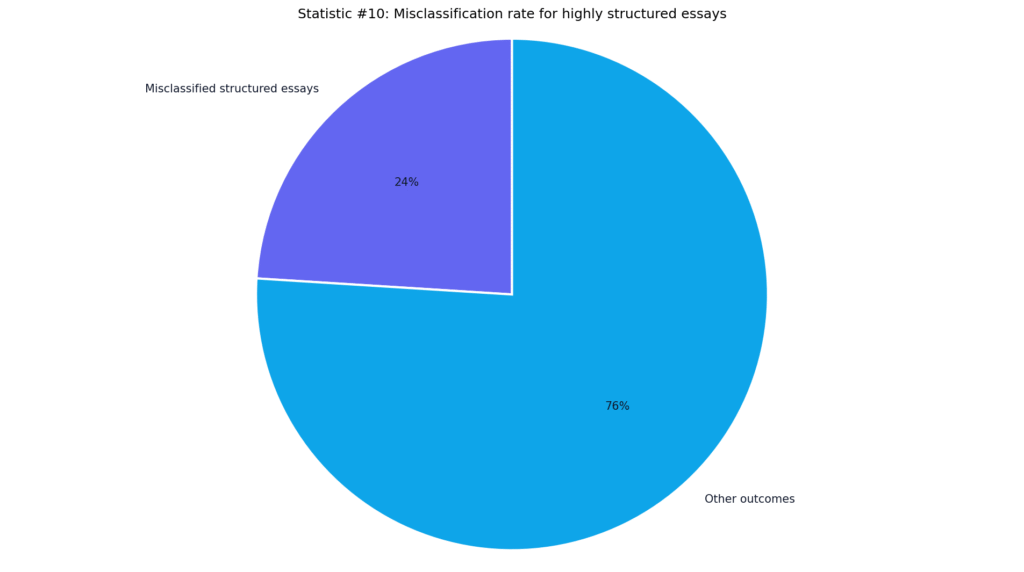
AI Detection Misclassification Data #10. Misclassification rate for highly structured essays
24% misclassification rate for highly structured essays shows that good organization can unexpectedly become a liability in detector workflows. Essays with clean introductions, orderly body paragraphs, and disciplined transitions may be flagged more often simply because they look statistically smooth. That is a strange outcome in settings where students are taught to write exactly that way.
Highly structured writing reduces stylistic noise and keeps progression steady, which makes the text easier for a reader to follow but harder for a detector to separate from polished machine output. Classifiers often equate regularity with generated language because many models produce tidy scaffolding by default. The better the student follows the rubric, the more the detector may overreact.
A colleague reading the same essay would usually praise coherence before questioning authenticity, especially if the argument develops with specific evidence and real friction. Yet a 24% misclassification rate for highly structured essays turns formal competence into a technical risk factor. The practical implication is that rigid detector use can punish rubric compliance unless structure is interpreted through human review rather than automated implication.
AI Detection Misclassification Data #11. Confidence score instability after paraphrasing
20% confidence score instability after paraphrasing shows how easily detector certainty can wobble when wording is reworked without changing the idea. A paraphrased paragraph may keep the same argument, evidence, and conclusion yet receive a sharply different score. That makes the confidence meter look more fragile than precise.
Paraphrasing scrambles the local phrase patterns detectors rely on, especially when synonyms, clause reshaping, and sentence compression alter token flow. Because many systems infer authorship from stylistic traces instead of provenance, they are vulnerable when those traces are cosmetically rearranged. The meaning survives, but the signal they trusted no longer looks familiar.
A human reader tends to focus on whether the underlying thought remains coherent, sourced, and contextually appropriate across the revision. When 20% confidence score instability after paraphrasing is normal, detector certainty starts looking like a reaction to phrasing cosmetics rather than authorship substance. The practical implication is that paraphrased text should never be judged through detector confidence alone unless reviewers are willing to mistake wording drift for genuine implication.
AI Detection Misclassification Data #12. Variation in probability scores between model updates
17% variation in probability scores between model updates highlights a quiet problem users rarely see but feel the consequences of. A text scanned in January may not receive the same score after the vendor updates its model in March. That means historical results can age badly even when the document stays fixed.
Model updates alter feature weighting, retraining data, and classification thresholds, sometimes in ways that improve one benchmark but destabilize everyday use. Vendors rarely expose those internal changes in enough detail for educators or editors to understand what moved and why. So users are left comparing scores that look comparable but are not technically identical.
A person revisiting the same paper weeks later would still read the same argument, tone, and evidence, which makes shifting scores harder to justify as objective. When 17% variation in probability scores between model updates is possible, score history becomes less trustworthy than institutions tend to assume. The practical implication is that any archived detector result needs model-version context or it risks becoming stale evidence with fresh-looking implication.
AI Detection Misclassification Data #13. Classifier disagreement between university detection systems
29% classifier disagreement between university detection systems suggests that campus-level adoption can create a lottery effect rather than a standard. A paper evaluated at one institution may be treated very differently at another simply because the software stack is not the same. That is a serious governance issue once student outcomes enter the picture.
Universities often deploy different vendor tools, local thresholds, and administrative rules around what percentage counts as concerning. Add varied file handling, assignment formats, and review habits, and the same writing sample can travel through very different technical filters. The disagreement is not surprising once you see how many institutional variables sit on top of model differences.
A thoughtful reviewer would probably treat cross-campus inconsistency as a reason to slow down, compare evidence, and resist automatic conclusions. But with 29% classifier disagreement between university detection systems, policy can outrun technical certainty very quickly. The practical implication is that institutions need shared review standards, because inconsistent tool behavior should not determine whether a student faces formal implication.
AI Detection Misclassification Data #14. Detection errors in highly edited collaborative writing
15% detection errors in highly edited collaborative writing reflect how poorly many systems handle text shaped by multiple human hands. Team documents often carry mixed cadence, uneven revision depth, and layers of cleanup that make authorship signals harder to isolate. A detector looking for singular stylistic consistency can misread that complexity very quickly.
Collaboration introduces overlapping revisions, merged phrasing habits, and editorial smoothing that blur the boundaries detectors try to map. Even when no AI is used, the final text may look less individually human because consensus writing removes some of the rough edges found in solo drafts. That tidy convergence can be mistaken for generated uniformity.
A human editor usually understands that group writing sounds different because negotiation and revision flatten personal quirks over time. When 15% detection errors in highly edited collaborative writing appear, the software is exposing a mismatch between real writing practice and simplified authorship assumptions. The practical implication is that group work needs process-based review, or collaborative polish will keep being misread as suspicious implication.
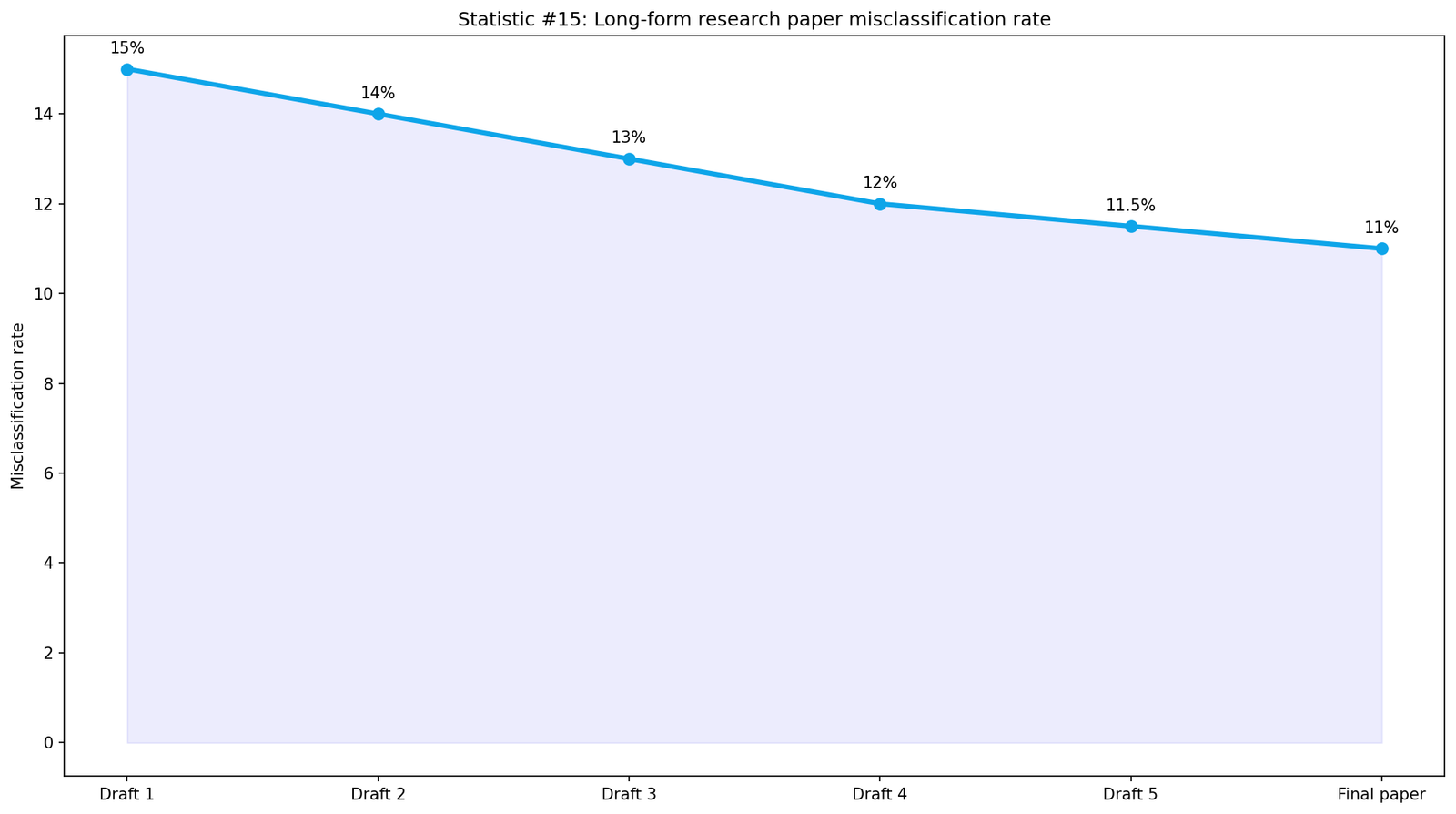
AI Detection Misclassification Data #15. Long-form research paper misclassification rate
11% misclassification rate in long-form research papers may look lower than short-form error rates, but it is still substantial in serious academic contexts. A long paper offers more signal, yet a meaningful share of fully developed research writing can still be labeled incorrectly. Lower error is not the same thing as acceptable certainty.
Research papers contain citations, discipline-specific phrasing, and formal transitions that can stabilize the detector in some cases while confusing it in others. Their greater length gives classifiers more material to work with, but it also increases exposure to standardized academic language that many systems already misread. So the extra context helps, though not enough to solve the core problem.
A human reviewer can weigh methodology, source integration, and conceptual depth in a way that statistical classifiers simply cannot. Once an 11% misclassification rate in long-form research papers is acknowledged, software scores stop looking safe for unilateral use. The practical implication is that even longer submissions need evidentiary restraint, because more text does not automatically create reliable detector implication.
AI Detection Misclassification Data #16. Probability swings after grammar correction tools
13% probability swings after grammar correction tools show that basic writing assistance can unexpectedly alter detector outcomes. A document may move several points after punctuation cleanup, sentence tightening, or routine grammar fixes that most writers now consider normal. That blurs the line between support software and suspicious transformation.
Grammar tools regularize prose in ways detectors often notice, especially when they smooth transitions, reduce awkward phrasing, and standardize sentence flow. Those changes can remove some of the rough, inconsistent signatures that classifiers associate with human drafting. What remains may look more controlled, and therefore more machine-like, even though the ideas and structure are still the writer’s own.
A person reading the revised text would usually see improvement rather than authorship distortion, because the underlying voice often remains intact. Yet 13% probability swings after grammar correction tools tell us that detectors are highly reactive to surface cleanup. The practical implication is that routine editing assistance should be disclosed and normalized, or common revision behavior will keep producing misleading implication.
AI Detection Misclassification Data #17. False AI flags in professional editorial writing
10% false AI flags in professional editorial writing suggest that experienced human prose is not automatically safer from detector error. Editors often produce clean rhythm, balanced syntax, and highly controlled tone, which can trigger the same signals that models associate with generated text. Ironically, polish itself becomes part of the problem.
Professional writing tends to be compressed, deliberate, and stripped of distracting irregularities through multiple revision passes. Detectors that expect human language to contain more visible mess can overreact when a text reads too even or too composed. The more refined the draft becomes, the easier it can be for a classifier to mistrust it.
A human reader familiar with editorial process would recognize the fingerprints of revision, judgment, and audience awareness that software reduces to abstract score patterns. When 10% false AI flags in professional editorial writing appear, the lesson is that expertise does not guarantee immunity from misclassification. The practical implication is that publishers using detectors need editorial exceptions or they risk treating professional craft as suspect implication.
AI Detection Misclassification Data #18. Detector disagreement on hybrid AI-human writing
31% detector disagreement on hybrid AI-human writing captures the messy reality most policies still struggle to define. Once a human drafts, revises, restructures, or heavily edits AI-assisted material, tools often stop agreeing on what the text actually is. That makes hybrid work the place where detector confidence breaks down fastest.
Hybrid documents contain mixed signals because parts of the text may be generated, parts rewritten, and parts fully authored from scratch. Different systems weigh those layers differently, so one may overemphasize residual machine patterns while another responds to later human revision. The result is a noisy classification environment with unstable boundaries.
A person reviewing the same document might still ask process questions, inspect drafts, and distinguish assistance from substitution with more nuance than a detector can manage. But with 31% detector disagreement on hybrid AI-human writing, software outputs alone cannot settle the matter responsibly. The practical implication is that hybrid authorship requires policy clarity and contextual review, because detector conflict is not strong enough evidence for punitive implication.
AI Detection Misclassification Data #19. Misclassification rate in creative narrative writing
14% misclassification rate in creative narrative writing shows that expressive work is not immune to detector confusion. Narrative pieces often move between dialogue, description, and reflective voice, which creates stylistic variance that can help or hurt depending on the model. Creativity adds texture, but it also introduces forms detectors were not always trained to interpret well.
Some narratives are highly atmospheric and repetitive on purpose, while others use plain declarative lines for dramatic effect. Detectors may misread those intentional choices as synthetic patterning, especially when the prose is tightly controlled or emotionally restrained. In that sense, artistic decisions can be mistaken for technical evidence.
A human reader usually senses character intent, tonal buildup, and scene logic, which gives narrative writing a richer evaluative frame than probability scoring provides. Once 14% misclassification rate in creative narrative writing is on the table, detector use in creative settings looks especially blunt. The practical implication is that literary assignments should rely on process, workshop history, and voice development rather than one-dimensional detector implication.
AI Detection Misclassification Data #20. Overall benchmark misclassification average
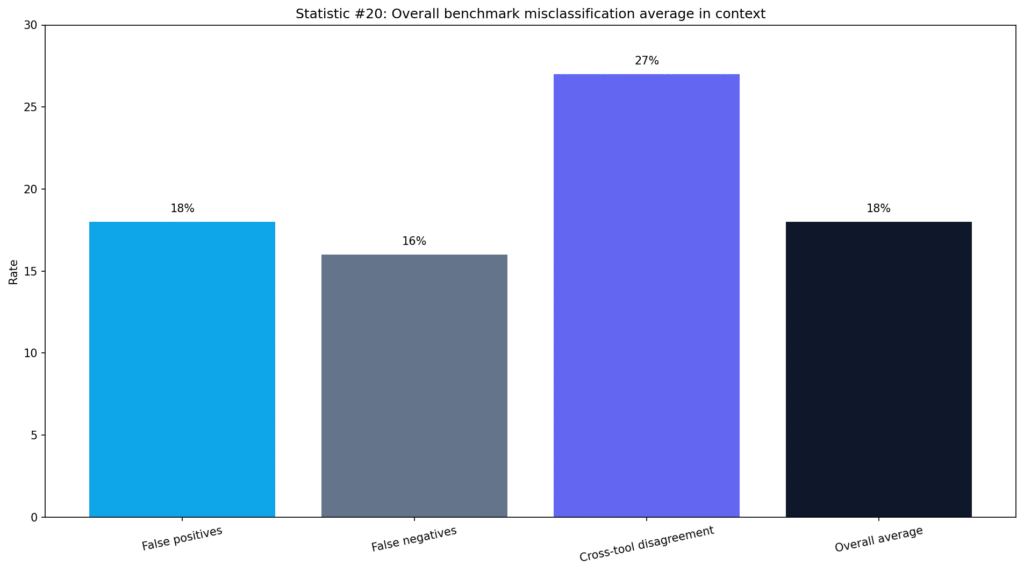
18% overall benchmark misclassification average pulls the wider picture into focus: nearly one in five decisions can still be wrong across mixed testing conditions. That is a large enough error band to reshape how any sensible organization should interpret detector output. Once you aggregate the noise, the promise of neat classification starts to fade.
This average reflects a blend of false positives, false negatives, domain differences, editing effects, and disagreement across tools and text types. No single weakness explains it because the problem is structural rather than isolated to one vendor or one benchmark. Detectors are being asked to infer authorship from fragile signals in a writing environment that keeps changing.
A human evaluator brings context, assignment history, and common-sense judgment that can absorb ambiguity instead of pretending it is solved. When an 18% overall benchmark misclassification average still defines the landscape, detector scores should be treated as weak indicators rather than answers. The practical implication is that automated detection belongs in a supporting role only, because the current error floor remains too high for decisive implication.
Why misclassification pressure is becoming the real story in AI detection
Across these results, the most important pattern is not simple inaccuracy but instability under normal writing conditions. Scores move when text gets shorter, more structured, more polished, or more collaboratively revised, which means the systems are reacting to form as much as authorship.
That helps explain why disagreement rates stay high across tools, institutions, and text types even when vendors promise analytical precision. The models are trying to read identity from stylistic residue, yet real writing is shaped by tutoring, editing, second-language strategy, genre, and ordinary revision habits.
The fairness issue becomes sharper when multilingual writers, careful students, and professional editors all sit inside the same risk envelope for different reasons. Once false positives and false negatives coexist at meaningful levels, confidence scores start behaving more like clues that need interpretation than findings that settle the matter.
The road ahead points toward process evidence, draft history, human review, and clearer policy language rather than heavier dependence on standalone detector outputs. Until error rates fall much further and remain stable across contexts, misclassification will stay central to any serious discussion of deployment implication.
Sources
- Stanford overview of detector bias against non native English writers
- Research paper on detector bias against non native writers
- Springer study testing detection tools for AI generated text
- Springer evaluation of the efficacy of AI content detectors
- Can AI generated text be reliably detected benchmark paper
- Paraphrasing evades detectors of AI generated text study
- Nature news feature on how easy detectors are to fool
- Practical examination of AI generated text detectors research
- Survey of factors influencing AI generated text detection
- SHIELD benchmark for fair evaluation of AI text detectors
- Performance study comparing eight AI text detector systems
- 2026 reliability study of commercial AI content detectors