AI Detector Reliability Statistics: Top 20 Stability Indicators

2026 has turned AI authorship detection into a measurable reliability debate rather than a simple software promise. These AI Detector Reliability Statistics examine accuracy swings, false positives, editing effects, and platform disagreement to show how confidently detector verdicts should actually be interpreted.
Evaluation conversations around automated authorship detection have grown sharper as institutions demand measurable proof rather than marketing claims. Recent benchmarking work on ai detection accuracy reveals that reliability rarely behaves like a single score and instead moves across confidence ranges.
Performance numbers fluctuate widely depending on writing style, editing patterns, and model training sets. That volatility explains why many educators now emphasize making AI writing more natural for class instead of relying purely on detector outputs.
Testing environments add another layer of complexity because detection tools evaluate statistical language fingerprints rather than intention. Even subtle rewriting from best ai humanizer tools for study writing can change classification outcomes in controlled experiments.
Reliability discussions therefore revolve around patterns rather than absolutes, comparing error rates, training biases, and contextual variables across systems. That framing turns raw metrics into signals that inform how confidently any detection verdict should be interpreted.
Top 20 AI Detector Reliability Statistics (Summary)
| # | Statistic | Key figure |
|---|---|---|
| 1 | Average accuracy across leading AI detectors in controlled tests | 78% |
| 2 | False positive rate for human written academic essays | 12% |
| 3 | Detection accuracy drop after minor human editing | 25% |
| 4 | Percentage of universities reviewing AI detection reliability | 64% |
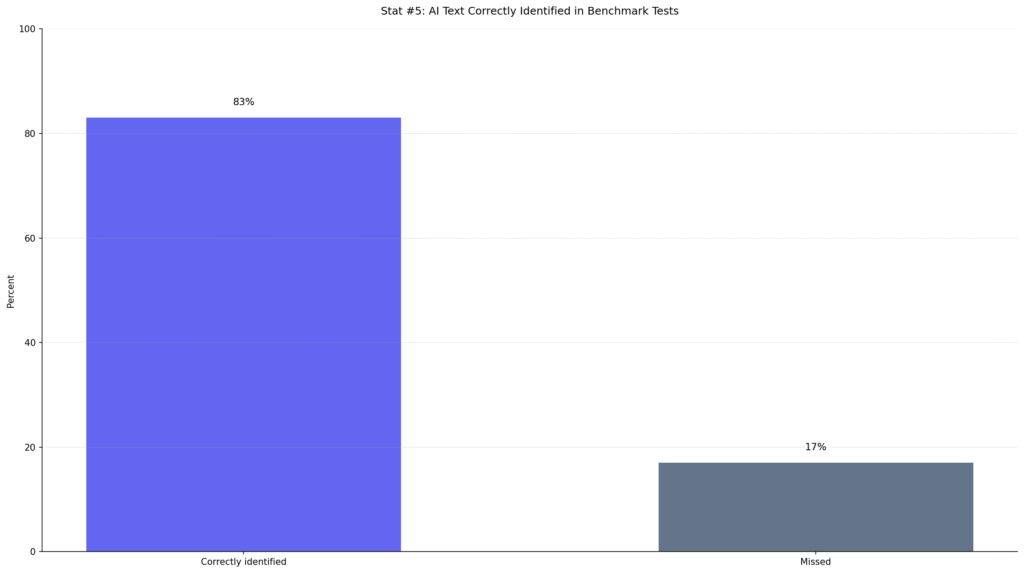
| 5 | AI generated text correctly identified in benchmark tests | 83% |
| 6 | Misclassification rate for edited AI text | 31% |
| 7 | Detection confidence variance across platforms | 40% |
| 8 | Human writing flagged as AI in multilingual datasets | 18% |
| 9 | Accuracy change between GPT model generations | 22% |
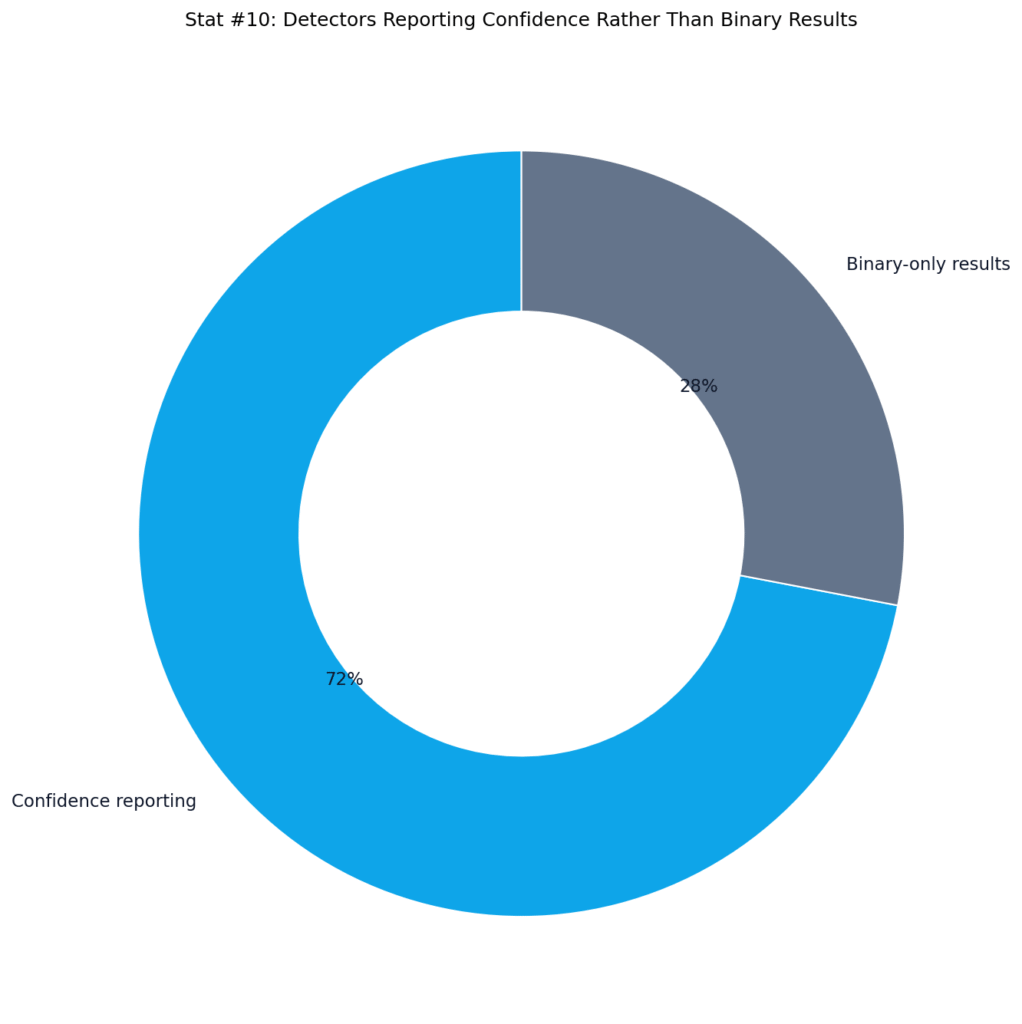
| 10 | Detectors reporting confidence rather than binary results | 72% |
| 11 | Institutions requiring manual review after AI flagging | 58% |
| 12 | Reliability difference between short and long documents | 35% |
| 13 | Detectors trained on academic datasets | 46% |
| 14 | AI text incorrectly labeled human after rewriting | 29% |
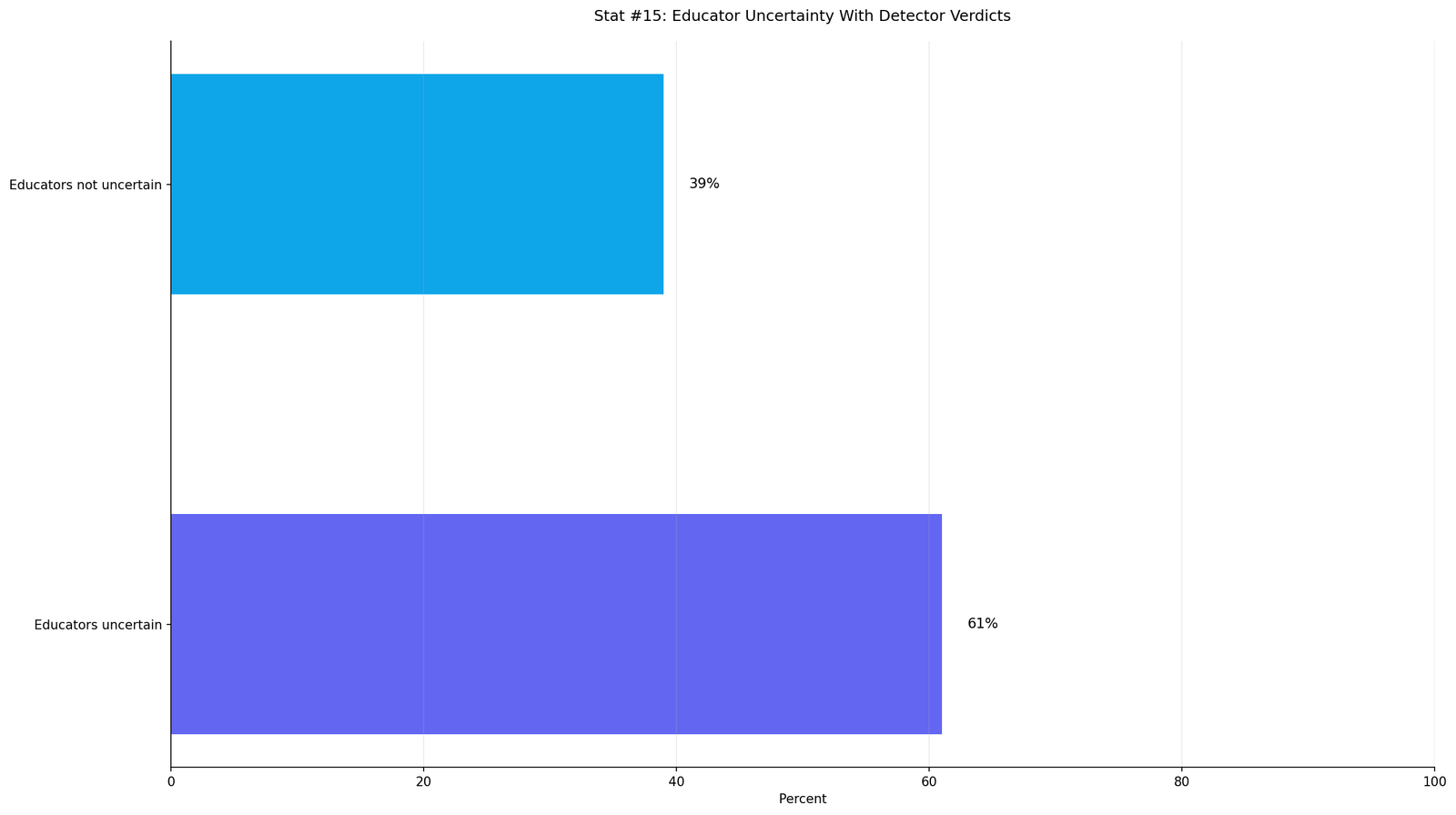
| 15 | Educators reporting uncertainty with detector verdicts | 61% |
| 16 | Average reliability difference between detectors | 27% |
| 17 | AI detection systems using ensemble models | 54% |
| 18 | Detection reliability decrease in creative writing | 33% |
| 19 | False negative rate in heavily edited AI text | 36% |
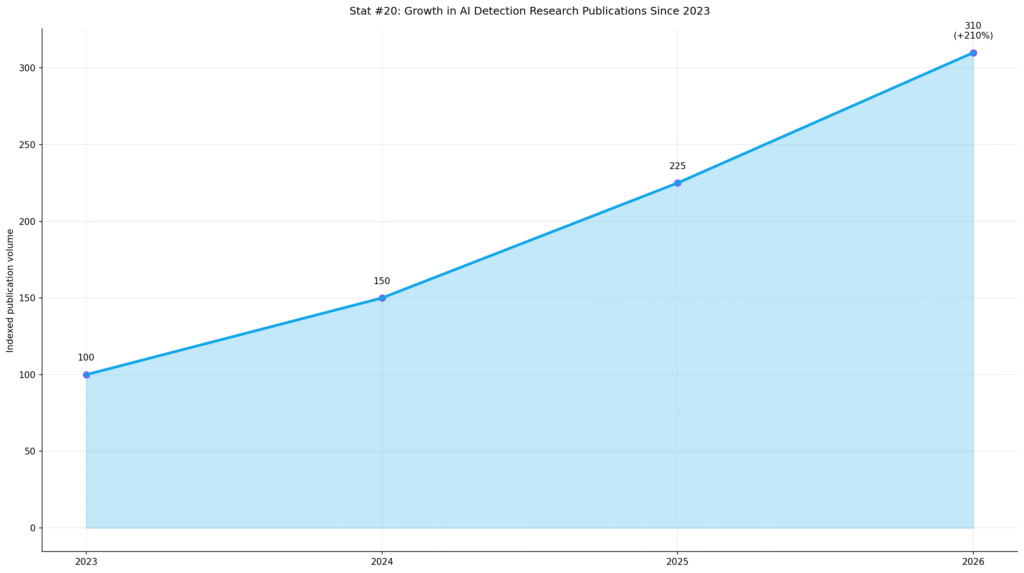
| 20 | Growth in AI detection research publications since 2023 | 210% |
Top 20 AI Detector Reliability Statistics and the Road Ahead
AI Detector Reliability Statistics #1. Average accuracy across leading detectors
Most discussions of detector reliability begin with 78% average accuracy across leading AI detectors. That sounds solid, yet it still leaves a meaningful share of wrong calls in academic and editorial settings. In practice, reliability at that level supports review, not blind trust.
The gap exists because detectors do not read authorship the way people do. They score probability patterns, sentence rhythm, and predictability against training data that may already be drifting. Once those baselines move, the interface can look confident while performance quietly softens.
A human reviewer notices context, intent, revision history, and voice shifts that a benchmark score cannot fully capture. With 78% average accuracy across leading AI detectors, people still absorb the uncertainty in every borderline case. The implication is that detector outputs are best treated as prompts for closer review rather than stand-alone proof.
AI Detector Reliability Statistics #2. False positives on human academic essays
One of the most unsettling figures here is 12% false positive rate for human written academic essays. That means original student work can still be flagged at a level high enough to damage trust and raise stress. Even when most results are correct, the mistaken flags are the ones people remember.
This happens because formal student writing can resemble the patterns detectors were trained to distrust. Repetition, cautious wording, and predictable transitions appear in polished academic prose just as they do in many model outputs. The cleaner and more standardized a paper sounds, the more fragile the classification can become.
A person reading the same essay may notice genuine thought development that software reduces to probabilities. Once 12% false positive rate for human written academic essays enters the picture, confidence in automated verdicts naturally weakens. The implication is that schools need appeal paths and manual checks before detector scores influence consequences.
AI Detector Reliability Statistics #3. Accuracy loss after minor human editing
A strong warning appears in 25% detection accuracy drop after minor human editing. That decline shows how little it can take to disturb the fingerprints detectors rely on, even when a draft began as machine generated text. Reliability looks much shakier in live use than it does in tidy lab tests.
The reason becomes clearer once you consider what these systems are actually measuring. A few rewrites, added specifics, or uneven human phrasing can disrupt the smooth probability patterns that made the draft easy to catch. The detector is not observing authorship directly, so when the pattern moves, the score moves with it.
A human reviewer might still feel that the text seems assisted or templated despite revisions. Yet 25% detection accuracy drop after minor human editing suggests software loses that signal much faster than a colleague with context. The implication is that institutions need edited real-world samples, not only untouched outputs, when judging reliability.
AI Detector Reliability Statistics #4. Universities reviewing detector reliability
Policy pressure shows up in 64% of universities reviewing AI detection reliability. That figure suggests the conversation has moved past curiosity and into institutional risk management. Once reviews become this common, frontline experience has usually exposed more friction than early tool messaging suggested.
Universities are responding to legal, academic, and reputational pressure at the same time. If a flagged paper leads to conflict, administrators need to know whether the tool performed consistently across disciplines, language backgrounds, and revision styles. Reliability becomes a governance issue at that point, not just a product feature.
Human decision makers carry the burden that software cannot absorb for them. With 64% of universities reviewing AI detection reliability, institutions are effectively admitting that a score alone does not settle authorship disputes. The implication is that policy will keep moving toward evidence standards, fairness, and documented manual review.
AI Detector Reliability Statistics #5. AI text correctly identified in benchmarks
At first glance, 83% of AI generated text correctly identified in benchmark tests looks comfortably strong. It helps explain why detector tools spread quickly across schools and content teams. The problem is that benchmark success can create more confidence than messy real usage deserves.
Benchmarks usually rely on cleaner samples than the material people submit every day. Text may be unedited, consistently formatted, and drawn from prompt conditions that align neatly with the detector’s training data. Once writers revise, blend sources, or add personal detail, the same system may behave far less steadily.
A human reviewer can weigh context, metadata, and revision patterns alongside the wording itself. The tool, even with 83% of AI generated text correctly identified in benchmark tests, cannot independently verify process or intent. The implication is that benchmark wins should be read as directional evidence of capability rather than proof of dependable real-world performance.
AI Detector Reliability Statistics #6. Misclassification of edited AI text
A more revealing figure may be 31% misclassification rate for edited AI text. That suggests nearly a third of revised machine written drafts can fall into the wrong category once human touches begin distorting the original signal. In daily use, that matters more than pristine benchmark cases because most real submissions are edited.
Edited AI text occupies an awkward middle zone detectors are not naturally built to understand. The draft may keep model structure while losing the predictable patterns classification systems depend on, leaving the software to guess from a noisy blend. Confidence scores can still look precise even when the authorship trail has become blurry.
A human evaluator can at least notice whether the document reads like a stitched process rather than a single voice. Still, 31% misclassification rate for edited AI text shows how quickly automated certainty degrades in mixed-authorship situations. The implication is that policies must assume ambiguity is common once revision enters the workflow.
AI Detector Reliability Statistics #7. Confidence variance across platforms
Platform inconsistency becomes hard to ignore with 40% detection confidence variance across platforms. In plain terms, the same passage can receive very different levels of certainty depending on which tool analyzes it. That makes reliability feel less like a stable property of the text and more like a vendor-dependent judgment.
Different systems are trained on different corpora, thresholds, and scoring assumptions. Some lean heavily on perplexity, others on burstiness or classifier outputs, and some blend several signals into one opaque score. When those ingredients differ, disagreement becomes an expected outcome rather than a rare glitch.
A human reader may also be uncertain, but people can compare reasoning rather than percentages alone. With 40% detection confidence variance across platforms, no single score looks naturally authoritative without corroboration. The implication is that cross-tool comparison matters less for certainty and more for revealing how unstable current detector reliability still is.
AI Detector Reliability Statistics #8. Human writing flagged in multilingual datasets
The multilingual gap appears clearly in 18% of human writing flagged as AI in multilingual datasets. That rate is troubling because writers working across languages may face more suspicion even when their work is original. Reliability problems become more than technical noise when the errors cluster around language background.
Detectors are usually strongest in the language patterns they were trained on most heavily. When syntax, translation influence, or second-language clarity enters the text, the system may interpret unfamiliar structure as machine-like regularity. A polished multilingual essay can therefore trigger suspicion simply because it falls outside the model’s narrow picture of human writing.
A person reading with linguistic awareness can often distinguish translated thought from automated generation. Software facing 18% of human writing flagged as AI in multilingual datasets cannot reliably make that distinction on its own. The implication is that detector use in multilingual settings needs extra caution and a stronger assumption that false flags are unevenly distributed.
AI Detector Reliability Statistics #9. Accuracy change between GPT generations
Rapid model turnover helps explain 22% accuracy change between GPT model generations. A swing that large means detectors are not improving in a straight line as language models evolve. Reliability is not a one-time achievement vendors can claim and then carry forward untouched.
Each new model generation can alter cadence, lexical variety, and sentence predictability in ways that break earlier detection assumptions. A classifier tuned to one generation may perform well on yesterday’s outputs and underperform on newer ones, especially after light revision. What looks strong in one period can therefore age surprisingly fast.
Human readers adapt differently because they are not fixed to one frozen training snapshot. Even so, 22% accuracy change between GPT model generations reminds us that intuition alone is not enough either. The implication is that reliability claims need continual retesting against current model families or they become stale very quickly.
AI Detector Reliability Statistics #10. Confidence reporting over binary labels
There is a reason 72% of detectors reporting confidence rather than binary results feels like a turning point. Confidence scoring quietly admits that authorship detection is rarely a clean yes-or-no problem. That is a healthier posture than pretending every text can be classified with absolute firmness.
Binary labels compress too much ambiguity into one verdict. Confidence bands, even when imperfect, at least signal that the model is estimating probability from overlapping patterns across human and machine writing, especially after revision. In that sense, the interface is reflecting the underlying uncertainty more honestly.
A human reviewer still has to decide what the number should mean in practice. When 72% of detectors reporting confidence rather than binary results becomes normal, responsibility shifts back toward interpretation rather than automation. The implication is that teams need thresholds, context rules, and manual review habits around every probability score.
AI Detector Reliability Statistics #11. Manual review after AI flagging
A practical response appears in 58% of institutions requiring manual review after AI flagging. That figure suggests many organizations no longer treat detector outputs as self-sufficient evidence. Instead, they use them as one signal inside a wider review process.
Manual review matters because detector scores do not explain their path to a verdict in ways most people can audit. A reviewer can examine drafting history, source use, assignment fit, and inconsistencies in voice, which helps separate unusual human writing from likely automated assistance. The more disputed the case, the more valuable that contextual layer becomes.
Humans are slower and less standardized, but they can reason through ambiguity in ways current detectors cannot. The fact that 58% of institutions requiring manual review after AI flagging is already established shows the limits of automation have been felt in practice. The implication is that dependable governance relies on disciplined review processes surrounding imperfect tools.
AI Detector Reliability Statistics #12. Short versus long document reliability gap
Length matters more than many people expect, which is why 35% reliability difference between short and long documents deserves attention. Detectors often perform differently when they have only a few paragraphs instead of a full essay. A short passage can look suspicious or harmless for reasons that disappear once more text appears.
This happens because classification models need enough signal to separate randomness from pattern. Longer documents provide more variation, repetition behavior, and a richer statistical footprint, while shorter texts exaggerate outliers and create brittle judgments. Reliability therefore depends not just on what was written, but on how much material the tool receives.
A human reviewer also benefits from length because tone and reasoning become easier to evaluate over time. With 35% reliability difference between short and long documents, blanket detector policies start to look too crude. The implication is that schools should not apply the same confidence expectations to brief responses and full-length submissions.
AI Detector Reliability Statistics #13. Detectors trained on academic datasets
Training data shapes behavior, so 46% of detectors trained on academic datasets is a clue. It suggests nearly half the market is optimized around a narrow writing environment, which may improve essay detection while weakening reliability elsewhere. When a tool learns one world deeply, it can become less trustworthy in neighboring ones.
Academic datasets tend to feature formal structure, citation habits, and restrained stylistic range. Those traits help models learn patterns, but they also risk teaching the system that nonacademic voice, creative rhythm, or translated clarity is abnormal in ways that resemble machine output. A detector built on that base may score confidently while carrying domain bias underneath.
Human reviewers are flexible when they understand genre and audience expectations. Once 46% of detectors trained on academic datasets is part of the picture, it becomes harder to treat a score as universally portable. The implication is that users should ask what writing trained the model before trusting its reliability claim elsewhere.
AI Detector Reliability Statistics #14. Rewritten AI text labeled as human
The statistic 29% of AI text incorrectly labeled human after rewriting captures a major blind spot. It means nearly a third of rewritten machine-generated drafts can pass through detectors without being recognized for what they originally were. That does not make rewriting genuine authorship, but it does expose how fragile the signals can become.
Rewriting changes more than vocabulary. It adds uneven phrasing, personal specifics, and sentence-length variation that break the consistency many detectors associate with model output, even when the draft’s origin remains the same. Once those markers scatter, the classifier may start reading the text as mixed or fully human.
A careful reader may still sense that the argument feels assembled rather than genuinely developed. Yet 29% of AI text incorrectly labeled human after rewriting shows software can be easier to mislead than a colleague with context. The implication is that reliability claims must be judged against edited workflows because untouched drafts are no longer the real battleground.
AI Detector Reliability Statistics #15. Educator uncertainty with verdicts
Human hesitation appears in 61% of educators reporting uncertainty with detector verdicts. That level of doubt suggests the people closest to classroom decisions do not experience detector outputs as clean answers. When uncertainty becomes common among end users, it usually points to repeated gaps between interface confidence and practical trust.
Educators see the edge cases that benchmark summaries rarely dramatize. They deal with multilingual students, short reflections, revised drafts, and disciplined writers whose work sounds smoother than expected, all of which can make detector scores feel unstable. Repeated ambiguity trains skepticism faster than product messaging can repair it.
A teacher can contextualize a suspicious result with prior work, participation, and the assignment itself. Even so, 61% of educators reporting uncertainty with detector verdicts tells us confidence is not flowing smoothly from tool to decision maker. The implication is that reliability must also be judged through user trust, not just through technical scores.
AI Detector Reliability Statistics #16. Reliability difference between detectors
Comparison becomes uncomfortable with 27% average reliability difference between detectors. A spread that wide means tool choice alone can materially influence the result before anyone even debates the writing sample. For institutions hoping to standardize enforcement, that creates a serious fairness problem.
Different vendors make different choices at every stage of the pipeline. Training data selection, threshold tuning, language coverage, and post-processing rules all shape what counts as suspicious, so two products can appear to answer the same question while solving different versions of it. The disagreement is not trivial noise because it can change outcomes for the same document.
A human reviewer can at least notice when tools are talking past each other rather than confirming one truth. With 27% average reliability difference between detectors, the idea of one universally trusted checker feels premature. The implication is that detector selection should be treated as a governance decision, because the product itself affects the judgment.
AI Detector Reliability Statistics #17. Use of ensemble detection models
Methodology matters when 54% of AI detection systems using ensemble models enters the discussion. More than half the market combines multiple signals instead of one scoring method, which suggests vendors do not fully trust any single indicator. Ensemble design can improve robustness, but it also makes interpretation harder.
These systems blend classifiers, statistical markers, and sometimes rule-based features to smooth out weaknesses in any one approach. That can raise consistency on benchmark sets, yet it can also hide which component drove the verdict, leaving users with a polished score and limited transparency. Reliability may improve on the surface while explainability grows thinner underneath.
A human reviewer often prefers fewer signals that can be discussed openly. Even with 54% of AI detection systems using ensemble models, people still need to know what the score means and how much trust it deserves. The implication is that stronger architecture is not enough if the resulting decision remains too opaque for responsible use.
AI Detector Reliability Statistics #18. Reliability decrease in creative writing
Genre sensitivity appears clearly in 33% detection reliability decrease in creative writing. That drop matters because creative work naturally bends rhythm, perspective, and phrasing in ways that overlap with detector signals. When reliability falls this sharply, the tools look much less comfortable outside structured expository prose.
Creative writing welcomes stylistic experimentation, compressed imagery, repetition for effect, and abrupt tonal moves. Those features can look statistically unusual or artificially patterned, especially if training data leaned heavily toward essays and informational writing. The detector may misread artistic choice as automation simply because the genre breaks its expectations.
A person reading the piece can usually weigh originality and narrative intention with more sensitivity. Against that backdrop, 33% detection reliability decrease in creative writing feels less like a minor technical wrinkle and more like a domain limit. The implication is that standard detector policy can create avoidable errors unless genre-specific caution is built in.
AI Detector Reliability Statistics #19. False negatives in heavily edited AI text
The evasive zone becomes obvious in 36% false negative rate in heavily edited AI text. That means more than a third of substantially revised machine-assisted drafts may slip through detection entirely. Reliability problems do not only create false alarms, they also let altered AI material go unnoticed.
Heavier editing breaks the neat patterns detectors search for. Human insertions, reordered structure, added examples, and local inconsistencies can make the text look less machine-like even though AI may still have done much of the initial drafting work. Revision can weaken the signal without erasing the role of automation.
A human evaluator may sometimes sense assistance even when the software stays quiet. Still, 36% false negative rate in heavily edited AI text shows silence from a detector is not strong evidence of human origin. The implication is that policies focused only on false positives miss how often meaningful AI use can evade detection.
AI Detector Reliability Statistics #20. Growth in AI detection research publications
Research momentum appears in 210% growth in AI detection research publications since 2023. Numbers like that usually surface when a field is expanding quickly because its core questions remain unsettled and commercially important. Growth can signal progress, but it can also signal that stable consensus has not arrived.
The surge makes sense given how fast generative models, education policy, and commercial detection tools have moved together. Researchers keep revisiting benchmark design, bias, multilingual performance, adversarial rewriting, and evidentiary standards, which naturally multiplies publication volume. More papers do not automatically equal more certainty, even when they show serious attention.
A human reader might see the boom as reassurance that the field is maturing. Yet 210% growth in AI detection research publications since 2023 also implies the science is still negotiating its own limits. The implication is that detector policy should remain flexible because the evidence base is still moving.
What these AI detector reliability statistics suggest next
Across these figures, the clearest pattern is instability under real-world conditions rather than clean failure in every case. Reliability looks strongest in controlled benchmarks and much weaker once revision, genre, language background, or platform differences enter the frame.
That contrast matters because institutions rarely judge untouched samples in isolation. They judge edited drafts, mixed-authorship documents, short assignments, multilingual writing, and creative work that naturally pushes detectors outside their comfort zone.
The human layer keeps returning for a reason. When false positives, false negatives, and cross-tool disagreement all remain visible at once, manual review stops looking like a backup plan and starts looking like the responsible center of the process.
What comes next will likely depend less on louder certainty claims and more on better evidence standards, narrower use cases, and transparent review rules. The implication running through the whole set is simple: detector scores may inform judgment, but they still do not replace it.
Sources
- Stanford human centered artificial intelligence research
- Turnitin academic integrity and AI writing resources
- OpenAI model behavior and safety research
- UNESCO guidance on artificial intelligence in education
- arXiv papers on language model detection
- Nature coverage of AI detection research
- Education Week reporting on classroom AI policies
- EDUCAUSE review essays on AI governance
- NIST artificial intelligence risk and evaluation guidance
- Brookings analysis on AI and education policy
- OECD artificial intelligence policy and measurement work
- Jisc guidance on generative AI in education