How to Make AI Writing More Natural for Class: 15 Readability Improvements

Updated for 2026, small readability edits can make AI-generated assignments sound more natural and easier to follow, which matters because writing clarity strongly affects comprehension, as shown in a study published in the journal Reading Research Quarterly.
How to Make AI Writing More Natural for Class: 15 Readability Improvements
Many students use AI tools to draft assignments, then realize the result sounds strangely polished for a classroom setting. That polished tone can create distance from the reader, which is exactly why teachers often notice the moments when creators sound polished but not personal.
Part of the problem comes from how AI organizes ideas and builds sentences that feel technically correct but emotionally flat. Students frequently try quick fixes using most used AI humanizer tools among students, yet readability issues often remain if the structure of the writing stays unchanged.
Small edits can dramatically improve how natural an assignment feels without rewriting the entire draft. The improvements below focus on realistic readability changes that also help reduce confusion around AI detection misclassification data in academic writing.
| # | Strategy focus | Practical takeaway |
|---|---|---|
| 1 | Shorter sentence rhythm | Break long, overly structured sentences into smaller ones so the writing reads closer to how students naturally explain ideas. |
| 2 | Natural transitions | Replace stiff connectors with everyday transitions that make ideas flow more smoothly from one point to the next. |
| 3 | Clear subject focus | Ensure each sentence clearly centers on a main idea rather than stacking multiple concepts into one block of text. |
| 4 | Conversational phrasing | Adjust wording so explanations sound closer to how students would discuss the topic in class or in a study group. |
| 5 | Balanced paragraph length | Keep paragraphs consistent and readable so each one introduces a clear point without feeling dense or mechanical. |
| 6 | Concrete examples | Add small examples that clarify ideas instead of leaving statements abstract or overly general. |
| 7 | Simple vocabulary choices | Swap unnecessarily formal words for plain language that feels more natural in classroom writing. |
| 8 | Human explanation style | Frame explanations in a way that mirrors how someone would naturally teach or explain the idea to a peer. |
| 9 | Logical sentence flow | Arrange sentences so each one builds logically on the previous idea instead of feeling algorithmically ordered. |
| 10 | Varied sentence openings | Avoid repetitive structures by starting sentences in different ways that maintain a smooth reading pace. |
| 11 | Natural emphasis | Highlight important ideas through clarity and placement rather than exaggerated academic phrasing. |
| 12 | Active voice clarity | Use direct, active phrasing to make statements easier to follow and more engaging to read. |
| 13 | Reader-friendly pacing | Adjust sentence length and spacing so readers can process ideas comfortably without feeling rushed. |
| 14 | Personal reasoning tone | Allow explanations to reflect student reasoning instead of sounding like a textbook summary. |
| 15 | Final readability pass | Review the entire draft once more to smooth awkward phrasing and ensure the writing feels natural from start to finish. |
15 Readability Improvements to Make AI Writing More Natural for Class
How to Make AI Writing More Natural for Class – Strategy #1: Shorter sentence rhythm
AI-generated writing frequently builds very long sentences that attempt to present multiple ideas at once, which may sound technically correct but tends to feel dense and overly structured in a classroom assignment. To make the writing feel more natural, begin separating those extended sentences into smaller units that focus on a single idea while still maintaining a smooth logical flow. This adjustment allows readers to process information gradually instead of encountering a wall of text that feels more like generated output than a student explanation.
Students naturally explain ideas in shorter bursts when speaking or writing, which means mirroring that rhythm in your assignment helps restore a more authentic tone. Imagine a paragraph explaining a historical event that contains one massive sentence listing causes, consequences, and interpretations, which can be rewritten as several connected statements that guide the reader through each point. Once that rhythm is established across the entire draft, the text begins to read more like human writing rather than a perfectly compressed block of analysis.
How to Make AI Writing More Natural for Class – Strategy #2: Natural transitions
AI tools tend to rely on predictable transitions such as “moreover,” “additionally,” and “furthermore,” which can quickly make a paper feel overly formal for a class assignment. Replacing those transitions with simpler connectors like “because of this,” “at the same time,” or “this also means” allows the writing to move between ideas in a way that feels closer to how students naturally connect their thoughts. The goal is not to eliminate structure but to make that structure feel conversational rather than mechanical.
Consider a paragraph discussing a scientific concept that jumps from explanation to implication using rigid academic transitions, which may appear polished but still feels detached from a classroom discussion tone. When those transitions are replaced with natural connective phrasing, the explanation begins to resemble the way a student would talk through the concept during a study session or group presentation. That subtle change helps the reader move smoothly from one point to the next without feeling like the text was assembled through a formula.
How to Make AI Writing More Natural for Class – Strategy #3: Clear subject focus
AI drafts frequently pack several related ideas into a single sentence, which creates paragraphs that appear impressive at first glance but become difficult to follow after careful reading. One effective readability improvement is identifying the central subject of each sentence and ensuring that everything within the sentence directly supports that idea rather than branching into unrelated explanations. Maintaining that focus helps the writing remain clear and grounded instead of drifting through layered statements that feel algorithmically assembled.
A useful exercise involves reviewing each sentence and asking whether a reader could easily identify the main idea within the first few words. When the subject becomes buried under multiple clauses and descriptive fragments, the sentence begins to resemble typical AI patterns rather than the reasoning process of a student explaining a concept. Clarifying the subject of each sentence gradually transforms the entire paragraph into a more readable and natural progression of ideas.
How to Make AI Writing More Natural for Class – Strategy #4: Conversational phrasing
AI-generated text frequently leans toward academic language that sounds formal but rarely resembles the tone students use in their everyday writing. Adjusting that phrasing so explanations feel closer to spoken reasoning can make the assignment appear far more authentic without reducing its academic quality. This means rewriting phrases that sound like textbook commentary into explanations that reflect how someone would naturally describe the topic while still remaining clear and thoughtful.
Imagine a paragraph explaining an economic principle that begins with dense phrasing and abstract terminology, which may technically convey the correct meaning but still feels distant and impersonal. Rewriting that explanation using natural phrasing can transform the same idea into something that reads like a student carefully thinking through the concept rather than reciting an academic summary. Over time, this conversational tone helps the entire paper feel more human and less like generated text.
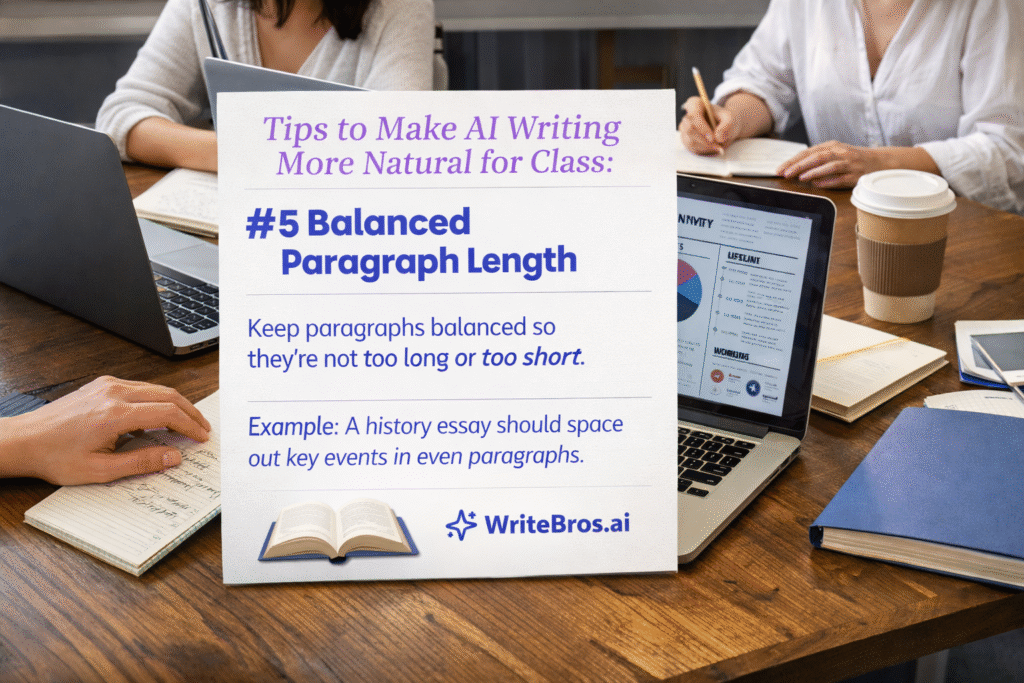
How to Make AI Writing More Natural for Class – Strategy #5: Balanced paragraph length
AI systems sometimes produce paragraphs that either stretch far beyond what readers comfortably follow or compress several complex ideas into a very short space. Improving readability often begins with balancing paragraph length so each section introduces one clear point, explains it thoroughly, and then transitions naturally to the next idea. When paragraphs maintain consistent size and focus, the entire assignment becomes easier to navigate for both teachers and classmates.
Think of a history essay that includes one extremely long paragraph explaining several events in a sequence, followed immediately by a short paragraph that abruptly introduces a new topic. Adjusting the structure so each paragraph carries a similar level of explanation helps maintain rhythm and prevents the text from feeling uneven. Over the course of the paper, balanced paragraphs create a steady reading pace that mirrors natural writing patterns.
How to Make AI Writing More Natural for Class – Strategy #6: Concrete examples
AI-generated explanations often remain abstract, presenting concepts in general terms without demonstrating how those ideas actually appear in practice. Introducing concrete examples allows the reader to visualize the concept more clearly while also making the writing feel closer to how students normally explain ideas in essays. Instead of describing a principle in isolation, connect it to a specific situation that illustrates how the concept works.
For example, a paragraph discussing environmental sustainability may feel vague when it simply lists general principles without connecting them to a recognizable scenario. When the explanation includes a realistic example, such as how recycling programs influence local waste management decisions, the writing begins to sound more thoughtful and grounded. Examples create clarity while also giving the text a natural storytelling quality that AI drafts frequently lack.
How to Make AI Writing More Natural for Class – Strategy #7: Simple vocabulary choices
AI writing frequently substitutes ordinary language with unnecessarily complex vocabulary, which may appear impressive but often makes the text feel artificial in a classroom assignment. Replacing those words with simpler alternatives does not weaken the explanation, and instead allows the reader to understand the idea more easily while maintaining a natural tone. Clear language communicates confidence and understanding without relying on complicated phrasing.
Imagine a sentence that describes a concept using formal academic terminology that most students would rarely use in everyday writing. When those terms are replaced with straightforward wording, the same explanation becomes easier to follow and begins to resemble the voice of someone genuinely engaging with the topic. Over time, consistent vocabulary simplification makes the entire assignment sound more authentic.
How to Make AI Writing More Natural for Class – Strategy #8: Human explanation style
One of the easiest ways to improve AI-generated writing is adjusting explanations so they mirror how people naturally teach or discuss ideas. Rather than presenting information in rigid definitions, structure the explanation as if you were walking a classmate through the concept step by step. This format introduces the idea, expands on it gradually, and clarifies why the concept matters within the context of the assignment.
When students explain a topic in conversation, they typically begin with a general idea and then add details that help the listener understand the reasoning behind it. Replicating that explanation pattern within a written assignment creates a tone that feels authentic and engaging rather than formulaic. The reader experiences the explanation as a guided thought process instead of a static block of generated text.
How to Make AI Writing More Natural for Class – Strategy #9: Logical sentence flow
AI-generated paragraphs sometimes present ideas in an order that technically connects the information but still feels slightly unnatural to a reader. Improving sentence flow means arranging ideas so each statement grows logically from the previous one, creating a chain of reasoning that feels intentional and easy to follow. When readers can anticipate the direction of the argument, the entire paragraph feels more coherent.
A common issue occurs when a paragraph introduces a conclusion before explaining the reasoning that supports it, which can leave the reader momentarily confused. Reorganizing those sentences so the explanation gradually builds toward the conclusion helps the paragraph mirror the natural way people develop arguments. Over time, this logical structure strengthens both clarity and credibility within the assignment.
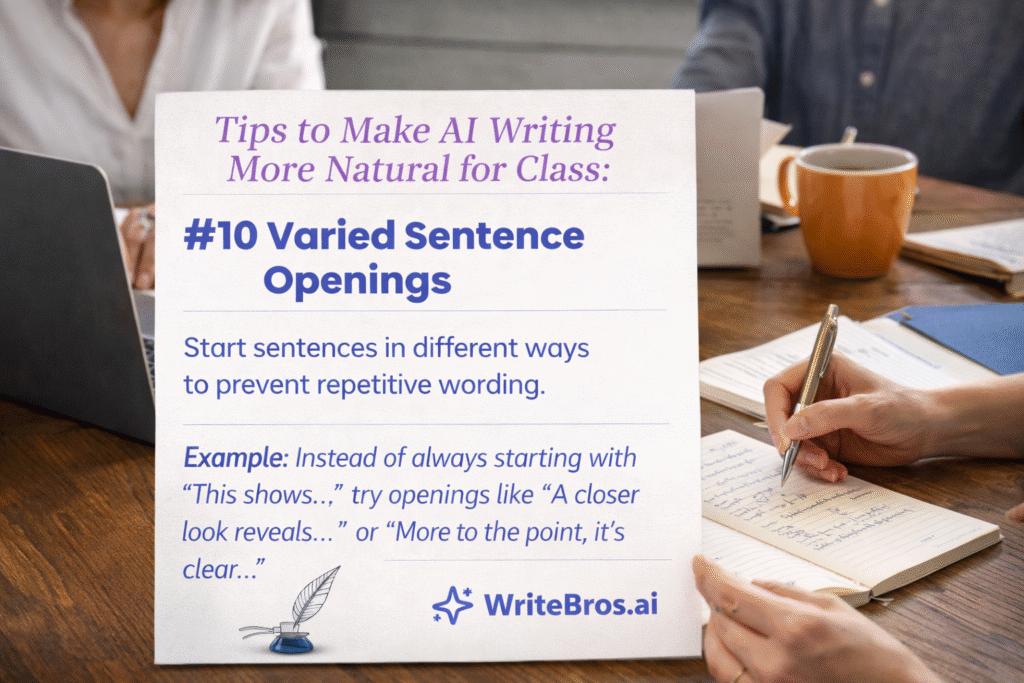
How to Make AI Writing More Natural for Class – Strategy #10: Varied sentence openings
AI writing frequently begins multiple sentences in the same way, which quickly creates a repetitive rhythm that attentive readers notice. Varying sentence openings introduces subtle changes in pacing that make the paragraph feel more dynamic and reflective of human writing patterns. This variation can involve beginning with context, examples, or clarifying phrases rather than repeating the same structure repeatedly.
Imagine reading a paragraph where every sentence starts with the subject followed immediately by a verb, which may be grammatically correct but becomes monotonous over time. Adjusting those openings so some sentences begin with descriptive context or connecting ideas introduces variety without disrupting clarity. That variation helps the writing feel more natural and engaging for the reader.
How to Make AI Writing More Natural for Class – Strategy #11: Natural emphasis
AI-generated writing sometimes tries to emphasize ideas through exaggerated wording or overly dramatic phrasing, which can feel out of place in a classroom assignment. A more natural method of emphasis focuses on clarity and positioning within the sentence rather than dramatic vocabulary. When the most important idea appears at the right moment in the sentence, the reader naturally understands its importance.
For example, placing the main point at the end of a sentence often allows it to stand out without requiring elaborate language or repetition. This subtle technique mirrors the way people highlight key ideas when explaining something during a discussion. As the paper develops, natural emphasis helps important insights stand out while keeping the tone balanced and readable.
How to Make AI Writing More Natural for Class – Strategy #12: Active voice clarity
AI drafts often rely on passive voice structures that technically describe events but make the writing feel distant and overly formal. Rewriting those sentences in active voice helps clarify who is performing the action while also creating a stronger and more direct explanation. This simple adjustment makes sentences easier to follow and reduces the sense that the text was automatically generated.
Consider a sentence that states that a discovery “was made by researchers,” which may sound correct but feels slightly detached from the narrative. Rewriting that sentence so the researchers become the subject immediately strengthens the connection between action and explanation. Active voice helps maintain clarity and keeps the writing aligned with natural communication patterns.
How to Make AI Writing More Natural for Class – Strategy #13: Reader-friendly pacing
Readable writing depends heavily on pacing, which determines how easily readers move from one idea to the next without feeling overwhelmed. AI-generated text sometimes rushes through complex explanations without giving the reader enough space to absorb the information. Adjusting sentence length and spacing creates natural pauses that allow each idea to settle before introducing the next point.
Imagine reading a paragraph that presents four complex ideas in rapid succession without any variation in sentence length. Introducing slightly longer sentences followed by shorter explanatory ones gives the reader time to process the argument while still maintaining momentum. Over the course of the assignment, this pacing helps transform dense sections into smoother reading experiences.
How to Make AI Writing More Natural for Class – Strategy #14: Personal reasoning tone
Many AI drafts summarize information in a neutral, detached manner that resembles a textbook rather than a student perspective. Introducing a reasoning tone allows the writing to reflect the thought process behind the explanation instead of simply presenting facts. This style demonstrates understanding and gives the reader insight into how the ideas connect.
For instance, instead of presenting a concept as a static statement, the paragraph can explain how the conclusion follows logically from earlier observations. That small shift transforms the writing into an explanation that feels thoughtful and reflective. Over time, this reasoning tone makes the entire assignment feel more authentic.
How to Make AI Writing More Natural for Class – Strategy #15: Final readability pass
The final stage of improving AI-generated writing is conducting a complete readability pass that focuses on flow rather than content. This review examines how each paragraph connects to the next and whether any sentences feel abrupt or overly formal. Reading the draft slowly allows you to identify areas that still sound mechanical.
During this pass, small adjustments such as combining short fragments, clarifying transitions, or smoothing awkward phrases can dramatically improve the overall tone. The goal is not to rewrite the assignment but to refine the reading experience so the ideas feel naturally connected. By the end of this review, the writing should feel cohesive and comfortably readable.
Common mistakes
- Many students attempt to make AI writing sound natural simply by replacing a few words with synonyms, which rarely changes the deeper structure of the sentences. This superficial editing leaves the underlying patterns of generated writing intact, so the text still feels overly polished and algorithmic even after minor vocabulary adjustments.
- A frequent mistake involves leaving extremely long sentences unchanged because they appear sophisticated or academically impressive. In reality, those sentences often contain multiple ideas that compete for attention, which can confuse readers and make the writing sound less like a student explanation.
- Another common problem occurs when writers rely too heavily on rigid academic transitions such as “moreover” or “therefore,” assuming that those phrases automatically improve clarity. When these transitions appear repeatedly, they create a mechanical tone that signals structured generation rather than natural reasoning.
- Students also sometimes accept AI paragraphs exactly as generated without considering whether each sentence contributes to a single clear idea. This can result in paragraphs that wander between loosely related concepts, which reduces readability and makes the argument feel unfocused.
- A related mistake is removing complex vocabulary without adjusting the surrounding sentence structure, which leaves the text sounding awkward or incomplete. Natural writing requires both vocabulary changes and structural edits so the explanation flows logically from one idea to the next.
- Finally, many writers skip the final readability review because the assignment already appears grammatically correct. Even when grammar is flawless, small structural improvements are often necessary to make the writing sound genuinely natural and consistent throughout the entire paper.
Edge cases
Some assignments require a more formal tone than others, especially in advanced academic subjects that rely heavily on technical terminology. In these cases, the goal is not to remove formal language entirely but to balance it with clear explanations that guide the reader through the concept. A well-structured paragraph can still use specialized terms while maintaining a natural flow of reasoning. Instead of simplifying every word, focus on clarity and logical progression so the explanation feels intentional rather than mechanical.
Another edge case appears in research-heavy assignments that depend on precise citations or structured argument formats. Those constraints may limit how much conversational phrasing can be introduced without affecting academic credibility. Even so, readability improvements such as clearer sentence flow, balanced paragraphs, and thoughtful examples still make the text easier to follow. When those adjustments are applied carefully, the writing remains academically appropriate while still feeling natural to the reader.
Supporting tools
- Grammar editing tools can help identify overly long sentences, passive voice patterns, and awkward phrasing that frequently appear in AI-generated drafts. Reviewing those suggestions manually allows writers to restructure sentences thoughtfully instead of simply accepting automated corrections.
- Readability analyzers evaluate sentence length, paragraph density, and vocabulary complexity, which makes it easier to identify sections that may feel difficult for readers to follow. These insights help guide targeted revisions that improve flow and comprehension.
- Outline editors allow writers to rearrange paragraphs and ideas before finalizing the text, which helps ensure that each section follows a logical progression. This structural clarity often improves readability more effectively than simple word-level edits.
- Voice checking tools highlight passive constructions and repetitive sentence structures that can make writing sound mechanical. Reviewing these suggestions encourages writers to introduce more varied phrasing and clearer action within each sentence.
- Text comparison tools help students examine how edited passages differ from the original AI output, which makes it easier to see which changes actually improved readability. This process also builds a stronger understanding of natural writing patterns.
- WriteBros.ai provides structured rewriting and readability refinement features designed to help generated drafts align more closely with natural writing patterns used in academic settings, which makes it easier for students to revise assignments while preserving their original ideas.
Ready to Transform Your AI Content?
Try WriteBros.ai and make your AI-generated content truly human.
Conclusion
Making AI writing sound natural for class does not require completely rewriting the draft, and instead depends on improving readability, structure, and explanation style so the ideas feel easier to follow. When sentences flow logically, examples clarify abstract ideas, and paragraphs maintain a steady rhythm, the writing begins to resemble the thoughtful reasoning that teachers expect from student work.
Perfection is not the goal when revising AI-assisted drafts, and small improvements often produce the biggest change in how the text feels to a reader. With careful editing, balanced pacing, and attention to clarity, a generated draft can evolve into a natural assignment that communicates ideas clearly and confidently.
Did You Know?
Students learning how to make AI writing more natural for class often focus on swapping complicated vocabulary for simpler words, even though the stronger signal of generated writing usually comes from the overall reading pattern. When every paragraph follows the same tidy structure, moves through ideas with identical pacing, and reaches conclusions with the same polished certainty, the assignment can still feel machine-shaped.
Changing the movement of the essay often improves realism more effectively because authentic student writing rarely develops with perfect symmetry. Allow one section to explore evidence more deeply, let another introduce a brief hesitation before the claim, and let the final paragraph close with a reflective cadence, since that natural variation helps the writing sound more like genuine academic reasoning.
Ready to Transform Your AI Content?