AI Writing in Higher Education Trends: Top 20 Shifts in Use

2026 signals a turning point where AI writing is no longer optional but structurally embedded in higher education. Usage patterns, policy responses, and assignment redesigns now reveal a system adjusting to assisted thinking, with implications for originality, evaluation, and institutional strategy.
Patterns across campuses feel less like a sudden disruption and more like a quiet recalibration of expectations. Faculty attention now leans toward how students interpret tools rather than whether they use them, echoing what professors expect from students using AI in evolving assessment models.
Student workflows are becoming layered, with drafting, refining, and validating steps blending into a single loop. That layering pushes institutions to define boundaries more clearly, often drawing on frameworks similar to refining AI content for academic integrity in policy discussions.
Tool adoption rarely stays confined to writing tasks alone, as editing, summarization, and tone adjustment converge into one interface. In practice, this convergence nudges students toward tools aligned with best AI humanizer tools for marketing copy, even when the intent is academic rather than commercial.
What stands out is not usage itself but the way evaluation criteria are adjusting in response to it. A small practical note emerges here, since aligning output with institutional expectations often matters more than the initial draft quality.
Top 20 AI Writing in Higher Education Trends (Summary)
| # | Statistic | Key figure |
|---|---|---|
| 1 | Students using AI tools weekly | 72% |
| 2 | Faculty integrating AI into assignments | 58% |
| 3 | Universities with AI usage guidelines | 81% |
| 4 | Students editing AI drafts before submission | 65% |
| 5 | Assignments redesigned due to AI adoption | 49% |
| 6 | Detection tools used in grading workflows | 54% |
| 7 | Students reporting productivity gains | 68% |
| 8 | Faculty concerned about originality | 62% |
| 9 | AI-assisted research summaries used | 59% |
| 10 | Students combining multiple AI tools | 47% |
| 11 | Universities offering AI literacy training | 44% |
| 12 | Students revising tone to sound human | 61% |
| 13 | AI used in non-English academic writing | 52% |
| 14 | Faculty adopting AI for feedback drafting | 36% |
| 15 | Students using AI for citation structuring | 55% |
| 16 | AI integrated into LMS platforms | 33% |
| 17 | Assignments requiring AI disclosure | 69% |
| 18 | Students concerned about detection accuracy | 63% |
| 19 | Peer collaboration using AI tools | 41% |
| 20 | Institutions investing in AI infrastructure | 57% |
Top 20 AI Writing in Higher Education Trends and the Road Ahead
AI Writing in Higher Education Trends #1. Students using AI tools weekly
72% of students using AI tools weekly points to routine behavior rather than occasional experimentation. That level of repetition usually means the tool has moved from novelty into the regular academic workflow. Once a behavior becomes weekly, it starts shaping deadlines, drafting habits, and expectations for how fast written work should come together.
The deeper reason is convenience stacked on pressure. Students are balancing dense reading loads, part-time work, and multiple submission formats, so an assistant that speeds up outlining or rewriting becomes hard to ignore. Higher education rarely removes workload when new tools appear, which is why adoption rises even when guidance stays fuzzy.
A human writer still brings judgment, context, and course-specific nuance that a generic system cannot reliably infer. Yet when weekly use reaches 72%, the baseline for support quietly changes from independent drafting to guided drafting with machine help. The implication is that institutions now need assessment models that evaluate thinking during the process, not only polished text at the end.
AI Writing in Higher Education Trends #2. Faculty integrating AI into assignments
58% of faculty integrating AI into assignments suggests a practical turn in teaching rather than a purely defensive one. Instructors are no longer reacting only to misuse concerns and are starting to design around the tool’s presence. That matters because assignment structure usually changes only when faculty believe a classroom reality is here to stay.
The pattern grows from necessity as much as curiosity. Once instructors see students already using AI outside class, the safer option becomes guided use inside the assignment where standards can be defined and observed. It also helps faculty expose weak outputs, which is often more educational than pretending automated writing does not exist.
Human feedback still catches discipline-specific blind spots, shallow reasoning, and overconfident wording better than a model can. Even so, 58% signals that classroom design is moving toward supervised interaction with AI rather than total prohibition. The implication is that the next competitive advantage for institutions may be assignment design quality, not simply policy strictness.
AI Writing in Higher Education Trends #3. Universities with AI usage guidelines
81% of universities with AI usage guidelines sounds reassuring at first, but the number deserves a closer read. A guideline can exist on paper and still leave students unsure what counts as acceptable drafting help. High policy coverage often reflects urgency, though it does not guarantee consistency across departments, courses, or individual instructors.
Institutions moved quickly because uncertainty is expensive. Without some visible guidance, disputes over plagiarism, disclosure, and authorship escalate fast and place faculty in uneven positions. Administrative leaders also know that silence invites patchwork enforcement, which tends to create distrust more quickly than a strict but clear rule set.
People read examples better than policy language, which is where human teaching still outperforms institutional documents. An 81% guideline rate tells us leadership understands the risk, but not yet that day-to-day interpretation is settled. The implication is that future credibility will depend less on publishing rules and more on making those rules usable in real coursework.
AI Writing in Higher Education Trends #4. Students editing AI drafts before submission
65% of students editing AI drafts before submission reveals that many users are not handing in raw machine output. Instead, they are treating AI as a starting layer and then reshaping tone, structure, or detail before the final version. That makes the conversation harder than a simple human versus machine split, because authorship is becoming blended and iterative.
The cause is partly strategic and partly practical. Students know untouched output can sound generic, miss course context, or raise suspicion, so revision becomes a form of risk management as well as quality control. Editing also helps them align language with a professor’s expectations, which matters more than broad fluency in most higher education settings.
Human revision adds intent, memory, and awareness of local classroom stakes in ways automated output still cannot mirror well. Still, when 65% are already revising generated drafts, the old idea of originality as fully separate creation becomes less descriptive of real student behavior. The implication is that evaluation needs to distinguish between assisted drafting, meaningful revision, and simple text laundering.
AI Writing in Higher Education Trends #5. Assignments redesigned due to AI adoption
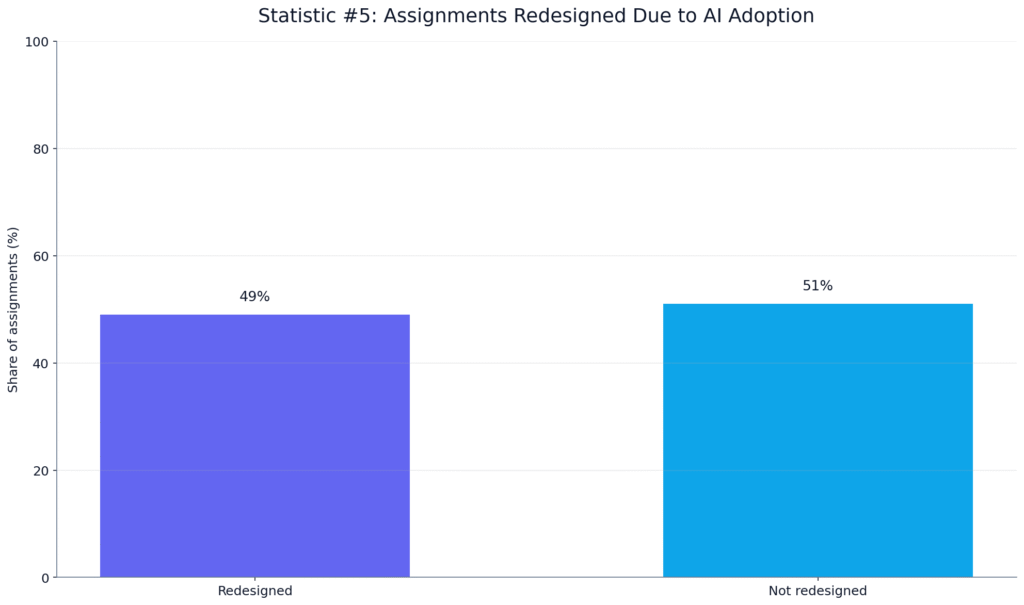
49% of assignments redesigned due to AI adoption shows that course architecture is already being rewritten in response to new writing habits. Nearly half is not a fringe adjustment, especially in a sector where assessment formats usually change slowly. When redesign appears at that scale, it suggests the pressure has reached the level of pedagogy rather than isolated concern.
The driver is straightforward. If a task can be completed too easily with generic prompting, instructors start adding reflection logs, oral defense, staged submissions, or evidence of process to restore meaningful evaluation. Redesign also happens because faculty want assignments that reward interpretation and judgment, which remain harder to automate than summary and surface-level prose.
Humans can explain why they chose a source, changed a claim, or softened a conclusion, whereas AI can only simulate that logic after the fact. So a 49% redesign rate tells us institutions are gradually moving assessment toward visible thinking instead of polished final copy alone. The implication is that the future of writing instruction may depend on process-rich assignments that make authorship easier to evaluate.
AI Writing in Higher Education Trends #6. Detection tools used in grading workflows
54% of grading workflows using detection tools suggests institutions are trying to recover certainty in an uncertain environment. The figure is high enough to show operational reliance, yet not high enough to imply full trust. That tension matters because workflow adoption can normalize a tool even when faculty remain skeptical of what its signals actually mean.
The reason these systems persist is that they promise speed where human review takes time. Instructors handling large class sizes may prefer a questionable indicator to having no indicator at all, especially during busy grading periods. Administrative pressure also plays a role, since a visible detection layer can look like accountability even when interpretation still depends on human judgment.
A lecturer reading tone, argument progression, and discipline fit still understands context better than a probability score can. With 54% already embedding detection into grading workflows, the risk is not blind faith alone but routine overreliance through convenience. The implication is that institutions need clearer boundaries for what detection can inform and what it should never decide on its own.
AI Writing in Higher Education Trends #7. Students reporting productivity gains
68% of students reporting productivity gains helps explain why AI writing tools keep spreading even under scrutiny. Students usually return to tools that save time on repetitive or structurally messy tasks. Productivity, in this case, is less a vague feeling and more a practical reduction in friction around brainstorming, outlining, and early drafting.
The gain appears because academic writing contains many stages that feel procedural before they feel intellectual. Generating a skeleton, rephrasing a sentence, or organizing notes can take long stretches of energy even before real analysis begins. AI compresses those setup costs, which makes the tool feel useful even when the final intellectual work still depends on the student.
Human productivity is richer than speed because it includes understanding, confidence, and the ability to defend choices under pressure. Still, 68% reporting gains means the tool is delivering enough immediate value to stay embedded in student behavior. The implication is that universities must separate efficiency support from learning outcomes, since faster writing does not automatically mean deeper learning.
AI Writing in Higher Education Trends #8. Faculty concerned about originality
62% of faculty concerned about originality reflects more than suspicion of technology. It shows discomfort with a growing gray zone where assistance, imitation, and authorship overlap in ways older plagiarism rules were not built to sort out. Originality used to be easier to infer from the finished page, but AI has made the finished page a weaker piece of evidence.
The concern persists because generated prose can sound competent without showing where insight actually came from. Faculty are not only asking whether a student used AI, but whether the student can still trace reasoning, justify phrasing choices, and own the intellectual path. Originality, then, becomes less about untouched language and more about visible thinking behind the language.
A human writer can explain why a claim matters in this course, for this source set, and for this reader at this moment. That is the layer AI tends to flatten, which is why 62% concern remains so understandable. The implication is that institutions may need to teach original contribution more explicitly as a process of reasoning, not just as a property of text.
AI Writing in Higher Education Trends #9. AI-assisted research summaries used
59% of AI-assisted research summaries used reveals how quickly students are outsourcing one of the most tempting bottlenecks in academic work. Summarizing dense material is time consuming, especially when vocabulary, methods, or theory feel unfamiliar. A high usage rate here suggests that AI is entering the reading stage, not just the writing stage.
The attraction is obvious because summary tools promise immediate orientation. Students facing long articles or unfamiliar domains can get a simplified map before they commit to deeper reading, which lowers the intimidation barrier. The problem is that simplified maps can omit caveats, flatten disagreement, and make weak comprehension feel stronger than it really is.
Human reading is slower, but it catches tension, ambiguity, and author intent in a way generated summaries often compress away. So 59% usage is helpful to explain behavior, yet it also hints at fragile understanding when summaries replace direct engagement. The implication is that faculty may need to assess reading depth more explicitly, since writing quality can now mask thin source comprehension.
AI Writing in Higher Education Trends #10. Students combining multiple AI tools
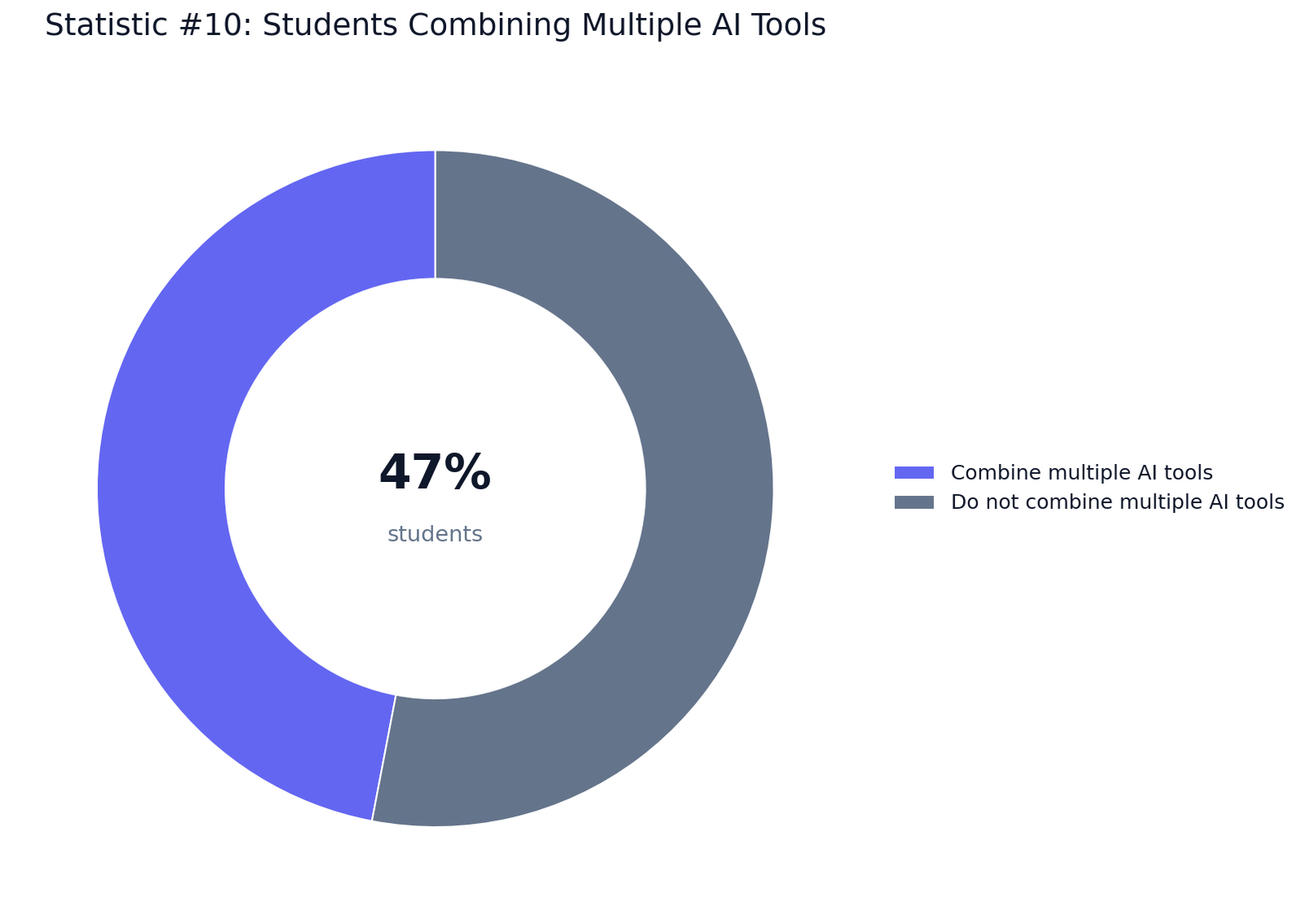
47% of students combining multiple AI tools suggests the ecosystem is becoming modular rather than platform-based. Students are not simply choosing one assistant and sticking with it from start to finish. They are assembling a chain where one tool drafts, another paraphrases, and a third checks tone, grammar, or structure.
This behavior grows because different tools solve different annoyances. One might be better at brainstorming, one cleaner at sentence refinement, and one more reassuring for detection concerns, so stacking becomes the logical strategy. Once students learn to compare outputs across tools, they also become more selective and more dependent on orchestration rather than simple usage.
A human editor can hold audience, assignment goals, and disciplinary tone together across the whole document without fragmenting purpose. Tool stacking, on the other hand, often improves surface quality while increasing the risk of inconsistency underneath. The implication is that higher education now has to think in terms of AI workflows, not isolated products, when defining acceptable writing support.
AI Writing in Higher Education Trends #11. Universities offering AI literacy training
44% of universities offering AI literacy training is notable because it is meaningful progress and still clearly incomplete. Less than half means many students and faculty are being asked to navigate powerful tools without shared language for risk, authorship, or evaluation. Training rates at this level usually mark a sector that understands the need but has not fully operationalized it.
The lag often comes from capacity rather than indifference. Designing useful AI literacy material means translating fast-moving technical behavior into discipline-specific guidance, and that takes staff time, coordination, and constant revision. Institutions also hesitate because they do not want training materials to become obsolete the moment tool behavior changes.
Human instruction remains essential here because literacy is not just feature awareness, but judgment under messy real conditions. A 44% training rate therefore suggests that many campuses are still relying on informal peer learning and uneven classroom-level explanations. The implication is that AI literacy may become a core academic support service, much like library instruction or writing center guidance.
AI Writing in Higher Education Trends #12. Students revising tone to sound human
61% of students revising tone to sound human shows how aware users have become of stylistic signals. Many students are not satisfied with readable output alone and are actively trying to remove stiffness, repetition, or generic phrasing before submission. That kind of revision reveals a strong social awareness of how AI text is perceived in academic settings.
The cause is partly fear and partly adaptation. Students know that machine-assisted prose can sound oddly polished in one sentence and strangely hollow in the next, so they revise to reduce that mismatch. They are also learning that academic writing is not just correct language, but voice calibrated to audience, discipline, and level of confidence.
A human voice carries lived emphasis, selective hesitation, and class-specific judgment that template-like prose rarely captures well. So when 61% are already tuning tone to appear more recognizably human, the issue is no longer raw generation alone but post-generation masking and refinement. The implication is that writing instruction may need to teach voice as a visible intellectual signal, not just a stylistic preference.
AI Writing in Higher Education Trends #13. AI used in non-English academic writing
52% of AI used in non-English academic writing highlights a dimension of adoption that is easy to underread. For many students, AI is not simply a shortcut but a language bridge that reduces friction around grammar, phrasing, and formal structure. When the number crosses the halfway mark, it suggests AI is becoming intertwined with linguistic access as well as productivity.
The underlying cause is straightforward because language confidence strongly shapes writing speed and risk tolerance. Students working across languages may use AI to smooth syntax, test vocabulary choices, or gain a first pass at academic phrasing before they apply their own subject knowledge. That creates real support value, though it can also blur where linguistic assistance ends and substantive contribution begins.
Human multilingual writers still bring cultural nuance, intended meaning, and discipline-aware phrasing choices that translation-like systems often flatten. Yet 52% usage shows why blanket bans can feel detached from actual student need. The implication is that policy conversations should treat AI not only as an integrity issue, but also as an access and equity issue within global higher education.
AI Writing in Higher Education Trends #14. Faculty adopting AI for feedback drafting
36% of faculty adopting AI for feedback drafting may look modest beside student usage, but it still marks a meaningful institutional turn. Once instructors use AI in their own workflow, the classroom conversation becomes less one-sided and more reciprocal. That matters because policy credibility changes when faculty are also negotiating the same tool they are regulating.
The main driver is time pressure. Feedback is one of the most pedagogically valuable parts of teaching and one of the most labor-intensive, so AI can feel helpful for producing a starting frame that an instructor then sharpens. Adoption stays lower than student use because faculty have reputational risk, stronger accountability, and a clearer sense of how generic wording can fail learners.
Human feedback still does the real teaching because it connects comments to the individual student, the assignment goal, and the developmental next step. Even so, 36% suggests that faculty-side AI use will steadily influence what reasonable tool use looks like on campus. The implication is that universities may need shared norms for instructional use as urgently as they need rules for student use.
AI Writing in Higher Education Trends #15. Students using AI for citation structuring
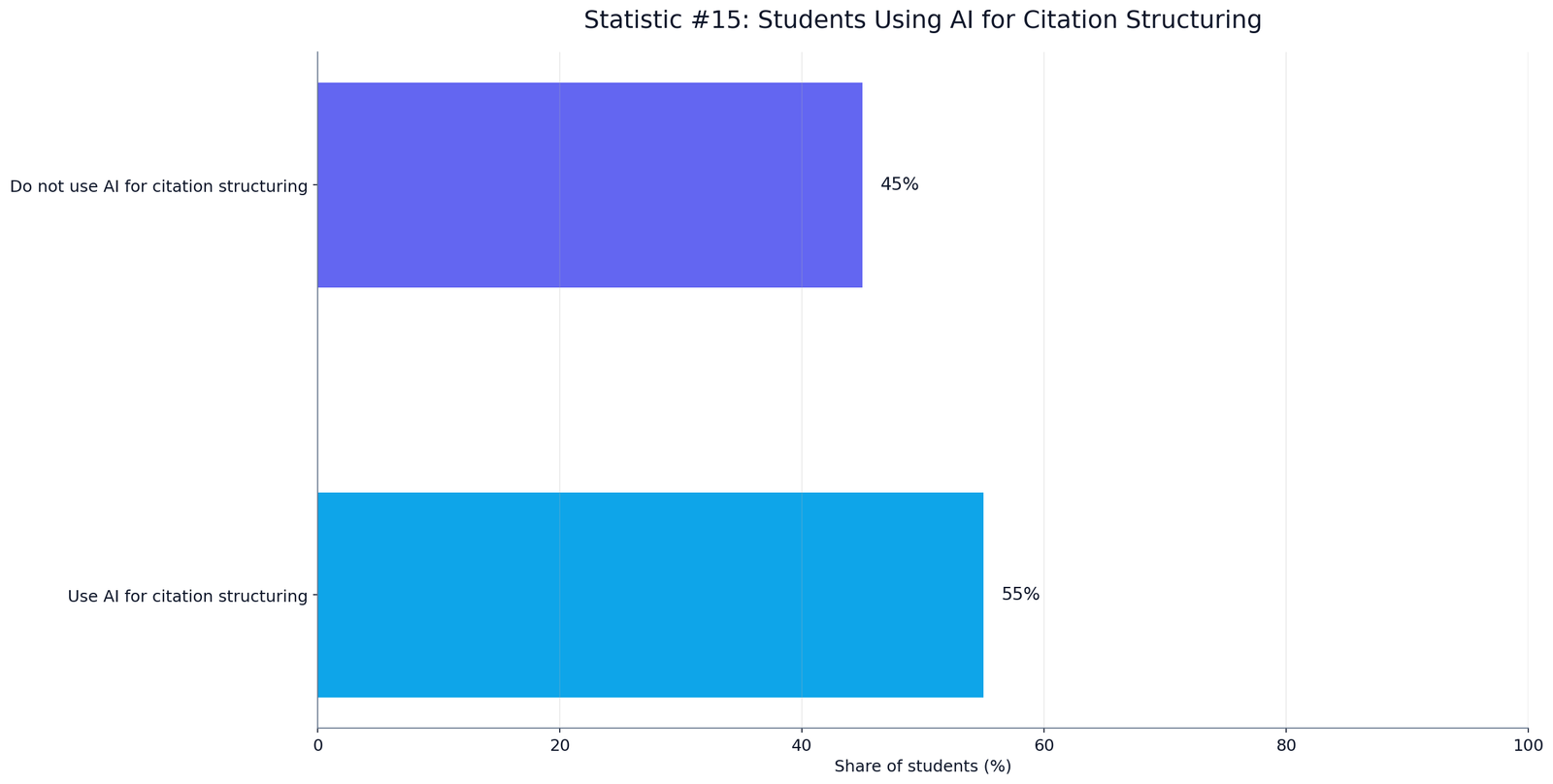
55% of students using AI for citation structuring shows that support demand is strongest where writing feels technical and unforgiving. Citation work can interrupt thinking because it requires precision, formatting recall, and attention to detail that many students find tedious under time pressure. A majority figure here tells us students are outsourcing the mechanics around scholarship, not only the prose itself.
The behavior grows because citation mistakes carry visible penalties even when ideas are strong. AI offers a quick way to organize references, format entries, or model citation patterns, which makes it appealing during the final assembly stage of an assignment. The risk, of course, is misplaced confidence, since neatly formatted citations can still contain invented or misread source details.
A careful human researcher checks whether the source exists, whether the citation matches the argument, and whether the reference actually supports the claim being made. That verification layer remains essential even when 55% use AI for structure. The implication is that information literacy now needs to cover not just how to cite, but how to audit machine-generated citation help.
AI Writing in Higher Education Trends #16. AI integrated into LMS platforms
33% of AI integrated into LMS platforms shows institutional embedding is still earlier than individual usage. Students may be using AI constantly, but platform-level integration remains selective, which creates a gap between informal practice and official infrastructure. That gap matters because once support appears inside the learning system itself, it starts to feel sanctioned, normalized, and harder to treat as exceptional.
The slower pace makes sense because platform integration requires procurement, privacy review, training, and support planning. Institutions move more cautiously when the tool becomes part of a shared environment rather than a private student choice. They also know that built-in tools influence behavior at scale, which raises the stakes of getting the policy and user experience right.
Human teaching still determines whether embedded AI is used thoughtfully or simply clicked for convenience. Yet a 33% integration rate suggests the direction of travel is institutional rather than purely personal. The implication is that governance will increasingly need to cover interface design, access defaults, and data practices, not only abstract statements on acceptable academic use.
AI Writing in Higher Education Trends #17. Assignments requiring AI disclosure
69% of assignments requiring AI disclosure indicates that transparency is becoming the preferred compromise between permission and prohibition. Disclosure rules do not eliminate uncertainty, but they create a record of tool involvement that can support more honest conversations around process. When nearly seven in ten assignments ask for this, disclosure is starting to function as a new norm of academic accountability.
The appeal is practical because disclosure is easier to implement than perfect detection or total bans. It gives faculty a framework to discuss acceptable use, and it places some responsibility on students to document how support entered the writing process. The weakness, of course, is that disclosure depends on honesty and on students understanding what actually counts as reportable use.
A human account of process can reveal intention, revision depth, and decision-making in ways a final document never fully can. So 69% disclosure tells us institutions are trying to make authorship more visible without pretending visibility is complete. The implication is that process statements and reflective notes may become ordinary companions to written work across many disciplines.
AI Writing in Higher Education Trends #18. Students concerned about detection accuracy
63% of students concerned about detection accuracy captures a trust problem that extends beyond software performance. Students worry not only about false signals, but also about how much those signals might matter once they enter formal academic review. Concern at this level suggests that detection anxiety has become part of the writing experience itself.
The cause is easy to understand because opaque scoring systems create fear when stakes are high and explanations are thin. Even students who use AI lightly, or not at all, can feel vulnerable if polished language, second-language fluency, or extensive revision might be misread. Once uncertainty becomes widespread, the tool affects behavior before any actual accusation appears.
Human review can slow the rush to judgment by considering context, drafting history, and the specific qualities of a student’s writing over time. But when 63% remain worried, reassurance cannot rely on vague promises that instructors will use discretion. The implication is that fair process and transparent evidence standards may matter as much as detection accuracy in preserving institutional trust.
AI Writing in Higher Education Trends #19. Peer collaboration using AI tools
41% of peer collaboration using AI tools suggests that writing support is becoming social as well as individual. Students are not always sitting alone with a chatbot and quietly producing text. In many cases, AI becomes part of group brainstorming, shared editing, or collaborative interpretation, which makes authorship even more distributed than policy language usually assumes.
This happens because group work already involves pooling strengths and dividing labor. Adding AI into that setting can feel like adding a neutral assistant that speeds discussion, drafts options, or resolves wording disagreements when time is short. The complication is that collaborative use can hide who contributed what, especially when the machine’s role is blended into group process rather than explicitly named.
Human collaboration carries negotiation, disagreement, and shared responsibility that can strengthen learning when it is visible. With 41% of peer activity already involving AI, institutions can no longer treat tool use as purely private behavior. The implication is that group assignments may need clearer disclosure language and stronger process documentation than solo assignments require.
AI Writing in Higher Education Trends #20. Institutions investing in AI infrastructure
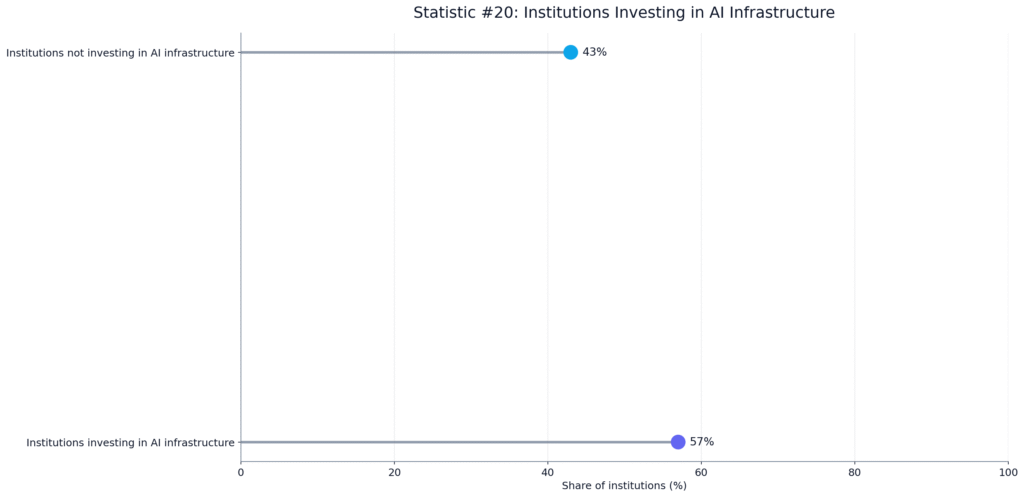
57% of institutions investing in AI infrastructure shows this is no longer a temporary monitoring phase. Investment decisions tend to signal strategic intent because budgets, procurement, staffing, and vendor relationships are involved. Once more than half are spending on infrastructure, AI moves from campus debate into institutional architecture.
The reason is that scattered tool use eventually creates pressure for a coordinated response. Universities need systems for access, privacy, support, training, policy enforcement, and integration, and those needs cannot be met through informal guidance alone. Infrastructure spending also reflects competition, since institutions do not want to appear technologically unprepared to students, faculty, or external partners.
Human leadership still decides whether investment supports learning or simply expands surveillance and dependency under a modern label. Yet 57% investing suggests that the argument has moved from whether AI belongs on campus to how it will be organized there. The implication is that governance quality may become the defining difference between campuses that adapt well and campuses that merely automate faster.
AI writing in higher education trends now point to process visibility, policy maturity, and deeper pressure on how institutions define learning
The strongest pattern across these figures is that AI is moving inward from student experimentation to institutional design. What began as tool use at the edge of coursework is now affecting feedback systems, assignment structures, disclosure norms, and platform strategy.
There is also a clear split between convenience and confidence. Campuses are adopting AI because it saves time and supports access, yet they are still working through originality, fairness, and evidence standards at the same time.
That tension explains why so many numbers cluster around partial adoption rather than full consensus. Higher education appears willing to integrate AI, but only with more visible process, more explicit expectations, and more human review wrapped around it.
The result is a sector that is neither resisting the technology nor fully settled with it. The road ahead seems less likely to be shaped by one perfect rule and more likely to depend on whether institutions can align support, transparency, and judgment in everyday academic practice.
Sources
- EDUCAUSE 2025 students and technology report on higher education
- EDUCAUSE AI landscape study introduction and key findings
- EDUCAUSE report on AI and work in higher education
- HEPI student generative AI survey 2025 overview page
- HEPI and Kortext student generative AI survey 2025 PDF
- HEPI student generative AI survey 2026 overview page
- HEPI and Kortext student generative AI survey 2026 PDF
- UNESCO guidance for generative AI in education and research
- Turnitin survey findings on the impact of AI in education
- Turnitin article on 2025 student generative AI behavior trends
- APRU white paper on generative AI in higher education
- Higher Education Authority evidence review on generative AI teaching
- Study on trajectories of AI policy in higher education