How to Refine AI Content for Academic Integrity: 15 Responsible Adjustments

2026 classroom standards are tightening as AI use grows, making refinement essential for credible submissions and consistent evaluation. Research such as this study in Nature Human Behaviour highlights how AI-generated text can blur authenticity, reinforcing the need for careful adjustments that restore clarity, accountability, and genuine authorship.
How to Refine AI Content for Academic Integrity: 15 Responsible Adjustments
AI-generated drafts can feel polished at first glance, yet something still feels off when you try to use them in academic work. You might notice vague claims, missing sources, or phrasing that doesn’t fully align with AI-assisted writing non-negotiables.
This happens because AI tools prioritize fluency over accountability, often skipping the deeper checks that academic standards demand. Without careful refinement, even well-written drafts can drift away from clarity, accuracy, and your own voice, which is why many turn to best AI humanizer tools to bridge that gap.
The good news is that refining AI content does not require starting over or removing its strengths. With a clear set of adjustments grounded in real AI writing support tools insights, you can turn rough outputs into credible, responsible academic work.
| # | Strategy focus | Practical takeaway |
|---|---|---|
| 1 | Clarify original intent | Align the draft with your actual assignment goals before editing details. |
| 2 | Replace vague claims | Swap general statements with precise, verifiable points. |
| 3 | Rebuild citations | Add credible sources where the draft makes unsupported assertions. |
| 4 | Adjust tone consistency | Match the writing style to academic expectations across sections. |
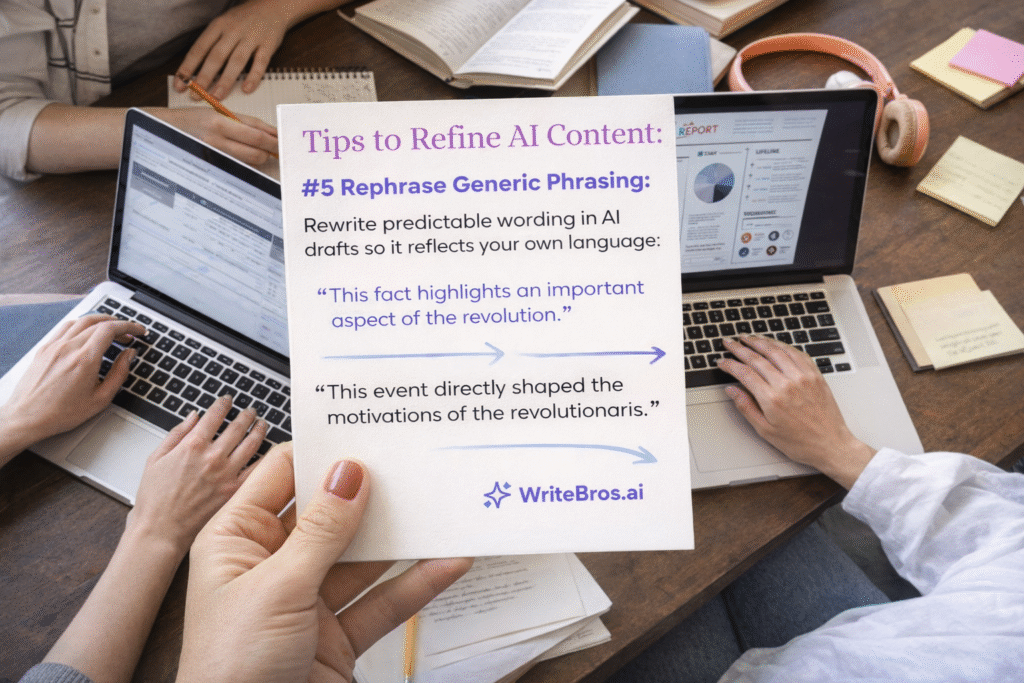
| 5 | Rephrase generic phrasing | Rewrite predictable wording so it reflects your own language. |
| 6 | Verify factual accuracy | Double-check names, dates, and data points before finalizing. |
| 7 | Strengthen argument flow | Ensure each idea logically connects to the next. |
| 8 | Add context depth | Expand thin explanations with relevant background or examples. |
| 9 | Remove filler language | Cut unnecessary phrases that dilute clarity. |
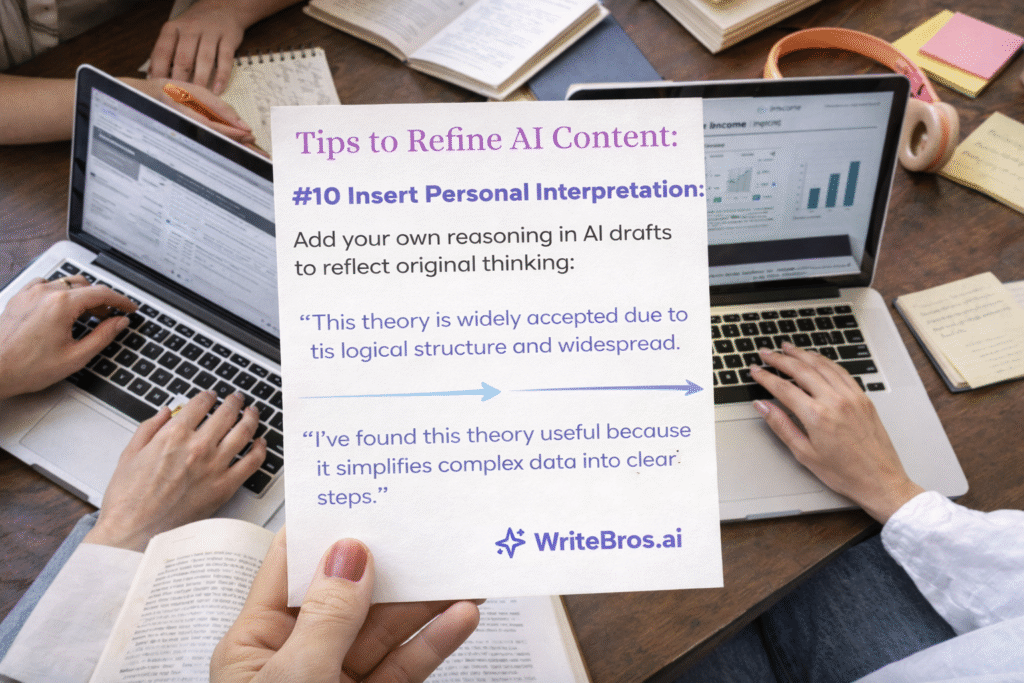
| 10 | Insert personal interpretation | Include your own reasoning instead of relying on generated summaries. |
| 11 | Check structural clarity | Organize paragraphs so each serves a clear purpose. |
| 12 | Balance sentence variety | Vary sentence length to improve readability and rhythm. |
| 13 | Ensure proper attribution | Clearly credit any ideas that are not originally yours. |
| 14 | Refine transitions | Use smoother connections to guide readers between ideas. |
| 15 | Final integrity review | Review the full piece to confirm it reflects honest, accurate work. |
15 Responsible Adjustments to Refine AI Content for Academic Integrity
How to Refine AI Content for Academic Integrity – Strategy #1: Clarify original intent
Start refining AI-generated content by carefully revisiting the original assignment prompt and aligning the draft with the intended learning outcome, since AI outputs often respond broadly rather than precisely to nuanced academic expectations. This means identifying what the task actually requires, such as analysis, comparison, or argument development, and then mapping the draft against those requirements. When this step is done properly, the content begins to reflect direction rather than general fluency, which is essential for maintaining academic integrity.
In practice, this works because many AI drafts include relevant information but lack focus, which can lead to misaligned submissions that appear incomplete or off-topic. A student working on a research essay might notice that the AI produced descriptive paragraphs instead of critical analysis, and adjusting the intent helps correct that imbalance. It also prevents subtle integrity issues where the content appears polished but does not truly answer the question being asked.
How to Refine AI Content for Academic Integrity – Strategy #2: Replace vague claims
AI-generated content often relies on broad or ambiguous statements that sound convincing but lack the specificity required in academic writing, so refining involves identifying and rewriting these sections with precise language. This includes replacing phrases that generalize findings with statements that reflect clear evidence, defined terms, or measurable outcomes. Doing so strengthens both credibility and clarity, ensuring the content meets academic standards rather than relying on surface-level fluency.
This matters in real scenarios because vague claims can easily be flagged during evaluation, especially when instructors expect detailed reasoning or supported arguments. For example, a sentence stating that a method is effective should instead explain how and why it is effective, supported by relevant context or data. Without this adjustment, the work risks appearing incomplete, even if the structure and tone seem acceptable.
How to Refine AI Content for Academic Integrity – Strategy #3: Rebuild citations
Refining AI content requires rebuilding citations from the ground up, since AI tools frequently generate references that are incomplete, outdated, or entirely fabricated. This step involves verifying every claim that requires support and replacing any unreliable references with credible, properly formatted sources. Taking the time to rebuild citations ensures that the content is grounded in verifiable research rather than unsupported assertions.
In real academic settings, citation accuracy directly impacts both grading and trust, especially when reviewers cross-check sources for authenticity. A student who relies on unverified AI-generated references may unintentionally submit work that cannot be validated, which raises integrity concerns. Rebuilding citations not only corrects this risk but also reinforces the legitimacy of the entire piece.
How to Refine AI Content for Academic Integrity – Strategy #4: Adjust tone consistency
AI drafts often shift tone unexpectedly, moving between formal, conversational, and overly simplified language, so refining involves standardizing the tone to match academic expectations throughout the entire piece. This requires reviewing each section and ensuring that vocabulary, sentence structure, and phrasing remain consistent. A steady tone signals control and intention, which are both essential for credible academic writing.
This adjustment becomes especially important in longer assignments where tone inconsistencies can make the writing feel fragmented or artificial. For instance, a section that suddenly becomes informal may disrupt the reader’s understanding and weaken the overall argument. Keeping tone consistent helps maintain coherence and supports the perception of original, carefully developed work.
How to Refine AI Content for Academic Integrity – Strategy #5: Rephrase generic phrasing
Generic phrasing is one of the most recognizable traits of AI-generated content, so refining involves rewriting these sections to reflect more specific and individualized language. This includes replacing predictable sentence structures with phrasing that mirrors your own way of expressing ideas. The goal is not to complicate the writing, but to make it feel intentional and grounded in your perspective.
In real use, this step helps reduce the risk of the content sounding formulaic or detached, which can raise concerns during review. A paragraph that reads like a template can be improved by adding subtle variation in wording and structure that reflects actual understanding. Over time, this habit builds a stronger writing voice that aligns with academic expectations.
How to Refine AI Content for Academic Integrity – Strategy #6: Verify factual accuracy
Verifying factual accuracy is essential when refining AI-generated content, since even well-written drafts can contain subtle errors in data, names, or timelines that are not immediately obvious. This step involves cross-checking each factual statement against reliable sources to confirm its validity before including it in the final version. Accuracy is not optional in academic work, and even minor inconsistencies can undermine the credibility of the entire piece.
In practice, this becomes especially important when dealing with technical subjects or historical references, where incorrect details can lead to misunderstandings or incorrect conclusions. A student might discover that an AI-generated statistic is outdated or misrepresented, requiring correction before submission. Taking time to verify facts ensures that the content reflects careful research rather than unchecked automation.
How to Refine AI Content for Academic Integrity – Strategy #7: Strengthen argument flow
AI-generated drafts often present ideas in isolation rather than as part of a cohesive argument, so refining requires restructuring the content to create a clear and logical progression. This involves connecting each paragraph to the next through reasoning rather than simply listing points. A strong argument flow allows the reader to follow the development of ideas without confusion or interruption.
This adjustment works because academic writing relies heavily on logical sequencing, where each point builds on the previous one to support a central thesis. For example, a paragraph introducing evidence should naturally lead into analysis rather than shifting abruptly to a new topic. Strengthening argument flow transforms a collection of ideas into a unified and persuasive piece.
How to Refine AI Content for Academic Integrity – Strategy #8: Add context depth
AI content can sometimes feel shallow because it summarizes information without providing enough background or explanation, so refining involves expanding these sections with meaningful context. This includes explaining key terms, outlining relevant frameworks, or connecting ideas to broader discussions within the subject area. Depth is what distinguishes a basic draft from a well-developed academic response.
In real scenarios, adding context helps demonstrate understanding rather than simple repetition of information. A paragraph discussing a concept becomes more effective when it explains how that concept applies within a specific situation or discipline. Without sufficient depth, the content may appear incomplete, even if it is technically correct.
How to Refine AI Content for Academic Integrity – Strategy #9: Remove filler language
AI-generated text often includes filler phrases that add length without contributing meaningful content, so refining requires identifying and removing these sections. This involves trimming redundant expressions and focusing on statements that directly support the argument or explanation. Clear and concise writing improves readability while maintaining substance.
This matters because filler language can dilute the strength of an argument, making the writing feel less focused and more repetitive. For instance, removing unnecessary qualifiers or repeated ideas can significantly improve clarity. A refined piece should feel deliberate and purposeful rather than padded for length.
How to Refine AI Content for Academic Integrity – Strategy #10: Insert personal interpretation
One of the key steps in refining AI content is adding your own interpretation, since academic work requires more than summarizing existing information. This involves explaining how you understand the material and presenting your reasoning in a way that reflects your perspective. Personal interpretation demonstrates engagement with the subject rather than passive reproduction of content.
In practice, this might involve connecting a concept to a specific example or explaining why a particular argument is convincing. A student who adds interpretation transforms a generic summary into a thoughtful analysis. This step is essential for maintaining academic integrity because it ensures that the work represents genuine understanding.
How to Refine AI Content for Academic Integrity – Strategy #11: Check structural clarity
Checking structural clarity involves reviewing how the content is organized to ensure that each section serves a clear purpose within the overall piece. This means confirming that introductions, body paragraphs, and conclusions are all functioning as intended and contributing to the main argument. A clear structure makes it easier for readers to follow the logic of the writing.
In real academic work, unclear structure can make even well-researched content difficult to understand. For example, a paragraph that mixes multiple ideas without clear transitions can confuse the reader and weaken the argument. Refining structure ensures that each part of the content supports the whole in a coherent way.
How to Refine AI Content for Academic Integrity – Strategy #12: Balance sentence variety
AI-generated writing often relies on repetitive sentence patterns, so refining involves introducing variation in sentence length and structure to improve readability. This includes combining shorter sentences where appropriate and breaking up overly long ones that may feel difficult to follow. Balanced sentence variety creates a more natural and engaging flow.
This adjustment works because consistent sentence patterns can make writing feel mechanical or monotonous. A paragraph that varies rhythm and pacing is easier to read and understand. Over time, this practice helps create writing that feels more dynamic and less predictable.
How to Refine AI Content for Academic Integrity – Strategy #13: Ensure proper attribution
Proper attribution is a fundamental part of academic integrity, so refining AI content requires clearly identifying which ideas come from external sources. This involves citing references accurately and ensuring that borrowed ideas are not presented as original. Transparency in attribution builds trust and credibility.
In real situations, failing to attribute sources correctly can lead to serious academic consequences. A student who includes information without proper citation risks accusations of plagiarism, even if the omission was unintentional. Ensuring proper attribution protects both the integrity of the work and the writer’s reputation.
How to Refine AI Content for Academic Integrity – Strategy #14: Refine transitions
Refining transitions involves improving the connections between ideas so that the content flows smoothly from one section to the next. This includes using linking phrases that guide the reader and clarify how each point relates to the overall argument. Strong transitions help maintain continuity throughout the piece.
In practice, weak transitions can make writing feel disjointed, even when the ideas themselves are solid. A paragraph that ends abruptly without connecting to the next one can disrupt the reader’s understanding. Refining transitions ensures that the content reads as a cohesive whole rather than a series of separate points.
How to Refine AI Content for Academic Integrity – Strategy #15: Final integrity review
The final step in refining AI content is conducting a comprehensive review to ensure that the work meets academic integrity standards in every aspect. This includes checking for accuracy, clarity, proper attribution, and alignment with the assignment requirements. A thorough review helps identify any remaining issues before submission.
In real academic settings, this final check acts as a safeguard against overlooked errors or inconsistencies. A student who reviews their work carefully can catch small issues that might otherwise affect the overall quality. Completing a final integrity review ensures that the content is both reliable and ready for evaluation.
Common mistakes
- Relying too heavily on AI-generated phrasing without reviewing whether it aligns with the assignment requirements, which often happens because the output sounds polished at first glance but lacks the necessary depth and specificity expected in academic work.
- Failing to verify citations provided by AI tools, which can lead to the inclusion of fabricated or inaccurate references that undermine the credibility of the entire submission and raise concerns during evaluation.
- Keeping vague or generalized statements in the final draft, which reduces the strength of the argument and makes the writing appear incomplete even if the structure is otherwise well organized.
- Ignoring tone inconsistencies throughout the document, which can result in sections that feel disconnected or artificial, especially in longer assignments that require sustained clarity and coherence.
- Overlooking the need for personal interpretation, which can cause the work to appear as a summary rather than an analysis, reducing its effectiveness in demonstrating understanding.
- Skipping the final review process, which often leads to small but impactful errors remaining in the content, ultimately affecting both quality and perceived integrity.
Edge cases
There are situations where AI-generated content may already appear highly refined, especially when dealing with general topics or widely discussed concepts, which can make it harder to identify areas that need improvement. In these cases, the focus should shift toward deeper evaluation, such as checking for originality in thought, ensuring alignment with specific assignment criteria, and verifying that the content reflects genuine understanding rather than surface-level fluency.
Another edge case involves time constraints, where students may rely more heavily on AI outputs due to limited preparation time, which increases the risk of submitting unrefined content. Even in these scenarios, applying a smaller set of high-impact adjustments, such as verifying facts and adding personal interpretation, can significantly improve the quality and integrity of the work without requiring a complete rewrite.
Supporting tools
- Reference management tools help organize and verify sources, ensuring that all citations are accurate and properly formatted, which is essential when rebuilding references from AI-generated drafts.
- Grammar and style checkers assist in identifying inconsistencies in tone and structure, allowing writers to refine their content for clarity and readability without altering the original meaning.
- Plagiarism detection tools provide an additional layer of review by highlighting sections that may require attribution or rewriting, helping maintain academic standards.
- Research databases offer access to credible and up-to-date sources, which is necessary for replacing unreliable references generated by AI tools.
- Note-taking applications help organize ideas and interpretations, making it easier to integrate personal insights into the refined content.
- WriteBros.ai supports the process of refining AI-generated content by helping adapt tone, improve clarity, and ensure alignment with academic expectations while maintaining the integrity of the original ideas.
Ready to Transform Your AI Content?
Try WriteBros.ai and make your AI-generated content truly human.
Conclusion
Refining AI-generated content for academic integrity is not about removing its strengths but about shaping it into something that reflects clarity, accuracy, and genuine understanding. Each adjustment builds toward a final piece that feels intentional, aligned, and credible within an academic context.
The goal is not perfection, but thoughtful improvement through consistent attention to detail and accountability. When each step is applied with care, the result is work that stands on its own merit and reflects both integrity and effort.
Did You Know?
AI academic drafts often sound credible because language models are good at producing clean structure and formal wording. Even when the writing looks polished, it can still blur the line between fluent language and work that is actually accurate, well-sourced, and clearly your own.
Reviewing the prompt again, checking sources, and rewriting generic sections usually improves integrity much faster than most people expect. Small edits can turn a smooth but risky draft into writing that feels more accountable, more specific, and much easier to defend in an academic setting.
Ready to Transform Your AI Content?