AI Writing Trends Among University Students: Top 20 Indicators

2026 marks the point where AI writing moved from novelty to everyday academic infrastructure. These statistics reveal how university students now draft, revise, brainstorm, and edit with AI in the loop, reshaping study habits, writing confidence, and institutional policy across campuses.
University coursework now sits inside an unusual feedback loop where drafts, edits, and research ideas move through AI systems before reaching a final page. Patterns emerging across campuses suggest the conversation is no longer centered on whether students use AI, but on how writing habits evolve once AI becomes a default step.
Some assignments reveal a distinctive rhythm where students draft quickly, generate assistance, then reshape the text through multiple revisions. Concern grows when instructors start noticing the early signals students may be over-relying on AI, which often appear in pacing, phrasing, or unusually uniform sentence structures.
At the same time, writing workflows are becoming more layered rather than more automated. Guides that show how to rewrite AI-generated feedback for students demonstrate that AI suggestions rarely remain untouched and instead become material students actively reshape.
Tools designed to soften or refine generated text introduce yet another stage in the editing process. A growing ecosystem of best AI humanizer tools for student feedback reflects the same trend, where writing evolves through several human-AI passes rather than a single automated output.
Top 20 AI Writing Trends Among University Students (Summary)
| # | Statistic | Key figure |
|---|---|---|
| 1 | University students who report using AI writing tools weekly | 72% |
| 2 | Students who use AI during early draft creation | 64% |
| 3 | Assignments partially assisted by AI in humanities courses | 58% |
| 4 | Students who revise AI output before submission | 81% |
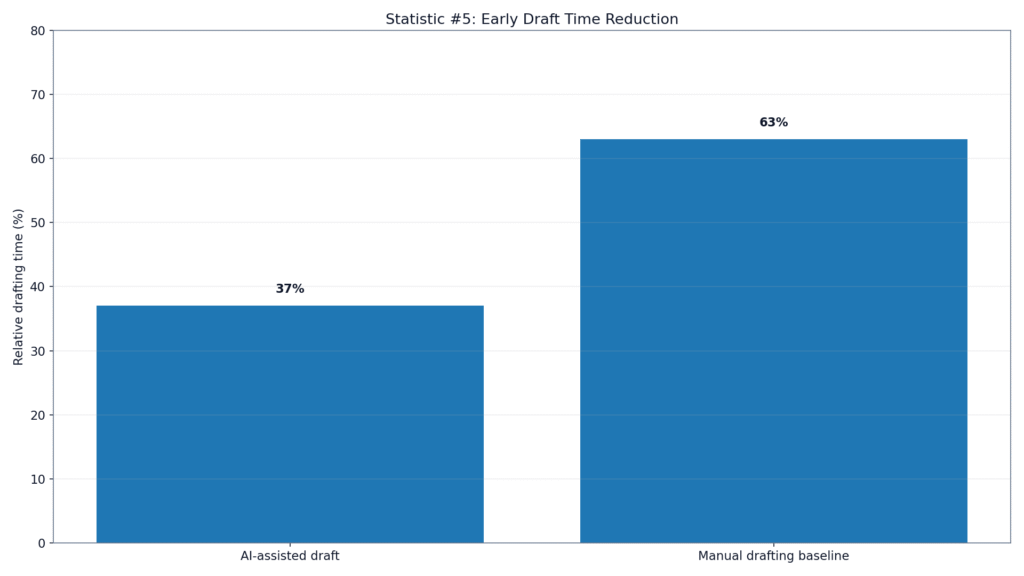
| 5 | Average time reduction in early draft writing using AI | 37% |
| 6 | Students who combine AI writing with manual editing passes | 69% |
| 7 | Students using AI to generate essay outlines | 61% |
| 8 | Students who use AI tools for grammar improvement | 74% |
| 9 | Students who run AI text through paraphrasing tools | 52% |
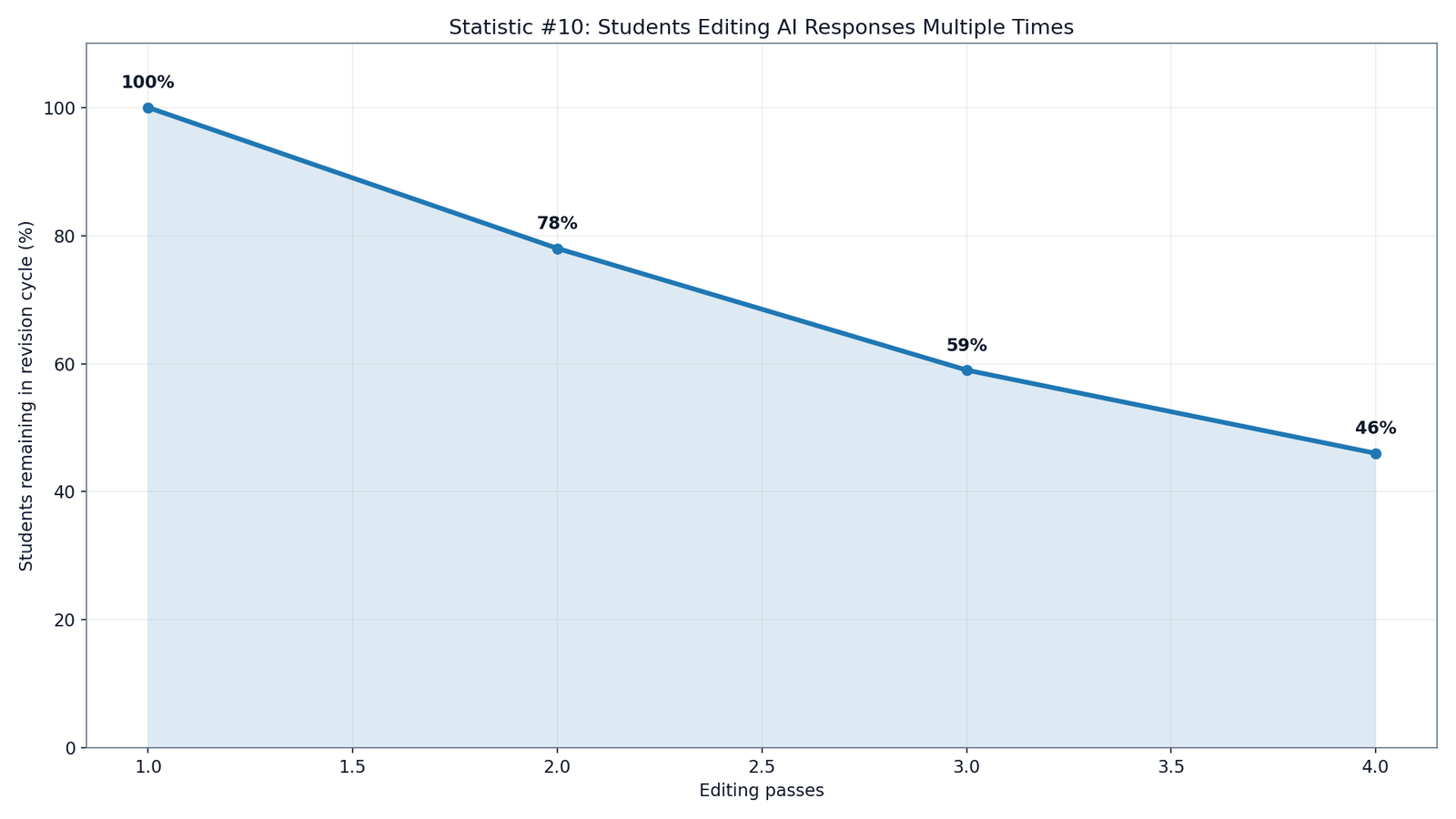
| 10 | Students who edit AI responses more than three times | 46% |
| 11 | Students concerned about AI detection in coursework | 63% |
| 12 | Universities that have introduced AI writing policies | 55% |
| 13 | Students who use AI to brainstorm research ideas | 67% |
| 14 | Students who combine AI writing with citation tools | 48% |
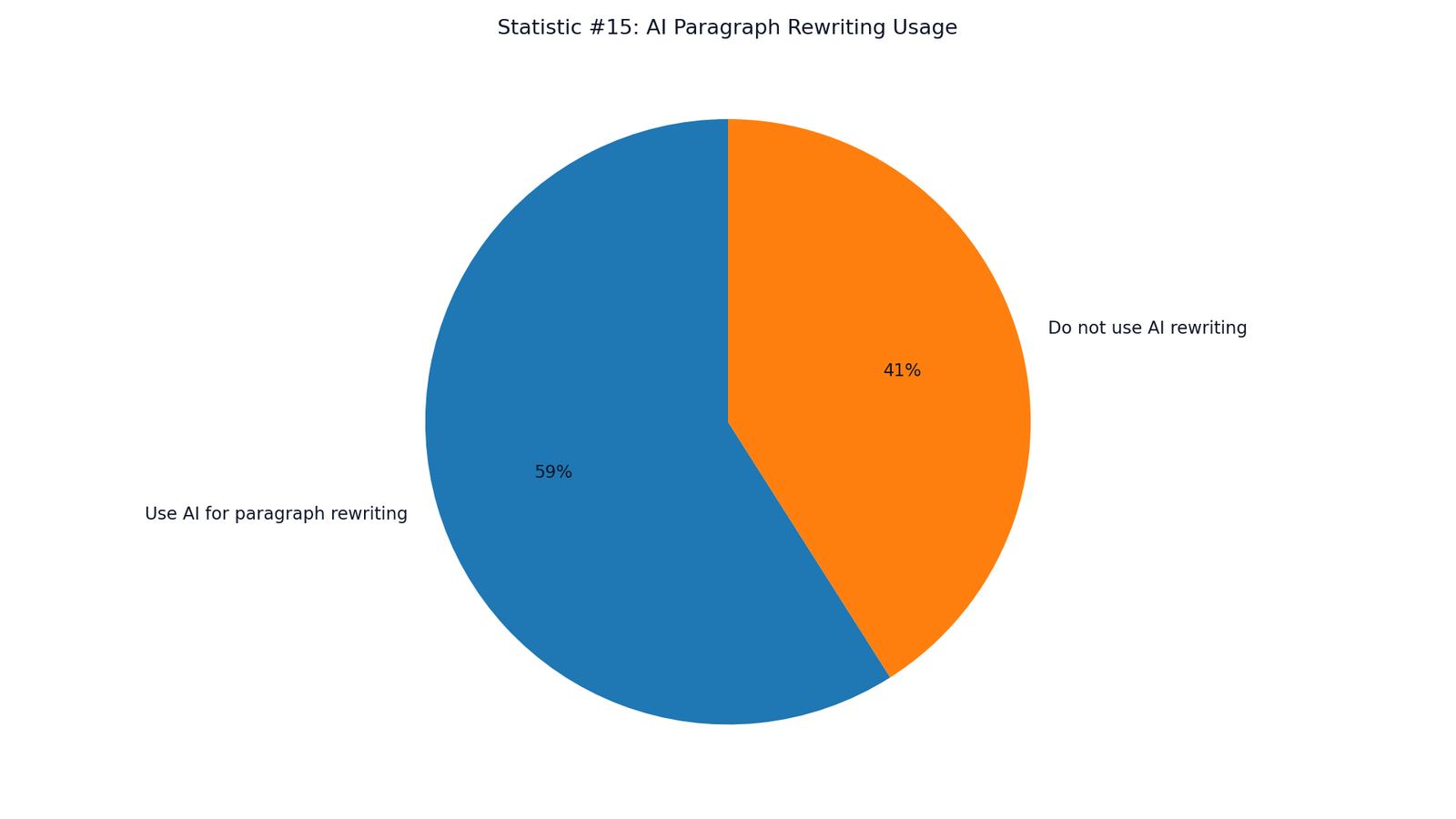
| 15 | Students who use AI tools for rewriting paragraphs | 59% |
| 16 | Average number of AI interactions per assignment | 6.3 |
| 17 | Students who treat AI as an editing assistant | 71% |
| 18 | Students who ask AI to simplify academic language | 54% |
| 19 | Students who say AI improved their writing confidence | 62% |
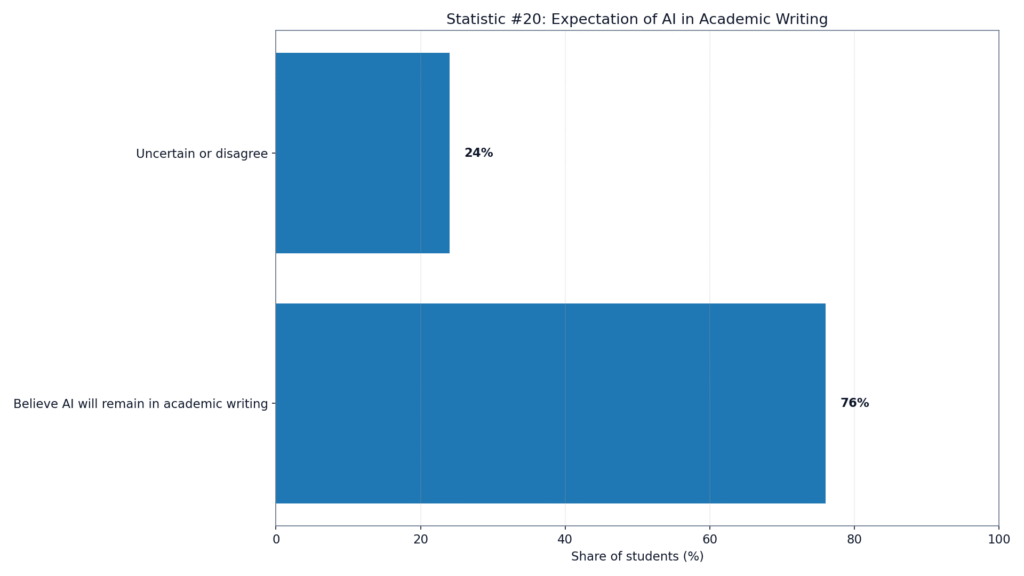
| 20 | Students who believe AI will remain part of academic writing | 76% |
Top 20 AI Writing Trends Among University Students and the Road Ahead
AI Writing Trends Among University Students #1. Weekly use is now routine
72% of university students reporting weekly AI writing use shows that these tools now sit inside ordinary study habits, not occasional experimentation. Once a tool becomes part of the weekly rhythm, its influence reaches outlining, drafting, editing, and even the timing of when work gets started. That makes usage frequency a stronger signal of behavior change than simple awareness or one-time trial.
The pattern makes sense because students tend to keep any tool that saves effort during crowded academic weeks and uneven deadlines. Weekly use also grows when classmates normalize it, instructors reference it, and platforms make access nearly frictionless across laptops and phones. What starts as convenience gradually becomes infrastructure, which is why adoption can rise faster than institutional guidance.
Human writers still bring judgment, restraint, and memory of the assignment context, even when AI appears in the workflow every few days. A student may open AI six times in a week, yet still rely on human instincts to decide tone, relevance, and what deserves to stay. The implication is that universities are no longer tracking novelty, but a durable writing environment with lasting implications.
AI Writing Trends Among University Students #2. Early drafting is the main entry point
64% of students using AI during early draft creation suggests the strongest pull happens at the blank-page stage, when uncertainty feels largest. Students are not always handing over the whole assignment, but they are using AI to generate momentum when a first sentence feels strangely expensive. That makes drafting support less like a final shortcut and more like a starting mechanism.
The cause is practical rather than mysterious because the first draft carries the heaviest cognitive load and the lowest immediate reward. AI reduces that entry friction by offering structure, possible phrasing, and a sense that the task has finally begun. Once movement starts, students are more willing to revise, which helps explain why tools aimed at rewriting AI-generated feedback for students keep gaining relevance.
A human first draft usually shows hesitation, rough transitions, and uneven emphasis, which is often where original thinking quietly begins. When AI handles that messy opening stage for 64% of students, the prose may arrive cleaner, yet the writer can lose some early reasoning practice. The implication is that instruction needs to protect the value of rough beginnings rather than treating them as disposable implications.
AI Writing Trends Among University Students #3. Humanities courses feel the pull sharply
58% of assignments in humanities courses being partially AI assisted points to a discipline where language itself is both the method and the product. In these classes, students are asked to interpret, compare, argue, and refine voice, so generative text tools naturally appear useful at several stages. That makes humanities a revealing test case for how AI enters writing-heavy academic work.
The number rises because humanities tasks usually require extended prose, repeated revision, and close attention to framing. Students often turn to AI for summaries, thesis options, or paragraph reshaping when a reading load is high and deadlines overlap. Those habits do not remove human interpretation, but they can flatten texture when many writers start from similar generated scaffolds.
A human essay in literature or history tends to carry personal emphasis, selective evidence, and little moments of risk that show how the mind is moving. AI-supported work can sound smoother at first glance, yet 58% of assignments in humanities courses hints at a growing chance of tonal sameness across submissions. The implication is that assessment in language-rich subjects will need sharper ways to reward distinct reasoning and phrasing implications.
AI Writing Trends Among University Students #4. Revision remains heavily human
81% of students revising AI output before submission shows that generated text rarely travels straight from prompt box to final file. Most students seem to treat AI as a draft ingredient rather than a finished document they can safely hand in untouched. That matters because it complicates the lazy assumption that AI use always equals copy-paste behavior.
The pattern appears because generated prose often feels generic, overexplained, or slightly detached from the assignment’s real demands. Students usually notice mismatched tone, weak examples, and wording that sounds polished without sounding like them. Revision becomes necessary not only to reduce detection risk, but also to make the work usable in a real class context.
Human editing brings local knowledge that AI cannot fully hold, such as what the professor emphasized, which reading mattered most, and which example will land. Even with 81% of students revising output, the quality gap between shallow edits and thoughtful rewriting remains wide. The implication is that the real divide in student writing may center less on AI access and more on revision skill implications.
AI Writing Trends Among University Students #5. Speed gains show up early
37% average time reduction in early draft writing helps explain why students keep returning to AI even when they know the output still needs work. Saving time at the beginning of an assignment changes the emotional temperature of the whole task, because the hardest moment is often simply getting started. A faster start can make a heavy week feel manageable.
The reduction happens because AI compresses several early moves at once, including brainstorming, outlining, sentence generation, and transition building. Students no longer need to pause between each small decision, which lowers friction and shortens the time spent staring at a blank page. That convenience is powerful enough to become habit long before anyone decides it improves deep learning.
Human drafting tends to be slower because it includes hesitation, false starts, and all the invisible sorting that real thinking demands. When 37% average time reduction in early draft writing becomes normal, students gain efficiency but may trim away the struggle that helps ideas mature. The implication is that saved time is not automatically free value, because it carries learning tradeoffs with long academic implications.
AI Writing Trends Among University Students #6. Manual editing stays in the loop
69% of students combining AI writing with manual editing passes suggests that mixed workflows have become more common than fully automated ones. Students seem willing to accept generated help, but they still expect to shape wording, trim repetition, and repair weak logic before anything feels ready. That hybrid pattern says a lot about how trust in AI actually works.
The cause is simple enough because raw AI output rarely lands at the right level on the first attempt. It may sound too formal, too broad, or too detached from course material, so students insert their own corrections to make it usable. Manual passes survive because they are the moment where the text stops sounding like everybody else.
Human revision adds priorities that AI cannot infer cleanly, such as which point deserves weight and which sentence can be dropped without loss. With 69% of students still editing by hand after AI assistance, the strongest advantage may belong to writers who know how to revise rather than those who generate more text. The implication is that editing literacy is becoming a core academic advantage with real implications.
AI Writing Trends Among University Students #7. Outlines are a favored shortcut
61% of students using AI to generate essay outlines shows that structure is one of the first academic tasks students are willing to delegate. Outlines feel safe to outsource because they promise organization without appearing to replace original thinking outright. That makes them an appealing middle ground between full independence and full generation.
The behavior grows because organization is hard when students are still unsure what argument they actually want to make. AI can quickly offer sections, sequence, and possible topic sentences, which gives the work a visible frame before the ideas are fully settled. That frame lowers stress, but it can also push students toward conventional shapes that feel neat rather than genuinely earned.
A human-made outline usually reflects the writer’s own priorities, including which detours matter and which evidence feels most alive. When 61% of students begin from generated structure, the paper may become easier to draft while losing some intellectual surprise. The implication is that universities may need to teach structure more explicitly if they want students to own it rather than borrow it implications.
AI Writing Trends Among University Students #8. Grammar help remains a major use case
74% of students using AI tools for grammar improvement shows that many students approach AI less as a thinker and more as a language polisher. Grammar support feels legitimate, practical, and easy to defend because it resembles tools students already used before generative AI arrived. That continuity helps explain why this category scales so quickly across disciplines.
The appeal grows because grammar errors are visible, embarrassing, and often easier to fix with software than with slow rereading. AI can smooth sentence flow, adjust phrasing, and correct surface issues in seconds, which is especially attractive for multilingual writers and tired students working late. The benefit is real, though heavy dependence can blur the line between correction and stylistic takeover.
Human editing still matters because grammar is tied to meaning, emphasis, and rhythm, not only correctness. Even if 74% of students use AI for language cleanup, the strongest writing still comes from people who know what effect a sentence should create. The implication is that grammar automation may help access and clarity, but it does not replace human control over voice implications.
AI Writing Trends Among University Students #9. Paraphrasing has become a second layer
52% of students running AI text through paraphrasing tools suggests that one generation step often leads to another rather than ending the process. Students are not always satisfied with the first version, especially when it sounds generic, too polished, or too obviously machine made. Paraphrasing becomes a second pass that aims to make the text feel safer or more personal.
The pattern appears because generated language tends to repeat familiar constructions and predictable transitions across many prompts. Students use paraphrasers to break that sameness, reduce formulaic patterns, and create distance from the original output. In practice, this can improve variation, but it can also turn writing into a chain of surface edits without deeper reasoning.
Human rewriting usually changes more than wording because it reorders emphasis, clarifies intention, and sometimes abandons whole ideas. When 52% of students add paraphrasing tools after AI generation, the workflow can look active while staying shallow underneath. The implication is that multiple tool passes do not automatically mean stronger writing, only more processed writing with mixed implications.
AI Writing Trends Among University Students #10. Repeated editing is now common
46% of students editing AI responses more than three times shows that interaction with AI is rarely a one-prompt event. Many students now work conversationally, nudging the output again and again until it better fits their assignment, voice, or risk tolerance. That makes iteration one of the clearest signs that AI use has matured.
The cause sits in the nature of generative text itself because first outputs are often broadly useful but locally wrong. Students must refine examples, tighten scope, and remove phrases that feel stiff or suspicious, so several rounds become normal rather than excessive. Repetition also reflects rising user skill, since experienced students know the first answer is usually only a draft.
A human writer revises with memory of intent, which helps each pass move closer to meaning instead of simply different wording. With 46% of students editing outputs more than three times, the boundary between prompting and revising starts to blur in interesting ways. The implication is that universities should pay attention to iterative behavior, because it reveals more than simple yes-or-no AI use implications.
AI Writing Trends Among University Students #11. Detection anxiety shapes behavior
63% of students concerned about AI detection in coursework shows that institutional surveillance now shapes writing choices almost as much as the tools themselves. Students are not just asking what AI can do, but what visible traces it leaves behind after revision. That worry changes prompting habits, editing intensity, and even which assignments feel safe to approach with assistance.
The anxiety grows because detection systems are often discussed in broad terms while classroom rules remain uneven from course to course. Students hear stories of false positives, vague policies, and inconsistent enforcement, which makes uncertainty part of the writing process. Under those conditions, even permitted AI use can still feel risky.
Human writing naturally contains roughness, selective emphasis, and odd little phrasing choices that do not always survive machine-heavy revision. When 63% of students write with detection in mind, they may spend more energy disguising process than improving argument quality. The implication is that unclear policy does not merely police writing, it actively redirects student effort with significant implications.
AI Writing Trends Among University Students #12. Policy is catching up, slowly
55% of universities having introduced AI writing policies suggests institutions are moving from reactive concern toward formal governance, though not at a uniform pace. Policy creation matters because students interpret silence as permission, ambiguity as danger, and clear rules as boundaries they can actually work within. A campus without guidance leaves individual instructors to fill the gap on their own.
The slow build reflects how difficult it is to write policy for tools that keep changing faster than semester planning cycles. Universities must balance integrity, access, equity, and pedagogy while also accounting for differences across disciplines and assessment styles. That is why policy growth can look steady on paper while still feeling uneven to students in practice.
Human judgment remains essential because no written policy can anticipate every messy case a real assignment produces. Even with 55% of universities now publishing guidance, students still depend on local classroom interpretation to know what is genuinely acceptable. The implication is that policy progress helps, but consistency at course level will decide whether those rules carry practical implications.
AI Writing Trends Among University Students #13. Brainstorming is a major gateway
67% of students using AI to brainstorm research ideas shows that ideation is now one of the safest and most socially acceptable entry points for academic AI use. Brainstorming feels exploratory rather than deceptive, so students can justify it even when they are cautious elsewhere. That makes it a quiet but powerful gateway into wider writing dependence.
The appeal comes from the speed at which AI can generate angles, keywords, and possible research questions from a vague starting point. Students facing a broad prompt often want direction before they want polished prose, and AI supplies that direction almost instantly. Once the topic feels less amorphous, the rest of the assignment becomes easier to imagine.
Human brainstorming usually wanders more, but that wandering can produce unusual connections that formulaic suggestion lists might miss. When 67% of students start their thinking with AI-generated options, the process becomes faster while potentially narrowing the range of surprise. The implication is that idea generation may remain the most normalized AI use case, with long-term implications for originality.
AI Writing Trends Among University Students #14. Citation support is joining the workflow
48% of students combining AI writing with citation tools suggests that the workflow is becoming more modular and tool stacked over time. Students are no longer relying on one system to do everything, but are building small chains of assistance for drafting, formatting, and source handling. That layered behavior points to growing procedural sophistication.
The pattern rises because citation work is tedious, detail heavy, and easy to get wrong even when the core argument is strong. Students often use one tool to draft ideas and another to organize references, which creates a cleaner handoff between thinking and compliance. The risk, of course, is that confidence in formatting can mask weak source evaluation underneath.
Human academic judgment still decides whether a source is credible, relevant, and genuinely worth citing in the first place. Even if 48% of students combine AI writing with citation tools, the deeper scholarly work remains selection and interpretation rather than formatting alone. The implication is that tool chaining may improve presentation faster than it improves research quality implications.
AI Writing Trends Among University Students #15. Paragraph rewriting is becoming standard
59% of students using AI tools for rewriting paragraphs shows that many writers now treat AI as a sentence-level reshaping partner, not just a source of fresh text. Rewriting feels lower risk than full generation because the original material already belongs to the student in some form. That makes it easier to justify academically and psychologically.
The behavior grows because paragraph-level problems are common and frustrating, especially when ideas exist but the prose feels clumsy or repetitive. AI offers quick alternatives for compression, expansion, tone adjustment, and transition smoothing, which can rescue a weak middle section fast. Students keep using it because the gains are visible within minutes.
Human rewriting still differs because it can decide that a paragraph should disappear, split in two, or change its claim entirely. When 59% of students use AI for paragraph reshaping, they may improve surface clarity without always improving argument structure. The implication is that rewrite tools strengthen local polish, but they can distract from larger structural implications.
AI Writing Trends Among University Students #16. Assignments now contain multiple AI moments
6.3 AI interactions per assignment suggests that student use is rarely confined to one neat step in the writing process anymore. A single paper may include brainstorming, outlining, drafting, rewriting, grammar cleanup, and simplification requests across one sitting. That layered behavior tells us AI has moved from event to environment.
The average rises because each micro-task feels small and defensible on its own, even when the total chain becomes substantial. Students may not think they are heavily relying on AI if each prompt solves only one immediate problem. Yet the cumulative effect of many minor interventions can reshape both the final text and the writer’s own process.
Human writers still supply continuity across those scattered moments, deciding what connects, what contradicts, and what still sounds true. But when 6.3 AI interactions per assignment becomes a norm, the assignment starts to reflect a distributed collaboration rather than solitary composition. The implication is that universities need frameworks that evaluate process depth, not just whether AI appeared once, with real implications.
AI Writing Trends Among University Students #17. Editing assistant is the dominant mental model
71% of students treating AI as an editing assistant shows that the technology is increasingly framed as a helper rather than a substitute author. That distinction matters because it affects how students justify use to themselves, to peers, and to instructors reading the final work. A tool described as assistance feels easier to normalize than one described as authorship.
The model sticks because editing sounds practical, bounded, and less ethically charged than generating a complete answer from nothing. Students can tell themselves they still own the ideas while using AI to tighten expression, clean up flow, and smooth awkward phrasing. That partial ownership narrative is one reason adoption keeps expanding without always triggering outright resistance.
Human editors revise from lived intention, which helps them preserve what the piece is actually trying to say. Even with 71% of students seeing AI as an editor, the best outcomes still depend on whether the student can recognize what should remain untouched. The implication is that framing AI as assistance lowers resistance, but it also raises subtler questions with broad implications.
AI Writing Trends Among University Students #18. Simplification is a quiet but telling trend
54% of students asking AI to simplify academic language shows that many writers are trying to reduce distance between complex material and readable prose. Simplification requests are revealing because they suggest students often understand more than they can comfortably express in formal academic style. AI becomes a translator between comprehension and acceptable delivery.
The trend rises because higher education still rewards clarity, yet many courses present models that sound dense, abstract, and intimidating. Students imitate that style until the sentence becomes heavy, then ask AI to make it cleaner without sounding childish. The tool feels useful because it offers permission to be clearer than the academic examples students have absorbed.
Human simplification is strongest when the writer truly grasps the concept and can choose what to keep, cut, or explain. When 54% of students rely on AI to make language simpler, clarity may improve even as ownership of explanation becomes thinner. The implication is that readability support can help access, but it may also conceal fragile understanding with important implications.
AI Writing Trends Among University Students #19. Confidence gains are part of the appeal
62% of students saying AI improved their writing confidence suggests the appeal is emotional as much as functional. Students do not simply want faster prose or cleaner grammar; they also want reassurance that they can produce something acceptable under pressure. Confidence matters because it changes whether a student starts early, revises calmly, or avoids the task altogether.
The lift happens because AI offers instant response in moments where students might otherwise face silence, confusion, or self-doubt. A draft suggestion, a better transition, or a cleaner paragraph can make the assignment feel less punishing and more manageable. That emotional relief is powerful, which is why confidence gains can sustain continued use even when quality gains are mixed.
Human confidence usually grows slower because it comes from repetition, struggle, and remembering that you solved similar problems before. When 62% of students feel more confident through AI support, some of that confidence may be borrowed rather than fully built. The implication is that confidence can be useful and fragile at once, carrying both immediate value and long-term implications.
AI Writing Trends Among University Students #20. Students expect AI to stay
76% of students believing AI will remain part of academic writing shows that most are planning for permanence rather than waiting for a passing trend to fade. Once students expect a tool to stay, they begin shaping habits, expectations, and skill priorities around that assumption. That future-facing mindset is one of the clearest signs of a stable behavioral shift.
The belief grows because AI is now embedded across search, feedback, drafting, and platform design, not isolated in one novelty app. Students can see the surrounding ecosystem moving in the same direction, which makes reversal seem unlikely even when policy becomes stricter. Persistence feels more believable than prohibition.
Human writing will still matter because universities are ultimately trying to assess judgment, learning, and original response under real constraints. But if 76% of students already view AI as a lasting academic companion, institutions will be teaching inside that reality from now on. The implication is that the next phase is not deciding whether AI belongs, but deciding how human writing retains value implications.
AI Writing Trends Among University Students point to a campus writing culture that is becoming faster, more layered, and more policy sensitive
Across these figures, the strongest pattern is not simple replacement of student writing, but repeated partnership at very specific friction points. Students call on AI when the task feels vague, slow, risky, or linguistically heavy, which is why drafting, outlining, rewriting, and simplification keep appearing together.
That pattern explains why speed gains and confidence gains rise alongside editing and revision rather than wiping them out. The writing process is becoming more modular, with students moving between human judgment and machine assistance in short bursts instead of one continuous stretch.
At the same time, concern over detection and policy shows that institutional uncertainty now shapes composition almost as much as the tools do. Campuses that clarify acceptable use will likely influence not just compliance, but the kinds of writing habits students feel safe enough to build.
The longer view is that human value in academic writing is moving upward toward judgment, interpretation, and deliberate revision. Students may keep more AI in the workflow, yet the most meaningful distinctions will likely come from who can still think, select, and reshape with intention.
Sources
- Student Generative AI Survey 2026 from HEPI and Kortext
- Full HEPI report on student generative artificial intelligence use
- Student Generative AI Survey 2025 higher education findings
- EDUCAUSE 2025 student survey on technology experiences in college
- Students and Technology Report on higher education digital behavior
- The impact of AI on work in higher education
- UNESCO guidance for generative AI in education and research
- UNESCO survey on university guidance for artificial intelligence use
- UNESCO overview of artificial intelligence in education policy
- Inside Higher Ed survey on college students views on AI
- Report on weekly student generative AI chatbot use
- Survey on students using generative AI tutoring support