How to Rewrite AI-Generated Feedback for Students: 15 Clear Improvements

2026 classrooms are quietly rewriting how feedback works as AI enters grading workflows. Evidence from the Stanford HAI study on generative AI in education shows teachers increasingly edit automated feedback to maintain clarity, tone, and student trust.
How to Rewrite AI-Generated Feedback for Students: 15 Clear Improvements
AI-generated feedback can feel technically correct yet strangely distant for students reading it. Many teachers notice that comments sound generic or mechanical, which creates hesitation around the fair use of AI writing tools in real classroom practice.
This happens because automated feedback systems rely on patterns rather than classroom context or student voice. Even when the ideas are helpful, educators still need editing habits similar to those used with best AI humanizer tools for teaching materials to make feedback clearer and more personal.
The goal is not to remove AI assistance but to reshape it so the comments feel natural and useful to students. The strategies below explain how teachers can refine AI comments effectively while keeping pace with trends such as student adoption of AI writing tools statistics that show how quickly AI is entering classrooms.
| # | Strategy focus | Practical takeaway |
|---|---|---|
| 1 | Clarify the main point | Identify the single idea the comment is trying to convey and rewrite it so the student immediately understands the priority. |
| 2 | Remove robotic phrasing | Replace formula-like sentences with conversational language that sounds like something a teacher would naturally say. |
| 3 | Make feedback specific | Swap vague advice with direct references to the student’s actual paragraph, claim, or example. |
| 4 | Shorten long explanations | Break dense comments into shorter, clearer sentences that students can process quickly. |
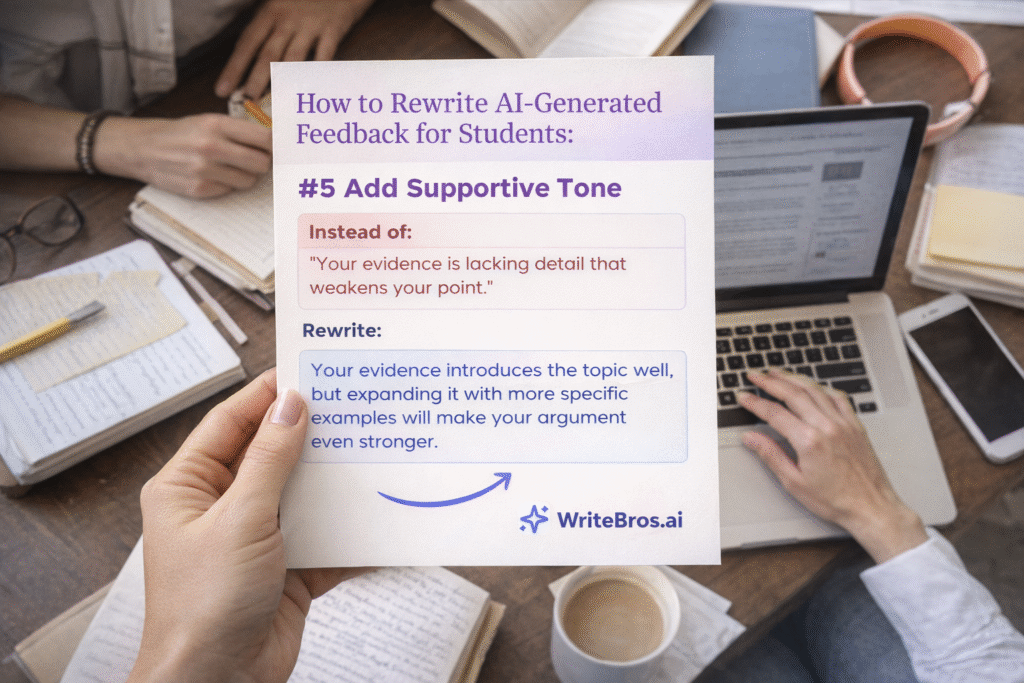
| 5 | Add supportive tone | Balance corrections with encouraging language so feedback feels constructive instead of purely corrective. |
| 6 | Connect to learning goals | Link the comment to a skill the student is practicing so the suggestion feels purposeful. |
| 7 | Highlight one improvement step | Guide the student toward a single revision they can attempt right away rather than multiple scattered suggestions. |
| 8 | Use examples from the draft | Point to a sentence or section from the student’s work to show exactly what needs attention. |
| 9 | Replace general advice | Turn broad recommendations into precise actions the student can apply during revision. |
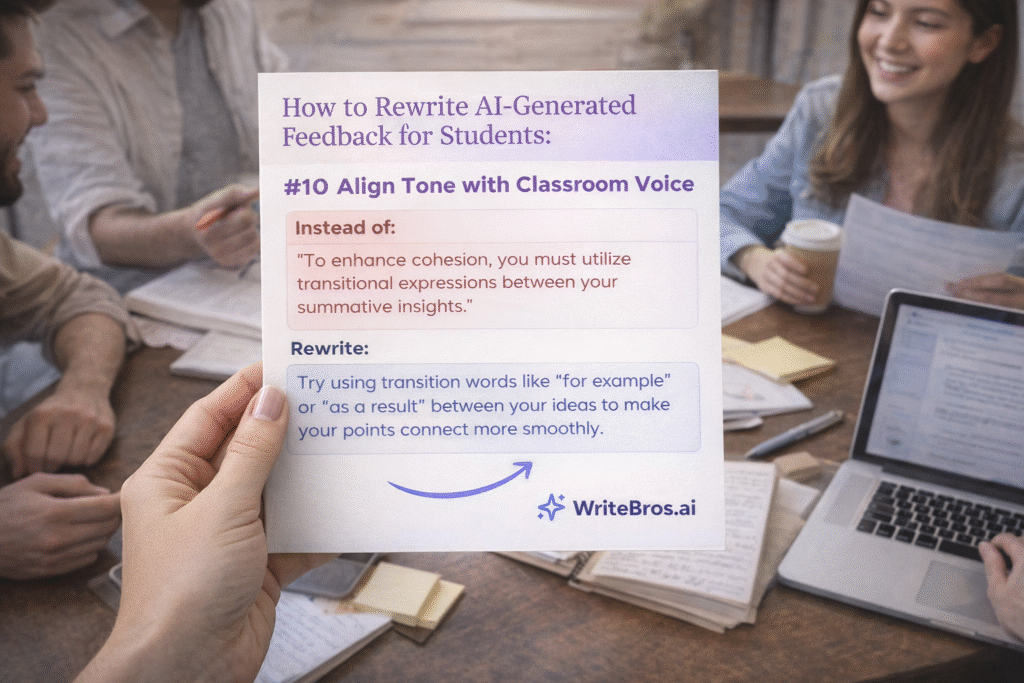
| 10 | Align tone with classroom voice | Edit the comment so it matches the tone students already recognize from classroom instruction. |
| 11 | Simplify academic wording | Translate overly formal language into everyday phrasing that students can interpret quickly. |
| 12 | Encourage reflection | Turn certain statements into short guiding questions that help students rethink their own work. |
| 13 | Remove repetitive comments | Condense repeated advice so students focus on the most meaningful suggestion. |
| 14 | Prioritize clarity over length | Edit comments so they communicate the idea quickly instead of overwhelming the reader. |
| 15 | End with an actionable revision | Close the feedback with a clear next step the student can implement during their next draft. |
15 Clear Improvements to Rewrite AI-Generated Feedback for Students
How to Rewrite AI-Generated Feedback for Students – Strategy #1: Clarify the main point
AI feedback frequently contains several loosely connected observations within a single comment, which can make it difficult for students to understand the central issue that deserves their attention first. When rewriting AI-generated feedback for students, the first step is identifying the one idea that actually matters most within the comment and restructuring the wording so the student immediately understands what they should focus on improving. This often requires removing filler phrases, reorganizing sentences, and reshaping the message so the main suggestion appears clearly rather than buried in a paragraph of general analysis.
Teachers who review automated feedback often notice that students respond better when each comment clearly signals a single direction rather than presenting multiple possible interpretations. Imagine a student reading a paragraph that discusses clarity, structure, evidence, and transitions all at once, which can feel overwhelming and prevent them from knowing what to revise first. A rewritten version that clearly states the main improvement, such as strengthening the claim or reorganizing the opening sentence, helps the student understand the purpose of the feedback and approach revision with confidence.
How to Rewrite AI-Generated Feedback for Students – Strategy #2: Remove robotic phrasing
Automated feedback systems tend to generate language patterns that sound technically accurate yet noticeably mechanical, which often makes students feel like the comment came from software rather than a teacher who read their work carefully. When rewriting AI-generated feedback for students, educators should reshape these phrases into language that resembles natural conversation, keeping the meaning intact while replacing rigid wording with clearer and more approachable sentences. This adjustment helps feedback feel more personal and prevents the student from disengaging simply because the tone feels artificial.
In practice, robotic phrasing often appears through formula-like structures such as “the argument could be improved through additional elaboration,” which may sound polished yet distant to a student reading their draft. A teacher rewriting the comment might transform that wording into something more natural that reflects classroom communication, such as explaining that the main point would become clearer if the student expanded their explanation in the next sentence. Students tend to interpret these revisions more easily because the language resembles how teachers actually speak when discussing writing.
How to Rewrite AI-Generated Feedback for Students – Strategy #3: Make feedback specific
AI-generated feedback frequently offers advice that is technically useful yet too general to guide real revision, which leaves students unsure how to apply the suggestion to their own writing. Rewriting AI-generated feedback for students requires turning those general statements into precise observations connected directly to the student’s paragraph, claim, or example within the assignment. Specific feedback allows students to identify the exact section of their work that needs attention rather than searching through the entire draft trying to guess what the comment refers to.
Consider a comment that tells the student their explanation needs more detail without pointing to any part of the essay where this issue appears. A rewritten version might mention the second paragraph where the student introduces a statistic yet does not explain why it supports the argument, which immediately clarifies the revision task. Once the feedback references a concrete moment in the writing, students can connect the suggestion to their own thinking process and make meaningful improvements.
How to Rewrite AI-Generated Feedback for Students – Strategy #4: Shorten long explanations
AI systems often generate comments that read like condensed academic explanations rather than instructional guidance, which means students must work through long and complicated sentences before understanding the main suggestion. When rewriting AI-generated feedback for students, teachers can restructure these explanations into shorter and clearer segments that still preserve the reasoning behind the comment. The goal is not to remove the insight entirely but to present it in a format that students can process quickly while reviewing their draft.
For example, an AI comment might produce a lengthy paragraph explaining how logical flow affects argument strength, which can feel more like a mini lecture than targeted feedback. A rewritten version could divide that explanation into two sentences that explain the problem and then suggest how to fix it within the next paragraph. Students generally respond better when feedback respects their attention span and directs them toward a clear next step.
How to Rewrite AI-Generated Feedback for Students – Strategy #5: Add supportive tone
Automated feedback often emphasizes what needs correction while overlooking the encouragement that teachers naturally include when discussing student writing. Rewriting AI-generated feedback for students provides an opportunity to balance critique with supportive language that acknowledges effort or progress without diluting the suggestion for improvement. This subtle tonal adjustment helps maintain student motivation while still communicating what must change within the assignment.
Students reading purely corrective feedback may interpret the comment as a negative evaluation of their work rather than an invitation to improve their draft. A teacher rewriting the message might briefly recognize the student’s clear topic sentence before explaining that the supporting evidence could be expanded further in the following paragraph. That combination of recognition and guidance mirrors how constructive feedback typically unfolds during classroom conversations.
How to Rewrite AI-Generated Feedback for Students – Strategy #6: Connect to learning goals
AI-generated comments sometimes provide technically accurate advice without explaining how the suggestion connects to the skill the student is practicing in that assignment. Rewriting AI-generated feedback for students should therefore link the suggestion directly to a learning objective such as argument clarity, evidence integration, or paragraph organization so the comment feels purposeful. When students understand which skill they are strengthening, they tend to interpret feedback as part of a broader learning process rather than as a list of corrections.
Teachers frequently observe that students revise more thoughtfully when feedback highlights the connection between the comment and the assignment’s goals. Imagine a comment explaining that adding a transition between two paragraphs will help strengthen logical flow, which ties directly to the objective of building coherent arguments. Once the student sees that connection, the revision becomes a deliberate improvement instead of a vague editing task.
How to Rewrite AI-Generated Feedback for Students – Strategy #7: Highlight one improvement step
AI systems often produce comments containing several suggestions at once, which can unintentionally overwhelm students who are already processing feedback across an entire draft. Rewriting AI-generated feedback for students should narrow the comment toward a single improvement that the student can realistically apply during revision. This approach reduces confusion and encourages students to focus on a manageable step that meaningfully improves their work.
Students reviewing feedback frequently scan comments quickly while deciding what revisions to attempt first. A comment that mentions multiple issues such as sentence clarity, citation formatting, and argument development may cause them to skip the feedback entirely because the revision feels too complex. When rewritten to emphasize one improvement, such as strengthening the explanation after a quoted source, the feedback becomes clearer and easier to act upon.
How to Rewrite AI-Generated Feedback for Students – Strategy #8: Use examples from the draft
AI-generated feedback often references writing problems in abstract terms, which can make it difficult for students to understand exactly where the issue appears in their draft. Rewriting AI-generated feedback for students should incorporate examples from the student’s own sentences or paragraphs so the comment connects directly to the writing they produced. This technique turns feedback into a concrete observation rather than a generalized suggestion.
Consider a comment explaining that the argument would benefit from stronger explanation without identifying the specific line where the explanation weakens. A teacher rewriting the feedback might mention the sentence introducing a statistic and suggest expanding the following line to explain its relevance to the argument. Once the comment references a real moment in the essay, the student can revise with far greater clarity.
How to Rewrite AI-Generated Feedback for Students – Strategy #9: Replace general advice
Automated feedback frequently relies on broad advice such as encouraging students to expand their analysis or clarify their reasoning, which sounds useful yet rarely provides direction for revision. Rewriting AI-generated feedback for students means transforming those general suggestions into concrete actions that the student can apply immediately within the draft. Clear instructions guide revision far more effectively than vague encouragement.
For instance, a comment might advise the student to strengthen their analysis without indicating how the analysis should change. A rewritten version could explain that the student should add a sentence explaining how the evidence connects to the claim introduced earlier in the paragraph. This revision translates abstract advice into a practical step that the student can implement during editing.
How to Rewrite AI-Generated Feedback for Students – Strategy #10: Align tone with classroom voice
Students often recognize the difference between comments written in a teacher’s familiar voice and comments generated through automated systems. Rewriting AI-generated feedback for students allows teachers to reshape the tone so it matches the conversational style students experience during instruction and discussion. Consistency between spoken guidance and written comments helps feedback feel authentic and easier to interpret.
When the tone reflects classroom communication, students are more likely to trust that the feedback genuinely relates to their work. A teacher might rewrite an AI comment that sounds overly formal into language that mirrors how they normally explain writing strategies during lessons. This adjustment maintains the insight of the original suggestion while ensuring the message feels natural and recognizable.
How to Rewrite AI-Generated Feedback for Students – Strategy #11: Simplify academic wording
AI systems often generate feedback using formal academic vocabulary that mirrors scholarly writing rather than everyday classroom language. Rewriting AI-generated feedback for students should translate these complex expressions into simpler wording that communicates the same idea without requiring students to decode unfamiliar phrasing. Clarity improves when feedback uses language that matches the student’s reading level and writing experience.
Students who encounter dense academic language may spend more time interpreting the comment than revising their writing. A teacher reviewing the feedback might replace abstract phrases with straightforward explanations that highlight the exact change the student should make. Once the language becomes accessible, the feedback functions as guidance instead of an additional comprehension challenge.
How to Rewrite AI-Generated Feedback for Students – Strategy #12: Encourage reflection
AI-generated comments frequently present conclusions about a student’s writing without encouraging the student to think through the reasoning behind the suggestion. Rewriting AI-generated feedback for students can transform some statements into reflective questions that guide the student toward examining their own choices within the draft. Reflection encourages deeper revision because the student becomes part of the decision-making process.
Instead of telling a student that a paragraph lacks clarity, a rewritten comment might ask whether the explanation following the claim fully shows why the example supports the argument. This question invites the student to reread their work and identify the gap themselves. When students engage with feedback in this way, they tend to develop stronger revision habits over time.
How to Rewrite AI-Generated Feedback for Students – Strategy #13: Remove repetitive comments
Automated systems often repeat similar suggestions across multiple sections of a draft because they detect recurring patterns in the writing. Rewriting AI-generated feedback for students involves condensing those repeated observations into one clear comment that addresses the broader issue without overwhelming the student with duplication. Consolidated feedback helps students focus on understanding the pattern rather than processing the same instruction repeatedly.
Imagine a draft that receives nearly identical comments on several paragraphs explaining that the argument requires stronger explanation. A teacher might rewrite these messages into a single observation that highlights the pattern across the essay and suggests expanding the reasoning after each key claim. This streamlined feedback allows the student to apply the improvement across the entire draft.
How to Rewrite AI-Generated Feedback for Students – Strategy #14: Prioritize clarity over length
AI feedback sometimes becomes unnecessarily detailed because the system attempts to cover every possible dimension of a writing issue. Rewriting AI-generated feedback for students means focusing on the clearest explanation rather than preserving every sentence generated by the system. Concise guidance improves comprehension and prevents students from losing the main idea within lengthy commentary.
Teachers often notice that students read feedback quickly while revising, especially when working through multiple assignments. A rewritten comment that communicates the issue directly, such as clarifying how the introduction connects to the thesis, is easier for the student to apply than a long analytical paragraph. Clear wording helps students move from reading feedback to making meaningful revisions.
How to Rewrite AI-Generated Feedback for Students – Strategy #15: End with an actionable revision
Effective feedback typically concludes with a clear step that shows the student exactly how to improve the draft. Rewriting AI-generated feedback for students should therefore end with an actionable suggestion that guides the next revision rather than stopping at analysis alone. Students benefit when comments point toward a practical change they can attempt immediately.
For instance, a teacher might conclude the comment by suggesting that the student add a sentence explaining why the evidence matters or reorganize the opening lines of a paragraph for clarity. These instructions translate feedback into a concrete task that the student can perform while editing. Ending with an action step ensures that the feedback leads directly to improvement.
Common mistakes
- Teachers sometimes copy AI-generated feedback directly into student comments without reviewing the tone or wording first, which can result in language that sounds mechanical or overly formal. Students often recognize that tone immediately, and the feedback loses credibility because it feels detached from the teacher’s own voice and classroom communication style.
- A common mistake occurs when educators leave AI feedback too vague, assuming that students will understand general advice such as expanding analysis or clarifying ideas. Without pointing to a specific paragraph or example, students must guess what the comment refers to, which often prevents meaningful revision.
- Another issue appears when teachers keep every sentence generated by the AI system instead of editing the comment for clarity. These long explanations can overwhelm students who are already reviewing multiple comments across an assignment and trying to determine which suggestions matter most.
- Some feedback becomes less effective when it contains several improvement suggestions within one comment, which can confuse students during revision. When comments highlight too many issues simultaneously, students may ignore the feedback entirely because they cannot identify a clear starting point.
- Educators occasionally forget to align automated feedback with the learning goals of the assignment, which can make comments feel disconnected from what students were asked to practice. When feedback lacks that connection, students may struggle to see why the suggested change matters.
- A final mistake occurs when teachers focus exclusively on correcting problems without acknowledging effort or improvement in the draft. Feedback that lacks supportive tone can discourage students and make revision feel like punishment rather than a constructive step toward better writing.
Edge cases
Some assignments require feedback that remains more analytical than conversational, particularly in advanced academic writing courses where students are already comfortable interpreting formal commentary. In these cases, rewriting AI-generated feedback for students may focus less on simplifying language and more on clarifying structure or highlighting patterns across the draft. The goal still remains to guide revision clearly, though the tone may stay closer to analytical discussion depending on the classroom context.
Another edge case appears when students request highly detailed feedback on complex projects such as research papers or capstone essays. In these situations, teachers may keep longer explanations yet still reorganize the AI-generated comment so the most important suggestion appears first. Even when the feedback remains detailed, careful rewriting helps students navigate the advice more effectively.
Supporting tools
- Comment management tools inside learning platforms such as Google Classroom or Canvas help teachers organize feedback while reviewing student drafts. These systems allow educators to edit AI-generated comments before posting them so the final message reflects the teacher’s voice and guidance style.
- Writing analysis tools such as Grammarly or similar editing assistants can help teachers quickly identify sections of AI feedback that contain awkward phrasing or overly complex sentences. Reviewing comments through these tools allows educators to simplify language before sharing the feedback with students.
- Collaborative annotation tools used in digital classrooms allow teachers to attach feedback directly to specific sentences or paragraphs. This placement makes it easier to rewrite automated comments so they clearly reference the part of the draft that requires revision.
- Draft comparison tools help teachers review multiple versions of student writing and identify patterns that automated systems may detect across revisions. These insights make it easier to rewrite feedback in a way that addresses the student’s recurring writing habits rather than isolated issues.
- Text editing environments that support comment templates can help teachers maintain consistent tone when rewriting automated feedback. These templates allow educators to adjust AI-generated suggestions quickly while keeping language clear and familiar to students.
- WriteBros.ai provides tools that help educators reshape AI-generated writing so the tone and wording feel more natural in classroom settings. Teachers can use the platform to refine automated comments before sharing them with students, ensuring feedback sounds human and clear while still benefiting from AI assistance.
Ready to Transform Your AI Content?
Try WriteBros.ai and make your AI-generated content truly human.
Conclusion
Rewriting AI-generated feedback for students helps transform automated suggestions into guidance that feels personal, clear, and meaningful within the classroom environment. When teachers review and refine AI comments thoughtfully, the feedback becomes easier for students to interpret and apply during revision, which ultimately improves both the writing process and the learning experience.
Perfect wording is less important than clear intention when editing automated feedback. Teachers who focus on clarity, tone, and actionable suggestions can combine AI efficiency with thoughtful instruction, ensuring that every comment encourages students to understand their writing more deeply and revise with confidence.
Did You Know?
AI feedback often appears helpful because it delivers polished sentences and well-structured explanations that resemble teacher commentary. The surface clarity can be misleading though, since students sometimes struggle to interpret feedback that lacks classroom context or specific references to their own writing.
Feedback usually becomes more effective once teachers rewrite automated comments to reflect their own tone and classroom expectations. Mentioning a specific sentence from the student’s draft and adding a simple revision step often turns generic feedback into guidance that students can immediately apply.
Ready to Transform Your AI Content?