AI Writing Usage Among Students Statistics: Top 20 Usage Trends

2026 marks the moment AI writing tools moved from occasional experimentation to routine academic support. These AI Writing Usage Among Students Statistics track how students draft, edit, summarize research, and revise assignments with AI, revealing how classroom writing workflows are rapidly evolving.
Patterns in student writing behavior now look noticeably different from even a few semesters ago. A growing number of classrooms are quietly navigating the effects documented in AI Writing Usage Among Students Statistics: Top 20 Usage Trends, where drafting habits, editing routines, and research workflows are increasingly shaped by automated assistance.
What makes the moment interesting is not just that tools exist, but how quickly students integrate them into everyday academic work. Many educators now spend as much time learning how to refine AI writing for academic standards as they do grading the final papers themselves.
Behind the scenes, usage patterns reveal subtle behavioral changes. Early drafts appear faster, revision cycles shorten, and students experiment with phrasing in ways that once required much more time and feedback.
At the same time, instructors increasingly evaluate tools designed to help teachers review AI-assisted writing so they can distinguish between thoughtful assistance and fully automated output. That balance between productivity and authenticity now shapes how academic writing evolves.
Top 20 AI Writing Usage Among Students Statistics (Summary)
| # | Statistic | Key figure |
|---|---|---|
| 1 | Students who have used AI tools for writing assignments | 56% |
| 2 | College students using AI weekly for academic writing | 38% |
| 3 | Students using AI to generate first drafts | 42% |
| 4 | Students using AI primarily for editing and rewriting | 47% |
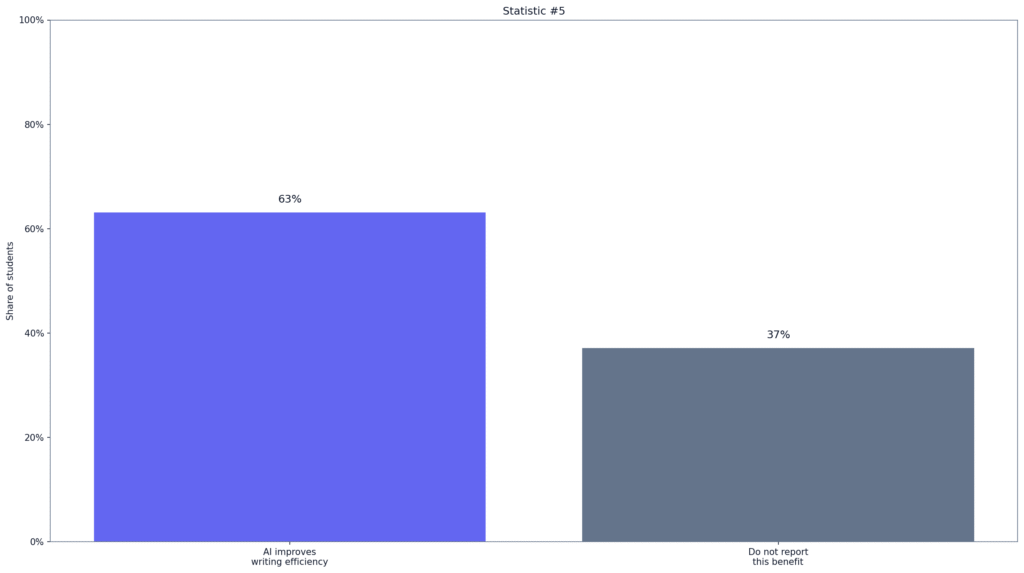
| 5 | Students who say AI improves writing efficiency | 63% |
| 6 | Students using AI to summarize research sources | 51% |
| 7 | Students who rely on AI for brainstorming ideas | 44% |
| 8 | Students concerned about AI detection tools | 61% |
| 9 | Students who say AI helps overcome writer’s block | 58% |
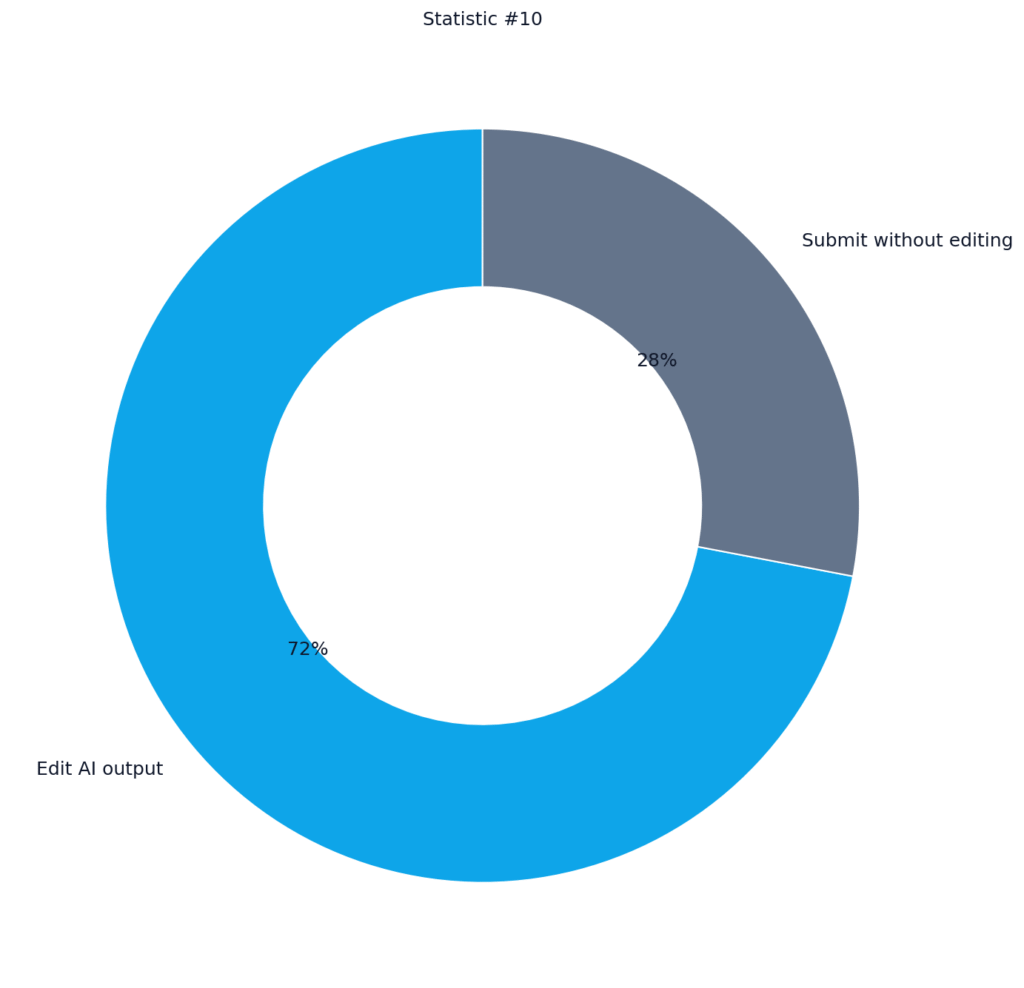
| 10 | Students who edit AI output before submitting work | 72% |
| 11 | Students using AI for grammar and clarity improvements | 65% |
| 12 | High school students experimenting with AI writing tools | 34% |
| 13 | Students who believe AI makes writing faster | 68% |
| 14 | Students who use AI to paraphrase existing drafts | 49% |
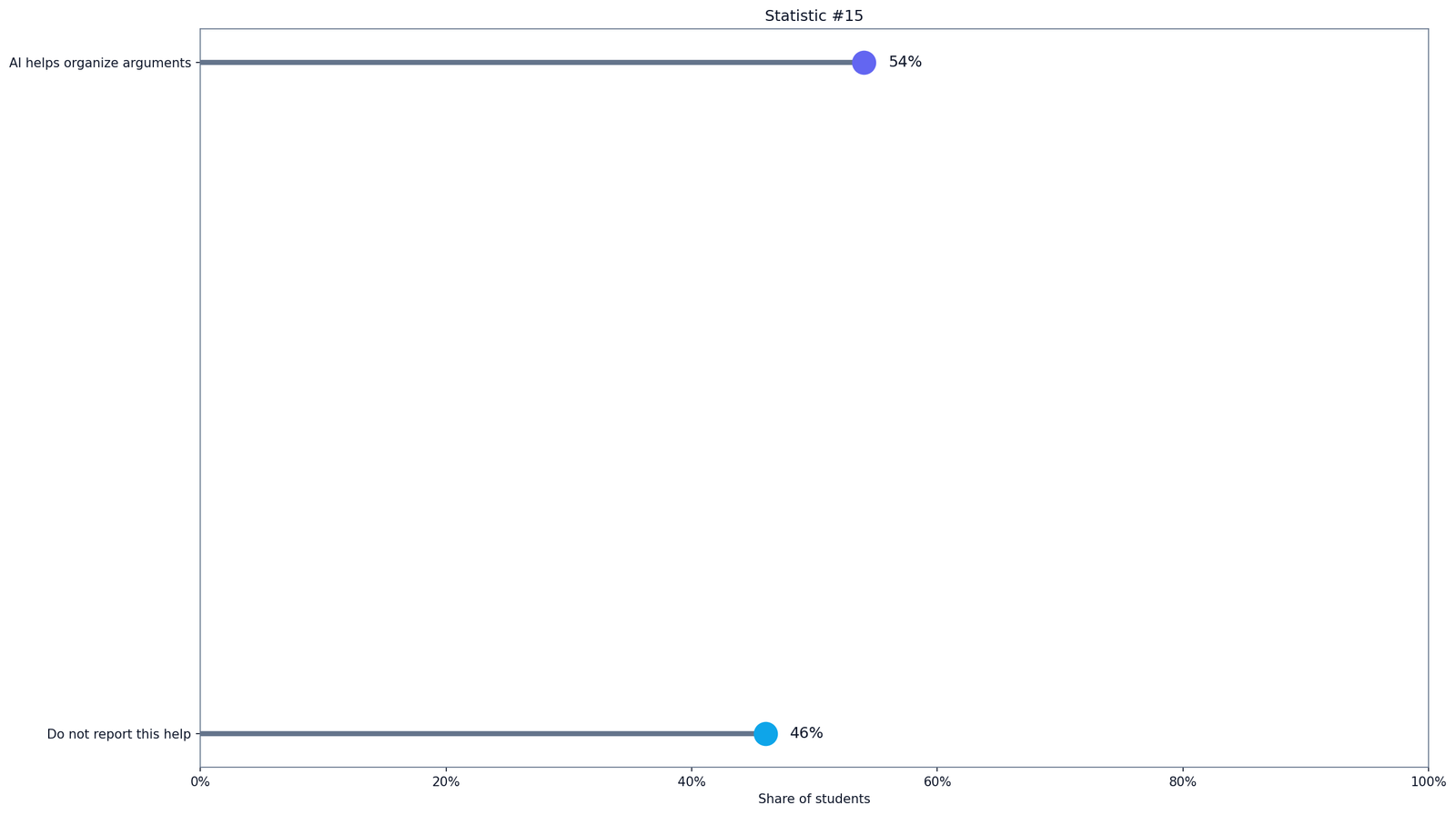
| 15 | Students who feel AI tools help organize arguments | 54% |
| 16 | Students who say AI reduced time spent writing essays | 46% |
| 17 | Students using AI tools on mobile devices | 31% |
| 18 | Students who verify AI outputs with research sources | 52% |
| 19 | Students who believe AI will remain part of education | 74% |
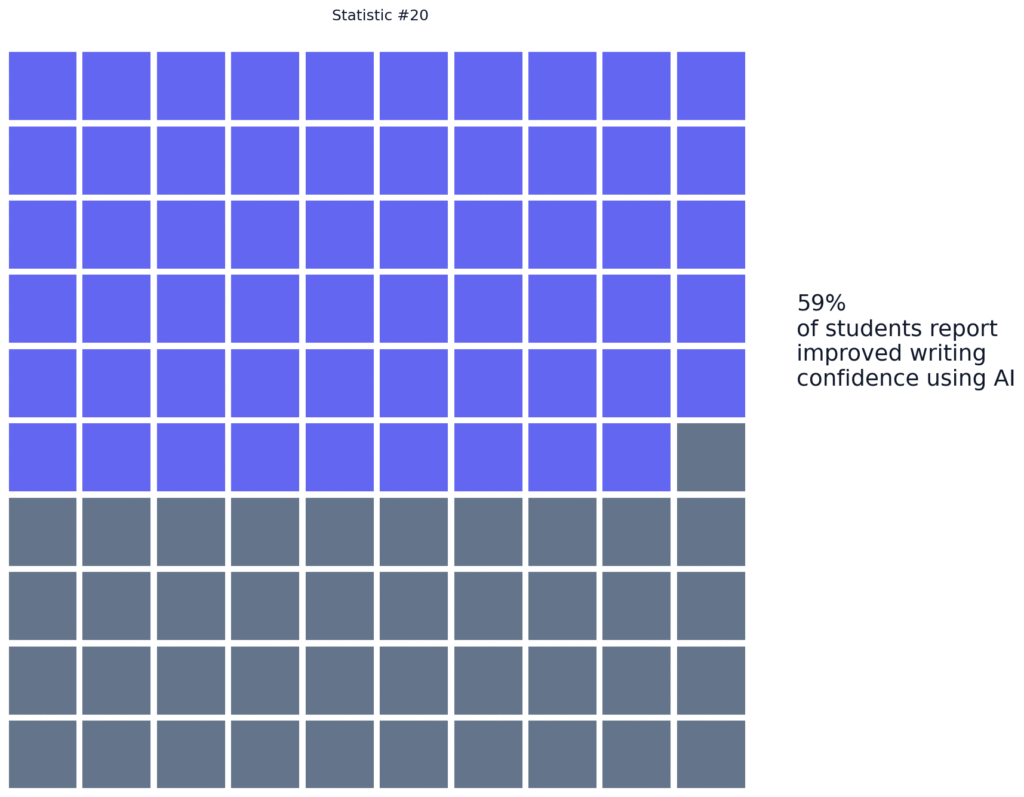
| 20 | Students who report improved writing confidence using AI | 59% |
Top 20 AI Writing Usage Among Students Statistics and the Road Ahead
AI Writing Usage Among Students Statistics #1. Most students have now used AI for writing tasks
92% of undergraduates now report some form of AI use, which makes the behavior look structural rather than experimental across campuses. That matters because tools stop feeling optional once nearly everyone has tried them at least once. In many courses, AI now appears near the start of the writing process instead of waiting at the margins.
The pattern follows convenience more than ideology in everyday student routines. When wording help, structure suggestions, and instant feedback live in one window, students begin writing sooner and hesitate less during early drafting. That changes assignment rhythm, especially in weeks when deadlines compress planning, reading, and revision into a narrow stretch.
Human judgment still decides what belongs in the paper at submission. Students choose evidence, tone, and classroom fit, even when 92% of undergraduates can access similar systems and similar prompts. The implication is that broad use no longer signals misconduct alone, while policy and instruction now carry much more weight.
AI Writing Usage Among Students Statistics #2. Weekly use has become routine rather than occasional
54% of students report using AI weekly, which means reliance is becoming routine rather than occasional. Repetition matters more than one-time experimentation because habits form around the tools students open every few days. Once use becomes weekly, it starts shaping pacing, confidence, and even how assignments feel at the outset.
The cause is simple: recurring coursework rewards quick assistance. Students who face reading responses, discussion posts, outlines, and short reflections keep returning to the same system because it reduces start-up friction across many small tasks. Weekly use grows not from one giant benefit, but from repeated moments where a blank page feels easier to cross.
Human writers still determine what sounds believable for a specific class and professor. Even with 54% of students using AI every week, people still need to trim formulaic phrasing and reconnect the draft to course material. The implication is that frequency, more than access alone, will define which students gain a durable workflow advantage.
AI Writing Usage Among Students Statistics #3. First drafts are no longer the slowest part of the process
42% of students use AI to generate first drafts, which shows the opening stage remains the hardest part of writing. The first draft carries the most uncertainty because students still need a structure before they can improve anything. AI becomes appealing here because it converts vague intent into something visible and editable within seconds.
The behavior grows from momentum. A rough machine draft gives students paragraphs to react to, which feels easier than producing every sentence from scratch under pressure. That lowers the emotional barrier to starting, especially for assignments that require tone, evidence, and organization all at once.
Human drafting still matters because the first version shapes the final intellectual direction. When 42% of students begin with generated text, strong papers still come from the students who reshape claims, reorder ideas, and discard weak framing early. The implication is that teaching revision now matters even more than teaching students how to face the first blank page.
AI Writing Usage Among Students Statistics #4. Editing has become the most socially accepted use case
47% of students use AI mainly for editing and rewriting, which makes this one of the more accepted academic uses. That pattern tells you students view polish as safer than full generation. Rewriting feels closer to assistance than authorship, so it attracts users who want speed without crossing a personal line.
The cause sits in classroom norms. Many students already use spellcheck, grammar tools, and feedback software, so AI editing feels like an extension of habits they already trust. Once the tool offers cleaner transitions, shorter sentences, and clearer phrasing, the value becomes immediate and easy to defend.
Human revision still does the heavier intellectual work. Even when 47% of students lean on AI for editing, they still need to preserve their argument, their evidence, and the slightly uneven voice that makes a paper sound real. The implication is that editing use will keep growing because it hides inside familiar workflows and appears academically reasonable.
AI Writing Usage Among Students Statistics #5. Efficiency remains the main reason students keep returning
63% of students say AI improves writing efficiency, which helps explain why adoption keeps spreading across semesters. Efficiency is persuasive because students rarely feel they have abundant writing time. When a tool shortens the path from assignment prompt to workable draft, it quickly earns a place in the routine.
The driver is time pressure more than fascination with technology. Students juggle readings, quizzes, part-time work, and deadlines, so any system that compresses brainstorming, outlining, and sentence repair looks practical instead of experimental. Faster completion also reduces the mental drag that makes long assignments feel larger than they are.
Human writing still determines whether faster work is actually better work. With 63% of students citing efficiency, the real separator becomes who uses saved time to verify claims, improve structure, and strengthen originality. The implication is that AI will be judged less as a novelty tool and more as a time management layer.
AI Writing Usage Among Students Statistics #6. Summarizing sources has become a standard shortcut
51% of students use AI to summarize sources, which shows research compression has become a major attraction. Summaries save effort at the point where reading volume starts to feel unmanageable. That makes AI valuable before a sentence of the actual essay is even written for the assignment itself.
The cause is workload density. Students often face long articles, short deadlines, and uneven familiarity with the topic, so a summary feels like a faster way to locate the useful parts before deeper reading begins. Once that shortcut becomes reliable enough, it easily enters regular study habits.
Human readers still catch nuance that compressed summaries often flatten or miss. When 51% of students lean on summarization, the stronger writers are still the ones who return to the original source and notice tension, methodology, or tone. The implication is that AI may speed source triage, but it cannot replace close reading where grades depend on precision.
AI Writing Usage Among Students Statistics #7. Brainstorming is where low-risk use expands fastest
44% of students use AI for brainstorming, which makes ideation one of the lower-friction entry points. Brainstorming feels safer because it helps students start thinking without fully outsourcing the assignment. That psychological boundary matters in classrooms where students still worry how much help is acceptable.
The cause is uncertainty at the planning stage. Students often know the topic area but not the angle, examples, or structure, so prompt-based idea generation reduces the panic that comes before writing actually begins. Once a few directions appear on screen, decision-making becomes easier and more concrete.
Human originality still shows up in what gets selected and developed. Even with 44% of students using AI to brainstorm, distinctive work usually comes from the student who rejects obvious ideas and pushes toward a sharper claim. The implication is that ideation tools will keep expanding because they feel useful without seeming fully substitutive within ordinary class practice.
AI Writing Usage Among Students Statistics #8. Detection anxiety now shapes how students use the tools
61% of students worry about AI detection tools, which means anxiety now shapes behavior alongside convenience. Adoption does not remove fear; it simply coexists with it. That tension explains why many students use AI, then spend extra effort trying to make the result sound less machine-made.
The cause is uncertainty around accuracy, policy, and classroom interpretation. When students are unsure whether detectors can misread revised writing, they become more cautious with phrasing, citation, and how directly they use generated text. Fear changes workflow by adding a defensive editing layer after the initial drafting support.
Human writers respond to scrutiny in ways systems cannot anticipate. Even when 61% of students feel detection pressure, they still have to decide how much revision is enough and what voice sounds natural for their own classwork. The implication is that concern over detectors will keep influencing writing habits even as tool use grows more common.
AI Writing Usage Among Students Statistics #9. Writer’s block relief keeps adoption sticky
58% of students say AI helps with writer’s block, which reveals a psychological benefit as much as a practical one. Writer’s block is rarely only a language problem. It usually appears when uncertainty, time pressure, and fear of weak ideas pile up at the same moment.
AI interrupts that spiral by producing a starting point. A suggestion, outline, or opening paragraph gives students something to push against, which feels easier than inventing direction from silence. That small release of pressure can be enough to restore movement on a stalled assignment during a stressful week.
Human momentum still depends on judgment after the block breaks. With 58% of students reporting relief, the stronger outcomes still come from students who revise the prompt response into something grounded in the course and their own thinking. The implication is that AI’s stickiest value may be emotional, because reducing paralysis keeps students engaged long enough to finish.
AI Writing Usage Among Students Statistics #10. Most users still revise the machine draft before submission
72% of students edit AI output before submitting it, which suggests most users understand raw text is rarely classroom-ready in most real courses. That matters because revision separates assistance from blind copying. Students seem to know the generated version usually needs reshaping before it can pass as competent academic work.
The cause is easy to see in the output itself. AI drafts may sound smooth, yet they often generalize, repeat, or miss the specific reading and tone a course expects, so students revise to narrow, localize, and humanize the language. Editing becomes a protective step rather than an optional flourish.
Human revision is what reintroduces accountability into the process. Even with 72% of students changing the text before submission, the quality gap still depends on how deeply they rethink claims rather than merely swap a few phrases. The implication is that revision literacy will become the real dividing line in AI-assisted student writing.
AI Writing Usage Among Students Statistics #11. Grammar help is normalizing everyday AI use
65% of students use AI for grammar and clarity, which shows everyday cleanup has become normal behavior. This kind of use spreads quietly because it feels practical rather than dramatic. Many students do not see it as replacing writing so much as smoothing rough language before anyone else reads it.
The cause is familiarity. Students already expect software to catch mistakes, so AI feels like a stronger version of the same safety net when it improves flow, sentence shape, and awkward wording at once. Because the benefit appears immediately, the habit sticks with little friction.
Human voice still determines whether clean writing sounds believable and appropriately uneven. Even when 65% of students use AI for clarity, they still need to keep discipline-specific terms, course references, and their own natural cadence intact. The implication is that grammar use will continue expanding because it sits inside the least controversial part of writing support.
AI Writing Usage Among Students Statistics #12. High school experimentation is feeding later college habits
34% of high school students experimenting with AI writing tools signals that usage habits now begin earlier. Early exposure matters because students carry familiar workflows into college. What once looked like a university issue now starts forming before many students reach higher education at all in practice.
The cause is access. School-aged users can reach the same public tools at home, on phones, and through everyday search habits, so experimentation happens long before formal policy catches up. Once AI becomes part of homework problem-solving in adolescence, its later use in writing feels less like a leap.
Human development still determines whether early use becomes dependency or skill-building. When 34% of high school students are already testing these systems, the real difference comes from whether they learn to question output rather than trust it automatically. The implication is that colleges will increasingly inherit students whose writing habits were shaped before arrival.
AI Writing Usage Among Students Statistics #13. Speed is the clearest benefit students report
68% of students believe AI makes writing faster, which is one of the clearest drivers of repeat use. Speed matters because academic writing competes with every other task in a crowded week. A tool that trims even one stage of the process can feel disproportionately valuable under deadline pressure.
The cause is cumulative time savings rather than one dramatic shortcut. Students save minutes on outlines, examples, transitions, and sentence repair, and those small reductions stack across many assignments during a term. Faster progress also lowers dread, which makes starting the work feel less heavy.
Human writers still decide whether faster means shallower or simply more efficient. With 68% of students seeing a speed benefit, better outcomes usually come when saved time gets redirected into sources, revision, and more careful argument control. The implication is that institutions should evaluate not just use, but what students do with the time AI returns.
AI Writing Usage Among Students Statistics #14. Paraphrasing has become a bridge between drafting and polishing
49% of students use AI to paraphrase drafts, placing the tool in the space between ideation and final polish. Paraphrasing appeals to students who want cleaner wording without starting over. It feels like adjustment rather than creation, which makes it easier to justify to themselves in ordinary coursework.
The cause is friction in sentence-level revision. Students often know what they mean yet dislike how a paragraph sounds, so paraphrasing tools promise alternative phrasing without forcing a full rewrite from scratch. That is especially attractive when deadlines leave little patience for slow stylistic refinement.
Human intent still matters because paraphrase quality depends on whether meaning stays intact. Even with 49% of students using AI in this way, careless rewrites can flatten nuance or quietly alter the claim beneath the surface. The implication is that paraphrasing will remain common, but its academic value depends on close rereading after the machine suggests alternatives.
AI Writing Usage Among Students Statistics #15. Argument organization is one of the quieter benefits
54% of students feel AI helps organize arguments, which points to a quieter benefit than raw text generation for many assignments. Organization problems often hide inside essays that seem fluent on the surface. A tool that proposes structure can therefore feel more useful than one that simply writes fuller paragraphs.
The cause is cognitive load. Students managing evidence, sequence, counterpoints, and assignment criteria at the same time often need help seeing the shape of an argument before they can strengthen its logic. AI can offer outlines and ordering options that make the structure visible earlier in the process.
Human reasoning still decides whether the structure actually holds. When 54% of students report help with organization, stronger papers still come from the student who tests whether the order makes sense for the evidence and course goals. The implication is that structural support may become one of AI’s most durable academic uses.
AI Writing Usage Among Students Statistics #16. Time savings matter more during deadline pressure
46% of students say AI reduced the time spent writing essays, which gives the tool obvious appeal during peak workload periods. Essay writing consumes hours not just in drafting, but in planning, phrasing, and repairing weak sections. Any noticeable reduction therefore feels meaningful to students balancing multiple deadlines at once across demanding academic weeks.
The cause is concentrated pressure. During midterms, finals, or crowded project weeks, students are more likely to use systems that shorten ideation and cleanup because the alternative is working tired or submitting late. Time savings become most persuasive when the academic calendar turns dense.
Human effort still determines whether a shorter process produces a defensible paper. Even with 46% of students reporting reduced essay time, the better results come from those who use the saved hours to verify evidence and sharpen reasoning. The implication is that AI becomes more attractive as workload spikes, not simply as technology improves.
AI Writing Usage Among Students Statistics #17. Mobile use shows AI writing has become ambient
31% of students use AI writing tools on mobile devices, which shows the behavior is becoming ambient and always available. Mobile use matters because it reduces the need for a formal study setup. Writing assistance can now happen in transit, between classes, or during short breaks that once felt unusable.
The cause is convenience at the edge of the day. When prompts, rewrites, and quick summaries are available from a phone, students can turn small fragments of time into productive moments instead of waiting for a full laptop session. That broadens when and where academic writing support enters daily life.
Human concentration still limits what mobile workflows can realistically achieve. Even when 31% of students use AI on phones, deeper revision, source checking, and careful argument work still tend to require slower attention than a mobile screen invites. The implication is that AI use will keep expanding because access now travels with the student.
AI Writing Usage Among Students Statistics #18. Verification habits remain uneven despite regular use
52% of students verify AI outputs with research sources, which is encouraging but still leaves a large gap. Verification matters because plausible language can hide weak facts. The number suggests many students understand that fluency is not the same thing as reliability.
The cause behind incomplete checking is usually time. Source verification adds a slower layer after the fast convenience of generation, and students under pressure do not always return to inspect each claim with equal care. That creates a split between students who use AI as a draft partner and those who treat it as a shortcut.
Human checking is the point where academic responsibility becomes visible. Even with 52% of students cross-checking outputs, the remaining share shows why institutions still worry that polished language can outrun factual discipline. The implication is that verification habits, more than access alone, will shape whether AI use improves or weakens academic standards.
AI Writing Usage Among Students Statistics #19. Students largely expect AI to remain embedded in education
74% of students believe AI will remain part of education, which shows expectations have moved past the temporary hype stage. Once students assume permanence, they stop treating the tools as a passing experiment. That expectation influences how they build study habits, writing routines, and career assumptions.
The cause is accumulated exposure across courses and platforms. Students now encounter AI in search, feedback, note-taking, tutoring, and writing support, so the technology feels woven into education rather than bolted onto it. Regular contact across tools, classes, and platforms turns prediction into common sense for most students.
Human learning still determines whether permanence becomes helpful integration or passive dependence. When 74% of students expect AI to stay, institutions need to teach boundaries, evaluation, and revision rather than relying on nostalgia for a pre-AI classroom. The implication is that planning for sustained coexistence now looks more realistic than hoping widespread usage simply fades away.
AI Writing Usage Among Students Statistics #20. Confidence gains help explain continued experimentation
59% of students report improved writing confidence when using AI, which helps explain why experimentation continues after the first trial. Confidence changes behavior because students attempt harder tasks when the starting barrier feels lower. That can make writing feel more manageable even before actual skill catches up over time.
The cause is reassurance during uncertain moments. When a student receives a suggested structure, clearer wording, or a possible opening, the work looks less chaotic and more solvable, which reduces avoidance and self-doubt. Confidence grows because the task seems breakable into smaller parts.
Human growth still depends on whether support becomes practice instead of dependence. Even with 59% of students feeling more confident, long-term improvement still comes from revising, reading carefully, and learning why a stronger sentence works. The implication is that confidence may be AI’s most persuasive benefit, but it helps most when paired with active learning and deliberate revision.
What these AI Writing Usage Among Students Statistics suggest for the next phase of academic writing
Student use is widening because AI fits the messy middle of writing, not just the final draft. The strongest pattern across these figures is that students reach for help when time, uncertainty, or workload density begins to pile up.
That helps explain why efficiency, speed, summarization, and confidence keep appearing together. They are not separate trends so much as connected signals that writing support is moving closer to the moment friction appears.
The tension is that access is becoming ordinary faster than judgment is developing. Students can get words quickly, yet the better outcomes still depend on source checking, revision depth, and the ability to keep a paper aligned with the class.
What comes next will likely center less on whether students use AI and more on how visibly they can use it well. The implication is that future academic standards will reward discernment, not just avoidance.
Sources
- HEPI student generative AI survey 2025 full report
- HEPI Kortext student generative AI survey 2025 PDF
- HEPI policy note on student assessment AI use
- Digital Education Council global AI student survey 2024
- Key results from DEC global AI student survey
- AI governance and student perspectives in higher education
- Tyton Partners artificial intelligence in higher education survey
- Tyton Partners listening to learners 2025 report
- BestColleges survey on student AI use in coursework
- BestColleges survey on college students and AI tools
- Wiley survey coverage on student classroom AI use
- BestColleges report on seniors using generative AI weekly