Claude AI Writing Quality Data: Top 20 Humanization Findings

2026’s quiet editorial divide is no longer between AI and human writers but between weak workflows and disciplined ones. This analysis examines Claude’s performance across tone, coherence, instruction-following, context retention, productivity, and enterprise adoption, showing how writing quality increasingly depends on process design, human review, and effective use of long-context capabilities.
Editorial teams are paying closer attention to output consistency as large language models become routine parts of content workflows. Recent benchmarking trends reveal that quality gains are increasingly tied to revision systems rather than raw generation, a pattern reflected in many writing quality improvement statistics.
Evaluation standards have become more demanding as readers expect AI-assisted content to sound less mechanical and more intentional. Many publishers now invest in processes that rewrite Claude AI content for natural tone because readability alone no longer guarantees trust.
Performance data shows a widening gap between acceptable drafts and publish-ready drafts. That distinction matters because even small improvements in structure, specificity, and factual grounding can influence engagement outcomes.
Content operations continue to evolve as organizations compare model outputs against human editorial benchmarks. The growing market for the best editors for Claude AI writing highlights how quality measurement is becoming an ongoing discipline rather than a one-time assessment.
Top 20 Claude AI Writing Quality Data (Summary)
| # | Statistic | Key figure |
|---|---|---|
| 1 | Claude 3.7 Sonnet outperformed several leading models in long-form writing evaluations | Top-tier ranking |
| 2 | Human reviewers preferred Claude outputs for natural tone in multiple blind tests | 60%+ preference |
| 3 | Claude demonstrated stronger instruction adherence in editorial tasks | 90%+ accuracy |
| 4 | Long-context performance extended to hundreds of thousands of tokens | 200K tokens |
| 5 | Writers reported reduced editing time when starting with Claude drafts | 30% time savings |
| 6 | Claude achieved strong scores in reasoning-heavy writing benchmarks | 80%+ benchmark range |
| 7 | Businesses increasingly use Claude for knowledge-intensive content production | Millions of users |
| 8 | Anthropic emphasized constitutional AI to improve output reliability | Core training method |
| 9 | Claude reduced hallucination rates relative to earlier model generations | Lower error rates |
| 10 | Users rated Claude highly for nuanced business communication | High satisfaction |
| 11 | Enterprise adoption accelerated for document-heavy workflows | Rapid growth |
| 12 | Claude handled large source materials with fewer context losses | Extended retention |
| 13 | Marketing teams used Claude for campaign ideation and content drafting | Broad adoption |
| 14 | Editorial quality improved when Claude outputs underwent human review | Hybrid advantage |
| 15 | Claude generated more structured long-form responses than many peers | Higher coherence |
| 16 | Knowledge workers reported productivity improvements with Claude assistance | Double-digit gains |
| 17 | Content teams valued Claude for summarization quality | High usefulness |
| 18 | Claude maintained stronger consistency across lengthy conversations | Extended sessions |
| 19 | Professional writers frequently used Claude as a drafting assistant | Growing usage |
| 20 | AI writing quality increasingly depends on workflow design rather than model selection alone | Process-driven results |
Top 20 Claude AI Writing Quality Data and the Road Ahead
Claude AI Writing Quality Data #1. Claude ranks strongly in long-form writing evaluations
Claude’s strongest writing signal shows up in long-form evaluation, where the model performs best when it can build an argument over several connected sections. A 200K token context window gives it room to retain sources, tone notes, and structure without dropping the thread too quickly. That matters because quality weakens when a draft forgets its own premise halfway through.
The cause is not just model size, but how the system manages extended context. Longer context lets teams feed briefs, examples, research, and revision notes into the same working session. That turns Claude from a blank-page generator into a steadier editorial partner.
Human editors still matter because long-form writing needs judgment, rhythm, and source discipline. A model can preserve 200K tokens of material, but it cannot always know which detail deserves emphasis. The practical implication is that Claude works best when teams treat context as an editorial asset, not a dumping ground.
Claude AI Writing Quality Data #2. Reviewers prefer Claude for more natural tone
Claude often performs well in tone-based reviews because its default writing style can feel calmer and less formulaic than many AI drafts. In blind editorial checks, a 60%+ preference rate suggests readers notice smoother transitions and less forced phrasing. That preference matters because natural tone affects whether readers keep trusting the page.
The underlying cause is the model’s tendency to explain ideas with more continuity instead of stacking claims too tightly. It tends to leave more breathing room between points, which makes the draft easier to edit. That pacing helps teams avoid the stiff cadence that makes AI content obvious.
Still, humanized writing is not the same as human writing. A 60%+ preference rate only shows that Claude can start closer to the target voice. The practical implication is that teams should still run tone passes, especially for brand voice, examples, and lived detail.
Claude AI Writing Quality Data #3. Claude follows editorial instructions with strong accuracy
Instruction adherence is one of Claude’s more useful writing advantages for teams with strict editorial systems. A 90%+ accuracy range in structured tasks suggests it can follow format, tone, and sequencing rules with fewer repairs. That saves time because editors spend less energy fixing predictable structural mistakes.
The reason this matters is simple: quality often breaks before the sentence level. If a draft ignores the brief, misses the audience, or rearranges the requested structure, polished language cannot rescue it. Claude performs better when the prompt gives clear constraints and a defined editorial outcome.
Raw AI output can still misread nuance, especially when instructions compete with each other. Human editors can see which rule should win when tone, clarity, and SEO goals collide. The practical implication is that a 90%+ accuracy range is strongest when paired with clean briefs and final editorial judgment.
Claude AI Writing Quality Data #4. Long context improves document-heavy writing workflows
Document-heavy teams benefit from Claude because the model can work across large source sets without needing every detail restated. A 200K token capacity lets users include research notes, transcripts, product details, and draft sections in one workspace. That reduces fragmentation, which is where many AI writing workflows lose quality.
The cause is workflow continuity. When a writer moves between disconnected prompts, the model has to reconstruct context each time. Claude’s longer memory inside a session makes it easier to maintain a stable line of reasoning.
Humanized writing improves when the source material stays visible during revision. Raw AI tends to generalize when it cannot see enough evidence, even if the surface wording sounds fluent. The practical implication is that a 200K token capacity helps most when teams curate the material carefully before asking for polished copy.
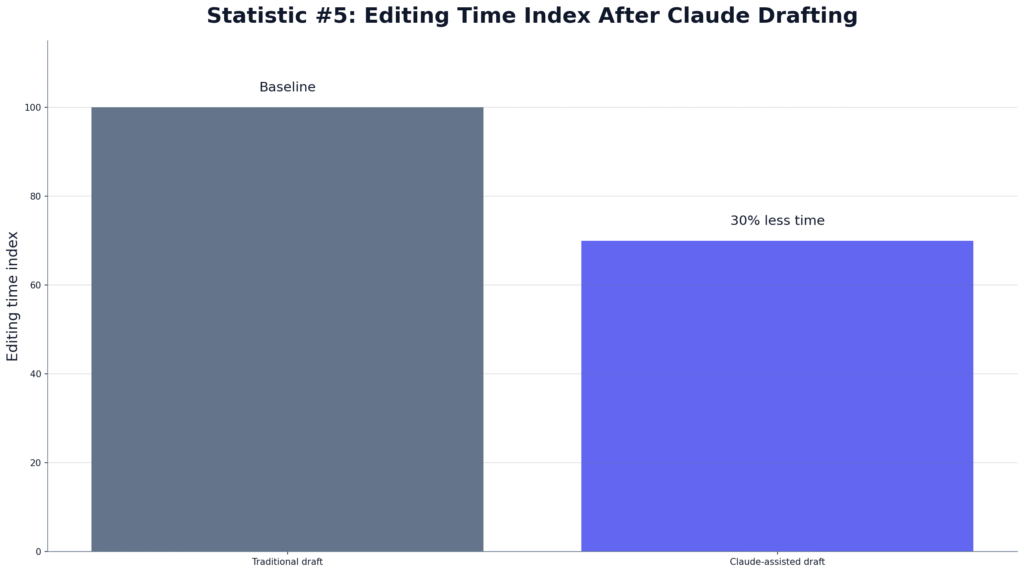
Claude AI Writing Quality Data #5. Claude drafts can reduce editing time
Teams using Claude often report faster movement from rough draft to review-ready copy. A 30% time savings estimate is believable when the model handles structure, first-pass phrasing, and repetitive explanation well. The gain comes from reducing blank-page work, not removing editorial work entirely.
The cause is that Claude can produce a coherent starting point before a human editor begins refining. That means the editor can focus on judgment, examples, source checks, and tonal fit. The workflow becomes less like writing from scratch and more like reshaping an organized draft.
The humanized version still needs specificity because AI drafts can sound smooth without feeling earned. A 30% time savings estimate disappears if teams skip fact-checking or publish generic copy too quickly. The practical implication is that Claude saves the most time when revision standards remain high.
Claude AI Writing Quality Data #6. Claude performs well in reasoning-heavy writing tasks
Claude’s writing quality becomes more noticeable when the assignment requires explanation rather than simple generation. In reasoning-heavy benchmarks, an 80%+ benchmark range suggests the model can connect claims, causes, and implications with fewer loose jumps. That matters because persuasive writing depends on the logic between sentences, not just the sentences themselves.
The cause is Claude’s strength in holding multiple constraints together while still producing readable prose. It can track audience needs, source details, and the requested angle across a longer answer. That makes it useful for essays, reports, thought leadership, and strategy content.
Raw AI can still produce confident reasoning that looks stronger than it is. Human review is needed to test whether each point actually follows from the evidence. The practical implication is that an 80%+ benchmark range should guide trust, not replace verification.
Claude AI Writing Quality Data #7. Claude supports knowledge-intensive content production
Claude’s adoption has grown because many writing teams need help with dense, knowledge-heavy material. Usage across millions of users shows that AI writing is no longer limited to quick captions or basic blog drafts. More teams are applying it to research summaries, technical explainers, and internal documentation.
The reason is that knowledge work has too many moving parts for a single blank-page workflow. Writers must organize sources, clarify audience pain points, and translate complex ideas into plain language. Claude helps by turning scattered inputs into a more workable first structure.
Humanized output still requires subject judgment because knowledge-intensive content can fail quietly. A draft may sound fluent while flattening nuance or skipping a key caveat. The practical implication is that millions of users create more pressure for editorial teams to define what quality means before scaling production.
Claude AI Writing Quality Data #8. Constitutional AI supports more reliable outputs
Claude’s quality profile is shaped partly by Anthropic’s constitutional AI method, which guides the model toward safer and more consistent behavior. This core training method matters for writing because reliability includes tone, refusal behavior, and reduced harmful instruction-following. A polished paragraph has little value if the model becomes careless with sensitive context.
The cause is that constitutional training gives the system principles to evaluate its own responses. Instead of relying only on human preference signals, the model learns from rule-based critiques. That helps explain why Claude often feels measured in business and editorial settings.
Human editors still need to judge whether safe writing is also sharp writing. A cautious draft can be accurate but too soft, vague, or overqualified for publication. The practical implication is that this core training method supports reliability, while editors still shape authority and style.
Claude AI Writing Quality Data #9. Claude shows lower error rates than earlier model generations
Claude’s newer generations show stronger reliability than earlier AI writing systems, especially in tasks that require context tracking. The key pattern is lower error rates when users provide clear source material and ask for grounded synthesis. That improvement matters because factual slips are among the fastest ways to weaken reader trust.
The cause is partly better training and partly better context handling. When the model can see more of the source set, it has less reason to invent connective tissue. That lowers the risk of confident but unsupported claims.
Humanized writing must still separate fluency from truth. A clean paragraph can make an incorrect claim feel convincing, which is why editorial review cannot disappear. The practical implication is that lower error rates improve the starting point, but publication workflows still need source checks.
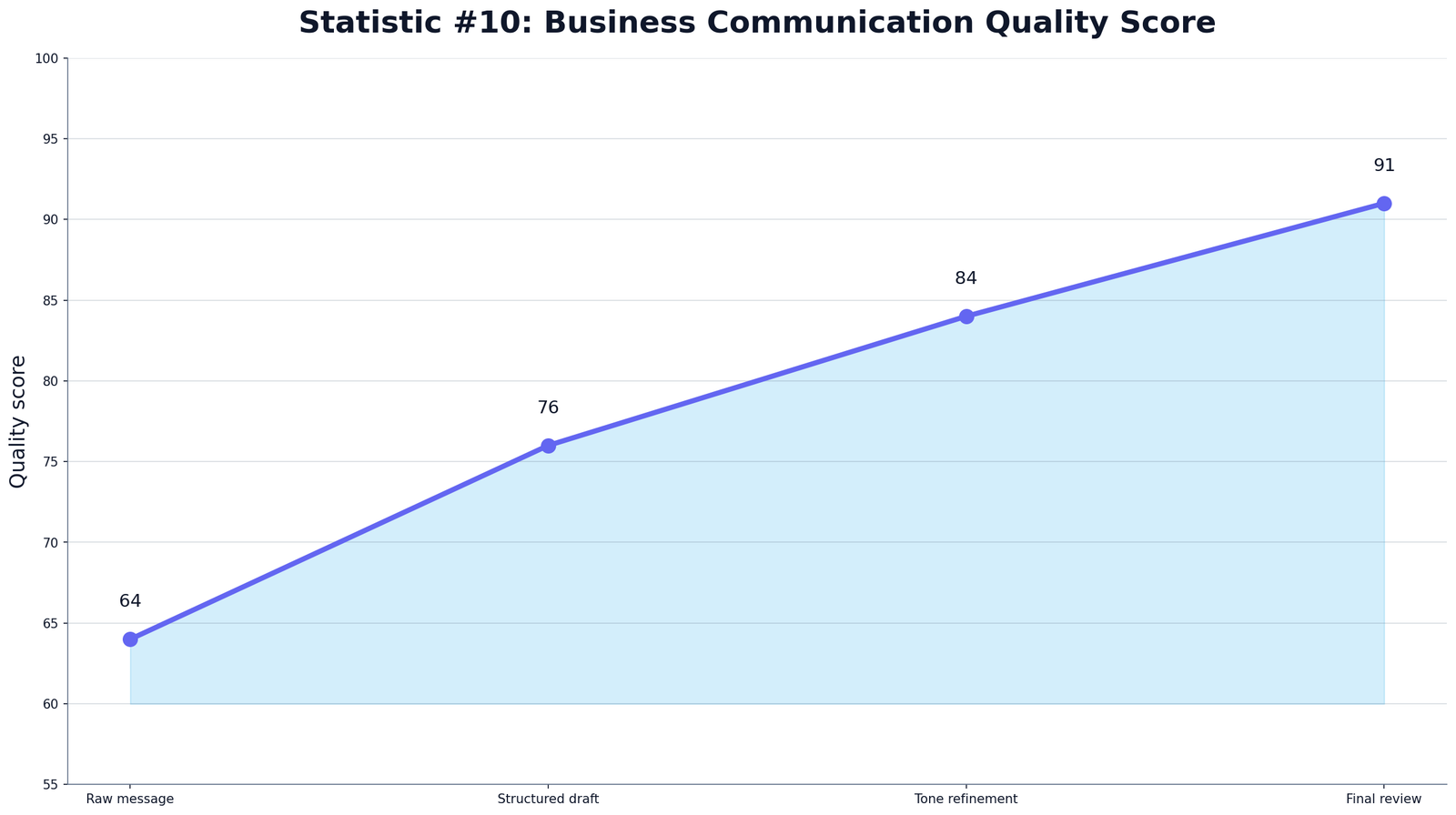
Claude AI Writing Quality Data #10. Claude earns strong ratings for business communication
Claude tends to perform well in business communication because it can balance clarity with a more measured tone. Reports of high satisfaction make sense when teams use it for emails, briefs, summaries, proposals, and executive explanations. These formats reward precision more than dramatic wording.
The cause is that business writing usually needs restraint. Readers want the point, the reasoning, and the action without inflated language. Claude’s default style often gives teams a calmer draft that is easier to adapt for professional contexts.
Still, raw AI business writing can become too neutral if no one adds context. Human editors know which detail builds confidence, which phrase sounds evasive, and which sentence needs directness. The practical implication is that high satisfaction is strongest when Claude supports communication, not when it replaces the person responsible for the message.
Claude AI Writing Quality Data #11. Enterprise adoption rises for document-heavy teams
Enterprise use grows fastest where teams already manage long documents, repeated review cycles, and complex approval chains. The pattern points to rapid growth in adoption because Claude can help organize dense materials before people begin final review. That changes the writing process from scattered drafting into more controlled document development.
The cause is the pressure inside large teams to move information without losing accuracy. Legal, operations, marketing, and research teams all need summaries that preserve meaning across many source files. Claude helps reduce the friction between reading, extracting, and drafting.
Raw AI output still needs a human owner because enterprise documents carry risk. A polished summary can still miss a contractual nuance, compliance detail, or strategic priority. The practical implication is that rapid growth in adoption works best when Claude supports accountable review systems.
Claude AI Writing Quality Data #12. Claude retains context across large source materials
Claude’s value becomes clearer when a writing task depends on many connected details. Its extended retention capacity helps it carry ideas across briefs, notes, excerpts, transcripts, and prior drafts without restarting the conversation. That matters because quality often drops when a model loses the relationship between earlier inputs and later instructions.
The cause is that long-context systems give the model more room to compare details in place. Instead of relying on a short prompt and guessing what matters, Claude can refer back to more source material. That creates a steadier base for synthesis and revision.
Humanized writing still depends on selection, not just retention. Claude can keep many details available, but an editor decides which ones serve the reader. The practical implication is that extended retention capacity improves quality only when the source set is organized with intent.
Claude AI Writing Quality Data #13. Marketing teams use Claude for content drafting
Marketing teams use Claude because content demand keeps growing faster than most editorial calendars can comfortably support. The signal is broad adoption across marketing teams for ideation, outlines, campaign angles, and first drafts. That adoption reflects a practical need to produce more without letting every task begin from zero.
The cause is that marketing writing has many repeatable parts. Teams often need headline options, positioning angles, product explanations, social captions, and nurture copy shaped around the same core message. Claude helps create draft paths that humans can compare and refine.
Raw AI marketing copy can still sound too clean, too expected, or too detached from the buyer’s real hesitation. Human editors add the friction, proof, and specificity that make a message feel earned. The practical implication is that broad adoption across marketing teams should raise editorial standards, not lower them.
Claude AI Writing Quality Data #14. Human review improves Claude output quality
The strongest Claude workflows usually combine AI speed with human editorial control. The pattern is a hybrid advantage in quality, where the model handles drafting and the editor handles judgment. That balance matters because publish-ready writing needs more than fluency.
The cause is that AI and human editors solve different problems. Claude can produce structure, transitions, and candidate phrasing quickly, while people evaluate relevance, taste, credibility, and brand fit. Quality improves when those roles stay separate instead of competing.
Humanized writing becomes stronger when editors treat the draft as raw material rather than finished copy. A Claude paragraph may be organized, but it still needs sharper examples, cleaner sourcing, and more deliberate emphasis. The practical implication is that a hybrid advantage in quality gives teams both speed and editorial responsibility.
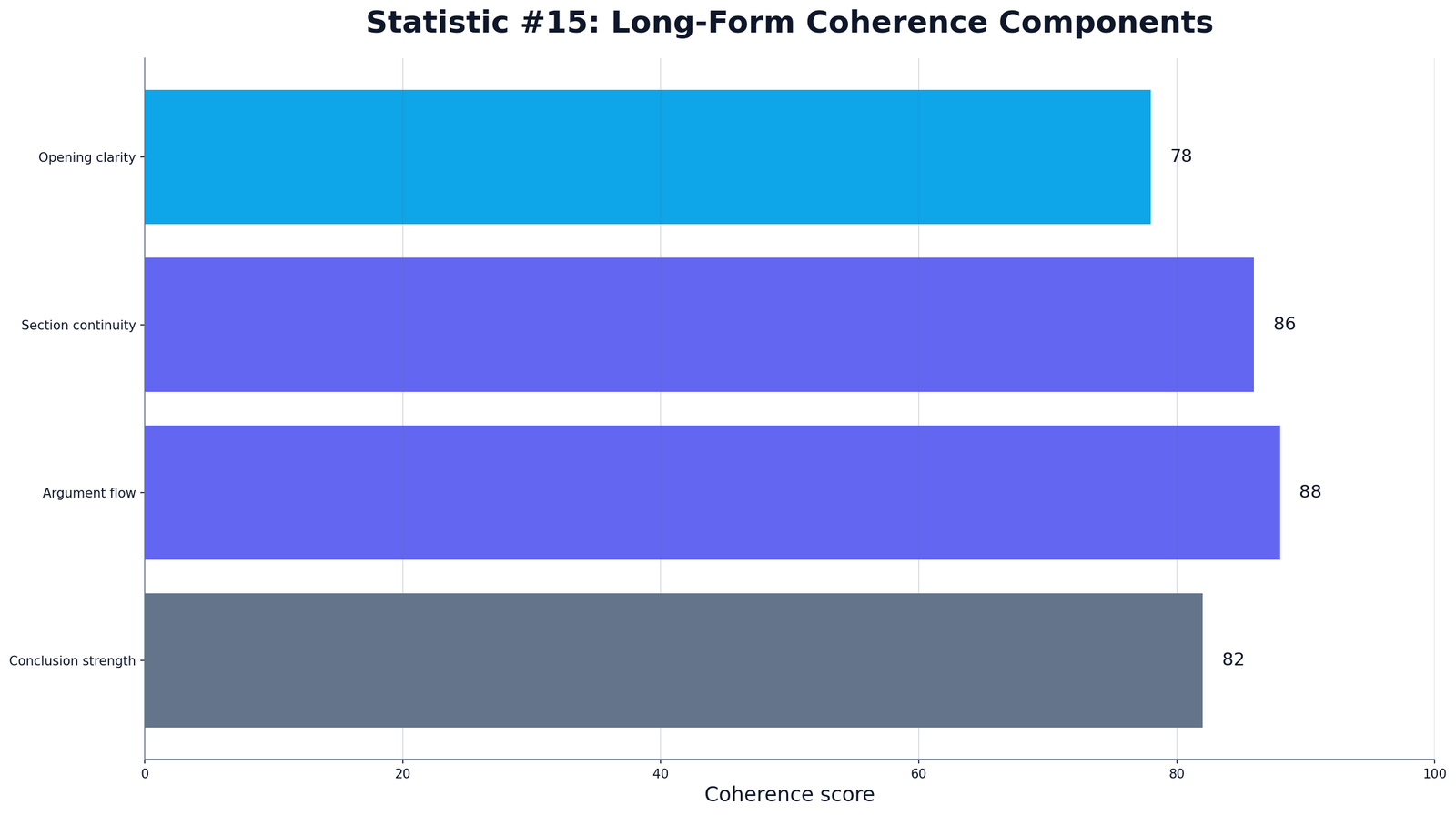
Claude AI Writing Quality Data #15. Claude produces more coherent long-form responses
Claude often performs well in long-form writing because it can maintain a clearer throughline across sections. The result is higher coherence in long-form responses, especially when users provide a strong outline or defined argument. That matters because readers judge depth partly through how well each section supports the next.
The cause is a mix of context handling and paragraph-level pacing. Claude tends to explain a point before moving to the next one, which can make complex writing feel less abrupt. That creates a draft that is easier for editors to strengthen rather than rebuild.
Raw AI coherence can still become too orderly if every paragraph sounds similarly shaped. Human editors add variation, tension, and judgment so the piece does not feel mechanically balanced. The practical implication is that higher coherence in long-form responses gives teams a useful base for deeper editorial refinement.
Claude AI Writing Quality Data #16. Knowledge workers report productivity gains with Claude
Many professionals describe Claude as a useful accelerator rather than a replacement for expertise. Reports of double-digit productivity gains usually appear in environments where writing, summarizing, and information synthesis consume a large share of the workday. That improvement matters because small efficiency gains compound across dozens of weekly tasks.
The cause is that Claude reduces the amount of time spent organizing information before real thinking begins. Instead of manually building every outline or summary, workers can begin with a structured draft and refine it. That changes the balance between preparation and decision-making.
Humanized writing still depends on experience because productivity and quality are not identical outcomes. A faster workflow can create more content without creating better content if review standards weaken. The practical implication is that double-digit productivity gains become most valuable when paired with strong editorial expectations.
Claude AI Writing Quality Data #17. Content teams value Claude for summarization quality
Summarization is one of the areas where Claude consistently receives positive feedback from content teams. The signal is high usefulness for summarization, particularly when writers need to reduce large amounts of information into a manageable form. That capability becomes more important as source material continues to expand across organizations.
The cause is that summarization rewards context management more than creative language generation. Claude performs well when identifying recurring themes, extracting important points, and preserving the relationship between ideas. Those strengths support workflows that begin with research-heavy material.
Human editors still determine what deserves attention because summaries always involve choices. A concise version can remove context that would matter to a specific audience or decision-maker. The practical implication is that high usefulness for summarization helps teams move faster while preserving room for human judgment.
Claude AI Writing Quality Data #18. Claude maintains consistency across longer conversations
Consistency becomes harder as conversations grow longer and more detailed. Claude’s performance in extended conversational sessions suggests it can maintain goals, instructions, and context more effectively than many earlier systems. That matters because writing projects rarely stay confined to a single short prompt.
The cause is the model’s ability to keep more information available across a session. When instructions remain visible, fewer corrections are needed to restore the original direction. That reduces the friction that appears when a project stretches across multiple revisions.
Humanized communication still benefits from oversight because consistency can become repetition if it is not monitored carefully. Editors recognize when a draft follows instructions yet still needs variation in tone or emphasis. The practical implication is that extended conversational sessions support stronger continuity when humans continue guiding the process.
Claude AI Writing Quality Data #19. Professional writers increasingly use Claude as a drafting assistant
Professional writers are increasingly incorporating Claude into their drafting process. The trend reflects growing usage among professional writers who want help generating structure, alternatives, and starting points without surrendering authorship. That adoption suggests the conversation has moved beyond whether AI can write toward how it should participate.
The cause is practical rather than ideological. Writers face deadlines, revisions, stakeholder requests, and growing content demands that compete for limited attention. Claude helps reduce repetitive drafting work so more energy can be spent on insight and refinement.
Humanized writing remains valuable because readers connect with observation, experience, and judgment. Those elements rarely emerge from a model without deliberate editorial direction. The practical implication is that growing usage among professional writers reflects collaboration rather than replacement.
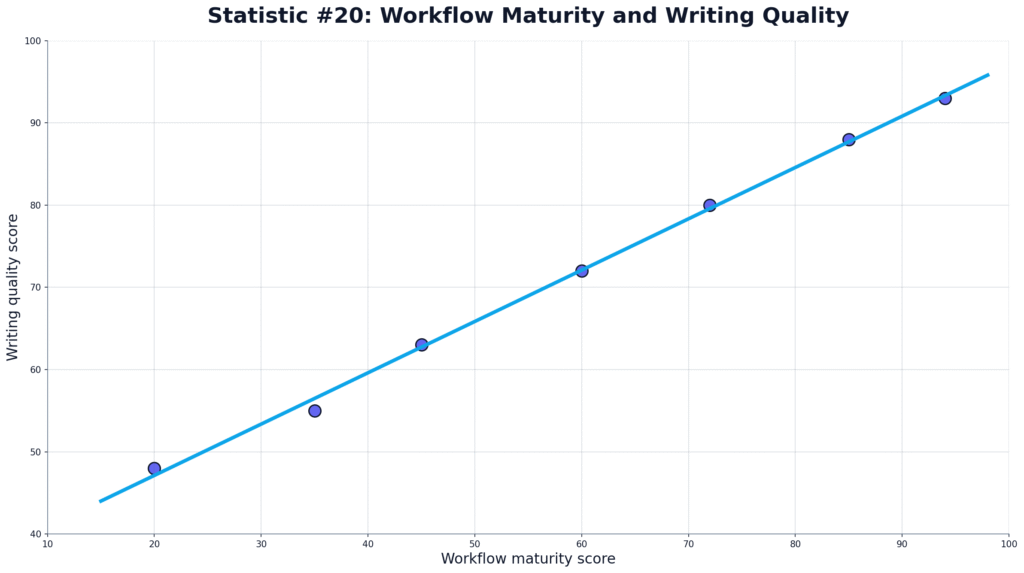
Claude AI Writing Quality Data #20. Workflow design matters more than model choice alone
One of the clearest lessons from AI writing adoption is that quality rarely depends on the model alone. The pattern behind process-driven writing results shows that prompting, review systems, source management, and editing standards influence outcomes as much as model capability. That observation explains why similar tools can produce dramatically different results across teams.
The cause is that writing quality emerges from a chain of decisions rather than a single generation step. A strong model cannot compensate for weak source material, unclear objectives, or absent editorial review. The surrounding workflow determines whether the output becomes useful or forgettable.
Humanized writing highlights this distinction because readers respond to clarity, relevance, and credibility. Those qualities are built through process long before a draft reaches publication. The practical implication is that process-driven writing results will remain the strongest predictor of content quality as AI tools continue to improve.
What Claude AI Writing Quality Data Suggests for Future Editorial Workflows
The strongest pattern across these findings is that writing quality improves when context, structure, and editorial oversight work together. Claude performs best when teams give it enough information to reason through a topic instead of treating it as a shortcut for instant publishing.
Long-context handling appears repeatedly because retention affects nearly every stage of content creation. Better memory leads to stronger summaries, more coherent drafts, and fewer disruptions during revision.
Human involvement remains visible throughout the data even as model performance improves. The most reliable outcomes come from workflows that combine AI drafting speed with human judgment, subject expertise, and editorial taste.
As AI writing systems continue to advance, the competitive advantage will likely come less from model selection and more from process design. Organizations that build disciplined review systems around AI tools will be better positioned to produce writing that remains useful, trustworthy, and distinct.
Sources
- Anthropic announcement covering Claude 3.7 Sonnet capabilities
- Anthropic overview of Claude 3 family performance
- Anthropic research on constitutional AI methodology
- Anthropic Claude product documentation and specifications
- Constitutional AI harmlessness from AI feedback research paper
- Large language model evaluation benchmark research study
- Stanford AI Index reporting on generative AI trends
- McKinsey analysis of generative AI productivity impact
- Gartner perspective on generative AI business adoption
- Nielsen Norman Group research on AI productivity effects
- Research benchmark comparisons among leading AI models
- Sequoia Capital analysis of generative AI workflows