How to Rewrite Claude AI Content for Natural Tone: 15 Human-Centered Edits
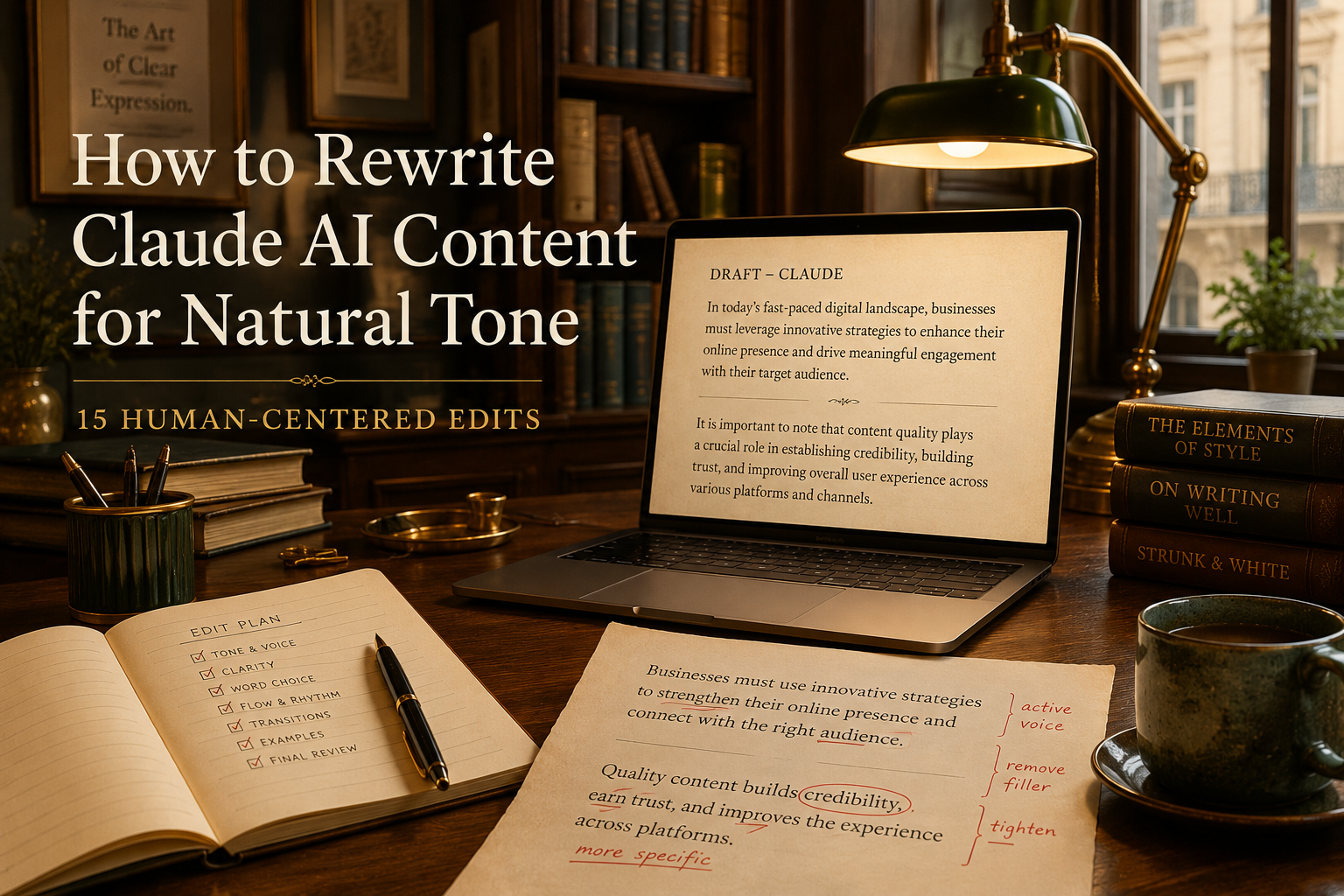
2026 editorial teams are spending less time generating drafts and more time refining tone, pacing, and reader trust. This guide breaks down 15 practical edits for making Claude-generated writing sound human, supported by research from Google and university researchers who found heavy LLM use can reduce perceived creativity and personal voice.
How to Rewrite Claude AI Content for Natural Tone: 15 Human-Centered Edits
Claude can produce clean, thoughtful drafts, but many writers still notice passages that feel slightly distant, overly polished, or disconnected from how people naturally communicate. If you want content that sounds more authentic, learning how to adjust AI writing style to sound natural becomes an important part of the editing process.
The challenge usually is not factual accuracy or structure. It is that AI systems tend to favor predictable phrasing, balanced sentence construction, and patterns that differ from the way experienced writers use the best refinement platforms for ChatGPT writing to shape content for real audiences.
Natural-sounding writing comes from deliberate refinement rather than automatic generation. This guide explains 15 practical edits that help Claude-generated drafts feel more human while drawing on broader content workflow statistics that reveal how professional teams improve AI-assisted content before publication.
| # | Strategy focus | Practical takeaway |
|---|---|---|
| 1 | Identify repetitive patterns | Spot recurring phrasing that makes the draft feel machine-generated. |
| 2 | Vary sentence rhythm | Create a more natural reading experience through mixed pacing. |
| 3 | Replace generic wording | Use more specific language that reflects real situations and observations. |
| 4 | Add human perspective | Introduce judgment, context, and interpretation that readers relate to. |
| 5 | Reduce over-explanation | Trim unnecessary detail that slows down otherwise clear ideas. |
| 6 | Strengthen transitions | Help ideas connect more smoothly from one section to the next. |
| 7 | Use realistic examples | Ground abstract points in situations readers can easily recognize. |
| 8 | Introduce subtle imperfections | Avoid a polished pattern that feels overly optimized or artificial. |
| 9 | Match audience expectations | Adapt language choices to the people who will actually read the content. |
| 10 | Remove template language | Replace stock expressions with wording that feels original and purposeful. |
| 11 | Improve emotional nuance | Add appropriate warmth, restraint, or emphasis to key points. |
| 12 | Refine conversational flow | Make the content sound more like a person communicating ideas naturally. |
| 13 | Adjust paragraph structure | Break up uniform formatting that can make drafts feel predictable. |
| 14 | Read aloud for clarity | Catch awkward wording and improve the overall reading experience. |
| 15 | Apply a final human pass | Review the complete piece with audience experience as the priority. |
15 Human-Centered Edits to Rewrite Claude AI Content for Natural Tone
How to Rewrite Claude AI Content for Natural Tone – Strategy #1: Identify repetitive patterns
One of the easiest ways to recognize AI-generated writing is to look for repeated sentence constructions, familiar transitions, and recurring wording that appears throughout the draft even when the subject matter changes. Claude frequently produces content that is coherent and organized, yet the underlying patterns can become noticeable once several paragraphs are read in sequence. A careful review focused on repetition helps expose areas that feel automated rather than intentionally written.
This works because human writers naturally vary their phrasing depending on context, emphasis, and audience expectations rather than relying on the same linguistic structures throughout a piece. A business article, for example, may repeatedly use phrases such as “it is important to note” or “one key consideration,” which gradually makes the content feel formulaic despite the information being accurate. Replacing recurring patterns with more context-specific language creates a reading experience that feels considerably more natural.
How to Rewrite Claude AI Content for Natural Tone – Strategy #2: Vary sentence rhythm
Claude often produces sentences that occupy a similar length range, which creates a steady cadence that can sound polished but also somewhat mechanical over time. Readers tend to respond better when pacing changes naturally, allowing some ideas to unfold gradually while others are delivered more directly depending on their importance. Adjusting sentence rhythm introduces variety that feels closer to how people communicate in real conversations and published writing.
The goal is not randomness but deliberate variation that supports comprehension and engagement throughout the article. A section explaining a complex process may benefit from longer explanatory sentences, whereas a concluding observation might feel stronger when expressed more concisely. When these pacing differences are introduced thoughtfully, the draft becomes easier to read and substantially less recognizable as AI-generated content.
How to Rewrite Claude AI Content for Natural Tone – Strategy #3: Replace generic wording
Many AI drafts rely on broad language that communicates the general idea without providing the specificity that makes writing memorable and believable. Terms such as “effective,” “valuable,” “important,” or “beneficial” often appear repeatedly because they are safe and widely applicable, yet they rarely contribute meaningful detail. Replacing these terms with precise descriptions immediately improves the authenticity of the content.
Specificity helps readers visualize situations, understand implications, and connect concepts to real experiences rather than abstract claims. Instead of saying a strategy is effective, describe what outcome improved, what challenge was addressed, or what measurable result occurred after implementation. These small changes accumulate quickly and transform a draft from something that sounds generated into something that feels informed by genuine observation.
How to Rewrite Claude AI Content for Natural Tone – Strategy #4: Add human perspective
AI systems are generally strong at summarizing information, yet they often struggle to express informed judgment in a way that reflects real-world experience and nuance. Adding human perspective means introducing interpretation, preference, skepticism, or contextual understanding that goes beyond simply presenting facts. This editorial layer helps distinguish content written for people from content assembled through pattern prediction.
Readers are usually interested in understanding not only what something is but also why it matters and how experienced practitioners think about it. A marketer discussing campaign performance may explain why a seemingly positive metric actually raises concerns, or why a popular tactic may not fit every situation. These forms of interpretation make the writing feel more grounded and considerably more human.
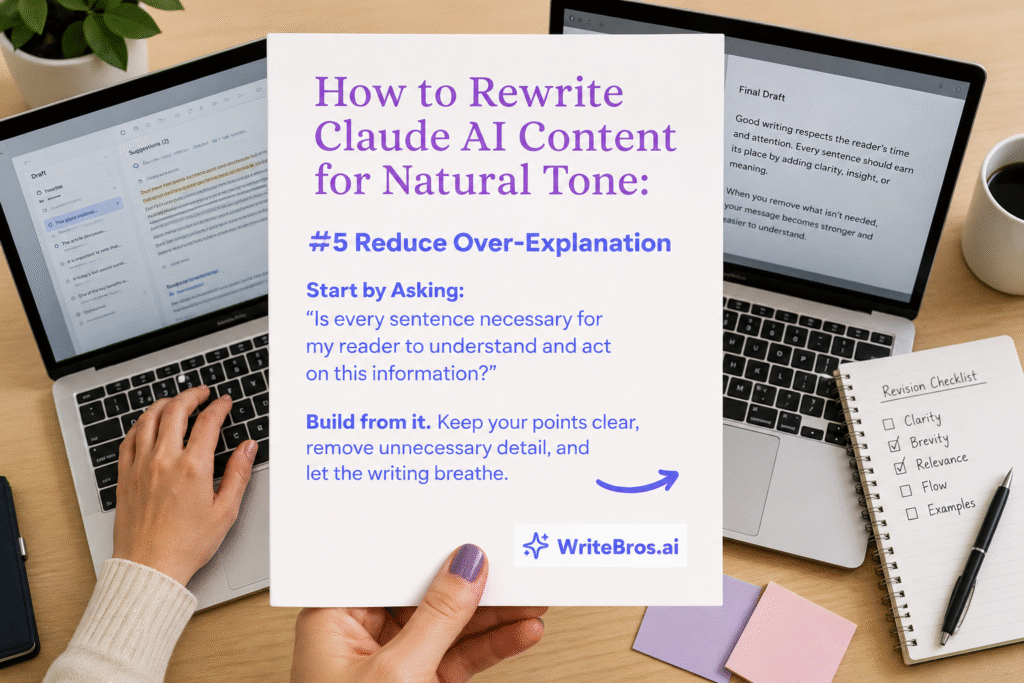
How to Rewrite Claude AI Content for Natural Tone – Strategy #5: Reduce over-explanation
Claude frequently expands on ideas in ways that ensure clarity, yet this tendency can result in paragraphs that explain straightforward concepts far beyond what most readers require. Excessive clarification often slows momentum and creates a feeling that the content is working too hard to prove its completeness. Identifying areas where ideas can be expressed more efficiently helps the writing feel more confident.
Human writers generally trust readers to connect certain dots without receiving exhaustive explanation for every statement and transition. An article discussing content editing, for example, does not need to repeatedly explain why readability matters if the audience already understands that objective. Removing unnecessary elaboration allows stronger ideas to stand out while making the overall piece feel more natural and authoritative.
How to Rewrite Claude AI Content for Natural Tone – Strategy #6: Strengthen transitions
Natural writing guides readers through ideas with transitions that feel purposeful rather than inserted merely to connect sections mechanically. Claude sometimes moves between concepts using broad linking phrases that accomplish the technical transition but fail to create a meaningful relationship between the ideas being discussed. Revising these moments improves both flow and reader engagement.
Strong transitions explain why the next point matters in relation to the previous one, creating continuity throughout the article. A discussion of audience research might naturally lead into messaging decisions because the second topic depends on insights gathered during the first. Establishing these logical connections makes the content feel as though it was intentionally developed rather than assembled from independent sections.
How to Rewrite Claude AI Content for Natural Tone – Strategy #7: Use realistic examples
Examples help transform abstract advice into practical guidance, yet AI-generated examples sometimes feel overly generic because they are designed to fit many possible situations simultaneously. Readers tend to trust content more when examples resemble recognizable workplace scenarios, familiar challenges, or realistic decision-making processes. Even a small amount of contextual detail can make a substantial difference.
A content manager revising a product page, a consultant preparing a client report, or an editor simplifying technical explanations are situations that immediately feel more tangible than vague references to businesses and professionals. These examples provide a framework that readers can imagine applying within their own work. As a result, the article becomes more relatable and significantly more persuasive.
How to Rewrite Claude AI Content for Natural Tone – Strategy #8: Introduce subtle imperfections
Perfect consistency can sometimes become a problem because readers unconsciously associate overly polished writing patterns with automated generation. Human communication naturally contains small variations in emphasis, structure, and pacing that emerge from personal judgment rather than rigid optimization. Introducing subtle irregularities helps reduce the impression that every sentence was produced through the same process.
This does not mean introducing errors or sacrificing quality, but rather allowing some flexibility in how ideas are expressed. A paragraph may occasionally include an unexpected observation, a slightly different sentence structure, or a more conversational transition that breaks a predictable pattern. These adjustments help the writing feel less engineered and more reflective of genuine human expression.
How to Rewrite Claude AI Content for Natural Tone – Strategy #9: Match audience expectations
Content that feels natural to one audience may feel awkward or inappropriate to another because expectations vary across industries, expertise levels, and communication styles. Claude can generate broadly acceptable language, yet broader acceptability is not always the same thing as audience alignment. Revising with a specific reader in mind helps create a more authentic voice.
A technical audience may appreciate precision and detailed terminology, whereas a general audience may prefer simpler explanations and more practical framing. The same information can therefore require different language choices depending on who will ultimately consume it. Aligning tone and complexity with audience expectations makes the content feel intentional rather than generalized.
How to Rewrite Claude AI Content for Natural Tone – Strategy #10: Remove template language
Many AI drafts contain phrases that appear frequently across articles because they serve as reliable templates for introducing ideas, summarizing points, or emphasizing conclusions. Although these expressions are not inherently wrong, their repeated use contributes to a recognizable AI writing style. Identifying and replacing them helps create a more original voice.
Expressions such as “in today’s fast-paced environment” or “it is essential to understand” often communicate very little beyond signaling the beginning of a discussion. Replacing them with statements tailored to the specific topic immediately improves clarity and authenticity. Over the course of an entire article, these edits can dramatically reduce the appearance of automated writing.

How to Rewrite Claude AI Content for Natural Tone – Strategy #11: Improve emotional nuance
Many AI-generated drafts communicate information effectively while remaining emotionally neutral in situations that would benefit from greater sensitivity, enthusiasm, caution, or empathy. Human writers often adjust emotional tone based on context, audience concerns, and the significance of the topic being discussed. Adding these layers helps readers feel that the content understands their perspective.
An article discussing career setbacks should not sound identical to an article discussing productivity improvements because the emotional context is entirely different. Introducing appropriate emotional nuance helps align the writing with reader expectations and experiences. This adjustment frequently makes the difference between content that feels technically correct and content that feels genuinely human.
How to Rewrite Claude AI Content for Natural Tone – Strategy #12: Refine conversational flow
Natural writing often feels like a knowledgeable person guiding the reader through a subject rather than presenting information from a distance. Claude can sometimes create content that remains informative yet detached because each section focuses heavily on completeness rather than interaction. Revising for conversational flow helps close that gap.
This can include using more direct phrasing, anticipating reader questions, and creating smoother progression between ideas. A writer might acknowledge a common concern before introducing a solution or explain why a recommendation matters before describing how to implement it. These adjustments create a stronger sense of dialogue and make the article easier to engage with.
How to Rewrite Claude AI Content for Natural Tone – Strategy #13: Adjust paragraph structure
Uniform paragraph lengths can contribute to a predictable reading experience that subtly reinforces the impression of machine-generated content. Human writers tend to organize paragraphs according to the needs of the material rather than maintaining identical structures throughout an article. Revisiting paragraph organization can therefore improve both readability and authenticity.
Some ideas require additional context, while others can be communicated effectively in a smaller amount of space. Allowing structure to follow content rather than pattern helps create a more dynamic reading experience. Readers may not consciously notice these changes, yet they often perceive the resulting article as more natural and engaging.
How to Rewrite Claude AI Content for Natural Tone – Strategy #14: Read aloud for clarity
Reading a draft aloud remains one of the most effective techniques for identifying awkward phrasing, unnatural transitions, and sentences that appear stronger on the screen than they do in actual communication. The process forces writers to experience the content in a way that closely resembles how readers process language. Weak areas become much easier to detect.
Sentences that feel cumbersome often reveal themselves immediately once spoken, particularly when multiple clauses compete for attention or transitions sound forced. Hearing the content also helps identify pacing issues that may not be obvious during silent review. As a final quality-control step, this technique consistently improves natural tone.
How to Rewrite Claude AI Content for Natural Tone – Strategy #15: Apply a final human pass
Even after substantial revisions, a dedicated human review remains essential because no checklist can fully replicate editorial judgment. The final pass focuses less on individual sentences and more on the overall experience of reading the article from beginning to end. This broader perspective helps uncover inconsistencies that isolated edits may overlook.
An editor reviewing the complete draft may notice recurring themes, tonal shifts, or sections that no longer align with the article’s central objective. These observations rarely emerge during sentence-level editing because they depend on understanding the piece as a whole. Completing a final human review ensures the content feels cohesive, intentional, and genuinely natural.
Common mistakes
- Many writers focus exclusively on replacing individual words while ignoring broader structural patterns, which causes the content to retain the same recognizable AI rhythm even after extensive editing and ultimately limits how natural the final result feels.
- Another common mistake is attempting to make the writing sound human through excessive informality, because forcing conversational language into every paragraph often makes professional content feel inconsistent and less credible.
- Some editors remove too much detail in pursuit of brevity, which can weaken explanations and leave readers without enough context to understand why a recommendation or observation matters.
- Writers frequently overlook audience expectations and instead apply the same editing style across every project, even though different industries and readership groups respond to different communication approaches.
- Many people rely entirely on automated rewriting tools without performing a manual review afterward, which can leave subtle tone issues unresolved despite noticeable surface-level improvements.
- Another mistake is treating every sentence as equally important, because this often results in uniform pacing that reduces emphasis and makes the content feel predictable from beginning to end.
Edge cases
Some Claude-generated content already contains a relatively natural tone, particularly when the original prompt included detailed audience instructions, stylistic guidance, and examples of preferred writing patterns. In these situations, extensive editing may actually reduce quality because unnecessary changes can remove clarity, consistency, or useful structure that was already working effectively.
There are also cases in which highly regulated industries, technical documentation, or legal communications require a degree of precision that naturally sounds more formal than conversational. The objective in these scenarios is not to maximize personality but to improve readability while preserving the accuracy, compliance requirements, and professional standards expected by the intended audience.
Supporting tools
- Read-aloud software can help identify awkward sentence structures, repetitive phrasing, and pacing problems that are difficult to recognize when reviewing text silently on a screen for long periods.
- Grammar and style checkers provide an additional review layer that helps surface clarity issues, unnecessary complexity, and consistency concerns before the content reaches publication.
- Editorial collaboration platforms make it easier for multiple reviewers to leave contextual feedback, compare revisions, and identify sections that still feel automated despite previous edits.
- Content analysis tools can highlight readability metrics, sentence-length distribution, and structural patterns that may contribute to a mechanical or overly uniform writing style.
- Voice and tone guidelines provide a practical reference point for maintaining consistency throughout revisions while ensuring the content reflects audience expectations and brand standards.
- WriteBros.ai can assist with refining AI-generated drafts, improving tone consistency, reducing repetitive phrasing, and helping editors create content that feels more aligned with human writing patterns.
Ready to Transform Your AI Content?
Try WriteBros.ai and make your AI-generated content truly human.
Conclusion
Rewriting Claude-generated content for a more natural tone is ultimately a process of adding judgment, variation, context, and editorial intent to material that may already be factually strong and structurally sound. The most effective edits rarely depend on dramatic rewrites, because small improvements applied consistently across an article often produce the most convincing results.
Natural writing does not require perfection, and readers rarely expect flawless prose as long as the content feels authentic, clear, and relevant to their needs. Focusing on genuine communication rather than eliminating every possible sign of AI involvement helps create articles that are more engaging, more trustworthy, and more enjoyable to read.
Did You Know?
“`Natural-sounding Claude content usually comes from thoughtful editing rather than prompt improvements alone.
Changes to rhythm, wording, perspective, and flow help AI-generated drafts feel substantially more human.
Ready to Transform Your AI Content?
“`