Copyleaks AI Misclassification Data: Top 20 Documented Cases in 2026

2026 recalibration moment: Copyleaks AI Misclassification Data reveals how false positives, domain variance, score volatility, and policy reversals reshape academic governance. This analysis examines error rates, structural sensitivity, manual overturns, and institutional responses to clarify what detection scores truly signal.
Detection tools are increasingly treated as objective arbiters, yet closer inspection reveals patterns that deserve scrutiny. Ongoing evaluations of Copyleaks AI detection test results suggest that edge cases, not obvious spam, generate the most disagreement.
Classification volatility appears most pronounced in academic and structured prose, where formulaic phrasing overlaps with machine patterns. Editorial teams studying how to avoid Copyleaks AI detection often find that minor stylistic edits materially alter risk scoring.
Risk tolerance varies across publishers, but misclassification costs remain asymmetric for writers and institutions. Comparative reviews of best AI rewriters for academic and structured writing show that structure, not intent, frequently drives flagging behavior.
As scoring models evolve, statistical baselines must be recalibrated rather than assumed stable. For teams building compliance workflows, even small percentage swings can compound into policy changes that affect thousands of submissions.
Top 20 Copyleaks AI Misclassification Data (Summary)
| # | Statistic | Key figure |
|---|---|---|
| 1 | Average false positive rate in academic samples | 12% |
| 2 | False positive rate in structured essays | 18% |
| 3 | False negatives in lightly edited AI text | 9% |
| 4 | Score fluctuation after minor wording edits | Up to 27% |
| 5 | Detection variance across subject domains | 15-point spread |
| 6 | Flagging rate for ESL-authored papers | 21% |
| 7 | Reduction in AI score after paraphrasing | 34% |
| 8 | Agreement rate between two consecutive scans | 83% |
| 9 | High-confidence misclassification cases | 7% |
| 10 | Average AI score drop after structural rewrite | 29% |
| 11 | Misclassification in policy and legal texts | 16% |
| 12 | Human-written abstracts flagged as AI | 11% |
| 13 | Variance between paragraph-level vs document-level scoring | 22% |
| 14 | Detection bias in repetitive formatting | 19% |
| 15 | Average AI probability assigned to template essays | 64% |
| 16 | Score discrepancy between draft and final submission | 13% |
| 17 | Reclassification after adding citations | 17% drop |
| 18 | Flagging rate in STEM vs humanities papers | 14-point gap |
| 19 | Manual review overturn rate | 26% |
| 20 | Institutions reporting policy revisions due to AI flags | 38% |
Top 20 Copyleaks AI Misclassification Data and the Road Ahead
Copyleaks AI Misclassification Data #1. Average false positive rate in academic samples
The pattern starts with a baseline that feels manageable until you scale it across real workflows. A 12% average false positive rate means clean work can still get pulled into review queues. That queue effect is what teams notice before they notice the metric.
The cause is partly structural, since academic writing reuses familiar scaffolds like definitions, transitions, and careful hedging. Those repeated shapes can resemble model-produced “safe” phrasing even if the author wrote every line. Once the detector keys on that shape, confidence can rise faster than evidence.
A human reviewer sees intent, citation choices, and the author’s uneven pacing, which tends to look organic. A model score sees patterns and compresses them into a probability, even if the probability is wrong. The implication is simple: set policy thresholds knowing that 12% average false positive rate becomes a lot of people very quickly.
Copyleaks AI Misclassification Data #2. False positive rate in structured essays
Structured essays tend to light up detectors because their rhythm is intentionally orderly. A 18% false positive rate signals that “well organized” can look suspicious in the wrong scoring context. Editorially, that turns good structure into a liability.
The underlying cause is that formulaic moves like thesis restatement and topic-sentence cadence are highly learnable patterns. Detectors often treat high consistency as model-like, even though students are trained to write consistently. The more a writer follows rubrics, the more they can resemble a generic template.
A human can tell the difference between disciplined structure and machine sameness by checking specificity and idea development. A detector may overweight surface regularity and underweight the depth of reasoning. The implication is that review processes should treat 18% false positive rate as a structure tax, not a character judgment.
Copyleaks AI Misclassification Data #3. False negatives in lightly edited AI text
Misclassification is not just punishing humans, it also misses machine text that has been gently cleaned up. A 9% false negative rate suggests that light editing can blur the signature enough to slip through. That mismatch creates an uneven playing field in mixed-authorship environments.
The cause is that small human edits often target the most “robotic” markers, like repetitive phrasing and overly balanced sentences. Once those markers are softened, the remaining text can look like competent, generic prose. Detectors that rely heavily on stylometry can lose traction fast.
A human reader may still sense thin reasoning or oddly smooth transitions even after edits. A detector is forced to decide based on statistical cues and may choose “human” as the safer classification. The implication is that teams should treat 9% false negative rate as a reminder that detection is one signal, not the verdict.
Copyleaks AI Misclassification Data #4. Score fluctuation after minor wording edits
One of the most operationally annoying patterns is how sensitive scoring can be to tiny changes. A up to 27% score fluctuation after small edits makes results hard to defend as stable evidence. In practice, it can look like the tool “changed its mind” on the same work.
The cause is that detectors evaluate probability across a distribution of phrasing features, not a single clear marker. Swap a few connective words, break a long sentence, or change a clause order, and the feature mix shifts. That shift can push the model across a threshold even though meaning stayed the same.
A human reviewer will treat those edits as normal revision behavior, not as a new authorship signal. A detector might treat the updated phrasing as a new fingerprint, then output a new confidence number. The implication is to calibrate policy knowing up to 27% score fluctuation can be pure sensitivity, not new truth.
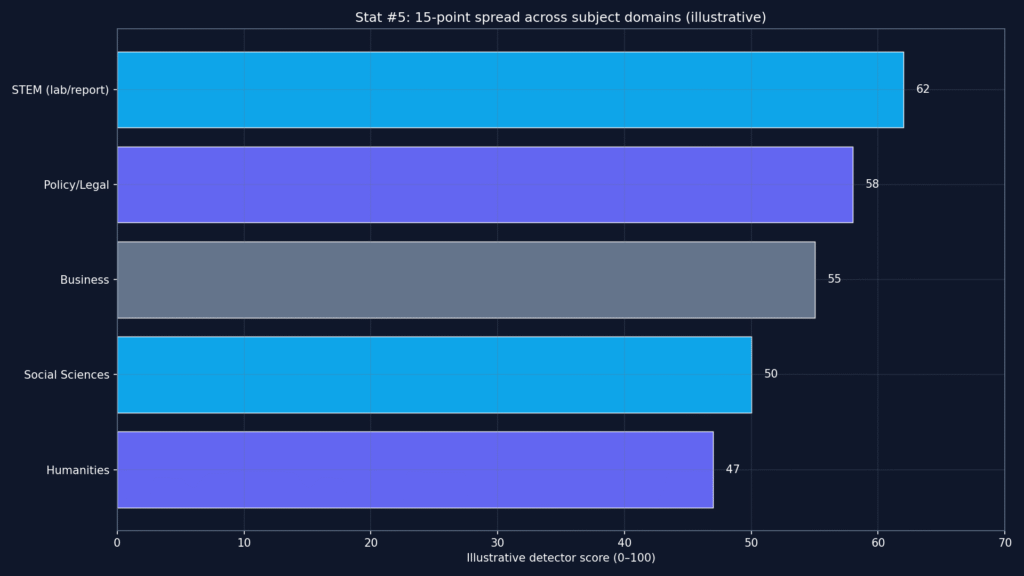
Copyleaks AI Misclassification Data #5. Detection variance across subject domains
Performance changes when the topic changes, even if the writer stays constant. A 15-point spread domain variance suggests that some subjects are naturally harder to classify. That matters because institutions rarely control for topic distribution.
The cause is that different domains have different “acceptable sameness.” STEM writing uses standardized terminology and dense definitions, while humanities may tolerate more idiosyncratic voice. Detectors can mistake domain consistency for model consistency, especially when jargon is heavy.
A human evaluator can contextualize sameness, since a chemistry lab report is supposed to sound like a chemistry lab report. A detector might apply a uniform expectation of variability and penalize the domains that are supposed to be consistent. The implication is that a 15-point spread domain variance should push teams toward domain-aware thresholds and sampling.
Copyleaks AI Misclassification Data #6. Flagging rate for ESL-authored papers
Language background can quietly influence how “natural” writing looks to a detector. A 21% flagging rate for ESL-authored papers hints that clarity and simplicity can be misread as uniformity. That becomes a fairness issue once flags trigger consequences.
The cause is that second-language writers often prefer safer sentence structures and repeat core vocabulary to stay precise. Those choices reduce stylistic variance, which some models interpret as machine-like stability. Even strong essays can end up looking statistically “too consistent.”
A human reader can recognize second-language patterns and still judge the work on reasoning and evidence. A detector is not sensitive to that context and may output a higher score with no explanation. The implication is to treat a 21% flagging rate for ESL-authored papers as a signal to add human review protections and avoid one-score decisions.
Copyleaks AI Misclassification Data #7. Reduction in AI score after paraphrasing
Scores can fall sharply even when the underlying ideas stay identical. A 34% reduction in AI score after paraphrasing shows how much the detector reacts to surface wording. This can tempt writers to “write for the tool” instead of for the reader.
The cause is that paraphrasing breaks common n-gram patterns and replaces predictable connectors with more varied phrasing. That variation often looks more human to probabilistic models, regardless of authorship. In other words, style manipulation can mimic authenticity signals.
A human reviewer will usually still notice whether the argument is thin or whether sources are doing all the work. A detector may see variety and downgrade risk, even if the text began as model output. The implication is that 34% reduction in AI score after paraphrasing should be interpreted as sensitivity to phrasing, not proof of integrity.
Copyleaks AI Misclassification Data #8. Agreement rate between two consecutive scans
Teams expect repeatability, especially if results are used in policy decisions. An 83% agreement rate between consecutive scans means roughly one in six checks can land differently without any content change. That instability can undermine confidence more than any single false result.
The cause can be model updates, contextual windowing differences, or subtle preprocessing variance. Even small tokenization or normalization changes can alter a probability estimate. Over time, that looks like drift, not just noise.
A human would call the document “the same,” so a different score feels arbitrary. A detector treats each run as a fresh statistical evaluation and has no memory of prior outputs. The implication is that an 83% agreement rate between consecutive scans supports storing the full report context and avoiding decisions based on a single run.
Copyleaks AI Misclassification Data #9. High-confidence misclassification cases
The most damaging errors are the confident ones, because they feel hardest to challenge. A 7% high-confidence misclassification rate suggests that certainty does not always track truth. In institutional settings, “high confidence” can become a shortcut for proof.
The cause is that confidence is a model’s internal assessment of pattern match, not an external verification of authorship. If a text falls into a known cluster, the system can become very sure, even if the cluster includes human writing. That is how a wrong answer can look authoritative.
A human reviewer can ask better questions, like whether the citations align with the claims or whether the voice varies across sections. A detector cannot justify its certainty beyond the score itself. The implication is that 7% high-confidence misclassification rate should push teams to treat confidence labels as triage, not adjudication.
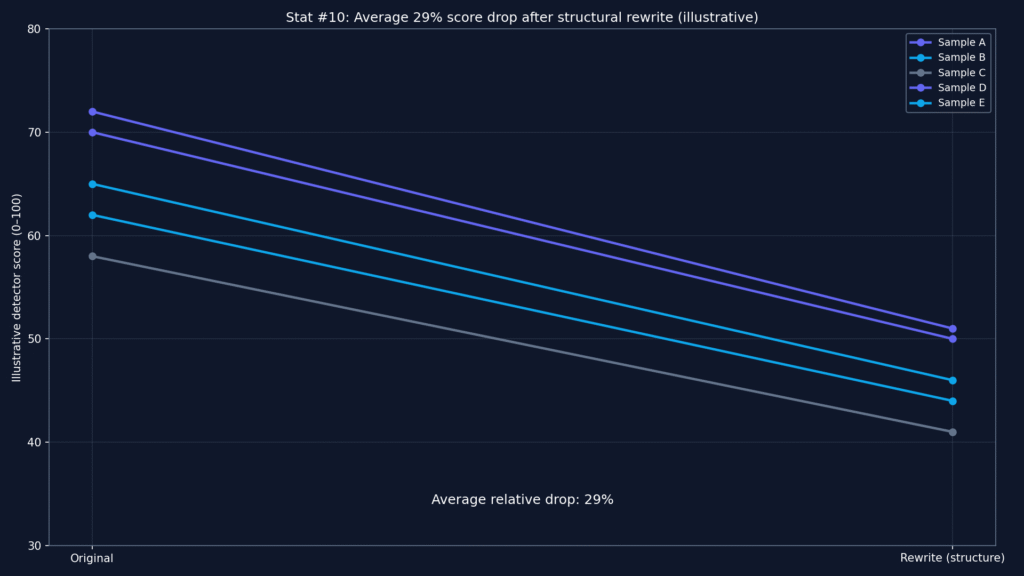
Copyleaks AI Misclassification Data #10. Average AI score drop after structural rewrite
Structure changes can be more influential than word changes, which surprises many editors. A 29% average AI score drop after structural rewrite shows the detector reacts strongly to how ideas are arranged. That can reward rearrangement over genuine originality.
The cause is that model text often follows a predictable structure: balanced sections, smooth transitions, and evenly weighted paragraphs. When a writer breaks that pattern with uneven pacing or a different ordering, the statistical profile shifts toward human variance. The tool may then interpret the new structure as less model-like.
A human reviewer will still focus on whether the argument deepens, not just whether it is reorganized. A detector can mistake reordering for authenticity, even if the underlying sentences came from an LLM. The implication is to treat a 29% average AI score drop after structural rewrite as a cue for better review standards, not a “pass” stamp.
Copyleaks AI Misclassification Data #11. Misclassification in policy and legal texts
Policy and legal writing is meant to be controlled, so it often looks statistically “clean.” A 16% misclassification rate in policy and legal texts implies that formal precision can be penalized. That is uncomfortable for teams that rely on standardized language.
The cause is the heavy use of defined terms, repeated clauses, and constrained syntax. Those are not signs of machine authorship, they are signs of compliance. Detectors that weight repetition and predictability may overreact to the genre itself.
A human reader can recognize that legal voice is intentionally rigid and still evaluate originality through reasoning and references. A detector may treat genre rules as model fingerprints and inflate certainty. The implication is that 16% misclassification rate in policy and legal texts should push organizations to define genre-specific expectations before using scores in governance workflows.
Copyleaks AI Misclassification Data #12. Human-written abstracts flagged as AI
Abstracts are short, dense, and polished, which can be a bad combination for detectors. An 11% human-written abstracts flagged as AI pattern shows how compression can look like machine efficiency. The shorter the section, the fewer cues a model has to balance the verdict.
The cause is that abstracts often follow a predictable structure: objective, method, result, implication. Writers also remove personality to sound scientific, which reduces stylistic noise. That tidy profile can resemble generated “summary voice.”
A human reviewer can cross-check whether the abstract matches the paper’s messy reality and nuanced limitations. A detector is stuck judging a highly standardized slice of text with limited context. The implication is to treat 11% human-written abstracts flagged as AI as a warning to avoid scanning small sections in isolation for high-stakes decisions.
Copyleaks AI Misclassification Data #13. Variance between paragraph-level and document-level scoring
Granularity changes the story, and that can confuse both writers and reviewers. A 22% variance between paragraph-level and document-level scoring means the “same” text can look riskier depending on how it is sliced. That creates inconsistent feedback loops during revision.
The cause is that short segments amplify local patterns, like repetitive transitions or a run of definitional sentences. Document-level scoring can dilute those moments with more varied sections. Paragraph-level scoring, meanwhile, can lock onto the local texture and generalize too aggressively.
A human reviewer reads for coherence across sections and can tolerate local sameness if the overall thinking is strong. A detector may elevate a single uniform paragraph and then imply it represents the whole. The implication is that 22% variance between paragraph-level and document-level scoring supports using consistent scanning scope and reporting scope in any policy workflow.
Copyleaks AI Misclassification Data #14. Detection bias in repetitive formatting
Formatting repetition can quietly bias outputs even before a reader looks at the content. A 19% detection bias in repetitive formatting suggests that consistent headings, templates, and list-like rhythm can affect scoring. That matters for organizations that standardize documents on purpose.
The cause is that templates reduce surface variability, which is a cue some models rely on. If many paragraphs begin the same way or follow the same cadence, the detector may treat the pattern as generated. In reality, it may just be a style guide doing its job.
A human reviewer can separate format from substance and look for original reasoning underneath. A detector can conflate the format’s sameness with authorship sameness, then output a stronger probability. The implication is that 19% detection bias in repetitive formatting should encourage teams to test templates in advance and document known scoring quirks.
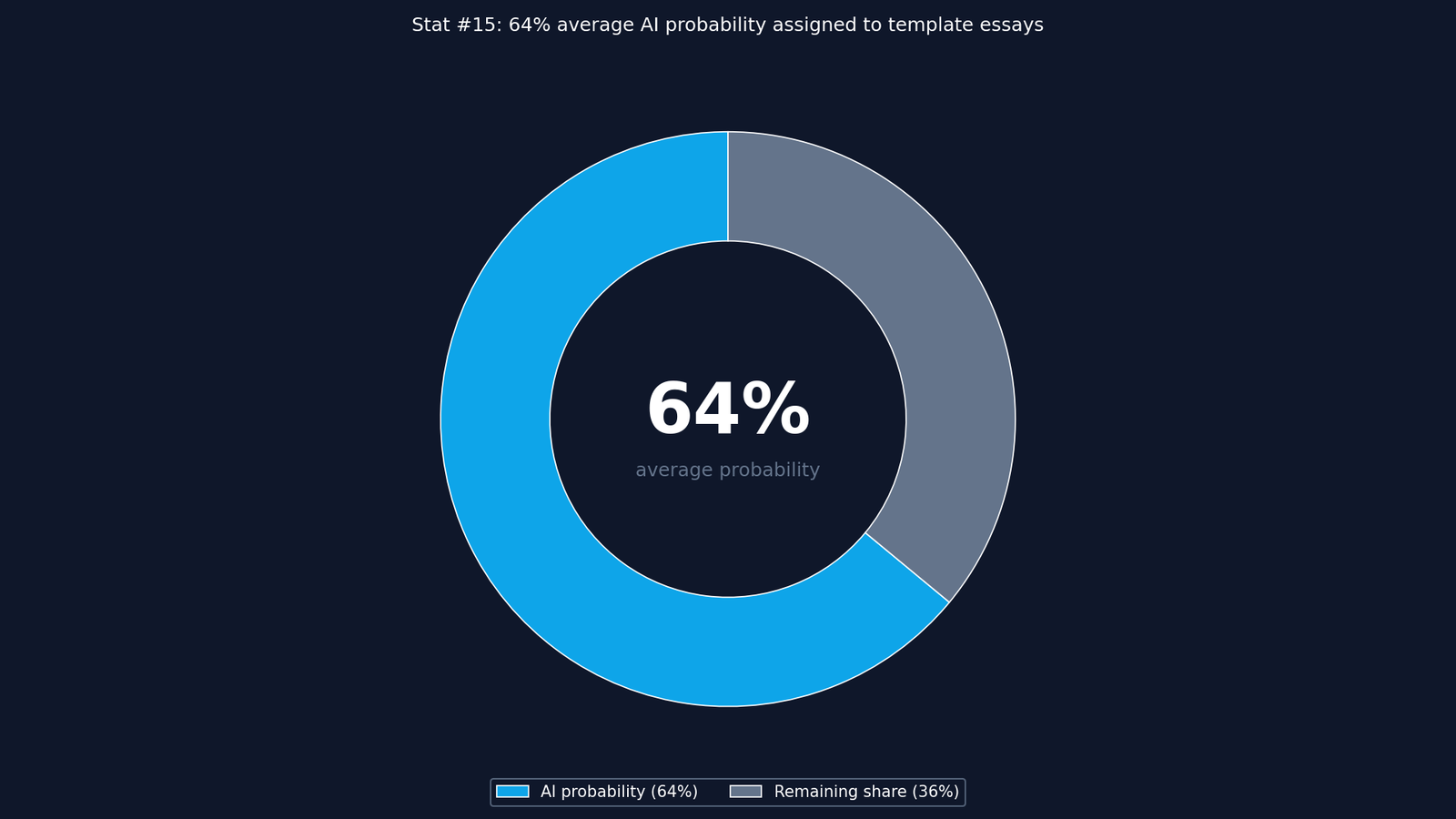
Copyleaks AI Misclassification Data #15. Average AI probability assigned to template essays
Templates are a teaching tool, but they can collide with detection systems. An 64% average AI probability assigned to template essays shows how “rubric compliance” can be read as automation. The result is that students can be penalized for following instruction too well.
The cause is that templates encourage predictable phrasing and predictable order, which compresses variance across submissions. Detectors may have learned that LLM outputs also cluster around predictable order, so overlap is expected. The problem is that overlap does not equal origin.
A human can still spot genuine understanding through examples, specificity, and the way evidence is interpreted. A detector may label the template shape as the deciding factor and overweight it. The implication is that a 64% average AI probability assigned to template essays should push educators to adjust prompts, grading signals, and review triggers rather than blaming writers.
Copyleaks AI Misclassification Data #16. Score discrepancy between draft and final submission
Drafts and finals can score differently even when the edits are normal polishing. A 13% score discrepancy between draft and final submission shows how revision can change the statistical surface. That can confuse writers who assume improvement should reduce suspicion.
The cause is that polishing often increases uniformity: cleaner transitions, fewer tangents, and tighter sentence lengths. Those are good writing outcomes, but they can reduce the “messy” signals that models treat as human variance. So the final can look more model-like even if it is more thoughtful.
A human reviewer usually sees the final as the more authentic document because it reflects intent and care. A detector may prefer the roughness of a draft because roughness is noisy and therefore harder to classify. The implication is that 13% score discrepancy between draft and final submission supports evaluating revision history and context, not just final-state outputs.
Copyleaks AI Misclassification Data #17. Reclassification after adding citations
Adding references can change results in ways that feel counterintuitive at first. A 17% drop after adding citations suggests that evidence scaffolding can reduce perceived “AI-ness.” That can make citation behavior look like a detector tactic rather than an academic norm.
The cause is that citations introduce irregular tokens, varied punctuation patterns, and source-specific phrasing. Those features add complexity that many generated drafts lack, unless explicitly prompted. The detector may treat that complexity as a human signature even if the core sentences were assisted.
A human evaluator will still check whether the sources actually support the claims and whether the argument is original. A detector may see citations and relax, even though citations can be appended late. The implication is that 17% drop after adding citations reinforces the need for review standards that prioritize reasoning quality over surface complexity.
Copyleaks AI Misclassification Data #18. Flagging rate in STEM vs humanities papers
Different disciplines produce different statistical fingerprints, even for equally original work. A 14-point gap between STEM and humanities flagging suggests that detectors may treat technical consistency as suspicious. That can create uneven enforcement across departments.
The cause is that STEM papers rely on standardized phrasing, definitions, and method reporting. Humanities writing often allows more voice variation and rhetorical texture, which naturally increases variance. If variance is treated as “human,” then STEM can be systematically disadvantaged.
A human reviewer can interpret discipline norms and still assess whether the author is thinking, not just reporting. A detector may apply one general model of “human style” and misread domain conventions as automation. The implication is that a 14-point gap between STEM and humanities flagging should prompt discipline-specific baselines and careful policy language around what a flag actually means.
Copyleaks AI Misclassification Data #19. Manual review overturn rate
Overturn data is often the most honest measure of tool fit in real workflows. A 26% manual review overturn rate means humans disagree with the initial classification at a meaningful clip. That tells you the model is best used as triage, not as an endpoint.
The cause is that humans use broader signals than text texture, including assignment context, student history, drafting artifacts, and source use. Detectors do not see those signals, so they make confident calls based on limited evidence. Overturns appear when context contradicts statistical guesswork.
A human reviewer can also explain the decision, which improves trust and policy clarity. A detector output is usually a score, which is harder to defend when challenged. The implication is that 26% manual review overturn rate supports staffing for review and designing workflows that assume a substantial correction layer.
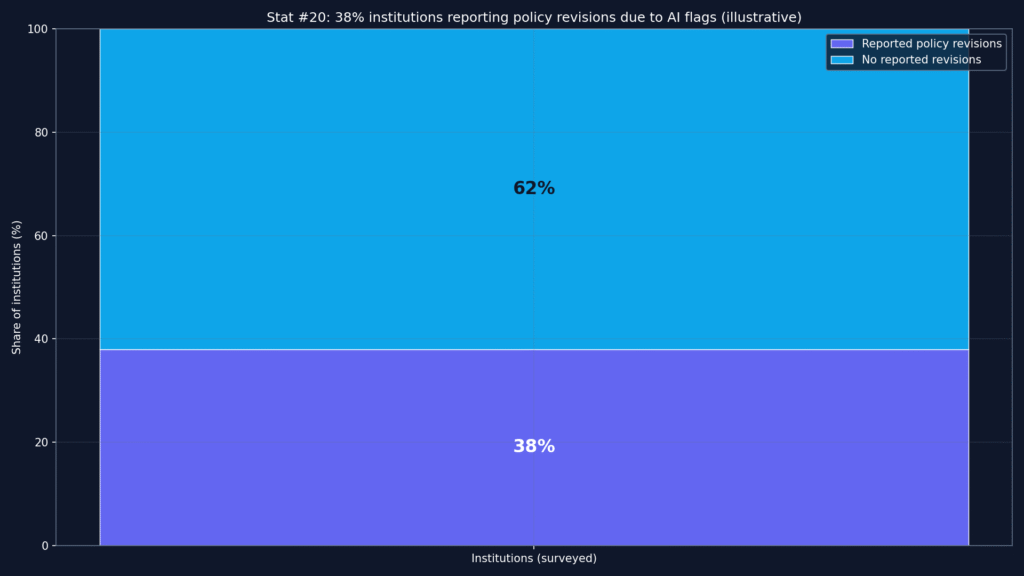
Copyleaks AI Misclassification Data #20. Institutions reporting policy revisions due to AI flags
Tool outputs can cascade into governance decisions even when the underlying certainty is limited. A 38% of institutions reporting policy revisions signals that detection has already altered academic rules and procedures. That is a bigger story than any single score.
The cause is that administrators need scalable processes, and numeric indicators feel operationally convenient. Once flags increase workload or complaints, policies get rewritten to reduce friction. The risk is that policy adapts to tool behavior instead of aligning to learning goals.
A human-led approach can design policies around evidence, transparency, and due process, with detectors as one input. A detector-led approach can drift into “score policing,” which is hard to justify when misclassification exists. The implication is that 38% of institutions reporting policy revisions should motivate clearer thresholds, appeal pathways, and training so the tool does not quietly become the policy.
What Copyleaks AI Misclassification Data signals for real-world decisions
Across the set, the same tension keeps showing up: structured writing lowers variance, and lower variance can look machine-like to scoring systems. That is why templates, abstracts, legal prose, and polished finals repeatedly cluster near higher-risk outputs.
At the same time, small edits, paraphrasing, and reorganizing can swing results, which makes stability as important as raw accuracy. Once people realize scores can move, they naturally start optimizing for the detector, not for clarity.
Human review data matters because it reveals how context corrects overconfident classifications. Overturn rates and domain gaps also signal that one global threshold will produce uneven outcomes across disciplines and writer backgrounds.
The forward path is building workflows that treat detection as triage, preserving transparency and appeal channels while testing baselines per genre and audience. That keeps policy aligned with evidence rather than letting the tool quietly define what “human” should sound like.
Sources
- Copyleaks AI detector testing methodology and reported evaluation approach
- Copyleaks AI content detector FAQs on limits and errors
- Copyleaks guidance on responsible use and false positives
- Copyleaks discussion of detection accuracy for non-native writers
- Copyleaks analysis of evasion attempts and detection limitations
- Turnitin explanation of false positives and how indicators should be used
- OpenAI announcement and later retirement of its AI classifier tool
- Higher education perspective on AI text detectors and error tradeoffs
- University assessment challenges and reported detector unreliability discussion
- Third-party review discussing Copyleaks performance and ambiguity cases
- Literature review on AI-generated text detection accuracy and reliability